BIOLOGY
ANIMAL TISSUE
Types of Animal Tissue
 Animal Tissues are divided as −
o Epithelial Tissue
o Connective Tissue
o Muscular Tissue
o Nervous Tissue
Epithelial Tissue
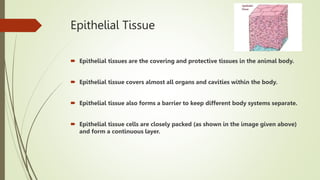
 Epithelial tissues are the covering and protective tissues in the animal body.
 Epithelial tissue covers almost all organs and cavities within the body.
 Epithelial tissue also forms a barrier to keep different body systems separate.
 Epithelial tissue cells are closely packed (as shown in the image given above)
and form a continuous layer.
Connective Tissue
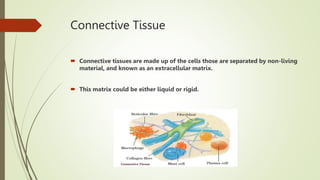
 Connective tissues are made up of the cells those are separated by non-living
material, and known as an extracellular matrix.
 This matrix could be either liquid or rigid.
 Connective tissues are further divided as −
 Fibrous connective tissue
 Skeletal connective tissue and
 Fluid connective tissue
 Tendons are the example of fibrous connective tissue.
 Bone is an example of a skeletal connective tissue.
 Bone forms the framework and provide supports to the body.
 Blood is an example of fluid connective tissue.
 Blood has a fluid (liquid) matrix known as plasma.
 In plasma, the red blood cells (RBCs), the white blood cells (WBCs), and the
platelets are remaining suspended.
Muscular Tissue
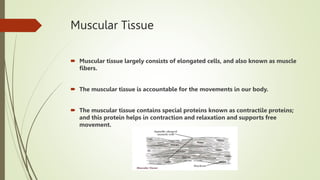
 Muscular tissue largely consists of elongated cells, and also known as muscle
fibers.
 The muscular tissue is accountable for the movements in our body.
 The muscular tissue contains special proteins known as contractile proteins;
and this protein helps in contraction and relaxation and supports free
movement.
Nervous Tissue
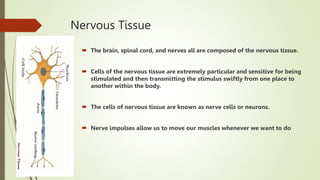
 The brain, spinal cord, and nerves all are composed of the nervous tissue.
 Cells of the nervous tissue are extremely particular and sensitive for being
stimulated and then transmitting the stimulus swiftly from one place to
another within the body.
 The cells of nervous tissue are known as nerve cells or neurons.
 Nerve impulses allow us to move our muscles whenever we want to do
THANK YOU!!

BIOLOGY- ANIMAL TISSUE.pptx

  • 1.
  • 2.
    Types of AnimalTissue  Animal Tissues are divided as − o Epithelial Tissue o Connective Tissue o Muscular Tissue o Nervous Tissue
  • 3.
    Epithelial Tissue  Epithelialtissues are the covering and protective tissues in the animal body.  Epithelial tissue covers almost all organs and cavities within the body.  Epithelial tissue also forms a barrier to keep different body systems separate.  Epithelial tissue cells are closely packed (as shown in the image given above) and form a continuous layer.
  • 4.
    Connective Tissue  Connectivetissues are made up of the cells those are separated by non-living material, and known as an extracellular matrix.  This matrix could be either liquid or rigid.
  • 5.
     Connective tissuesare further divided as −  Fibrous connective tissue  Skeletal connective tissue and  Fluid connective tissue
  • 6.
     Tendons arethe example of fibrous connective tissue.  Bone is an example of a skeletal connective tissue.  Bone forms the framework and provide supports to the body.  Blood is an example of fluid connective tissue.  Blood has a fluid (liquid) matrix known as plasma.  In plasma, the red blood cells (RBCs), the white blood cells (WBCs), and the platelets are remaining suspended.
  • 7.
    Muscular Tissue  Musculartissue largely consists of elongated cells, and also known as muscle fibers.  The muscular tissue is accountable for the movements in our body.  The muscular tissue contains special proteins known as contractile proteins; and this protein helps in contraction and relaxation and supports free movement.
  • 8.
    Nervous Tissue  Thebrain, spinal cord, and nerves all are composed of the nervous tissue.  Cells of the nervous tissue are extremely particular and sensitive for being stimulated and then transmitting the stimulus swiftly from one place to another within the body.  The cells of nervous tissue are known as nerve cells or neurons.  Nerve impulses allow us to move our muscles whenever we want to do
  • 9.