WHAT IS AN ANTENNA?
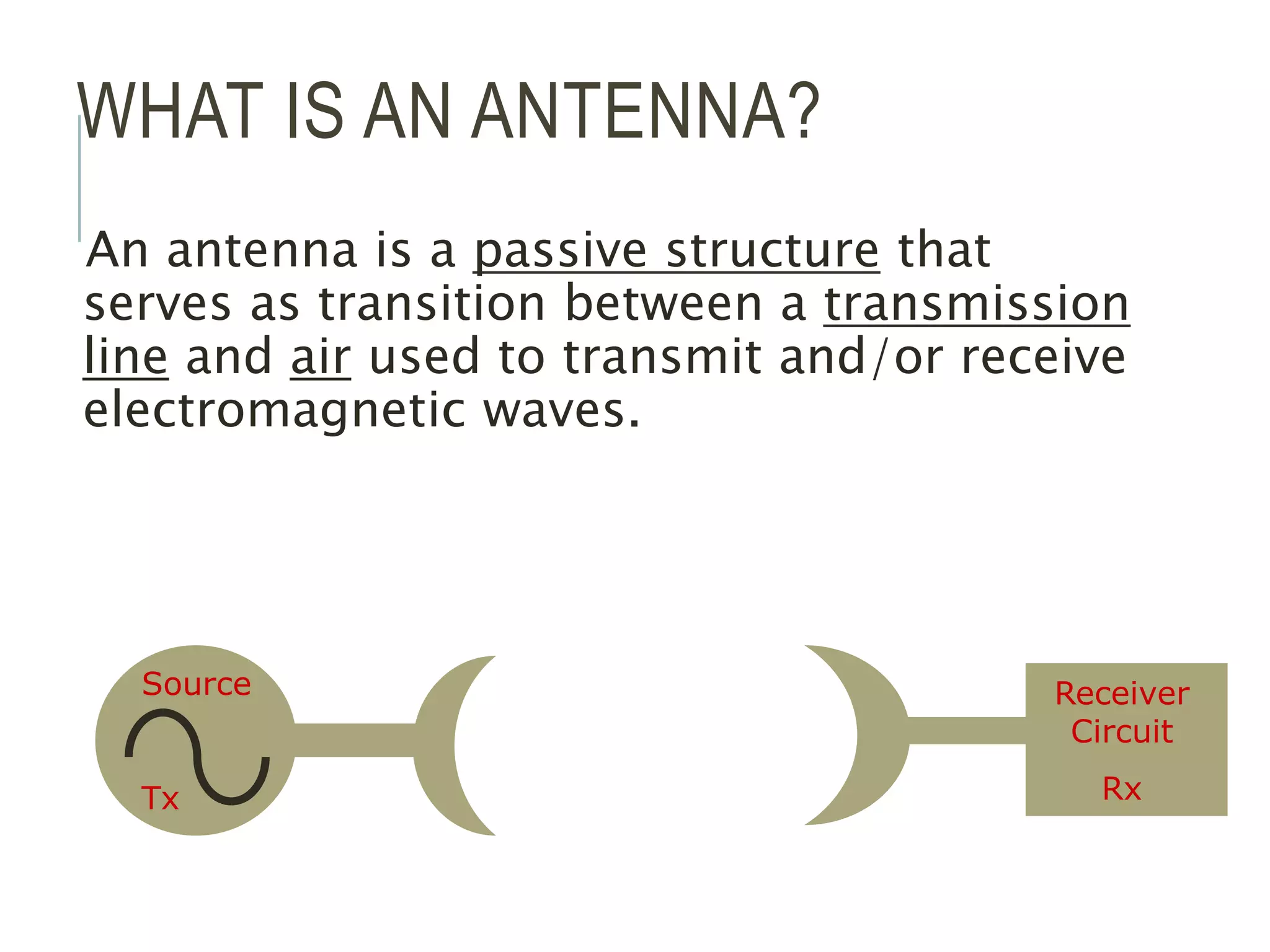
An antenna is a passive structure that
serves as transition between a transmission
line and air used to transmit and/or receive
electromagnetic waves.
Source
Tx
Receiver
Circuit
Rx
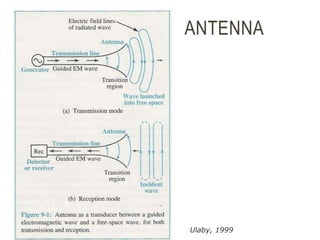
ANTENNA
Ulaby, 1999
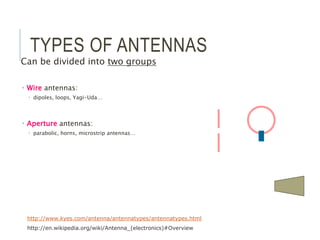
TYPES OF ANTENNAS
Can be divided into two groups
 Wire antennas:
 dipoles, loops, Yagi-Uda…
 Aperture antennas:
 parabolic, horns, microstrip antennas…
http://www.kyes.com/antenna/antennatypes/antennatypes.html
http://en.wikipedia.org/wiki/Antenna_(electronics)#Overview
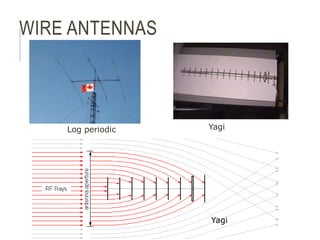
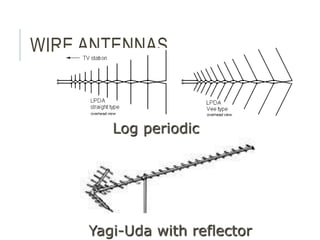
WIRE ANTENNAS
Yagi
Log periodic
Yagi
WIRE ANTENNAS
Log periodic
Yagi-Uda with reflector
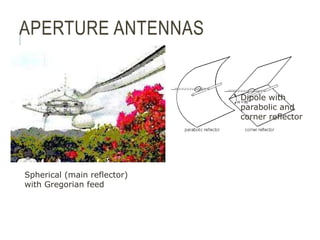
APERTURE ANTENNAS
Spherical (main reflector)
with Gregorian feed
Dipole with
parabolic and
corner reflector
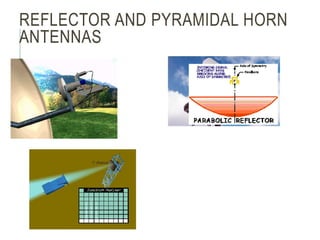
REFLECTOR AND PYRAMIDAL HORN
ANTENNAS
RELATED PARAMETERS
Solid angle, WA and Radiation intensity, U
Radiation pattern, Pn, sidelobes, HPBW
Far field zone, rff
Directivity, D or Gain, G
Antenna radiation impedance, Rrad
Effective Area, Ae
All of these parameters are expressed in terms of a
transmission antenna, but are identically applicable to a
receiving antenna. We’ll also study:
Friis Transmission Equation
Radar Equation
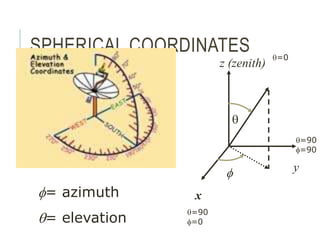
SPHERICAL COORDINATES
z (zenith)
x
y
q
f
f= azimuth
q= elevation
q=90
f=0
q=0
q=90
f=90
SOLID ANGLE
s1 = r dq s2 = r sin q dø
s = qr = arc dA = s1 s2
dA = r2 sin q dø dq
= r2 dΩ
q = Plan angle dΩ = Element of solid angle
•The arc of a complete cirlce: • Area of a complete sphere:
= 2pr = 4pr2
•Total angle: = 2p [radianes] •Total solid angle: =4p [rad2]
=4p [sr]
1 steradian (sr) = (1 radian)2
RADIATION INTENSITY
Is the power density per solid angle:
vector.
Poynting
as
known
also
density
power
the
is
]
[W/m
ˆ
Re 2
r
2
r
H*}
{E
½
where
r
U
r 


P
P [W/sr]
TOTAL RADIATED POWER BY
ANTENNA
[W]
[W]




W


dS
P
or
d
U
P
r
rad
rad
P
Can be calculated as;
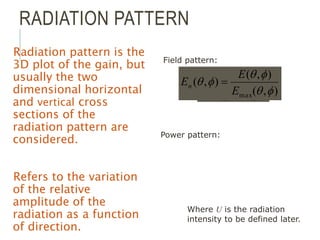
RADIATION PATTERN
Radiation pattern is the
3D plot of the gain, but
usually the two
dimensional horizontal
and vertical cross
sections of the
radiation pattern are
considered.
Refers to the variation
of the relative
amplitude of the
radiation as a function
of direction.
)
,
(
)
,
(
)
,
(
)
,
(
)
,
(
max
max f
q
f
q
f
q
f
q
f
q
U
U
Fn 

P
P
Field pattern:
Where U is the radiation
intensity to be defined later.
)
,
(
)
,
(
)
,
(
max f
q
f
q
f
q
E
E
En 
Power pattern:
TOTAL SOLID ANGLE OF AN
ANTENNA
[sr]
)
,
(
4
A W

W  d
Fn
p
f
q z
y
x
žA
Patrón
|P |
n
WA
Is as if you changed the
radiation pattern
beam of an antenna
into a pencil beam
shape and find out
what’s the equivalent
solid angle occupied by
this pattern.
ISOTROPIC ANTENNA
It’s an hypothetic antenna, i.e., it
does not exist in real life, yet it’s
used as a measuring bar for real
antenna characteristics.
It’s a point source that occupies
a negligible space. Has no
directional preference.
Its pattern is simply a sphere so
it has WA= Wisotropic= 4p
[steradians].
p
f
q
q
p
q
p
f
p
4
sin
)
1
(
)
1
(
0
2
0
4
isotropic

W

W
 

 
d
d
d
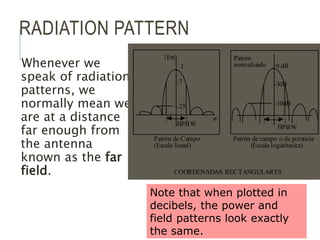
RADIATION PATTERN
Whenever we
speak of radiation
patterns, we
normally mean we
are at a distance
far enough from
the antenna
known as the far
field.
_ 1
HPBW
ø
-.25
-.7
|En|
- 0 dB
-3dB
-10dB
| | | |
HPBW
Patrón de campo o de potencia
(Escala logarítmica)
Patrón de Campo
(Escala lineal)
COORDENADAS RECTANGULARES
Patrón
normalizado
Note that when plotted in
decibels, the power and
field patterns look exactly
the same.
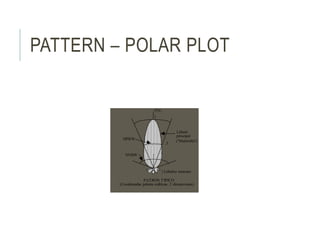
PATTERN – POLAR PLOT
Lóbulo
principal
.5
1
HPBW
Lóbulos menores
NNBW
("Mainlobe")
|Pn|
}
PATRON TIPICO
(Coordenadas polares esféricas, 2 dimensiones)
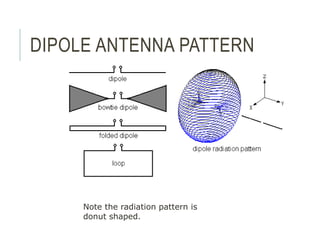
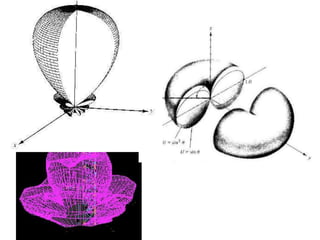
DIPOLE ANTENNA PATTERN
Note the radiation pattern is
donut shaped.
SIDELOBES
Antennas sometimes show side lobes in the
radiation pattern.
Side lobes are peaks in gain other than the
main lobe (the "beam").
Side lobes have bad impact to the antenna
quality whenever the system is being used
to determine the direction of a signal, for
example in RADAR systems.
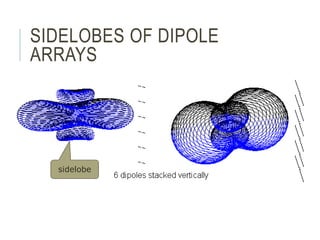
SIDELOBES OF DIPOLE
ARRAYS
sidelobe
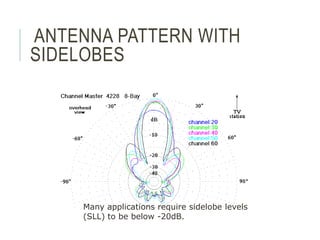
ANTENNA PATTERN WITH
SIDELOBES
Many applications require sidelobe levels
(SLL) to be below -20dB.
GAIN OR DIRECTIVITY
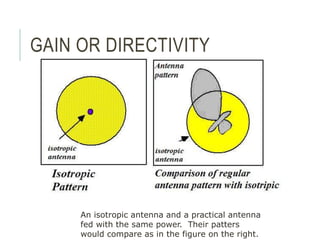
An isotropic antenna and a practical antenna
fed with the same power. Their patters
would compare as in the figure on the right.
DIRECTIVITY AND GAIN
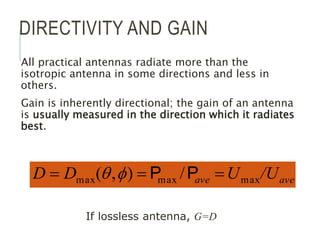
All practical antennas radiate more than the
isotropic antenna in some directions and less in
others.
Gain is inherently directional; the gain of an antenna
is usually measured in the direction which it radiates
best.
ave
ave /U
U
D
D max
max
max /
)
,
( 

 P
P
f
q
If lossless antenna, G=D
GAIN OR DIRECTIVITY
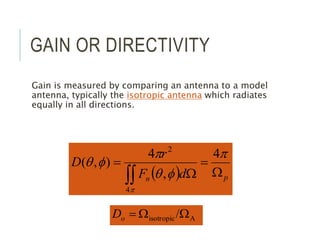
Gain is measured by comparing an antenna to a model
antenna, typically the isotropic antenna which radiates
equally in all directions.
  p
n d
F
r
D
W

W


p
f
q
p
f
q
p
4
,
4
)
,
(
4
2
/ A
isotropic W
W

o
D
DIRECTIVITY
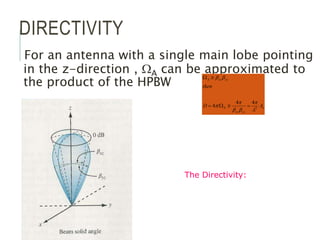
For an antenna with a single main lobe pointing
in the z-direction , WA can be approximated to
the product of the HPBW
e
yz
xz
yz
xz
A
A
D
then
2
A
4
4
/
4

p


p
p




W


W
The Directivity:
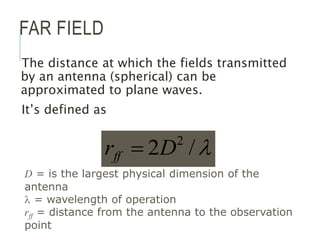
FAR FIELD
The distance at which the fields transmitted
by an antenna (spherical) can be
approximated to plane waves.
It’s defined as

/
2 2
D
rff 
D = is the largest physical dimension of the
antenna
 = wavelength of operation
rff = distance from the antenna to the observation
point
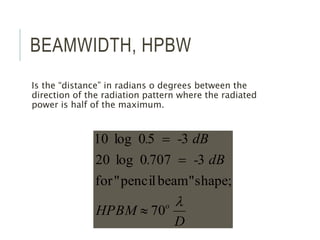
BEAMWIDTH, HPBW
Is the “distance” in radians o degrees between the
direction of the radiation pattern where the radiated
power is half of the maximum.
D
HPBM
dB
-
.
dB
-
.
o 
70
shape;
beam"
pencil
"
for
3
707
0
log
20
3
5
0
log
10



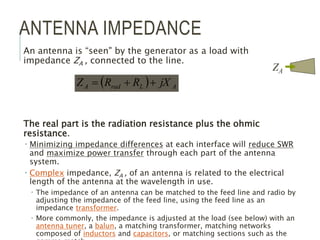
ANTENNA IMPEDANCE
An antenna is “seen" by the generator as a load with
impedance ZA , connected to the line.
The real part is the radiation resistance plus the ohmic
resistance.
 Minimizing impedance differences at each interface will reduce SWR
and maximize power transfer through each part of the antenna
system.
 Complex impedance, ZA , of an antenna is related to the electrical
length of the antenna at the wavelength in use.
 The impedance of an antenna can be matched to the feed line and radio by
adjusting the impedance of the feed line, using the feed line as an
impedance transformer.
 More commonly, the impedance is adjusted at the load (see below) with an
antenna tuner, a balun, a matching transformer, matching networks
composed of inductors and capacitors, or matching sections such as the
  A
L
rad
A jX
R
R
Z 


ZA
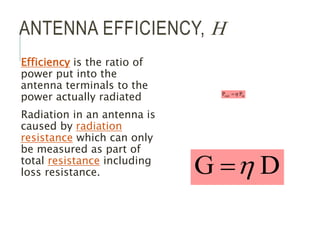
ANTENNA EFFICIENCY, H
Efficiency is the ratio of
power put into the
antenna terminals to the
power actually radiated
Radiation in an antenna is
caused by radiation
resistance which can only
be measured as part of
total resistance including
loss resistance.
in
rad P
P 

D
G 

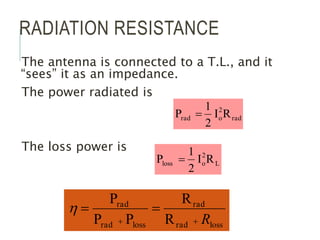
RADIATION RESISTANCE
The antenna is connected to a T.L., and it
“sees” it as an impedance.
The power radiated is
The loss power is
loss
rad
rad
loss
rad
rad
R
R
P
P
P
R





rad
2
o
rad R
I
2
1
P 
L
2
o
loss R
I
2
1
P 
RADAR EQUATION
What is a radar?
Received power by a radar from a single target is
Where s is the backscattering coefficient of the
target [m2]
 

s
p
 2
4
3
2
2
4

 e
R
G
P
P o
o
t
r
ANTENNA POLARIZATION
The polarization of an antenna is the
polarization of the signals it emits.
 The ionosphere changes the polarization of signals
unpredictably, so for signals which will be reflected
by the ionosphere, polarization is not crucial.
 However, for line-of-sight communications, it can
make a tremendous difference in signal quality to
have the transmitter and receiver using the same
polarization.
 Polarizations commonly considered are vertical,
horizontal, and circular.
ANTENNA BANDWIDTH
The bandwidth of an antenna is the range of
frequencies over which it is effective, usually centered
around the operating or resonant frequency.
 The bandwidth of an antenna may be increased by several
techniques, including using thicker wires, replacing wires with
cages to simulate a thicker wire, tapering antenna components
(like in a feed horn), and combining multiple antennas into a
single assembly and allowing the natural impedance to select
the correct antenna.
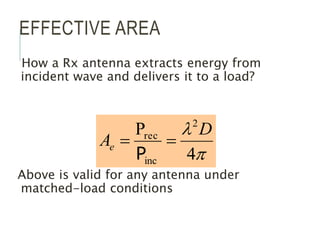
EFFECTIVE AREA
How a Rx antenna extracts energy from
incident wave and delivers it to a load?
Above is valid for any antenna under
matched-load conditions
p

4
P 2
inc
rec D
Ae 

P
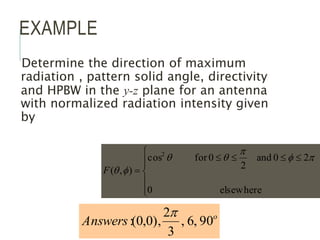
EXAMPLE
Determine the direction of maximum
radiation , pattern solid angle, directivity
and HPBW in the y-z plane for an antenna
with normalized radiation intensity given
by
o
Answers 90
,
6
,
3
2
),
0
,
0
(
:
p
elsewhere
0
2
0
and
2
0
for
cos
)
,
(
2












p
f
p
q
q
f
q
F
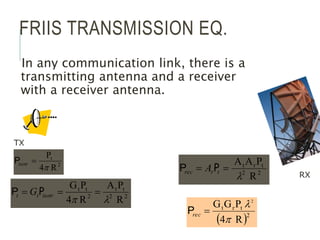
FRIIS TRANSMISSION EQ.
In any communication link, there is a
transmitting antenna and a receiver
with a receiver antenna.
2
t
R
4
P
p

isotr
P
2
2
t
t
2
t
t
R
P
A
R
4
P
G

p


 isotr
t
t G P
P
2
2
t
r
t
R
P
A
A


 t
r
rec A P
P
 2
t
r
t
R
4
P
G
G 2
p


rec
P
TX
RX
ANTENNA ARRAYS
Uses many antennas synchronized with each other to increase
Pattern multiplication, AF
[ ]
Factor
Array
Pattern
Antenna
Individual
)
( 






r
E













2
sin
2
sin


N
N
AFN
1
-1 1
x
|T (x)|
4
-R
x
0
°
Uniform illumination Tschebyscheff Illumination
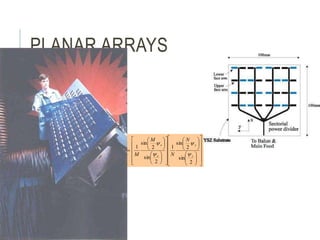
PLANAR ARRAYS
 



















































2
sin
2
sin
1
2
sin
2
sin
1
,
y
y
x
x
n
N
N
M
M
AF




f
q

Antenna Analogies .ppt

  • 1.
    WHAT IS ANANTENNA? An antenna is a passive structure that serves as transition between a transmission line and air used to transmit and/or receive electromagnetic waves. Source Tx Receiver Circuit Rx
  • 2.
  • 3.
    TYPES OF ANTENNAS Canbe divided into two groups  Wire antennas:  dipoles, loops, Yagi-Uda…  Aperture antennas:  parabolic, horns, microstrip antennas… http://www.kyes.com/antenna/antennatypes/antennatypes.html http://en.wikipedia.org/wiki/Antenna_(electronics)#Overview
  • 4.
  • 5.
  • 6.
    APERTURE ANTENNAS Spherical (mainreflector) with Gregorian feed Dipole with parabolic and corner reflector
  • 7.
  • 8.
    RELATED PARAMETERS Solid angle,WA and Radiation intensity, U Radiation pattern, Pn, sidelobes, HPBW Far field zone, rff Directivity, D or Gain, G Antenna radiation impedance, Rrad Effective Area, Ae All of these parameters are expressed in terms of a transmission antenna, but are identically applicable to a receiving antenna. We’ll also study: Friis Transmission Equation Radar Equation
  • 9.
    SPHERICAL COORDINATES z (zenith) x y q f f=azimuth q= elevation q=90 f=0 q=0 q=90 f=90
  • 10.
    SOLID ANGLE s1 =r dq s2 = r sin q dø s = qr = arc dA = s1 s2 dA = r2 sin q dø dq = r2 dΩ q = Plan angle dΩ = Element of solid angle •The arc of a complete cirlce: • Area of a complete sphere: = 2pr = 4pr2 •Total angle: = 2p [radianes] •Total solid angle: =4p [rad2] =4p [sr] 1 steradian (sr) = (1 radian)2
  • 11.
    RADIATION INTENSITY Is thepower density per solid angle: vector. Poynting as known also density power the is ] [W/m ˆ Re 2 r 2 r H*} {E ½ where r U r    P P [W/sr]
  • 12.
    TOTAL RADIATED POWERBY ANTENNA [W] [W]     W   dS P or d U P r rad rad P Can be calculated as;
  • 13.
    RADIATION PATTERN Radiation patternis the 3D plot of the gain, but usually the two dimensional horizontal and vertical cross sections of the radiation pattern are considered. Refers to the variation of the relative amplitude of the radiation as a function of direction. ) , ( ) , ( ) , ( ) , ( ) , ( max max f q f q f q f q f q U U Fn   P P Field pattern: Where U is the radiation intensity to be defined later. ) , ( ) , ( ) , ( max f q f q f q E E En  Power pattern:
  • 14.
    TOTAL SOLID ANGLEOF AN ANTENNA [sr] ) , ( 4 A W  W  d Fn p f q z y x žA Patrón |P | n WA Is as if you changed the radiation pattern beam of an antenna into a pencil beam shape and find out what’s the equivalent solid angle occupied by this pattern.
  • 15.
    ISOTROPIC ANTENNA It’s anhypothetic antenna, i.e., it does not exist in real life, yet it’s used as a measuring bar for real antenna characteristics. It’s a point source that occupies a negligible space. Has no directional preference. Its pattern is simply a sphere so it has WA= Wisotropic= 4p [steradians]. p f q q p q p f p 4 sin ) 1 ( ) 1 ( 0 2 0 4 isotropic  W  W      d d d
  • 16.
    RADIATION PATTERN Whenever we speakof radiation patterns, we normally mean we are at a distance far enough from the antenna known as the far field. _ 1 HPBW ø -.25 -.7 |En| - 0 dB -3dB -10dB | | | | HPBW Patrón de campo o de potencia (Escala logarítmica) Patrón de Campo (Escala lineal) COORDENADAS RECTANGULARES Patrón normalizado Note that when plotted in decibels, the power and field patterns look exactly the same.
  • 17.
    PATTERN – POLARPLOT Lóbulo principal .5 1 HPBW Lóbulos menores NNBW ("Mainlobe") |Pn| } PATRON TIPICO (Coordenadas polares esféricas, 2 dimensiones)
  • 18.
    DIPOLE ANTENNA PATTERN Notethe radiation pattern is donut shaped.
  • 19.
    SIDELOBES Antennas sometimes showside lobes in the radiation pattern. Side lobes are peaks in gain other than the main lobe (the "beam"). Side lobes have bad impact to the antenna quality whenever the system is being used to determine the direction of a signal, for example in RADAR systems.
  • 20.
  • 21.
    ANTENNA PATTERN WITH SIDELOBES Manyapplications require sidelobe levels (SLL) to be below -20dB.
  • 22.
    GAIN OR DIRECTIVITY Anisotropic antenna and a practical antenna fed with the same power. Their patters would compare as in the figure on the right.
  • 23.
    DIRECTIVITY AND GAIN Allpractical antennas radiate more than the isotropic antenna in some directions and less in others. Gain is inherently directional; the gain of an antenna is usually measured in the direction which it radiates best. ave ave /U U D D max max max / ) , (    P P f q If lossless antenna, G=D
  • 24.
    GAIN OR DIRECTIVITY Gainis measured by comparing an antenna to a model antenna, typically the isotropic antenna which radiates equally in all directions.   p n d F r D W  W   p f q p f q p 4 , 4 ) , ( 4 2 / A isotropic W W  o D
  • 25.
    DIRECTIVITY For an antennawith a single main lobe pointing in the z-direction , WA can be approximated to the product of the HPBW e yz xz yz xz A A D then 2 A 4 4 / 4  p   p p     W   W The Directivity:
  • 26.
    FAR FIELD The distanceat which the fields transmitted by an antenna (spherical) can be approximated to plane waves. It’s defined as  / 2 2 D rff  D = is the largest physical dimension of the antenna  = wavelength of operation rff = distance from the antenna to the observation point
  • 27.
    BEAMWIDTH, HPBW Is the“distance” in radians o degrees between the direction of the radiation pattern where the radiated power is half of the maximum. D HPBM dB - . dB - . o  70 shape; beam" pencil " for 3 707 0 log 20 3 5 0 log 10   
  • 28.
    ANTENNA IMPEDANCE An antennais “seen" by the generator as a load with impedance ZA , connected to the line. The real part is the radiation resistance plus the ohmic resistance.  Minimizing impedance differences at each interface will reduce SWR and maximize power transfer through each part of the antenna system.  Complex impedance, ZA , of an antenna is related to the electrical length of the antenna at the wavelength in use.  The impedance of an antenna can be matched to the feed line and radio by adjusting the impedance of the feed line, using the feed line as an impedance transformer.  More commonly, the impedance is adjusted at the load (see below) with an antenna tuner, a balun, a matching transformer, matching networks composed of inductors and capacitors, or matching sections such as the   A L rad A jX R R Z    ZA
  • 29.
    ANTENNA EFFICIENCY, H Efficiencyis the ratio of power put into the antenna terminals to the power actually radiated Radiation in an antenna is caused by radiation resistance which can only be measured as part of total resistance including loss resistance. in rad P P   D G  
  • 30.
    RADIATION RESISTANCE The antennais connected to a T.L., and it “sees” it as an impedance. The power radiated is The loss power is loss rad rad loss rad rad R R P P P R      rad 2 o rad R I 2 1 P  L 2 o loss R I 2 1 P 
  • 31.
    RADAR EQUATION What isa radar? Received power by a radar from a single target is Where s is the backscattering coefficient of the target [m2]    s p  2 4 3 2 2 4   e R G P P o o t r
  • 32.
    ANTENNA POLARIZATION The polarizationof an antenna is the polarization of the signals it emits.  The ionosphere changes the polarization of signals unpredictably, so for signals which will be reflected by the ionosphere, polarization is not crucial.  However, for line-of-sight communications, it can make a tremendous difference in signal quality to have the transmitter and receiver using the same polarization.  Polarizations commonly considered are vertical, horizontal, and circular.
  • 33.
    ANTENNA BANDWIDTH The bandwidthof an antenna is the range of frequencies over which it is effective, usually centered around the operating or resonant frequency.  The bandwidth of an antenna may be increased by several techniques, including using thicker wires, replacing wires with cages to simulate a thicker wire, tapering antenna components (like in a feed horn), and combining multiple antennas into a single assembly and allowing the natural impedance to select the correct antenna.
  • 34.
    EFFECTIVE AREA How aRx antenna extracts energy from incident wave and delivers it to a load? Above is valid for any antenna under matched-load conditions p  4 P 2 inc rec D Ae   P
  • 35.
    EXAMPLE Determine the directionof maximum radiation , pattern solid angle, directivity and HPBW in the y-z plane for an antenna with normalized radiation intensity given by o Answers 90 , 6 , 3 2 ), 0 , 0 ( : p elsewhere 0 2 0 and 2 0 for cos ) , ( 2             p f p q q f q F
  • 37.
    FRIIS TRANSMISSION EQ. Inany communication link, there is a transmitting antenna and a receiver with a receiver antenna. 2 t R 4 P p  isotr P 2 2 t t 2 t t R P A R 4 P G  p    isotr t t G P P 2 2 t r t R P A A    t r rec A P P  2 t r t R 4 P G G 2 p   rec P TX RX
  • 38.
    ANTENNA ARRAYS Uses manyantennas synchronized with each other to increase Pattern multiplication, AF [ ] Factor Array Pattern Antenna Individual ) (        r E              2 sin 2 sin   N N AFN 1 -1 1 x |T (x)| 4 -R x 0 ° Uniform illumination Tschebyscheff Illumination
  • 39.