Introduction
• Tracheo-oesophageal fistula and
  Oesophagal Atresia are the
  malformation of digestive
  system, In which oesophagus
  does not develop properly. The
  oesophagus is a tube that
  normally carries food from the
  mouth to stomach.
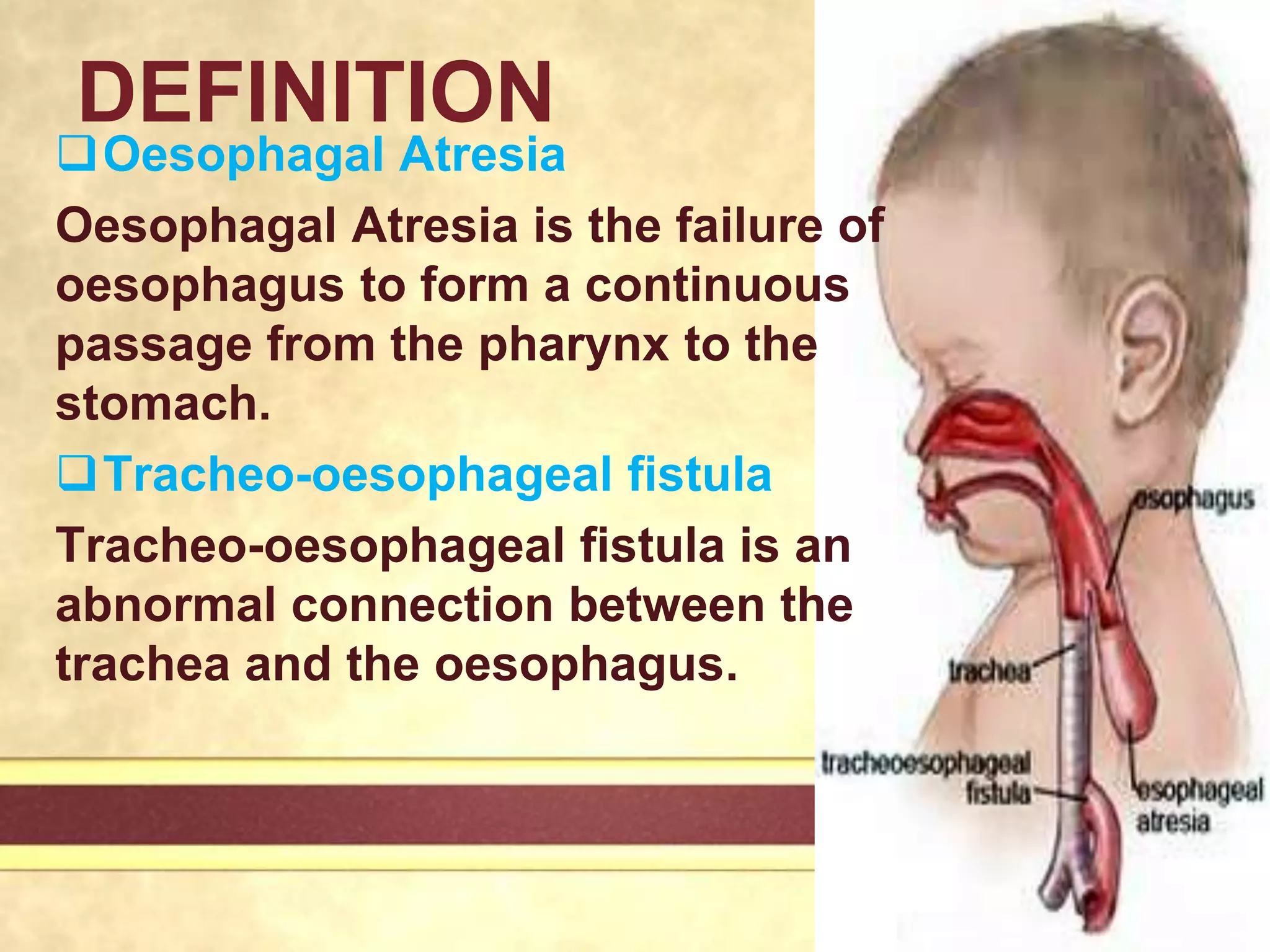
DEFINITION
Oesophagal Atresia
Oesophagal Atresia is the failure of
oesophagus to form a continuous
passage from the pharynx to the
stomach.
Tracheo-oesophageal fistula
Tracheo-oesophageal fistula is an
abnormal connection between the
trachea and the oesophagus.
EPIDEMIOLOGY
• Tracheo-oesophageal fistula occurs in 1 in 3500
  births, with slight male dominance. Oesophagus
  atresia with or without Tracheo-oesophageal
  fistula is common in prematurity, with 34% of
  cases weighing less than 2500 grams.

• Approximately 50% of neonates with oesophagus
  atresia or Tracheo-oesophageal fistula have other
  anomalies also. Usually cardiac anomalies are
  seen in 14.7 – 28 % cases of TEF.
ETIOLOGY
• The cause of Tracheo-
  oesophageal fistula and
  Oesophagal Atresia is still
  unknown.
PATHOPHYSIOLOGY
• The upper part of oesophagus is developed from
  the retropharyngeal segment and lower part from
  the pregastric segment of foregut. At about 4
  weeks of gestation, a laryngo-tracheal groove is
  formed which divides the foregut into two
  longitudinal tubes, which further develop into the
  respiratory tract and the digestive tract. Defective
  separation due to deviated or incomplete septum
  or incomplete fusion of tracheal fold results in
  malformation of trachea and oesophagus.
TYPES OF TEF
Type A:
In this type, there is Oesophagal Atresia
and proximal and distal segments of
oesophagus are blind. There is no
communication between trachea and
oesophagus. This type is present in 3-7
% of cases.
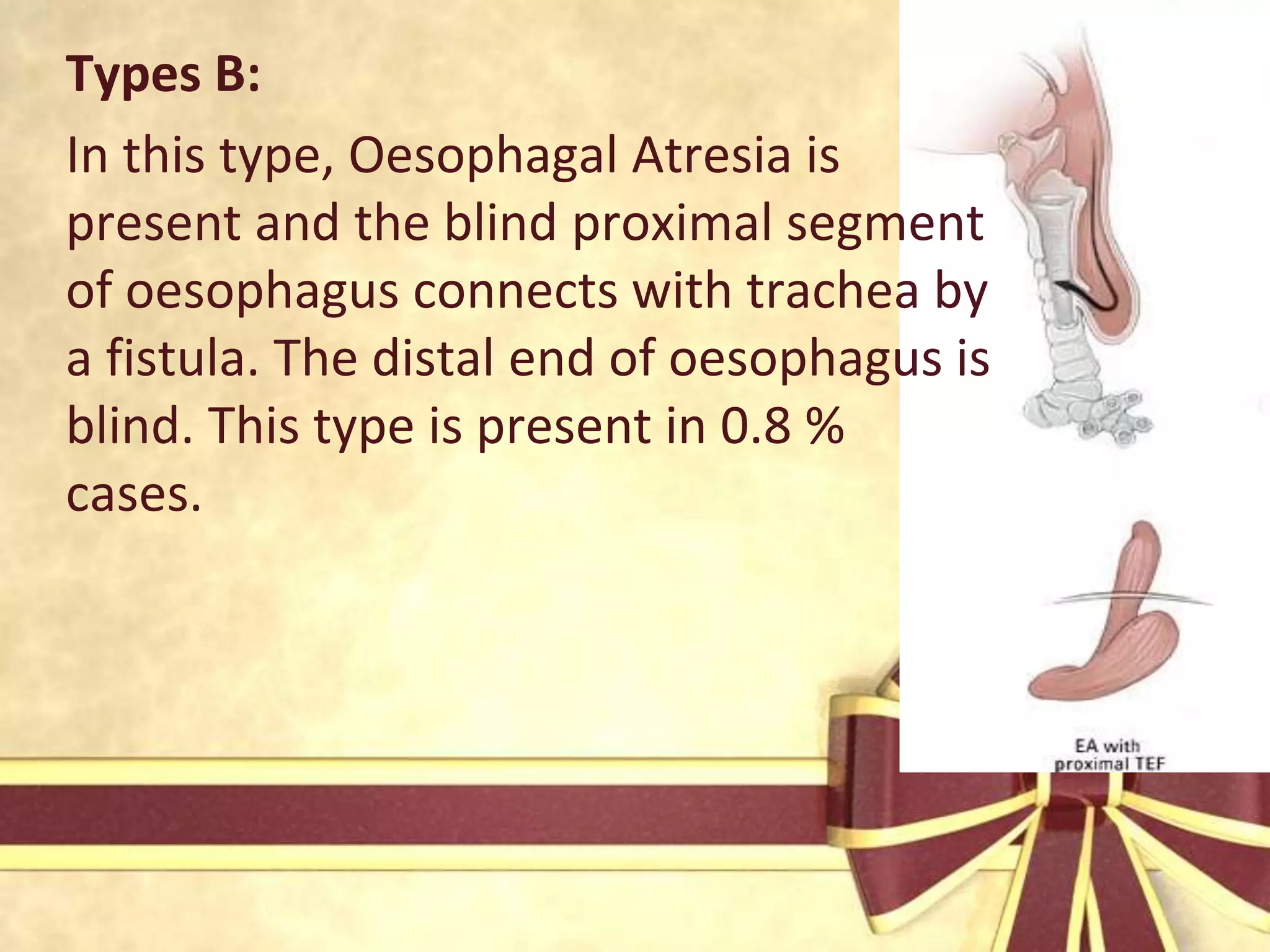
Types B:
In this type, Oesophagal Atresia is
present and the blind proximal segment
of oesophagus connects with trachea by
a fistula. The distal end of oesophagus is
blind. This type is present in 0.8 %
cases.
Type C:
In this type, Oesophagal Atresia is
present. The proximal end of oesophagus
is a blind pouch and distal segment of
oesophagus is connected by fistula to
trachea. This is the commonest type,
present in about 87 % cases.
Type D:
It is the rarest type that occurs in 0.7 %
cases. In this type, both upper and
lower segments of oesophagus
communicate with trachea.
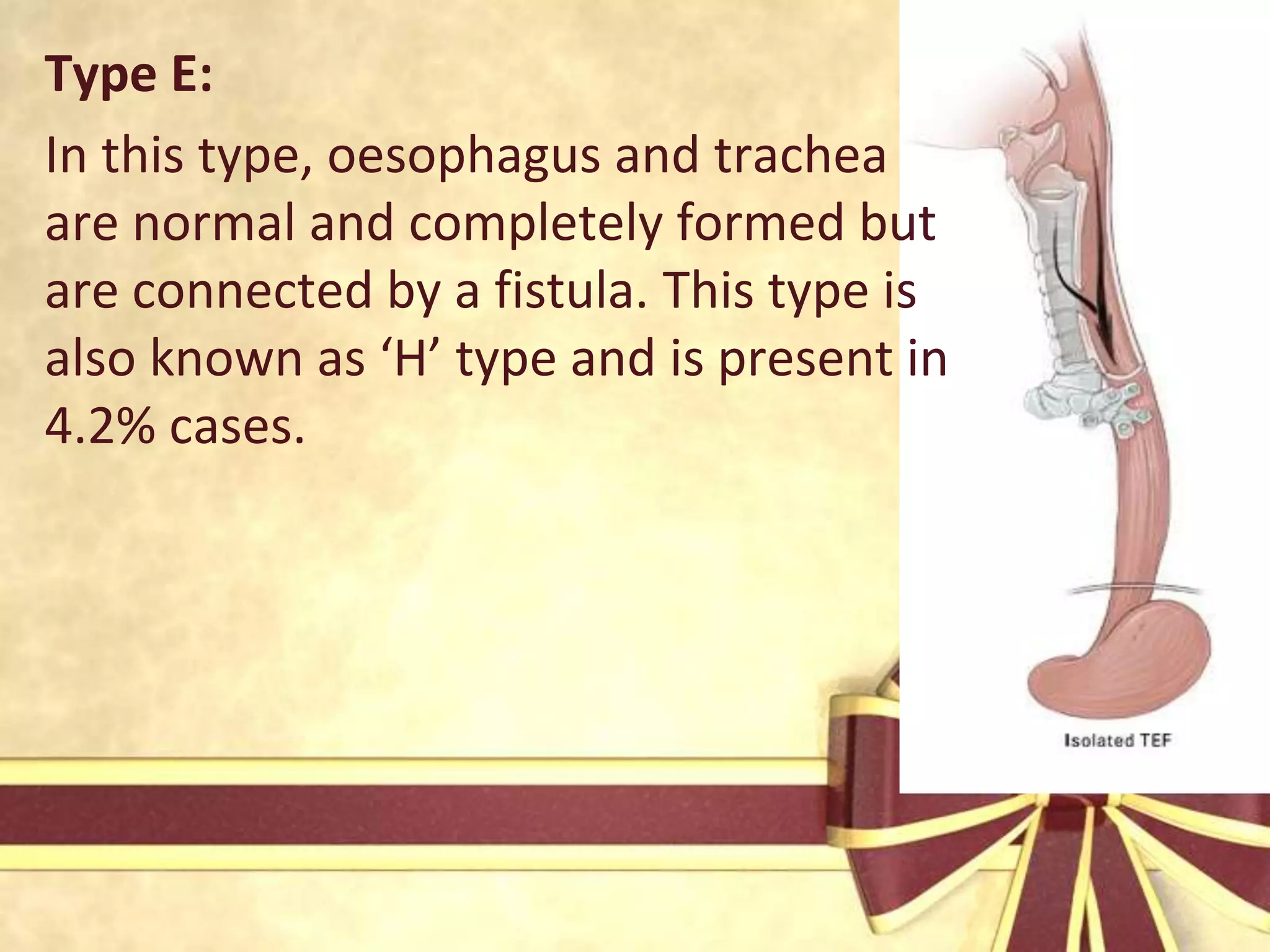
Type E:
In this type, oesophagus and trachea
are normal and completely formed but
are connected by a fistula. This type is
also known as ‘H’ type and is present in
4.2% cases.
CLINICAL MANIFESTATIONS
The disorder is usually detected soon after
   birth when feeding is attempted on the
   basis of following :
1. Violent response occurs on feeding
 Infant coughs and chokes
 Fluid returns through nose and mouth.
 Cyanosis occur
 The infant struggles
Cont.… coming out of nose and constant
2. Excessive secretions
     drooling of saliva.
3.   Saliva is frothy.
4.   Abdominal distension occurs in presence of type III, IV
     and V fistula.
5.   Intermittent unexplained cyanosis and laryngospasm,
     caused by aspiration of accumulated saliva in blind
     oesophageal pouch.
6.   Pneumonia may occur due to overflow of milk and
     saliva from oesophagus through fistula into the lungs.
DIAGNOSTIC EVLUATION
The EA/TEF may be suspected
 prenatally if
 Ultrasound examination reveals
  polyhydramnios, absence of a fluid-filled
  stomach, a small abdomen, lower-than-
  expected fetal weight, and a distended
  esophageal pouch.
 Fetal MRI may be used to confirm the
  presence of EA/TEF
TEF may be detected postnatally by
 X-ray taken with radiopaque catheter placed in
  esophagus to check for obstruction; standard
  chest X- ray shows a dilated air-filled upper
  esophageal pouch and can demonstrate
  pneumonia.
 Inability to pass a NG tube into stomach because
  it meets resistance:;
 Bronchoscopy visualizes fistula between trachea
  and esophagus;
 Abdominal ultrasound and echocardiogram to
  check for cardiac abnormalities.
TREATMENT
• The management of trachea-
  oesophageal fistula is mainly surgical.
  Surgical intervention depends on the
  distance between proximal and distal
  pouch of oesophagus, type of defect,
  condition of neonate and his weight.
If distance between upper and lower
 oesophageal segments is less than 2.5
 cm and if the condition of infant is
 good, primary repair is done by
 division and ligation of the fistula
 along with end-to-end anastomosis of
 proximal and distal segments of
 oesophagus.
 Staging Surgery: When the distance between the two
  oesophageal segments is large and condition of the
  infant is poor, a two- stage procedure may be
  required:

 Initially in the first stage, the trachea-oesophageal
  fistula is ligated and gastrostomy done to reduce the
  risk of reflux and to provide feeding.
 In the second stage, both proximal and distal
  oesophageal segments are anastomosed. If the gap is
  too large, a segment of colon is used for
  reconstruction of the oesophagus. This is done at
  about 18-24 months.
NURSING DIAGNOSIS
Pre-Operative
Risk for aspiration related to
 structural abnormality.
Risk for deficient fluid volume related
 to inability to take oral feeds.
Impaired breathing related to
 frequent laryngospasm and excessive
 secretions in the trachea.
Post-Operative
Ineffective airway clearance related
 to disease process.
Impaired nutrition related to surgery.
Altered comfort related to surgical
 process.
NURSING INTERVENTION
 A nasogastric tube is put in the upper
  oesophageal segment and is aspirated
  frequently, to prevent collection and
  aspiration of secretion into the trachea.
 Intravenous fluids are administered to
  maintain the hydration status of infant.
 Place the infant in semi-upright position
  and administer oxygen if cyanosis is
  present.
A cervical oesophagostomy is made
 to drain out secretions from blind
 oesophageal pouch and administer
 oxygen to infant.
Feed the infant orally or by
 gastrostomy.
Position the baby comfortably in
 semi-fowler’s position and administer
 analgesics.
COMPLICATION
Tracheomalacia (weakness of tracheal wall)
Anastomotic leak (tension)
Strictures (narrowing, esophageal dilation)
Dysphagia (esophageal motility disorder)
Respiratory distress
Gastro-esophageal reflux.
Tracheo oesophageal fistula

Tracheo oesophageal fistula

  • 2.
    Introduction • Tracheo-oesophageal fistulaand Oesophagal Atresia are the malformation of digestive system, In which oesophagus does not develop properly. The oesophagus is a tube that normally carries food from the mouth to stomach.
  • 3.
    DEFINITION Oesophagal Atresia Oesophagal Atresiais the failure of oesophagus to form a continuous passage from the pharynx to the stomach. Tracheo-oesophageal fistula Tracheo-oesophageal fistula is an abnormal connection between the trachea and the oesophagus.
  • 4.
    EPIDEMIOLOGY • Tracheo-oesophageal fistulaoccurs in 1 in 3500 births, with slight male dominance. Oesophagus atresia with or without Tracheo-oesophageal fistula is common in prematurity, with 34% of cases weighing less than 2500 grams. • Approximately 50% of neonates with oesophagus atresia or Tracheo-oesophageal fistula have other anomalies also. Usually cardiac anomalies are seen in 14.7 – 28 % cases of TEF.
  • 5.
    ETIOLOGY • The causeof Tracheo- oesophageal fistula and Oesophagal Atresia is still unknown.
  • 6.
    PATHOPHYSIOLOGY • The upperpart of oesophagus is developed from the retropharyngeal segment and lower part from the pregastric segment of foregut. At about 4 weeks of gestation, a laryngo-tracheal groove is formed which divides the foregut into two longitudinal tubes, which further develop into the respiratory tract and the digestive tract. Defective separation due to deviated or incomplete septum or incomplete fusion of tracheal fold results in malformation of trachea and oesophagus.
  • 7.
    TYPES OF TEF TypeA: In this type, there is Oesophagal Atresia and proximal and distal segments of oesophagus are blind. There is no communication between trachea and oesophagus. This type is present in 3-7 % of cases.
  • 8.
    Types B: In thistype, Oesophagal Atresia is present and the blind proximal segment of oesophagus connects with trachea by a fistula. The distal end of oesophagus is blind. This type is present in 0.8 % cases.
  • 9.
    Type C: In thistype, Oesophagal Atresia is present. The proximal end of oesophagus is a blind pouch and distal segment of oesophagus is connected by fistula to trachea. This is the commonest type, present in about 87 % cases.
  • 10.
    Type D: It isthe rarest type that occurs in 0.7 % cases. In this type, both upper and lower segments of oesophagus communicate with trachea.
  • 11.
    Type E: In thistype, oesophagus and trachea are normal and completely formed but are connected by a fistula. This type is also known as ‘H’ type and is present in 4.2% cases.
  • 12.
    CLINICAL MANIFESTATIONS The disorderis usually detected soon after birth when feeding is attempted on the basis of following : 1. Violent response occurs on feeding  Infant coughs and chokes  Fluid returns through nose and mouth.  Cyanosis occur  The infant struggles
  • 13.
    Cont.… coming outof nose and constant 2. Excessive secretions drooling of saliva. 3. Saliva is frothy. 4. Abdominal distension occurs in presence of type III, IV and V fistula. 5. Intermittent unexplained cyanosis and laryngospasm, caused by aspiration of accumulated saliva in blind oesophageal pouch. 6. Pneumonia may occur due to overflow of milk and saliva from oesophagus through fistula into the lungs.
  • 14.
    DIAGNOSTIC EVLUATION The EA/TEFmay be suspected prenatally if  Ultrasound examination reveals polyhydramnios, absence of a fluid-filled stomach, a small abdomen, lower-than- expected fetal weight, and a distended esophageal pouch.  Fetal MRI may be used to confirm the presence of EA/TEF
  • 15.
    TEF may bedetected postnatally by  X-ray taken with radiopaque catheter placed in esophagus to check for obstruction; standard chest X- ray shows a dilated air-filled upper esophageal pouch and can demonstrate pneumonia.  Inability to pass a NG tube into stomach because it meets resistance:;  Bronchoscopy visualizes fistula between trachea and esophagus;  Abdominal ultrasound and echocardiogram to check for cardiac abnormalities.
  • 16.
    TREATMENT • The managementof trachea- oesophageal fistula is mainly surgical. Surgical intervention depends on the distance between proximal and distal pouch of oesophagus, type of defect, condition of neonate and his weight.
  • 17.
    If distance betweenupper and lower oesophageal segments is less than 2.5 cm and if the condition of infant is good, primary repair is done by division and ligation of the fistula along with end-to-end anastomosis of proximal and distal segments of oesophagus.
  • 18.
     Staging Surgery:When the distance between the two oesophageal segments is large and condition of the infant is poor, a two- stage procedure may be required:  Initially in the first stage, the trachea-oesophageal fistula is ligated and gastrostomy done to reduce the risk of reflux and to provide feeding.  In the second stage, both proximal and distal oesophageal segments are anastomosed. If the gap is too large, a segment of colon is used for reconstruction of the oesophagus. This is done at about 18-24 months.
  • 19.
    NURSING DIAGNOSIS Pre-Operative Risk foraspiration related to structural abnormality. Risk for deficient fluid volume related to inability to take oral feeds. Impaired breathing related to frequent laryngospasm and excessive secretions in the trachea.
  • 20.
    Post-Operative Ineffective airway clearancerelated to disease process. Impaired nutrition related to surgery. Altered comfort related to surgical process.
  • 21.
    NURSING INTERVENTION Anasogastric tube is put in the upper oesophageal segment and is aspirated frequently, to prevent collection and aspiration of secretion into the trachea. Intravenous fluids are administered to maintain the hydration status of infant. Place the infant in semi-upright position and administer oxygen if cyanosis is present.
  • 22.
    A cervical oesophagostomyis made to drain out secretions from blind oesophageal pouch and administer oxygen to infant. Feed the infant orally or by gastrostomy. Position the baby comfortably in semi-fowler’s position and administer analgesics.
  • 23.
    COMPLICATION Tracheomalacia (weakness oftracheal wall) Anastomotic leak (tension) Strictures (narrowing, esophageal dilation) Dysphagia (esophageal motility disorder) Respiratory distress Gastro-esophageal reflux.