

ANN Based SVC SwitchingANN Based SVC Switching
at Distribution Level forat Distribution Level for
Minimal Injected HarmonicsMinimal Injected Harmonics
Presented By
A.Yateesh Kumar Yadav
AURORA’S RESEARCH AND
TECHNOLOGICAL INSTITUTE
DEPARTMENT OF ELECTRICAL AND ELECTRONICS ENGINEERING
 The Indian power distribution systems are facing a variety of problems due
to non-linear loads in the last decade. In addition to poor voltage profile, the
power factor and harmonics of the system are the major concerns of the utility.
 To improve voltage stability and power system stability in long transmission
line reactive power need to be compensated.
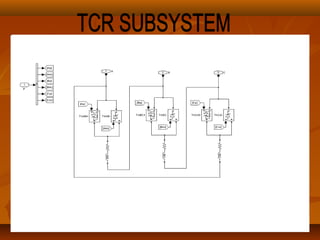
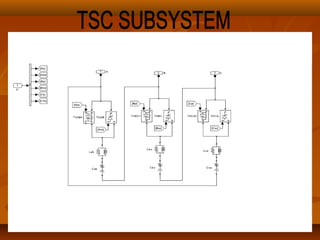
 A Static Var Compensator generally consists of a Thyristor Controlled
Reactor (TCR) & a Thyristor Switched Capacitor (TSC) and compensates loads
through generation or absorption of reactive power.
 The ANN controller is used to control the SVC so that it balances the reactive
power drawn by the supply, minimize the reactive power drawn from the
supply and minimize the harmonics injected into the system in an acceptable
time.
 In this shunt type compensation are used because generally voltage
is maintained constant and current is variable .
 Thus series, series-series & series-shunt connections are not used
for compensations due to variable voltage.
 For shunt type compensation the techniques used for minimal
injecting harmonics are
1) SVC
2) STATCOM
3) DSTATCOM
 In transmission line, 99% SVC or STATCOM are used where as
1% DSTATCOM are used.
1) STATIC VAR COMPENSATOR
 The Static Var Compensator (SVC) is a shunt type FACTS device which is
used to improve the power quality for the purpose of voltage and reactive power
control.
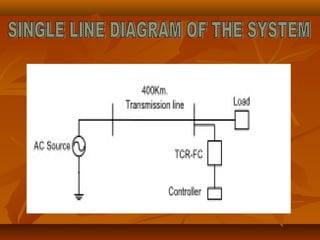
 SVC is connected as Thyristor Controlled Reactor- Fixed Capacitor (TCR-
FC).
 The SVC is an automated impedance matching device, designed to bring the
system closer to unity power factor .The current in the reactor is varied by the
method of firing delay angle control method.
2) ARTIFICIAL NEURAL NETWORK
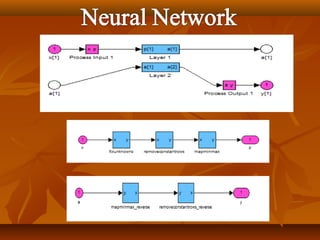
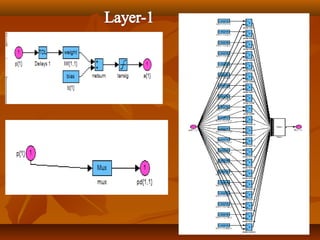
 ANN is a controller which is used to solve non-linear problem caused due to
harmonics.
 The function of ANN is to process the information.
 ANN choose the optimum combination of firing angles of TCR for controlling
SVCs on-line.
 Dr Cleve Moler, Chief scientist at MathWorks, originally wrote
Matlab, to provide easy access to matrix software.
 Stands for MATrix LABoratory.
 Matlab is a high-performance language for technical computing.
 SIMULINK is a Matlab toolbox designed for the dynamic simulation
of linear and nonlinear systems as well as continuous and discrete-time
systems.
 Use the Library Browser to browse and search Simulink block
libraries for blocks to use in your models.
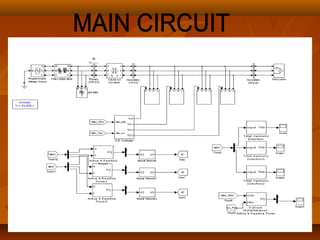
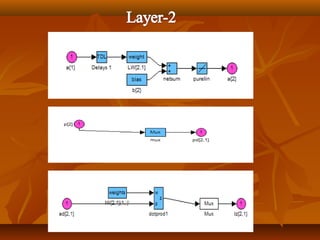
 Neural network toolbox in MATLAB 7.0 version was used for
training and simulating ANNs.
 Advantages
1) Unlimited data transfer.
2) Higher efficiency within compensating techniques.
 Disadvantages
1) It is very costly.
2) Working process is complex.
 These type of techniques can be used in
1) Transmission Line
2) Sub-Stations
3) Micro-Grid
 This type of control techniques are used for minimization
of harmonics but present this are not used in India due to cost
point of view.
The proposed ANN based approach can be effectively used to
reduce and balance the reactive power drawn from the source
under unbalanced loadings while keeping the harmonic
injection into the power system low. The case study proves that
the percentage THD under optimized condition is much less
than the percentage THD under unity power factor condition.
The computational time required was found to be satisfactory
for the system considered. The scheme can be effectively used at
distribution level where the load harmonics is not a major
problem. The performance of various controllers is then
compared based on non linear simulation results. Among these
the performance of the proposed controller is found to be better
and damp out the system oscillations at faster rate. Digital
computer simulations were performed using
MATLAB/SIMULINK software.
ANN Based SVC Switching at Distribution Level for Minimal Injected Harmonics

ANN Based SVC Switching at Distribution Level for Minimal Injected Harmonics

  • 1.
    ANN Based SVCSwitchingANN Based SVC Switching at Distribution Level forat Distribution Level for Minimal Injected HarmonicsMinimal Injected Harmonics Presented By A.Yateesh Kumar Yadav AURORA’S RESEARCH AND TECHNOLOGICAL INSTITUTE DEPARTMENT OF ELECTRICAL AND ELECTRONICS ENGINEERING
  • 2.
     The Indianpower distribution systems are facing a variety of problems due to non-linear loads in the last decade. In addition to poor voltage profile, the power factor and harmonics of the system are the major concerns of the utility.  To improve voltage stability and power system stability in long transmission line reactive power need to be compensated.  A Static Var Compensator generally consists of a Thyristor Controlled Reactor (TCR) & a Thyristor Switched Capacitor (TSC) and compensates loads through generation or absorption of reactive power.  The ANN controller is used to control the SVC so that it balances the reactive power drawn by the supply, minimize the reactive power drawn from the supply and minimize the harmonics injected into the system in an acceptable time.
  • 3.
     In thisshunt type compensation are used because generally voltage is maintained constant and current is variable .  Thus series, series-series & series-shunt connections are not used for compensations due to variable voltage.  For shunt type compensation the techniques used for minimal injecting harmonics are 1) SVC 2) STATCOM 3) DSTATCOM  In transmission line, 99% SVC or STATCOM are used where as 1% DSTATCOM are used.
  • 5.
    1) STATIC VARCOMPENSATOR  The Static Var Compensator (SVC) is a shunt type FACTS device which is used to improve the power quality for the purpose of voltage and reactive power control.  SVC is connected as Thyristor Controlled Reactor- Fixed Capacitor (TCR- FC).  The SVC is an automated impedance matching device, designed to bring the system closer to unity power factor .The current in the reactor is varied by the method of firing delay angle control method. 2) ARTIFICIAL NEURAL NETWORK  ANN is a controller which is used to solve non-linear problem caused due to harmonics.  The function of ANN is to process the information.  ANN choose the optimum combination of firing angles of TCR for controlling SVCs on-line.
  • 6.
     Dr CleveMoler, Chief scientist at MathWorks, originally wrote Matlab, to provide easy access to matrix software.  Stands for MATrix LABoratory.  Matlab is a high-performance language for technical computing.  SIMULINK is a Matlab toolbox designed for the dynamic simulation of linear and nonlinear systems as well as continuous and discrete-time systems.  Use the Library Browser to browse and search Simulink block libraries for blocks to use in your models.  Neural network toolbox in MATLAB 7.0 version was used for training and simulating ANNs.
  • 14.
     Advantages 1) Unlimiteddata transfer. 2) Higher efficiency within compensating techniques.  Disadvantages 1) It is very costly. 2) Working process is complex.
  • 15.
     These typeof techniques can be used in 1) Transmission Line 2) Sub-Stations 3) Micro-Grid  This type of control techniques are used for minimization of harmonics but present this are not used in India due to cost point of view.
  • 16.
    The proposed ANNbased approach can be effectively used to reduce and balance the reactive power drawn from the source under unbalanced loadings while keeping the harmonic injection into the power system low. The case study proves that the percentage THD under optimized condition is much less than the percentage THD under unity power factor condition. The computational time required was found to be satisfactory for the system considered. The scheme can be effectively used at distribution level where the load harmonics is not a major problem. The performance of various controllers is then compared based on non linear simulation results. Among these the performance of the proposed controller is found to be better and damp out the system oscillations at faster rate. Digital computer simulations were performed using MATLAB/SIMULINK software.