Enhancement of Power system stability using Thyristor Controlled
Series Capacitor (TCSC)
ANAS ALI USMANI
MOHAMMAD FAIZAN KHAN
MOHAMMAD WAQAR YOUNUS
1
Dept. of Electrical Engineering
Aligarh muslim University
 Introduction
 Review of stability
 Improvement of power system stability
 Factors limiting loading capability of transmission line
 Principle of working and application of FACTS
 Transient power system stability
 Fault analysis
 Governing equations and MATLAB simulation results
 Conclusion
 Scope for future work
 References
CONTENTS
2
Introduction
 FACTS technology is used to control the flow of power by using existing power system
network most effectively.
 FACTS controllers can also improve stability of a system by helping critically disturbed
generators during fault.
 TCSC concept is that, capacitor is inserted directly in series with the transmission line
and the thyristor controlled inductor is mounted directly in parallel with the capacitor.
 No interfacing equipment like high voltage transformer is required.
 Thyristor controlled series capacitor is a series FACTS device.
 It is a more effective and provides suitable solutions due to flexible control of thyristor.
3
Review of Stability
 Power system stability is defined as ability to respond to a disturbance from its normal
operation by returning to a condition where the operation is again normal.
 Three stability condition
Steady state, Transient and Dynamic stability
 Steady State Stability
Maximum power which can flow past a point in the system without causing loss of
stability
 Transient Stability
After large sudden disturbance, it can regain and maintain synchronism.
 Dynamic Stability
It maintains synchronism after primary swing (transient stability period) till it
normalizes to a new steady state equilibrium condition.
4
Factors Limiting Loading Capability Of Transmission Line
Three kind of limitations---Thermal, Dielectric, Stability
 Thermal
 It is a function of ambient temperature, wind conditions, condition of conductor and the
ground clearance.
 To reach the thermal , the system meets the following constraints:
• Transmission stability limit.
Limit of power transmission with which a transmission system can ride through major fault in
the system.
• Voltage limit
Limit of power transmission where the system voltage can be kept within permitted deviation
from nominal.
5
• Loop flows
Can be a problem as the laws of nature govern them, which may not be coincident with
the interest of man.
 Dielectric
For a given nominal voltage rating, it is often possible to increase normal operation by
+10% voltage or even higher.
The facts technology could be ensure acceptable over-voltage and power flow conditions.
 Improvement of Power Stability
Using high speed circuit breakers, high speed excitation systems, using series capacitors
and braking resistors.
6
FACTS-Technology
 Flexible AC Transmission System (FACTS) is a new integrated concept based on power
electronic.
 Switching converters and dynamic controllers to enhance the system utilization.
 Power transfer capacity as well as the stability, security, reliability and power.
 Quality of AC system interconnections.
Applications
 Power Flow Control
 Series Compensation
 Voltage Regulation of Long Transmission System
 Voltage Stability Enhancement
FACTS-Technology and Applications
7
PRINCIPLE OF WORKING & APPLICATIONS OF
FACTS COMPONENTS
FACTS Controllers:
 Series FACTS Controllers (SSSC, TCSC)
 Shunt FACTS Controllers (SVC and STATCOM)
 Combined Series-Series FACTS Controllers (IPFC)
 Combined Series-Shunt FACTS Controllers (UPFC)
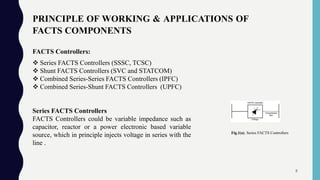
Series FACTS Controllers
FACTS Controllers could be variable impedance such as
capacitor, reactor or a power electronic based variable
source, which in principle injects voltage in series with the
line .
Fig.1(a). Series FACTS Controllers
8
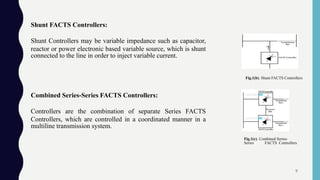
Shunt FACTS Controllers:
Shunt Controllers may be variable impedance such as capacitor,
reactor or power electronic based variable source, which is shunt
connected to the line in order to inject variable current.
Fig.1(b). Shunt FACTS Controllers
Combined Series-Series FACTS Controllers:
Controllers are the combination of separate Series FACTS
Controllers, which are controlled in a coordinated manner in a
multiline transmission system.
Fig.1(c). Combined Series-
Series FACTS Controllers
9
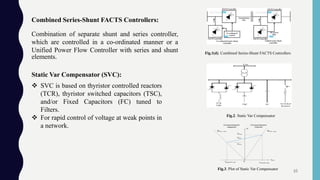
Combined Series-Shunt FACTS Controllers:
Fig.1(d). Combined Series-Shunt FACTS Controllers
Combination of separate shunt and series controller,
which are controlled in a co-ordinated manner or a
Unified Power Flow Controller with series and shunt
elements.
Static Var Compensator (SVC):
Fig.2. Static Var Compensator
 SVC is based on thyristor controlled reactors
(TCR), thyristor switched capacitors (TSC),
and/or Fixed Capacitors (FC) tuned to
Filters.
 For rapid control of voltage at weak points in
a network.
Fig.3. Plot of Static Var Compensator
10
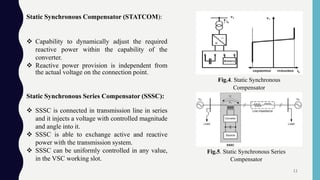
Static Synchronous Compensator (STATCOM):
 Capability to dynamically adjust the required
reactive power within the capability of the
converter.
 Reactive power provision is independent from
the actual voltage on the connection point.
Fig.4. Static Synchronous
Compensator
Static Synchronous Series Compensator (SSSC):
 SSSC is connected in transmission line in series
and it injects a voltage with controlled magnitude
and angle into it.
 SSSC is able to exchange active and reactive
power with the transmission system.
 SSSC can be uniformly controlled in any value,
in the VSC working slot.
Fig.5. Static Synchronous Series
Compensator
11
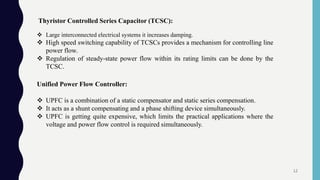
Thyristor Controlled Series Capacitor (TCSC):
 Large interconnected electrical systems it increases damping.
 High speed switching capability of TCSCs provides a mechanism for controlling line
power flow.
 Regulation of steady-state power flow within its rating limits can be done by the
TCSC.
Unified Power Flow Controller:
 UPFC is a combination of a static compensator and static series compensation.
 It acts as a shunt compensating and a phase shifting device simultaneously.
 UPFC is getting quite expensive, which limits the practical applications where the
voltage and power flow control is required simultaneously.
12
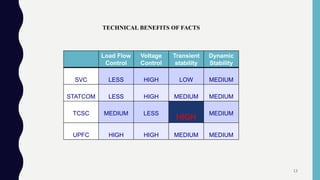
Load Flow
Control
Voltage
Control
Transient
stability
Dynamic
Stability
SVC LESS HIGH LOW MEDIUM
STATCOM LESS HIGH MEDIUM MEDIUM
TCSC MEDIUM LESS
HIGH
MEDIUM
UPFC HIGH HIGH MEDIUM MEDIUM
TECHNICAL BENEFITS OF FACTS
13
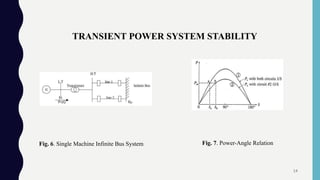
Fig. 6. Single Machine Infinite Bus System
TRANSIENT POWER SYSTEM STABILITY
Fig. 7. Power-Angle Relation
14
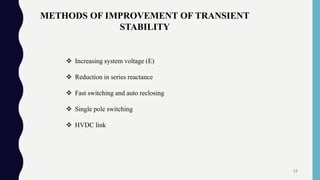
METHODS OF IMPROVEMENT OF TRANSIENT
STABILITY
 Increasing system voltage (E)
 Reduction in series reactance
 Fast switching and auto reclosing
 Single pole switching
 HVDC link
15
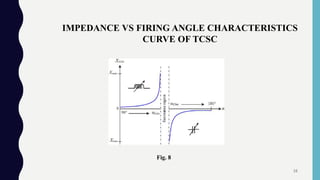
IMPEDANCE VS FIRING ANGLE CHARACTERISTICS
CURVE OF TCSC
Fig. 8
16
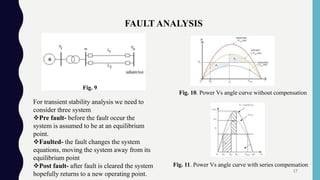
FAULT ANALYSIS
Fig. 10. Power Vs angle curve without compensation
Fig. 11. Power Vs angle curve with series compensation
For transient stability analysis we need to
consider three system
Pre fault- before the fault occur the
system is assumed to be at an equilibrium
point.
Faulted- the fault changes the system
equations, moving the system away from its
equilibrium point
Post fault- after fault is cleared the system
hopefully returns to a new operating point.
Fig. 9
17
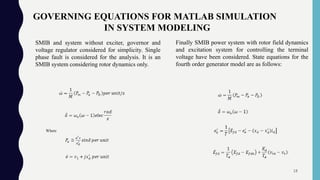
GOVERNING EQUATIONS FOR MATLAB SIMULATION
IN SYSTEM MODELING
Where
Finally SMIB power system with rotor field dynamics
and excitation system for controlling the terminal
voltage have been considered. State equations for the
fourth order generator model are as follows:
SMIB and system without exciter, governor and
voltage regulator considered for simplicity. Single
phase fault is considered for the analysis. It is an
SMIB system considering rotor dynamics only.
18
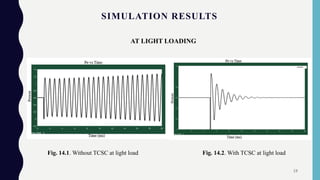
SIMULATION RESULTS
AT LIGHT LOADING
Fig. 14.1. Without TCSC at light load Fig. 14.2. With TCSC at light load
19
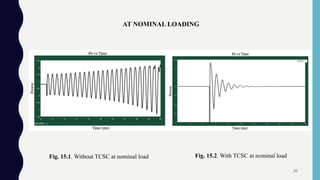
AT NOMINAL LOADING
Fig. 15.1. Without TCSC at nominal load Fig. 15.2. With TCSC at nominal load
20
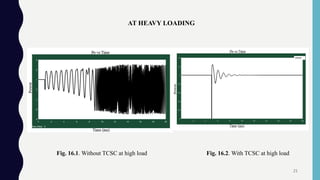
AT HEAVY LOADING
Fig. 16.1. Without TCSC at high load Fig. 16.2. With TCSC at high load
21
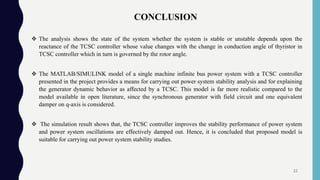
CONCLUSION
 The analysis shows the state of the system whether the system is stable or unstable depends upon the
reactance of the TCSC controller whose value changes with the change in conduction angle of thyristor in
TCSC controller which in turn is governed by the rotor angle.
 The MATLAB/SIMULINK model of a single machine infinite bus power system with a TCSC controller
presented in the project provides a means for carrying out power system stability analysis and for explaining
the generator dynamic behavior as affected by a TCSC. This model is far more realistic compared to the
model available in open literature, since the synchronous generator with field circuit and one equivalent
damper on q-axis is considered.
 The simulation result shows that, the TCSC controller improves the stability performance of power system
and power system oscillations are effectively damped out. Hence, it is concluded that proposed model is
suitable for carrying out power system stability studies.
22
SCOPE FOR FUTURE WORK
The present controller is suitable only in capacitive mode. The SMIB system studied does not
include exciter , governor and voltage regulator. if compensation level is changed or if the
system fault is different type then TCSC controller designed need to be changed accordingly.
23
REFERENCES
[1] Tanwani, N. K., Memon, A. P., Adil, W. A., & Ansari, J. A. Simulation Techniques of
Electrical Power System Stability Studies Utilizing Matlab/Simulink. engineer, 9, 18.
[2] Yarlagadda, Venu, BV Sankar Ram, and K. R. M. Rao. "Automatic Control of Thyristor
Controlled Series Capacitor (TCSC)." margin 2.3 (2012): 444-449.
[3] Narne, Rajendraprasad, P. C. Panda, and Jose P. Therattil. "Transient stability
enhancement of SMIB system using PSS and TCSC-based controllers." Power Electronics
and Drive Systems (PEDS), 2011 IEEE Ninth International Conference on. IEEE, 2011.
[4] Narain G.Hingorani, Laszlo Gyugyi, 2000, “Concepts and Technology of Flexible AC
Transmission Systems”, Understanding FACTS:IEEE Inc., New York, USA, 0-78033455-8.
[5] R. Mohan Mathur, R.K Verma, “Thyristor Based FACTS Controllers for Electrical
Transmission System “, Wiley & Sons, Inc. Publication, 2002.
[6] Kothari, Dwarkadas Pralhaddas, and I. J. Nagrath. Modern power system analysis. Tata
McGraw-Hill Education, 2003.
24
25

TCSC

  • 1.
    Enhancement of Powersystem stability using Thyristor Controlled Series Capacitor (TCSC) ANAS ALI USMANI MOHAMMAD FAIZAN KHAN MOHAMMAD WAQAR YOUNUS 1 Dept. of Electrical Engineering Aligarh muslim University
  • 2.
     Introduction  Reviewof stability  Improvement of power system stability  Factors limiting loading capability of transmission line  Principle of working and application of FACTS  Transient power system stability  Fault analysis  Governing equations and MATLAB simulation results  Conclusion  Scope for future work  References CONTENTS 2
  • 3.
    Introduction  FACTS technologyis used to control the flow of power by using existing power system network most effectively.  FACTS controllers can also improve stability of a system by helping critically disturbed generators during fault.  TCSC concept is that, capacitor is inserted directly in series with the transmission line and the thyristor controlled inductor is mounted directly in parallel with the capacitor.  No interfacing equipment like high voltage transformer is required.  Thyristor controlled series capacitor is a series FACTS device.  It is a more effective and provides suitable solutions due to flexible control of thyristor. 3
  • 4.
    Review of Stability Power system stability is defined as ability to respond to a disturbance from its normal operation by returning to a condition where the operation is again normal.  Three stability condition Steady state, Transient and Dynamic stability  Steady State Stability Maximum power which can flow past a point in the system without causing loss of stability  Transient Stability After large sudden disturbance, it can regain and maintain synchronism.  Dynamic Stability It maintains synchronism after primary swing (transient stability period) till it normalizes to a new steady state equilibrium condition. 4
  • 5.
    Factors Limiting LoadingCapability Of Transmission Line Three kind of limitations---Thermal, Dielectric, Stability  Thermal  It is a function of ambient temperature, wind conditions, condition of conductor and the ground clearance.  To reach the thermal , the system meets the following constraints: • Transmission stability limit. Limit of power transmission with which a transmission system can ride through major fault in the system. • Voltage limit Limit of power transmission where the system voltage can be kept within permitted deviation from nominal. 5
  • 6.
    • Loop flows Canbe a problem as the laws of nature govern them, which may not be coincident with the interest of man.  Dielectric For a given nominal voltage rating, it is often possible to increase normal operation by +10% voltage or even higher. The facts technology could be ensure acceptable over-voltage and power flow conditions.  Improvement of Power Stability Using high speed circuit breakers, high speed excitation systems, using series capacitors and braking resistors. 6
  • 7.
    FACTS-Technology  Flexible ACTransmission System (FACTS) is a new integrated concept based on power electronic.  Switching converters and dynamic controllers to enhance the system utilization.  Power transfer capacity as well as the stability, security, reliability and power.  Quality of AC system interconnections. Applications  Power Flow Control  Series Compensation  Voltage Regulation of Long Transmission System  Voltage Stability Enhancement FACTS-Technology and Applications 7
  • 8.
    PRINCIPLE OF WORKING& APPLICATIONS OF FACTS COMPONENTS FACTS Controllers:  Series FACTS Controllers (SSSC, TCSC)  Shunt FACTS Controllers (SVC and STATCOM)  Combined Series-Series FACTS Controllers (IPFC)  Combined Series-Shunt FACTS Controllers (UPFC) Series FACTS Controllers FACTS Controllers could be variable impedance such as capacitor, reactor or a power electronic based variable source, which in principle injects voltage in series with the line . Fig.1(a). Series FACTS Controllers 8
  • 9.
    Shunt FACTS Controllers: ShuntControllers may be variable impedance such as capacitor, reactor or power electronic based variable source, which is shunt connected to the line in order to inject variable current. Fig.1(b). Shunt FACTS Controllers Combined Series-Series FACTS Controllers: Controllers are the combination of separate Series FACTS Controllers, which are controlled in a coordinated manner in a multiline transmission system. Fig.1(c). Combined Series- Series FACTS Controllers 9
  • 10.
    Combined Series-Shunt FACTSControllers: Fig.1(d). Combined Series-Shunt FACTS Controllers Combination of separate shunt and series controller, which are controlled in a co-ordinated manner or a Unified Power Flow Controller with series and shunt elements. Static Var Compensator (SVC): Fig.2. Static Var Compensator  SVC is based on thyristor controlled reactors (TCR), thyristor switched capacitors (TSC), and/or Fixed Capacitors (FC) tuned to Filters.  For rapid control of voltage at weak points in a network. Fig.3. Plot of Static Var Compensator 10
  • 11.
    Static Synchronous Compensator(STATCOM):  Capability to dynamically adjust the required reactive power within the capability of the converter.  Reactive power provision is independent from the actual voltage on the connection point. Fig.4. Static Synchronous Compensator Static Synchronous Series Compensator (SSSC):  SSSC is connected in transmission line in series and it injects a voltage with controlled magnitude and angle into it.  SSSC is able to exchange active and reactive power with the transmission system.  SSSC can be uniformly controlled in any value, in the VSC working slot. Fig.5. Static Synchronous Series Compensator 11
  • 12.
    Thyristor Controlled SeriesCapacitor (TCSC):  Large interconnected electrical systems it increases damping.  High speed switching capability of TCSCs provides a mechanism for controlling line power flow.  Regulation of steady-state power flow within its rating limits can be done by the TCSC. Unified Power Flow Controller:  UPFC is a combination of a static compensator and static series compensation.  It acts as a shunt compensating and a phase shifting device simultaneously.  UPFC is getting quite expensive, which limits the practical applications where the voltage and power flow control is required simultaneously. 12
  • 13.
    Load Flow Control Voltage Control Transient stability Dynamic Stability SVC LESSHIGH LOW MEDIUM STATCOM LESS HIGH MEDIUM MEDIUM TCSC MEDIUM LESS HIGH MEDIUM UPFC HIGH HIGH MEDIUM MEDIUM TECHNICAL BENEFITS OF FACTS 13
  • 14.
    Fig. 6. SingleMachine Infinite Bus System TRANSIENT POWER SYSTEM STABILITY Fig. 7. Power-Angle Relation 14
  • 15.
    METHODS OF IMPROVEMENTOF TRANSIENT STABILITY  Increasing system voltage (E)  Reduction in series reactance  Fast switching and auto reclosing  Single pole switching  HVDC link 15
  • 16.
    IMPEDANCE VS FIRINGANGLE CHARACTERISTICS CURVE OF TCSC Fig. 8 16
  • 17.
    FAULT ANALYSIS Fig. 10.Power Vs angle curve without compensation Fig. 11. Power Vs angle curve with series compensation For transient stability analysis we need to consider three system Pre fault- before the fault occur the system is assumed to be at an equilibrium point. Faulted- the fault changes the system equations, moving the system away from its equilibrium point Post fault- after fault is cleared the system hopefully returns to a new operating point. Fig. 9 17
  • 18.
    GOVERNING EQUATIONS FORMATLAB SIMULATION IN SYSTEM MODELING Where Finally SMIB power system with rotor field dynamics and excitation system for controlling the terminal voltage have been considered. State equations for the fourth order generator model are as follows: SMIB and system without exciter, governor and voltage regulator considered for simplicity. Single phase fault is considered for the analysis. It is an SMIB system considering rotor dynamics only. 18
  • 19.
    SIMULATION RESULTS AT LIGHTLOADING Fig. 14.1. Without TCSC at light load Fig. 14.2. With TCSC at light load 19
  • 20.
    AT NOMINAL LOADING Fig.15.1. Without TCSC at nominal load Fig. 15.2. With TCSC at nominal load 20
  • 21.
    AT HEAVY LOADING Fig.16.1. Without TCSC at high load Fig. 16.2. With TCSC at high load 21
  • 22.
    CONCLUSION  The analysisshows the state of the system whether the system is stable or unstable depends upon the reactance of the TCSC controller whose value changes with the change in conduction angle of thyristor in TCSC controller which in turn is governed by the rotor angle.  The MATLAB/SIMULINK model of a single machine infinite bus power system with a TCSC controller presented in the project provides a means for carrying out power system stability analysis and for explaining the generator dynamic behavior as affected by a TCSC. This model is far more realistic compared to the model available in open literature, since the synchronous generator with field circuit and one equivalent damper on q-axis is considered.  The simulation result shows that, the TCSC controller improves the stability performance of power system and power system oscillations are effectively damped out. Hence, it is concluded that proposed model is suitable for carrying out power system stability studies. 22
  • 23.
    SCOPE FOR FUTUREWORK The present controller is suitable only in capacitive mode. The SMIB system studied does not include exciter , governor and voltage regulator. if compensation level is changed or if the system fault is different type then TCSC controller designed need to be changed accordingly. 23
  • 24.
    REFERENCES [1] Tanwani, N.K., Memon, A. P., Adil, W. A., & Ansari, J. A. Simulation Techniques of Electrical Power System Stability Studies Utilizing Matlab/Simulink. engineer, 9, 18. [2] Yarlagadda, Venu, BV Sankar Ram, and K. R. M. Rao. "Automatic Control of Thyristor Controlled Series Capacitor (TCSC)." margin 2.3 (2012): 444-449. [3] Narne, Rajendraprasad, P. C. Panda, and Jose P. Therattil. "Transient stability enhancement of SMIB system using PSS and TCSC-based controllers." Power Electronics and Drive Systems (PEDS), 2011 IEEE Ninth International Conference on. IEEE, 2011. [4] Narain G.Hingorani, Laszlo Gyugyi, 2000, “Concepts and Technology of Flexible AC Transmission Systems”, Understanding FACTS:IEEE Inc., New York, USA, 0-78033455-8. [5] R. Mohan Mathur, R.K Verma, “Thyristor Based FACTS Controllers for Electrical Transmission System “, Wiley & Sons, Inc. Publication, 2002. [6] Kothari, Dwarkadas Pralhaddas, and I. J. Nagrath. Modern power system analysis. Tata McGraw-Hill Education, 2003. 24
  • 25.