POWER SYSTEM SECURITY

Viren B. Pandya
OUTLINE
 System security and reliability
 Illustrative example
 Classification of power system states and
actions to be taken
POWER SYSTEM SECURITY
 Power system security is the ability of the

system to provide electricity with the appropriate
quality under normal and disturbance conditions
 In

security

applications,

we

refer

to

the

disturbances of interest as contingencies
 In

power

system

operations,

security

assessment analyzes the vulnerability of the
system to a set of postulated contingencies on a
real-time or near-real-time basis
POWER SYSTEM SECURITY
Reliability of a power system refers to the probability
of its satisfactory operation over the long run. It
denotes the ability to supply adequate electric service
on a nearly continuous basis, with few interruptions
over an extended time period.
- IEEE Paper on Terms & Definitions, 2004
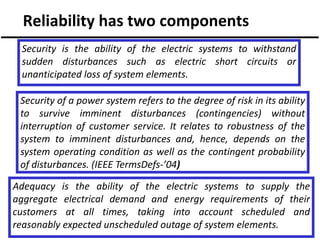
Reliability has two components
Security is the ability of the electric systems to withstand
sudden disturbances such as electric short circuits or
unanticipated loss of system elements.
Security of a power system refers to the degree of risk in its ability
to survive imminent disturbances (contingencies) without
interruption of customer service. It relates to robustness of the
system to imminent disturbances and, hence, depends on the
system operating condition as well as the contingent probability
of disturbances. (IEEE TermsDefs-’04)
Adequacy is the ability of the electric systems to supply the
aggregate electrical demand and energy requirements of their
customers at all times, taking into account scheduled and
reasonably expected unscheduled outage of system elements.
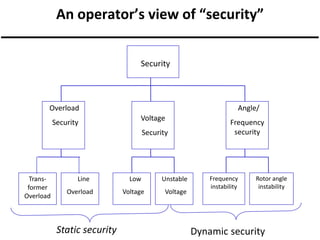
An operator’s view of “security”
Security

Overload
Security

Angle/
Voltage
Security

Transformer
Overload

Line
Overload

Static security

Low

Unstable

Voltage

Voltage

Frequency
security

Frequency
instability

Rotor angle
instability

Dynamic security
POWER SYSTEM SECURITY
 Power system security is broken into three major

functions being done at control centre:
 System monitoring
 Contingency analysis
 Security constrained optimal power flow
 System monitoring is done by SCADA and state

estimator at central computer
 Contingency analysis gives results for different
known outages to operate system defensively
POWER SYSTEM SECURITY
 Several contingencies can be solved by power

flow programs and real time data and state
estimations
 Security constrained OPF: Here contingency
analysis is combined with OPF which seeks to
make changes optimal dispatches of generation

so that when security analysis is run, no
contingency results in violations.
POWER SYSTEM SECURITY
 Operating states of power system:

 Optimal dispatch: prior to contingency, OPF is
run but system may not be secure
 Post contingency: after contingency, security
violation i.e. line or Xmer beyond its flow limit
or bus voltage outside limit

 Secure dispatch: no contingency outages, but
corrections to operating parameters to
account for security violations
POWER SYSTEM SECURITY
Conti….

 Secure post contingency: state of system when
contingency is applied to base operating
condition with correction
Example
Line max loadability is 400 MW
250 MW

250 MW
700 MW

500 MW

Unit 1

1200 MW
Optimal Dispatch

Unit 2
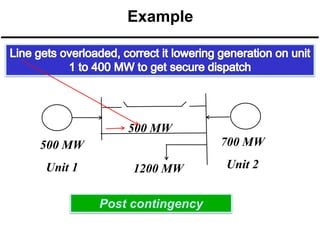
Example

500 MW
700 MW

500 MW

Unit 1

1200 MW
Post contingency

Unit 2
Example

200 MW

200 MW
800 MW

400 MW

Unit 1

1200 MW
Secure dispatch

Unit 2
Example

400 MW
800 MW

400 MW

Unit 1

1200 MW

Unit 2

Secure post contingency state
Example
 Thus by adjusting generation on unit 1 and 2
we have prevented post contingency operating
state from getting overloaded. This is called
security correction.
 The

programs

which

can

make

control

adjustments to the base or pre-contingency
operation to prevent violations in the postcontingency conditions are called “ Security
Constrained Optimal Power Flows or SCOPF”
Example
 These programs can take account of many
contingencies and calculate adjustments to
generator

MW,

generator

transformer taps, interchange etc.

voltages,
Security-related decisions
Time-frame

Decision maker

Decision

Basis for decision

On-line

Operator

How to constrain the

Operating rules,

assessment

economic operation to

on-line assessment,

(min-hours)

maintain the normal state ?

and Rs

Operational

Analyst

Planning
(months-years)

Analyst

Minimum operating

operating rules ?

planning
(hrs-months)

What should be the

criteria, reliability,
and Rs

How to reinforce/maintain

Reliability criteria

the transmission system ?

for system design,

and Rs

17
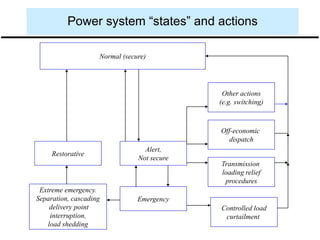
Power system “states” and actions
Normal (secure)

Other actions
(e.g. switching)

Off-economic
dispatch
Restorative

Extreme emergency.
Separation, cascading
delivery point
interruption,
load shedding

Alert,
Not secure

Transmission
loading relief
procedures

Emergency
Controlled load
curtailment
Definition of states and control actions
(1) Real and Reactive power balance at each node (Equality
Constraints
(2) Limitations of physical equipment, such as currents and
voltages must not exceed maximum limits(Inequality
Constraints)
Normal (Secure) State: Here all equality (E) and inequality
constraints (I) are satisfied. In this state, generation is adequate
to supply the existing load demand and no equipment is
overloaded. Also in this state, reserve margins (for transmission
as well as generation) are sufficient to provide an adequate
level of security with respect to the stresses to which the system
may be subjected. The latter maybe treated as the satisfaction
of security constraints.
Definition of states and control actions
Alert (Insecure) State: The difference between this and the
previous state is that in this state, the security level is below
some threshold of adequacy. This implies that there is a
danger of violating some of the inequality (I) constraints when
subjected to disturbances (stresses). It can also be said that
security constraints are not met. Preventive control enables
the transition from an alert state to a secure state.
Emergency state: Due to a severe disturbance, the system
can enter emergency state. Here (I) constraints are violated.
The system, would still be intact, and emergency control
action (heroic measures) could be initiated to restore the
system to an alert state. If these measures are not taken in
time or are ineffective, and if the initiating disturbance or a
subsequent one is severe enough to overstress the system,
the system will breakdown and reach "In Extremis" state.
Definition of states and control actions
In Extremis State: Here, both (E) and (I) constraints are
violated. The violation of equality constraints implies that
parts of the system load are lost. Emergency control action
should be directed at avoiding total collapse.
Restorative State: This is a transitional state in which (I)
constraints are met from emergency control actions taken
but the (E) constraints are yet to be satisfied. From this
state, the system can transmit to either the alert or the
normal state depending on the circumstances.
STEADY-STATE SECURITY CONTROL
OBJECTIVE
 To prevent the system state from transitioning
from normal secure to emergency
 For an insecure normal state, two possible
responses are
 modification of the pre-contingency state to

eliminate the potential overload, in case the
contingency actually occurs
 a dispatch strategy to manage the emergency
once it occurs

Security analysis black and white 2007

  • 1.
  • 2.
    OUTLINE  System securityand reliability  Illustrative example  Classification of power system states and actions to be taken
  • 3.
    POWER SYSTEM SECURITY Power system security is the ability of the system to provide electricity with the appropriate quality under normal and disturbance conditions  In security applications, we refer to the disturbances of interest as contingencies  In power system operations, security assessment analyzes the vulnerability of the system to a set of postulated contingencies on a real-time or near-real-time basis
  • 4.
    POWER SYSTEM SECURITY Reliabilityof a power system refers to the probability of its satisfactory operation over the long run. It denotes the ability to supply adequate electric service on a nearly continuous basis, with few interruptions over an extended time period. - IEEE Paper on Terms & Definitions, 2004
  • 5.
    Reliability has twocomponents Security is the ability of the electric systems to withstand sudden disturbances such as electric short circuits or unanticipated loss of system elements. Security of a power system refers to the degree of risk in its ability to survive imminent disturbances (contingencies) without interruption of customer service. It relates to robustness of the system to imminent disturbances and, hence, depends on the system operating condition as well as the contingent probability of disturbances. (IEEE TermsDefs-’04) Adequacy is the ability of the electric systems to supply the aggregate electrical demand and energy requirements of their customers at all times, taking into account scheduled and reasonably expected unscheduled outage of system elements.
  • 6.
    An operator’s viewof “security” Security Overload Security Angle/ Voltage Security Transformer Overload Line Overload Static security Low Unstable Voltage Voltage Frequency security Frequency instability Rotor angle instability Dynamic security
  • 7.
    POWER SYSTEM SECURITY Power system security is broken into three major functions being done at control centre:  System monitoring  Contingency analysis  Security constrained optimal power flow  System monitoring is done by SCADA and state estimator at central computer  Contingency analysis gives results for different known outages to operate system defensively
  • 8.
    POWER SYSTEM SECURITY Several contingencies can be solved by power flow programs and real time data and state estimations  Security constrained OPF: Here contingency analysis is combined with OPF which seeks to make changes optimal dispatches of generation so that when security analysis is run, no contingency results in violations.
  • 9.
    POWER SYSTEM SECURITY Operating states of power system:  Optimal dispatch: prior to contingency, OPF is run but system may not be secure  Post contingency: after contingency, security violation i.e. line or Xmer beyond its flow limit or bus voltage outside limit  Secure dispatch: no contingency outages, but corrections to operating parameters to account for security violations
  • 10.
    POWER SYSTEM SECURITY Conti…. Secure post contingency: state of system when contingency is applied to base operating condition with correction
  • 11.
    Example Line max loadabilityis 400 MW 250 MW 250 MW 700 MW 500 MW Unit 1 1200 MW Optimal Dispatch Unit 2
  • 12.
    Example 500 MW 700 MW 500MW Unit 1 1200 MW Post contingency Unit 2
  • 13.
    Example 200 MW 200 MW 800MW 400 MW Unit 1 1200 MW Secure dispatch Unit 2
  • 14.
    Example 400 MW 800 MW 400MW Unit 1 1200 MW Unit 2 Secure post contingency state
  • 15.
    Example  Thus byadjusting generation on unit 1 and 2 we have prevented post contingency operating state from getting overloaded. This is called security correction.  The programs which can make control adjustments to the base or pre-contingency operation to prevent violations in the postcontingency conditions are called “ Security Constrained Optimal Power Flows or SCOPF”
  • 16.
    Example  These programscan take account of many contingencies and calculate adjustments to generator MW, generator transformer taps, interchange etc. voltages,
  • 17.
    Security-related decisions Time-frame Decision maker Decision Basisfor decision On-line Operator How to constrain the Operating rules, assessment economic operation to on-line assessment, (min-hours) maintain the normal state ? and Rs Operational Analyst Planning (months-years) Analyst Minimum operating operating rules ? planning (hrs-months) What should be the criteria, reliability, and Rs How to reinforce/maintain Reliability criteria the transmission system ? for system design, and Rs 17
  • 18.
    Power system “states”and actions Normal (secure) Other actions (e.g. switching) Off-economic dispatch Restorative Extreme emergency. Separation, cascading delivery point interruption, load shedding Alert, Not secure Transmission loading relief procedures Emergency Controlled load curtailment
  • 20.
    Definition of statesand control actions (1) Real and Reactive power balance at each node (Equality Constraints (2) Limitations of physical equipment, such as currents and voltages must not exceed maximum limits(Inequality Constraints) Normal (Secure) State: Here all equality (E) and inequality constraints (I) are satisfied. In this state, generation is adequate to supply the existing load demand and no equipment is overloaded. Also in this state, reserve margins (for transmission as well as generation) are sufficient to provide an adequate level of security with respect to the stresses to which the system may be subjected. The latter maybe treated as the satisfaction of security constraints.
  • 21.
    Definition of statesand control actions Alert (Insecure) State: The difference between this and the previous state is that in this state, the security level is below some threshold of adequacy. This implies that there is a danger of violating some of the inequality (I) constraints when subjected to disturbances (stresses). It can also be said that security constraints are not met. Preventive control enables the transition from an alert state to a secure state. Emergency state: Due to a severe disturbance, the system can enter emergency state. Here (I) constraints are violated. The system, would still be intact, and emergency control action (heroic measures) could be initiated to restore the system to an alert state. If these measures are not taken in time or are ineffective, and if the initiating disturbance or a subsequent one is severe enough to overstress the system, the system will breakdown and reach "In Extremis" state.
  • 22.
    Definition of statesand control actions In Extremis State: Here, both (E) and (I) constraints are violated. The violation of equality constraints implies that parts of the system load are lost. Emergency control action should be directed at avoiding total collapse. Restorative State: This is a transitional state in which (I) constraints are met from emergency control actions taken but the (E) constraints are yet to be satisfied. From this state, the system can transmit to either the alert or the normal state depending on the circumstances.
  • 23.
    STEADY-STATE SECURITY CONTROL OBJECTIVE To prevent the system state from transitioning from normal secure to emergency  For an insecure normal state, two possible responses are  modification of the pre-contingency state to eliminate the potential overload, in case the contingency actually occurs  a dispatch strategy to manage the emergency once it occurs