AURORA’S RESEARCH AND
TECHNOLOGICAL INSTITUTE

Presented By
 A.Yateesh Kumar Yadav
What is an electromagnetic
bomb………………..?????
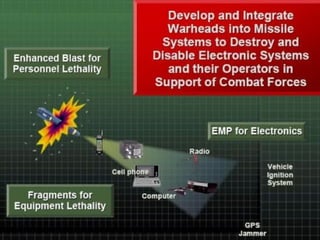
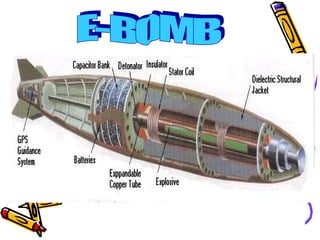
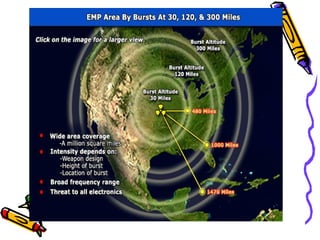
An electromagnetic bomb or E-bomb is a weapon
designed to disable electronics with an
electromagnetic pulse (EMP) that can couple with
electrical/electronic systems to produce damaging
current.
The Technology Base for Conventional
Electromagnetic Bombs
 The technology base which may be applied to the design of
electromagnetic bombs.
 Key technologies which are extant in the area are ,
* Explosively pumped FCG
* Explosive or propellant driven MHD generators
* Range of HPM devices
Explosively Pumped Flux
Compression Generators
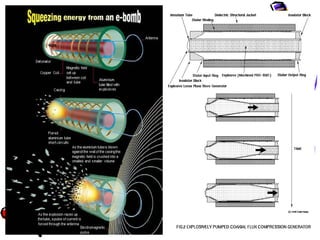
 The explosively pumped FCG is the most mature technology applicable to bomb designs.
 The FCG was first demonstrated by Clarence Fowler at Los Alamos National Laboratories
(LANL) in the late fifties.

 The current produced by a large FCG is between ten to a thousand times greater than that
produced by a typical lightning stroke .

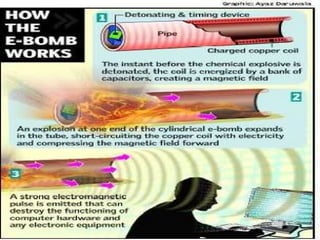
 The central idea behind the construction of FCGs is that of using a fast explosive to rapidly
compress a magnetic field

The most commonly used arrangement is that of the coaxial FCG.
 In assessing how power is coupled into targets.

 Two principal coupling modes are recognised in the literature:
* Front Door Coupling
* Back Door Coupling
 Equipment connected to exposed cables or wiring can damage power supplies
and communications interfaces if these are not hardened.
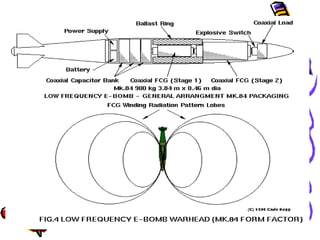
LOW FREQUENCY E-BOMB
WARHEAD
A low frequency weapon will couple well into a typical
wiring infrastructure.
The relative orientation of the weapons field to be
oriented in a such way that a good coupling efficiency can
be achieved.
Targeting
Electromagnetic Bombs
 The

task of identifying targets for attack with E-bombs can be
complex.

 All targets which can be readily identified through conventional
photographic, satellite, imaging radar.

 Mobile and relocatable air defence equipment are all good
examples of this category of target.
Defence Against Electromagnetic Bombs
The most effective defence against electromagnetic
bombs is to prevent their delivery by destroying the
launch platform or delivery vehicle.

 The systems which can be expected to suffer exposure
to the electromagnetic weapons effects must be
electromagnetically hardened.
Limitations of Electromagnetic Bombs
 The limitations of electromagnetic weapons are determined by ,
* Weapon implementation
* Means of delivery

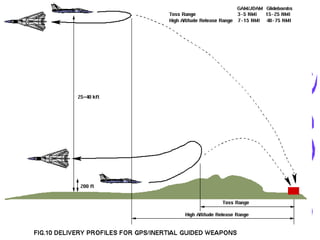
 Accuracy of delivery and achievable range must be considered against the
allowable damage for the chosen target.

 An inaccurately delivered weapon of large range may be unusable against a
target .
Battlefield Air Interdiction
Operations
using Electromagnetic Bombs

 A carefully planned schemed warfare methods are typical for contemporary
land warfare.

 Coordination and control are essential to the successful conduct of planned
scheme operations.

 Communications and command sites are key elements in the structure of such
a land army, and these concentrate communications and computer equipment.

 They should be attacked with electromagnetic weapons, to disrupt the
command and control of land operations.
If you want to see some of the
effects of a E-bomb, put your laptop
in your microwave oven (at your own
risks).
 Electromagnetic bombs are Weapons of Electrical Mass Destruction with applications
across a broad spectrum of targets, spanning both the strategic and tactical.
 E-bombs can cause hard electrical kills over larger areas than conventional explosive
weapons of similar mass.
 E-bombs can be an affordable for military forces which are under post Cold War
pressures to reduce force sizes, increasing their combat potential.
E bomb
E bomb

E bomb

  • 1.
    AURORA’S RESEARCH AND TECHNOLOGICALINSTITUTE Presented By  A.Yateesh Kumar Yadav
  • 2.
    What is anelectromagnetic bomb………………..????? An electromagnetic bomb or E-bomb is a weapon designed to disable electronics with an electromagnetic pulse (EMP) that can couple with electrical/electronic systems to produce damaging current.
  • 4.
    The Technology Basefor Conventional Electromagnetic Bombs  The technology base which may be applied to the design of electromagnetic bombs.  Key technologies which are extant in the area are , * Explosively pumped FCG * Explosive or propellant driven MHD generators * Range of HPM devices
  • 5.
    Explosively Pumped Flux CompressionGenerators  The explosively pumped FCG is the most mature technology applicable to bomb designs.  The FCG was first demonstrated by Clarence Fowler at Los Alamos National Laboratories (LANL) in the late fifties.  The current produced by a large FCG is between ten to a thousand times greater than that produced by a typical lightning stroke .  The central idea behind the construction of FCGs is that of using a fast explosive to rapidly compress a magnetic field The most commonly used arrangement is that of the coaxial FCG.
  • 7.
     In assessinghow power is coupled into targets.  Two principal coupling modes are recognised in the literature: * Front Door Coupling * Back Door Coupling  Equipment connected to exposed cables or wiring can damage power supplies and communications interfaces if these are not hardened.
  • 8.
    LOW FREQUENCY E-BOMB WARHEAD Alow frequency weapon will couple well into a typical wiring infrastructure. The relative orientation of the weapons field to be oriented in a such way that a good coupling efficiency can be achieved.
  • 12.
    Targeting Electromagnetic Bombs  The taskof identifying targets for attack with E-bombs can be complex.  All targets which can be readily identified through conventional photographic, satellite, imaging radar.  Mobile and relocatable air defence equipment are all good examples of this category of target.
  • 15.
    Defence Against ElectromagneticBombs The most effective defence against electromagnetic bombs is to prevent their delivery by destroying the launch platform or delivery vehicle.  The systems which can be expected to suffer exposure to the electromagnetic weapons effects must be electromagnetically hardened.
  • 16.
    Limitations of ElectromagneticBombs  The limitations of electromagnetic weapons are determined by , * Weapon implementation * Means of delivery  Accuracy of delivery and achievable range must be considered against the allowable damage for the chosen target.  An inaccurately delivered weapon of large range may be unusable against a target .
  • 17.
    Battlefield Air Interdiction Operations usingElectromagnetic Bombs  A carefully planned schemed warfare methods are typical for contemporary land warfare.  Coordination and control are essential to the successful conduct of planned scheme operations.  Communications and command sites are key elements in the structure of such a land army, and these concentrate communications and computer equipment.  They should be attacked with electromagnetic weapons, to disrupt the command and control of land operations.
  • 18.
    If you wantto see some of the effects of a E-bomb, put your laptop in your microwave oven (at your own risks).
  • 19.
     Electromagnetic bombsare Weapons of Electrical Mass Destruction with applications across a broad spectrum of targets, spanning both the strategic and tactical.  E-bombs can cause hard electrical kills over larger areas than conventional explosive weapons of similar mass.  E-bombs can be an affordable for military forces which are under post Cold War pressures to reduce force sizes, increasing their combat potential.