Guided by: Presented by:
Mr. Sumeet Sehrawat Komal Wadhwa
Dept. of EEE M.Tech Power Systems(Weekend)
ASET, NOIDA A2327313001
CONTROLLING FREQUENCY DEVIATIONS IN
INTERCONNECTED POWER SYSTEM USING SMART
TECHNIQUES
OBJECTIVE
1) Study of load frequency control in interconnected power system.
2) Study of conventional and advanced controllers using Matlab
Simulation.
3) Comparative study of different controllers.
4) Result comparison.
WHY FREQUNCY CONTROL IS REQUIRED?
 The speed of the alternating current motors depends on the frequency of the
power supply. There are situations where speed consistency is expected to be of
high order.
 The accuracy of the electric clocks are dependent on the frequency of the supply.
 If the normal frequency is 50 Hertz and the system frequency falls below 47.5
Hertz or goes up above 52.5 Hertz then the blades of the turbine are likely to get
damaged so as to prevent the stalling of the generator .
 Due to the subnormal frequency operation the blast of the ID and FD fans in the
power stations get reduced and thereby reduce the generation power in the
thermal plants.
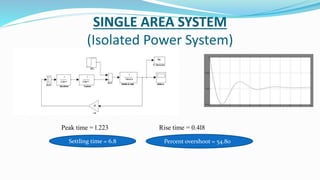
SINGLE AREA SYSTEM
(Isolated Power System)
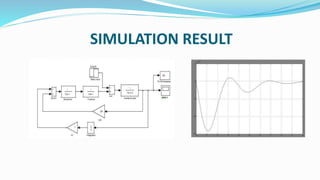
Peak time = l.223 Rise time = 0.4l8
Settling time = 6.8 Percent overshoot = 54.80
SINGLE AREA SYSTEM
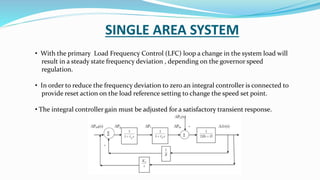
• With the primary Load Frequency Control (LFC) loop a change in the system load will
result in a steady state frequency deviation , depending on the governor speed
regulation.
• In order to reduce the frequency deviation to zero an integral controller is connected to
provide reset action on the load reference setting to change the speed set point.
• The integral controller gain must be adjusted for a satisfactory transient response.
SIMULATION RESULT
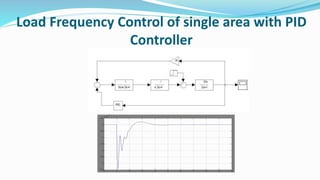
Load Frequency Control of single area with PID
Controller
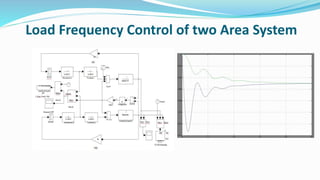
Load Frequency Control of two Area System
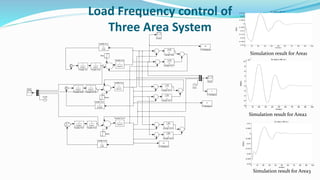
Load Frequency control of
Three Area System
1
0.4s+1
Transfer Fcn9
1
0.08
Transfer Fcn8
1
0.25s+1
Transfer Fcn7
1.918
s
Transfer Fcn6
1
0.3s+1
Transfer Fcn5
1
8s+0.9
Transfer Fcn4
1
10s+0.6
Transfer Fcn3
1
0.5s+1
Transfer Fcn2
1.918
s
Transfer Fcn17
1.861
s
Transfer Fcn16
1.861
s
Transfer Fcn15
1.720
s
Transfer Fcn14
1.720
s
Transfer Fcn13
1
0.6s+1
Transfer Fcn12
1
0.0625
Transfer Fcn11
1
12s+0.8
Transfer Fcn10
1
0.05
Transfer Fcn1
1
0.2s+1
Transfer Fcn
z3
To Workspace3
z2
To Workspace2
z1
To Workspace1
z
To Workspace
Step2
Step1
Step
Scope2
Scope1
Scope
Clock1
Clock
0 10 20 30 40 50 60 70 80 90 100
-0.03
-0.025
-0.02
-0.015
-0.01
-0.005
0
0.005
0.01
0.015
for area 1 df1 vs t
time(s)
df1(hz)
0 10 20 30 40 50 60 70 80 90 100
-8
-6
-4
-2
0
2
4
6
8
10
x 10
-3
for area 2 df2 vs t
time(s)
df2(hz)
0 10 20 30 40 50 60 70 80 90 100
-0.03
-0.025
-0.02
-0.015
-0.01
-0.005
0
0.005
0.01
for area 3 df3 vs t
time(s)
df3(hz)
Simulation result for Area2
Simulation result for Area1
Simulation result for Area3
Control Techniques used:
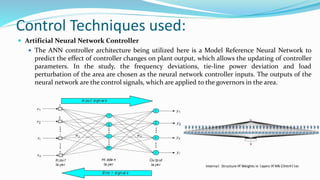
 Artificial Neural Network Controller
 The ANN controller architecture being utilized here is a Model Reference Neural Network to
predict the effect of controller changes on plant output, which allows the updating of controller
parameters. In the study, the frequency deviations, tie-line power deviation and load
perturbation of the area are chosen as the neural network controller inputs. The outputs of the
neural network are the control signals, which are applied to the governors in the area.
Interna1 Structure 0f Weights in 1ayers 0f NN C0ntr011er.
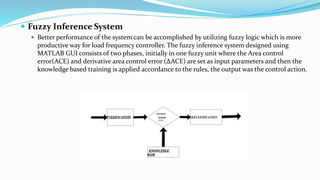
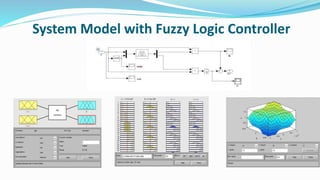
 Fuzzy Inference System
 Better performance of the system can be accomplished by utilizing fuzzy logic which is more
productive way for load frequency controller. The fuzzy inference system designed using
MATLAB GUI consists of two phases, initially in one fuzzy unit where the Area control
error(ACE) and derivative area control error (ΔACE) are set as input parameters and then the
knowledge based training is applied accordance to the rules, the output was the control action.
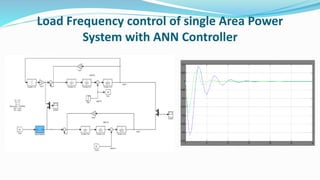
Load Frequency control of single Area Power
System with ANN Controller
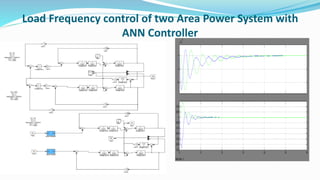
Load Frequency control of two Area Power System with
ANN Controller
System Model with Fuzzy Logic Controller
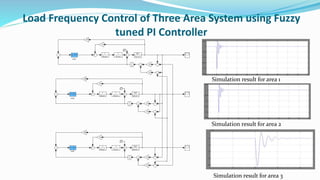
Load Frequency Control of Three Area System using Fuzzy
tuned PI Controller
FGPI
FGPI
FGPI
1
Tt3.s+1
1
Ts3.s+1
Kp2
Tp2.s+1
1
Tt2.s+1
1
Ts2.s+1
Kp1
Tp1.s+1
Kp3
Tp3.s+1
1
Tt1.s+1
1
Ts1.s+1
IN OUT
IN OUT
IN OUT
1
s
1
s
1
s
-K-
-K-
B2
-K-
-K-
-K-
B1
-K-
B3
-K-
-K-
-K-
Simulation result for area 1
Simulation result for area 3
Simulation result for area 2
CONCLUSION AND FUTURE SCOPE
Conclusion:
The research provides a practical means for balancing frequency oscillations in an
interconnected power system through an HVDC link. By appropriate usage of the system
integrations as regulatory medium, a new application of HVDC link to stabilize frequency
oscillations in AC power systems was developed. The proposed controller is highly efficient in
restraining the frequency oscillations and can also be integrated with the traditional governors
productively. The work described in this explained the modeling of three area power system
using FLC containing three thermal power generators. Different types of controller were used
to improve the transients that occurs in the system due to frequency variations .The simulation
results using FLC gives the better result as compared to other controller in an efficient manner.
.
Future scope:
For further study, the proposed control design of HVDC link can be extended to stabilization
of frequency oscillations in a multi-area interconnected power system with any configuration,
in integration with different intelligent techniques including longitudinal and radial loops.
REFERENCES
[l] D.P Kothari ;I J Nagrath , Modern Power System Analysis
[2] P Kundur, Power System Stability and Control
[3] D. Das,Automatic Generation Control In Restructured Scenario, Electrical Power
System
[4] Prof. S.N Singh, Video :lecture , Power system operation and control
[4] Load frequency control of a realistic power system with multi-source power generation K.P. Singh Parmar ,
S. Majhi , D.P. Kothari
[5] R N Deo; S P Jaiswal; M. Venkentasvalru Naik :Fuzzy logic based automatic load
frequency control of multi area system .
[6] M. Suman, M. Venu Gopala Rao, G. R. S. Naga Kumar and O. Chandra Sekhar, "Load frequency control of
three unit interconnected multimachine power system with PI and fuzzy controllers," Advances in Electrical
Engineering (ICAEE), 2ol4 International Conference on, Vellore, 2ol4
[7] N. E. Y. Kouba, M. Menaa, M. Hasni and M. Boudour, "Load Frequency Control in multi-area power
system based on Fuzzy Logic-PID Controller," Smart Energy Grid Engineering (SEGE), 2ol5 IEEE
International Conference on, Oshawa, ON, 2ol5.
[8] V. S. Sundaram and T. Jayabarathi, "Load Frequency Control using PID tuned ANN controller in power
system," Electrical Energy Systems (ICEES), 2oll lst International Conference on, Newport Beach, CA, 2oll.
Continue…
[9] R. Umrao, S. Kumar, M. Mohan and D. K. Chaturvedi, "Load Frequency Control methodologies for power
system," Power, Control and Embedded Systems (ICPCES), 2ol2 2nd International Conference on, Allahabad, 2ol2.
[lo] A. Safaei, H. M. Roodsari and H. A. Abyaneh, "Optimal load frequency control of an island small hydropower
plant," Thermal Power Plants (CTPP), 2oll Proceedings of the 3rd Conference on, Tehran, 2oll.
[ll]Fuzzy Logic Toolbox :Fuzzy Reference http://in.mathworks.com/products/fuzzy-logic/features.html#working-
with-the-fuzzy-logic-toolbox
[l2] Thesis: Implementation Of Fuzzy Logic Controller For Load Frequency Control In Two Area Power System ,Nit
Rourkela
[l3] K.S.S Ramakrishna , P Sharma ,T.S Bhatti: Automatic generation control of interconnected power system with
diverse Sources of power generation
[l4] S. K. Jain, A. Bhargava and R. K. Pal, "Three area power system load frequency control using fuzzy logic
controller," Computer, Communication and Control (IC4), 2ol5 International Conference on, Indore, 2ol5
CONTROLLING FREQUENCY DEVIATIONS IN INTERCONNECTED POWER SYSTEM USING SMART TECHNIQUES

CONTROLLING FREQUENCY DEVIATIONS IN INTERCONNECTED POWER SYSTEM USING SMART TECHNIQUES

  • 1.
    Guided by: Presentedby: Mr. Sumeet Sehrawat Komal Wadhwa Dept. of EEE M.Tech Power Systems(Weekend) ASET, NOIDA A2327313001 CONTROLLING FREQUENCY DEVIATIONS IN INTERCONNECTED POWER SYSTEM USING SMART TECHNIQUES
  • 2.
    OBJECTIVE 1) Study ofload frequency control in interconnected power system. 2) Study of conventional and advanced controllers using Matlab Simulation. 3) Comparative study of different controllers. 4) Result comparison.
  • 3.
    WHY FREQUNCY CONTROLIS REQUIRED?  The speed of the alternating current motors depends on the frequency of the power supply. There are situations where speed consistency is expected to be of high order.  The accuracy of the electric clocks are dependent on the frequency of the supply.  If the normal frequency is 50 Hertz and the system frequency falls below 47.5 Hertz or goes up above 52.5 Hertz then the blades of the turbine are likely to get damaged so as to prevent the stalling of the generator .  Due to the subnormal frequency operation the blast of the ID and FD fans in the power stations get reduced and thereby reduce the generation power in the thermal plants.
  • 4.
    SINGLE AREA SYSTEM (IsolatedPower System) Peak time = l.223 Rise time = 0.4l8 Settling time = 6.8 Percent overshoot = 54.80
  • 5.
    SINGLE AREA SYSTEM •With the primary Load Frequency Control (LFC) loop a change in the system load will result in a steady state frequency deviation , depending on the governor speed regulation. • In order to reduce the frequency deviation to zero an integral controller is connected to provide reset action on the load reference setting to change the speed set point. • The integral controller gain must be adjusted for a satisfactory transient response.
  • 6.
  • 7.
    Load Frequency Controlof single area with PID Controller
  • 8.
    Load Frequency Controlof two Area System
  • 9.
    Load Frequency controlof Three Area System 1 0.4s+1 Transfer Fcn9 1 0.08 Transfer Fcn8 1 0.25s+1 Transfer Fcn7 1.918 s Transfer Fcn6 1 0.3s+1 Transfer Fcn5 1 8s+0.9 Transfer Fcn4 1 10s+0.6 Transfer Fcn3 1 0.5s+1 Transfer Fcn2 1.918 s Transfer Fcn17 1.861 s Transfer Fcn16 1.861 s Transfer Fcn15 1.720 s Transfer Fcn14 1.720 s Transfer Fcn13 1 0.6s+1 Transfer Fcn12 1 0.0625 Transfer Fcn11 1 12s+0.8 Transfer Fcn10 1 0.05 Transfer Fcn1 1 0.2s+1 Transfer Fcn z3 To Workspace3 z2 To Workspace2 z1 To Workspace1 z To Workspace Step2 Step1 Step Scope2 Scope1 Scope Clock1 Clock 0 10 20 30 40 50 60 70 80 90 100 -0.03 -0.025 -0.02 -0.015 -0.01 -0.005 0 0.005 0.01 0.015 for area 1 df1 vs t time(s) df1(hz) 0 10 20 30 40 50 60 70 80 90 100 -8 -6 -4 -2 0 2 4 6 8 10 x 10 -3 for area 2 df2 vs t time(s) df2(hz) 0 10 20 30 40 50 60 70 80 90 100 -0.03 -0.025 -0.02 -0.015 -0.01 -0.005 0 0.005 0.01 for area 3 df3 vs t time(s) df3(hz) Simulation result for Area2 Simulation result for Area1 Simulation result for Area3
  • 10.
    Control Techniques used: Artificial Neural Network Controller  The ANN controller architecture being utilized here is a Model Reference Neural Network to predict the effect of controller changes on plant output, which allows the updating of controller parameters. In the study, the frequency deviations, tie-line power deviation and load perturbation of the area are chosen as the neural network controller inputs. The outputs of the neural network are the control signals, which are applied to the governors in the area. Interna1 Structure 0f Weights in 1ayers 0f NN C0ntr011er.
  • 11.
     Fuzzy InferenceSystem  Better performance of the system can be accomplished by utilizing fuzzy logic which is more productive way for load frequency controller. The fuzzy inference system designed using MATLAB GUI consists of two phases, initially in one fuzzy unit where the Area control error(ACE) and derivative area control error (ΔACE) are set as input parameters and then the knowledge based training is applied accordance to the rules, the output was the control action.
  • 12.
    Load Frequency controlof single Area Power System with ANN Controller
  • 13.
    Load Frequency controlof two Area Power System with ANN Controller
  • 14.
    System Model withFuzzy Logic Controller
  • 15.
    Load Frequency Controlof Three Area System using Fuzzy tuned PI Controller FGPI FGPI FGPI 1 Tt3.s+1 1 Ts3.s+1 Kp2 Tp2.s+1 1 Tt2.s+1 1 Ts2.s+1 Kp1 Tp1.s+1 Kp3 Tp3.s+1 1 Tt1.s+1 1 Ts1.s+1 IN OUT IN OUT IN OUT 1 s 1 s 1 s -K- -K- B2 -K- -K- -K- B1 -K- B3 -K- -K- -K- Simulation result for area 1 Simulation result for area 3 Simulation result for area 2
  • 16.
    CONCLUSION AND FUTURESCOPE Conclusion: The research provides a practical means for balancing frequency oscillations in an interconnected power system through an HVDC link. By appropriate usage of the system integrations as regulatory medium, a new application of HVDC link to stabilize frequency oscillations in AC power systems was developed. The proposed controller is highly efficient in restraining the frequency oscillations and can also be integrated with the traditional governors productively. The work described in this explained the modeling of three area power system using FLC containing three thermal power generators. Different types of controller were used to improve the transients that occurs in the system due to frequency variations .The simulation results using FLC gives the better result as compared to other controller in an efficient manner. . Future scope: For further study, the proposed control design of HVDC link can be extended to stabilization of frequency oscillations in a multi-area interconnected power system with any configuration, in integration with different intelligent techniques including longitudinal and radial loops.
  • 17.
    REFERENCES [l] D.P Kothari;I J Nagrath , Modern Power System Analysis [2] P Kundur, Power System Stability and Control [3] D. Das,Automatic Generation Control In Restructured Scenario, Electrical Power System [4] Prof. S.N Singh, Video :lecture , Power system operation and control [4] Load frequency control of a realistic power system with multi-source power generation K.P. Singh Parmar , S. Majhi , D.P. Kothari [5] R N Deo; S P Jaiswal; M. Venkentasvalru Naik :Fuzzy logic based automatic load frequency control of multi area system . [6] M. Suman, M. Venu Gopala Rao, G. R. S. Naga Kumar and O. Chandra Sekhar, "Load frequency control of three unit interconnected multimachine power system with PI and fuzzy controllers," Advances in Electrical Engineering (ICAEE), 2ol4 International Conference on, Vellore, 2ol4 [7] N. E. Y. Kouba, M. Menaa, M. Hasni and M. Boudour, "Load Frequency Control in multi-area power system based on Fuzzy Logic-PID Controller," Smart Energy Grid Engineering (SEGE), 2ol5 IEEE International Conference on, Oshawa, ON, 2ol5. [8] V. S. Sundaram and T. Jayabarathi, "Load Frequency Control using PID tuned ANN controller in power system," Electrical Energy Systems (ICEES), 2oll lst International Conference on, Newport Beach, CA, 2oll.
  • 18.
    Continue… [9] R. Umrao,S. Kumar, M. Mohan and D. K. Chaturvedi, "Load Frequency Control methodologies for power system," Power, Control and Embedded Systems (ICPCES), 2ol2 2nd International Conference on, Allahabad, 2ol2. [lo] A. Safaei, H. M. Roodsari and H. A. Abyaneh, "Optimal load frequency control of an island small hydropower plant," Thermal Power Plants (CTPP), 2oll Proceedings of the 3rd Conference on, Tehran, 2oll. [ll]Fuzzy Logic Toolbox :Fuzzy Reference http://in.mathworks.com/products/fuzzy-logic/features.html#working- with-the-fuzzy-logic-toolbox [l2] Thesis: Implementation Of Fuzzy Logic Controller For Load Frequency Control In Two Area Power System ,Nit Rourkela [l3] K.S.S Ramakrishna , P Sharma ,T.S Bhatti: Automatic generation control of interconnected power system with diverse Sources of power generation [l4] S. K. Jain, A. Bhargava and R. K. Pal, "Three area power system load frequency control using fuzzy logic controller," Computer, Communication and Control (IC4), 2ol5 International Conference on, Indore, 2ol5