SHASHWAT SHEKHAR
WORK PORTFOLIO
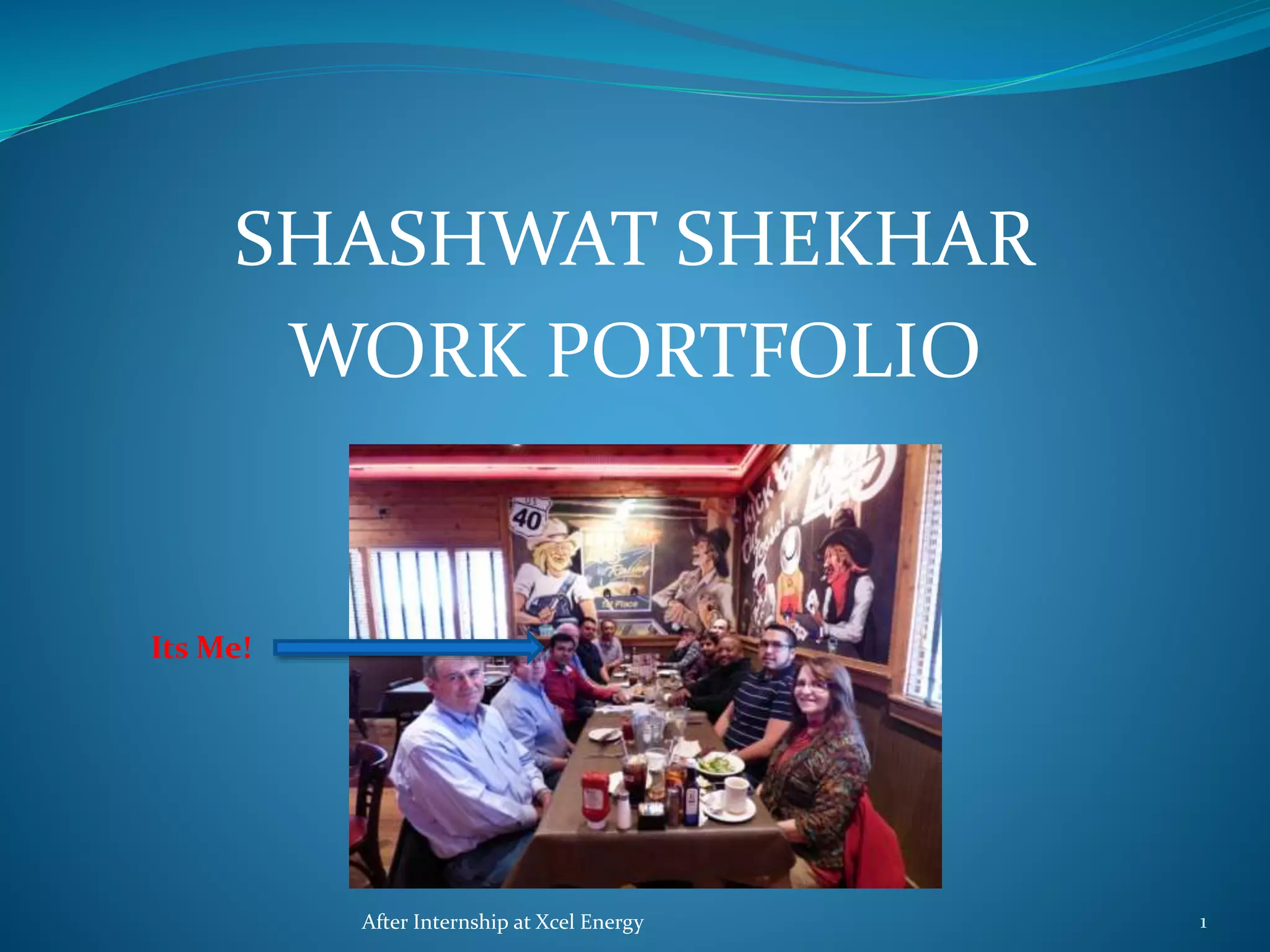
Its Me!
1After Internship at Xcel Energy
Work /Education Experience:
XCEL Energy, Amarillo, TX- Transmission Planning Engineering Intern (July
2015-January 2016)
JAYPEE Cements Corp, India- Engineering Intern (April 2012- September 2012)
Education:
1. University of Texas at Arlington, Arlington, TX December 2016 (Expected)
Master of Science in Electrical Engineering
2. Gandhi Institute of Technology and Management, India June 2009-May 2013
Bachelor of Technology in Electrical and Electronics Engineering
Courses Taken:
Power System Modeling and Analysis, Power System Protective Relaying, Power System Planning Operation
and Control in Competitive Electricity Markets, Power Electronics.
2
Internship Experience at XCEL Energy
 Assisted Transmission Planning Engineers with NERC TPL-001-4
Reliability Standard.
 P12- Single Contingency Normal System on a Transmission Circuit- 3-phase fault
 P22- Single Contingency Normal System Bus Section Fault- SLG fault
 P55- Multiple Contingency(Fault plus relay failure to operate)- Delayed fault clearing due
to the failure of a Non-redundant relay protecting the faulted element on a Bus Section.
 Performed Steady State N-1 contingency analysis to analyze the reliability
of the Southwestern Public Service (SPS) Transmission System for
NERC TPL-001-4 compliance.
 Prepared and verified power flow contingency (.con) and transient
stability PSAS (.psa) files related to NERC TPL-001-4 standard.
 Studied and analyzed switching maps to determine the bus configuration
of different substations and defined breaker contingencies for single-line-
to-ground faults or three-phase faults on the transmission system.
3
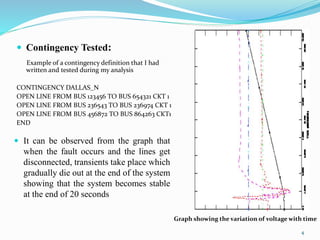
 Contingency Tested:
Example of a contingency definition that I had
written and tested during my analysis
CONTINGENCY DALLAS_N
OPEN LINE FROM BUS 123456 TO BUS 654321 CKT 1
OPEN LINE FROM BUS 236543 TO BUS 236974 CKT 1
OPEN LINE FROM BUS 456872 TO BUS 864263 CKT1
END
 It can be observed from the graph that
when the fault occurs and the lines get
disconnected, transients take place which
gradually die out at the end of the system
showing that the system becomes stable
at the end of 20 seconds
Graph showing the variation of voltage with time
4
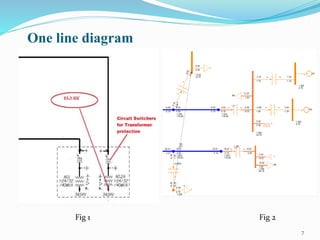
 Built one-line diagrams on CAPE to study and analyze breaker positions at
a substation, simulate faults, calculate fault impedance and accordingly use
this data to write the code for contingencies for faults occurring on the
transmission system for the .con and .psa files.
 Developed VBA code to generate PSSE Response files to facilitate the
dispatch of wind generation in seasonal planning models, using historical
wind data.
 Extensively studied the SCADA system and analyzed the line flows, the
working of generators, buses and the breakers installed.
 Extracted Generation data (MW, MVAR, KV, Station Power, Startup
Power) for wind farms and fossil fuel power plants from SCADA and used
this data in PSSE models to determine generation dispatch.
5
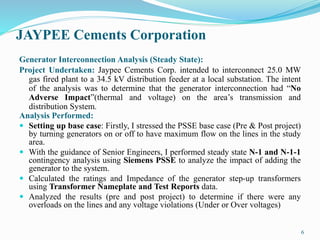
JAYPEE Cements Corporation
Generator Interconnection Analysis (Steady State):
Project Undertaken: Jaypee Cements Corp. intended to interconnect 25.0 MW
gas fired plant to a 34.5 kV distribution feeder at a local substation. The intent
of the analysis was to determine that the generator interconnection had “No
Adverse Impact”(thermal and voltage) on the area’s transmission and
distribution System.
Analysis Performed:
 Setting up base case: Firstly, I stressed the PSSE base case (Pre & Post project)
by turning generators on or off to have maximum flow on the lines in the study
area.
 With the guidance of Senior Engineers, I performed steady state N-1 and N-1-1
contingency analysis using Siemens PSSE to analyze the impact of adding the
generator to the system.
 Calculated the ratings and Impedance of the generator step-up transformers
using Transformer Nameplate and Test Reports data.
 Analyzed the results (pre and post project) to determine if there were any
overloads on the lines and any voltage violations (Under or Over voltages)
6
7
One line diagram
Fig 1 Fig 2
Academic Projects:
8
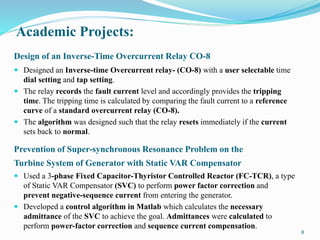
Design of an Inverse-Time Overcurrent Relay CO-8
 Designed an Inverse-time Overcurrent relay- (CO-8) with a user selectable time
dial setting and tap setting.
 The relay records the fault current level and accordingly provides the tripping
time. The tripping time is calculated by comparing the fault current to a reference
curve of a standard overcurrent relay (CO-8).
 The algorithm was designed such that the relay resets immediately if the current
sets back to normal.
Prevention of Super-synchronous Resonance Problem on the
Turbine System of Generator with Static VAR Compensator
 Used a 3-phase Fixed Capacitor-Thyristor Controlled Reactor (FC-TCR), a type
of Static VAR Compensator (SVC) to perform power factor correction and
prevent negative-sequence current from entering the generator.
 Developed a control algorithm in Matlab which calculates the necessary
admittance of the SVC to achieve the goal. Admittances were calculated to
perform power-factor correction and sequence current compensation.
Adaptive Energy Management Scheme in Real Time Energy
Harvesting Systems
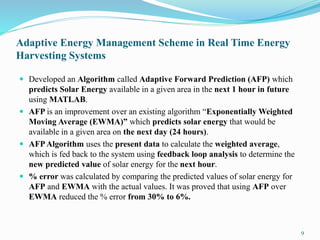
 Developed an Algorithm called Adaptive Forward Prediction (AFP) which
predicts Solar Energy available in a given area in the next 1 hour in future
using MATLAB.
 AFP is an improvement over an existing algorithm “Exponentially Weighted
Moving Average (EWMA)” which predicts solar energy that would be
available in a given area on the next day (24 hours).
 AFPAlgorithm uses the present data to calculate the weighted average,
which is fed back to the system using feedback loop analysis to determine the
new predicted value of solar energy for the next hour.
 % error was calculated by comparing the predicted values of solar energy for
AFP and EWMA with the actual values. It was proved that using AFP over
EWMA reduced the % error from 30% to 6%.
9
Areas of Interest
 Steady-state and Stability analysis of Power Systems
 Power Systems Protection
 Substation Engineering and Design
 Power System Operations
10
Thank You
Q&A?
11
Contact Details:
Shashwat Shekhar
E-Mail: shashwat.uta@gmail.com
shashwats_uta@yahoo.com
Phone: 617-949-9210

Work Portfolio

  • 1.
    SHASHWAT SHEKHAR WORK PORTFOLIO ItsMe! 1After Internship at Xcel Energy
  • 2.
    Work /Education Experience: XCELEnergy, Amarillo, TX- Transmission Planning Engineering Intern (July 2015-January 2016) JAYPEE Cements Corp, India- Engineering Intern (April 2012- September 2012) Education: 1. University of Texas at Arlington, Arlington, TX December 2016 (Expected) Master of Science in Electrical Engineering 2. Gandhi Institute of Technology and Management, India June 2009-May 2013 Bachelor of Technology in Electrical and Electronics Engineering Courses Taken: Power System Modeling and Analysis, Power System Protective Relaying, Power System Planning Operation and Control in Competitive Electricity Markets, Power Electronics. 2
  • 3.
    Internship Experience atXCEL Energy  Assisted Transmission Planning Engineers with NERC TPL-001-4 Reliability Standard.  P12- Single Contingency Normal System on a Transmission Circuit- 3-phase fault  P22- Single Contingency Normal System Bus Section Fault- SLG fault  P55- Multiple Contingency(Fault plus relay failure to operate)- Delayed fault clearing due to the failure of a Non-redundant relay protecting the faulted element on a Bus Section.  Performed Steady State N-1 contingency analysis to analyze the reliability of the Southwestern Public Service (SPS) Transmission System for NERC TPL-001-4 compliance.  Prepared and verified power flow contingency (.con) and transient stability PSAS (.psa) files related to NERC TPL-001-4 standard.  Studied and analyzed switching maps to determine the bus configuration of different substations and defined breaker contingencies for single-line- to-ground faults or three-phase faults on the transmission system. 3
  • 4.
     Contingency Tested: Exampleof a contingency definition that I had written and tested during my analysis CONTINGENCY DALLAS_N OPEN LINE FROM BUS 123456 TO BUS 654321 CKT 1 OPEN LINE FROM BUS 236543 TO BUS 236974 CKT 1 OPEN LINE FROM BUS 456872 TO BUS 864263 CKT1 END  It can be observed from the graph that when the fault occurs and the lines get disconnected, transients take place which gradually die out at the end of the system showing that the system becomes stable at the end of 20 seconds Graph showing the variation of voltage with time 4
  • 5.
     Built one-linediagrams on CAPE to study and analyze breaker positions at a substation, simulate faults, calculate fault impedance and accordingly use this data to write the code for contingencies for faults occurring on the transmission system for the .con and .psa files.  Developed VBA code to generate PSSE Response files to facilitate the dispatch of wind generation in seasonal planning models, using historical wind data.  Extensively studied the SCADA system and analyzed the line flows, the working of generators, buses and the breakers installed.  Extracted Generation data (MW, MVAR, KV, Station Power, Startup Power) for wind farms and fossil fuel power plants from SCADA and used this data in PSSE models to determine generation dispatch. 5
  • 6.
    JAYPEE Cements Corporation GeneratorInterconnection Analysis (Steady State): Project Undertaken: Jaypee Cements Corp. intended to interconnect 25.0 MW gas fired plant to a 34.5 kV distribution feeder at a local substation. The intent of the analysis was to determine that the generator interconnection had “No Adverse Impact”(thermal and voltage) on the area’s transmission and distribution System. Analysis Performed:  Setting up base case: Firstly, I stressed the PSSE base case (Pre & Post project) by turning generators on or off to have maximum flow on the lines in the study area.  With the guidance of Senior Engineers, I performed steady state N-1 and N-1-1 contingency analysis using Siemens PSSE to analyze the impact of adding the generator to the system.  Calculated the ratings and Impedance of the generator step-up transformers using Transformer Nameplate and Test Reports data.  Analyzed the results (pre and post project) to determine if there were any overloads on the lines and any voltage violations (Under or Over voltages) 6
  • 7.
  • 8.
    Academic Projects: 8 Design ofan Inverse-Time Overcurrent Relay CO-8  Designed an Inverse-time Overcurrent relay- (CO-8) with a user selectable time dial setting and tap setting.  The relay records the fault current level and accordingly provides the tripping time. The tripping time is calculated by comparing the fault current to a reference curve of a standard overcurrent relay (CO-8).  The algorithm was designed such that the relay resets immediately if the current sets back to normal. Prevention of Super-synchronous Resonance Problem on the Turbine System of Generator with Static VAR Compensator  Used a 3-phase Fixed Capacitor-Thyristor Controlled Reactor (FC-TCR), a type of Static VAR Compensator (SVC) to perform power factor correction and prevent negative-sequence current from entering the generator.  Developed a control algorithm in Matlab which calculates the necessary admittance of the SVC to achieve the goal. Admittances were calculated to perform power-factor correction and sequence current compensation.
  • 9.
    Adaptive Energy ManagementScheme in Real Time Energy Harvesting Systems  Developed an Algorithm called Adaptive Forward Prediction (AFP) which predicts Solar Energy available in a given area in the next 1 hour in future using MATLAB.  AFP is an improvement over an existing algorithm “Exponentially Weighted Moving Average (EWMA)” which predicts solar energy that would be available in a given area on the next day (24 hours).  AFPAlgorithm uses the present data to calculate the weighted average, which is fed back to the system using feedback loop analysis to determine the new predicted value of solar energy for the next hour.  % error was calculated by comparing the predicted values of solar energy for AFP and EWMA with the actual values. It was proved that using AFP over EWMA reduced the % error from 30% to 6%. 9
  • 10.
    Areas of Interest Steady-state and Stability analysis of Power Systems  Power Systems Protection  Substation Engineering and Design  Power System Operations 10
  • 11.
    Thank You Q&A? 11 Contact Details: ShashwatShekhar E-Mail: shashwat.uta@gmail.com shashwats_uta@yahoo.com Phone: 617-949-9210