UPQC a novel method to
efficiently utilize Sustainable /
Alternate Energy Sources
AJAL.A.J

Assistant Professor –Dept of ECE,
UNIVERSAL ENGINEERING COLLEGE
MAIL: ec2reach@gmail.com Mob: 8907305642

PSERC
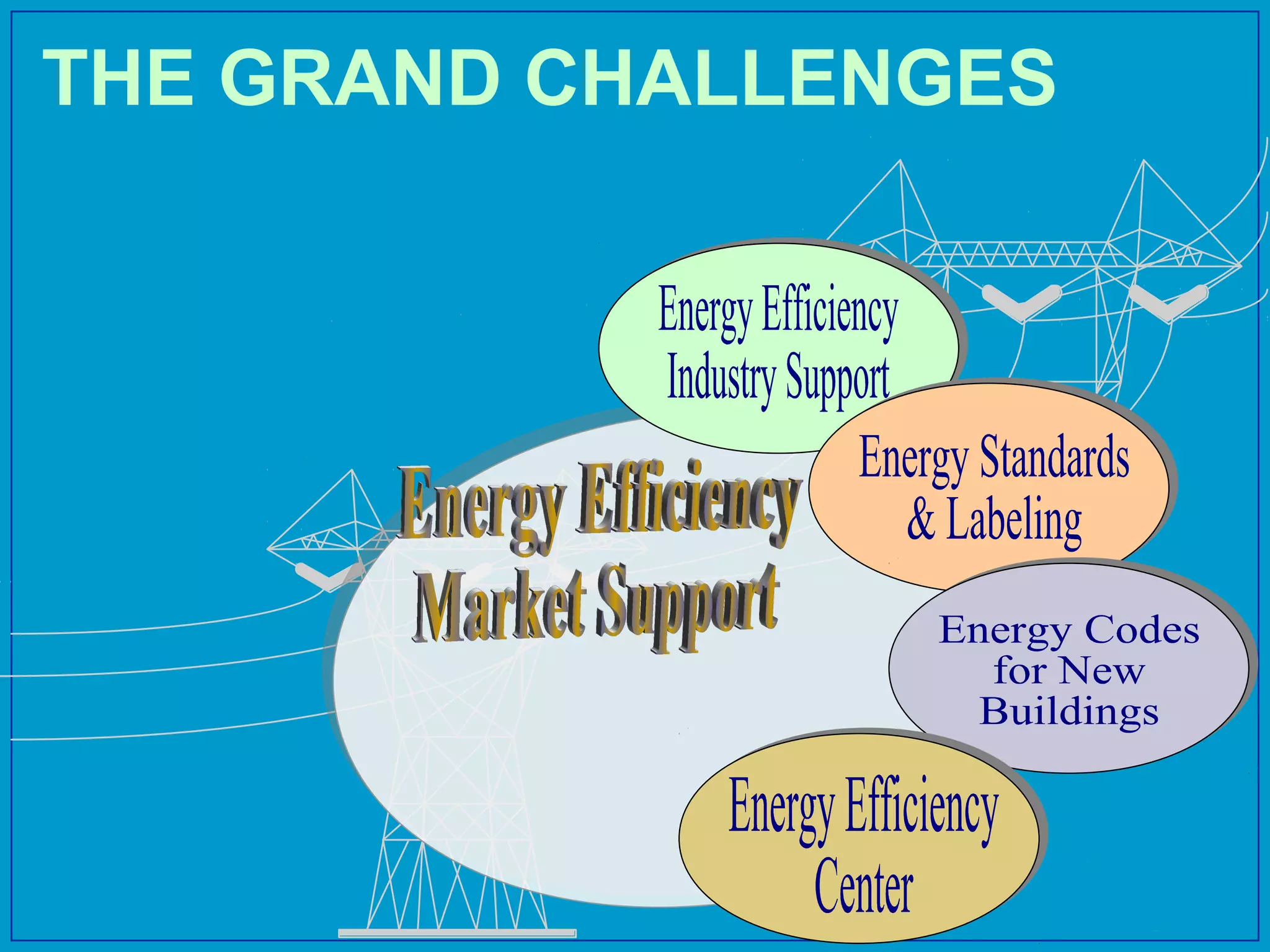
THE GRAND CHALLENGES

PSERC
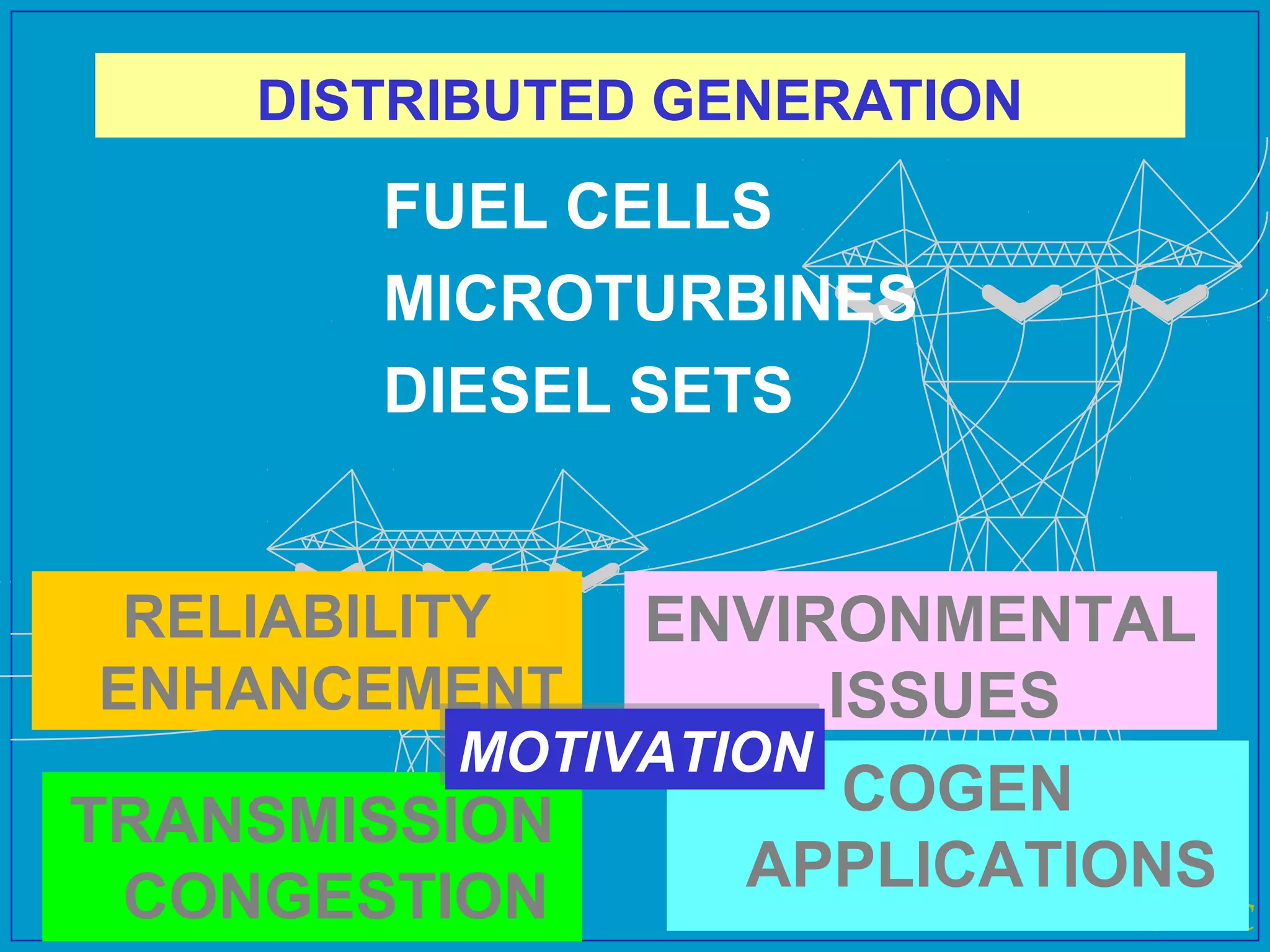
DISTRIBUTED GENERATION

FUEL CELLS
MICROTURBINES
DIESEL SETS
RELIABILITY
ENHANCEMENT

ENVIRONMENTAL
ISSUES
MOTIVATION
COGEN
TRANSMISSION
APPLICATIONS
CONGESTION

PSERC
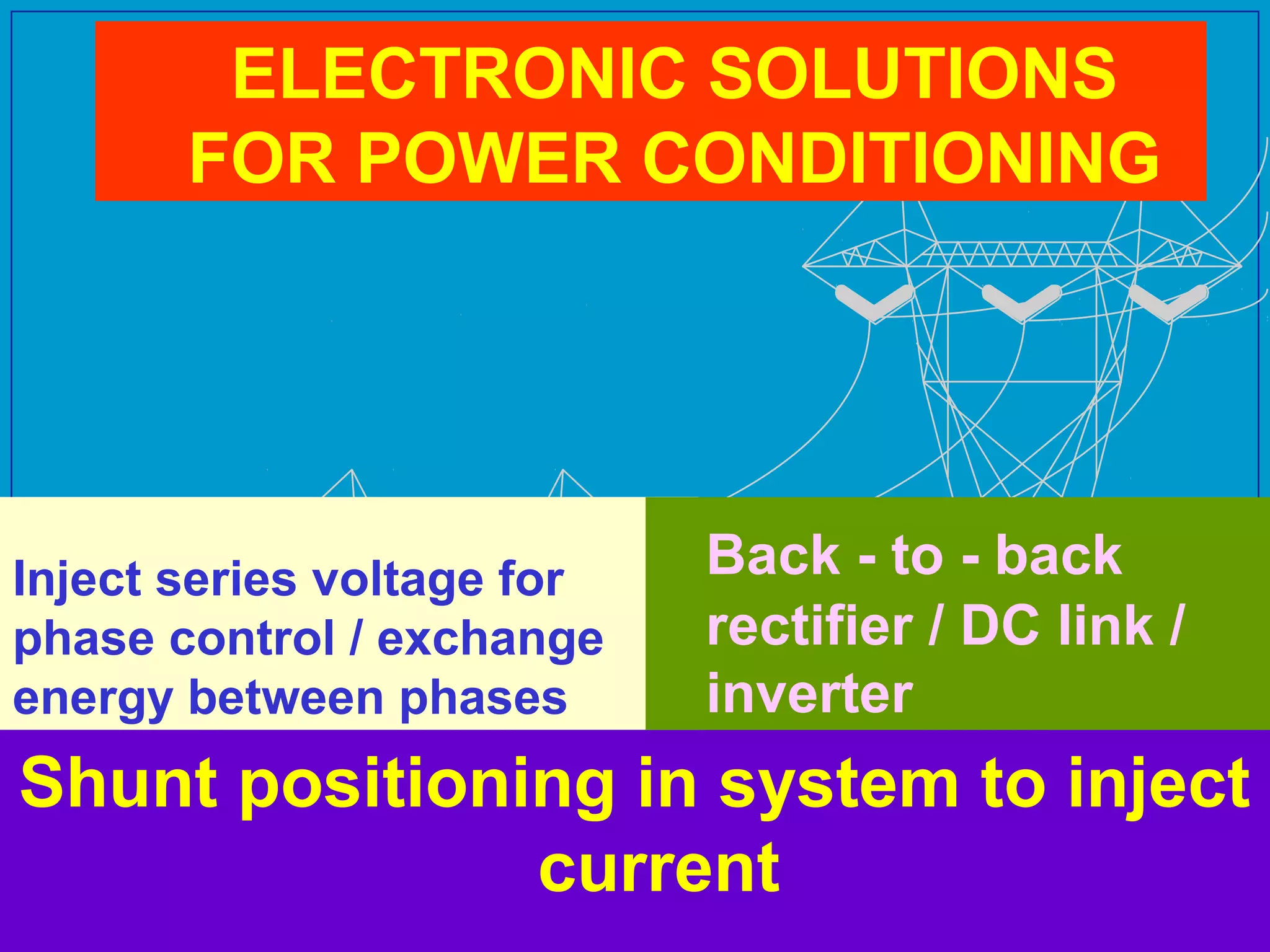
ELECTRONIC SOLUTIONS
FOR POWER CONDITIONING

Inject series voltage for
phase control / exchange
energy between phases

Back - to - back
rectifier / DC link /
inverter

Shunt positioning in system to inject
current

PSERC
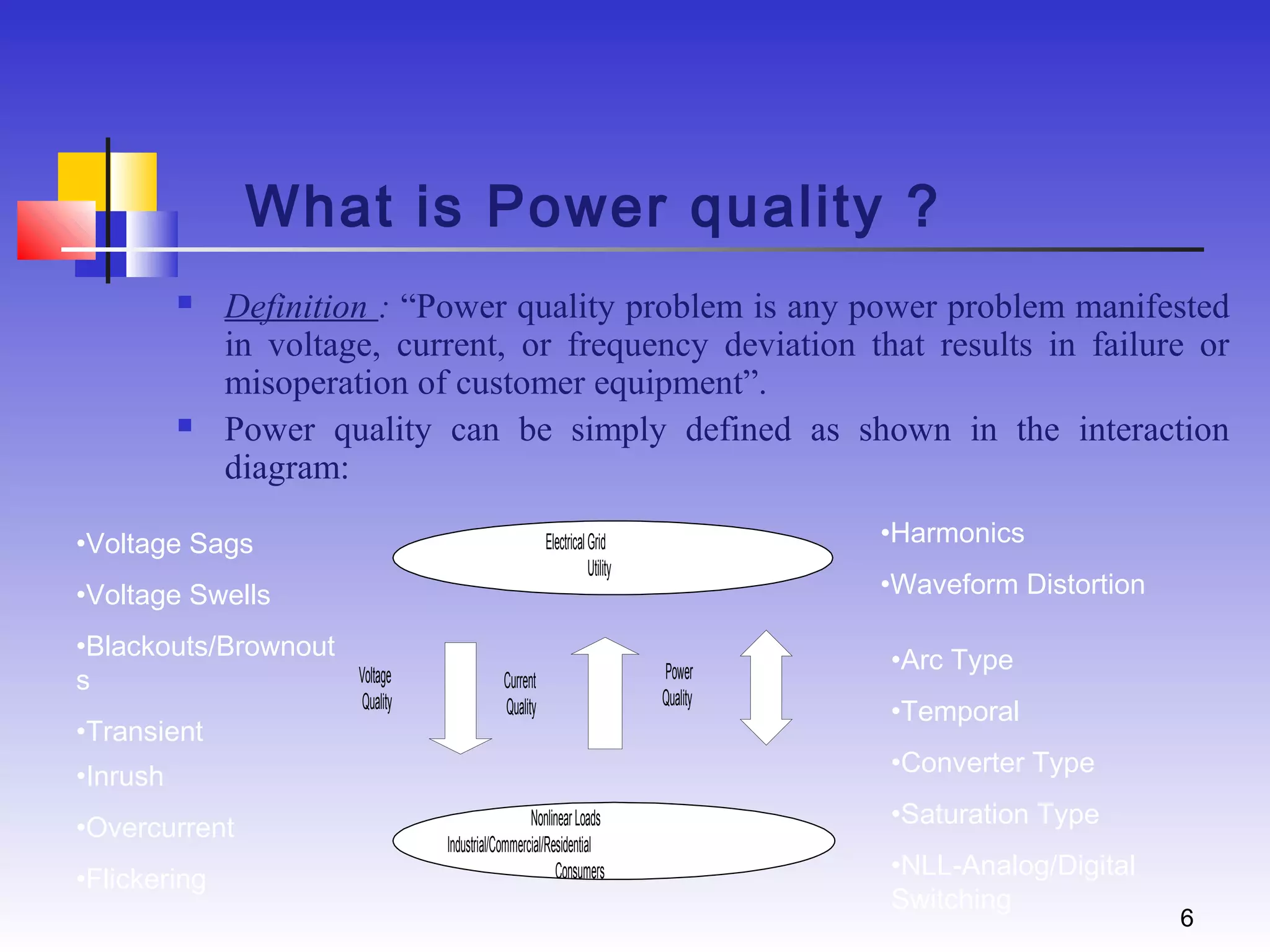
What is Power quality ?




Definition : “Power quality problem is any power problem manifested
in voltage, current, or frequency deviation that results in failure or
misoperation of customer equipment”.
Power quality can be simply defined as shown in the interaction
diagram:

•Voltage Sags
•Voltage Swells
•Blackouts/Brownout
s
•Transient

Voltage
Quality

Current
Quality

•Flickering

•Waveform Distortion
Power
Quality

•Arc Type
•Temporal
•Converter Type

•Inrush
•Overcurrent

•Harmonics

Electrical Grid
Utility

Nonlinear Loads
Industrial/Commercial/Residential
Consumers

•Saturation Type
•NLL-Analog/Digital
Switching

6
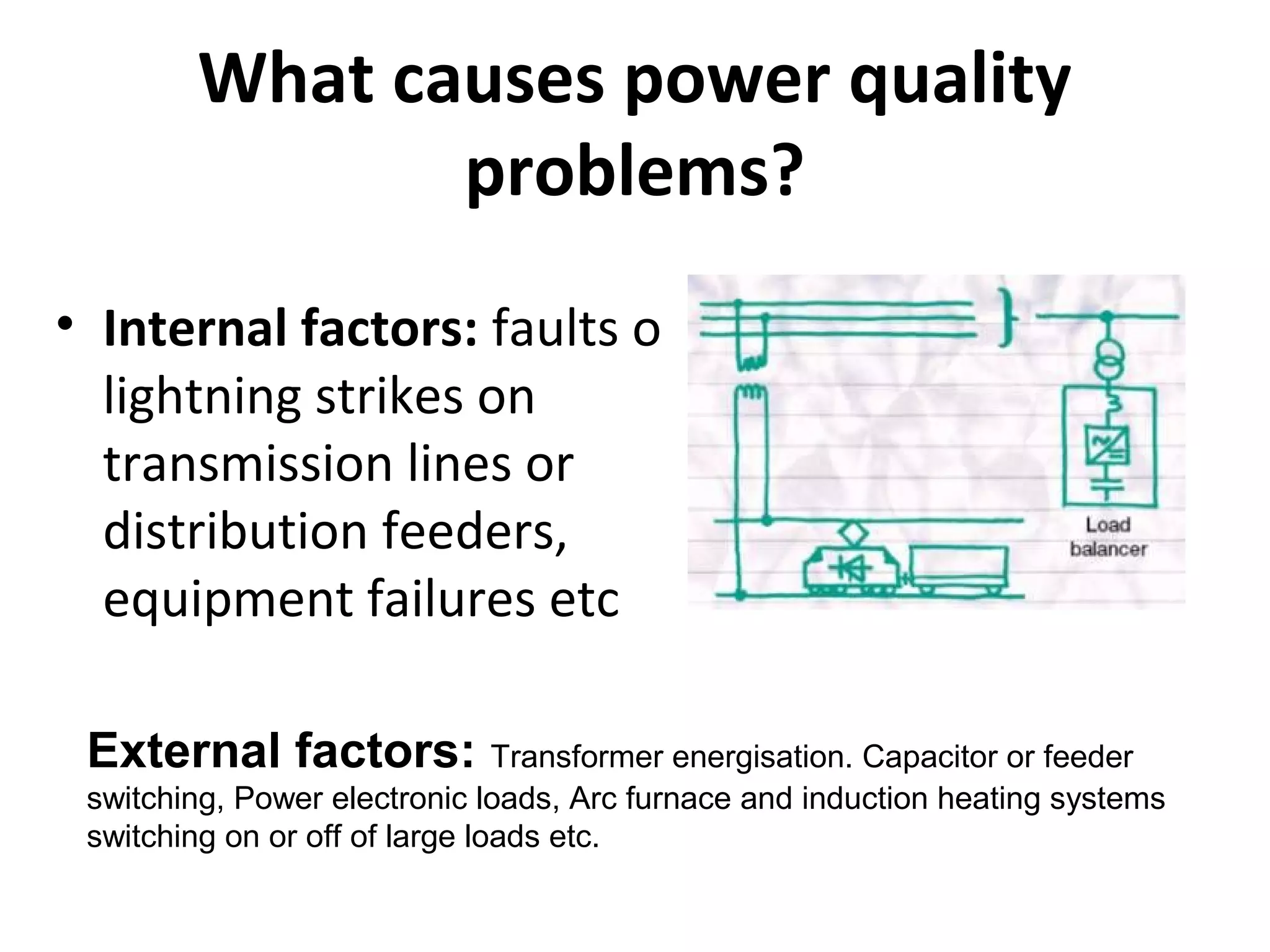
What causes power quality
problems?
• Internal factors: faults o
lightning strikes on
transmission lines or
distribution feeders,
equipment failures etc
External factors: Transformer energisation. Capacitor or feeder
switching, Power electronic loads, Arc furnace and induction heating systems
switching on or off of large loads etc.
Why are we concerned about PQ
All nonlinear and time varying temporal type electric loads fall
generally in two wide categories, namely the analog arc
(inrush/saturation) type and digital converter (power electronic)
switching type.
Key Problems:

1.
2.
3.
4.
5.
6.
7.

Damage to sensitive equipment
Interference
Malfunction
Extra losses
Personnel Safety issues
Poor Utilization
Poor Power Factor.

8
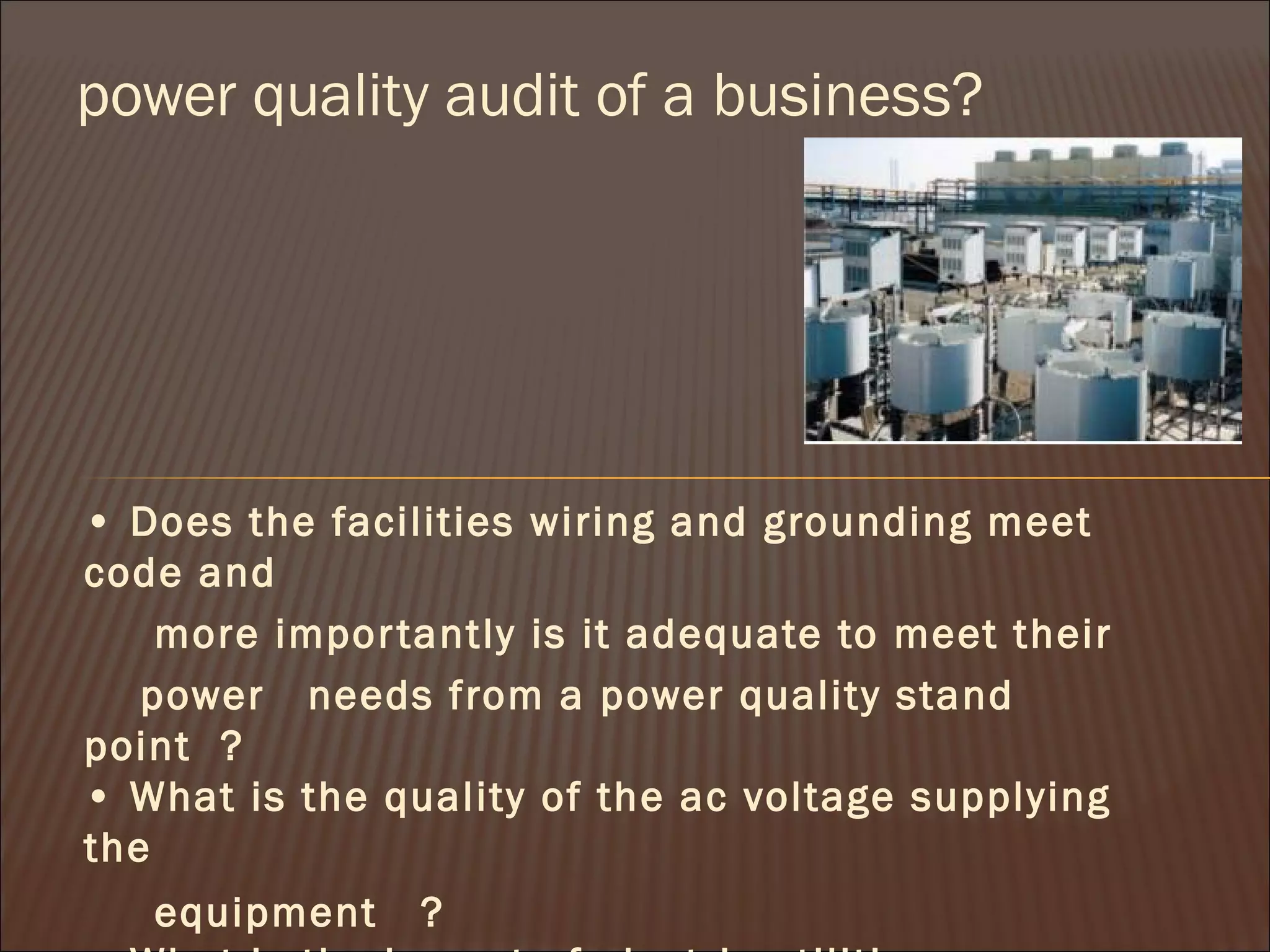
power quality audit of a business?

• Does the facilities wiring and grounding meet
code and
more impor tantly is it adequate to meet their
power   needs from a power quality stand
point ?
• What is the quality of the ac voltage supplying
the
equipment

?
Electricity Market De-Regulation
Means:
 Service Security
 Service Quality
 Competition
 Efficient Utilization
 Demand Side Management
10
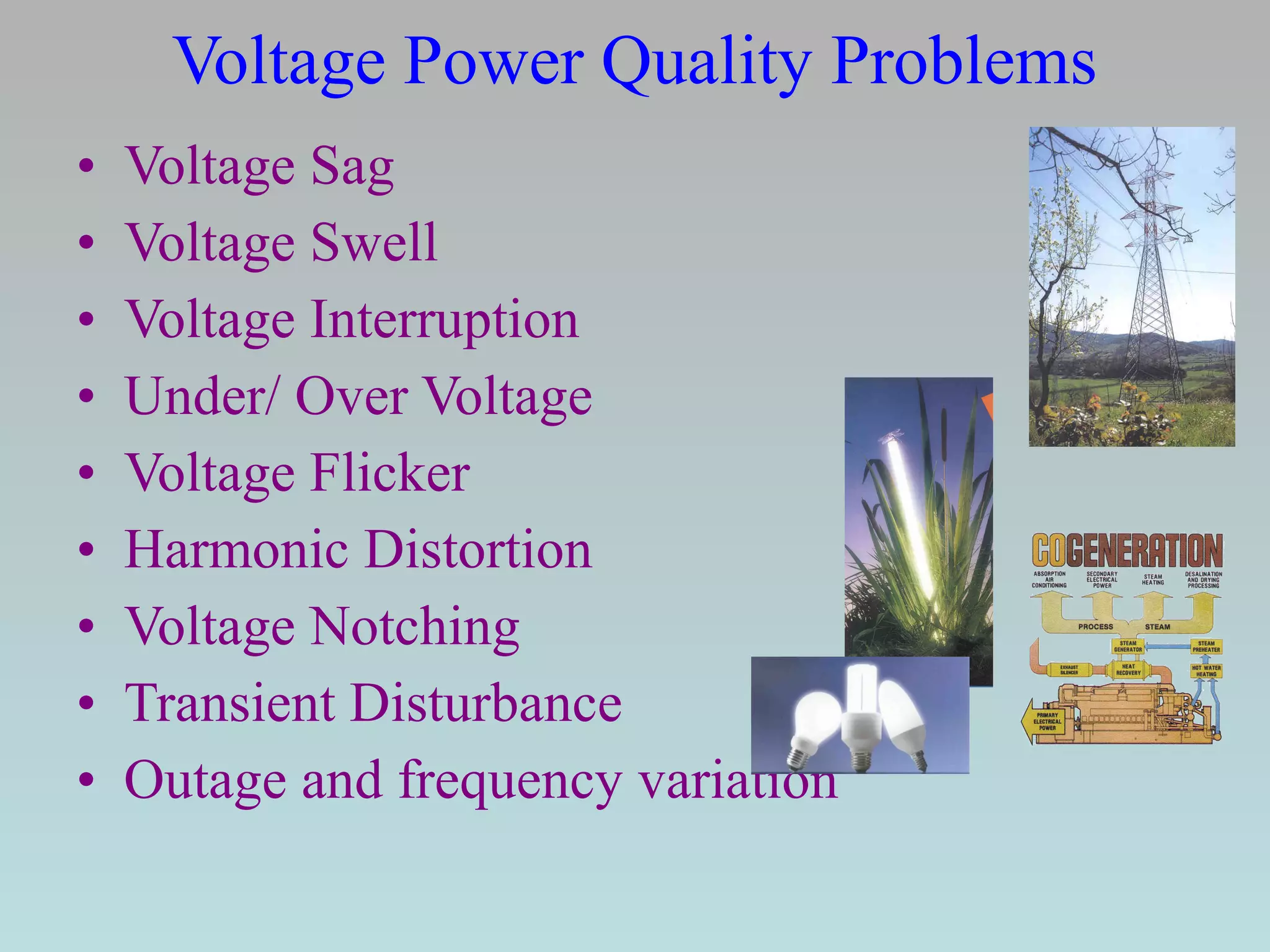
Voltage Power Quality Problems
•
•
•
•
•
•
•
•
•

Voltage Sag
Voltage Swell
Voltage Interruption
Under/ Over Voltage
Voltage Flicker
Harmonic Distortion
Voltage Notching
Transient Disturbance
Outage and frequency variation
Current Based Power Quality
Problems
• Reactive Power Compensation
• Voltage Regulation
• Current Harmonics Compensation
• Load Unbalancing (for 3-phase systems)
• Neutral Current Compensation (for 3-phase
4-wire systems)
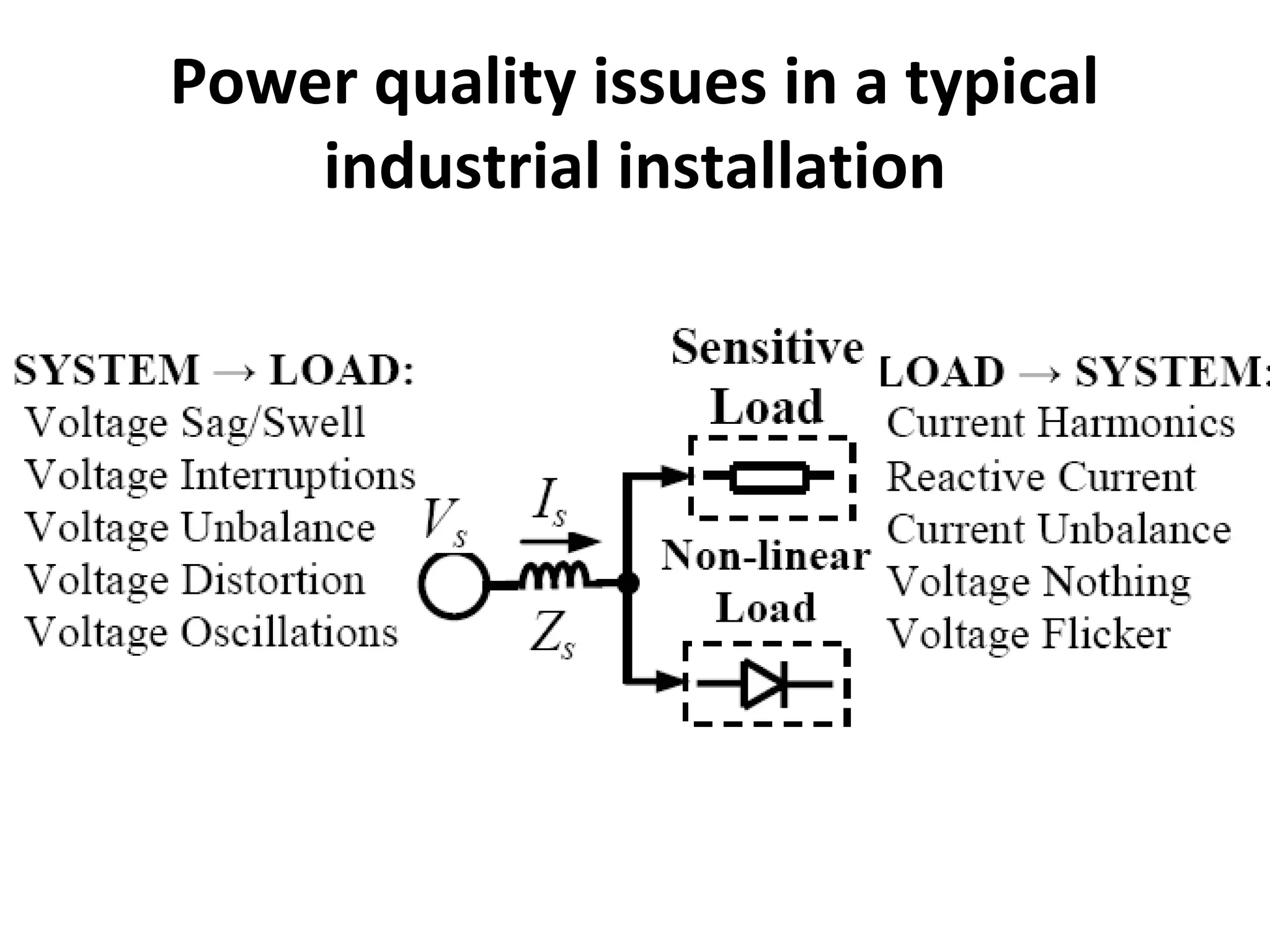
Power quality issues in a typical
industrial installation
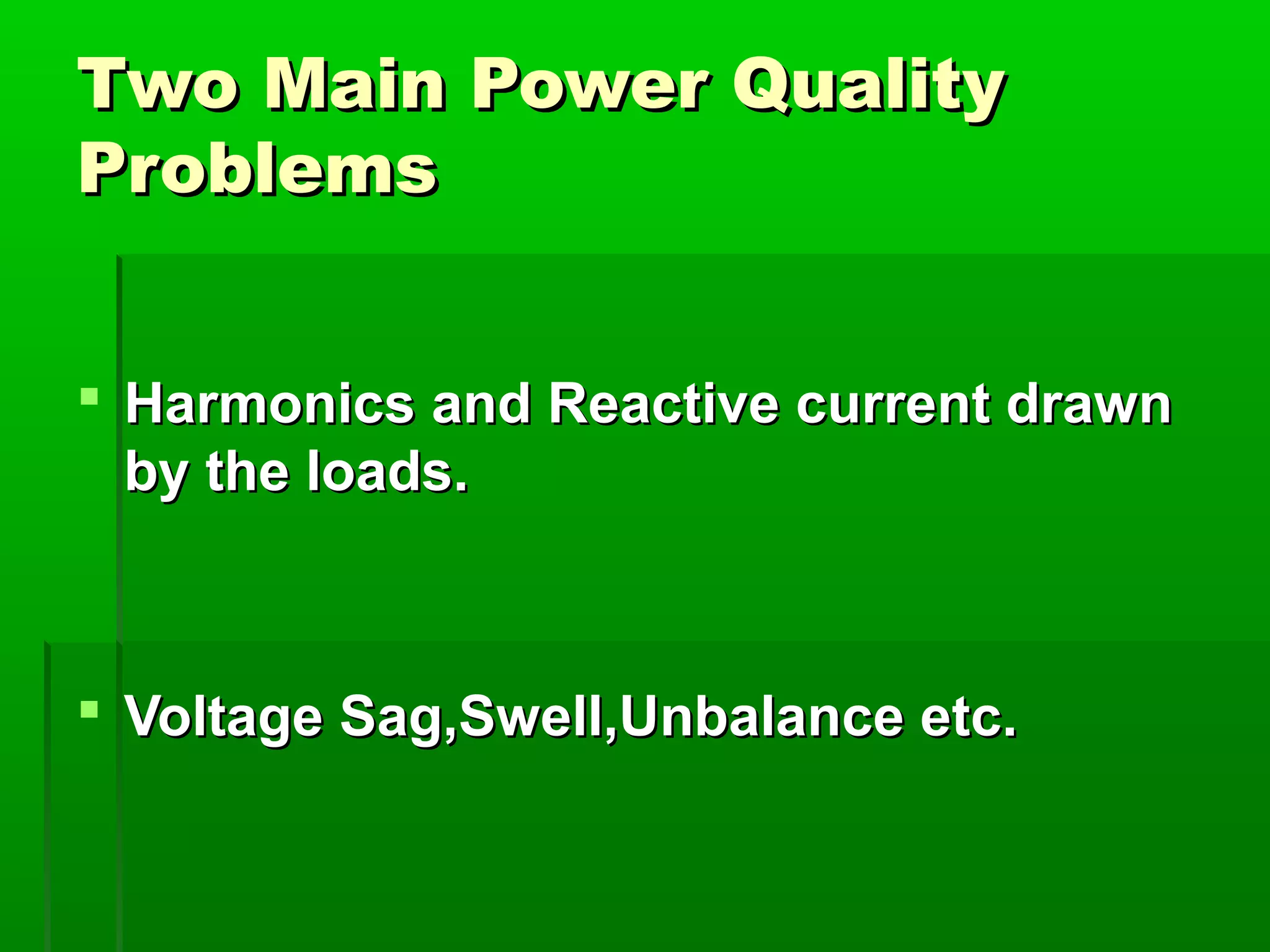
Two Main Power Quality
Problems
 Harmonics and Reactive current drawn
by the loads.

 Voltage Sag,Swell,Unbalance etc.
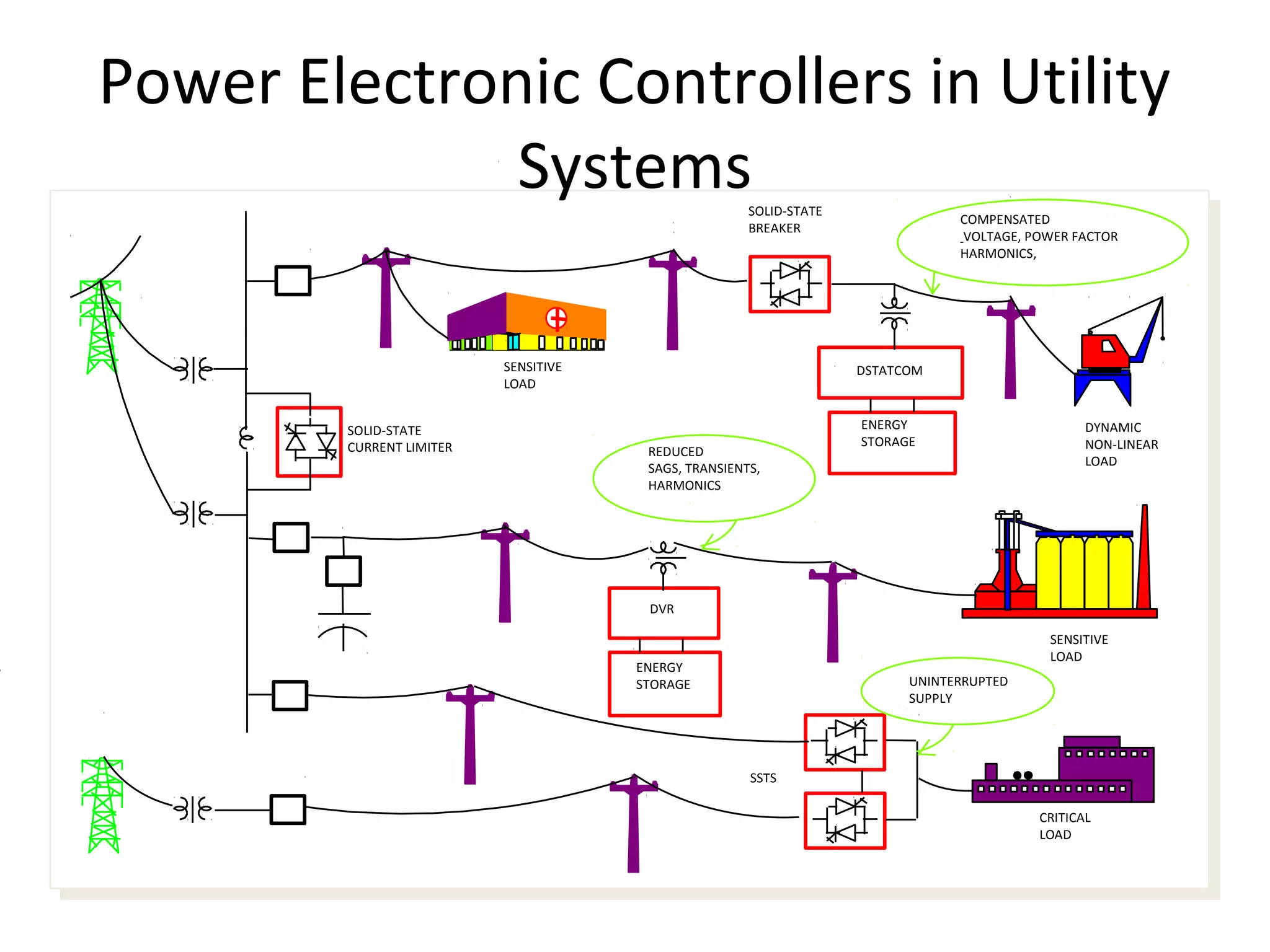
Power Electronic Controllers in Utility
Systems
SOLID-STATE
BREAKER

SENSITIVE
LOAD
SOLID-STATE
CURRENT LIMITER

COMPENSATED
VOLTAGE, POWER FACTOR
HARMONICS,

DSTATCOM

REDUCED
SAGS, TRANSIENTS,
HARMONICS

ENERGY
STORAGE

DYNAMIC
NON-LINEAR
LOAD

DVR
SENSITIVE
LOAD

ENERGY
STORAGE

UNINTERRUPTED
SUPPLY

SSTS
CRITICAL
LOAD
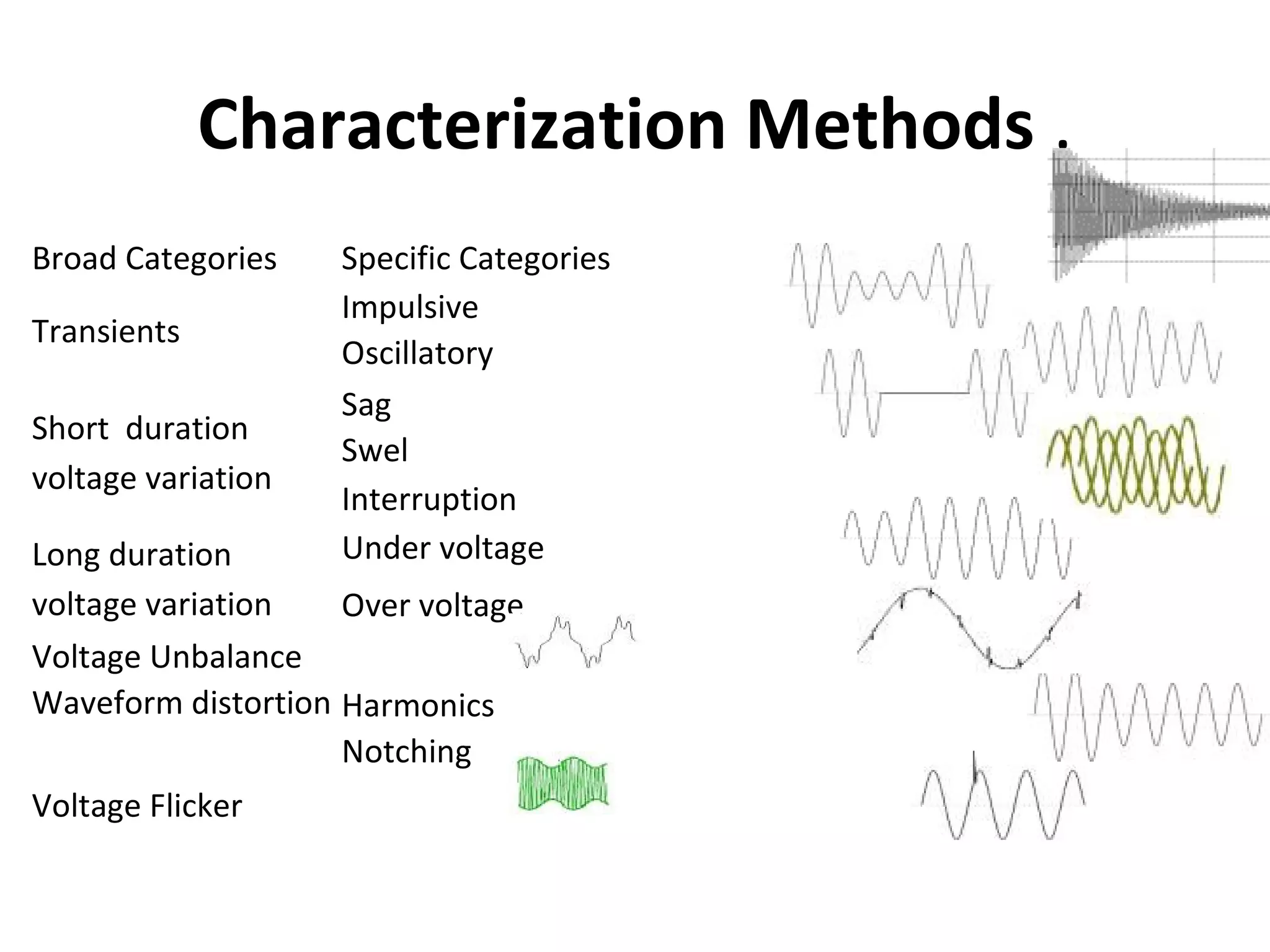
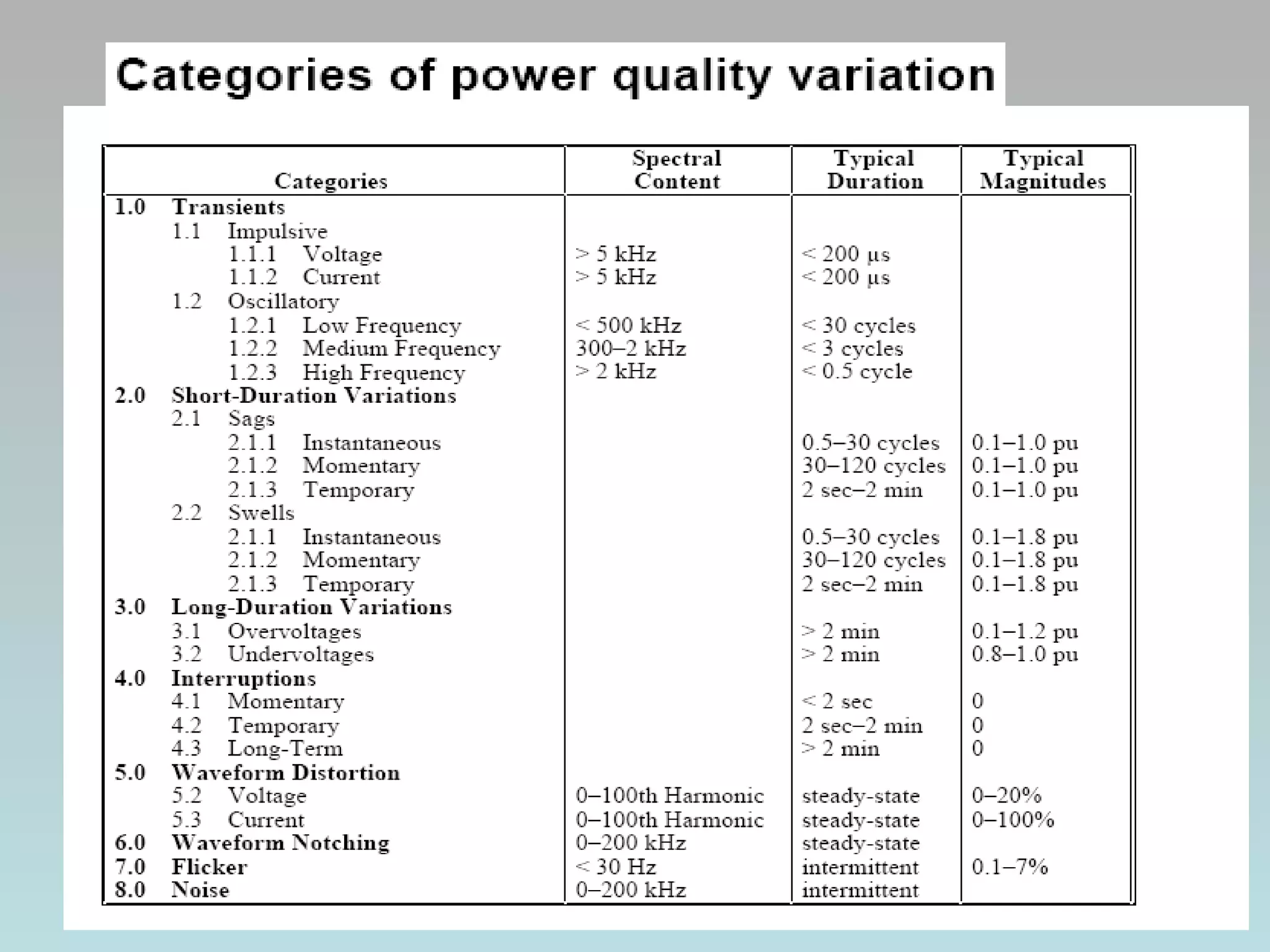
Characterization Methods .
Broad Categories
Transients
Short duration
voltage variation

Specific Categories
Impulsive
Oscillatory
Sag
Swel
Interruption
Under voltage

Long duration
voltage variation
Over voltage
Voltage Unbalance
Waveform distortion Harmonics
Notching
Voltage Flicker
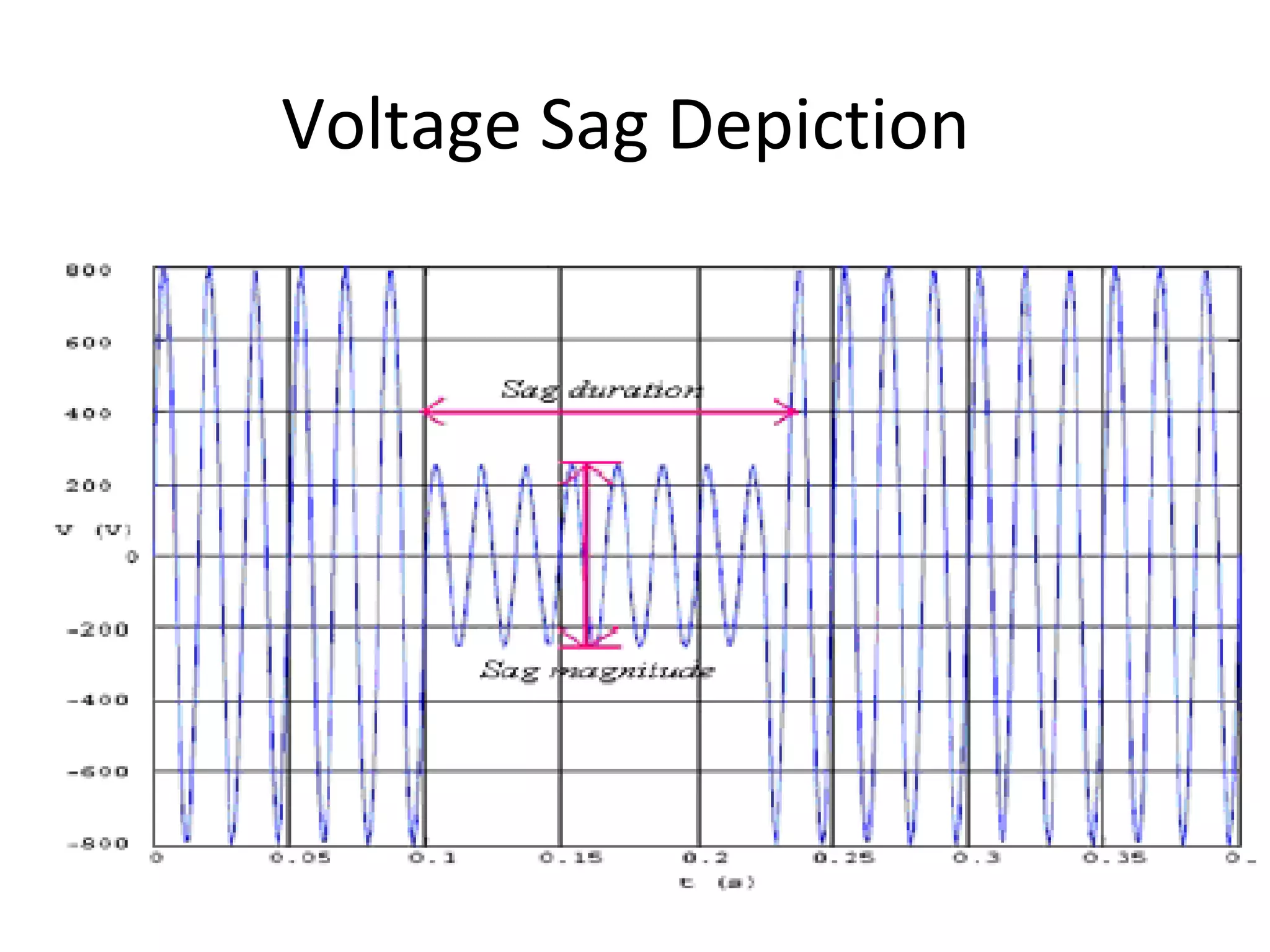
Voltage Sag Depiction
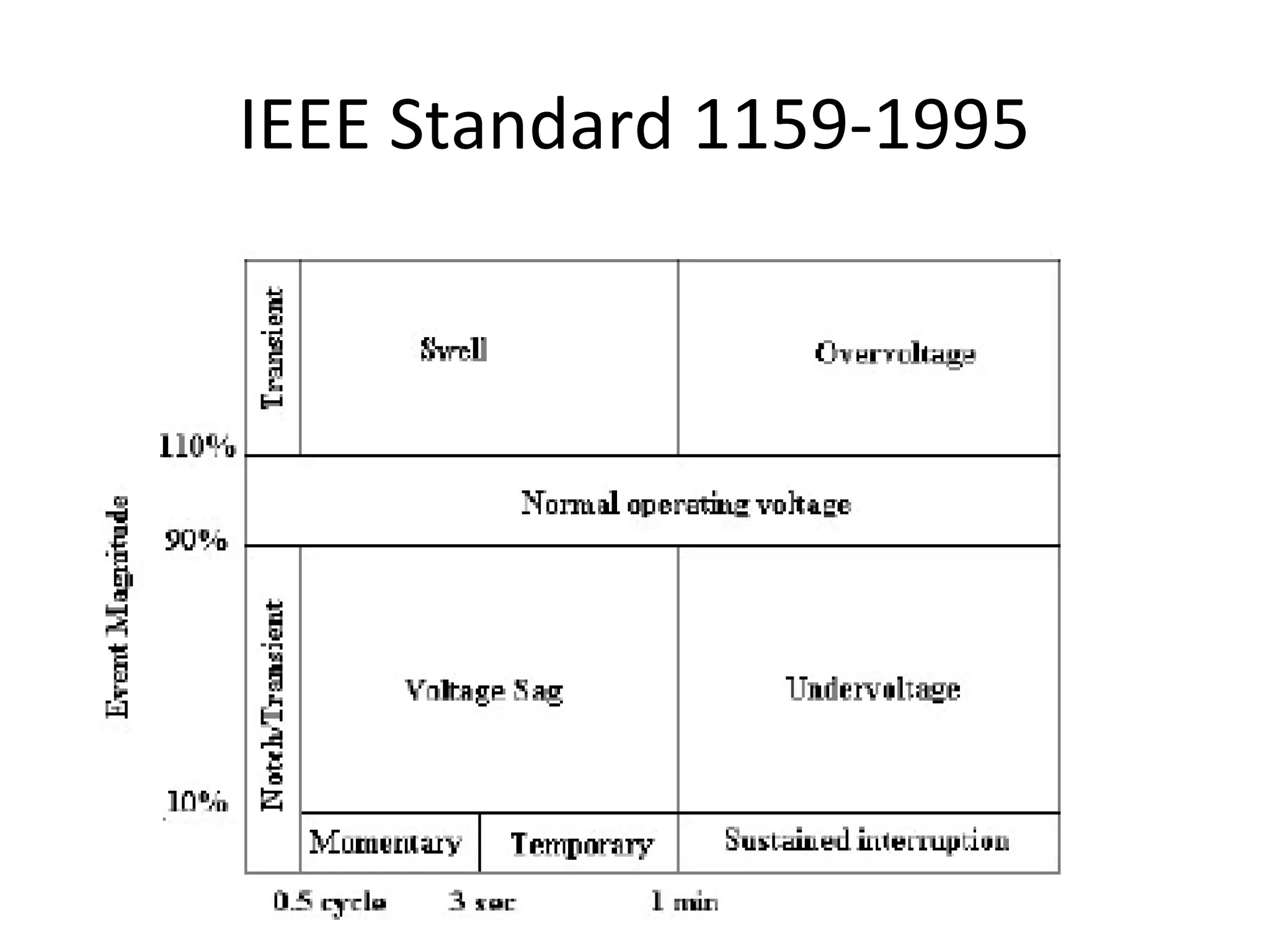
IEEE Standard 1159-1995
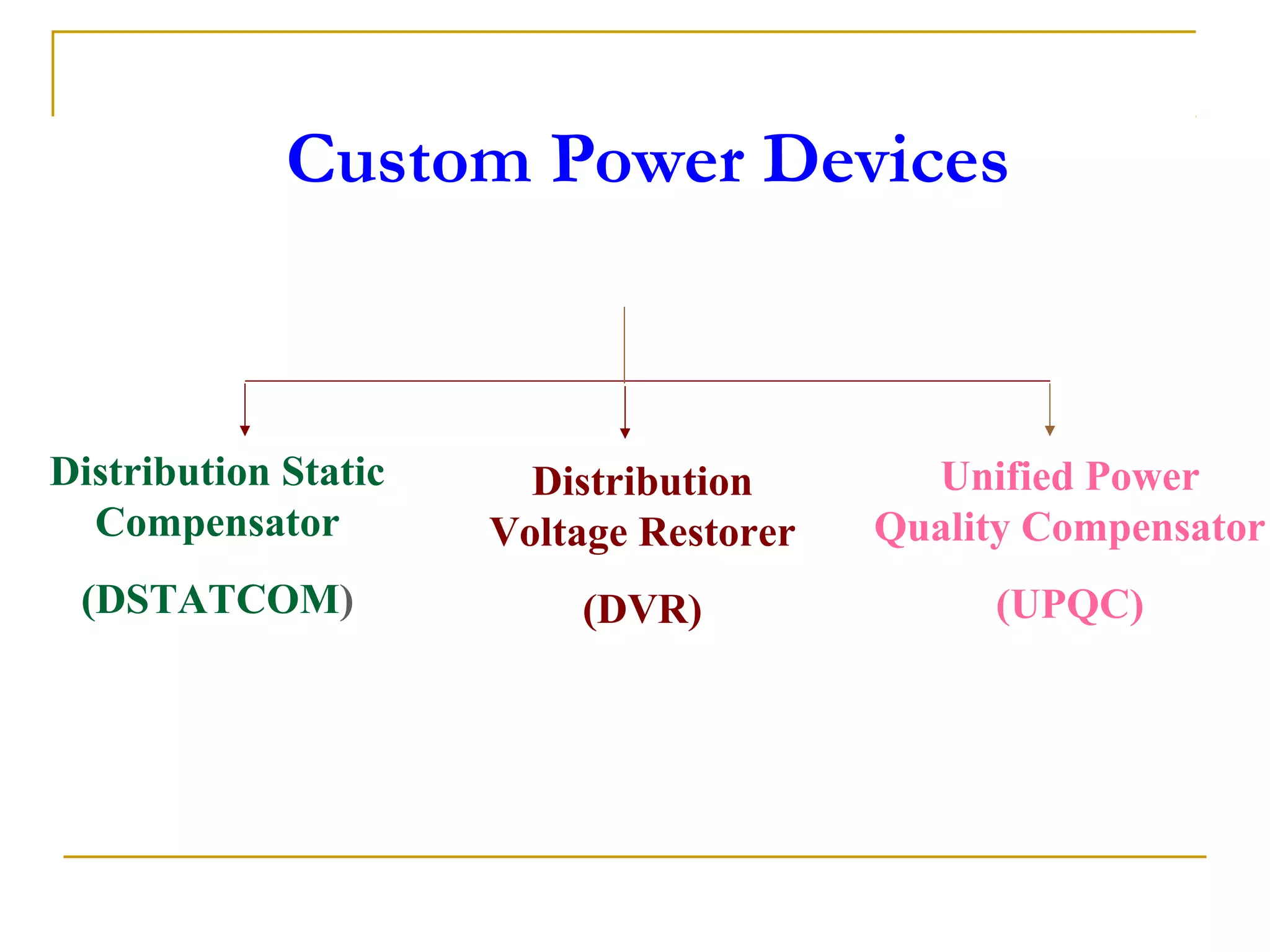
Custom Power Devices

Distribution Static
Compensator

Distribution
Voltage Restorer

Unified Power
Quality Compensator

(DSTATCOM)

(DVR)

(UPQC)
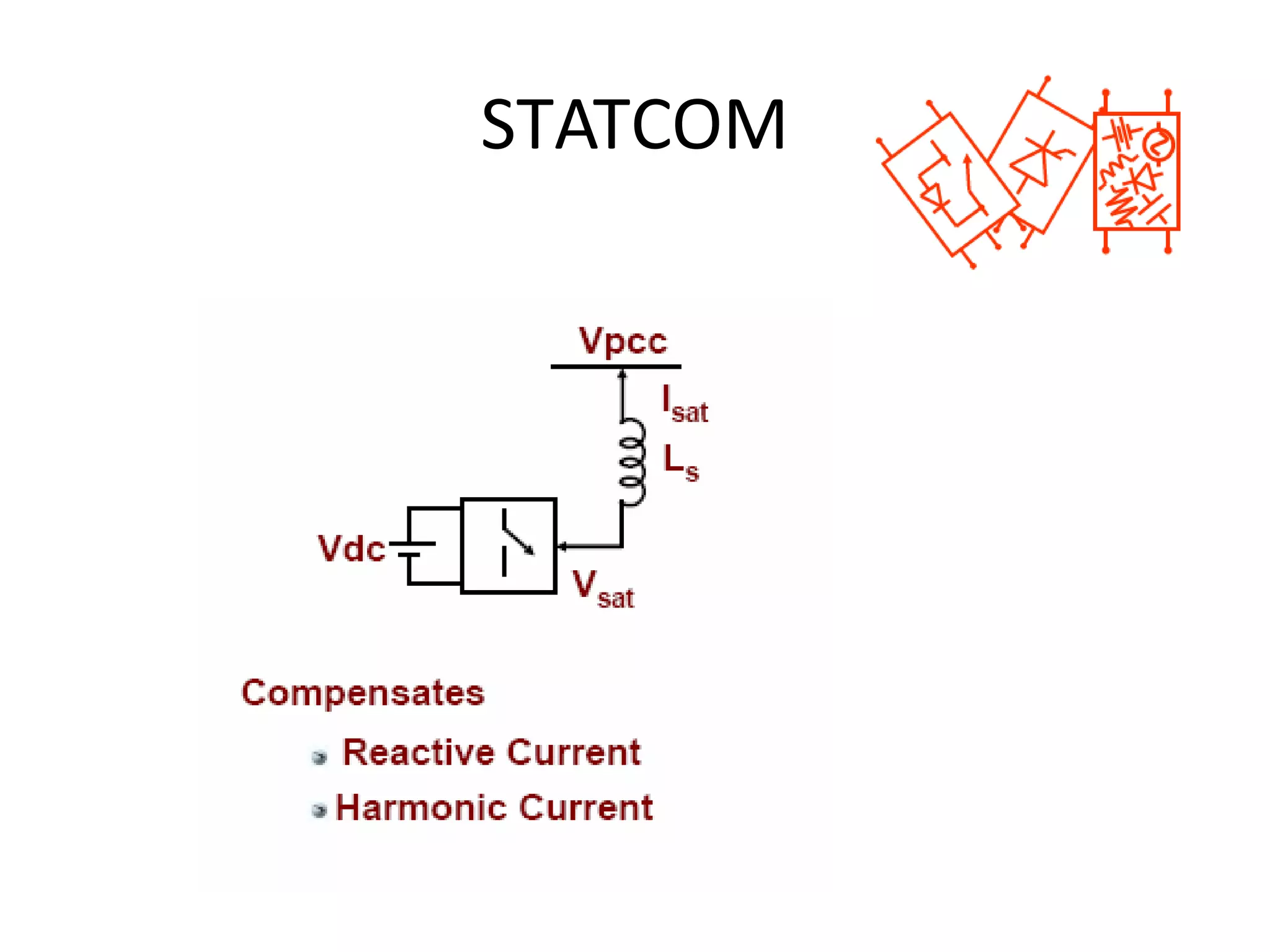
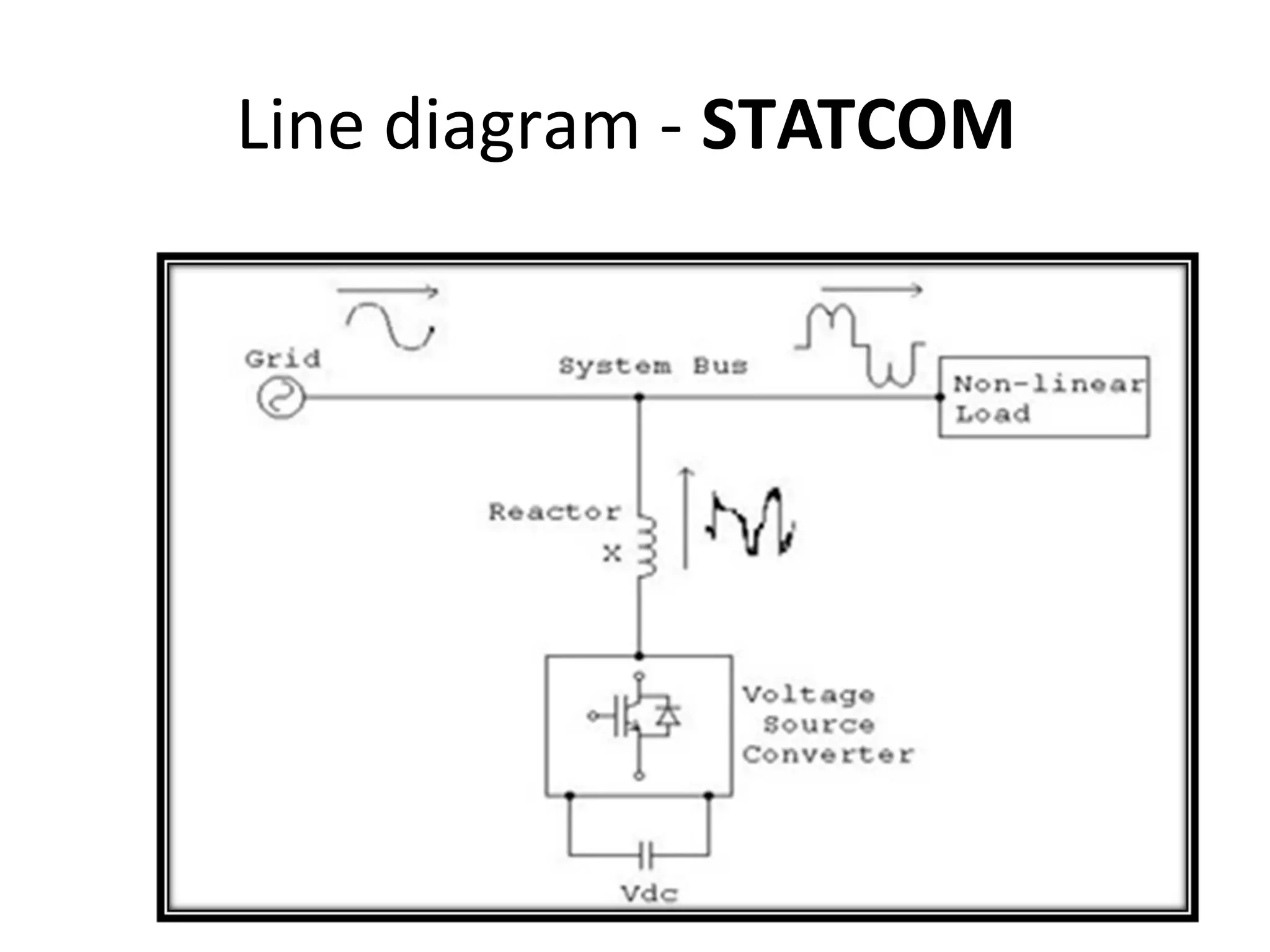
STATCOM
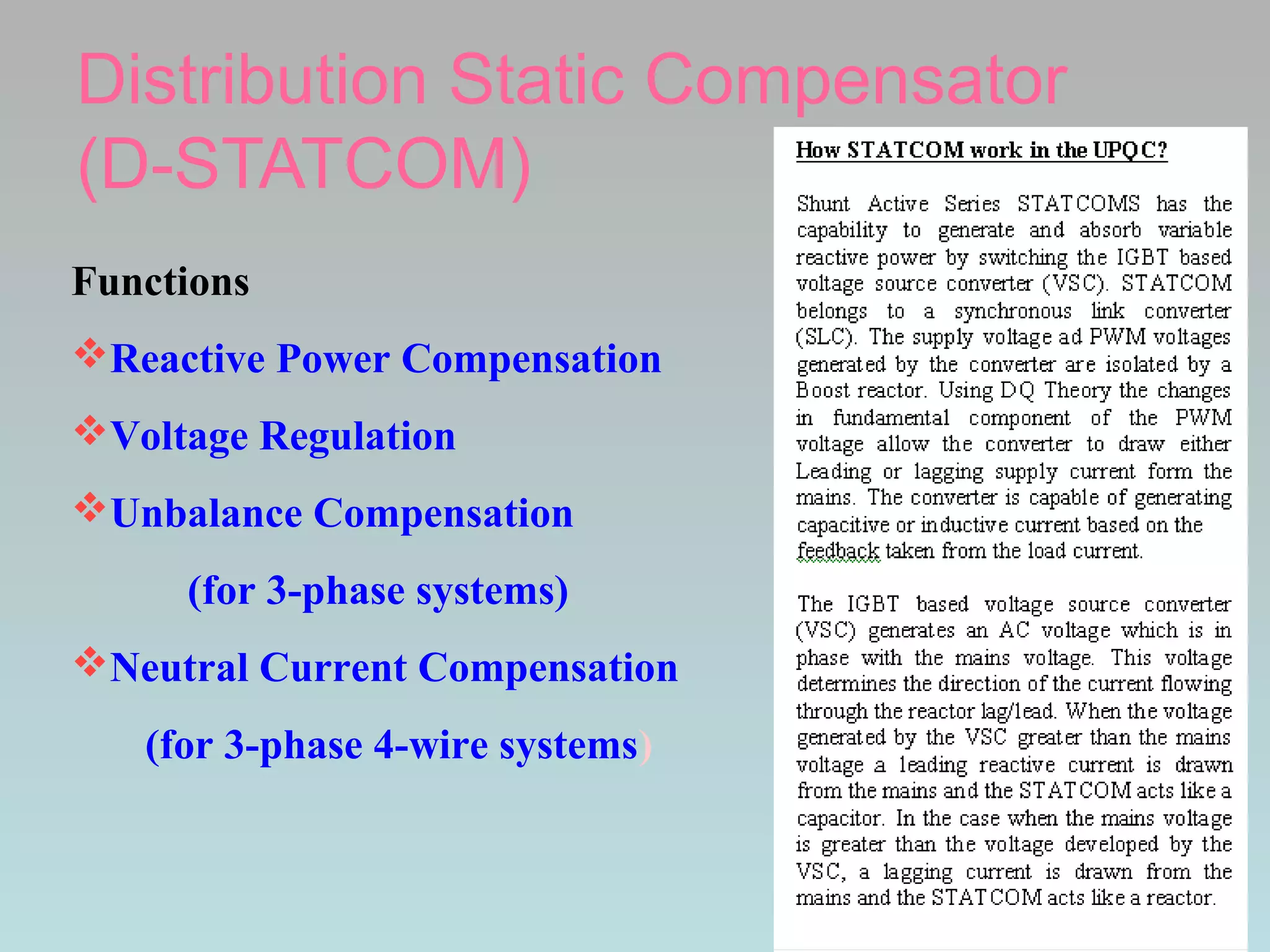
Distribution Static Compensator
(D-STATCOM)
Functions
Reactive Power Compensation
Voltage Regulation
Unbalance Compensation
(for 3-phase systems)
Neutral Current Compensation
(for 3-phase 4-wire systems)
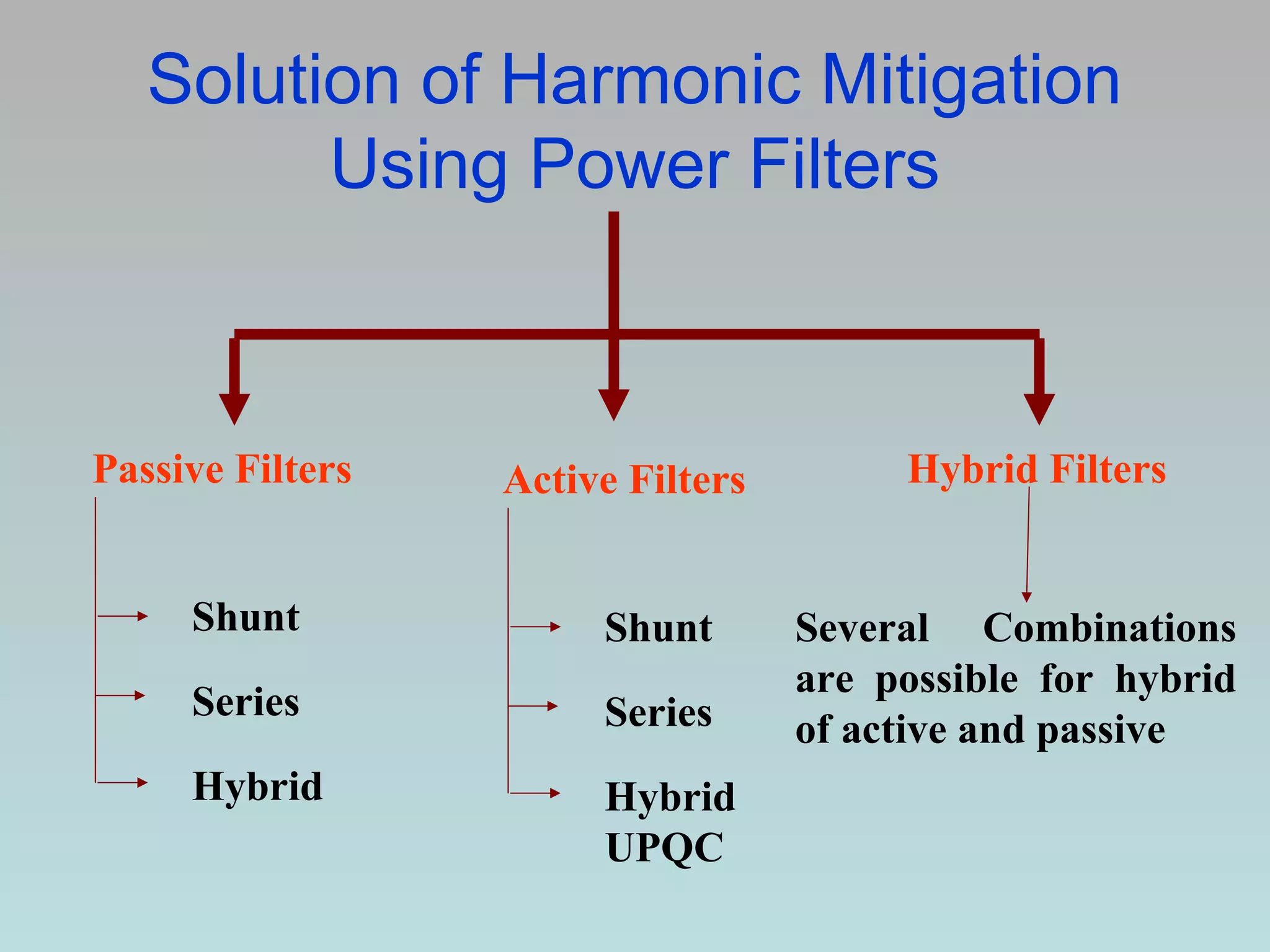
Solution of Harmonic Mitigation
Using Power Filters

Passive Filters

Active Filters

Shunt

Shunt

Series

Series

Hybrid

Hybrid
UPQC

Hybrid Filters

Several Combinations
are possible for hybrid
of active and passive
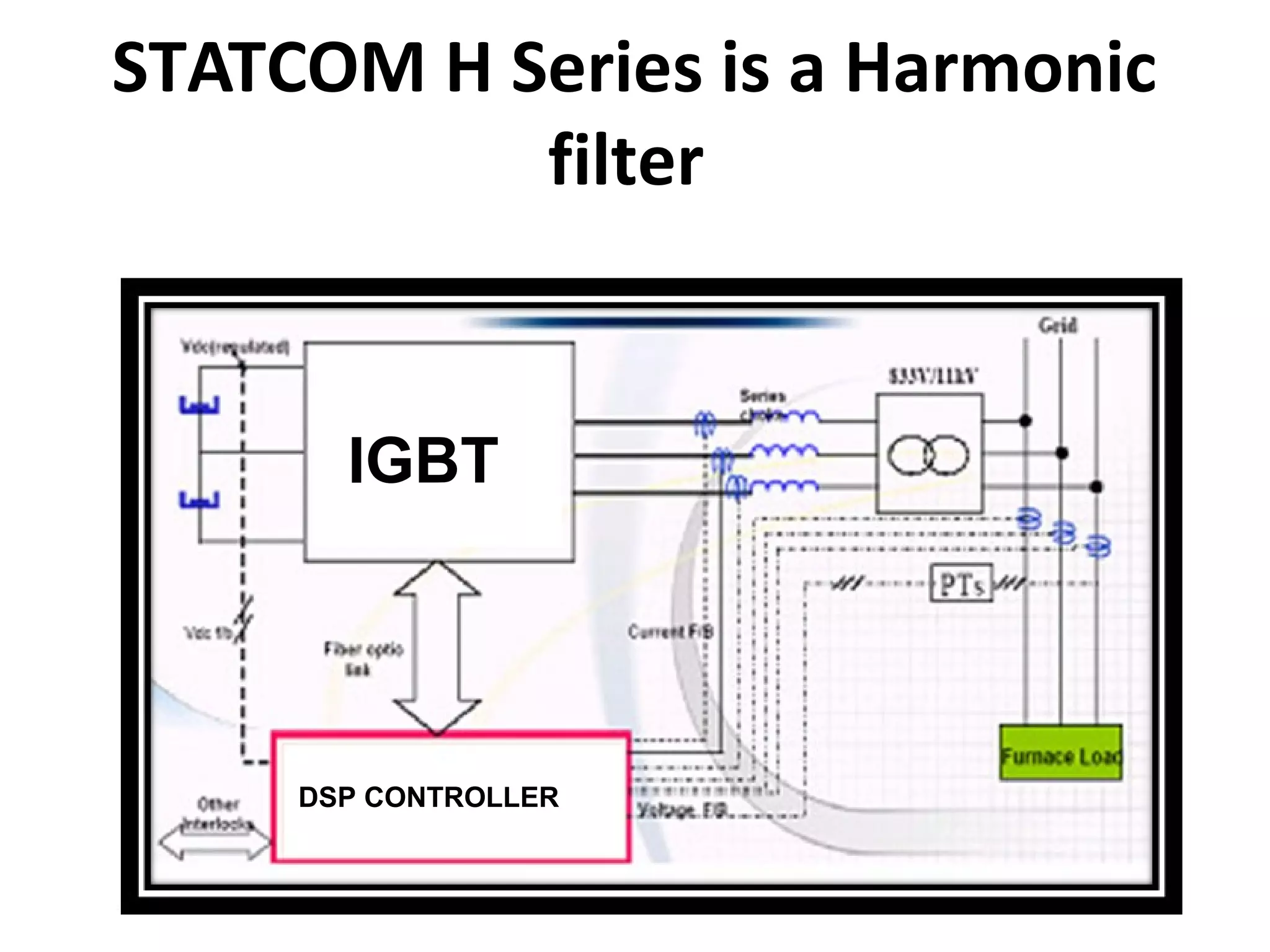
STATCOM H Series is a Harmonic
filter

IGBT

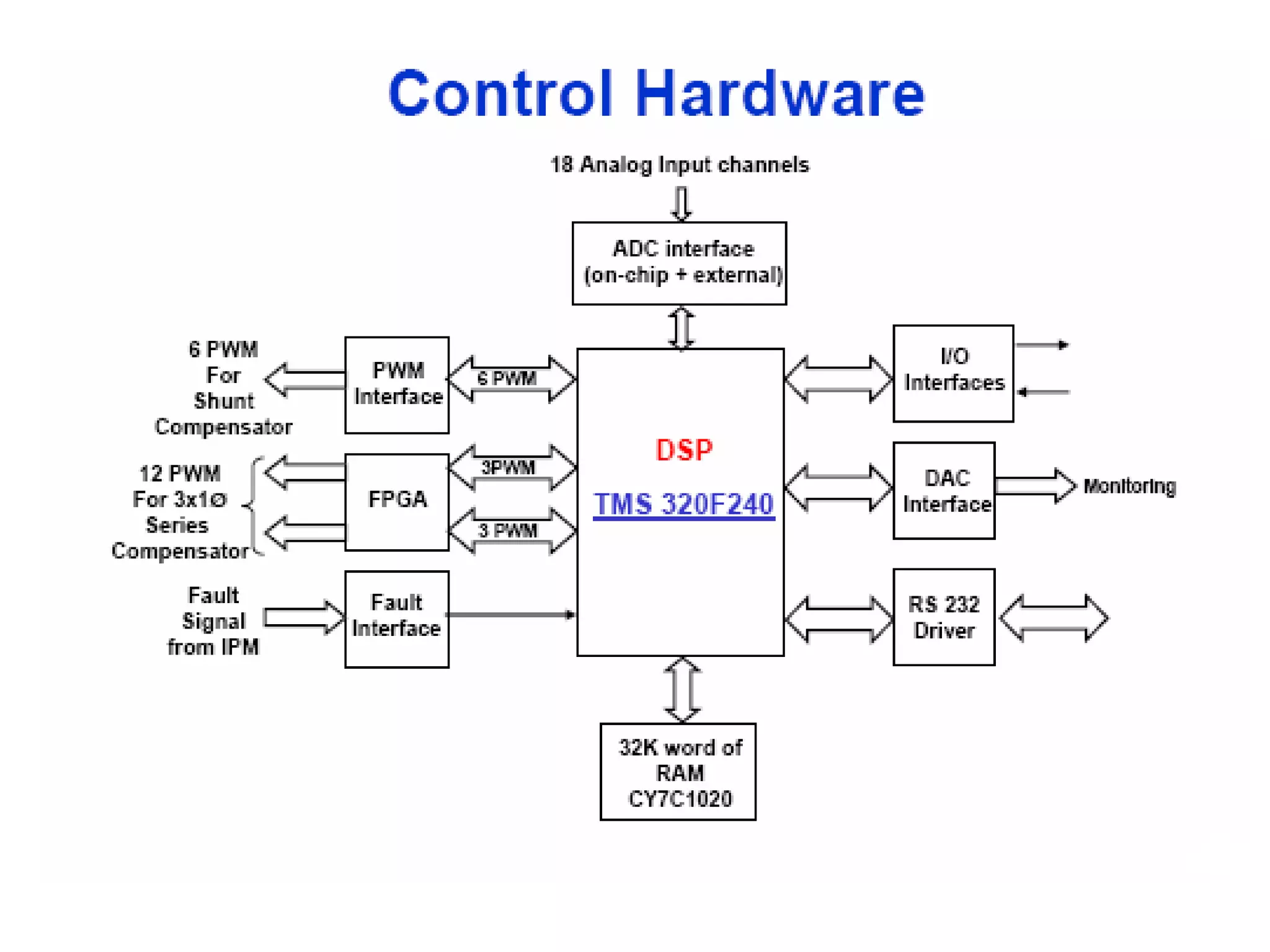
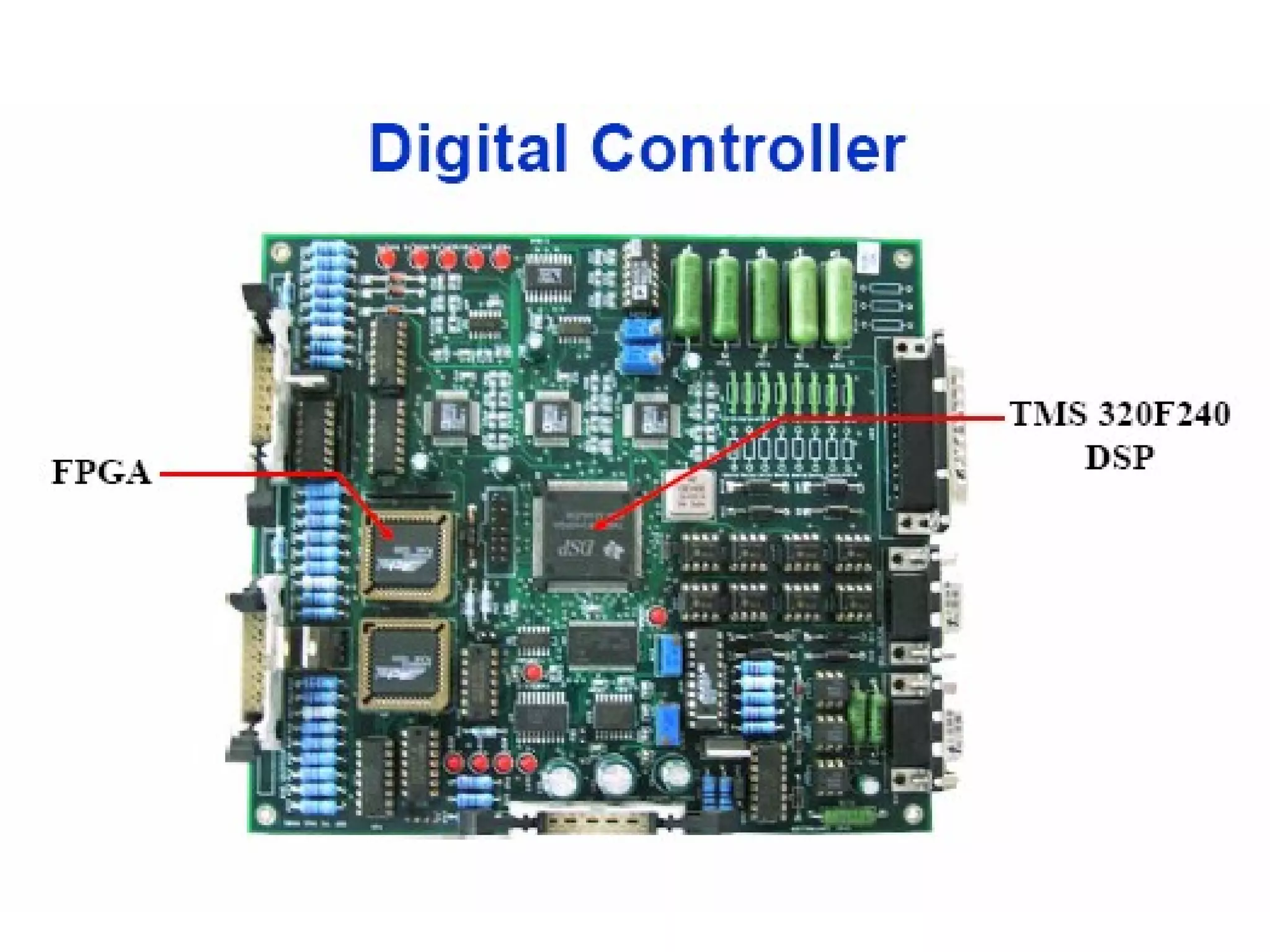
DSP CONTROLLER
Line diagram - STATCOM
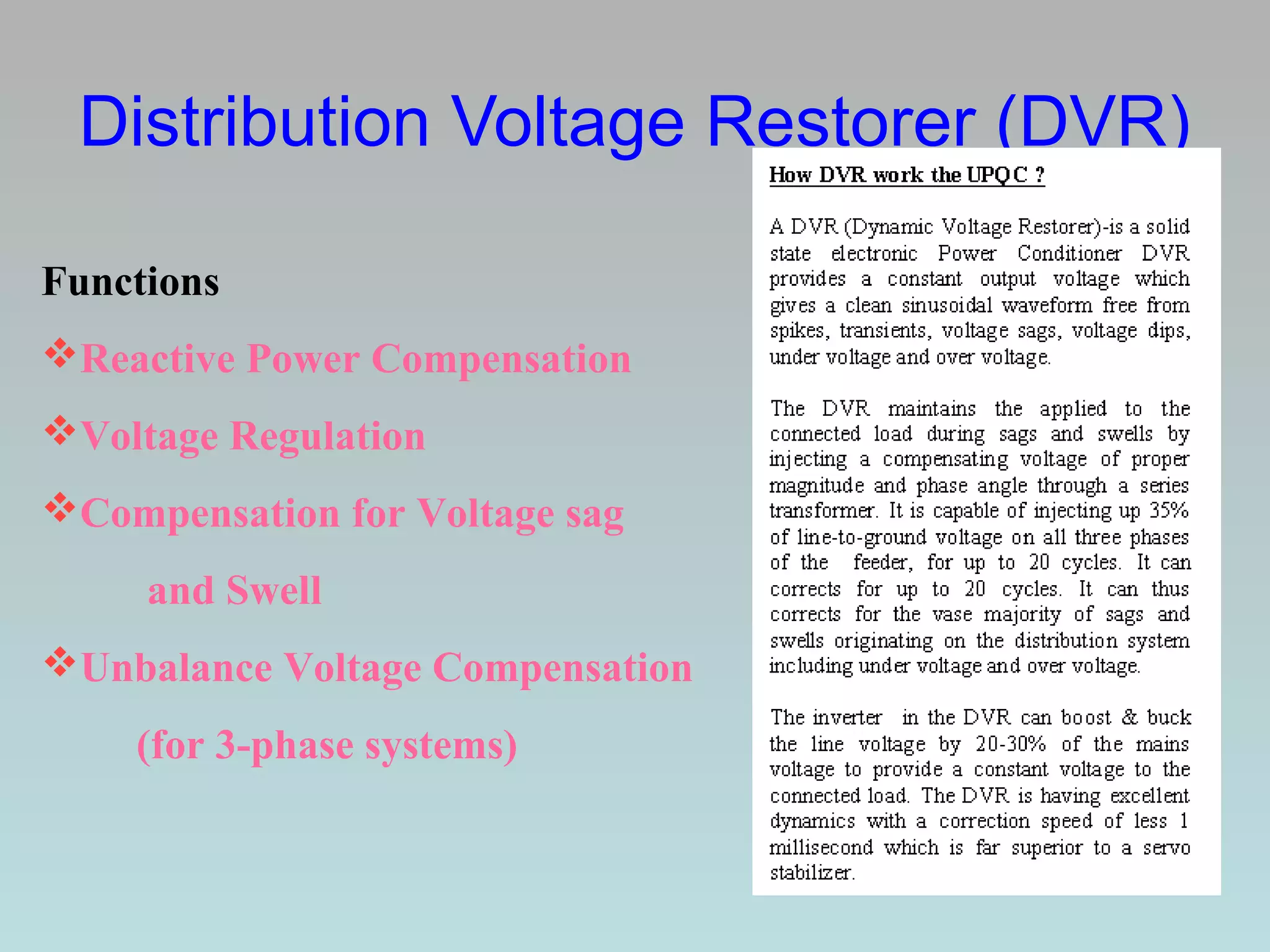
Distribution Voltage Restorer (DVR)
Functions
Reactive Power Compensation
Voltage Regulation
Compensation for Voltage sag
and Swell
Unbalance Voltage Compensation
(for 3-phase systems)
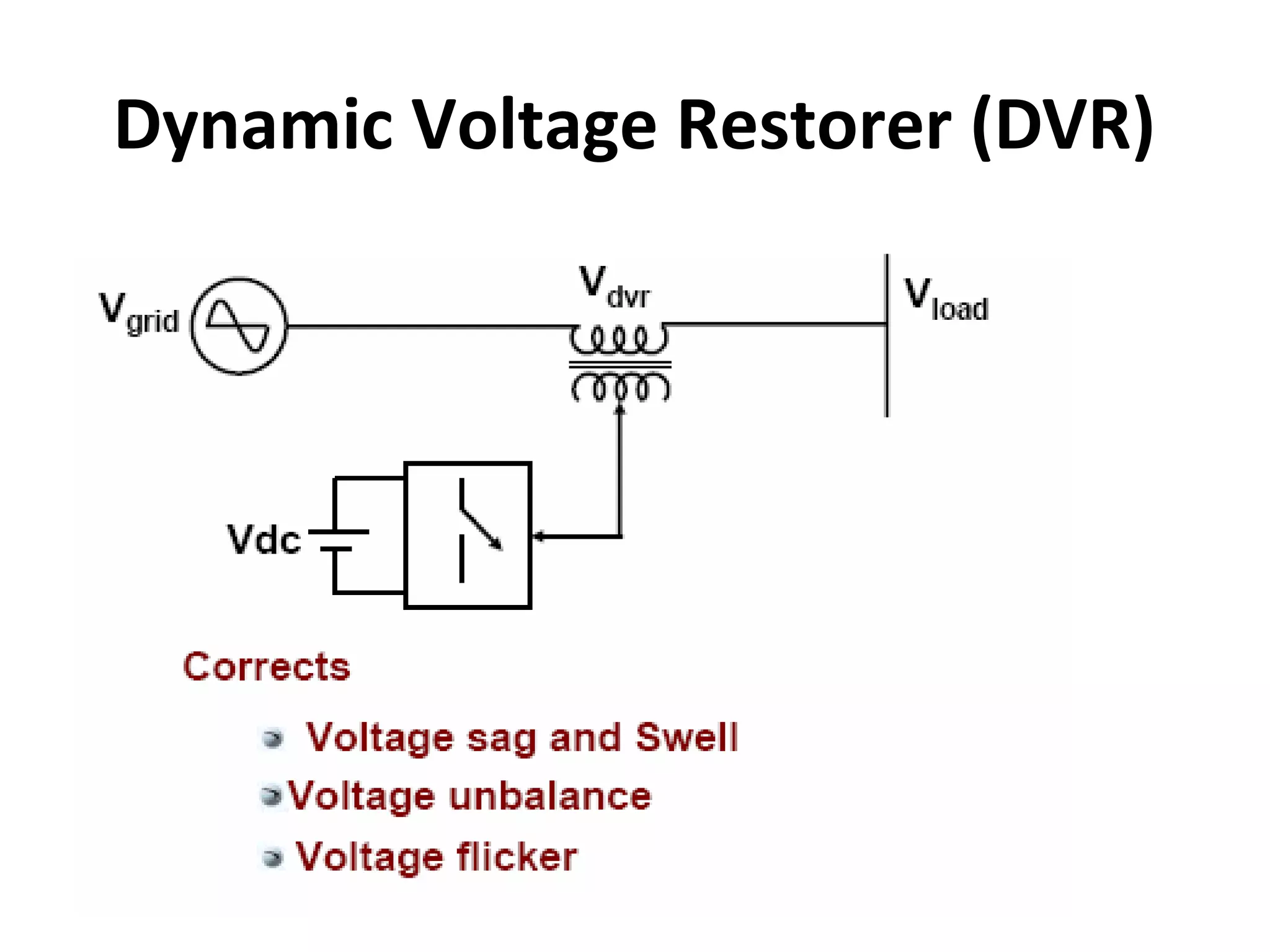
Dynamic Voltage Restorer (DVR)
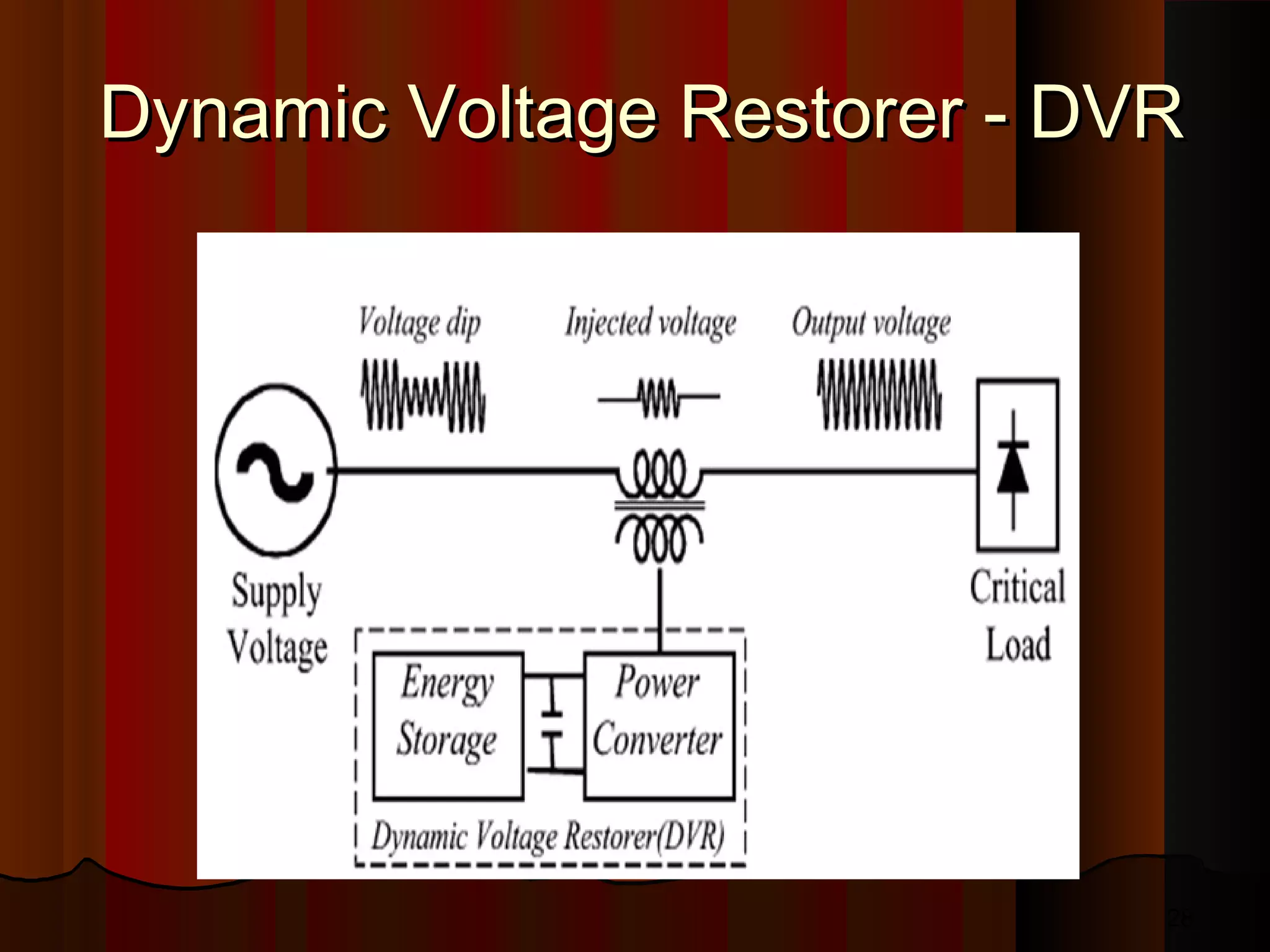
Dynamic Voltage Restorer - DVR

28
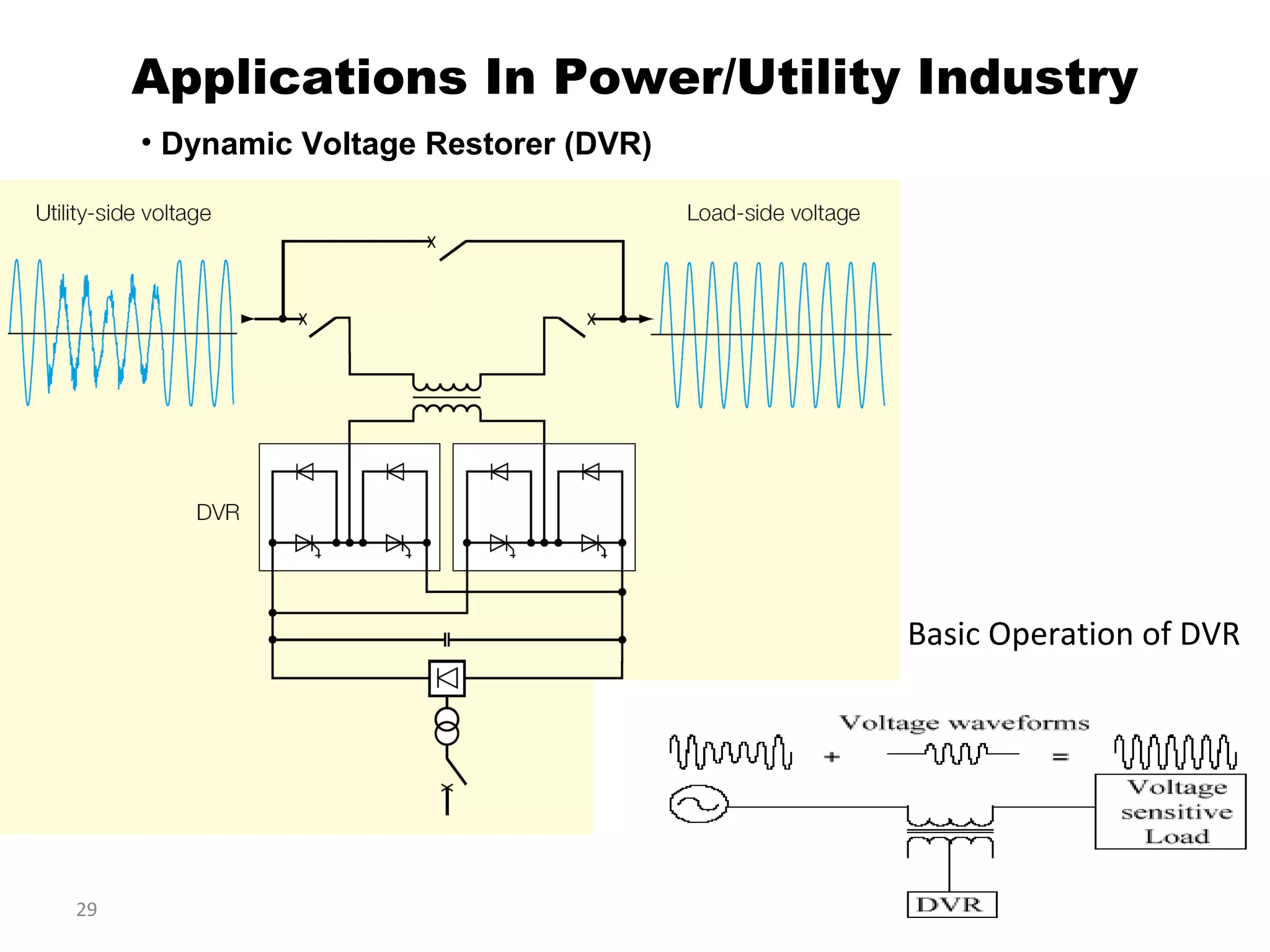
Applications In Power/Utility Industry
• Dynamic Voltage Restorer (DVR)

Basic Operation of DVR

29
Improving of Power
Quality in Distribution
Systems with UPQC
Under Non-Linear Load
Condition
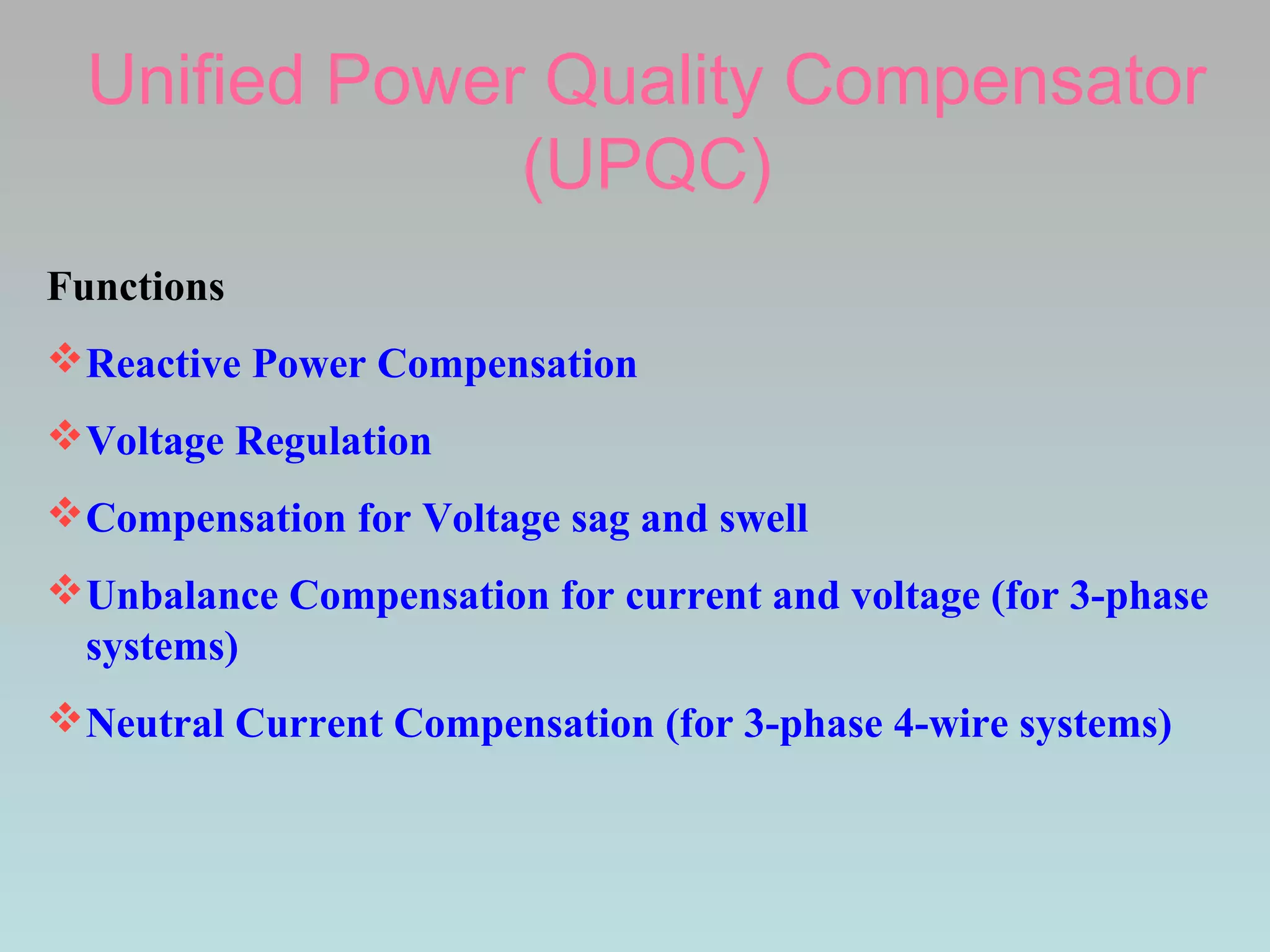
Unified Power Quality Compensator
(UPQC)
Functions
Reactive Power Compensation
Voltage Regulation
Compensation for Voltage sag and swell
Unbalance Compensation for current and voltage (for 3-phase
systems)
Neutral Current Compensation (for 3-phase 4-wire systems)
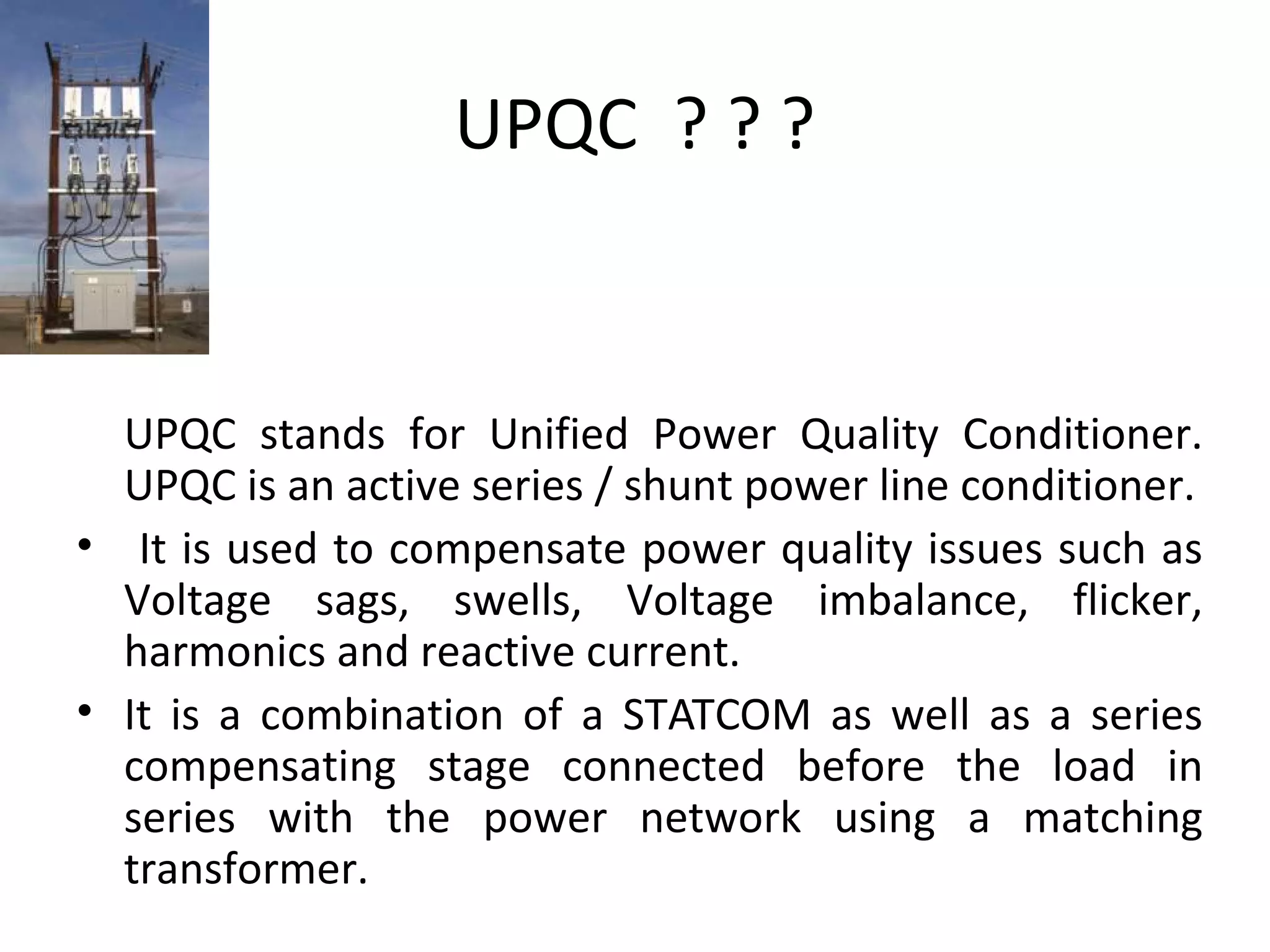
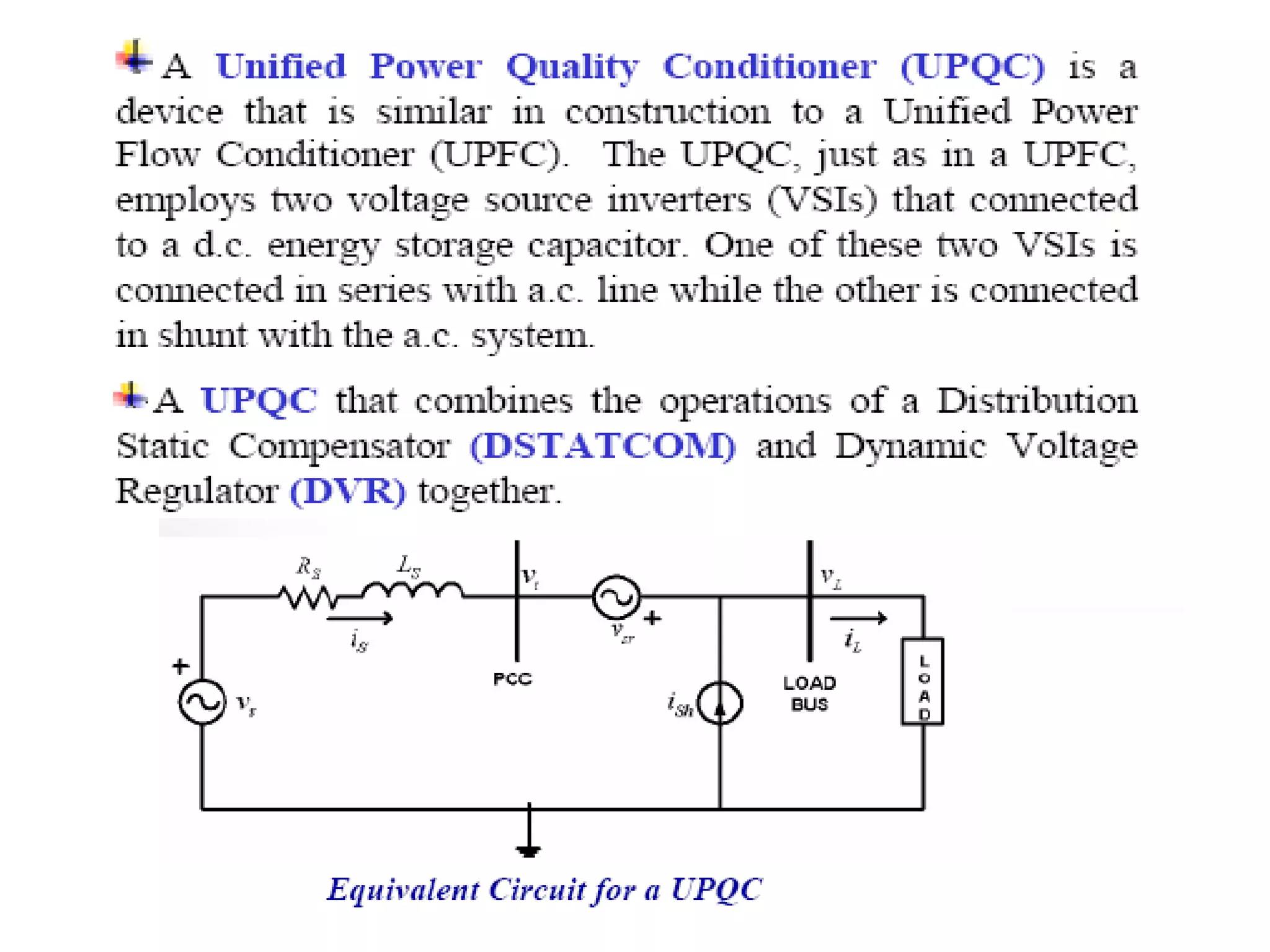
UPQC ? ? ?

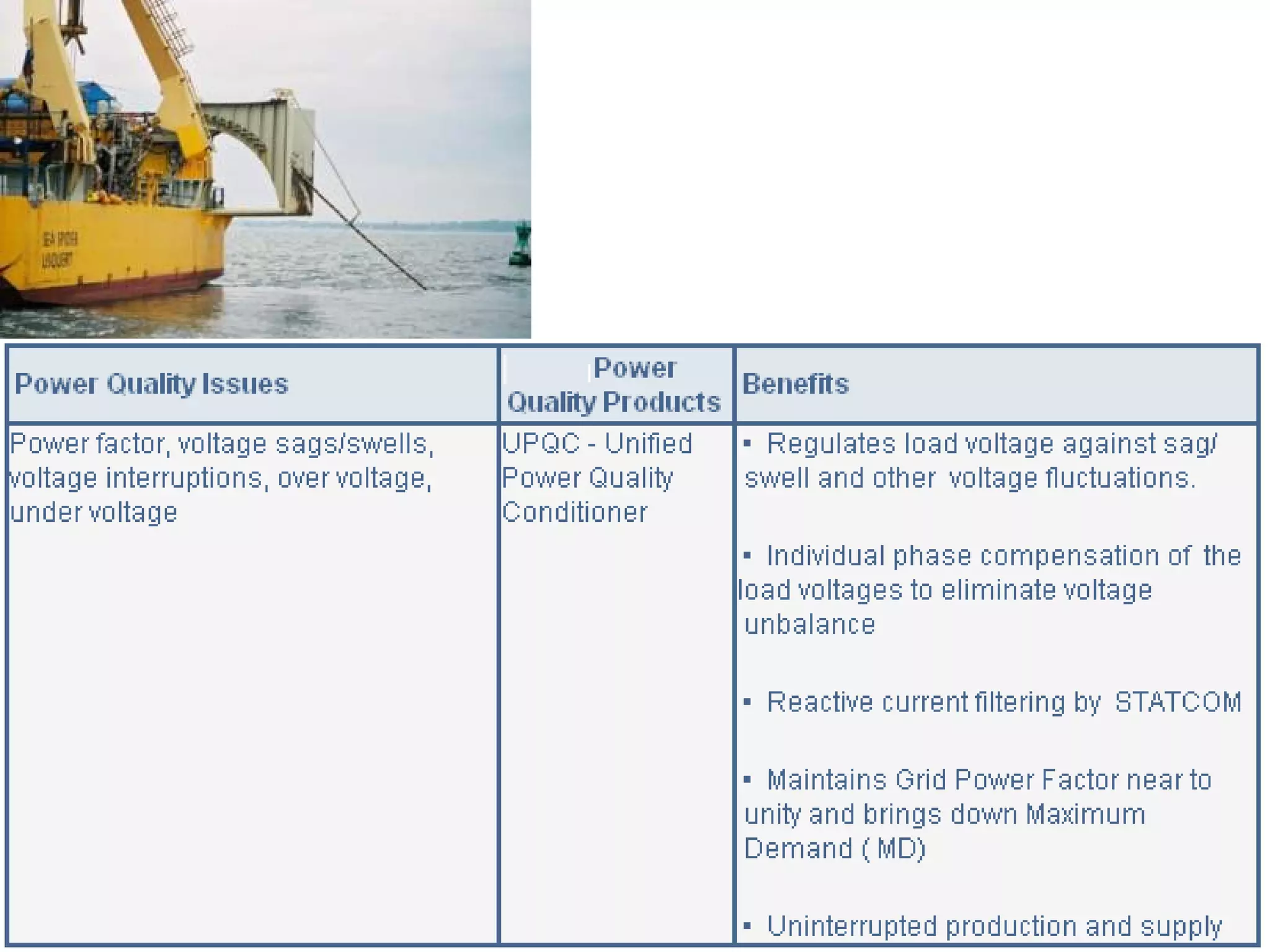
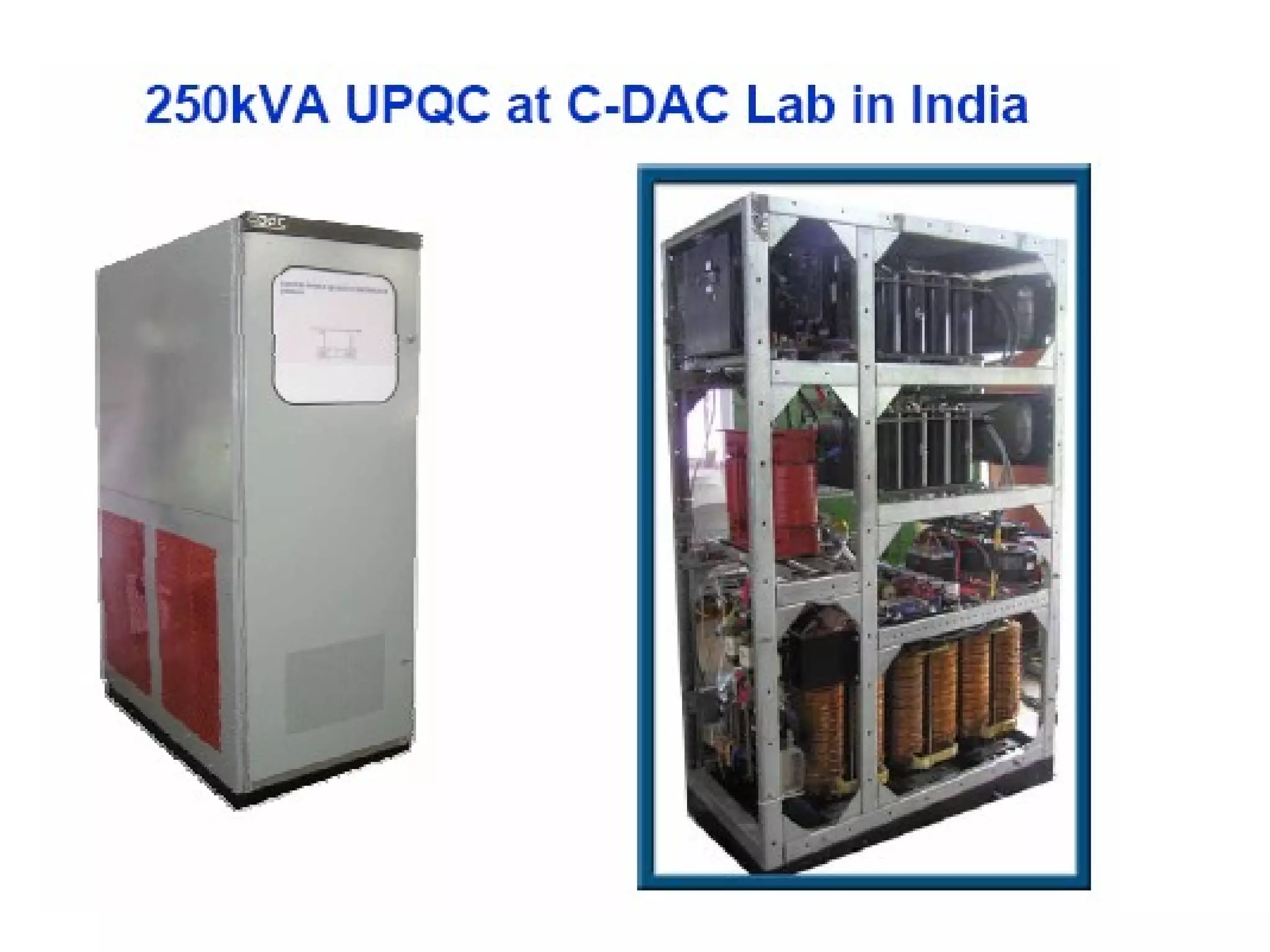
UPQC stands for Unified Power Quality Conditioner.
UPQC is an active series / shunt power line conditioner.
• It is used to compensate power quality issues such as
Voltage sags, swells, Voltage imbalance, flicker,
harmonics and reactive current.
• It is a combination of a STATCOM as well as a series
compensating stage connected before the load in
series with the power network using a matching
transformer.
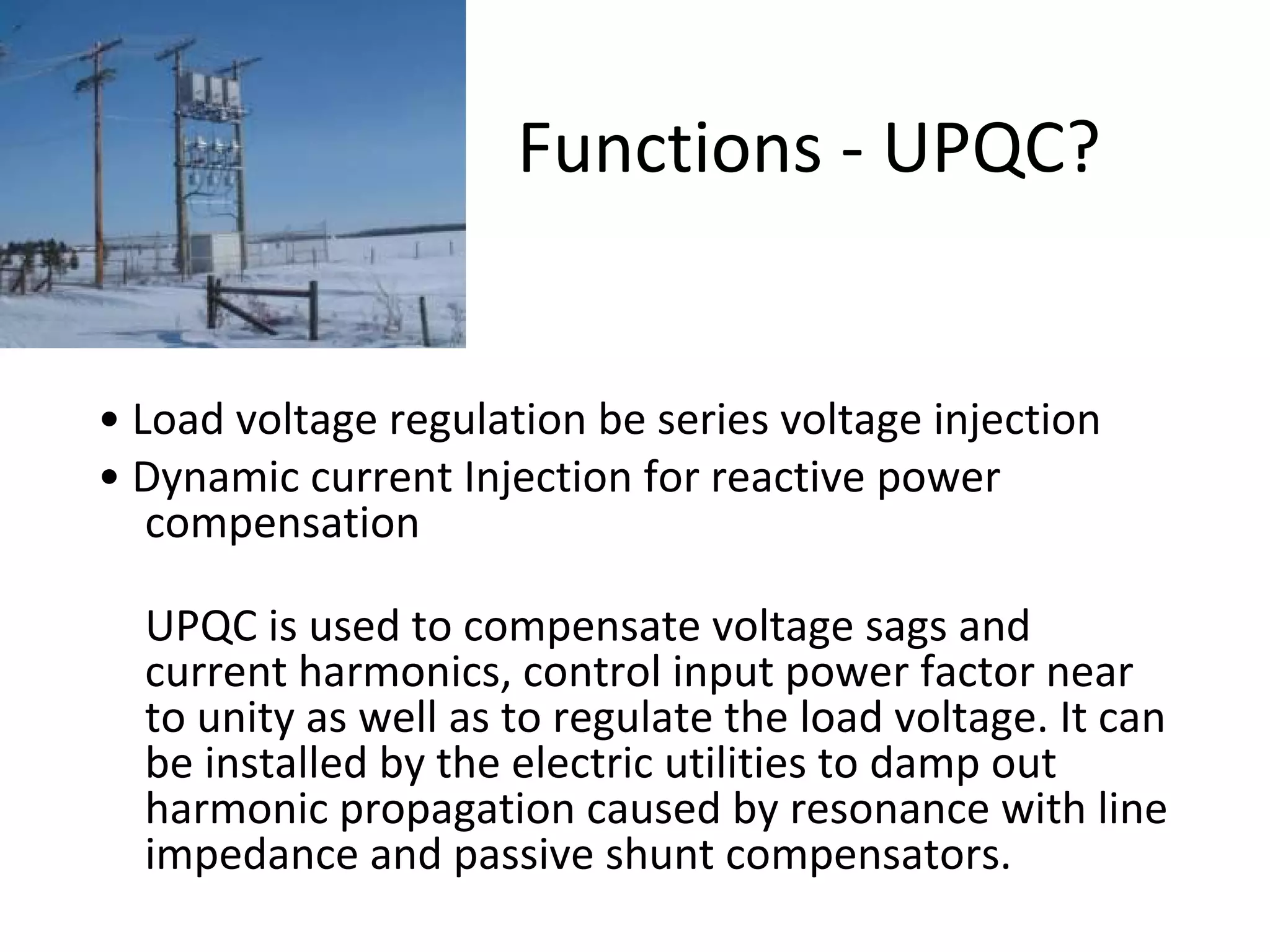
Functions - UPQC?

• Load voltage regulation be series voltage injection
• Dynamic current Injection for reactive power
compensation
UPQC is used to compensate voltage sags and
current harmonics, control input power factor near
to unity as well as to regulate the load voltage. It can
be installed by the electric utilities to damp out
harmonic propagation caused by resonance with line
impedance and passive shunt compensators.
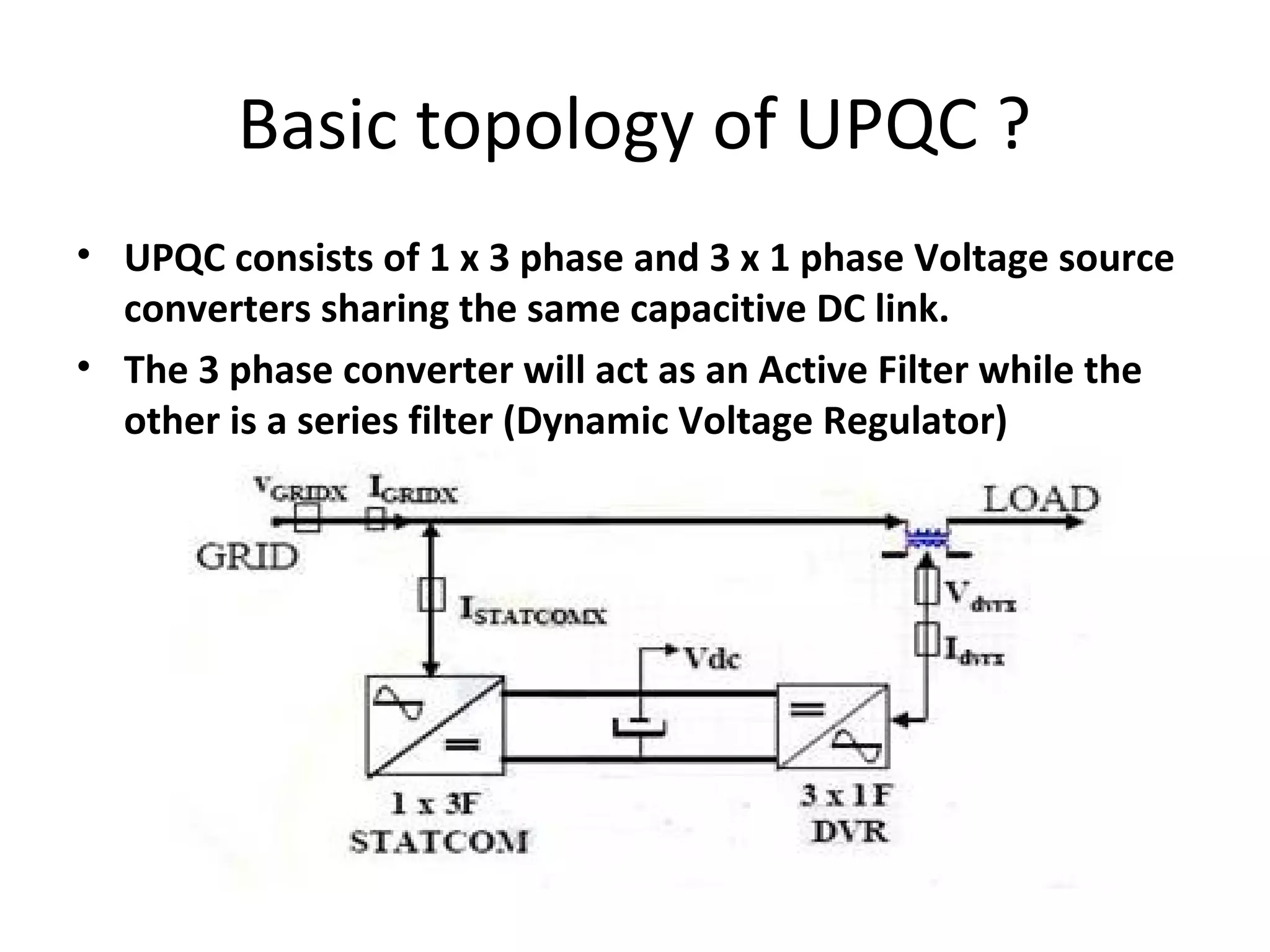
Basic topology of UPQC ?
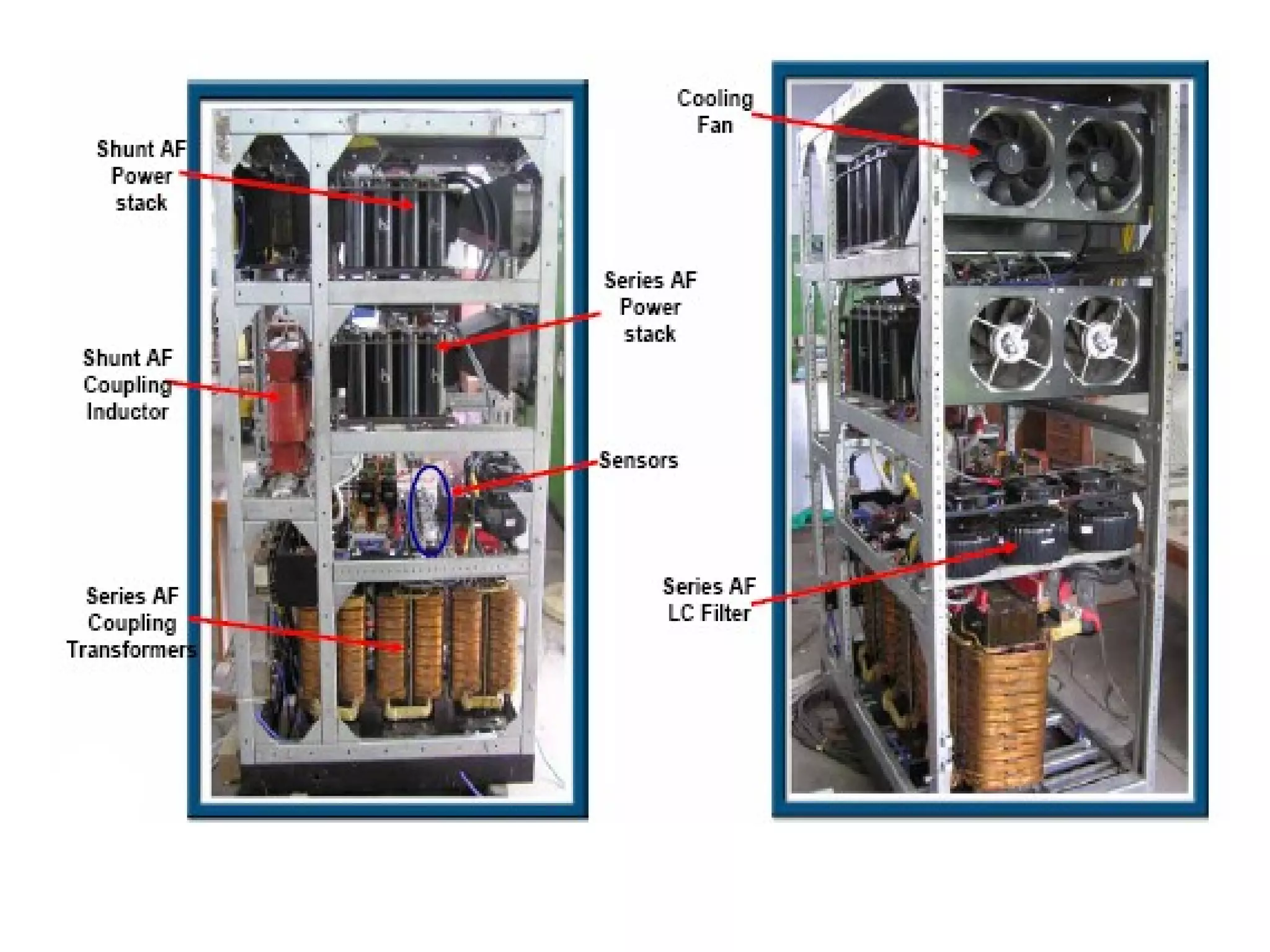
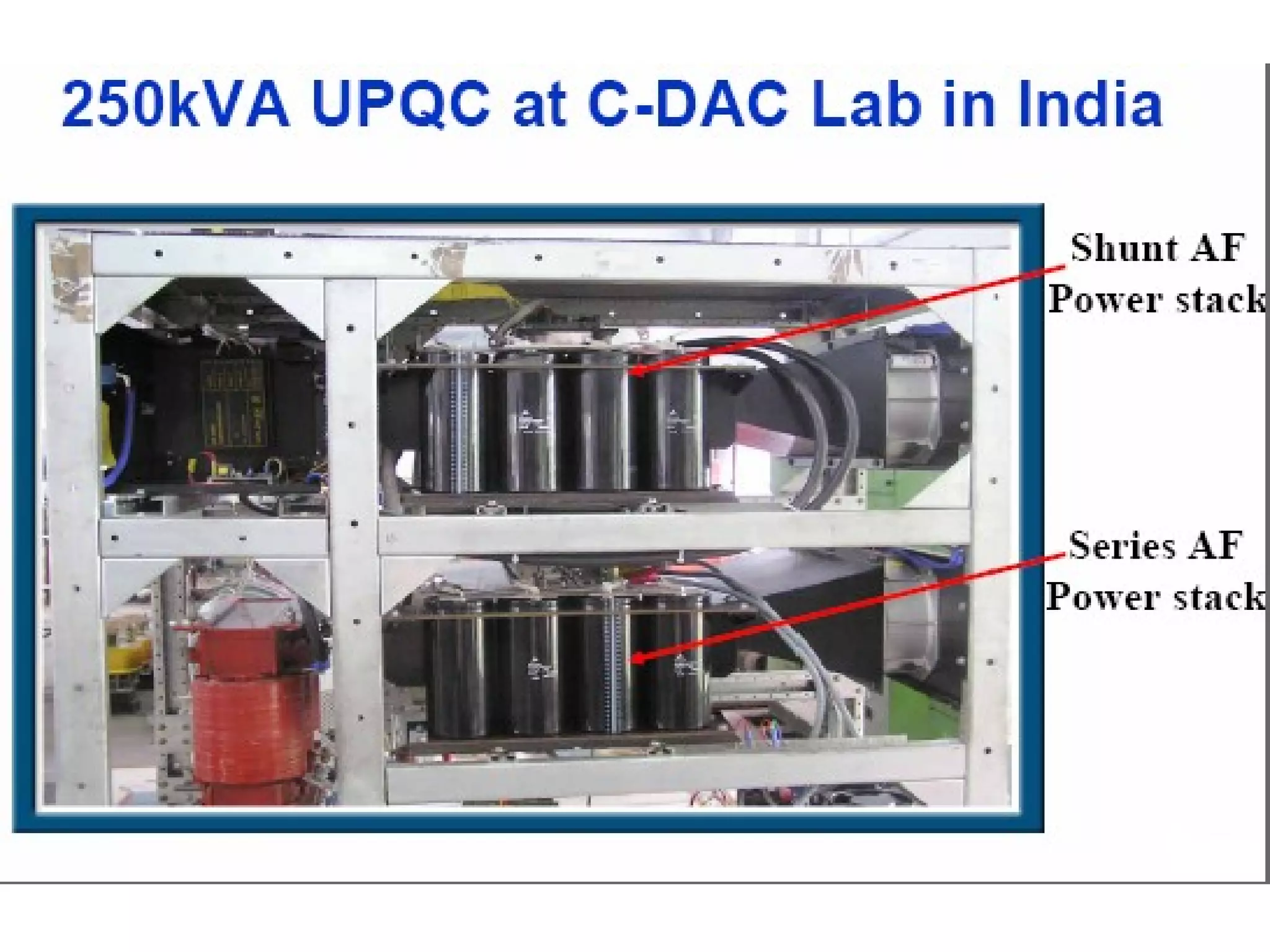
• UPQC consists of 1 x 3 phase and 3 x 1 phase Voltage source
converters sharing the same capacitive DC link.
• The 3 phase converter will act as an Active Filter while the
other is a series filter (Dynamic Voltage Regulator)
35
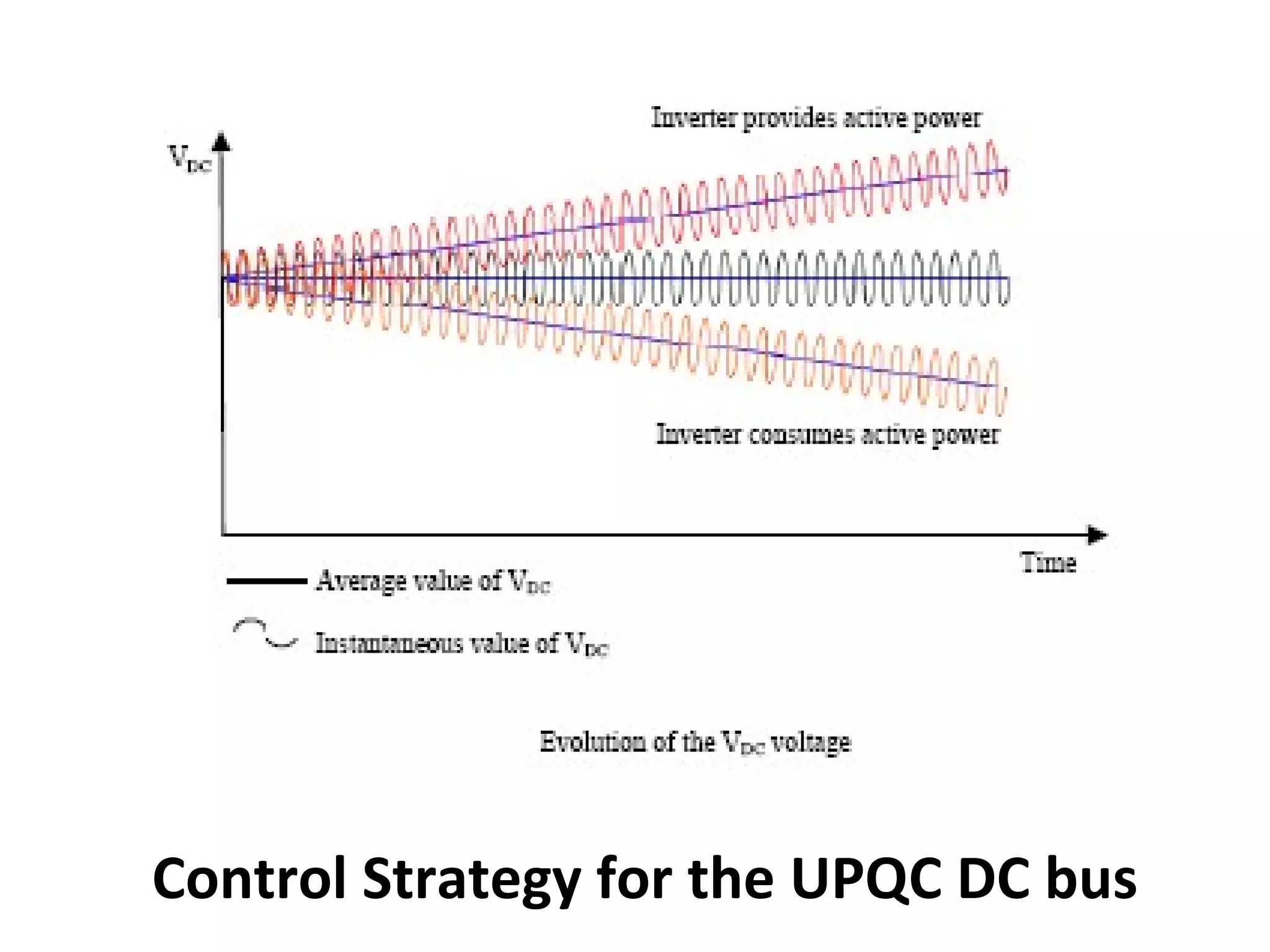
Control Strategy for the UPQC DC bus
45/155
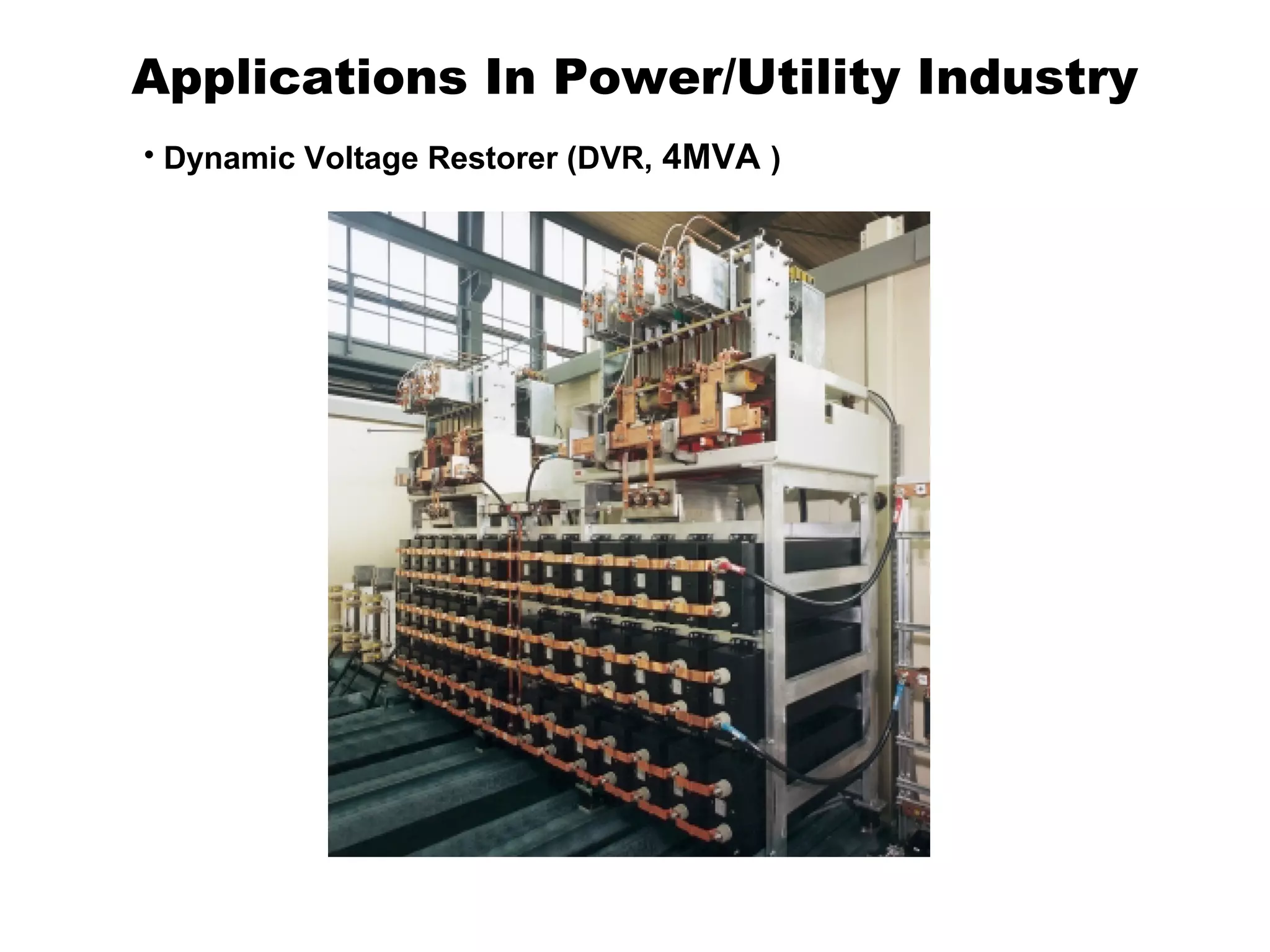
Applications In Power/Utility Industry
• Dynamic Voltage Restorer (DVR, 4MVA )
Applications In Power/Utility Industry
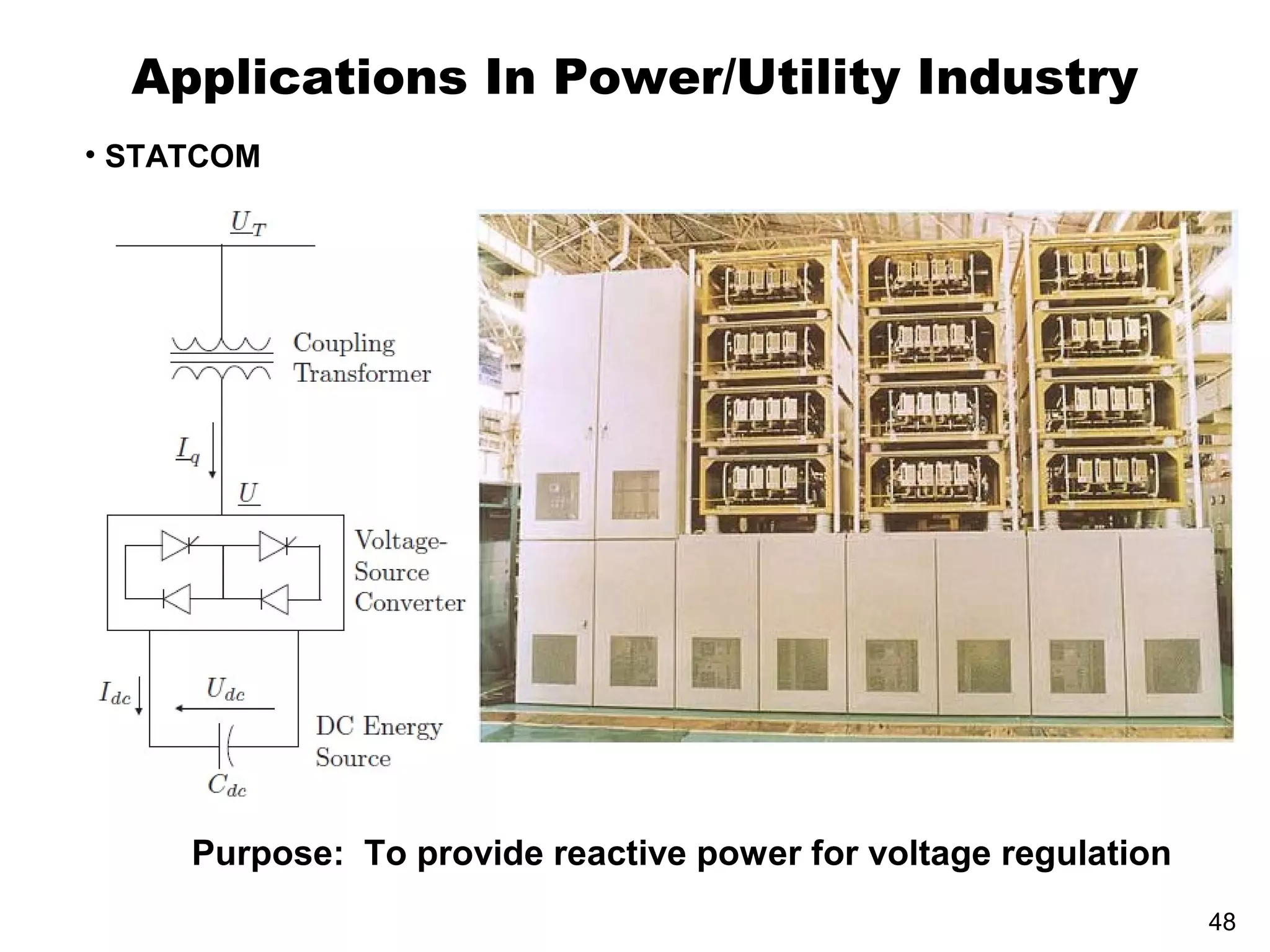
• STATCOM

Purpose: To provide reactive power for voltage regulation
48
Future Trends
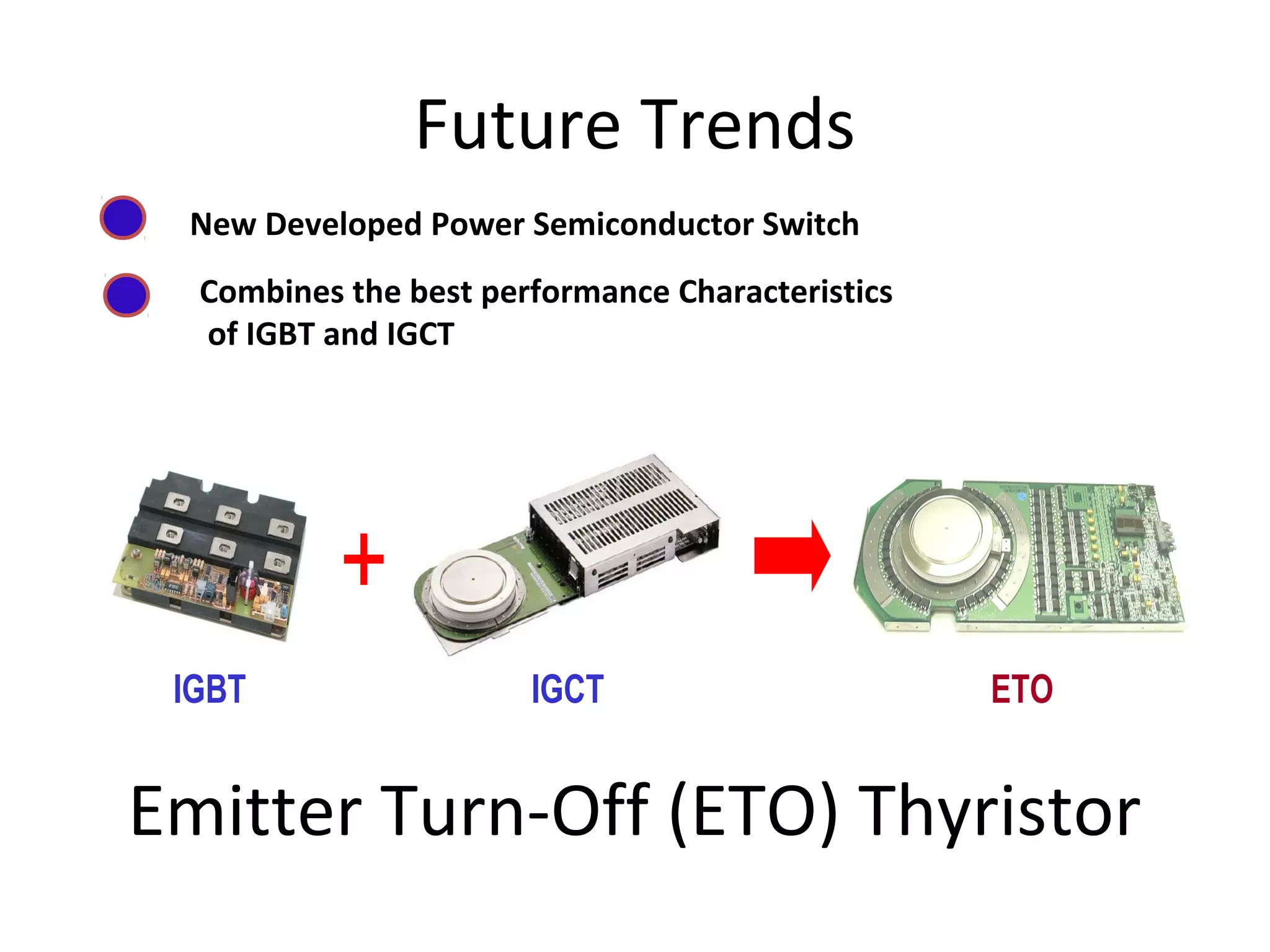
New Developed Power Semiconductor Switch
Combines the best performance Characteristics
of IGBT and IGCT

=

+
IGBT

IGCT

ETO

Emitter Turn-Off (ETO) Thyristor
Conclusions
A Balanced and Cautious Application
The acceptance of the new tools and technologies will take time,
due to the computational requirements and educational barriers.
The flexibility and adaptability of these new techniques indicate that
they will become part of the tools for solving power quality
problems in this increasingly complex electrical environment.
The implementation and use of these advanced techniques needs
to be done with much care and sensitivity. They should not
replace the engineering understanding of the electromagnetic
nature of the problems that need to be solved.

55


G. J. Porter and J. A. V. Sciver, “Power Quality Solutions: Case Study for
Troubleshooters”, Fairmont Press, Inc., 1999.



J. Arrillaga, N. R. Watson and S. Chen, “Power System Quality Assessment”,
John Wiley & Sons, Inc., New York, 2000.



M. H. J. Bollen, “Understanding Power Quality Problems”, Standard Publishers
Distributors, First Indian Edition, 2001, Delhi.



J. Schlabbach, D. Blume and T. Stephanblome, “Voltage Quality in Electrical
Power Systems, 2001, U. K. ISBN 0-85296-975-9.



IEEE Guide for Application and Specification of Harmonic Filters, IEEE
Standard 1573, 2003.
Ajal UPQC

Ajal UPQC

  • 1.
    UPQC a novelmethod to efficiently utilize Sustainable / Alternate Energy Sources AJAL.A.J Assistant Professor –Dept of ECE, UNIVERSAL ENGINEERING COLLEGE MAIL: ec2reach@gmail.com Mob: 8907305642 PSERC
  • 3.
  • 4.
    DISTRIBUTED GENERATION FUEL CELLS MICROTURBINES DIESELSETS RELIABILITY ENHANCEMENT ENVIRONMENTAL ISSUES MOTIVATION COGEN TRANSMISSION APPLICATIONS CONGESTION PSERC
  • 5.
    ELECTRONIC SOLUTIONS FOR POWERCONDITIONING Inject series voltage for phase control / exchange energy between phases Back - to - back rectifier / DC link / inverter Shunt positioning in system to inject current PSERC
  • 6.
    What is Powerquality ?   Definition : “Power quality problem is any power problem manifested in voltage, current, or frequency deviation that results in failure or misoperation of customer equipment”. Power quality can be simply defined as shown in the interaction diagram: •Voltage Sags •Voltage Swells •Blackouts/Brownout s •Transient Voltage Quality Current Quality •Flickering •Waveform Distortion Power Quality •Arc Type •Temporal •Converter Type •Inrush •Overcurrent •Harmonics Electrical Grid Utility Nonlinear Loads Industrial/Commercial/Residential Consumers •Saturation Type •NLL-Analog/Digital Switching 6
  • 7.
    What causes powerquality problems? • Internal factors: faults o lightning strikes on transmission lines or distribution feeders, equipment failures etc External factors: Transformer energisation. Capacitor or feeder switching, Power electronic loads, Arc furnace and induction heating systems switching on or off of large loads etc.
  • 8.
    Why are weconcerned about PQ All nonlinear and time varying temporal type electric loads fall generally in two wide categories, namely the analog arc (inrush/saturation) type and digital converter (power electronic) switching type. Key Problems: 1. 2. 3. 4. 5. 6. 7. Damage to sensitive equipment Interference Malfunction Extra losses Personnel Safety issues Poor Utilization Poor Power Factor. 8
  • 9.
    power quality auditof a business? • Does the facilities wiring and grounding meet code and more impor tantly is it adequate to meet their power   needs from a power quality stand point ? • What is the quality of the ac voltage supplying the equipment ?
  • 10.
    Electricity Market De-Regulation Means: Service Security  Service Quality  Competition  Efficient Utilization  Demand Side Management 10
  • 11.
    Voltage Power QualityProblems • • • • • • • • • Voltage Sag Voltage Swell Voltage Interruption Under/ Over Voltage Voltage Flicker Harmonic Distortion Voltage Notching Transient Disturbance Outage and frequency variation
  • 12.
    Current Based PowerQuality Problems • Reactive Power Compensation • Voltage Regulation • Current Harmonics Compensation • Load Unbalancing (for 3-phase systems) • Neutral Current Compensation (for 3-phase 4-wire systems)
  • 13.
    Power quality issuesin a typical industrial installation
  • 14.
    Two Main PowerQuality Problems  Harmonics and Reactive current drawn by the loads.  Voltage Sag,Swell,Unbalance etc.
  • 15.
    Power Electronic Controllersin Utility Systems SOLID-STATE BREAKER SENSITIVE LOAD SOLID-STATE CURRENT LIMITER COMPENSATED VOLTAGE, POWER FACTOR HARMONICS, DSTATCOM REDUCED SAGS, TRANSIENTS, HARMONICS ENERGY STORAGE DYNAMIC NON-LINEAR LOAD DVR SENSITIVE LOAD ENERGY STORAGE UNINTERRUPTED SUPPLY SSTS CRITICAL LOAD
  • 17.
    Characterization Methods . BroadCategories Transients Short duration voltage variation Specific Categories Impulsive Oscillatory Sag Swel Interruption Under voltage Long duration voltage variation Over voltage Voltage Unbalance Waveform distortion Harmonics Notching Voltage Flicker
  • 18.
  • 19.
  • 20.
    Custom Power Devices DistributionStatic Compensator Distribution Voltage Restorer Unified Power Quality Compensator (DSTATCOM) (DVR) (UPQC)
  • 21.
  • 22.
    Distribution Static Compensator (D-STATCOM) Functions ReactivePower Compensation Voltage Regulation Unbalance Compensation (for 3-phase systems) Neutral Current Compensation (for 3-phase 4-wire systems)
  • 23.
    Solution of HarmonicMitigation Using Power Filters Passive Filters Active Filters Shunt Shunt Series Series Hybrid Hybrid UPQC Hybrid Filters Several Combinations are possible for hybrid of active and passive
  • 24.
    STATCOM H Seriesis a Harmonic filter IGBT DSP CONTROLLER
  • 25.
  • 26.
    Distribution Voltage Restorer(DVR) Functions Reactive Power Compensation Voltage Regulation Compensation for Voltage sag and Swell Unbalance Voltage Compensation (for 3-phase systems)
  • 27.
  • 28.
  • 29.
    Applications In Power/UtilityIndustry • Dynamic Voltage Restorer (DVR) Basic Operation of DVR 29
  • 30.
    Improving of Power Qualityin Distribution Systems with UPQC Under Non-Linear Load Condition
  • 31.
    Unified Power QualityCompensator (UPQC) Functions Reactive Power Compensation Voltage Regulation Compensation for Voltage sag and swell Unbalance Compensation for current and voltage (for 3-phase systems) Neutral Current Compensation (for 3-phase 4-wire systems)
  • 32.
    UPQC ? ?? UPQC stands for Unified Power Quality Conditioner. UPQC is an active series / shunt power line conditioner. • It is used to compensate power quality issues such as Voltage sags, swells, Voltage imbalance, flicker, harmonics and reactive current. • It is a combination of a STATCOM as well as a series compensating stage connected before the load in series with the power network using a matching transformer.
  • 33.
    Functions - UPQC? •Load voltage regulation be series voltage injection • Dynamic current Injection for reactive power compensation UPQC is used to compensate voltage sags and current harmonics, control input power factor near to unity as well as to regulate the load voltage. It can be installed by the electric utilities to damp out harmonic propagation caused by resonance with line impedance and passive shunt compensators.
  • 34.
    Basic topology ofUPQC ? • UPQC consists of 1 x 3 phase and 3 x 1 phase Voltage source converters sharing the same capacitive DC link. • The 3 phase converter will act as an Active Filter while the other is a series filter (Dynamic Voltage Regulator)
  • 35.
  • 44.
    Control Strategy forthe UPQC DC bus
  • 45.
  • 47.
    Applications In Power/UtilityIndustry • Dynamic Voltage Restorer (DVR, 4MVA )
  • 48.
    Applications In Power/UtilityIndustry • STATCOM Purpose: To provide reactive power for voltage regulation 48
  • 54.
    Future Trends New DevelopedPower Semiconductor Switch Combines the best performance Characteristics of IGBT and IGCT = + IGBT IGCT ETO Emitter Turn-Off (ETO) Thyristor
  • 55.
    Conclusions A Balanced andCautious Application The acceptance of the new tools and technologies will take time, due to the computational requirements and educational barriers. The flexibility and adaptability of these new techniques indicate that they will become part of the tools for solving power quality problems in this increasingly complex electrical environment. The implementation and use of these advanced techniques needs to be done with much care and sensitivity. They should not replace the engineering understanding of the electromagnetic nature of the problems that need to be solved. 55
  • 56.
     G. J. Porterand J. A. V. Sciver, “Power Quality Solutions: Case Study for Troubleshooters”, Fairmont Press, Inc., 1999.  J. Arrillaga, N. R. Watson and S. Chen, “Power System Quality Assessment”, John Wiley & Sons, Inc., New York, 2000.  M. H. J. Bollen, “Understanding Power Quality Problems”, Standard Publishers Distributors, First Indian Edition, 2001, Delhi.  J. Schlabbach, D. Blume and T. Stephanblome, “Voltage Quality in Electrical Power Systems, 2001, U. K. ISBN 0-85296-975-9.  IEEE Guide for Application and Specification of Harmonic Filters, IEEE Standard 1573, 2003.