International Journal of Power Electronics and Drive System (IJPEDS)
Vol. 6, No. 1, March 2015, pp. 10~17
ISSN: 2088-8694  10
Journal homepage: http://iaesjournal.com/online/index.php/IJPEDS
Enhancement of Power Quality by an Application FACTS
Devices
Prashant Kumar
Departement of Electrical Engineering, Ashokrao Mane Group of Institutes, Shivaji University, Maharshtra, India
Article Info ABSTRACT
Article history:
Received Aug 12, 2014
Revised Nov 18, 2014
Accepted Dec 5, 2014
The paper narrates widespread use of electrical energy by modern
civilization has necessitated producing bulk electrical energy economically
and efficiently. The Flexible AC Transmission system (FACTS) is a new
technology based on power electronics, which offers an opportunity to
enhance controllability, stability, and power transfer capability of AC
transmission systems. Here SVC has been developed with the combination of
TCSC and TCR. The paper contains simulation models of Thyristor
controlled Series Capacitor (TCSC) and Thyristor controlled Reactor (TCR)-
based Static VAR Compensator (SVC) which are the series and shunt
Flexible AC Transmission Systems (FACTS) devices. The fact devices are
designed by considering the line losses and their stability. The design and
simulations of TCSC and TCR-based SVC shows the effectiveness of result
using the MATLAB/Simulink. The designed system will try to reduce the
voltage drops and electrical losses in the network without the possibility of
transient especially in case of long transmission system. Student feedback
indicates that this package is user-friendly and considerably effective for
students and researchers to study theory of controlled reactor compensators,
series capacitor compensator, and the reactive power control and voltage
regulation
Keyword:
Facts Controller
Matlab/Simulink
Thyristor Controlled Reactor
Thyristor Controlled Series
Capacitor
Copyright © 2015 Institute of Advanced Engineering and Science.
All rights reserved.
Corresponding Author:
Prashant Kumar,
Departement of Electrical Engineering,
Ashokrao Mane Group of Institutes, Shivaji University,
Kolhapur, Shivaji University, Maharshtra, India.
Email: prashant2685@gmail.com
1. INTRODUCTION
Since from the last decade we facing problems to meet the demand of energy as because of
industrial growth of a nation requires increased consumption of energy, particularly electrical energy. This
has led to increase the generation and transmission facility to meet the increasing demand. For generation,
transmission, distribution and utilization of electrical energy, 3 phase AC systems are used universally. It is
beneficial to use AC system because of its features like reduction of electrical losses, increasing transmission
efficiency and capacity, better voltage regulation, reduction in conducting material, flexibility for growth and
possibility of interconnection. FACTS Controller is defined as a power electronic-based system and the other
static equipment that provide control of one or more AC transmission system parameters. This paper
describes basic types of FACTS controllers. Use of HVAC is economical till breakeven point having distance
around 800km only, after this point HVAC become much costlier. The corona effects tend to be highly
significant for HVAC and the design of AC conductors based on the corona limitations gives a cross-section
much larger than that with respect to economical power transfer limits. Also it needs heavy supportive
structures that lead to erection difficulties. Stability of AC networks is very low due to the line inductive
reactance. Voltage control is difficult for long line due to series inductance and capacitance and requires
more complex circuits. Hence the reliability issue needs to be addressed seriously. To compensate drawback
IJPEDS ISSN: 2088-8694 
Enhancement of Power Quality by an Application FACTS Devices (Prashant Kumar)
11
of HVAC mention above we require HVDC transmission system. The reliability of HVDC is quite good. A
DC line can carry as much power with two conductors as an AC line with three conductors of the same line.
In HVDC there are less power losses, absence of skin effect, less corona effect as compared to AC. No
compensation is required, no limits for power transfer and control of voltage is easier.It is not possible and
economical to replace already exists AC transmission system by HVDC up to certain breakeven level of
power as well as distance. The converter required at both the end of the line have proved to be reliable but
they are much more expensive than the conventional equipments. HVDC converters need complex cooling
systems. Maintenance of insulation is more in HVDC. The DC system cannot be employed for a distribution,
sub transmission and the backbone transmission. Voltage transformation is not easier in case of DC; hence it
has to be accomplished on the AC side of system. So it is not much suitable for transmission
interconnections.
Power system engineers are currently facing challenges to increase the power transfer capabilities of
existing transmission system. This is where the Flexible AC Transmission Systems (FACTS) technology
comes into effect. With relatively low investment, compared to new transmission or generation facilities, the
FACTS technology allows the industries to better utilize the existing transmission and generation reserves,
while enhancing the power system performance. Moreover, the current trend of deregulated electricity
market also favors the FACTS controllers in many ways. FACTS controllers in the deregulated electricity
market allow the system to be used in more flexible way with increase in various stability margins. FACTS
controllers are products of FACTS technology; a group of power electronics controllers expected to
revolutionize the power transmission and distribution system in many ways. The FACTS controllers clearly
enhance power system performance, improve quality of supply and also provide an optimal utilization of the
existing resources. Thyristor Controlled Series Compensator (TCSC) is a key FACTS controller and is
widely recognized as an effective and economical means to enhance power system stability. In this paper an
overview to the general types of FACTS controllers is given along with the simulation of TCSC FACTS
controller using SIMULINK. Analysis of the simulated TCSC shows similar functions as a physical one.
2. THEORY OF THYRISTOR-CONTROLLED AND THYRISTOR-SWITCHED REACTOR (TCR
AND TSR)
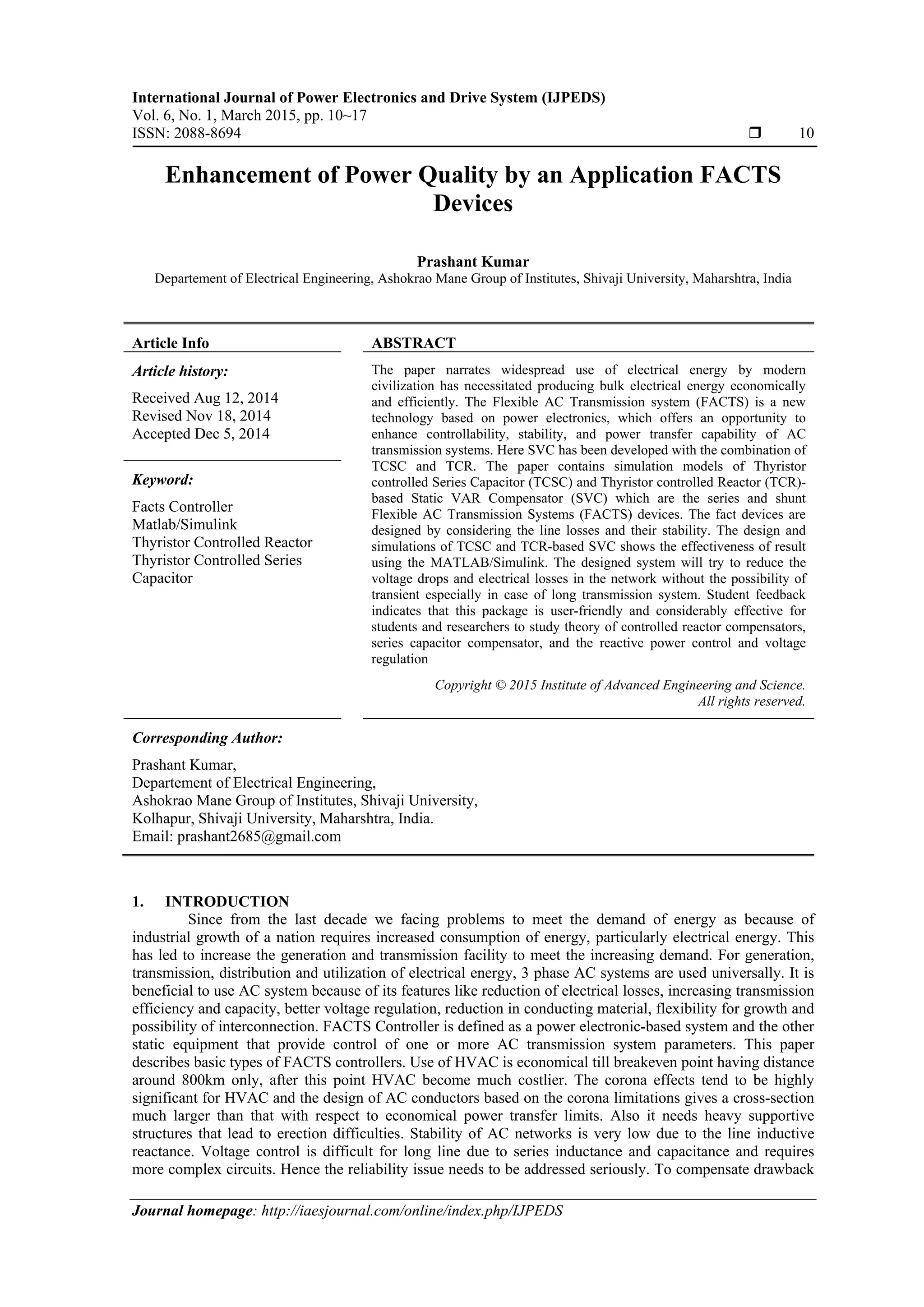
An elementary single phase Thyristor-controlled reactor (TCR) is shown in Figure 1.
Figure 1. Basic Thyristor-controlled reactor (TCR) firing Delay Angle Control and operating waveform
It consists of a fixed reactor of inductance L, and a bidirectional thyristors valve or a switch sw. The
current in the reactor can be controlled from maximum to zero by the method of firing delay angle control.
That is, closure of the thyristors valve is delayed with respect to the peak of the applied voltage in each half
cycle and thus the duration of the current conduction intervals is controlled. This methods of current control
is illustrated separately for the positive and negative half cycles in Figure 1, where the applied voltage v and
the rector current iL(α), at zero delay angle and at arbitrary α delay angle, are shown.
The current in the reactor can be expressed with, v (t) = V cos ωt as follow:
iL 	 	 sin sin (1)
Where V is the amplitude of the applied ac voltage, L is the inductance of the thyristor-controlled reactor,
and ω is the angular frequency of the applied voltage.The TCR can control the fundamental current
continuously from zero (valve open) to the maximum (valve closed).
 ISSN: 2088-8694
IJPEDS Vol. 6, No. 1, March 2015 : 10 – 17
12
SVC Configurations: Providing reactive shunt compensation with shunt-connected capacitors and
reactors is a well-established technique to get a better voltage profile in a power system [2]. The basic form
of reactive power compensation required, to compensate reactive power loads, is the fixed shunt capacitors
being well distributed across the network and located preferably closed to the loads. This would ensure
reasonable voltage profile during steady state condition. However, this may not be adequate to ensure
stability under overload or contingency conditions. Shunt capacitors are inexpensive but lack dynamic
capabilities, thus some form of dynamically controlled reactive power compensation becomes essential. The
phase angle between the end voltages, determined by the real component of the line current, is not affected
by the shunt compensation. Similarly, adding a reactor instead of a capacitor in shunt will reduce the voltage.
Instead of mechanical switching (using circuit breakers) of these devices, we can use thyristor valves, thereby
increasing the control capability radically. This approach is called static VA R compensation (SVC).
Figure 2. Basic configuration static var compensator
SVC can be of one of the following types:
1. Thyristor controlled Reactor (TCR)
2. TCR plus Fixed Capacitor (FC)
3. Thyristor switched Capacitor (TSC)
4. TSC plus TCR
Figure 2 is a one-line diagram of a typical static VAR system for the transmission application. TSC
plus TCR is very popular and most effective. Fig 3 gives the general idea of realization of SVC using TSC
plus TCR scheme. The idea is to sense the voltage of the line and keep it stable by introducing capacitance or
inductance in the circuit.
The Figure 3 presents an equivalent circuit of the TCR. The TCR consists of two thyristor in anti-
parallel, a reactor. Also in the three phase applications, the basic TCR elements are connected in delta. A
SMIB system with a TCR based SVC as shown in Figure 4. The shunt controller is injects current into the
line at point of common coupling (PCC). The main function of TCR is to current controlled by controlling
the firing angles of thyristor. So obviously power can be controlled. Since control can be achieved in every
cycle of the voltage waveform by (controlling the conduction time of thyristors), the control is very fast and
accurate.
Figure 3. Basic structure of TCR Figure 4. SMIB system with a TCR based SVC
IJPEDS ISSN: 2088-8694 
Enhancement of Power Quality by an Application FACTS Devices (Prashant Kumar)
13
3. THEORY OF THYRISTOR CONTROLLED SERIES CAPACITOR (TCSC)
The basic conceptual TCSC module comprises a series capacitor, C, in parallel with a thyristor-
controlled reactor, LS, as shown in Figure 5(a). A TCSC is a series-controlled capacitive reactance that can
provide continuous control of power on the ac line over a wide range. From the system viewpoint, the
principle of variable-series compensation is simply to increase the fundamental-frequency voltage across
fixed capacitor (FC) in a series- compensated line through appropriate variation of the firing angle [4]. This
enhanced voltage changes the effective value of the series-capacitive reactance.
Simple understanding of TCSC functioning can be obtained by analysing the behaviour of a variable
inductor connected in parallel with an FC, as shown in Figure 5(b).
(a) (b)
Figure 5. TCSC Module (a) Basic module and (b) A Variable inductor connected in shunt with FC
The equivalent impedance, Zeq, of this LC combination is expressed as:
)()
1
( jwL
wc
jZeq 
(2)
The impedance of the FC alone, however, is given by –j(1 / C).
If C− (1 / L) > 0 or, in other words, L > (1 / C), the reactance of the FC is less than that of
the parallel-connected variable reactor and that this combination provides a variable-capacitive reactance are
both implied. Moreover, this inductor increases the equivalent capacitive reactance of the LC combination
above that of the FC. If C− (1 / L) = 0, a resonance develops that results in an infinite capacitive
impedance an obviously unacceptable condition. If, however, C−(1 / L) < 0, the LC combination
provides inductance above the value of the fixed inductor. This situation corresponds to the inductive mode
of the TCSC operation. In the variable-capacitance mode of the TCSC, as the inductive reactance of the
variable inductor is increased, the equivalent-capacitive reactance is gradually decreased. The minimum
equivalent-capacitive reactance is obtained for extremely large inductive reactance or when the variable
inductor is open-circuited, in which the value is equal to the reactance of the FC itself. The behaviour of the
TCSC is similar to that of the parallel LC combination. The difference is that the LC-combination analysis is
based on the presence of pure sinusoidal voltage and current in the circuit, whereas in the TCSC, because of
the voltage and current in the FC and thyristor-controlled reactor (TCR) are not sinusoidal because of
thyristor switching.
The series compensation provided by the TCSC can be adjusted rapidly to ensure specified
magnitudes of power flow along designated transmission lines. This condition is evident from the TCSC’s
efficiency, that is, ability to change its power flow as a function of its capacitive-reactance setting:


 sin
)(
21
12
XCXL
VV
P
(3)
Where:
P12= the power flow from bus 1 to bus 2
V1, V2 = the voltage magnitudes of buses 1 and 2, respectively
XL = the line-inductive reactance
XC = the controlled TCSC reactance combined with fixed-series- capacitor reactance
d = the difference in the voltage angles of buses 1 and 2
 ISSN: 2088-8694
IJPEDS Vol. 6, No. 1, March 2015 : 10 – 17
14
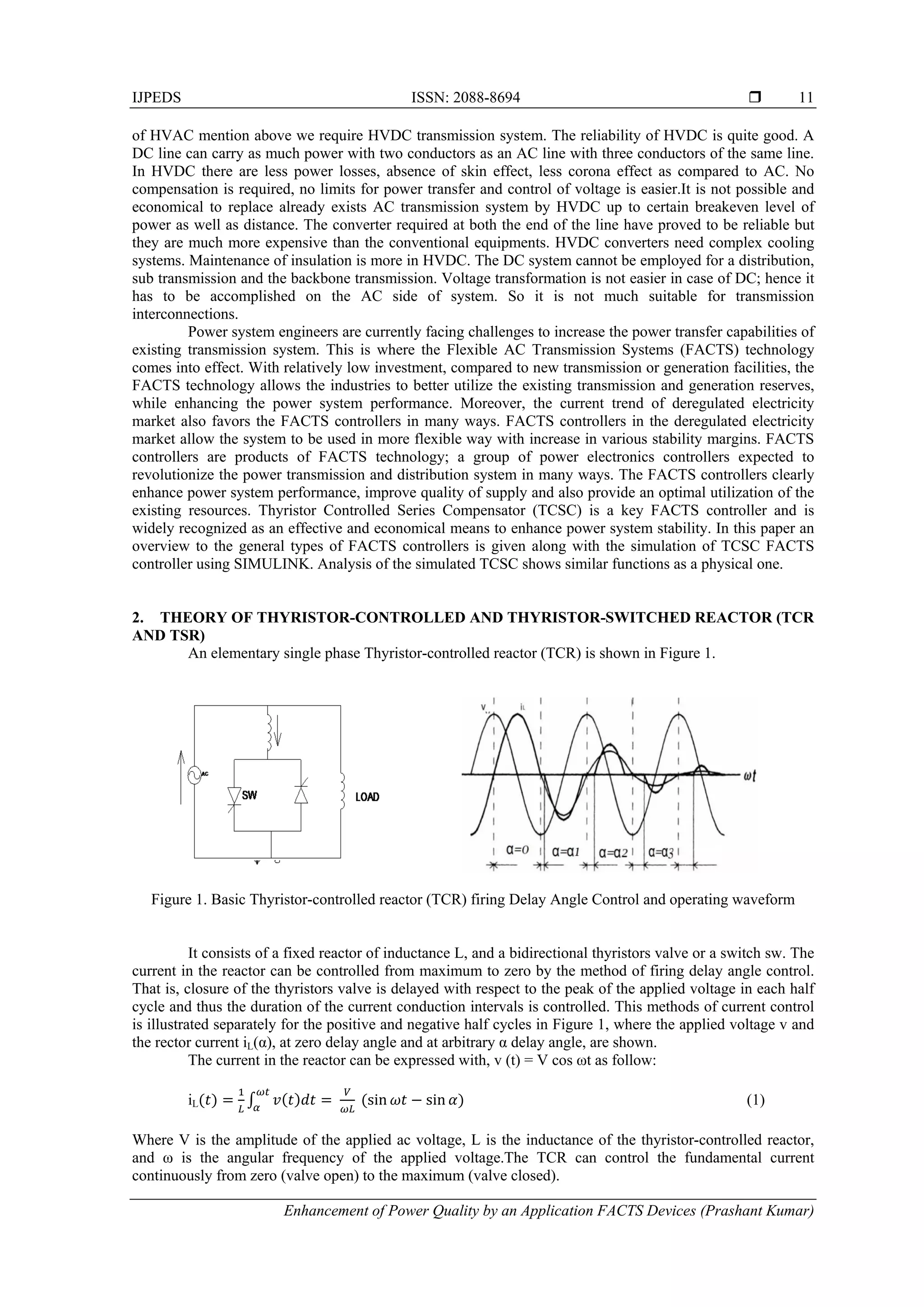
This change in transmitted power is further accomplished with minimal influence on the voltage of
interconnecting buses, as it introduces voltage in quadrature. In contrast, the SVC improves power transfer by
substantially modifying the interconnecting bus voltage, which may change the power into any connected
passive loads. The freedom to locate a TCSC almost anywhere in a line is a significant advantage. Power-
flow control does not necessitate the high-speed operation of power-flow control devices. Hence discrete
control through a TSSC may also be adequate in certain situations. However, the TCSC cannot reverse the
power flow in a line, unlike HVDC controllers and phase shifters.
Figure 5. TCSC controller model
4. RESULTS AND ANALYSIS
4.1. Simulation Model of Shunt Connected TCR on 1-phase Line
In first case study, a single-phase system with TCR is considered.The single-phase transmission line
is simulated using MATLAB/Simulink. In the simulation study, it is assumed that the current source peak
amplitude = 50A, It is connected to capacitive load through Pi transmission line, and the TCR controller is
shunt connected to the transmission line. Analysis and comparison are done based on the results obtained
from the line power of the single-phase line employing the shunt controller, in terms of output power
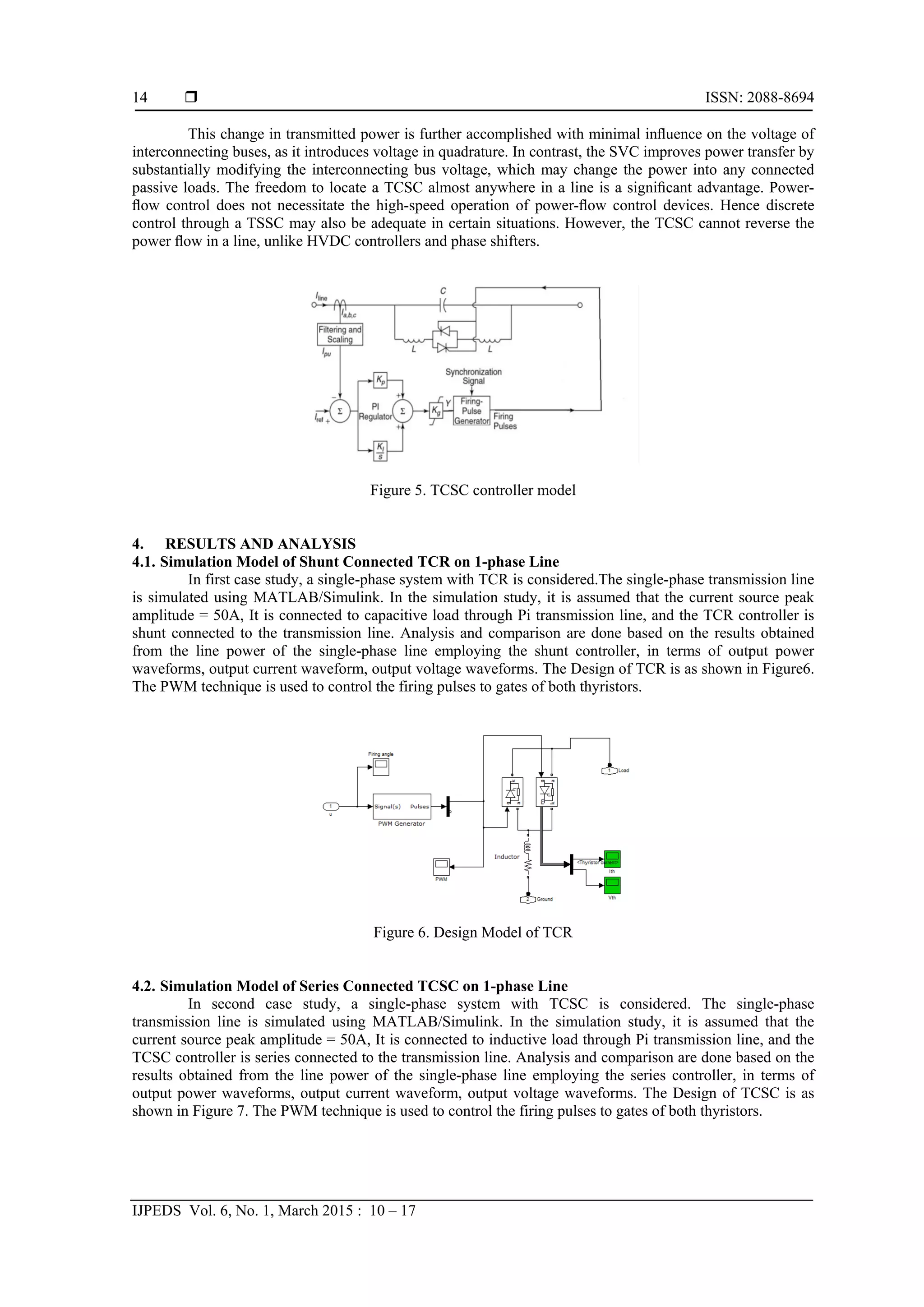
waveforms, output current waveform, output voltage waveforms. The Design of TCR is as shown in Figure6.
The PWM technique is used to control the firing pulses to gates of both thyristors.
Figure 6. Design Model of TCR
4.2. Simulation Model of Series Connected TCSC on 1-phase Line
In second case study, a single-phase system with TCSC is considered. The single-phase
transmission line is simulated using MATLAB/Simulink. In the simulation study, it is assumed that the
current source peak amplitude = 50A, It is connected to inductive load through Pi transmission line, and the
TCSC controller is series connected to the transmission line. Analysis and comparison are done based on the
results obtained from the line power of the single-phase line employing the series controller, in terms of
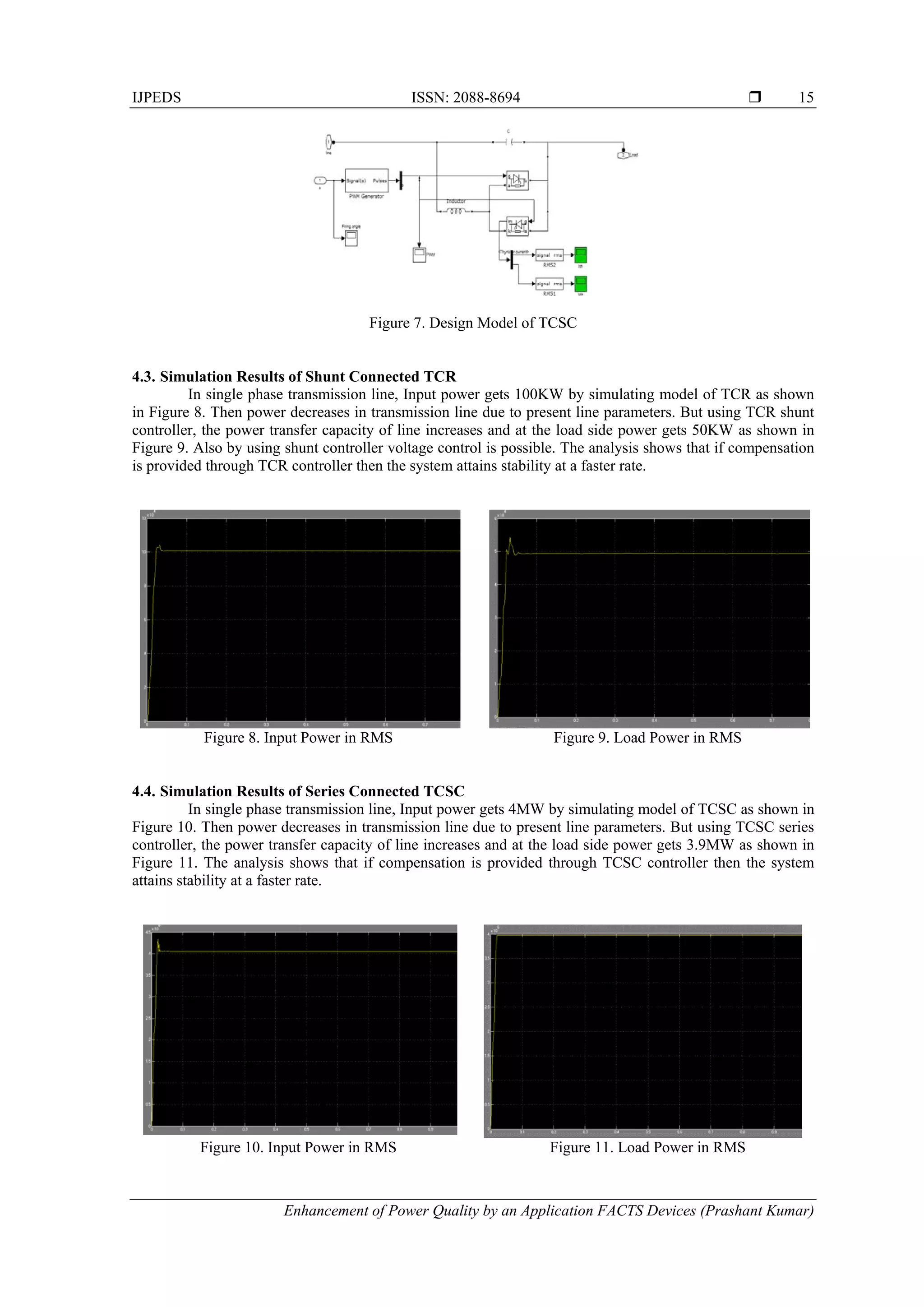
output power waveforms, output current waveform, output voltage waveforms. The Design of TCSC is as
shown in Figure 7. The PWM technique is used to control the firing pulses to gates of both thyristors.
IJPEDS ISSN: 2088-8694 
Enhancement of Power Quality by an Application FACTS Devices (Prashant Kumar)
15
Figure 7. Design Model of TCSC
4.3. Simulation Results of Shunt Connected TCR
In single phase transmission line, Input power gets 100KW by simulating model of TCR as shown
in Figure 8. Then power decreases in transmission line due to present line parameters. But using TCR shunt
controller, the power transfer capacity of line increases and at the load side power gets 50KW as shown in
Figure 9. Also by using shunt controller voltage control is possible. The analysis shows that if compensation
is provided through TCR controller then the system attains stability at a faster rate.
Figure 8. Input Power in RMS Figure 9. Load Power in RMS
4.4. Simulation Results of Series Connected TCSC
In single phase transmission line, Input power gets 4MW by simulating model of TCSC as shown in
Figure 10. Then power decreases in transmission line due to present line parameters. But using TCSC series
controller, the power transfer capacity of line increases and at the load side power gets 3.9MW as shown in
Figure 11. The analysis shows that if compensation is provided through TCSC controller then the system
attains stability at a faster rate.
Figure 10. Input Power in RMS Figure 11. Load Power in RMS
 ISSN: 2088-8694
IJPEDS Vol. 6, No. 1, March 2015 : 10 – 17
16
4.5. PID Controller is Designed for TCR and TCSC
The PID controller is a very simple controller, but the major drawback is that there is no analytical
way of finding the optimal set of parameters KP, KI, and KD. The conventional Proportional Integration
Derivative (PID) structure remains the controllers of choice in many industrial applications because of its
structural simplicity, reliability and the favourable ratio between performance and cost. Beyond these
benefits, this controller also offers simplified dynamic modelling, lower user skill requirement, and minimal
development effort. The design of PID controller is same for TCR and TCSC.
5. CONCLUSION
This paper presents the TCR and TCSC controller developed by using the MATLAB/Simulink. The
developed software package consists of two main application menus which are the TCSC menu and the TCR-
based SVC menu. These menus include seventeen simulation models about different applications of TCSC
and TCR-based SVC. The effects of the TCSC and TCR-based SVC on load voltage have been studied in the
single-phase and three-phase system with static load types. Besides, a single-machine infinite-bus system
with static load type has been studied. The studied power systems are two and three bus with a long
transmission line model. In this paper, we have demonstrated few applications of the FACTS controller such
as a single-phase system with TCSC for the static load, and a SMIB system with TCR-based SVC for the
static load. The simulation results show that significant improvement on voltage regulation and reactive
power compensation is obtained by using the TSC and the TCR-based SVC. A survey which has six
statements regarding facts controller was prepared. According to the survey, majority of the students thought
that the MATLAB software package is user-friendly, easy to understand and several system parameters could
be changed easily. This package is considerably effective for students and instructors to study theory of
controlled compensators, the reactive power control and voltage regulation. Future work will concentrate on
designing laboratory prototypes of the TCSC and the TCR-based SVC devices to provide the ability to
experimentally verify the MATLAB software package.
REFERENCES
[1] NG Hingorani, L Gyugyi, Understanding FACTS, IEEE Press, New York, 1999.
[2] Aboytes F, Arroyo G, Villa G. Application of Static V AR Compensators in Longitudinal Power Systems, IEEE
Trans on PAS, 1983; 102: 3460-3466.
[3] R Arulmozhiyal, K Baskaran, Implementation of a Fuzzy PI Controller for Speed Control of Induction Motors
Using FPGA, Journal of Power Electronics, 2010; 10: 65-71.
[4] LAS Pilotto, AR Carvalho, A Bianco, WF Long, FL Alvarado, CL DeMarco, A Edris, The Impact of Different
TCSC Control Methodologies on the Subsynchronous Resonance Problem, Proceedings of EPRI Conference on
FACTS, Washington, DC, 1996.
[5] N Christl, P Luelzberger, M Pereira, K Sadek, PE Krause, AH Montoya, DR Torgerson, BA Vossler, Advanced
Series Compensation with Variable Impedance, Proceedings of EPRI Conference on FACTS, 1990.
[6] RM Mathur, RK Varma, Thyristor-Based FACTS Controllers for Electrical Transmission Systems, IEEE Press,
USA, 2002
[7] M Hedayati, Technical specification and requirements of static VAr compensation (SVC) protection consist of TCR,
TSC and combined TCR/TSC, Proceedings of the 39th International Universities Power Engineering Conference,
Bristol, UK, 2004; 1: 261–264.
[8] CIGRE Working Group 14.18, Thyristor-Controlled Series Compensation, Technical Brochure, Paris, 1996.
[9] A Ghosh, G Ledwich, Modelling and control of thyristor controlled series compensators, IEE Proc. Generation
Transmission and Distribution, 1995; 142(3): 297-304.
[10] D Zhang, et al., Common Mode Circulating Current Control of Interleaved Three-Phase Two-Level Voltage-Source
Converters with Discontinuous Space-Vector Modulation, 2009 IEEE Energy Conversion Congress and Exposition,
2009; 1(6): 3906-3912.
[11] A Gelen, T Yalcinoz, The behaviour of TSR-based SVC and TCR-based SVC installed in an infinite bus system,
Proceedings of the IEEE 25th
Convention Electrical and Electronics Engineers in Israel, Eilat, Israel, 2008; 120–
124.
[12] Z Yinhai, et al., A Novel SVPWM Modulation Scheme, Applied Power Electronics Conference and Exposition,
2009. APEC 2009. Twenty-Fourth Annual IEEE, 2009; 128-131.
[13] BK Johnson, Simulation of TSC and TSSC, Proceedings of the IEEE Power Engineering Society Winter Meeting,
Columbus, USA, 2001; 637–63.
IJPEDS ISSN: 2088-8694 
Enhancement of Power Quality by an Application FACTS Devices (Prashant Kumar)
17
BIBLIOGRAPHY OF AUTHOR
Prof. Prashant Kumar born in Dhanbad, Jharkhand on 2nd
Feb 1985. Completed M-Tech in
Power System from SRM University Kattankulathur, Chennai and Tamilnadu, India in 2013.
Major Field of Studies are Optimization Techniques and Power System Stability. Published
Several Papers in International/National Journals as well as in International and National
Conferences Proceedings (Springer, Elesevier and IEEE Xplore).
Currently working as an Assistant Professor in Ashokrao Mane Group of institution, Faculty of
Engg., Kolhapur, India and research interest areas are Power Quality, Voltage Stability in
Electrical Power System and Renewable Energy System.

Enhancement of Power Quality by an Application FACTS Devices

  • 1.
    International Journal ofPower Electronics and Drive System (IJPEDS) Vol. 6, No. 1, March 2015, pp. 10~17 ISSN: 2088-8694  10 Journal homepage: http://iaesjournal.com/online/index.php/IJPEDS Enhancement of Power Quality by an Application FACTS Devices Prashant Kumar Departement of Electrical Engineering, Ashokrao Mane Group of Institutes, Shivaji University, Maharshtra, India Article Info ABSTRACT Article history: Received Aug 12, 2014 Revised Nov 18, 2014 Accepted Dec 5, 2014 The paper narrates widespread use of electrical energy by modern civilization has necessitated producing bulk electrical energy economically and efficiently. The Flexible AC Transmission system (FACTS) is a new technology based on power electronics, which offers an opportunity to enhance controllability, stability, and power transfer capability of AC transmission systems. Here SVC has been developed with the combination of TCSC and TCR. The paper contains simulation models of Thyristor controlled Series Capacitor (TCSC) and Thyristor controlled Reactor (TCR)- based Static VAR Compensator (SVC) which are the series and shunt Flexible AC Transmission Systems (FACTS) devices. The fact devices are designed by considering the line losses and their stability. The design and simulations of TCSC and TCR-based SVC shows the effectiveness of result using the MATLAB/Simulink. The designed system will try to reduce the voltage drops and electrical losses in the network without the possibility of transient especially in case of long transmission system. Student feedback indicates that this package is user-friendly and considerably effective for students and researchers to study theory of controlled reactor compensators, series capacitor compensator, and the reactive power control and voltage regulation Keyword: Facts Controller Matlab/Simulink Thyristor Controlled Reactor Thyristor Controlled Series Capacitor Copyright © 2015 Institute of Advanced Engineering and Science. All rights reserved. Corresponding Author: Prashant Kumar, Departement of Electrical Engineering, Ashokrao Mane Group of Institutes, Shivaji University, Kolhapur, Shivaji University, Maharshtra, India. Email: prashant2685@gmail.com 1. INTRODUCTION Since from the last decade we facing problems to meet the demand of energy as because of industrial growth of a nation requires increased consumption of energy, particularly electrical energy. This has led to increase the generation and transmission facility to meet the increasing demand. For generation, transmission, distribution and utilization of electrical energy, 3 phase AC systems are used universally. It is beneficial to use AC system because of its features like reduction of electrical losses, increasing transmission efficiency and capacity, better voltage regulation, reduction in conducting material, flexibility for growth and possibility of interconnection. FACTS Controller is defined as a power electronic-based system and the other static equipment that provide control of one or more AC transmission system parameters. This paper describes basic types of FACTS controllers. Use of HVAC is economical till breakeven point having distance around 800km only, after this point HVAC become much costlier. The corona effects tend to be highly significant for HVAC and the design of AC conductors based on the corona limitations gives a cross-section much larger than that with respect to economical power transfer limits. Also it needs heavy supportive structures that lead to erection difficulties. Stability of AC networks is very low due to the line inductive reactance. Voltage control is difficult for long line due to series inductance and capacitance and requires more complex circuits. Hence the reliability issue needs to be addressed seriously. To compensate drawback
  • 2.
    IJPEDS ISSN: 2088-8694 Enhancement of Power Quality by an Application FACTS Devices (Prashant Kumar) 11 of HVAC mention above we require HVDC transmission system. The reliability of HVDC is quite good. A DC line can carry as much power with two conductors as an AC line with three conductors of the same line. In HVDC there are less power losses, absence of skin effect, less corona effect as compared to AC. No compensation is required, no limits for power transfer and control of voltage is easier.It is not possible and economical to replace already exists AC transmission system by HVDC up to certain breakeven level of power as well as distance. The converter required at both the end of the line have proved to be reliable but they are much more expensive than the conventional equipments. HVDC converters need complex cooling systems. Maintenance of insulation is more in HVDC. The DC system cannot be employed for a distribution, sub transmission and the backbone transmission. Voltage transformation is not easier in case of DC; hence it has to be accomplished on the AC side of system. So it is not much suitable for transmission interconnections. Power system engineers are currently facing challenges to increase the power transfer capabilities of existing transmission system. This is where the Flexible AC Transmission Systems (FACTS) technology comes into effect. With relatively low investment, compared to new transmission or generation facilities, the FACTS technology allows the industries to better utilize the existing transmission and generation reserves, while enhancing the power system performance. Moreover, the current trend of deregulated electricity market also favors the FACTS controllers in many ways. FACTS controllers in the deregulated electricity market allow the system to be used in more flexible way with increase in various stability margins. FACTS controllers are products of FACTS technology; a group of power electronics controllers expected to revolutionize the power transmission and distribution system in many ways. The FACTS controllers clearly enhance power system performance, improve quality of supply and also provide an optimal utilization of the existing resources. Thyristor Controlled Series Compensator (TCSC) is a key FACTS controller and is widely recognized as an effective and economical means to enhance power system stability. In this paper an overview to the general types of FACTS controllers is given along with the simulation of TCSC FACTS controller using SIMULINK. Analysis of the simulated TCSC shows similar functions as a physical one. 2. THEORY OF THYRISTOR-CONTROLLED AND THYRISTOR-SWITCHED REACTOR (TCR AND TSR) An elementary single phase Thyristor-controlled reactor (TCR) is shown in Figure 1. Figure 1. Basic Thyristor-controlled reactor (TCR) firing Delay Angle Control and operating waveform It consists of a fixed reactor of inductance L, and a bidirectional thyristors valve or a switch sw. The current in the reactor can be controlled from maximum to zero by the method of firing delay angle control. That is, closure of the thyristors valve is delayed with respect to the peak of the applied voltage in each half cycle and thus the duration of the current conduction intervals is controlled. This methods of current control is illustrated separately for the positive and negative half cycles in Figure 1, where the applied voltage v and the rector current iL(α), at zero delay angle and at arbitrary α delay angle, are shown. The current in the reactor can be expressed with, v (t) = V cos ωt as follow: iL sin sin (1) Where V is the amplitude of the applied ac voltage, L is the inductance of the thyristor-controlled reactor, and ω is the angular frequency of the applied voltage.The TCR can control the fundamental current continuously from zero (valve open) to the maximum (valve closed).
  • 3.
     ISSN: 2088-8694 IJPEDSVol. 6, No. 1, March 2015 : 10 – 17 12 SVC Configurations: Providing reactive shunt compensation with shunt-connected capacitors and reactors is a well-established technique to get a better voltage profile in a power system [2]. The basic form of reactive power compensation required, to compensate reactive power loads, is the fixed shunt capacitors being well distributed across the network and located preferably closed to the loads. This would ensure reasonable voltage profile during steady state condition. However, this may not be adequate to ensure stability under overload or contingency conditions. Shunt capacitors are inexpensive but lack dynamic capabilities, thus some form of dynamically controlled reactive power compensation becomes essential. The phase angle between the end voltages, determined by the real component of the line current, is not affected by the shunt compensation. Similarly, adding a reactor instead of a capacitor in shunt will reduce the voltage. Instead of mechanical switching (using circuit breakers) of these devices, we can use thyristor valves, thereby increasing the control capability radically. This approach is called static VA R compensation (SVC). Figure 2. Basic configuration static var compensator SVC can be of one of the following types: 1. Thyristor controlled Reactor (TCR) 2. TCR plus Fixed Capacitor (FC) 3. Thyristor switched Capacitor (TSC) 4. TSC plus TCR Figure 2 is a one-line diagram of a typical static VAR system for the transmission application. TSC plus TCR is very popular and most effective. Fig 3 gives the general idea of realization of SVC using TSC plus TCR scheme. The idea is to sense the voltage of the line and keep it stable by introducing capacitance or inductance in the circuit. The Figure 3 presents an equivalent circuit of the TCR. The TCR consists of two thyristor in anti- parallel, a reactor. Also in the three phase applications, the basic TCR elements are connected in delta. A SMIB system with a TCR based SVC as shown in Figure 4. The shunt controller is injects current into the line at point of common coupling (PCC). The main function of TCR is to current controlled by controlling the firing angles of thyristor. So obviously power can be controlled. Since control can be achieved in every cycle of the voltage waveform by (controlling the conduction time of thyristors), the control is very fast and accurate. Figure 3. Basic structure of TCR Figure 4. SMIB system with a TCR based SVC
  • 4.
    IJPEDS ISSN: 2088-8694 Enhancement of Power Quality by an Application FACTS Devices (Prashant Kumar) 13 3. THEORY OF THYRISTOR CONTROLLED SERIES CAPACITOR (TCSC) The basic conceptual TCSC module comprises a series capacitor, C, in parallel with a thyristor- controlled reactor, LS, as shown in Figure 5(a). A TCSC is a series-controlled capacitive reactance that can provide continuous control of power on the ac line over a wide range. From the system viewpoint, the principle of variable-series compensation is simply to increase the fundamental-frequency voltage across fixed capacitor (FC) in a series- compensated line through appropriate variation of the firing angle [4]. This enhanced voltage changes the effective value of the series-capacitive reactance. Simple understanding of TCSC functioning can be obtained by analysing the behaviour of a variable inductor connected in parallel with an FC, as shown in Figure 5(b). (a) (b) Figure 5. TCSC Module (a) Basic module and (b) A Variable inductor connected in shunt with FC The equivalent impedance, Zeq, of this LC combination is expressed as: )() 1 ( jwL wc jZeq  (2) The impedance of the FC alone, however, is given by –j(1 / C). If C− (1 / L) > 0 or, in other words, L > (1 / C), the reactance of the FC is less than that of the parallel-connected variable reactor and that this combination provides a variable-capacitive reactance are both implied. Moreover, this inductor increases the equivalent capacitive reactance of the LC combination above that of the FC. If C− (1 / L) = 0, a resonance develops that results in an infinite capacitive impedance an obviously unacceptable condition. If, however, C−(1 / L) < 0, the LC combination provides inductance above the value of the fixed inductor. This situation corresponds to the inductive mode of the TCSC operation. In the variable-capacitance mode of the TCSC, as the inductive reactance of the variable inductor is increased, the equivalent-capacitive reactance is gradually decreased. The minimum equivalent-capacitive reactance is obtained for extremely large inductive reactance or when the variable inductor is open-circuited, in which the value is equal to the reactance of the FC itself. The behaviour of the TCSC is similar to that of the parallel LC combination. The difference is that the LC-combination analysis is based on the presence of pure sinusoidal voltage and current in the circuit, whereas in the TCSC, because of the voltage and current in the FC and thyristor-controlled reactor (TCR) are not sinusoidal because of thyristor switching. The series compensation provided by the TCSC can be adjusted rapidly to ensure specified magnitudes of power flow along designated transmission lines. This condition is evident from the TCSC’s efficiency, that is, ability to change its power flow as a function of its capacitive-reactance setting:    sin )( 21 12 XCXL VV P (3) Where: P12= the power flow from bus 1 to bus 2 V1, V2 = the voltage magnitudes of buses 1 and 2, respectively XL = the line-inductive reactance XC = the controlled TCSC reactance combined with fixed-series- capacitor reactance d = the difference in the voltage angles of buses 1 and 2
  • 5.
     ISSN: 2088-8694 IJPEDSVol. 6, No. 1, March 2015 : 10 – 17 14 This change in transmitted power is further accomplished with minimal influence on the voltage of interconnecting buses, as it introduces voltage in quadrature. In contrast, the SVC improves power transfer by substantially modifying the interconnecting bus voltage, which may change the power into any connected passive loads. The freedom to locate a TCSC almost anywhere in a line is a significant advantage. Power- flow control does not necessitate the high-speed operation of power-flow control devices. Hence discrete control through a TSSC may also be adequate in certain situations. However, the TCSC cannot reverse the power flow in a line, unlike HVDC controllers and phase shifters. Figure 5. TCSC controller model 4. RESULTS AND ANALYSIS 4.1. Simulation Model of Shunt Connected TCR on 1-phase Line In first case study, a single-phase system with TCR is considered.The single-phase transmission line is simulated using MATLAB/Simulink. In the simulation study, it is assumed that the current source peak amplitude = 50A, It is connected to capacitive load through Pi transmission line, and the TCR controller is shunt connected to the transmission line. Analysis and comparison are done based on the results obtained from the line power of the single-phase line employing the shunt controller, in terms of output power waveforms, output current waveform, output voltage waveforms. The Design of TCR is as shown in Figure6. The PWM technique is used to control the firing pulses to gates of both thyristors. Figure 6. Design Model of TCR 4.2. Simulation Model of Series Connected TCSC on 1-phase Line In second case study, a single-phase system with TCSC is considered. The single-phase transmission line is simulated using MATLAB/Simulink. In the simulation study, it is assumed that the current source peak amplitude = 50A, It is connected to inductive load through Pi transmission line, and the TCSC controller is series connected to the transmission line. Analysis and comparison are done based on the results obtained from the line power of the single-phase line employing the series controller, in terms of output power waveforms, output current waveform, output voltage waveforms. The Design of TCSC is as shown in Figure 7. The PWM technique is used to control the firing pulses to gates of both thyristors.
  • 6.
    IJPEDS ISSN: 2088-8694 Enhancement of Power Quality by an Application FACTS Devices (Prashant Kumar) 15 Figure 7. Design Model of TCSC 4.3. Simulation Results of Shunt Connected TCR In single phase transmission line, Input power gets 100KW by simulating model of TCR as shown in Figure 8. Then power decreases in transmission line due to present line parameters. But using TCR shunt controller, the power transfer capacity of line increases and at the load side power gets 50KW as shown in Figure 9. Also by using shunt controller voltage control is possible. The analysis shows that if compensation is provided through TCR controller then the system attains stability at a faster rate. Figure 8. Input Power in RMS Figure 9. Load Power in RMS 4.4. Simulation Results of Series Connected TCSC In single phase transmission line, Input power gets 4MW by simulating model of TCSC as shown in Figure 10. Then power decreases in transmission line due to present line parameters. But using TCSC series controller, the power transfer capacity of line increases and at the load side power gets 3.9MW as shown in Figure 11. The analysis shows that if compensation is provided through TCSC controller then the system attains stability at a faster rate. Figure 10. Input Power in RMS Figure 11. Load Power in RMS
  • 7.
     ISSN: 2088-8694 IJPEDSVol. 6, No. 1, March 2015 : 10 – 17 16 4.5. PID Controller is Designed for TCR and TCSC The PID controller is a very simple controller, but the major drawback is that there is no analytical way of finding the optimal set of parameters KP, KI, and KD. The conventional Proportional Integration Derivative (PID) structure remains the controllers of choice in many industrial applications because of its structural simplicity, reliability and the favourable ratio between performance and cost. Beyond these benefits, this controller also offers simplified dynamic modelling, lower user skill requirement, and minimal development effort. The design of PID controller is same for TCR and TCSC. 5. CONCLUSION This paper presents the TCR and TCSC controller developed by using the MATLAB/Simulink. The developed software package consists of two main application menus which are the TCSC menu and the TCR- based SVC menu. These menus include seventeen simulation models about different applications of TCSC and TCR-based SVC. The effects of the TCSC and TCR-based SVC on load voltage have been studied in the single-phase and three-phase system with static load types. Besides, a single-machine infinite-bus system with static load type has been studied. The studied power systems are two and three bus with a long transmission line model. In this paper, we have demonstrated few applications of the FACTS controller such as a single-phase system with TCSC for the static load, and a SMIB system with TCR-based SVC for the static load. The simulation results show that significant improvement on voltage regulation and reactive power compensation is obtained by using the TSC and the TCR-based SVC. A survey which has six statements regarding facts controller was prepared. According to the survey, majority of the students thought that the MATLAB software package is user-friendly, easy to understand and several system parameters could be changed easily. This package is considerably effective for students and instructors to study theory of controlled compensators, the reactive power control and voltage regulation. Future work will concentrate on designing laboratory prototypes of the TCSC and the TCR-based SVC devices to provide the ability to experimentally verify the MATLAB software package. REFERENCES [1] NG Hingorani, L Gyugyi, Understanding FACTS, IEEE Press, New York, 1999. [2] Aboytes F, Arroyo G, Villa G. Application of Static V AR Compensators in Longitudinal Power Systems, IEEE Trans on PAS, 1983; 102: 3460-3466. [3] R Arulmozhiyal, K Baskaran, Implementation of a Fuzzy PI Controller for Speed Control of Induction Motors Using FPGA, Journal of Power Electronics, 2010; 10: 65-71. [4] LAS Pilotto, AR Carvalho, A Bianco, WF Long, FL Alvarado, CL DeMarco, A Edris, The Impact of Different TCSC Control Methodologies on the Subsynchronous Resonance Problem, Proceedings of EPRI Conference on FACTS, Washington, DC, 1996. [5] N Christl, P Luelzberger, M Pereira, K Sadek, PE Krause, AH Montoya, DR Torgerson, BA Vossler, Advanced Series Compensation with Variable Impedance, Proceedings of EPRI Conference on FACTS, 1990. [6] RM Mathur, RK Varma, Thyristor-Based FACTS Controllers for Electrical Transmission Systems, IEEE Press, USA, 2002 [7] M Hedayati, Technical specification and requirements of static VAr compensation (SVC) protection consist of TCR, TSC and combined TCR/TSC, Proceedings of the 39th International Universities Power Engineering Conference, Bristol, UK, 2004; 1: 261–264. [8] CIGRE Working Group 14.18, Thyristor-Controlled Series Compensation, Technical Brochure, Paris, 1996. [9] A Ghosh, G Ledwich, Modelling and control of thyristor controlled series compensators, IEE Proc. Generation Transmission and Distribution, 1995; 142(3): 297-304. [10] D Zhang, et al., Common Mode Circulating Current Control of Interleaved Three-Phase Two-Level Voltage-Source Converters with Discontinuous Space-Vector Modulation, 2009 IEEE Energy Conversion Congress and Exposition, 2009; 1(6): 3906-3912. [11] A Gelen, T Yalcinoz, The behaviour of TSR-based SVC and TCR-based SVC installed in an infinite bus system, Proceedings of the IEEE 25th Convention Electrical and Electronics Engineers in Israel, Eilat, Israel, 2008; 120– 124. [12] Z Yinhai, et al., A Novel SVPWM Modulation Scheme, Applied Power Electronics Conference and Exposition, 2009. APEC 2009. Twenty-Fourth Annual IEEE, 2009; 128-131. [13] BK Johnson, Simulation of TSC and TSSC, Proceedings of the IEEE Power Engineering Society Winter Meeting, Columbus, USA, 2001; 637–63.
  • 8.
    IJPEDS ISSN: 2088-8694 Enhancement of Power Quality by an Application FACTS Devices (Prashant Kumar) 17 BIBLIOGRAPHY OF AUTHOR Prof. Prashant Kumar born in Dhanbad, Jharkhand on 2nd Feb 1985. Completed M-Tech in Power System from SRM University Kattankulathur, Chennai and Tamilnadu, India in 2013. Major Field of Studies are Optimization Techniques and Power System Stability. Published Several Papers in International/National Journals as well as in International and National Conferences Proceedings (Springer, Elesevier and IEEE Xplore). Currently working as an Assistant Professor in Ashokrao Mane Group of institution, Faculty of Engg., Kolhapur, India and research interest areas are Power Quality, Voltage Stability in Electrical Power System and Renewable Energy System.