Anionic Polymerization
Prof. Cyrille Boyer
2
Introduction
3
Anionic Polymerisation
• Michael Szwarc reported in the year 1956 the first anionic polymerisation
https://onlinelibrary.wiley.com/doi/full/10.1002/macp.201700217
Lowest dispersity of all synthetic methods
known, described by a Poisson distribution.
Excellent molecular weight control by the
ratio of monomer and initiator, [M]/[I]
High and even extremely high molecular
weights exceeding 106 g mol–1 can be
achieved.
Complete chain end functionalization is
possible, enabling the synthesis of
AB‐diblock, ABC‐triblock and even
(AB)n‐multiblock copolymers as well as a
broad range of precisely end‐functionalized
polymers. M. Szwarc, Nature 1956, 178, 1168.
4
Anionic polymerization
• Two main steps:
→ As free radical polymerization, there are initiation and propagation steps
Initiation step:
Dissociation of anionic initiator: A-X ↔ A- + X+
Addition to monomer: A- + M + X+ → AM- + X+
Propagation step: AM- + n × M + X+ → AMn+1
- + X+
No termination step: AMn+1
- + AMm+1
- → No reaction
5
Anionic Polymerization – Initiation Step
• Initiating species is a carbanion and the counterion is typically a metallic
species
– Usually organometallic compounds
• n-butyl, sec-butyl, di-phenyl ethyl
– Li, Na, K, or Cs
– Alkyl lithium compounds are the most used, i.e. C4H9Li
– Also used other nucleophilic compounds
• Alkoxides, hydroxides, cyanides, amines and phosphines
Macromolecules 2017, 50, 18, 6979-6997
6
Alkyl lithium Initiators
• The most extensively used and robust systems
– Highly soluble in a wide range of hydrocarbons.
– The heavier the metal, the less soluble the initiator tends to be.
• Alkyl and aryl alkali metal initiators are highly soluble in ethers
– However, very reactive with ether
Why alkyl lithium is very reactive in ether solvent?
– Lower temperatures are required or less reactive species
• Benzyl potassium, cumyl cesium, diphenylmethyl lithium
• Large resonance stability
7
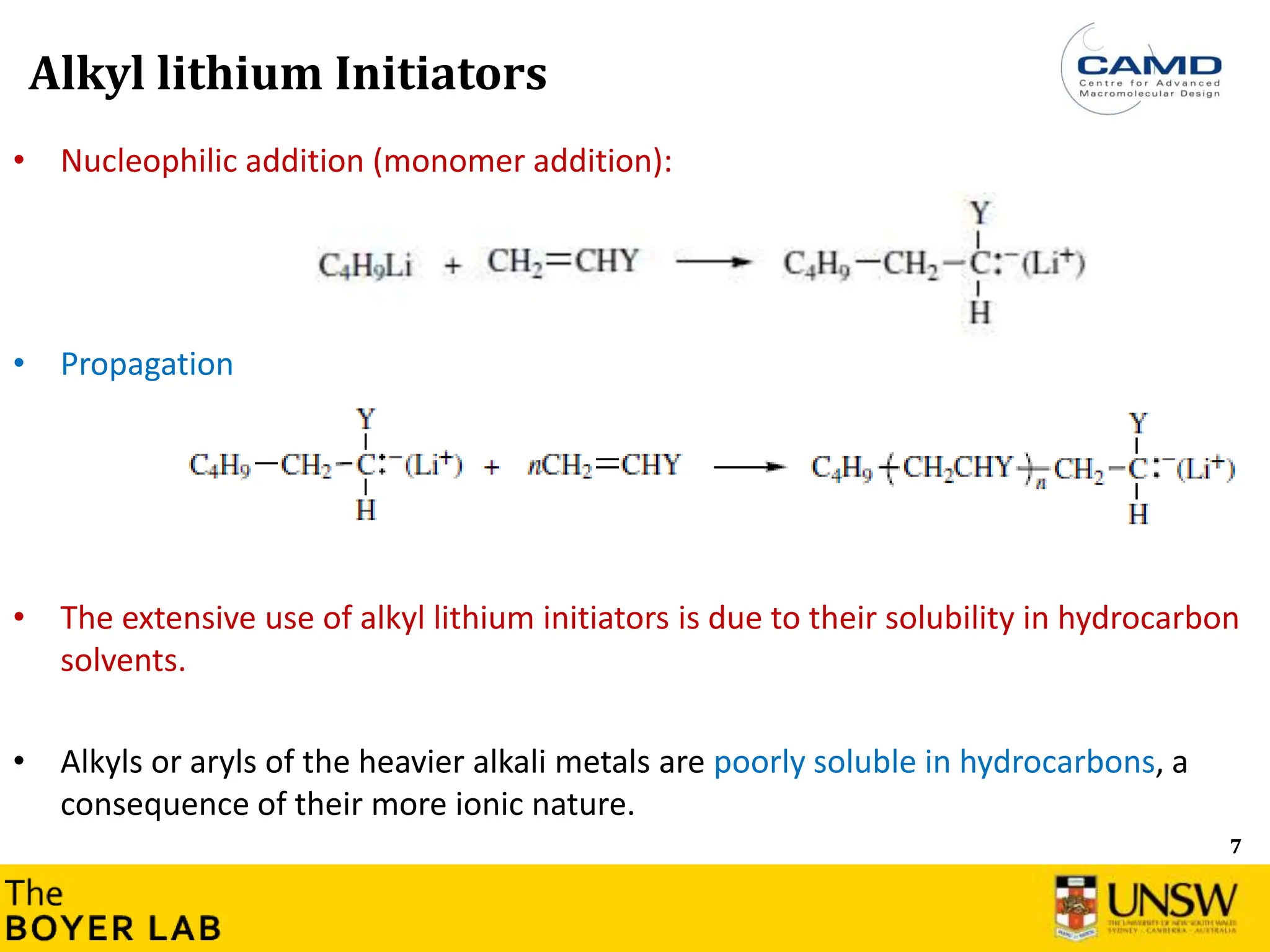
• Nucleophilic addition (monomer addition):
• Propagation
• The extensive use of alkyl lithium initiators is due to their solubility in hydrocarbon
solvents.
• Alkyls or aryls of the heavier alkali metals are poorly soluble in hydrocarbons, a
consequence of their more ionic nature.
Alkyl lithium Initiators
8
Initiation and propagation
What is the consequence on the consumption of the initiator during the
polymerisation? Can you plot [initiator] versus time (qualitatively)?
How this compares with radical polymerisation? Can you plot [Initiator]
versus time (qualitatively)?
→ Initiation step is usually very fast and much faster than the propagation in anionic
polymerisation
9
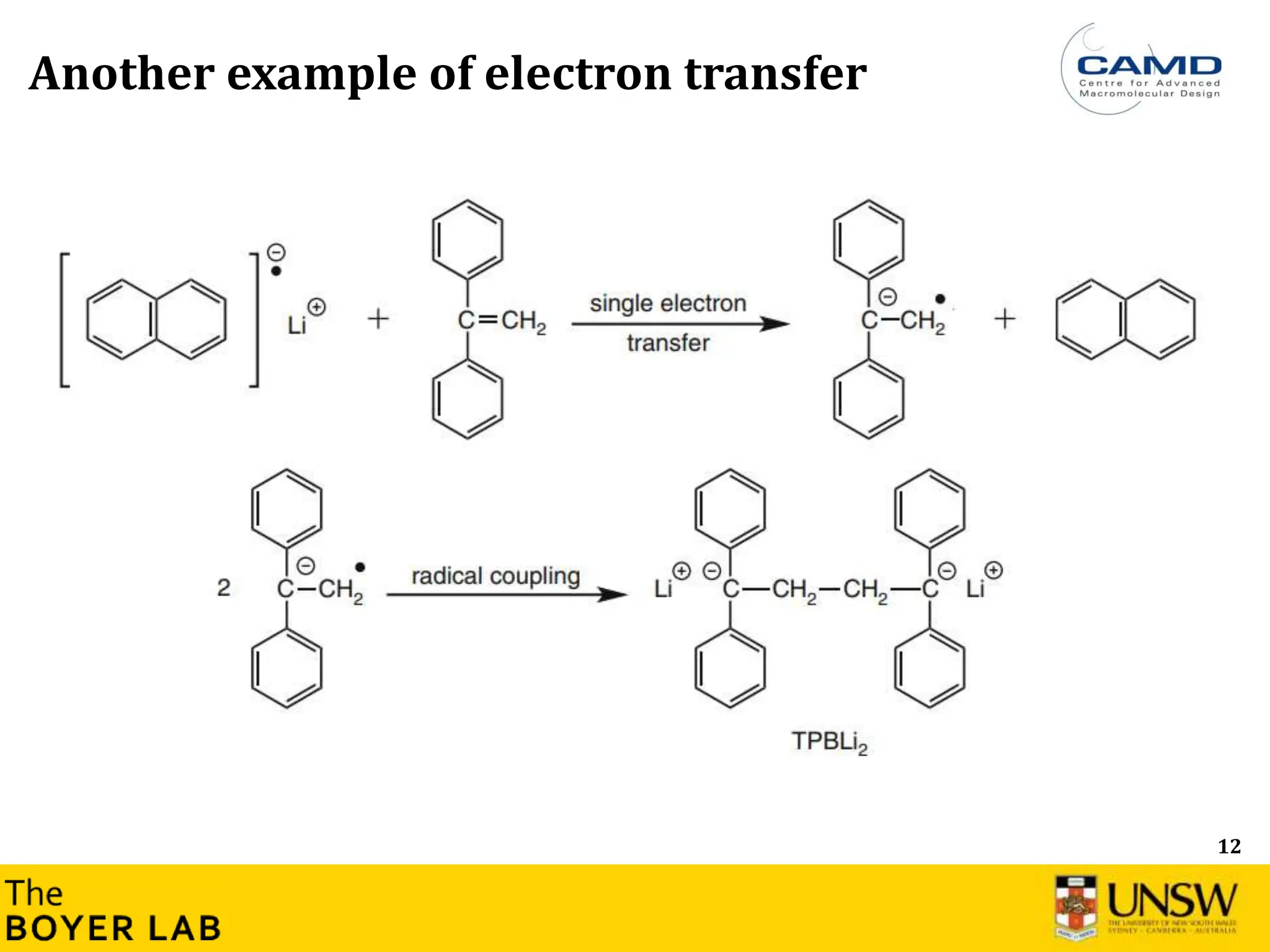
Initiation (by electron transfer)
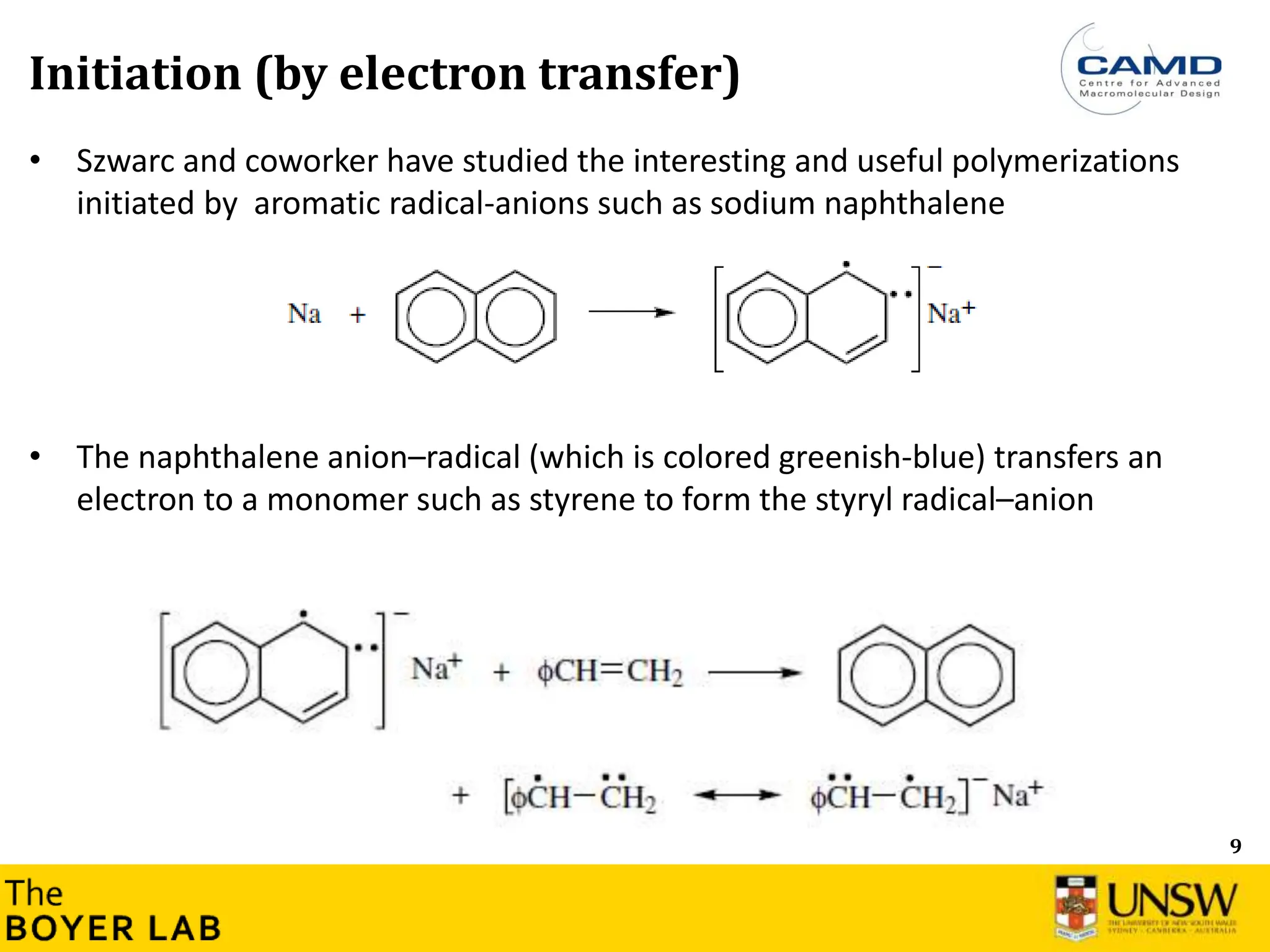
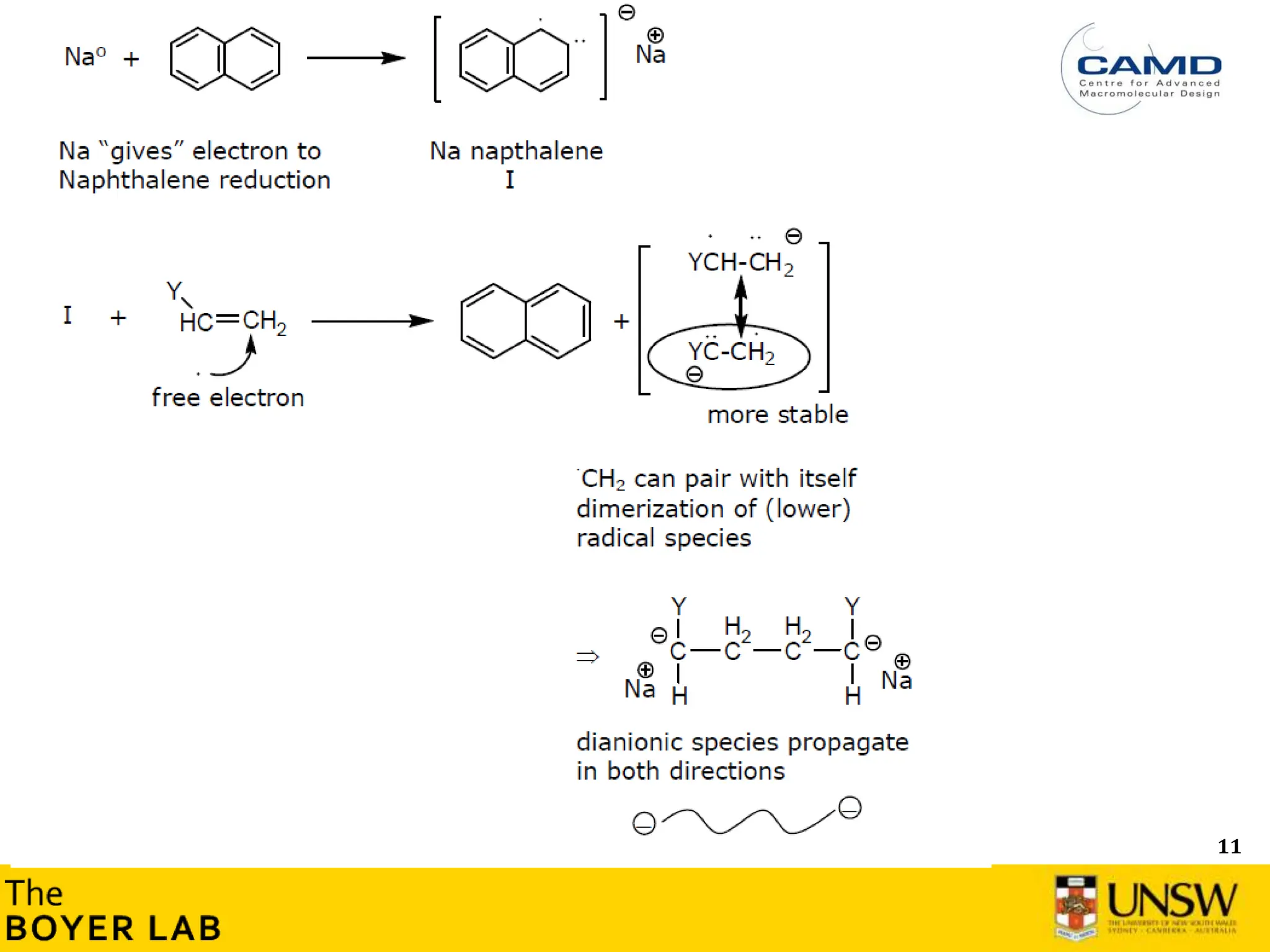
• Szwarc and coworker have studied the interesting and useful polymerizations
initiated by aromatic radical-anions such as sodium naphthalene
• The naphthalene anion–radical (which is colored greenish-blue) transfers an
electron to a monomer such as styrene to form the styryl radical–anion
10
Initiation (by electron transfer)
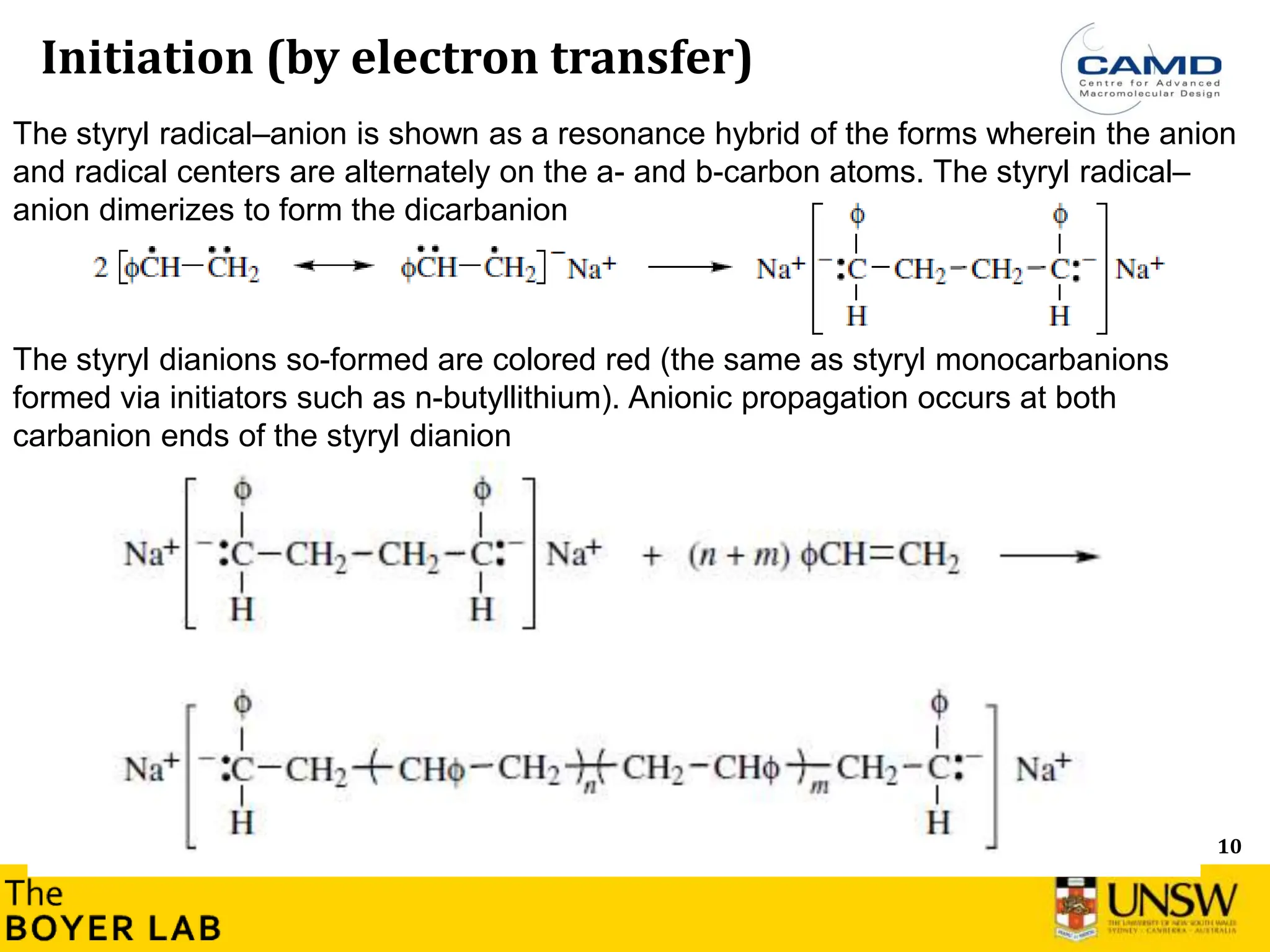
The styryl dianions so-formed are colored red (the same as styryl monocarbanions
formed via initiators such as n-butyllithium). Anionic propagation occurs at both
carbanion ends of the styryl dianion
The styryl radical–anion is shown as a resonance hybrid of the forms wherein the anion
and radical centers are alternately on the a- and b-carbon atoms. The styryl radical–
anion dimerizes to form the dicarbanion
11
12
Another example of electron transfer
13
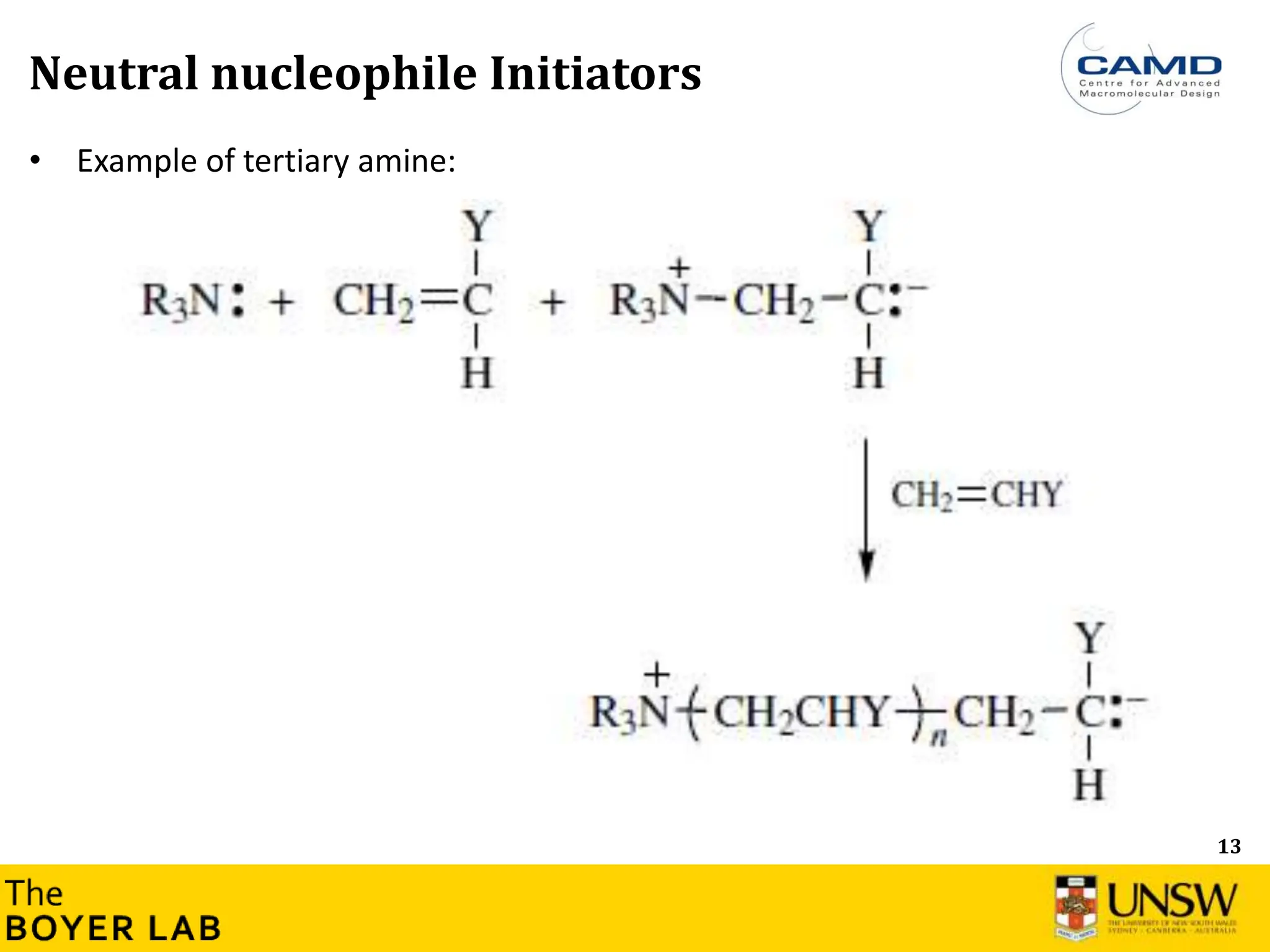
• Example of tertiary amine:
Neutral nucleophile Initiators
14
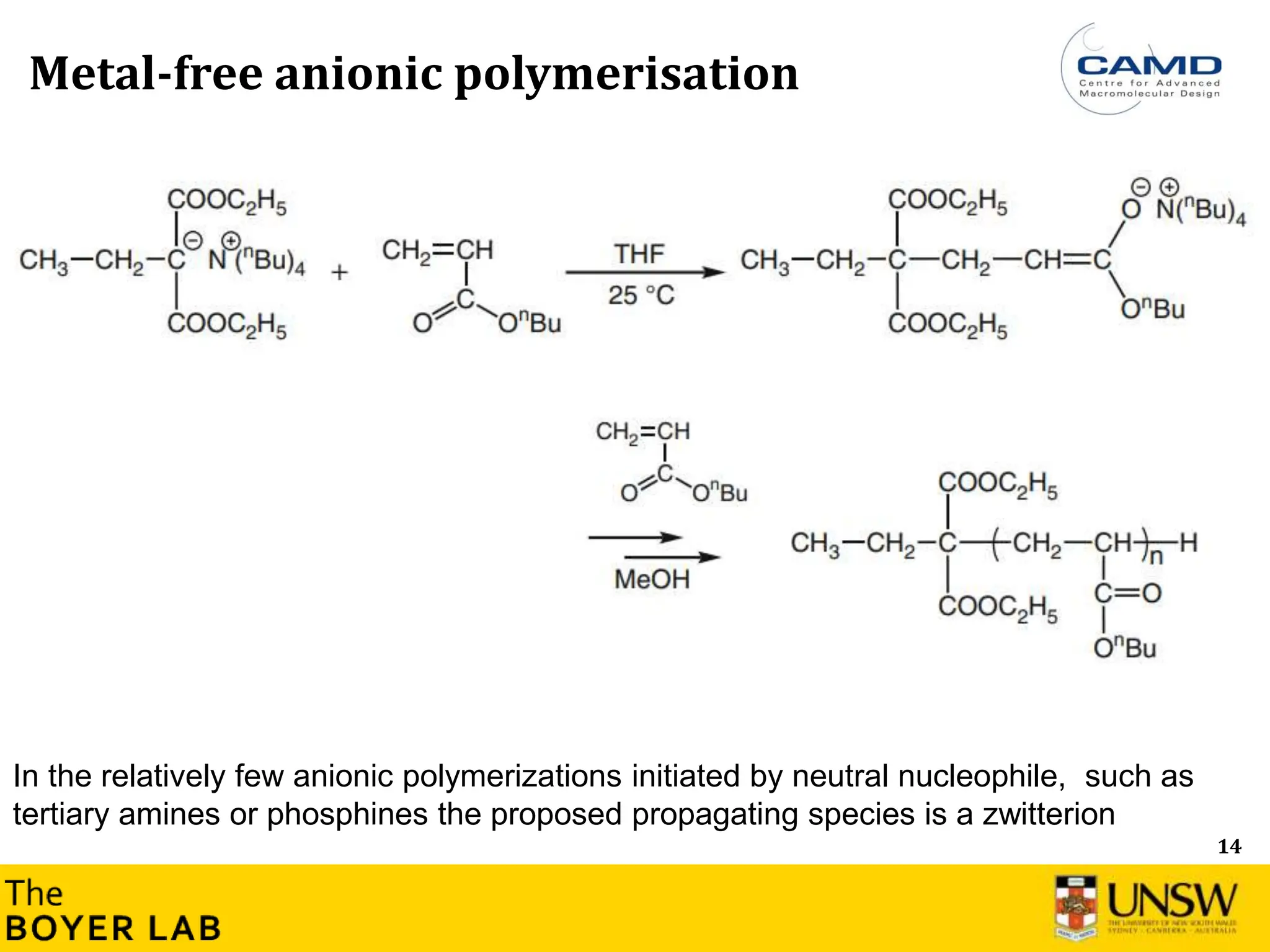
Metal-free anionic polymerisation
In the relatively few anionic polymerizations initiated by neutral nucleophile, such as
tertiary amines or phosphines the proposed propagating species is a zwitterion
15
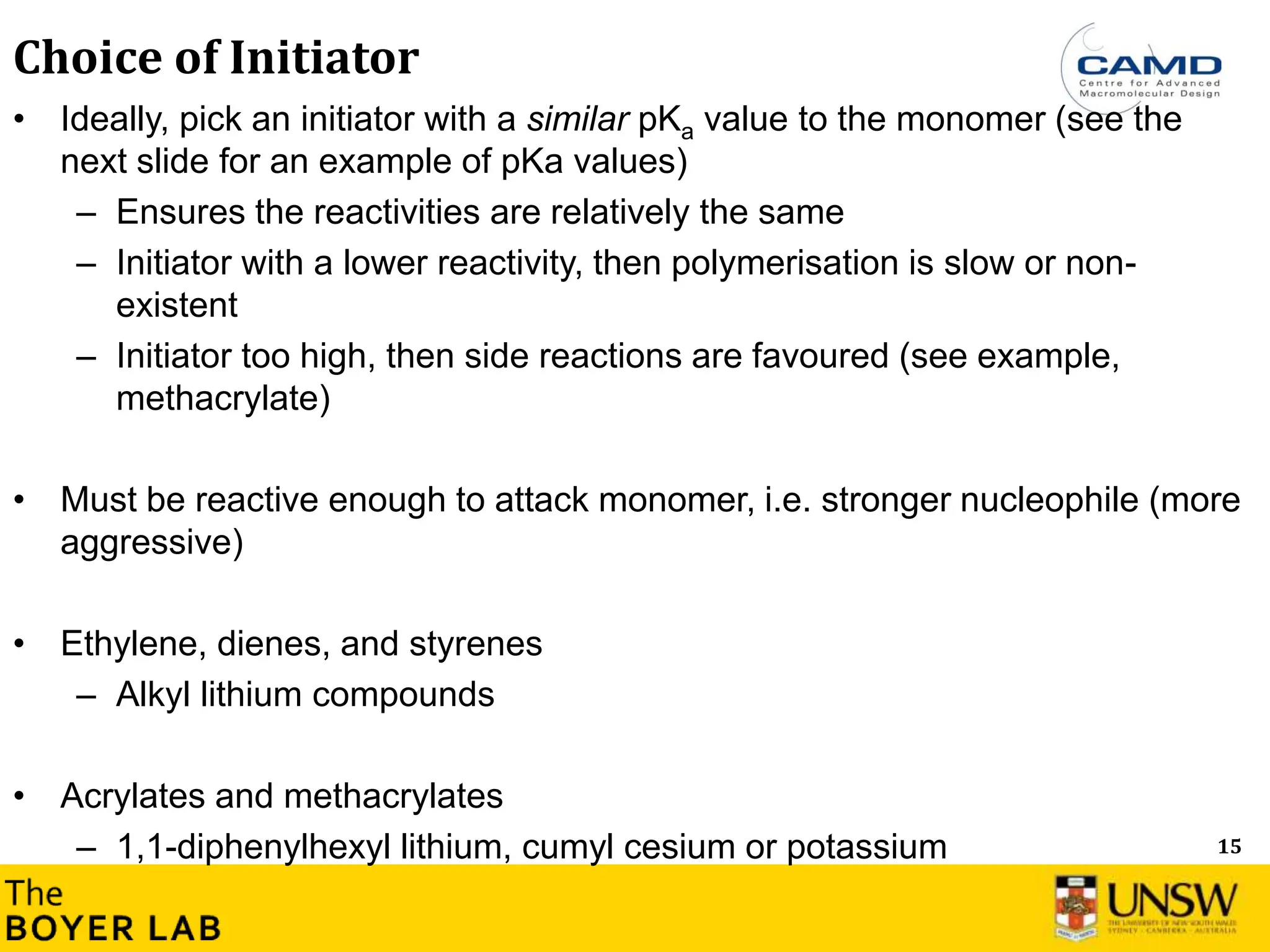
Choice of Initiator
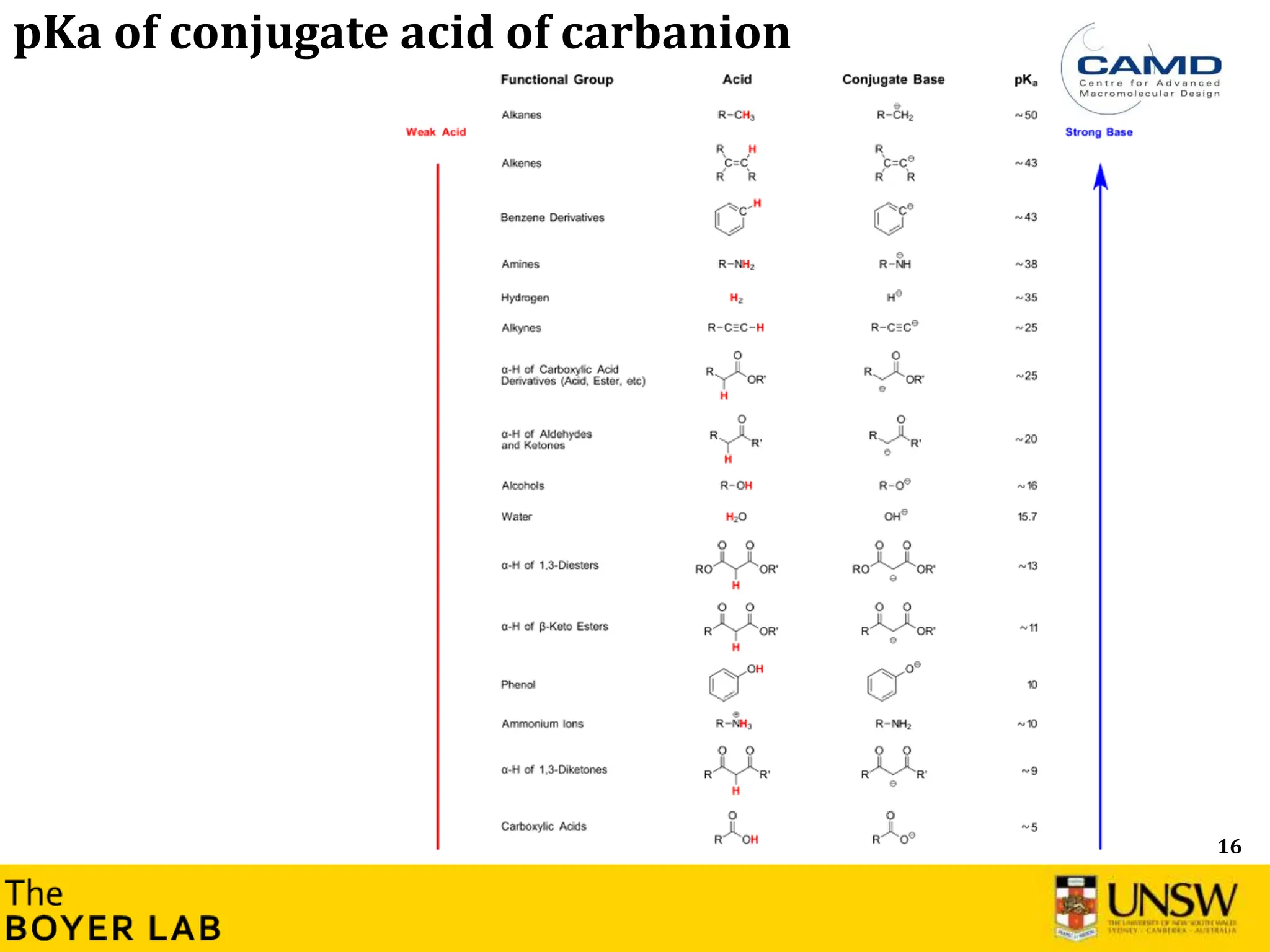
• Ideally, pick an initiator with a similar pKa value to the monomer (see the
next slide for an example of pKa values)
– Ensures the reactivities are relatively the same
– Initiator with a lower reactivity, then polymerisation is slow or non-
existent
– Initiator too high, then side reactions are favoured (see example,
methacrylate)
• Must be reactive enough to attack monomer, i.e. stronger nucleophile (more
aggressive)
• Ethylene, dienes, and styrenes
– Alkyl lithium compounds
• Acrylates and methacrylates
– 1,1-diphenylhexyl lithium, cumyl cesium or potassium
16
pKa of conjugate acid of carbanion
17
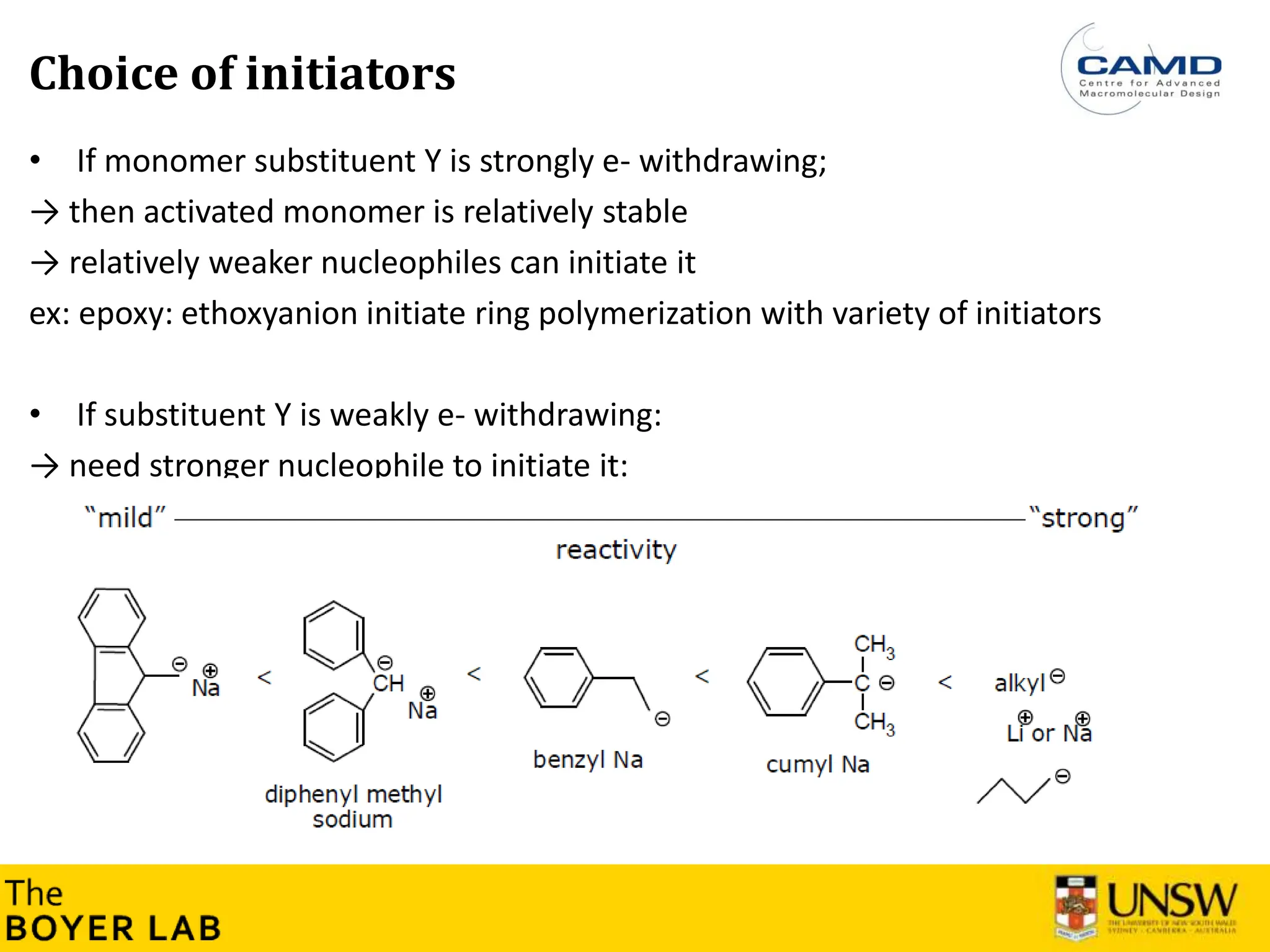
Choice of initiators
• If monomer substituent Y is strongly e- withdrawing;
→ then activated monomer is relatively stable
→ relatively weaker nucleophiles can initiate it
ex: epoxy: ethoxyanion initiate ring polymerization with variety of initiators
• If substituent Y is weakly e- withdrawing:
→ need stronger nucleophile to initiate it:
18
Propagation step (monomer type)
Anionic polymerization takes place with monomers possessing electron-withdrawing
groups such as nitrile, carbonyl, phenyl, and vinyl.
19
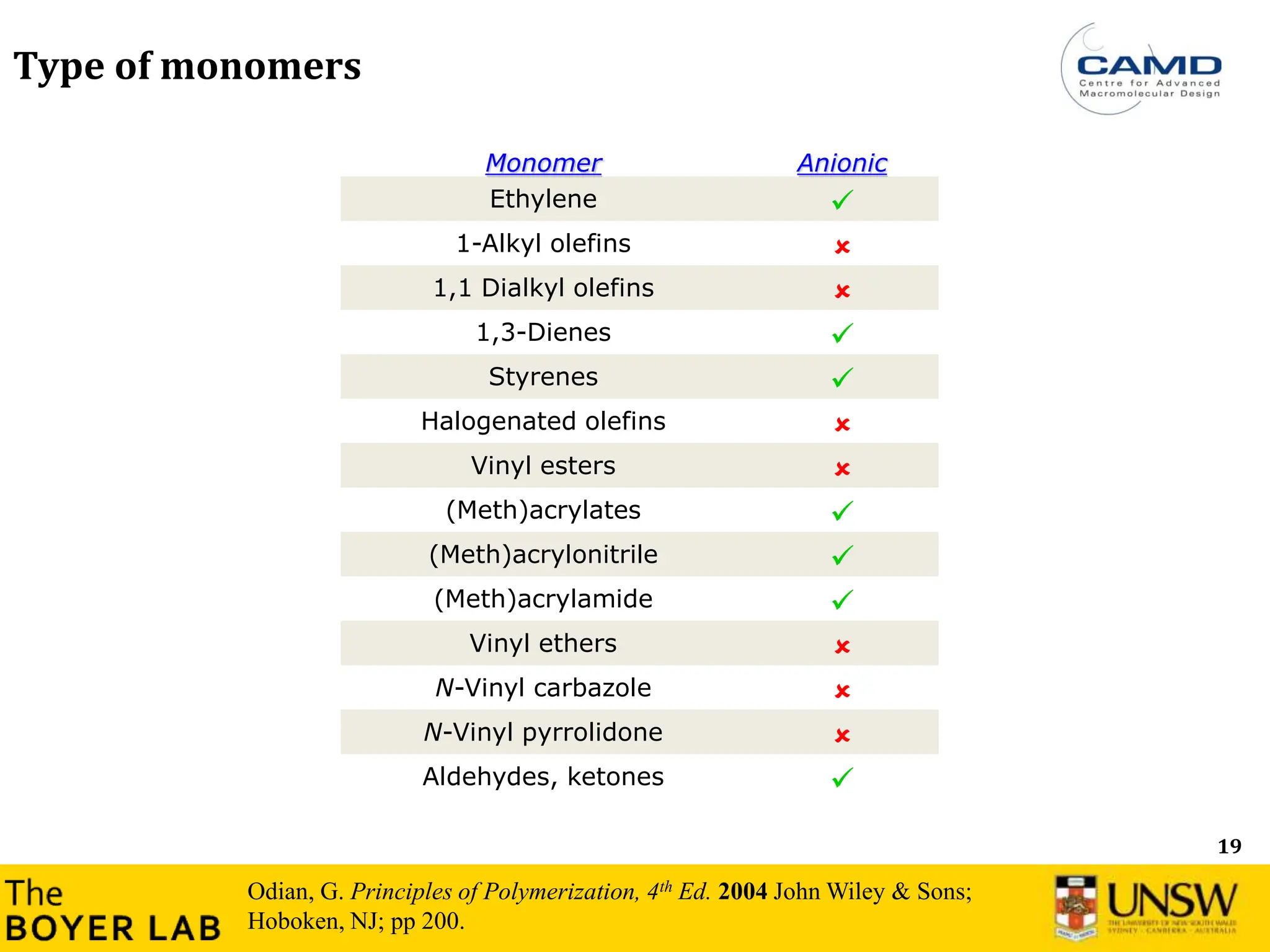
Type of monomers
Monomer Anionic
Ethylene 
1-Alkyl olefins 
1,1 Dialkyl olefins 
1,3-Dienes 
Styrenes 
Halogenated olefins 
Vinyl esters 
(Meth)acrylates 
(Meth)acrylonitrile 
(Meth)acrylamide 
Vinyl ethers 
N-Vinyl carbazole 
N-Vinyl pyrrolidone 
Aldehydes, ketones 
Odian, G. Principles of Polymerization, 4th Ed. 2004 John Wiley & Sons;
Hoboken, NJ; pp 200.
20
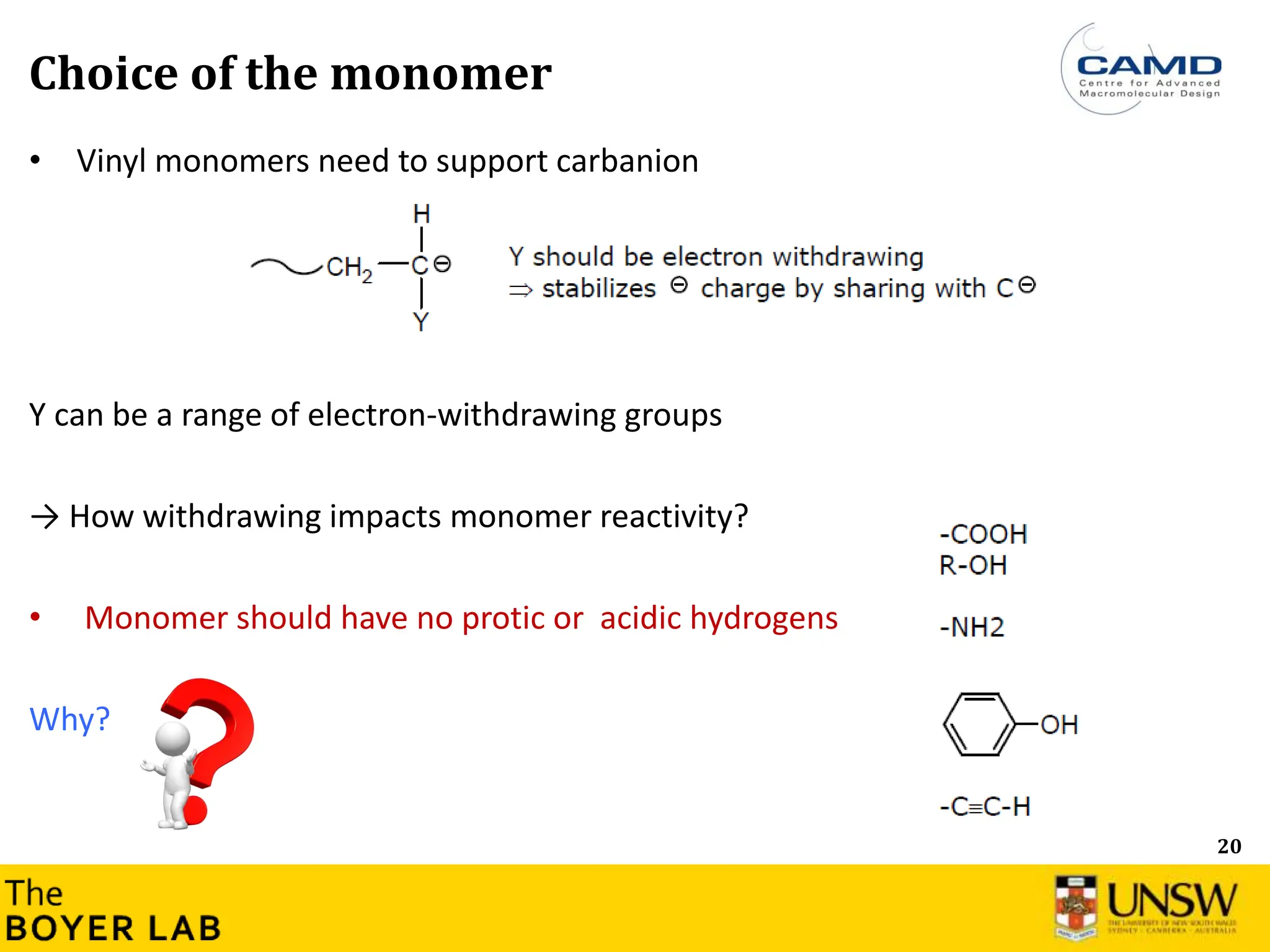
Choice of the monomer
• Vinyl monomers need to support carbanion
Y can be a range of electron-withdrawing groups
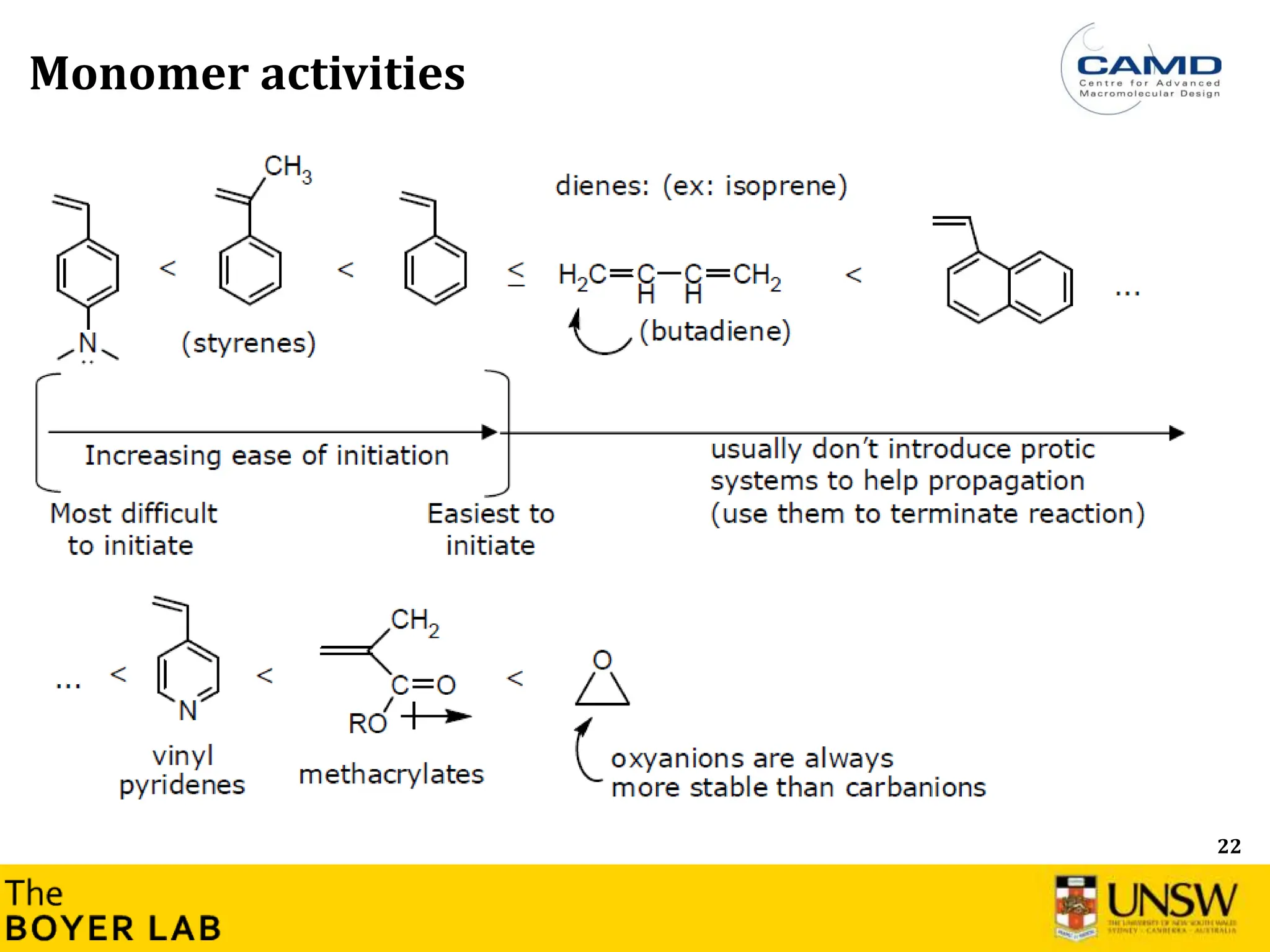
→ How withdrawing impacts monomer reactivity?
• Monomer should have no protic or acidic hydrogens
Why?
21
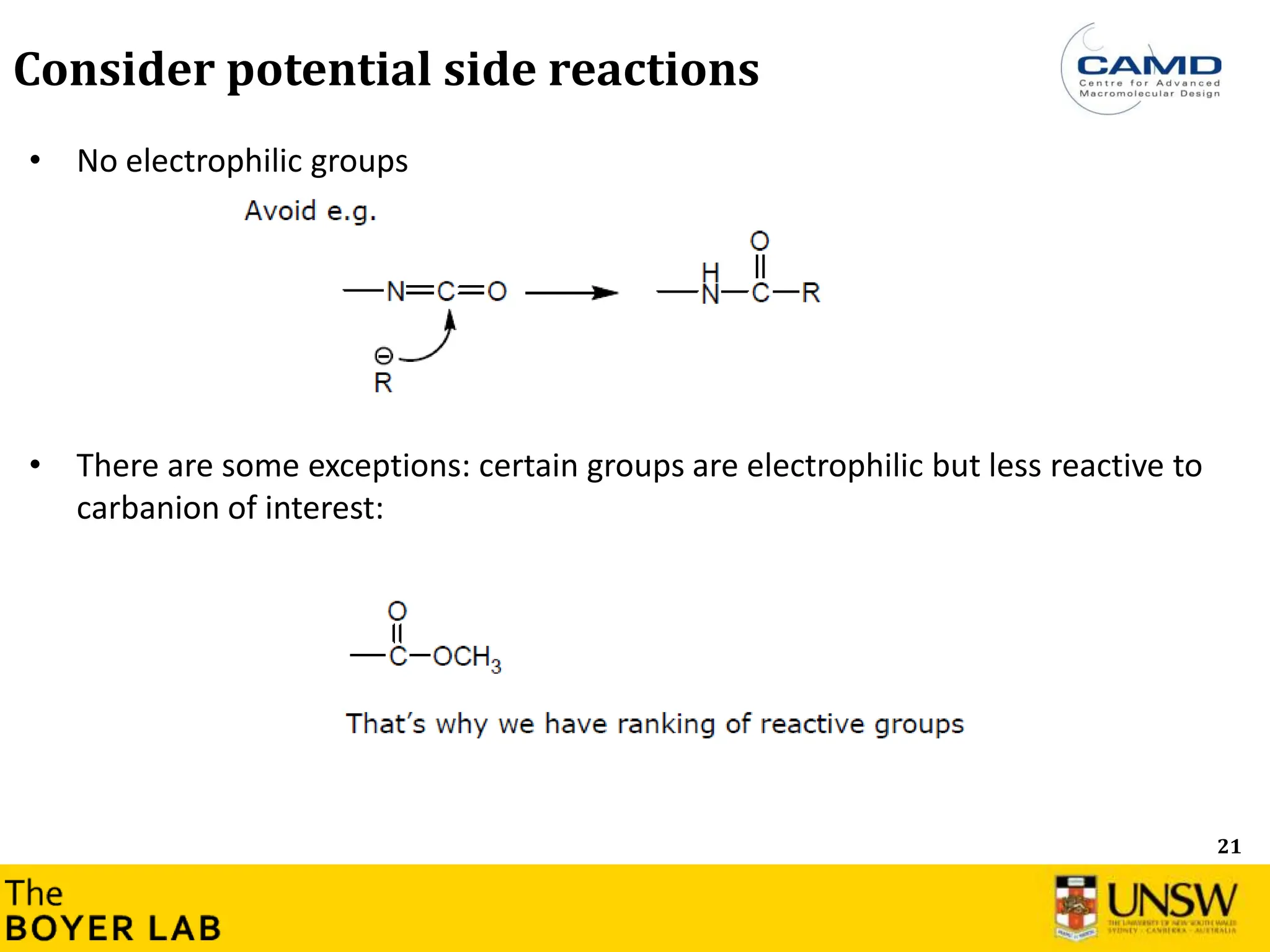
Consider potential side reactions
• No electrophilic groups
• There are some exceptions: certain groups are electrophilic but less reactive to
carbanion of interest:
22
Monomer activities
23
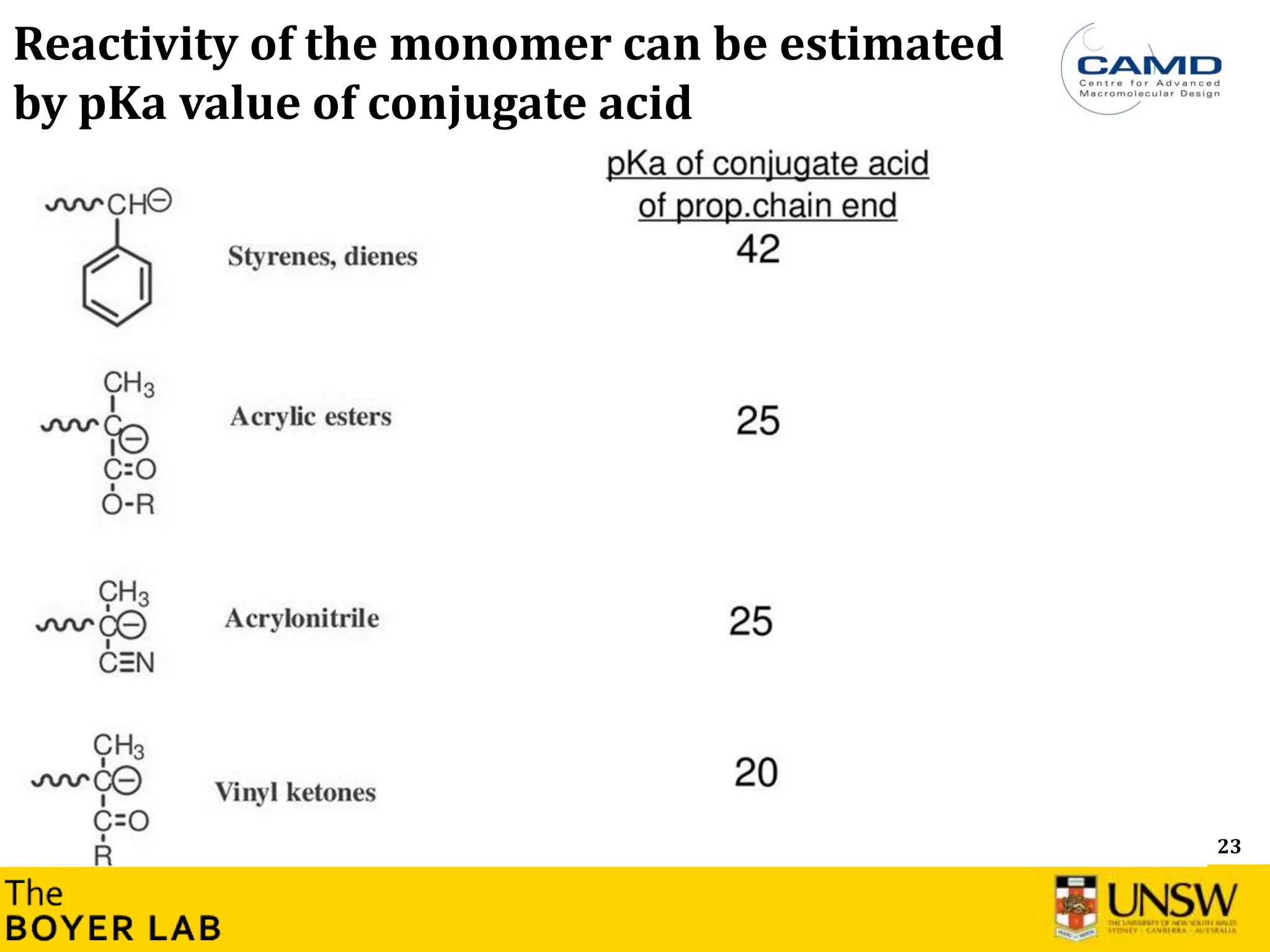
Reactivity of the monomer can be estimated
by pKa value of conjugate acid
24
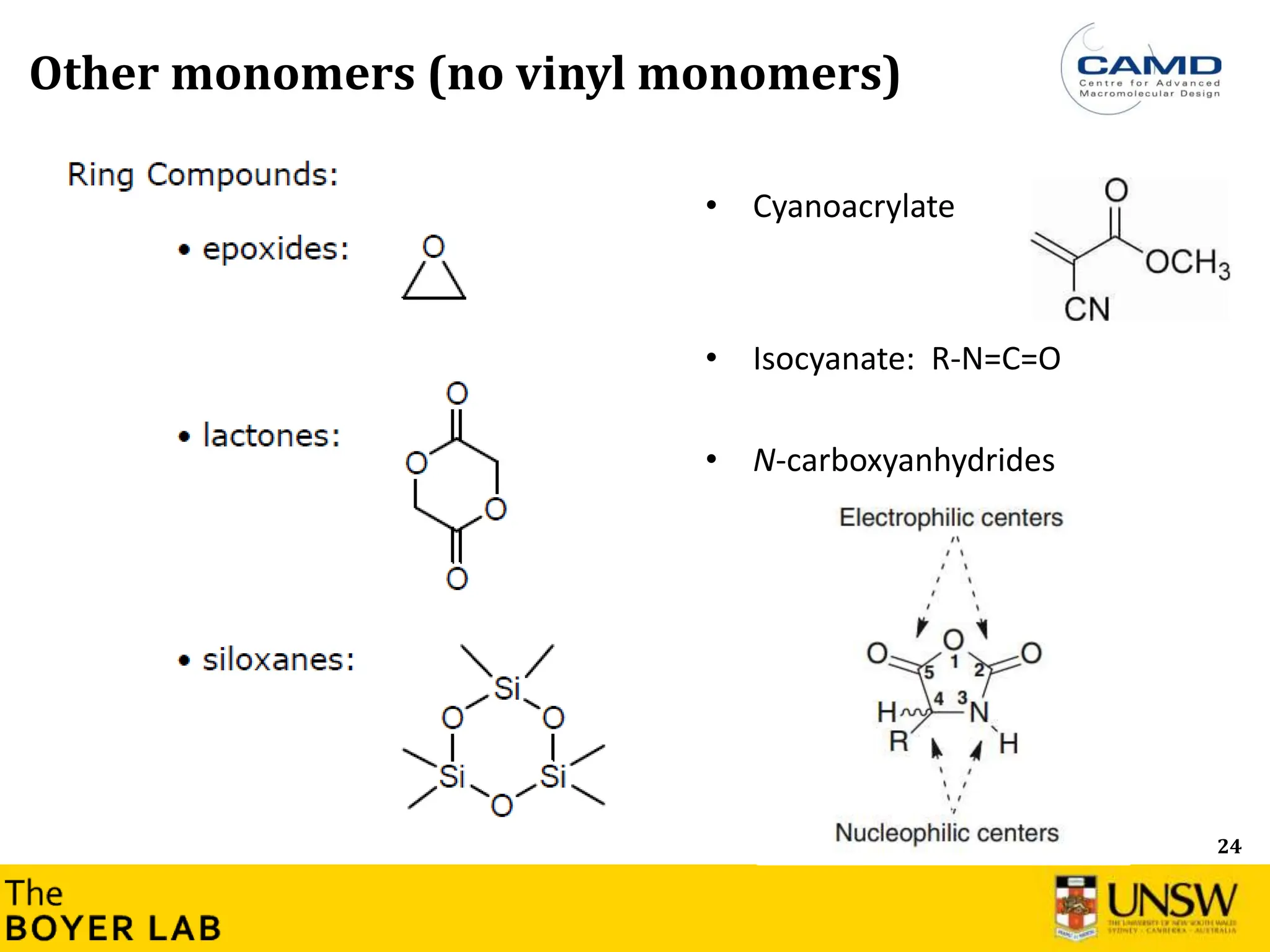
Other monomers (no vinyl monomers)
• Cyanoacrylate
• Isocyanate: R-N=C=O
• N-carboxyanhydrides
25
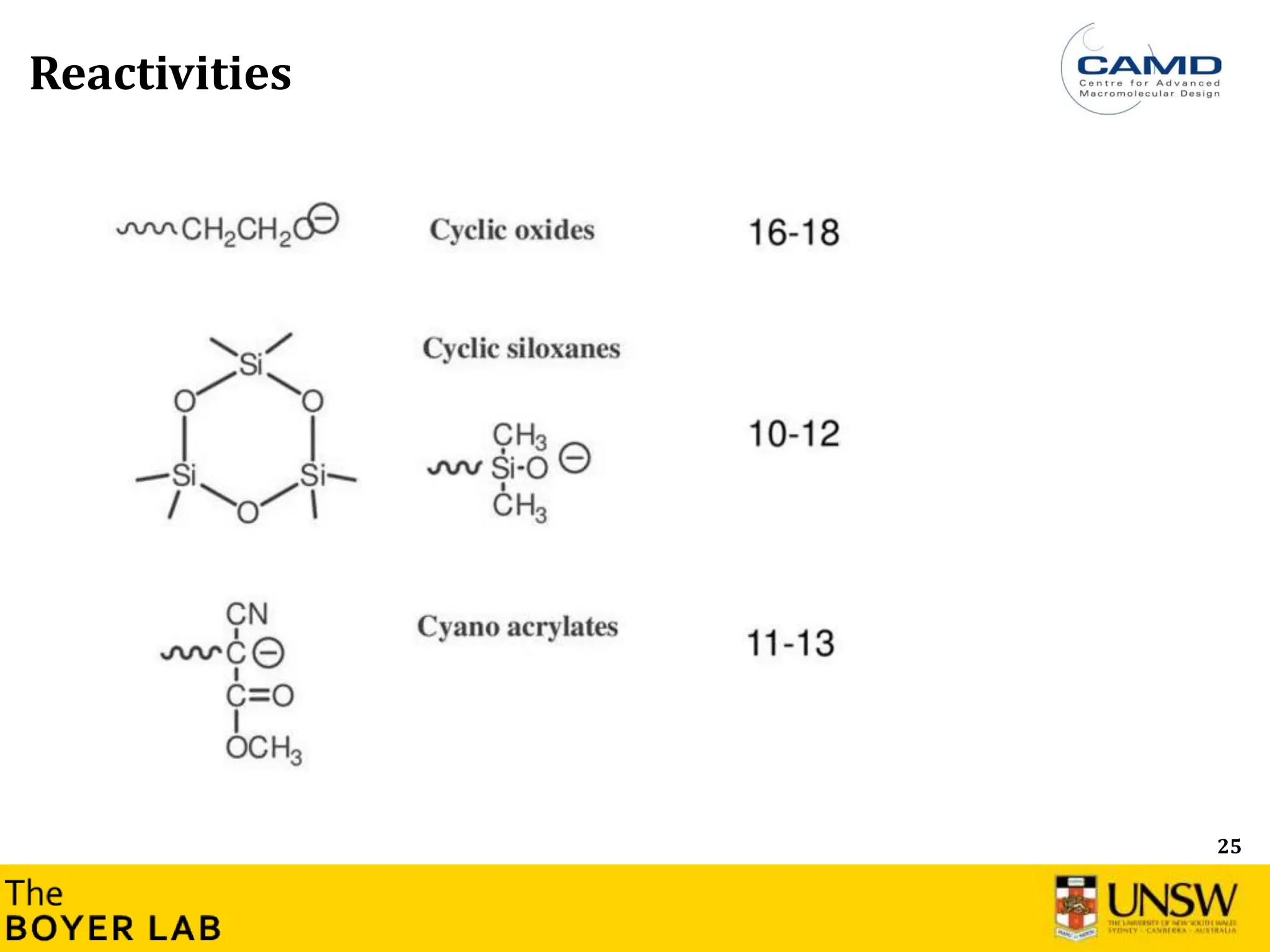
Reactivities
26
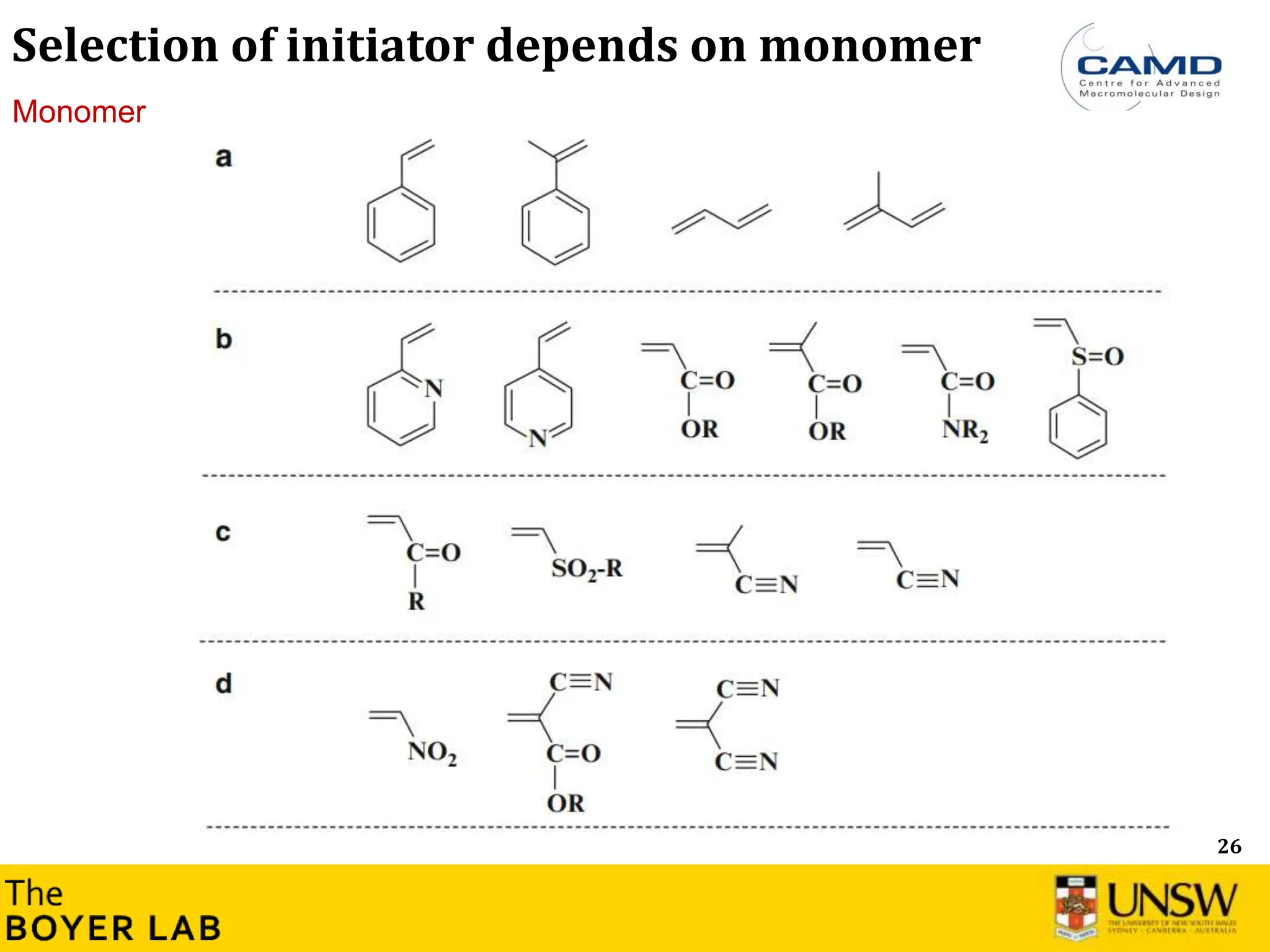
Monomer
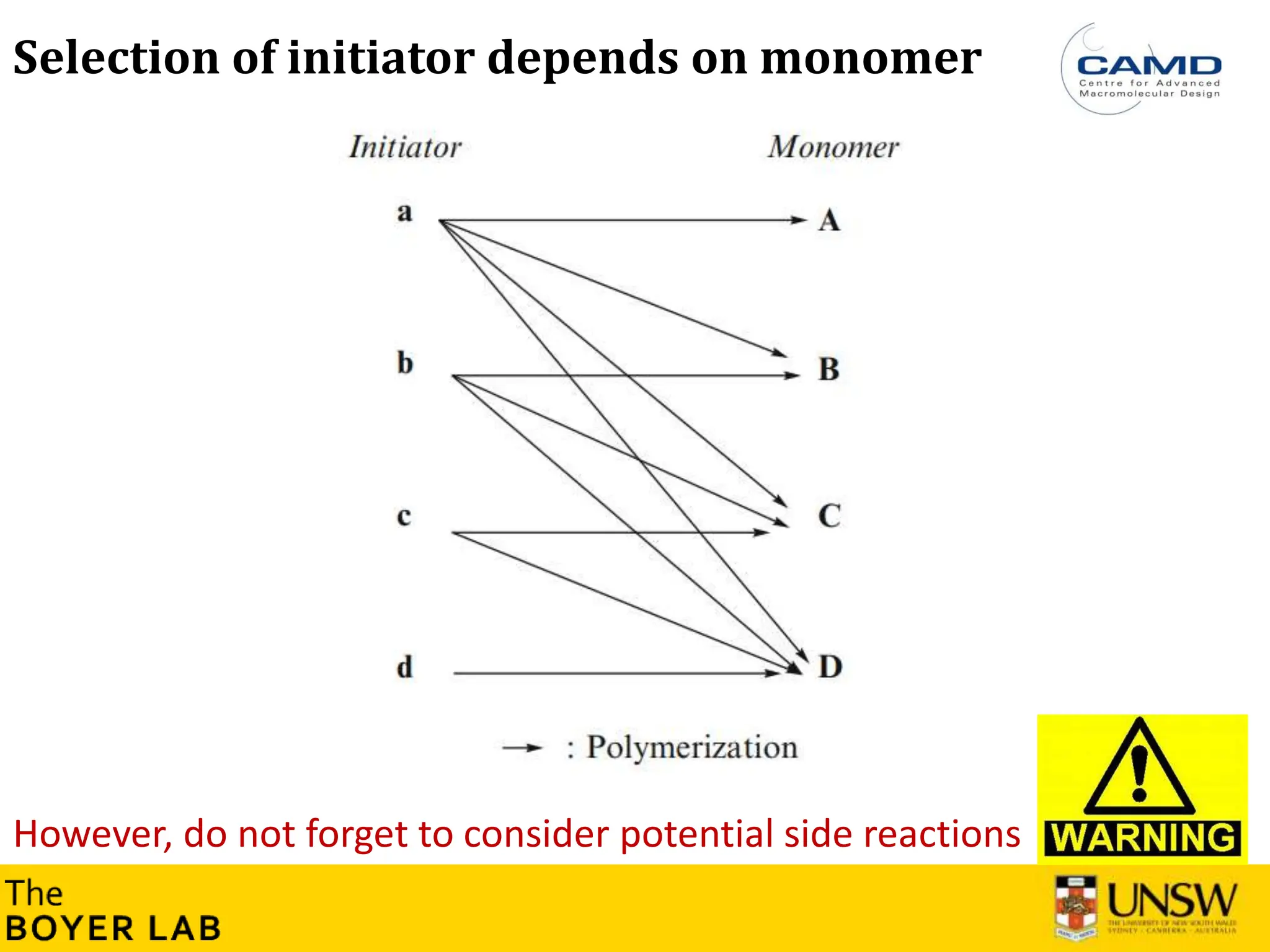
Selection of initiator depends on monomer
27
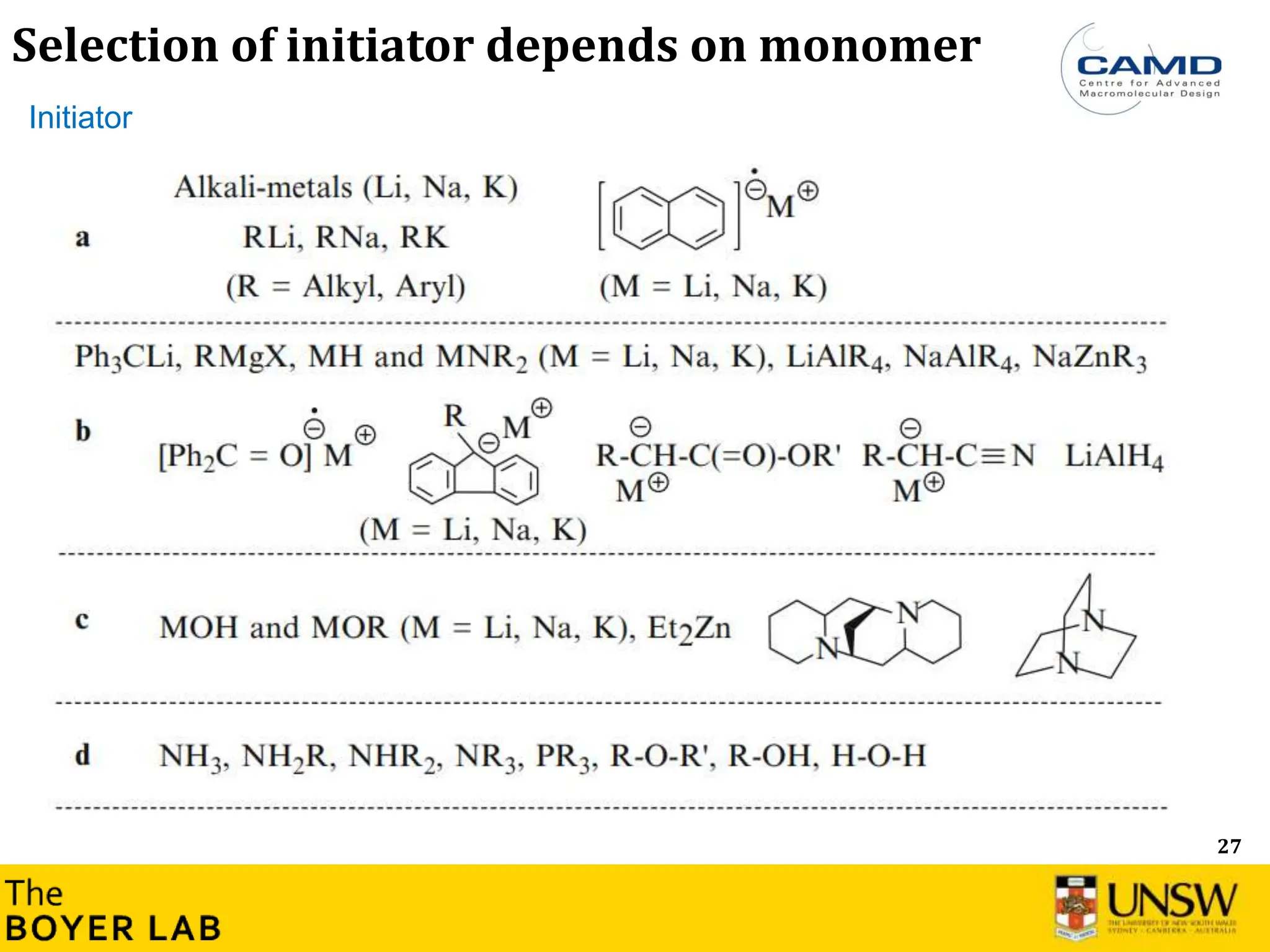
Selection of initiator depends on monomer
Initiator
28
However, do not forget to consider potential side reactions
Selection of initiator depends on monomer
29
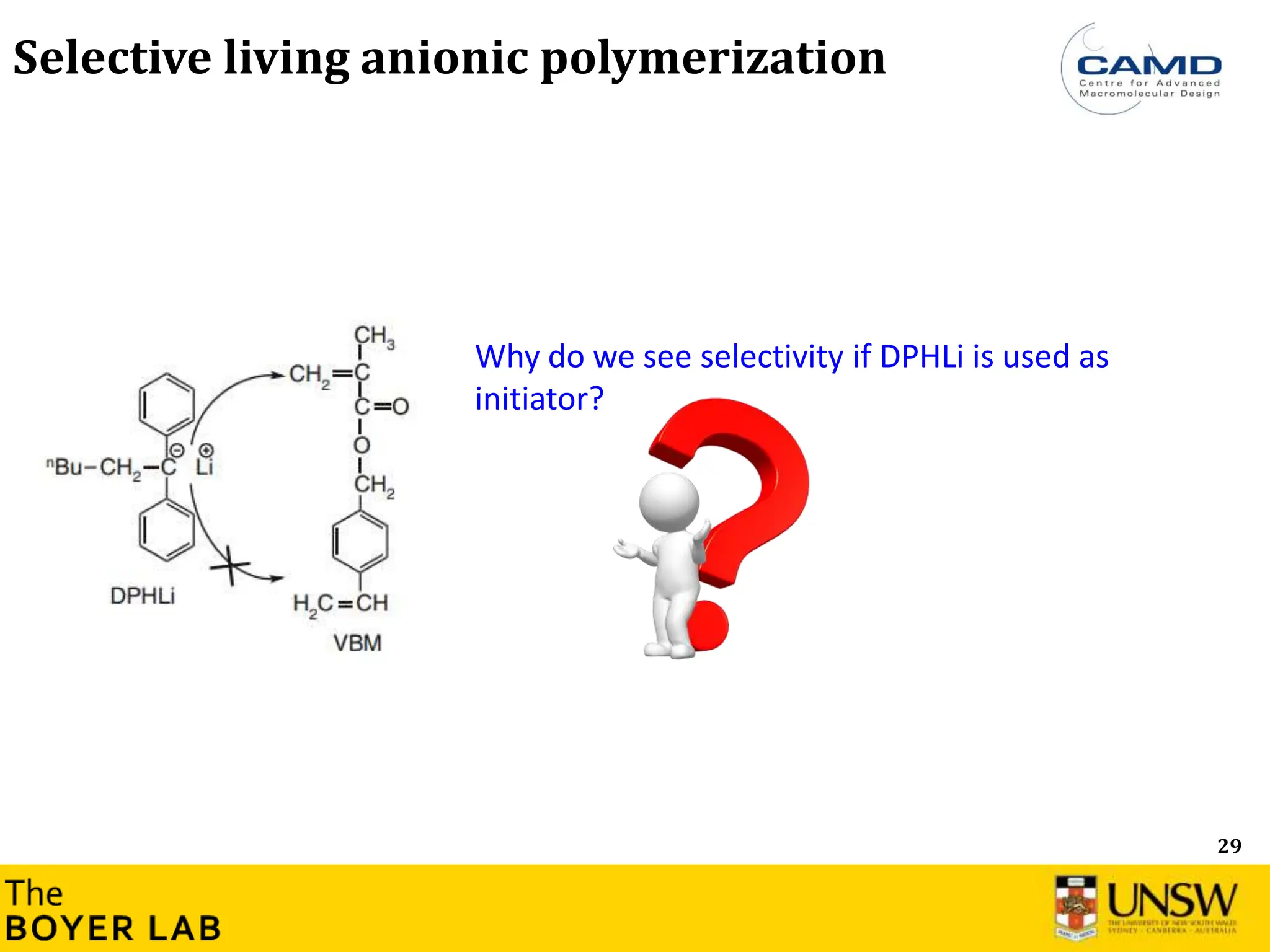
Selective living anionic polymerization
Why do we see selectivity if DPHLi is used as
initiator?
30
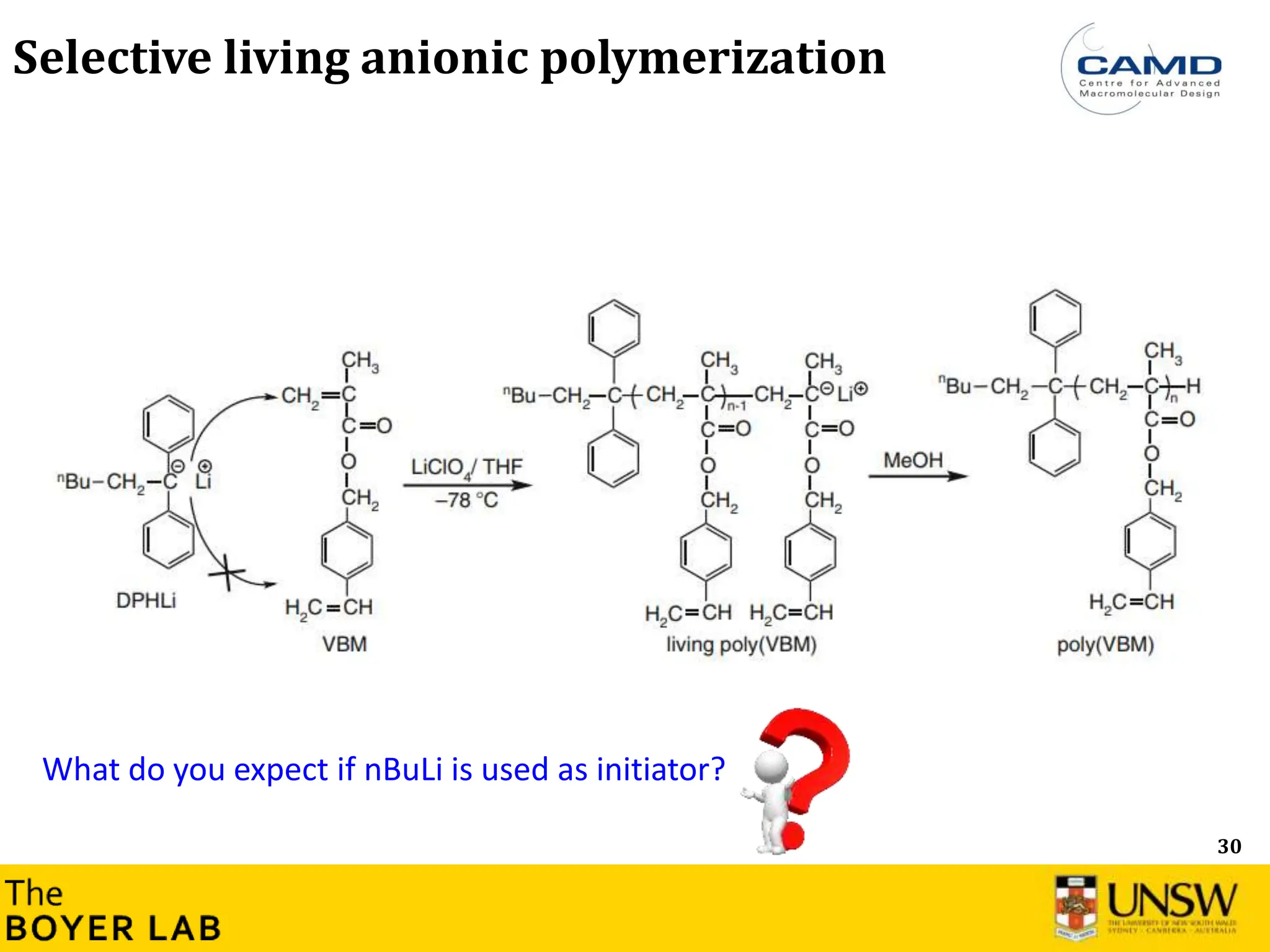
Selective living anionic polymerization
What do you expect if nBuLi is used as initiator?
31
Case of polar monomers
32
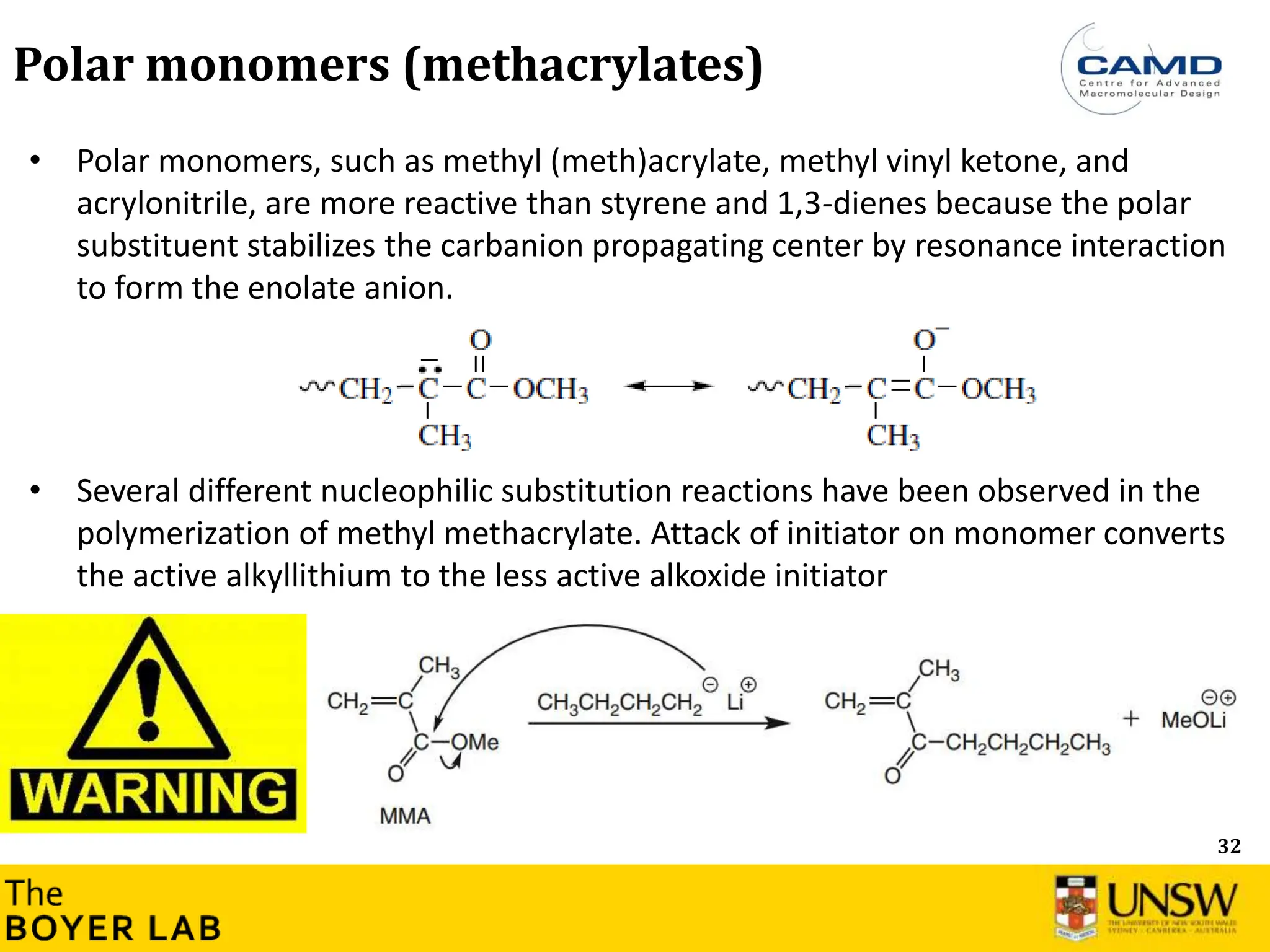
Polar monomers (methacrylates)
• Polar monomers, such as methyl (meth)acrylate, methyl vinyl ketone, and
acrylonitrile, are more reactive than styrene and 1,3-dienes because the polar
substituent stabilizes the carbanion propagating center by resonance interaction
to form the enolate anion.
• Several different nucleophilic substitution reactions have been observed in the
polymerization of methyl methacrylate. Attack of initiator on monomer converts
the active alkyllithium to the less active alkoxide initiator
33
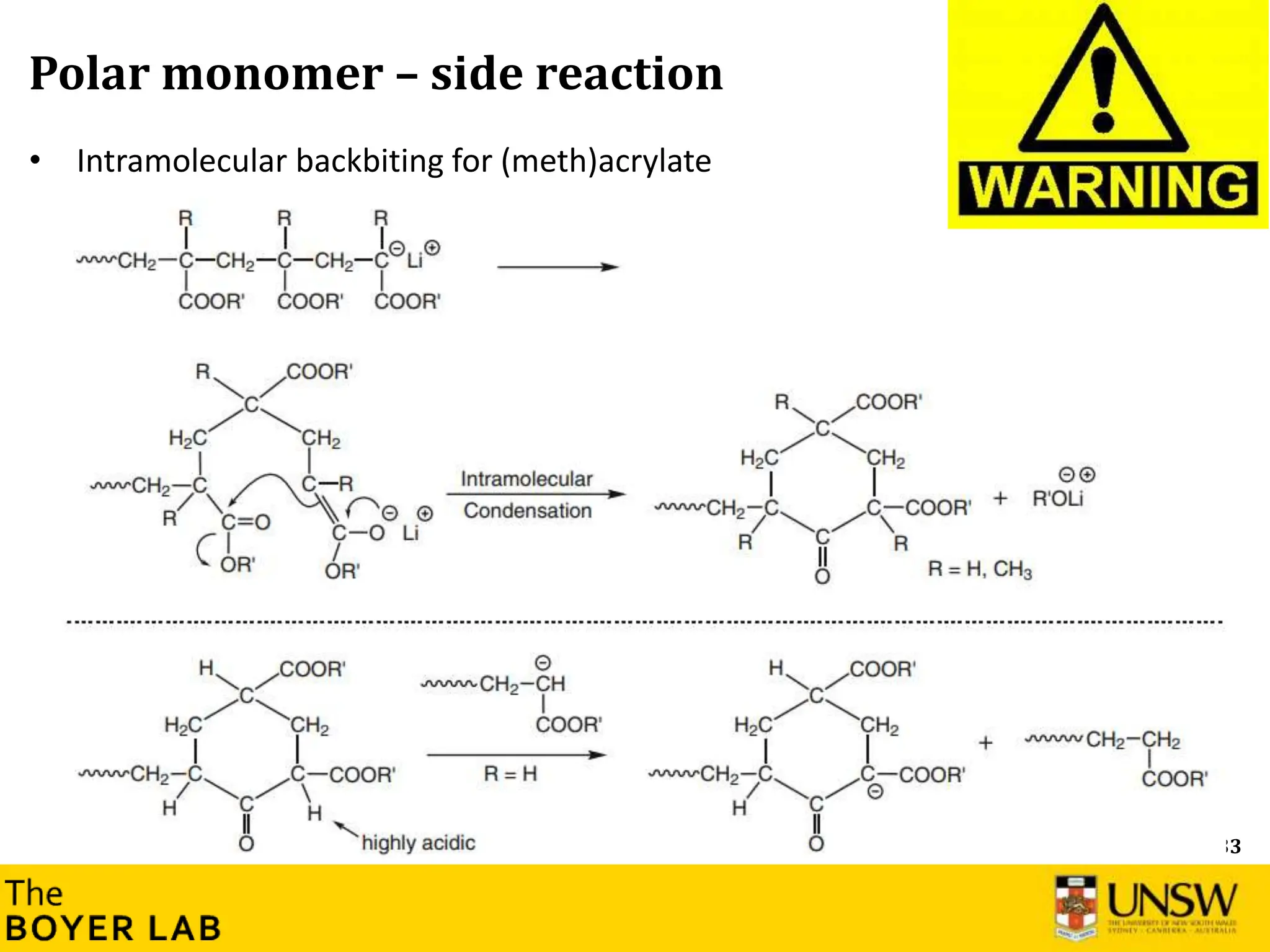
Polar monomer – side reaction
• Intramolecular backbiting for (meth)acrylate
34
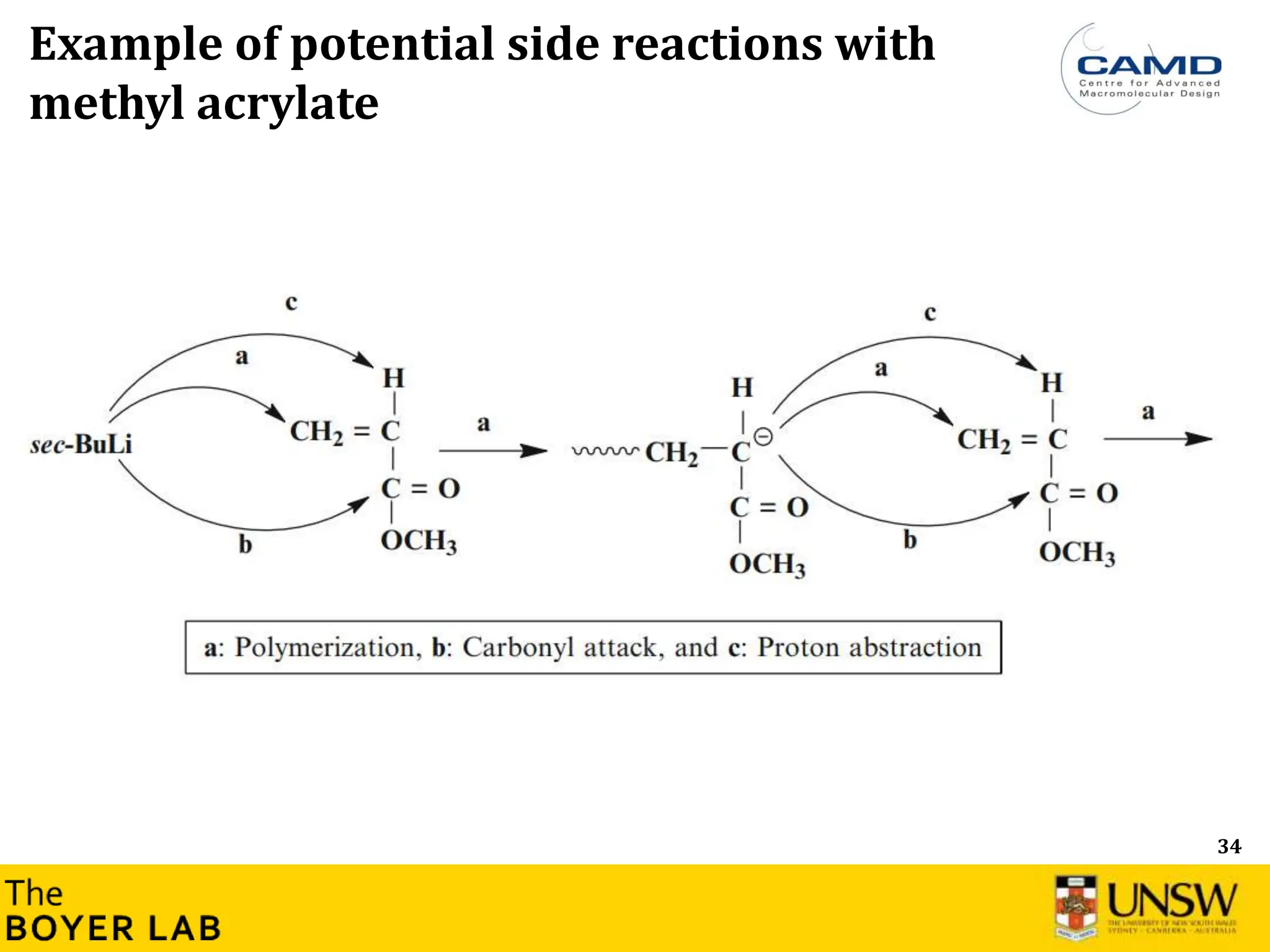
Example of potential side reactions with
methyl acrylate
35
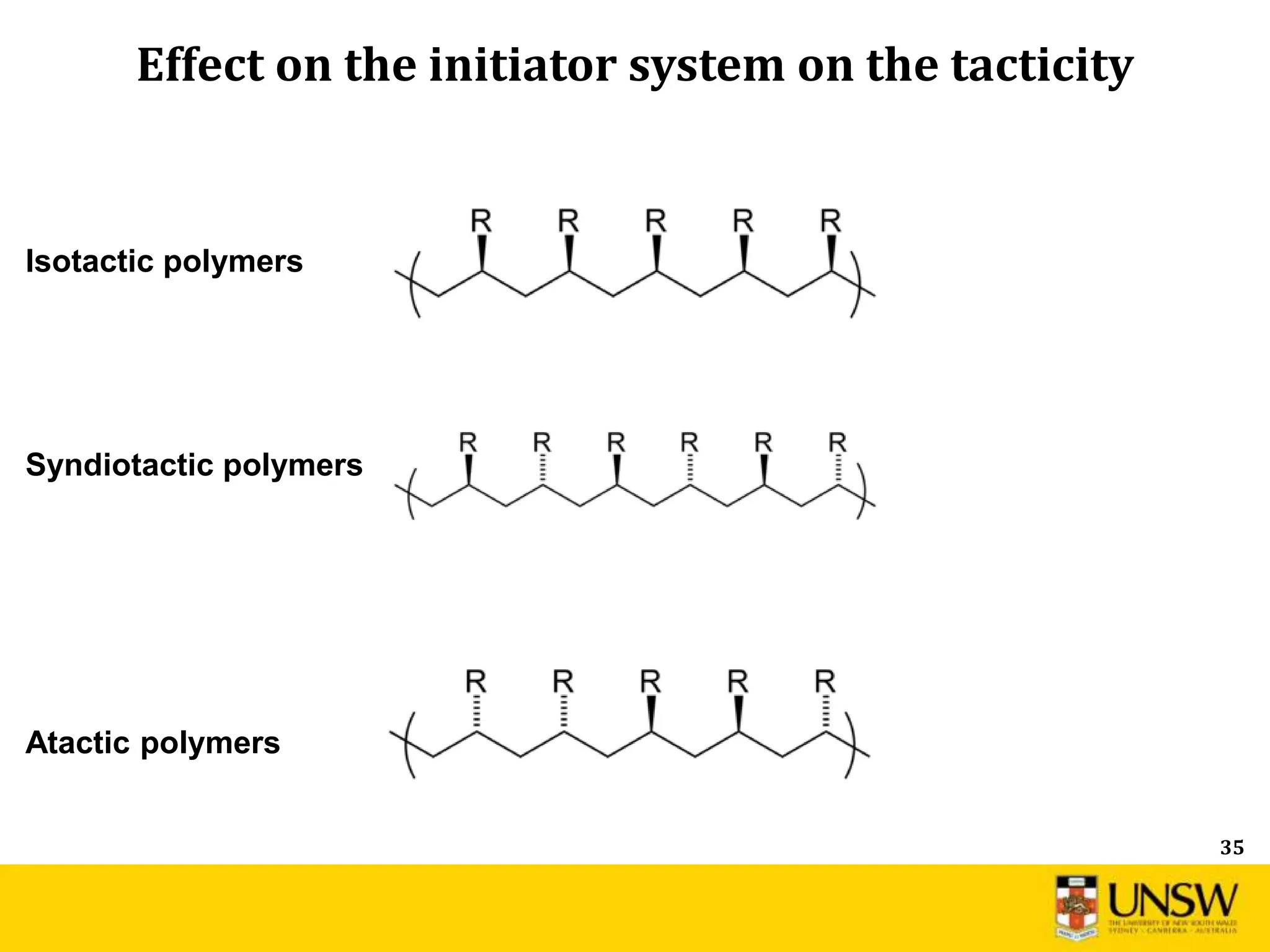
Effect on the initiator system on the tacticity
Atactic polymers
Syndiotactic polymers
Isotactic polymers
36
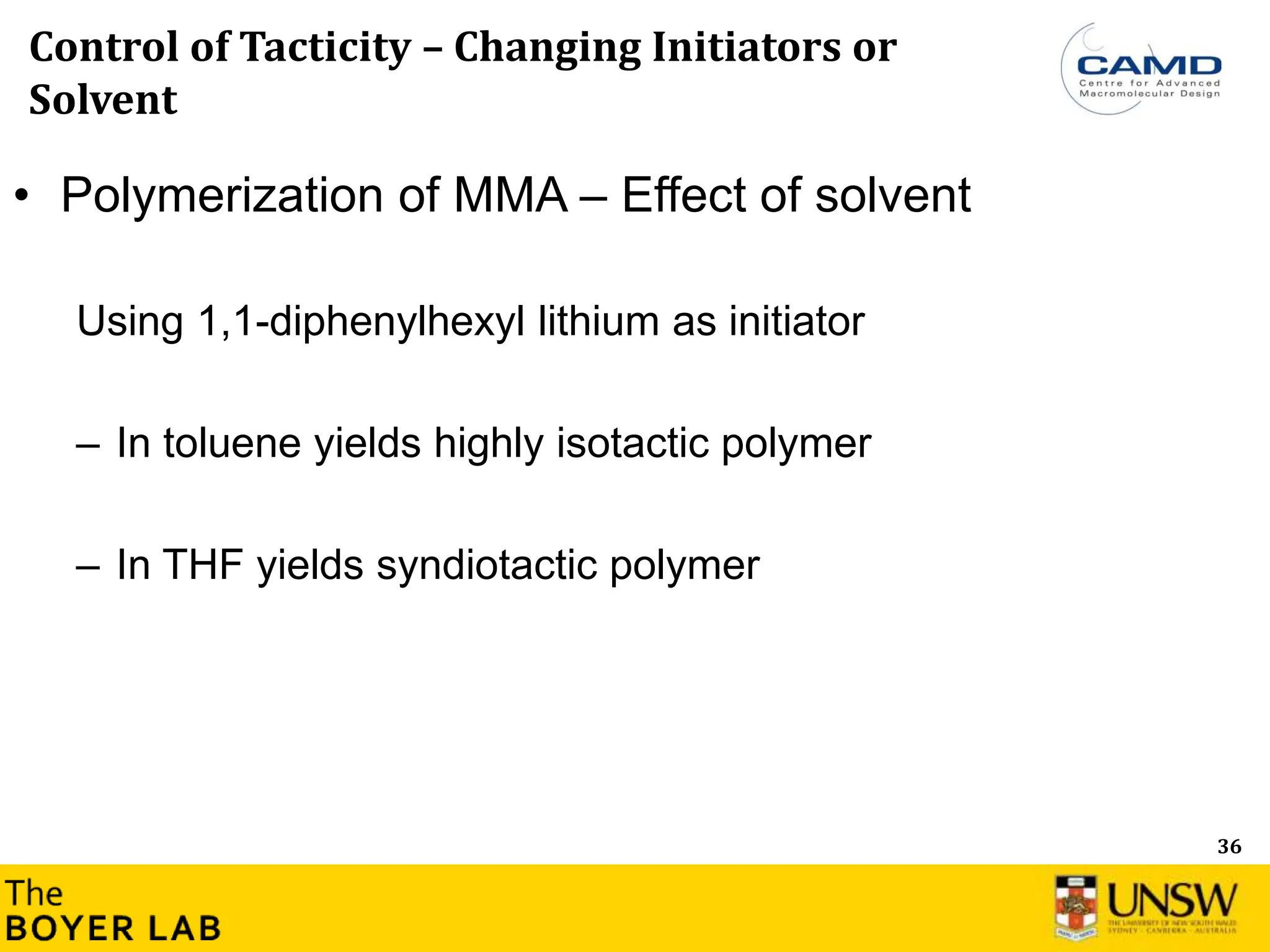
Control of Tacticity – Changing Initiators or
Solvent
• Polymerization of MMA – Effect of solvent
Using 1,1-diphenylhexyl lithium as initiator
– In toluene yields highly isotactic polymer
– In THF yields syndiotactic polymer
37
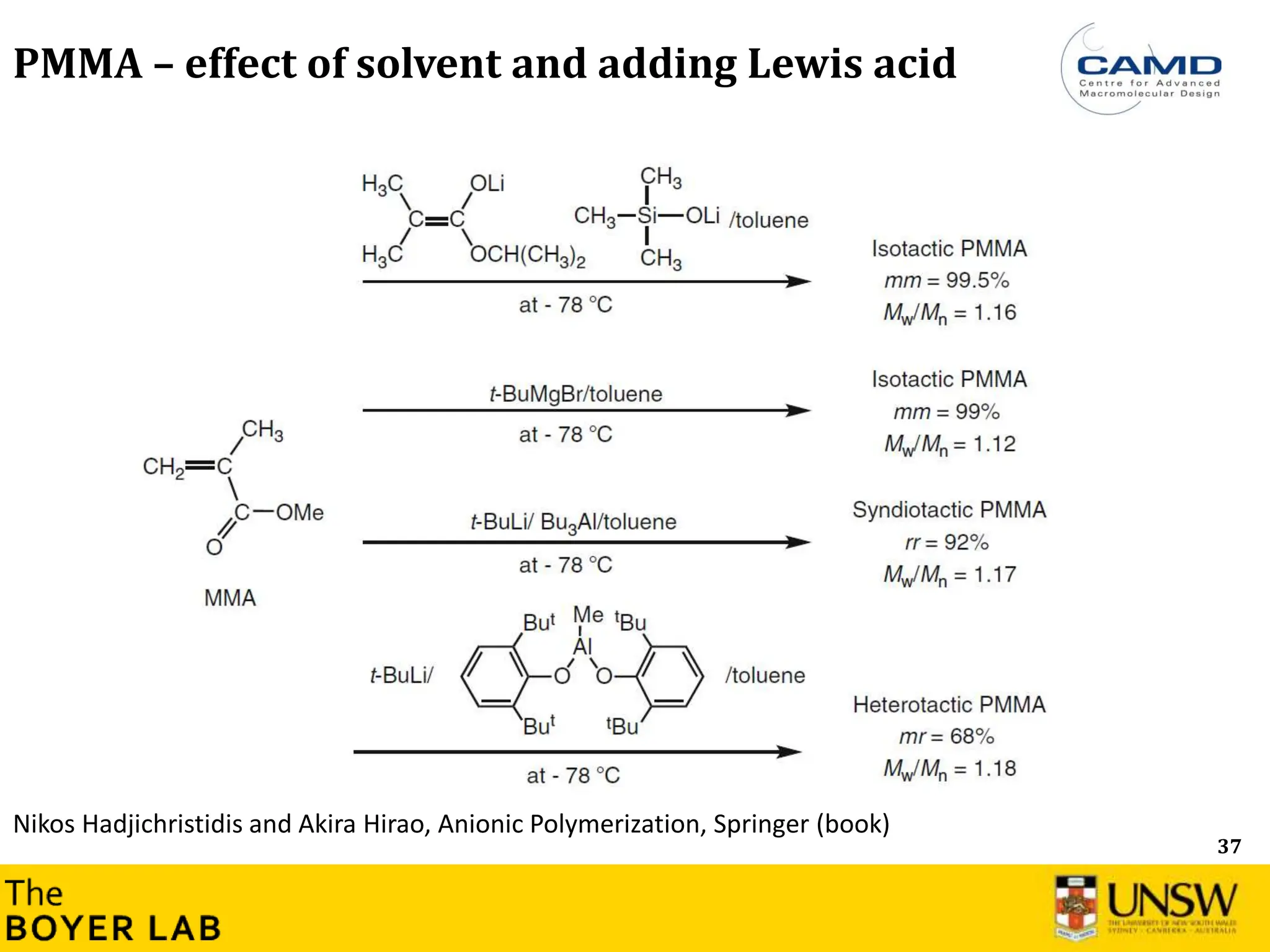
PMMA – effect of solvent and adding Lewis acid
Nikos Hadjichristidis and Akira Hirao, Anionic Polymerization, Springer (book)
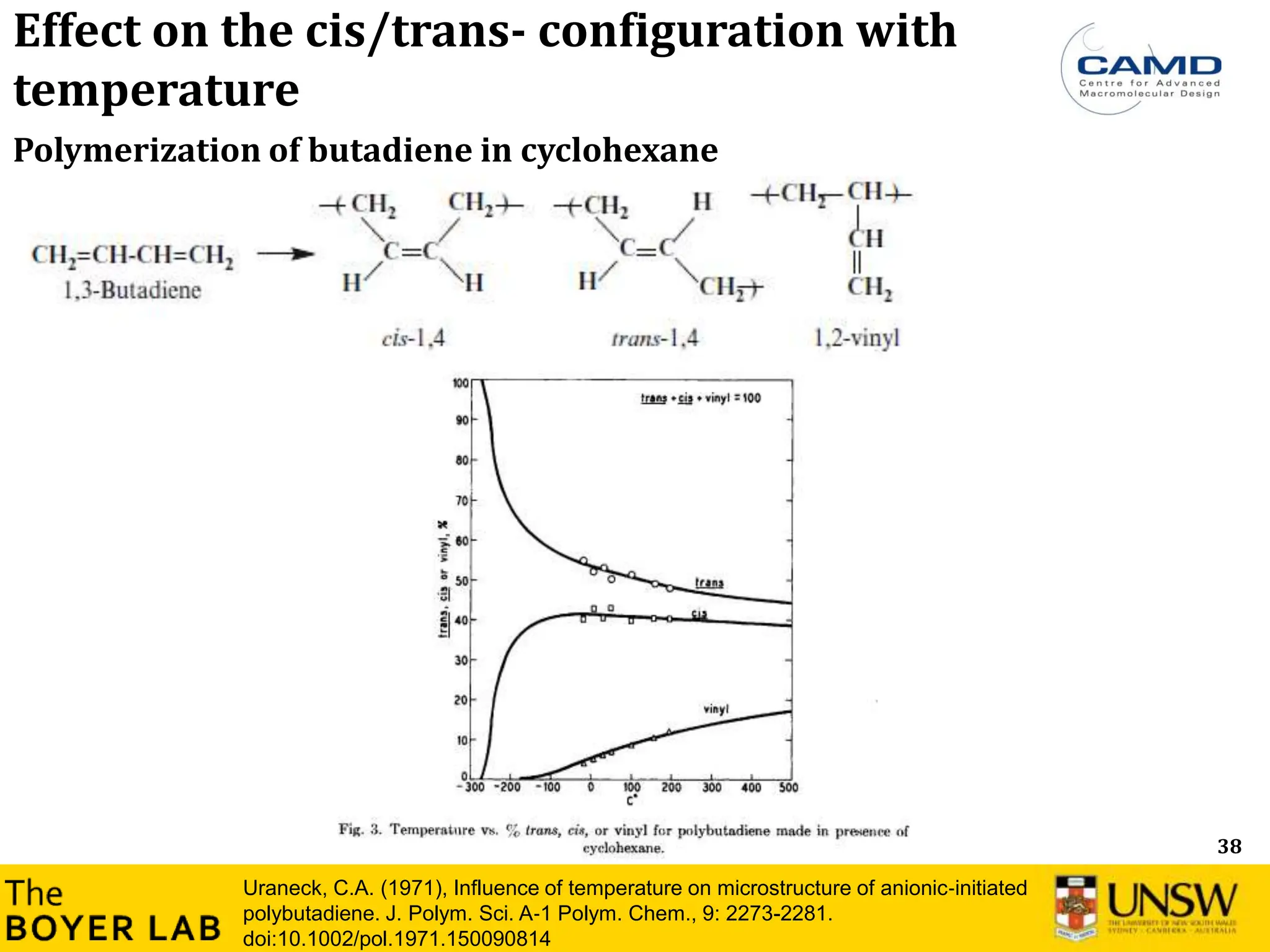
38
Uraneck, C.A. (1971), Influence of temperature on microstructure of anionic‐initiated
polybutadiene. J. Polym. Sci. A‐1 Polym. Chem., 9: 2273-2281.
doi:10.1002/pol.1971.150090814
Polymerization of butadiene in cyclohexane
Effect on the cis/trans- configuration with
temperature
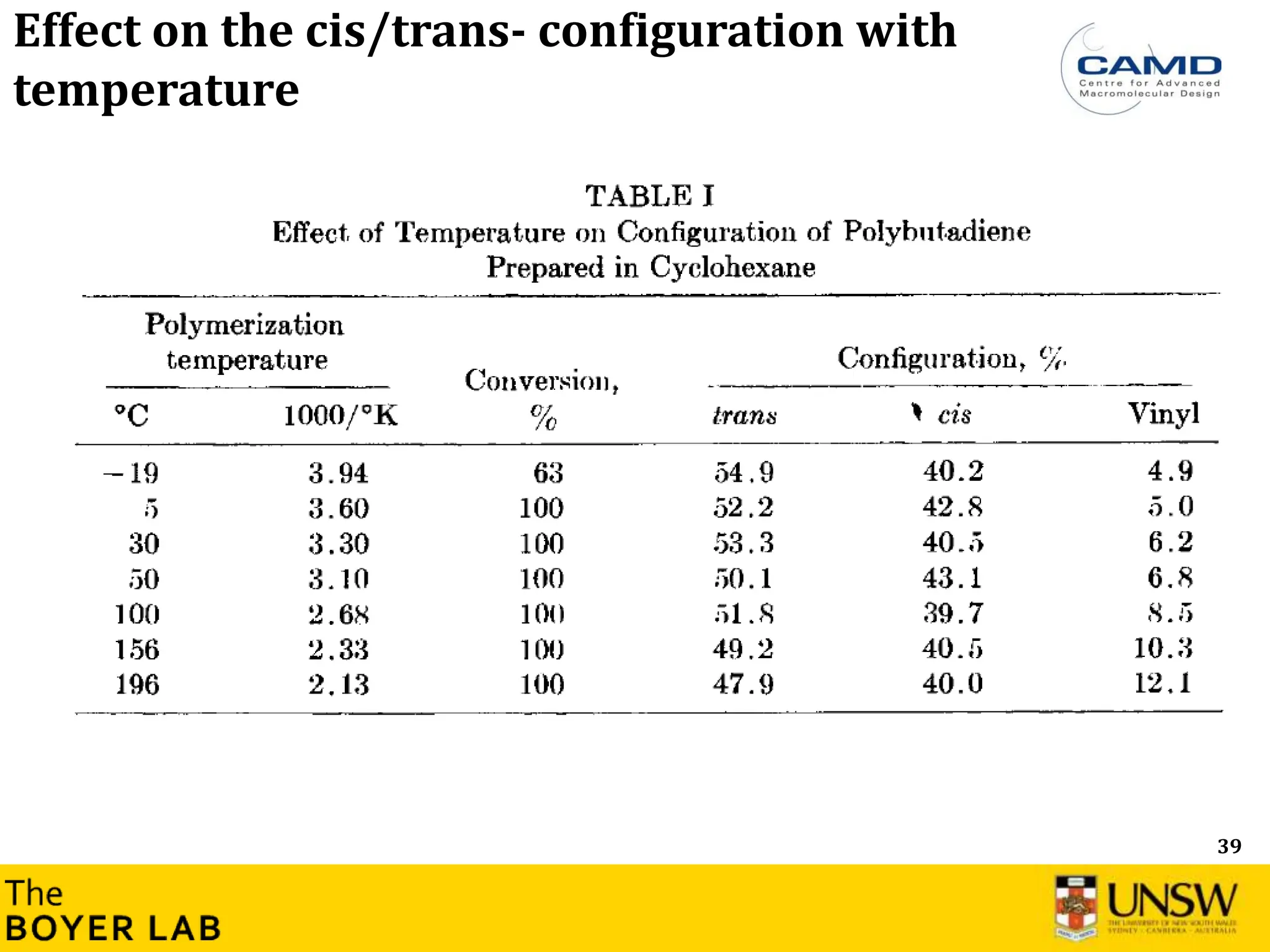
39
Effect on the cis/trans- configuration with
temperature
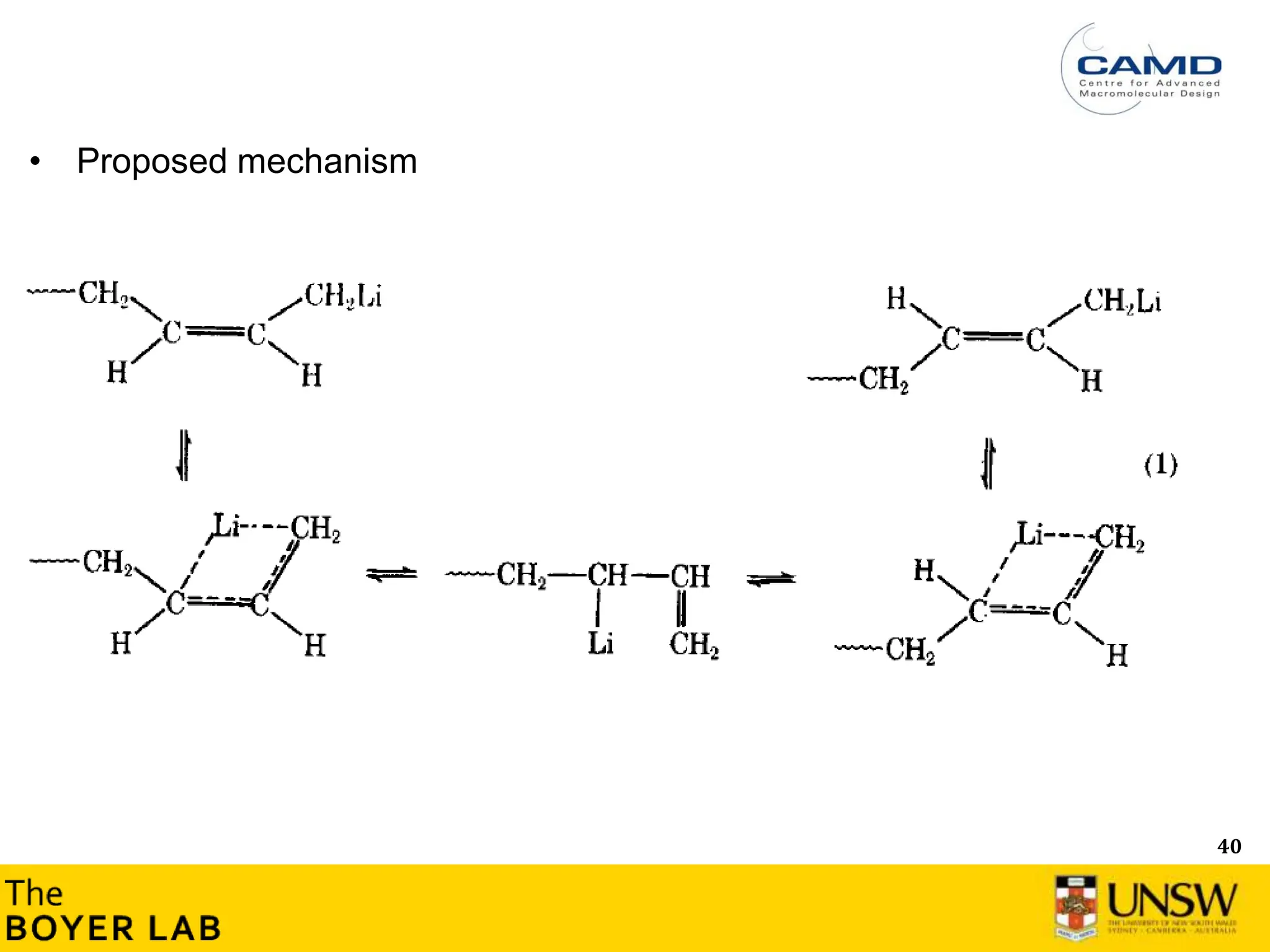
40
• Proposed mechanism
41
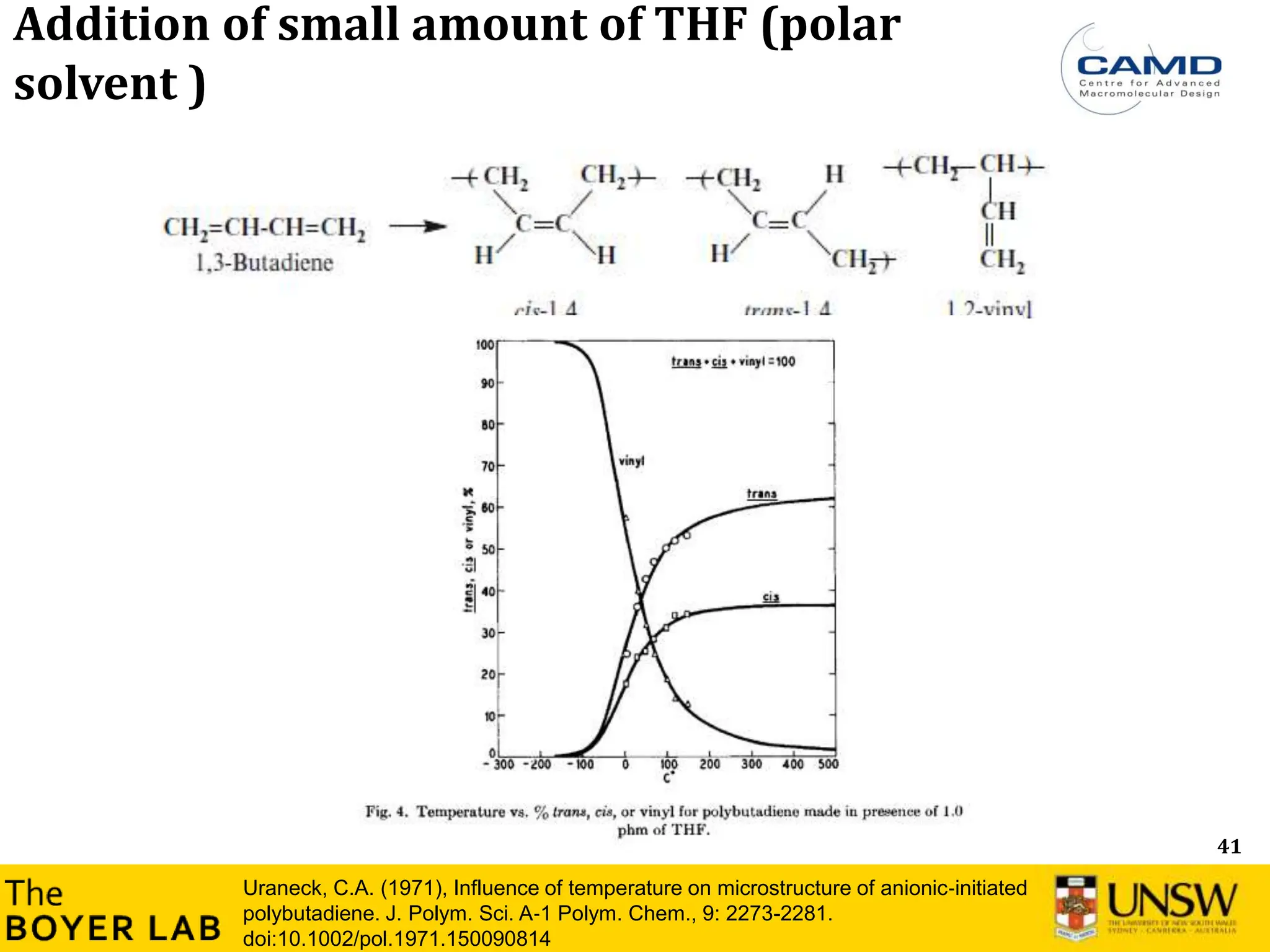
Addition of small amount of THF (polar
solvent )
Uraneck, C.A. (1971), Influence of temperature on microstructure of anionic‐initiated
polybutadiene. J. Polym. Sci. A‐1 Polym. Chem., 9: 2273-2281.
doi:10.1002/pol.1971.150090814
42
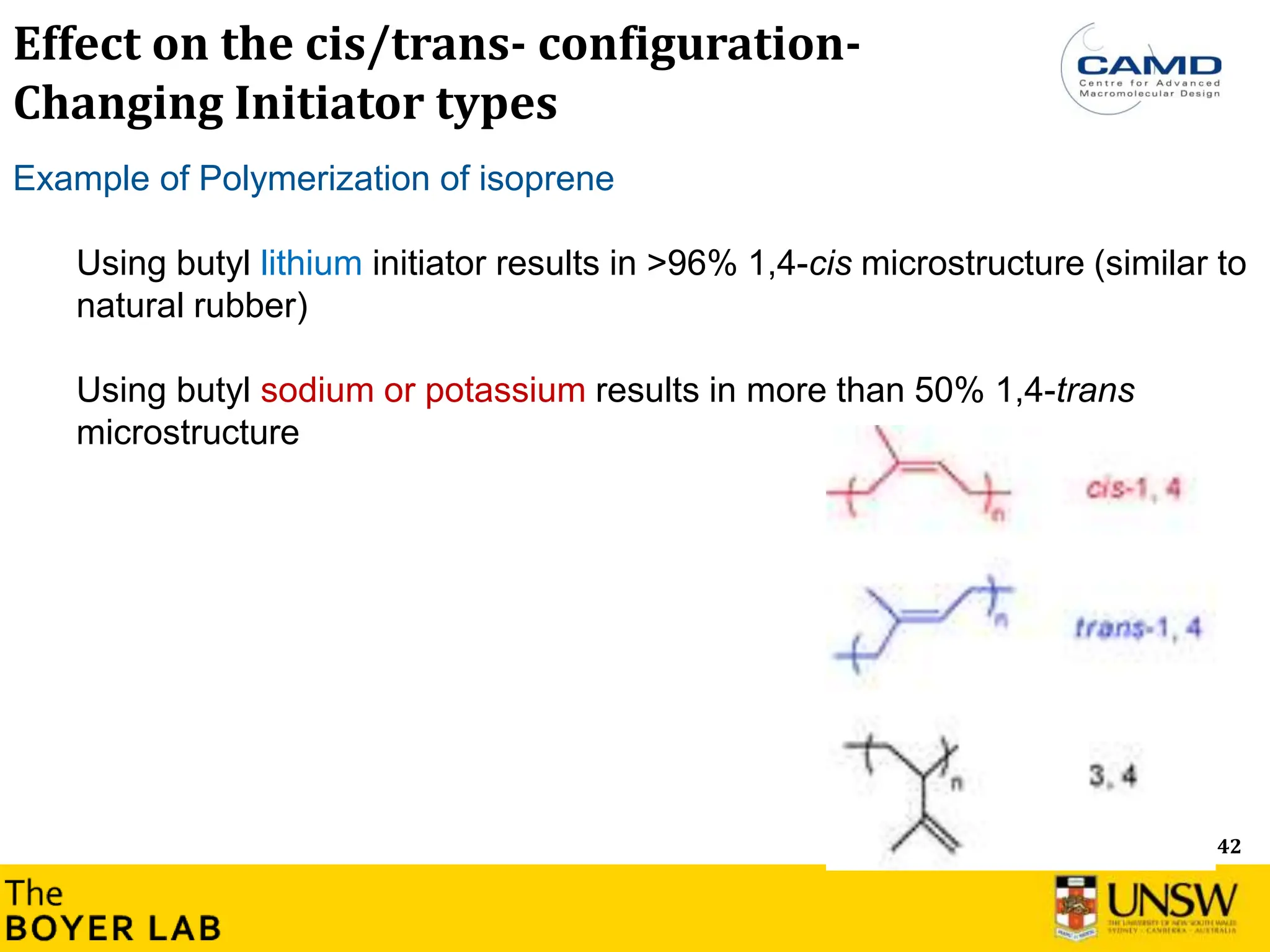
Effect on the cis/trans- configuration-
Changing Initiator types
Example of Polymerization of isoprene
Using butyl lithium initiator results in >96% 1,4-cis microstructure (similar to
natural rubber)
Using butyl sodium or potassium results in more than 50% 1,4-trans
microstructure
43
Polymerization of functional monomers
44
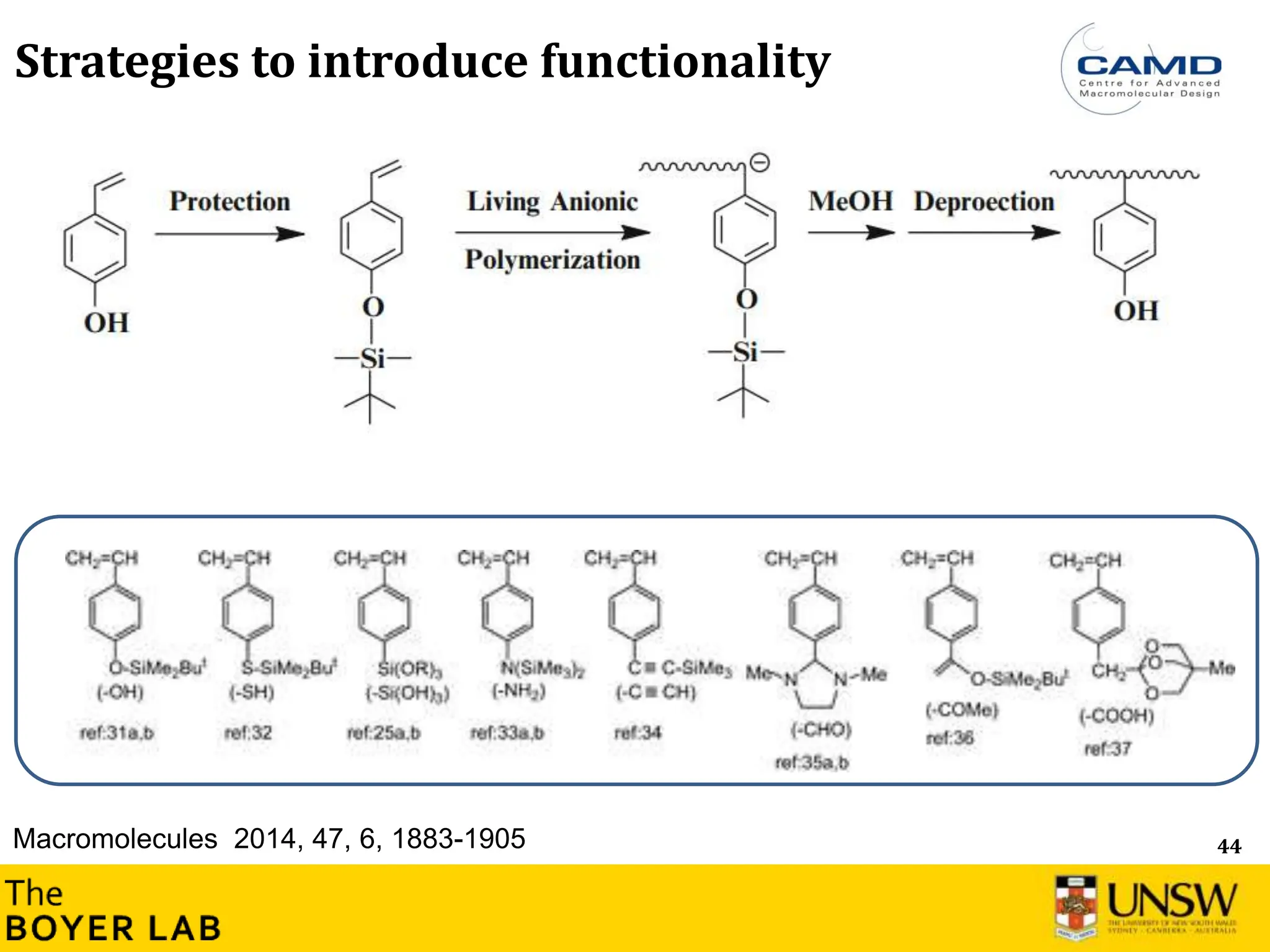
Strategies to introduce functionality
Macromolecules 2014, 47, 6, 1883-1905
45
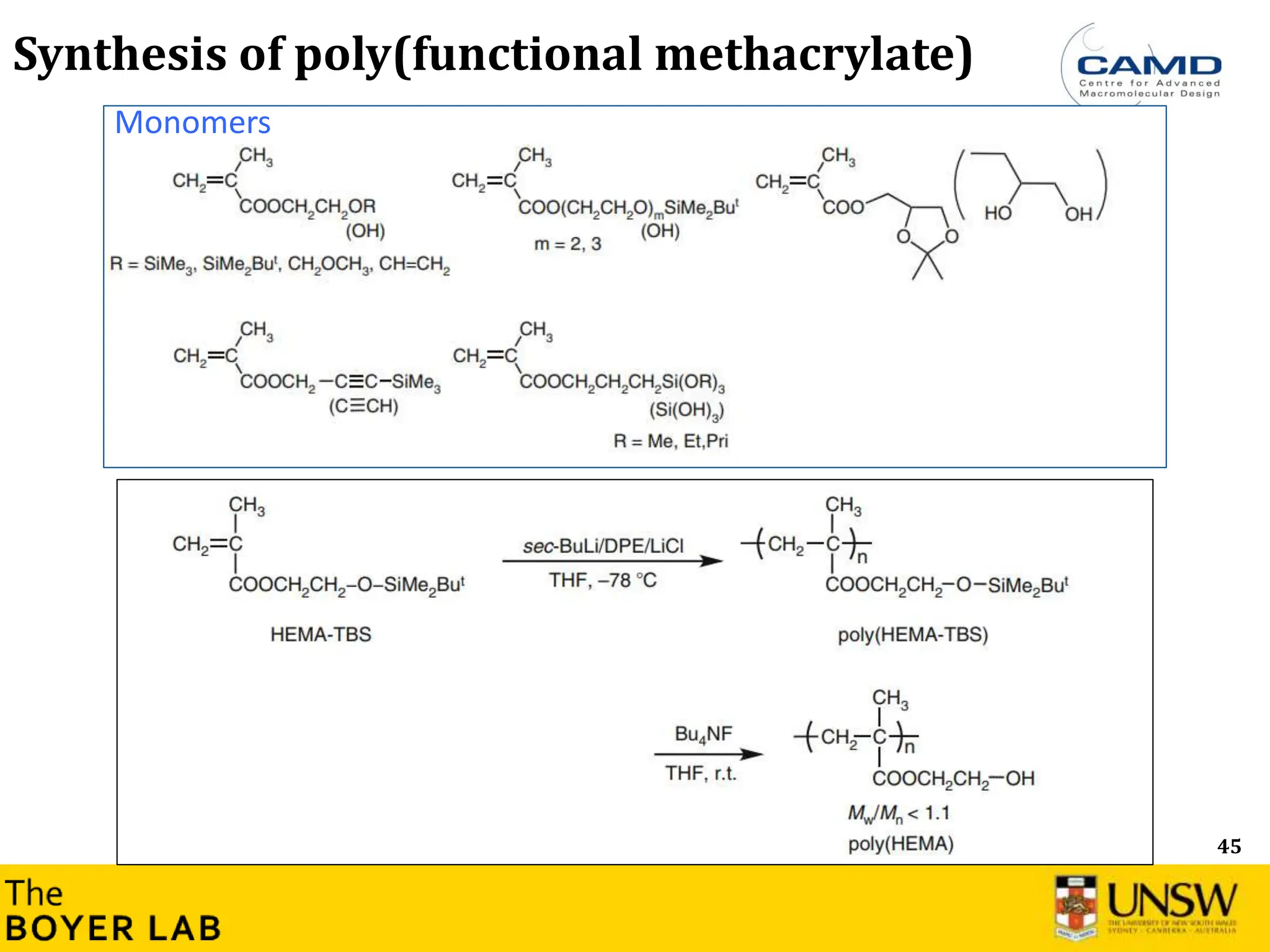
Synthesis of poly(functional methacrylate)
Monomers
46
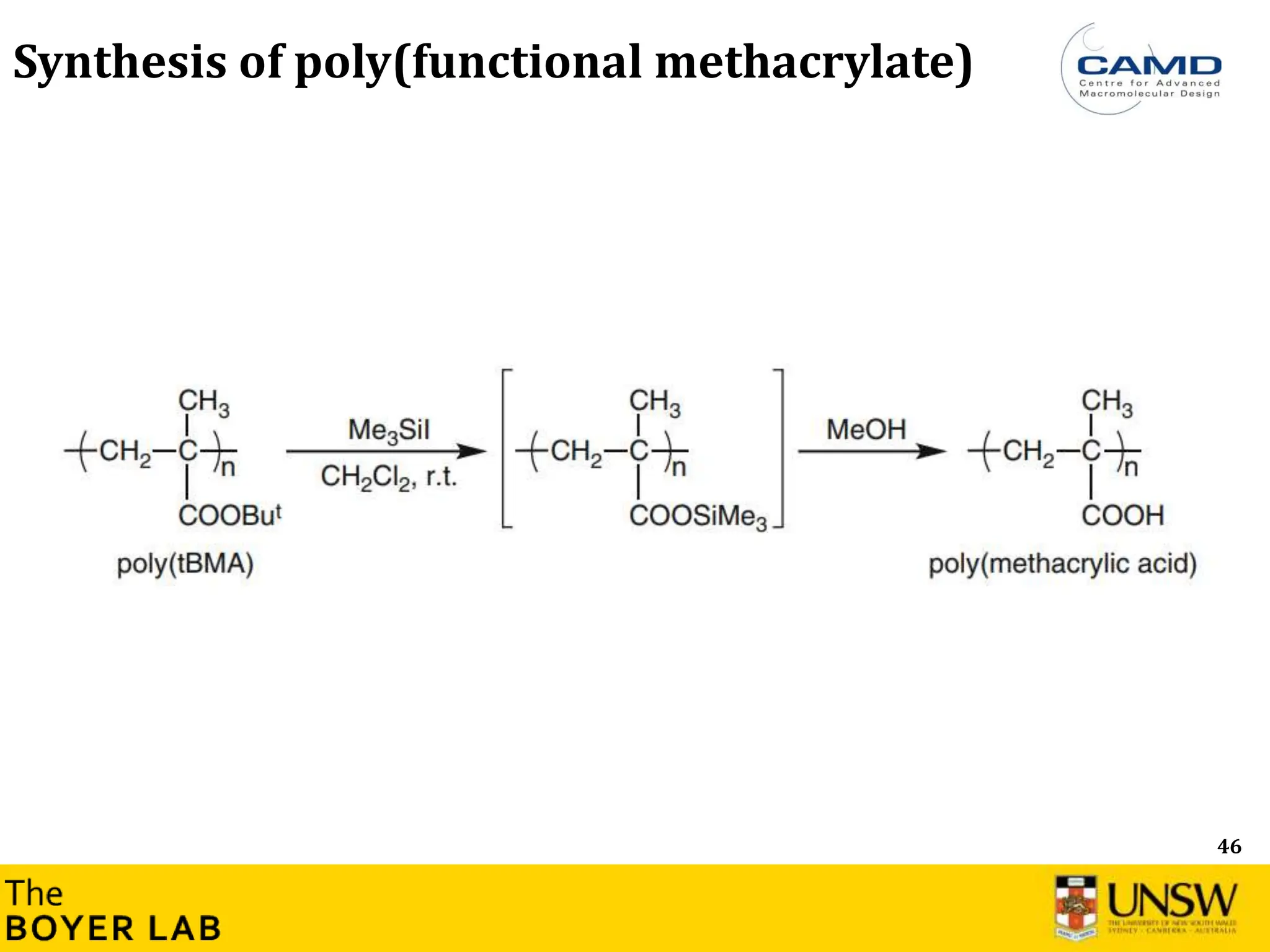
Synthesis of poly(functional methacrylate)
47
Termination reactions
48
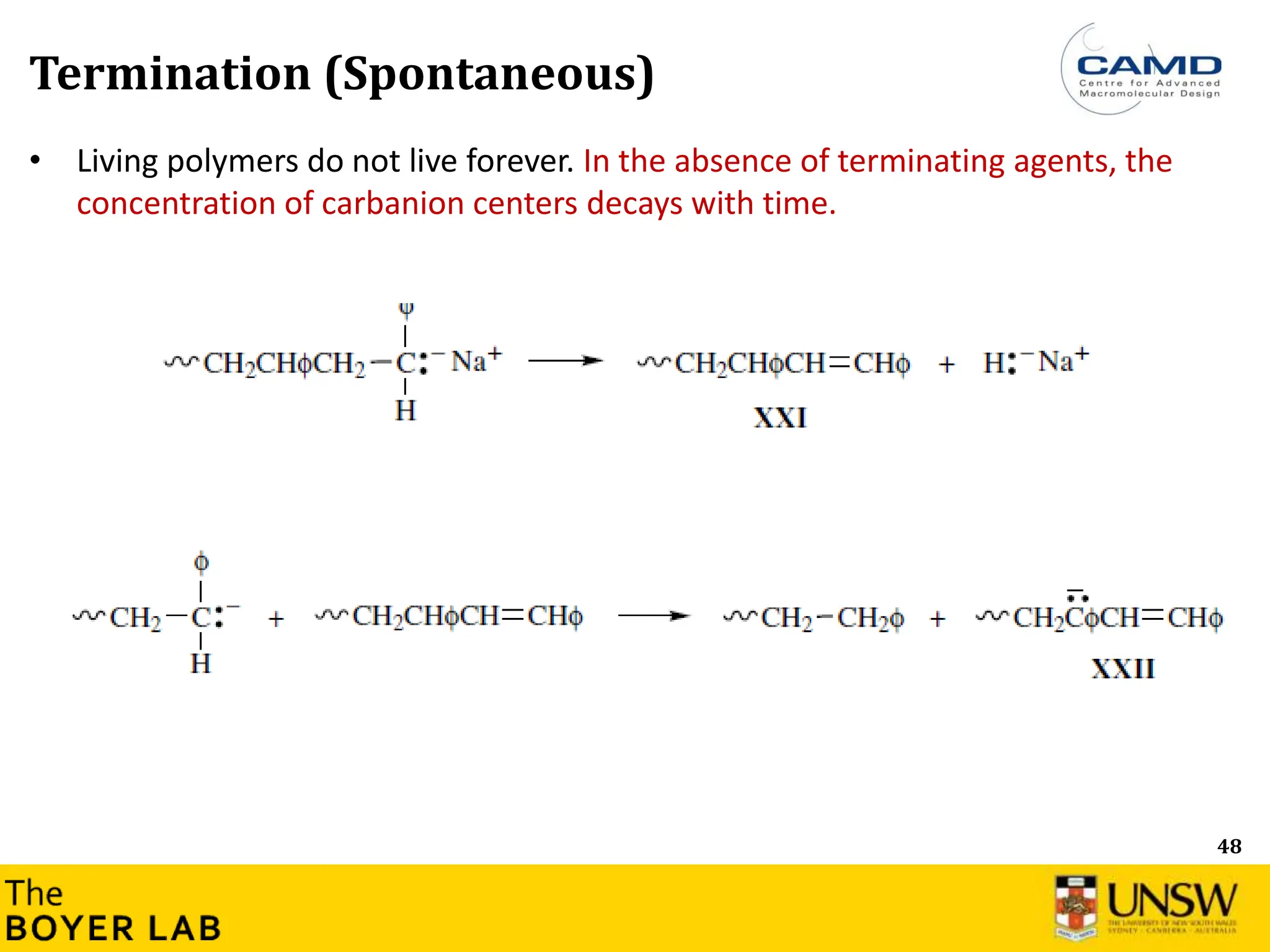
Termination (Spontaneous)
• Living polymers do not live forever. In the absence of terminating agents, the
concentration of carbanion centers decays with time.
49
Termination
• Water: Most anionic (as well as cationic) polymerizations are carried out in an
inert atmosphere with rigorously cleaned reagents and glassware since trace
impurities (including moisture) lead to termination.
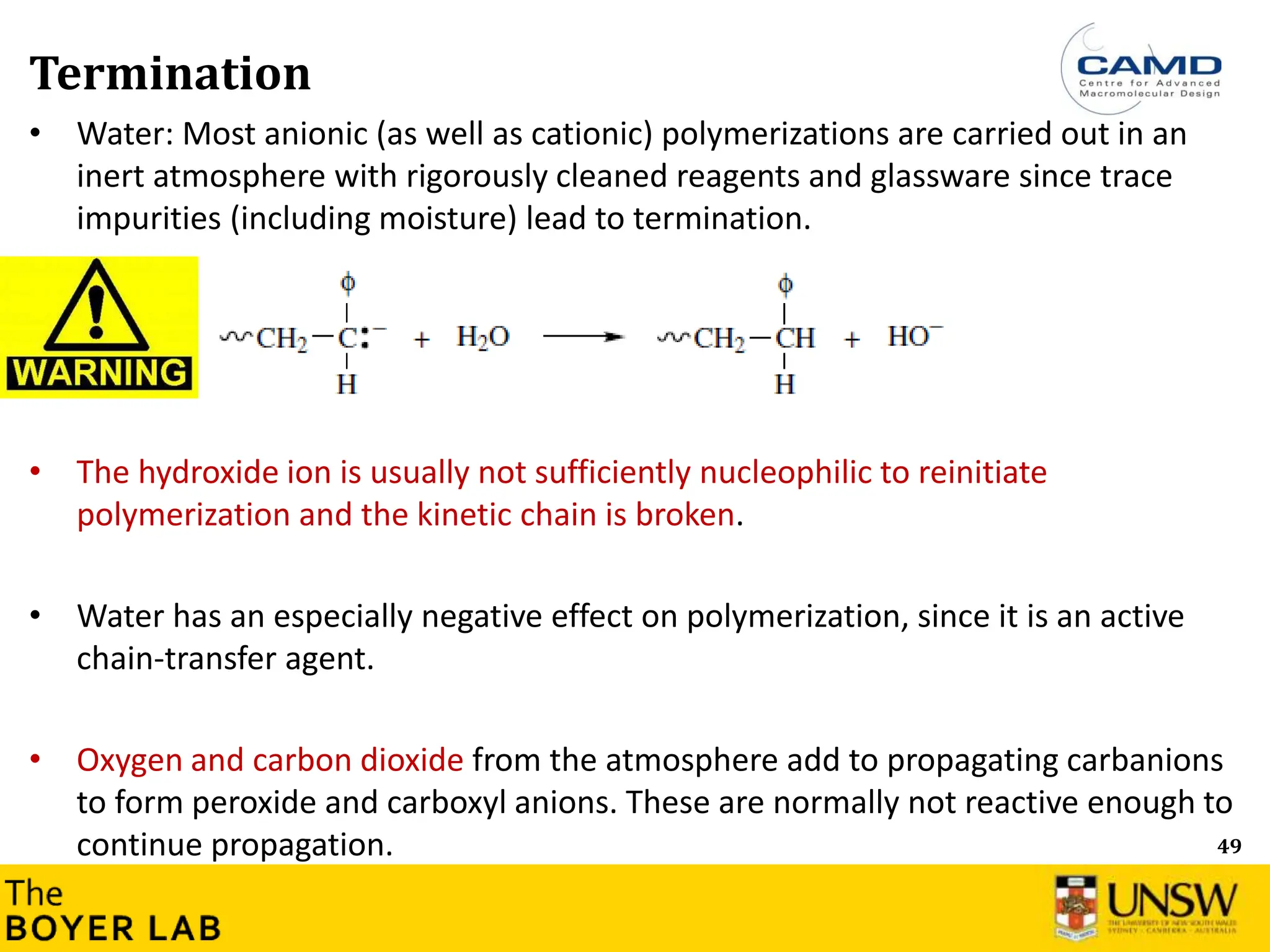
• The hydroxide ion is usually not sufficiently nucleophilic to reinitiate
polymerization and the kinetic chain is broken.
• Water has an especially negative effect on polymerization, since it is an active
chain-transfer agent.
• Oxygen and carbon dioxide from the atmosphere add to propagating carbanions
to form peroxide and carboxyl anions. These are normally not reactive enough to
continue propagation.
50
End-Capping of Polymer Chains
• Adding carbon dioxide at the end of anionic polymerization of
styrene can result in carboxylic acid formation
• In case of styrene, adding CO2 can result in 70% carboxylic acid
formation due to side reactions
Solution: By adding 1,1-diphenylethylene first (reducing the
reactivity of carbanion), >98% carboxylic acid formation results
• Reaction with ethylene oxide results in an alcohol functionality
51
Anionic polymerization kinetics
Anionic Polymerization
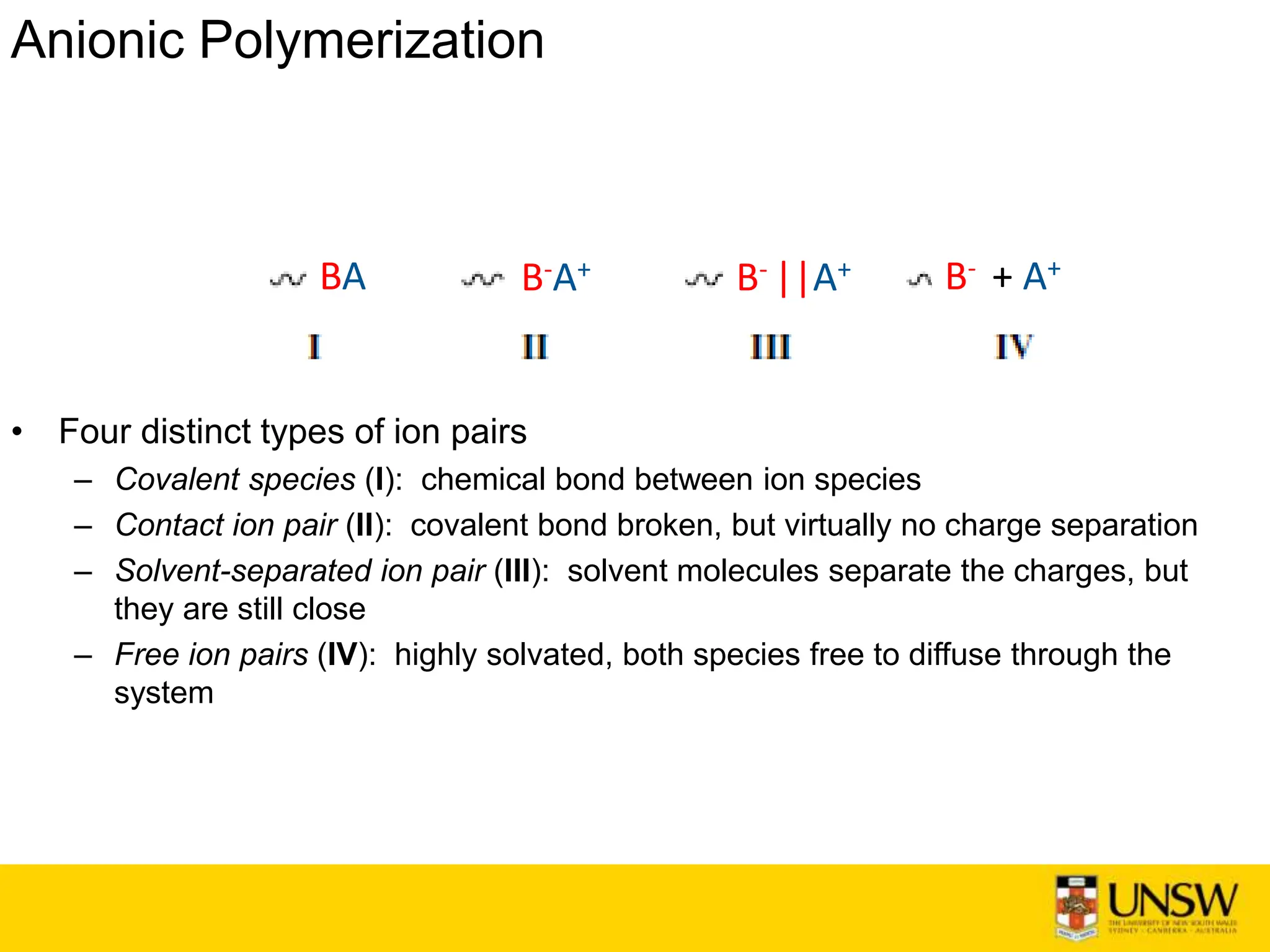
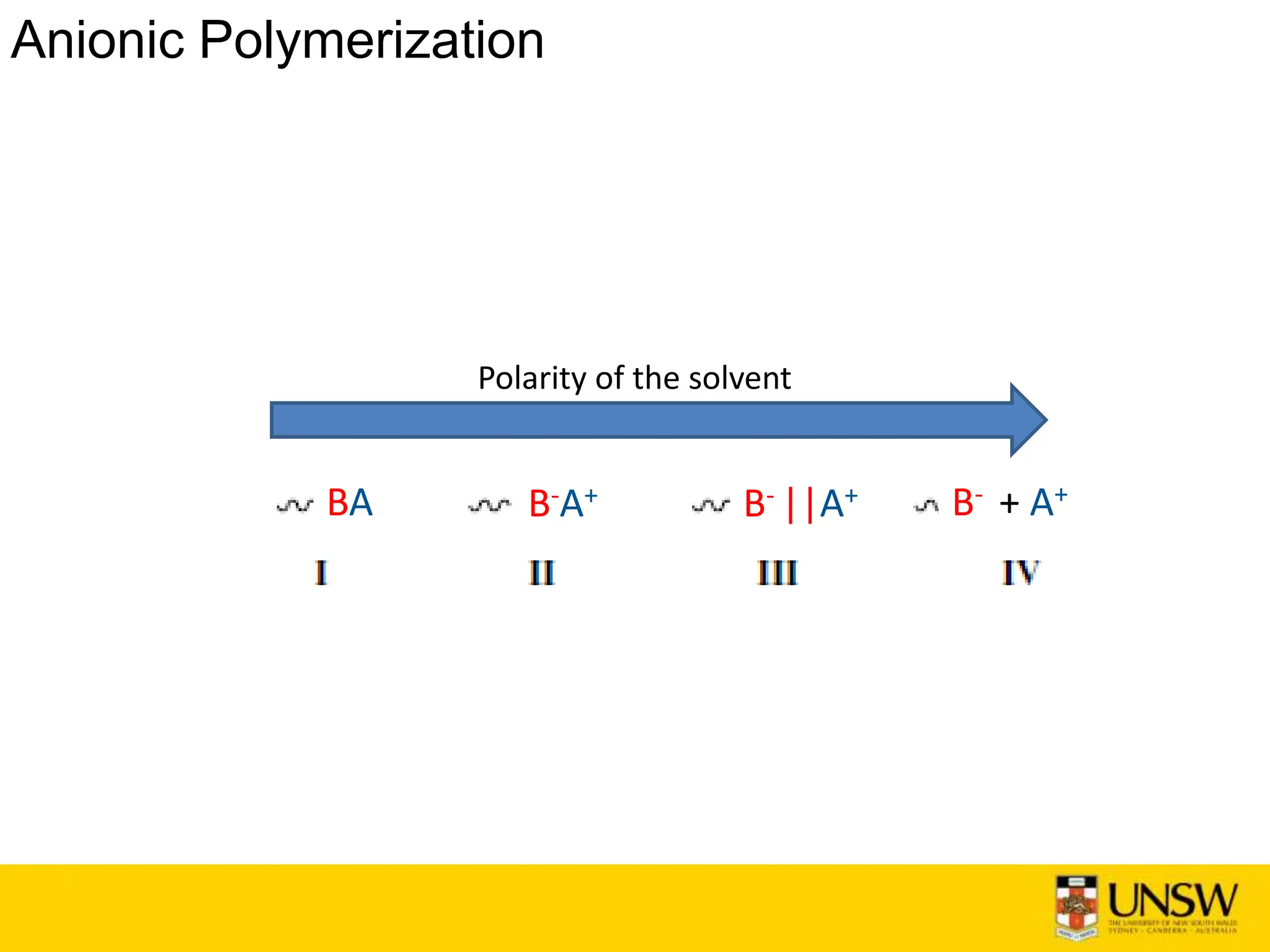
• Four distinct types of ion pairs
– Covalent species (I): chemical bond between ion species
– Contact ion pair (II): covalent bond broken, but virtually no charge separation
– Solvent-separated ion pair (III): solvent molecules separate the charges, but
they are still close
– Free ion pairs (IV): highly solvated, both species free to diffuse through the
system
B-A+ B- ||A+ B- + A+
BA
53
Polymerization Kinetics
Ln([M]
0
/[M]
t
)
Time
Ln([M]0/[M]t) = kp
app × time → Constant concentration of active group
Ln([M]0/[M]t) = Rp= kp
app× [M-] × [M]
[M-] corresponds to active species, where [M] is the total concentration of all types of
living anionic propagating centers (free ions and ion pairs).
→ Most of anionic polymerization: Constant active groups (carbanion), i.e. Ln(M0/M) is
linear
54
Ln(M
0
/M)
Time
A
C
B
Polymerisation Kinetics
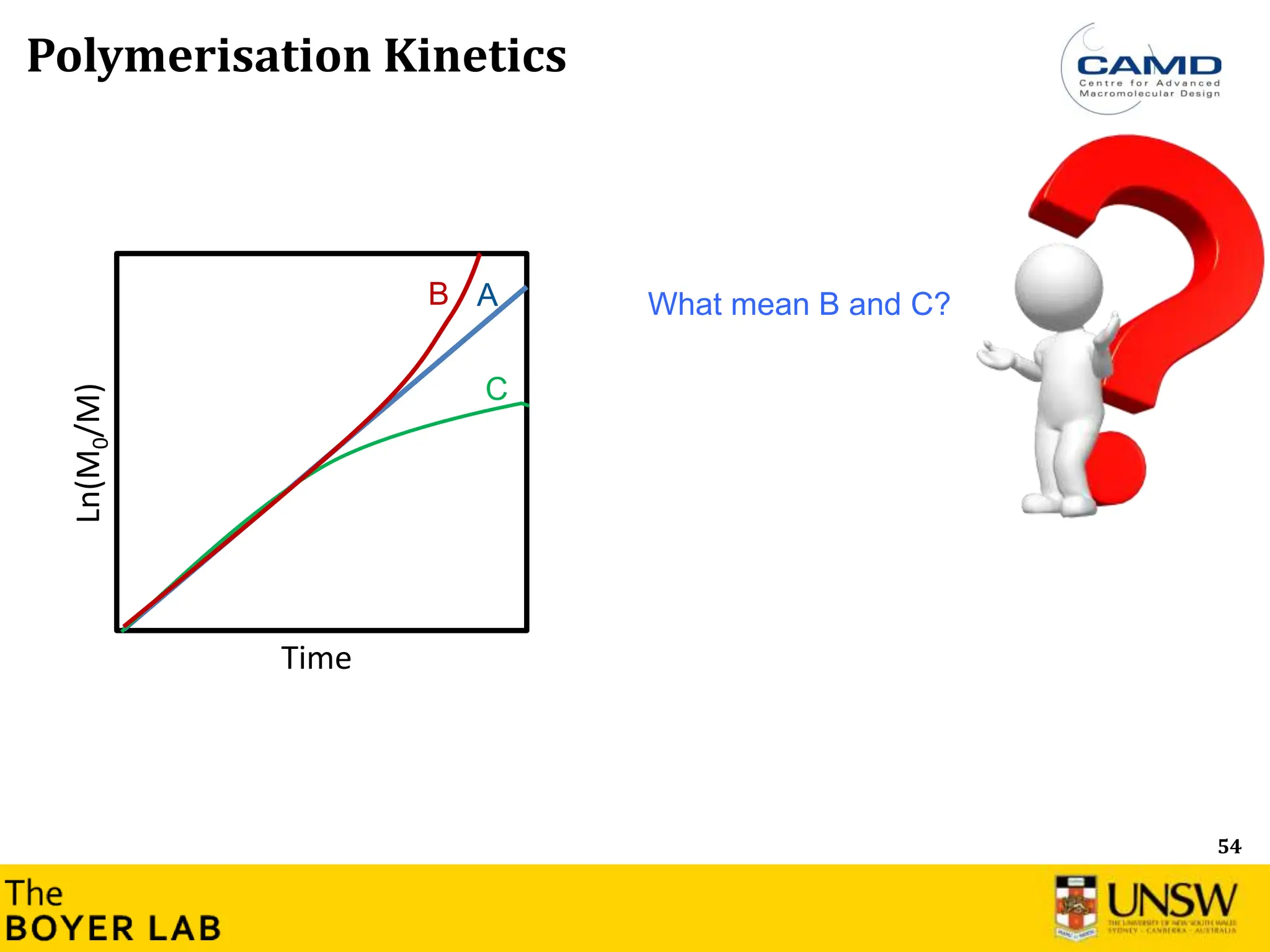
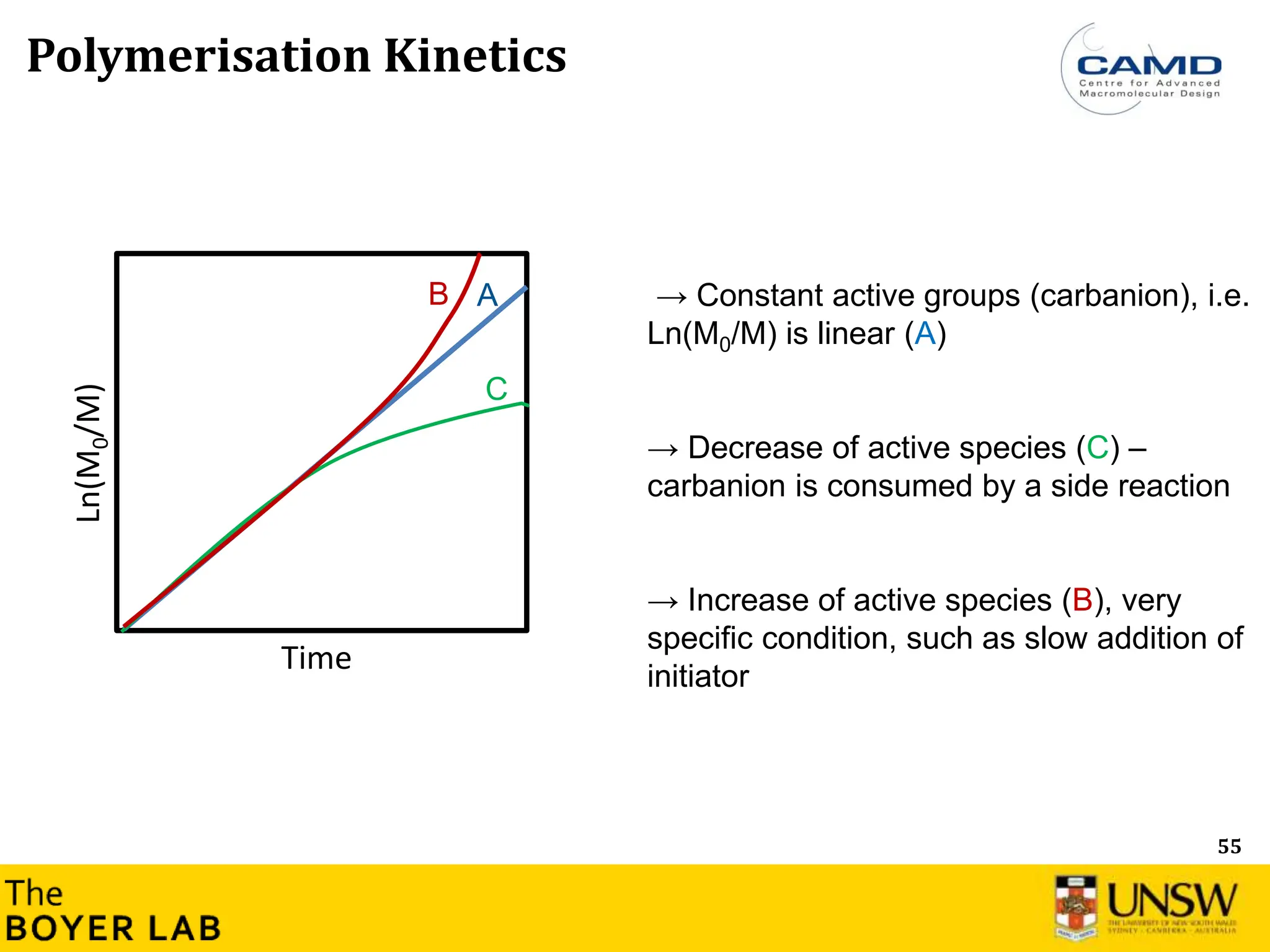
What mean B and C?
55
Ln(M
0
/M)
Time
A
C
→ Constant active groups (carbanion), i.e.
Ln(M0/M) is linear (A)
→ Decrease of active species (C) –
carbanion is consumed by a side reaction
→ Increase of active species (B), very
specific condition, such as slow addition of
initiator
B
Polymerisation Kinetics
56
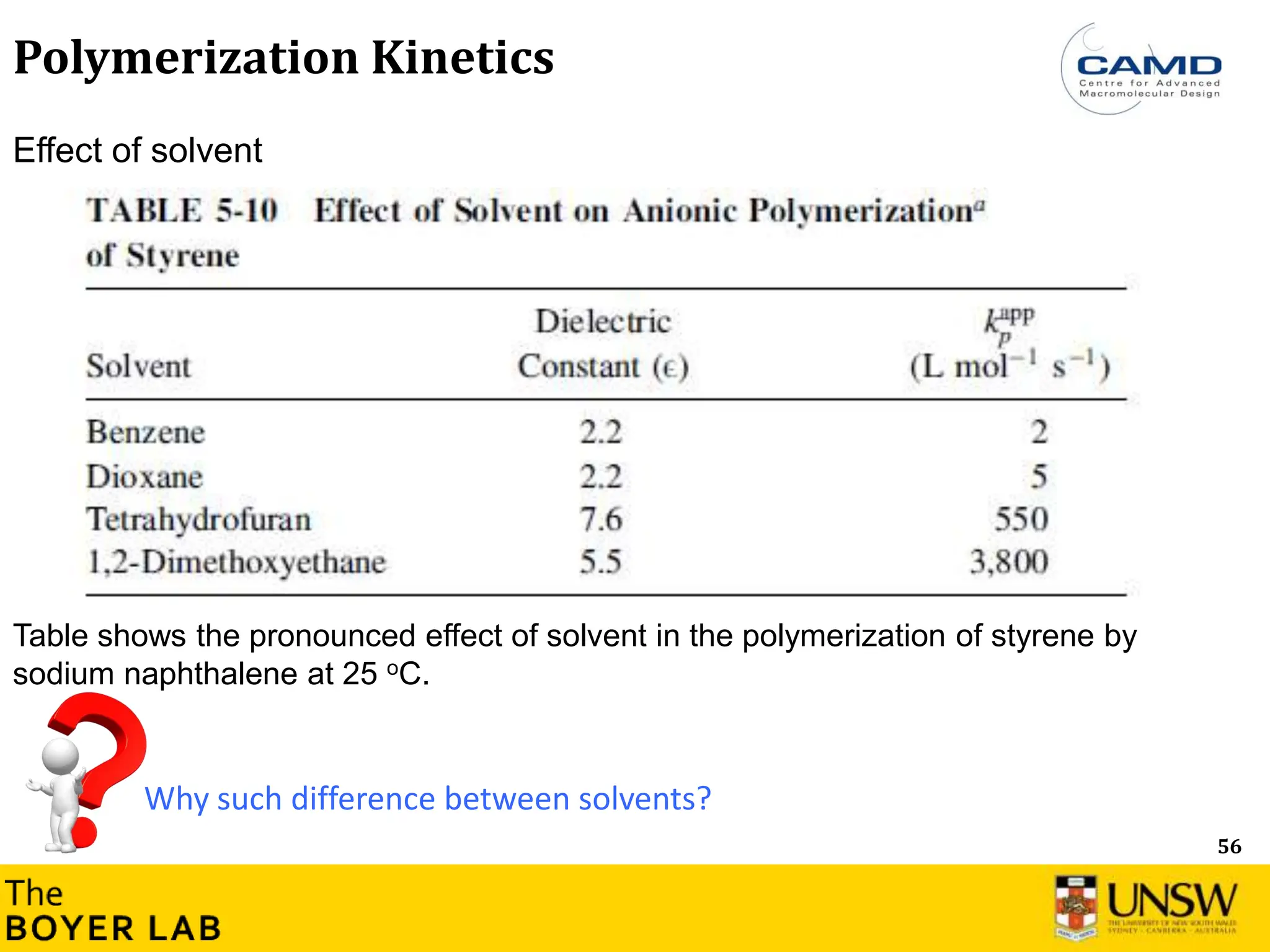
Polymerization Kinetics
Effect of solvent
Why such difference between solvents?
Table shows the pronounced effect of solvent in the polymerization of styrene by
sodium naphthalene at 25 oC.
57
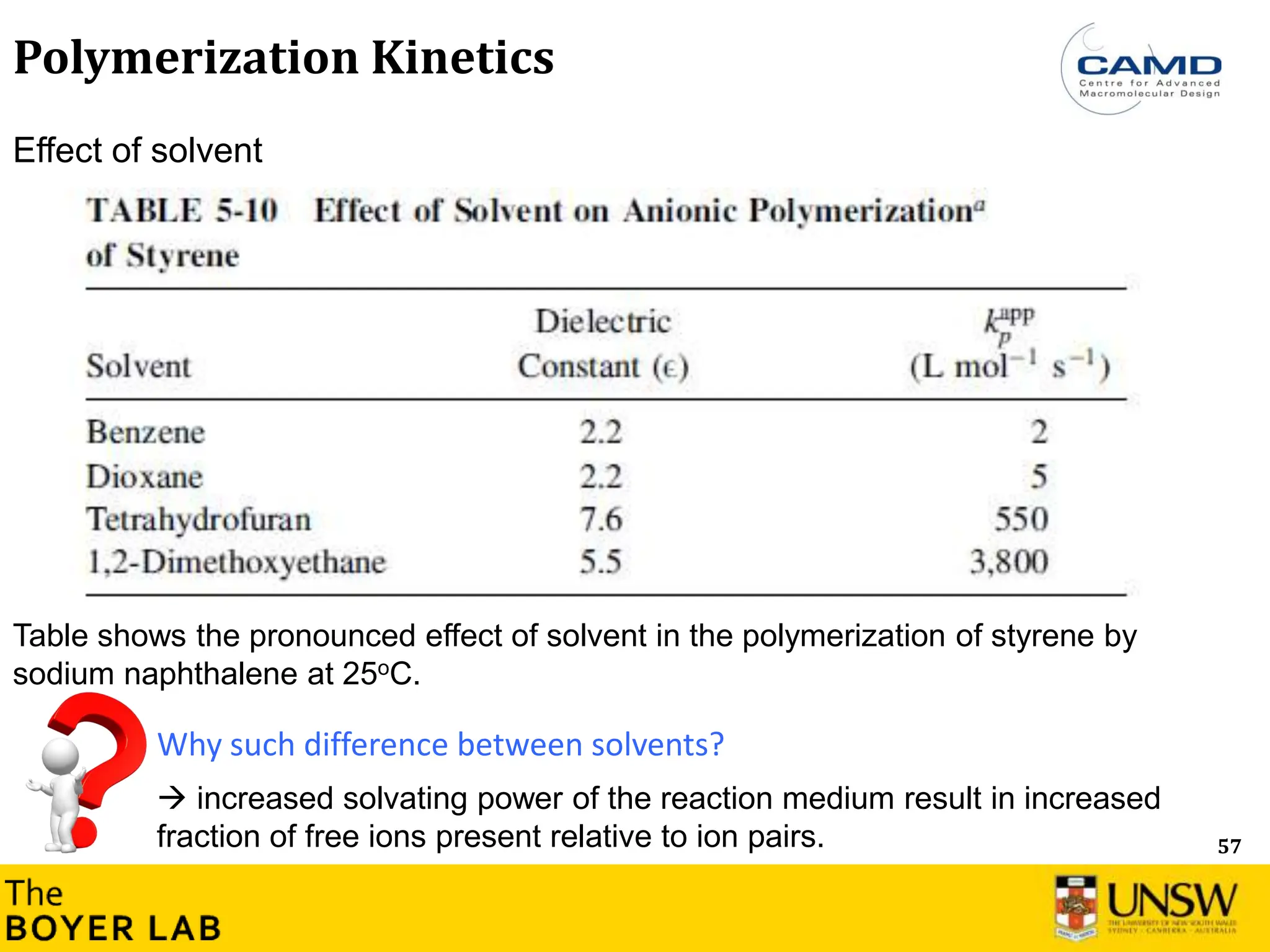
Polymerization Kinetics
Effect of solvent
Why such difference between solvents?
Table shows the pronounced effect of solvent in the polymerization of styrene by
sodium naphthalene at 25oC.
 increased solvating power of the reaction medium result in increased
fraction of free ions present relative to ion pairs.
Anionic Polymerization
B-A+ B- ||A+ B- + A+
BA
Polarity of the solvent
59
Factors affecting kp
app
• [M-] is combination of [P-] + [P-(C+)]  [M-] = [P-] + [P-(C+)]
• Rp = kp
-[P-][M] + Kp
±[P-(C+)][M] (1)
• Rp = = kp
app× [M-] × [M] (2)
Combined (1) and (2)
• kp
app=
[kp
−[P−]+ Kp
±[P−(C+)]
[M−]
• P-(C+) ↔ P- + C+ Dissociation constant: 𝐾 =
𝑃
−
[𝐶
+
]
[𝑃
−
𝐶
+
]
,
• if [P-]=[C+] 𝐾 =
𝑃
−
2
[𝑃
−
𝐶
+
]
 𝑃
−
= √(𝐾 × 𝑃
−
𝐶
+
)
60
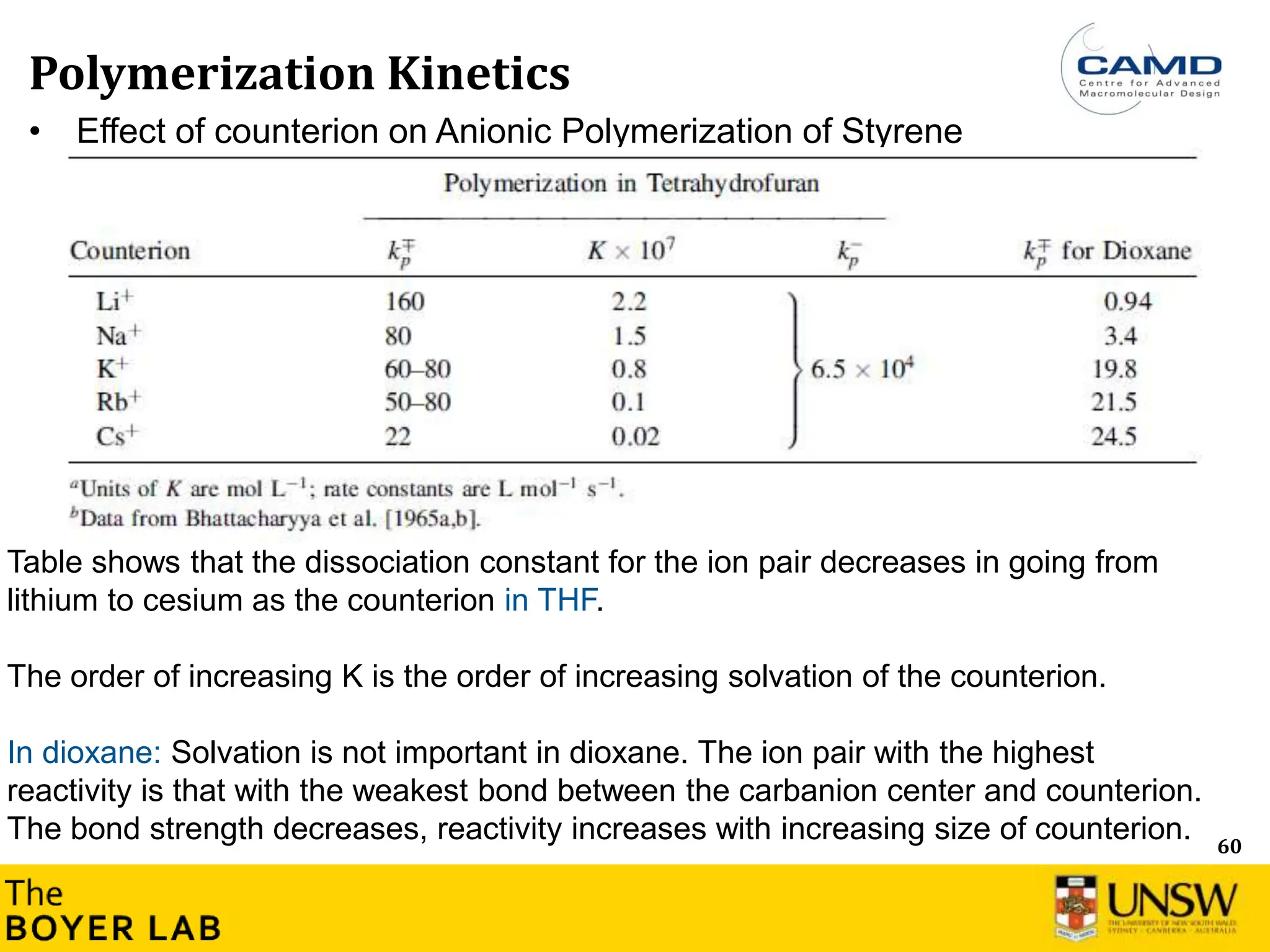
• Effect of counterion on Anionic Polymerization of Styrene
Polymerization Kinetics
Table shows that the dissociation constant for the ion pair decreases in going from
lithium to cesium as the counterion in THF.
The order of increasing K is the order of increasing solvation of the counterion.
In dioxane: Solvation is not important in dioxane. The ion pair with the highest
reactivity is that with the weakest bond between the carbanion center and counterion.
The bond strength decreases, reactivity increases with increasing size of counterion.
61
Anionic Polymerization – Evolution of Mn
versus monomer conversion
• Because termination only occurs when small molecules are added
(or leaked in), the system never dies
– Polymerization continues til monomer is used up
– Alkyl and aryl lithium compounds are stable for several days
What is the expected molecular weight at full monomer
conversion? Can you write the equation to link Mn,
monomer concentration, initiator concentration?
62
Anionic Polymerization – Evolution of Mn
versus monomer conversion
• Because termination only occurs when small molecules are added (or
leaked in), the system never dies
– Polymerization continues til monomer is used up
– Alkyl and aryl lithium compounds are stable for several days
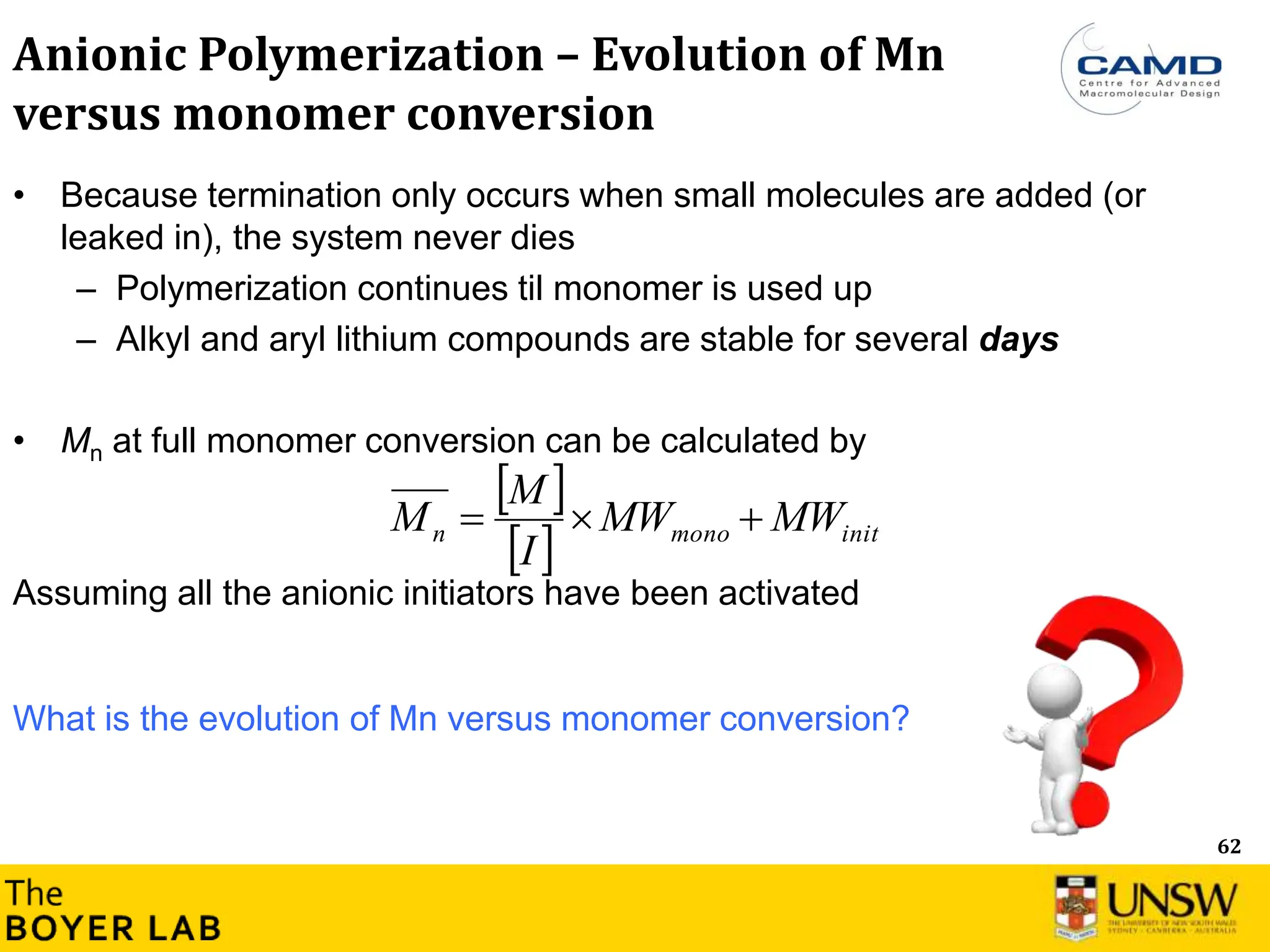
• Mn at full monomer conversion can be calculated by
Assuming all the anionic initiators have been activated
 
  init
mono
n MW
MW
I
M
M 


What is the evolution of Mn versus monomer conversion?
63
Molecular
weight
Monomer conversion
• Linear evolution of Mn versus monomer
conversion
→ Prediction of the molecular weight versus
monomer conversion
Mn = ([M]0/[Initiator]0) × α × MW (Monomer)
+ MW (Initiator)
What is the condition for this equation to be
valid?
Anionic Polymerization – Evolution of Mn
versus monomer conversion
64
Molecular
weight
Monomer conversion
• Linear evolution of Mn versus monomer
conversion
→ Prediction of the molecular weight versus
monomer conversion
Mn = [M]0/[Initiator]0 × α × MW (Monomer) +
MW (Initiator)
Anionic Polymerization – Evolution of Mn
versus monomer conversion
Condition: In anionic polymerisation, the initiation is fast (all chains are activated at the
beginning of the polymerization) in comparison to the rate of chain propagation.
What is the consequence for the dispersity (or polydispersity)?
65
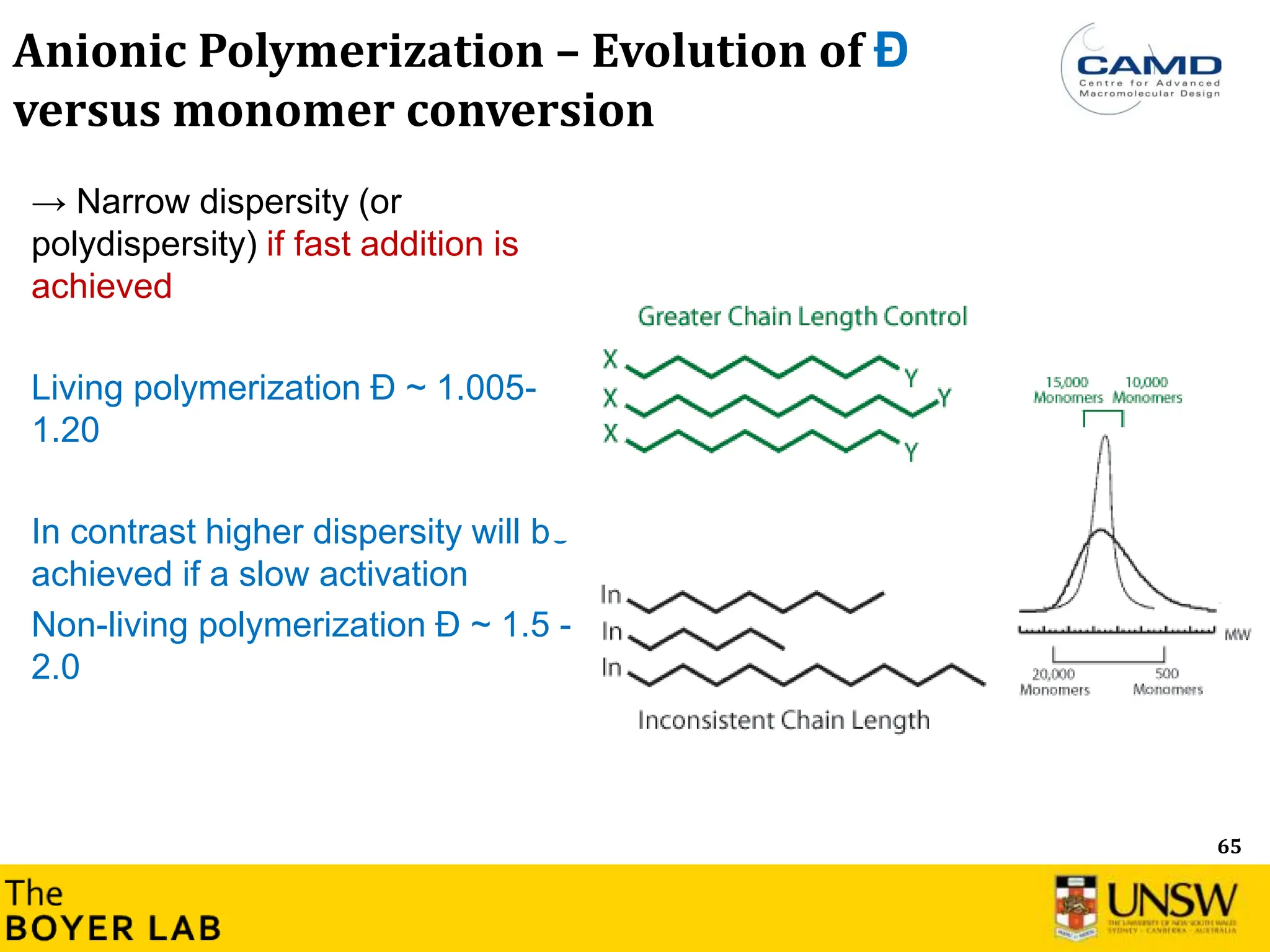
→ Narrow dispersity (or
polydispersity) if fast addition is
achieved
Living polymerization Đ ~ 1.005-
1.20
In contrast higher dispersity will be
achieved if a slow activation
Non-living polymerization Đ ~ 1.5 -
2.0
Anionic Polymerization – Evolution of Đ
versus monomer conversion
66
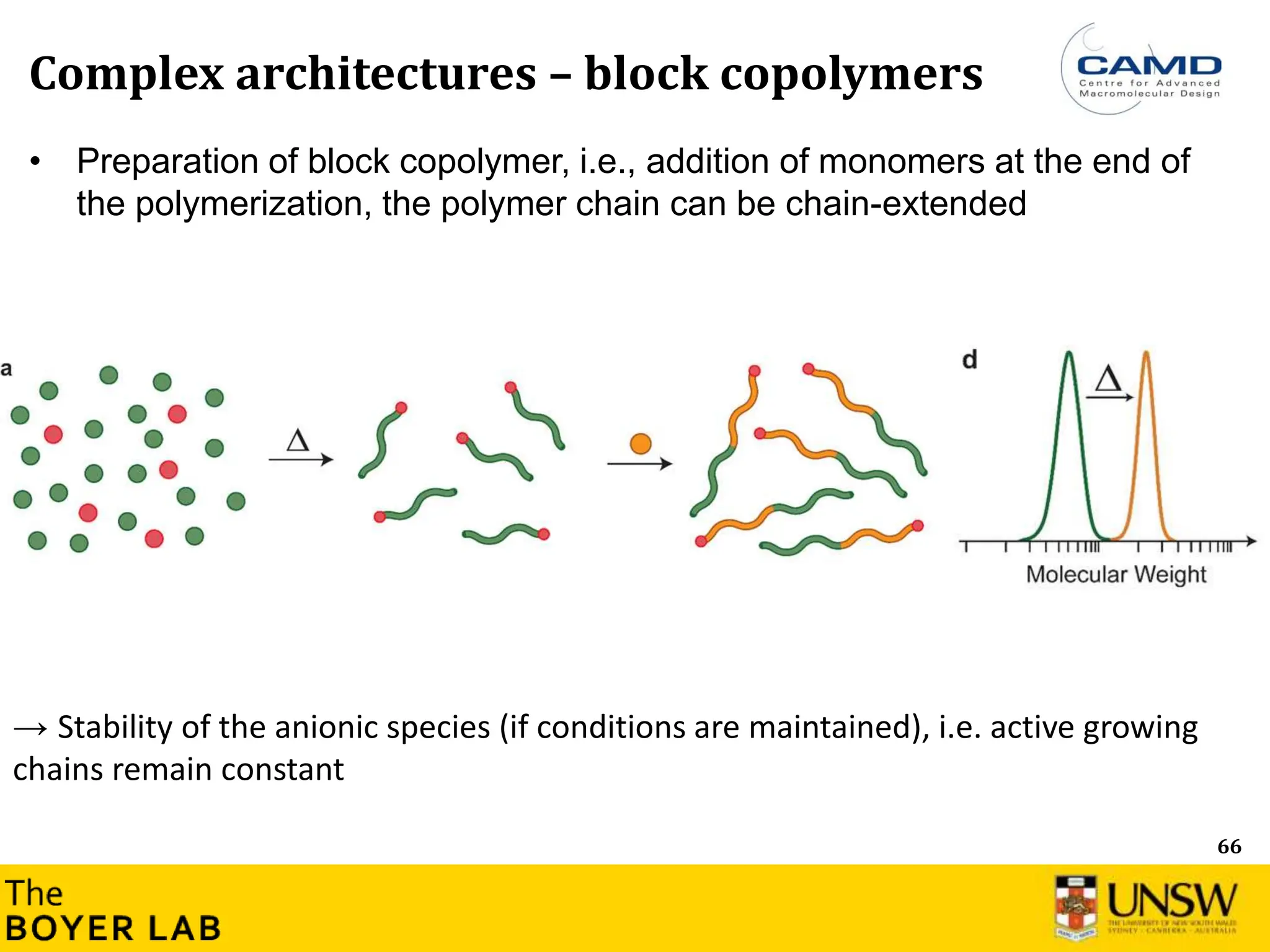
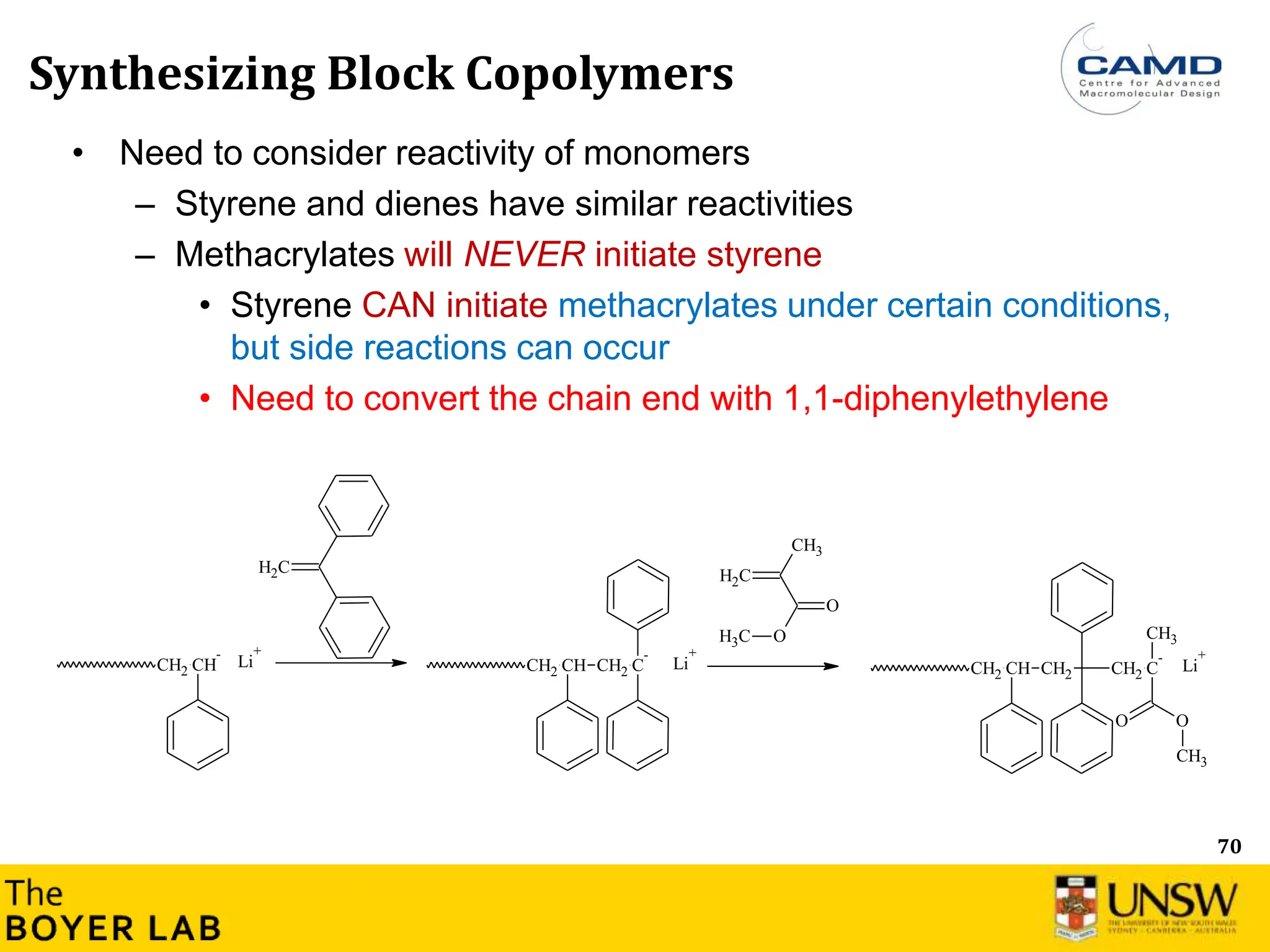
Complex architectures – block copolymers
• Preparation of block copolymer, i.e., addition of monomers at the end of
the polymerization, the polymer chain can be chain-extended
→ Stability of the anionic species (if conditions are maintained), i.e. active growing
chains remain constant
67
Synthesis of Block Copolymers
• Need to consider the reactivity of monomers
– Styrene and dienes have similar reactivities
– Methacrylates will NEVER initiate styrene
Why?
68
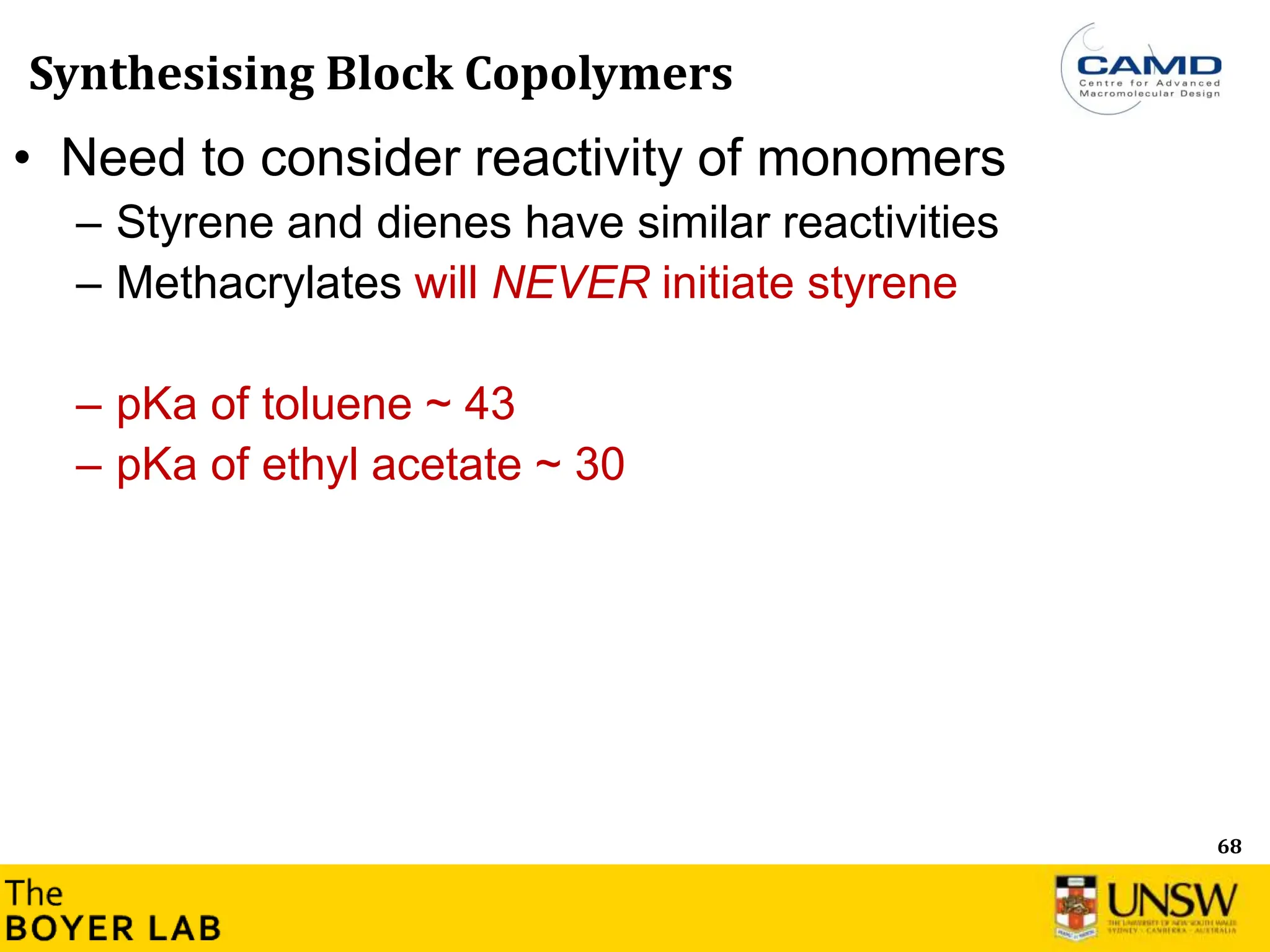
Synthesising Block Copolymers
• Need to consider reactivity of monomers
– Styrene and dienes have similar reactivities
– Methacrylates will NEVER initiate styrene
– pKa of toluene ~ 43
– pKa of ethyl acetate ~ 30
69
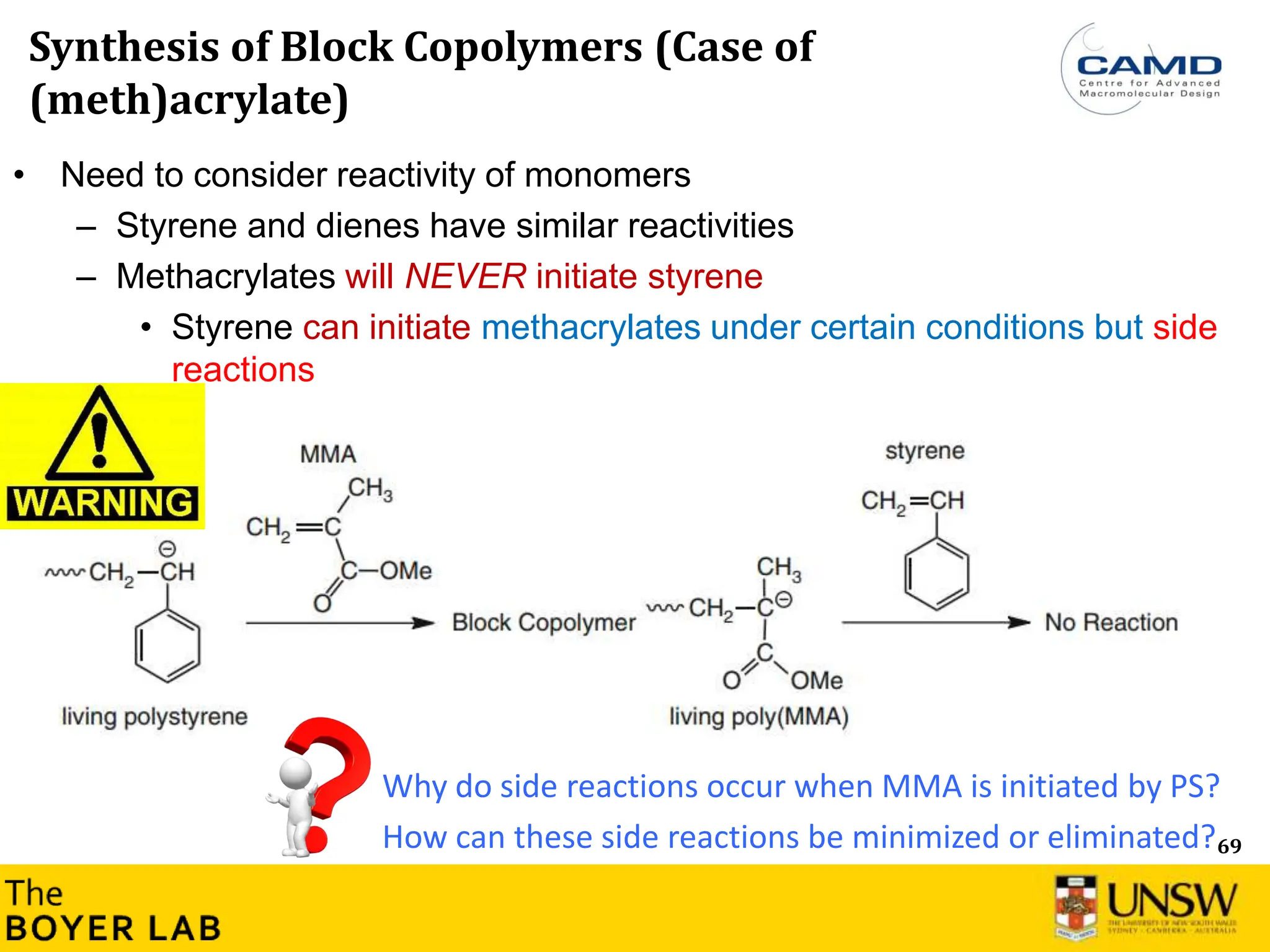
Synthesis of Block Copolymers (Case of
(meth)acrylate)
• Need to consider reactivity of monomers
– Styrene and dienes have similar reactivities
– Methacrylates will NEVER initiate styrene
• Styrene can initiate methacrylates under certain conditions but side
reactions
Why do side reactions occur when MMA is initiated by PS?
How can these side reactions be minimized or eliminated?
70
Synthesizing Block Copolymers
• Need to consider reactivity of monomers
– Styrene and dienes have similar reactivities
– Methacrylates will NEVER initiate styrene
• Styrene CAN initiate methacrylates under certain conditions,
but side reactions can occur
• Need to convert the chain end with 1,1-diphenylethylene
CH2 CH
-
Li
+
CH2 CH CH2 C
-
Li
+
C
H2
CH2 CH CH2 CH2 C
-
CH3
O O
CH3
Li
+
C
H2
O
O
CH3
C
H3
71
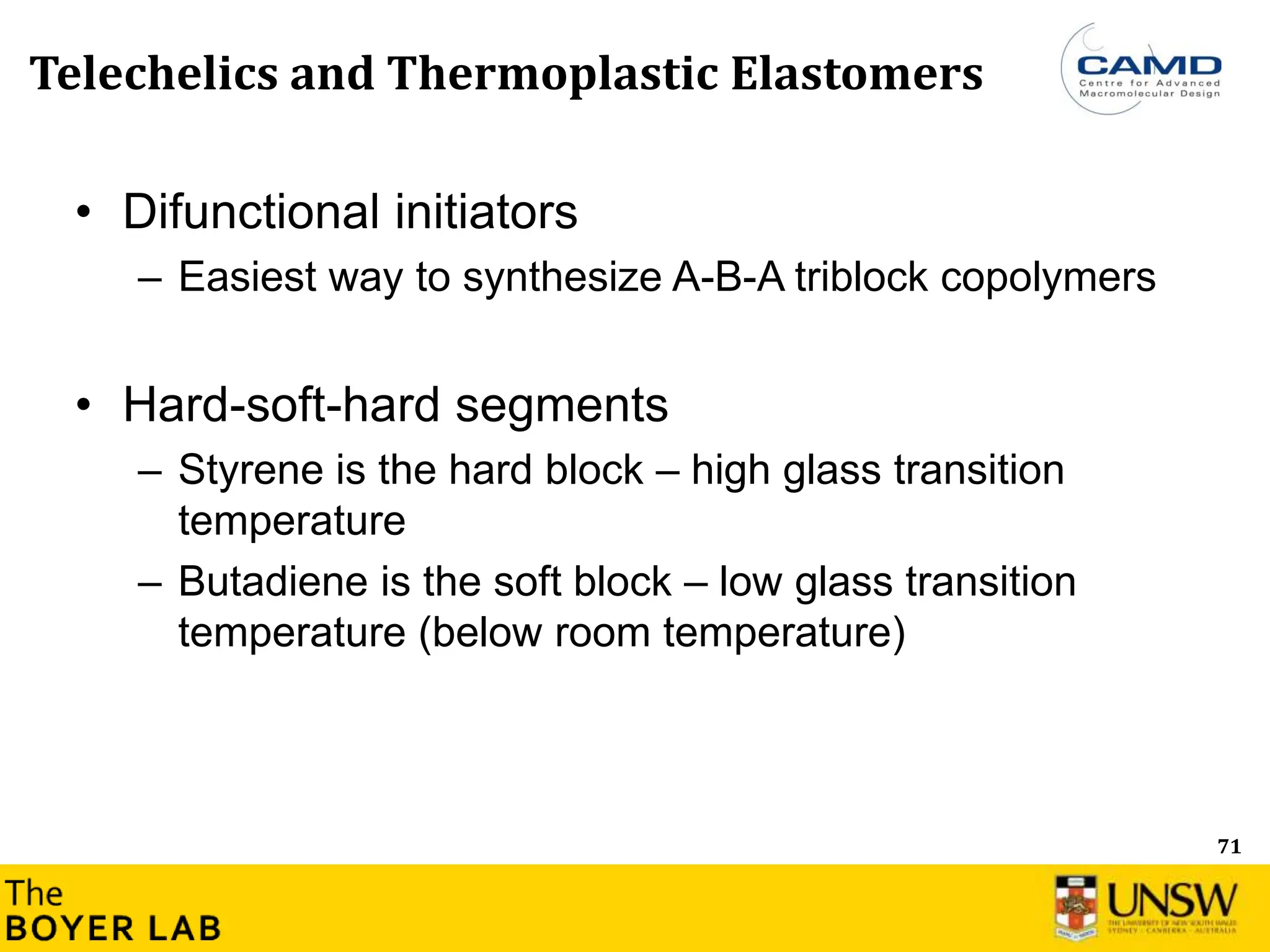
Telechelics and Thermoplastic Elastomers
• Difunctional initiators
– Easiest way to synthesize A-B-A triblock copolymers
• Hard-soft-hard segments
– Styrene is the hard block – high glass transition
temperature
– Butadiene is the soft block – low glass transition
temperature (below room temperature)
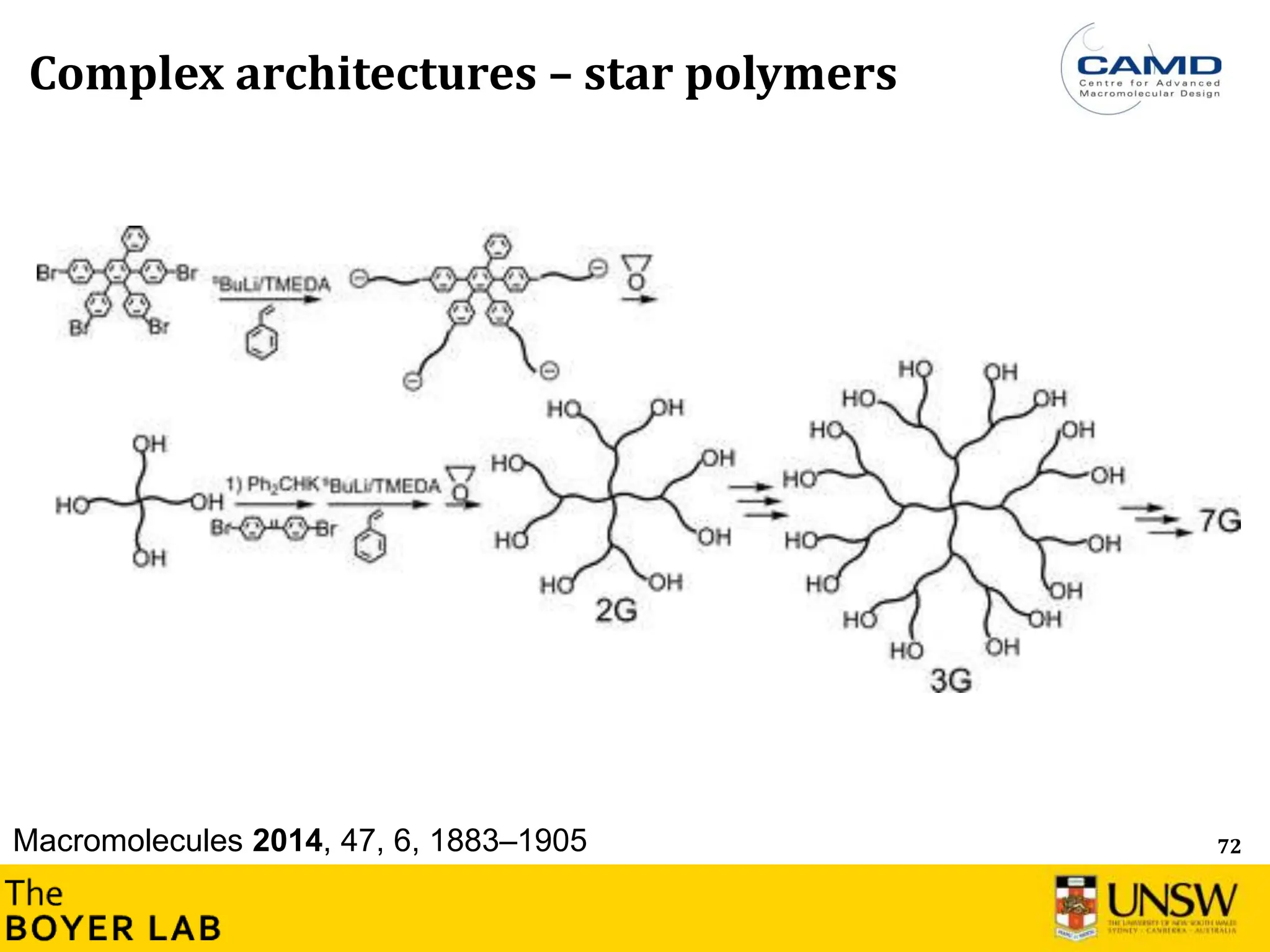
72
Complex architectures – star polymers
Macromolecules 2014, 47, 6, 1883–1905
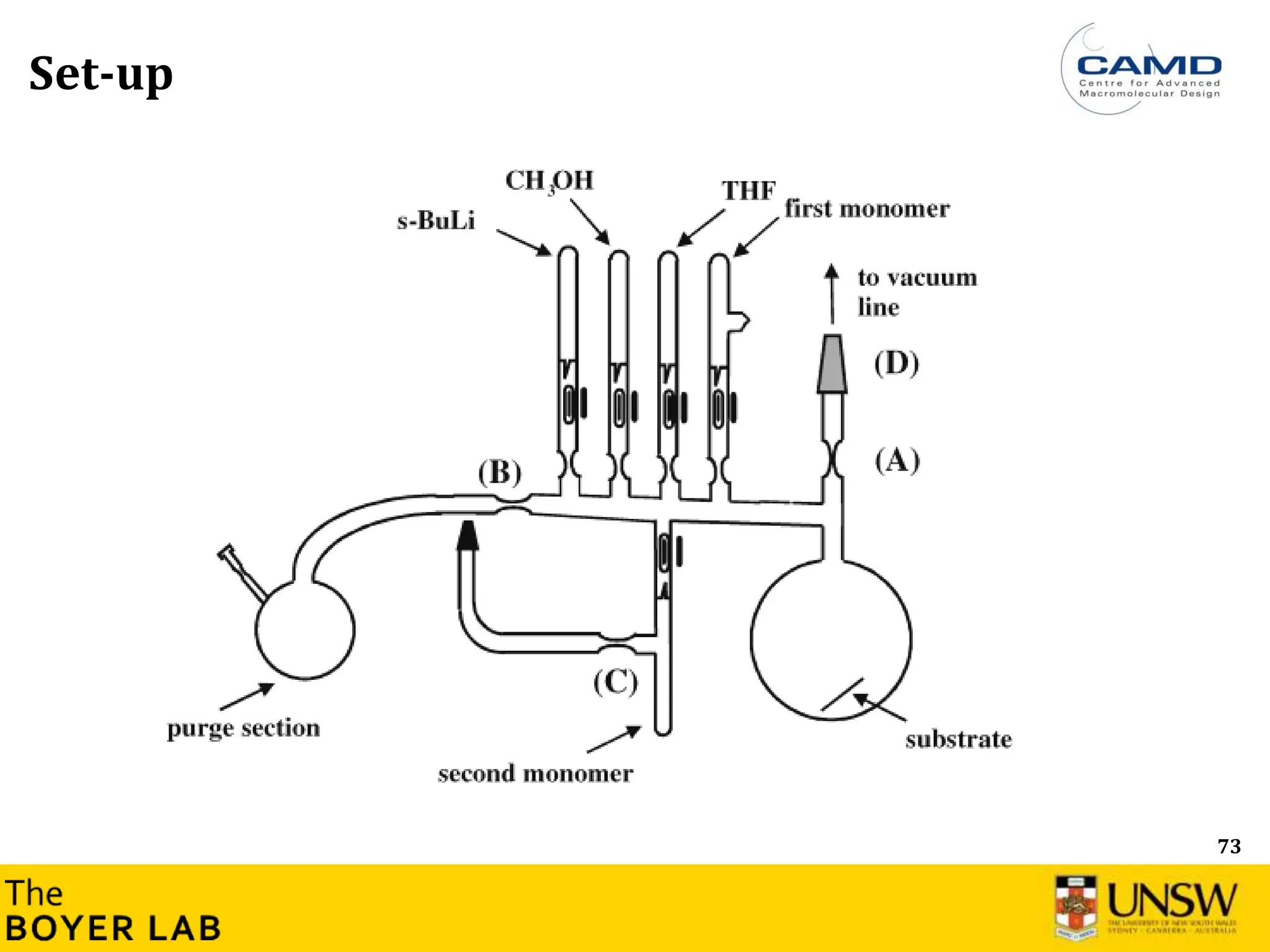
73
Set-up

Anionic Polymerization 2024 Chemistry course

  • 1.
  • 2.
  • 3.
    3 Anionic Polymerisation • MichaelSzwarc reported in the year 1956 the first anionic polymerisation https://onlinelibrary.wiley.com/doi/full/10.1002/macp.201700217 Lowest dispersity of all synthetic methods known, described by a Poisson distribution. Excellent molecular weight control by the ratio of monomer and initiator, [M]/[I] High and even extremely high molecular weights exceeding 106 g mol–1 can be achieved. Complete chain end functionalization is possible, enabling the synthesis of AB‐diblock, ABC‐triblock and even (AB)n‐multiblock copolymers as well as a broad range of precisely end‐functionalized polymers. M. Szwarc, Nature 1956, 178, 1168.
  • 4.
    4 Anionic polymerization • Twomain steps: → As free radical polymerization, there are initiation and propagation steps Initiation step: Dissociation of anionic initiator: A-X ↔ A- + X+ Addition to monomer: A- + M + X+ → AM- + X+ Propagation step: AM- + n × M + X+ → AMn+1 - + X+ No termination step: AMn+1 - + AMm+1 - → No reaction
  • 5.
    5 Anionic Polymerization –Initiation Step • Initiating species is a carbanion and the counterion is typically a metallic species – Usually organometallic compounds • n-butyl, sec-butyl, di-phenyl ethyl – Li, Na, K, or Cs – Alkyl lithium compounds are the most used, i.e. C4H9Li – Also used other nucleophilic compounds • Alkoxides, hydroxides, cyanides, amines and phosphines Macromolecules 2017, 50, 18, 6979-6997
  • 6.
    6 Alkyl lithium Initiators •The most extensively used and robust systems – Highly soluble in a wide range of hydrocarbons. – The heavier the metal, the less soluble the initiator tends to be. • Alkyl and aryl alkali metal initiators are highly soluble in ethers – However, very reactive with ether Why alkyl lithium is very reactive in ether solvent? – Lower temperatures are required or less reactive species • Benzyl potassium, cumyl cesium, diphenylmethyl lithium • Large resonance stability
  • 7.
    7 • Nucleophilic addition(monomer addition): • Propagation • The extensive use of alkyl lithium initiators is due to their solubility in hydrocarbon solvents. • Alkyls or aryls of the heavier alkali metals are poorly soluble in hydrocarbons, a consequence of their more ionic nature. Alkyl lithium Initiators
  • 8.
    8 Initiation and propagation Whatis the consequence on the consumption of the initiator during the polymerisation? Can you plot [initiator] versus time (qualitatively)? How this compares with radical polymerisation? Can you plot [Initiator] versus time (qualitatively)? → Initiation step is usually very fast and much faster than the propagation in anionic polymerisation
  • 9.
    9 Initiation (by electrontransfer) • Szwarc and coworker have studied the interesting and useful polymerizations initiated by aromatic radical-anions such as sodium naphthalene • The naphthalene anion–radical (which is colored greenish-blue) transfers an electron to a monomer such as styrene to form the styryl radical–anion
  • 10.
    10 Initiation (by electrontransfer) The styryl dianions so-formed are colored red (the same as styryl monocarbanions formed via initiators such as n-butyllithium). Anionic propagation occurs at both carbanion ends of the styryl dianion The styryl radical–anion is shown as a resonance hybrid of the forms wherein the anion and radical centers are alternately on the a- and b-carbon atoms. The styryl radical– anion dimerizes to form the dicarbanion
  • 11.
  • 12.
    12 Another example ofelectron transfer
  • 13.
    13 • Example oftertiary amine: Neutral nucleophile Initiators
  • 14.
    14 Metal-free anionic polymerisation Inthe relatively few anionic polymerizations initiated by neutral nucleophile, such as tertiary amines or phosphines the proposed propagating species is a zwitterion
  • 15.
    15 Choice of Initiator •Ideally, pick an initiator with a similar pKa value to the monomer (see the next slide for an example of pKa values) – Ensures the reactivities are relatively the same – Initiator with a lower reactivity, then polymerisation is slow or non- existent – Initiator too high, then side reactions are favoured (see example, methacrylate) • Must be reactive enough to attack monomer, i.e. stronger nucleophile (more aggressive) • Ethylene, dienes, and styrenes – Alkyl lithium compounds • Acrylates and methacrylates – 1,1-diphenylhexyl lithium, cumyl cesium or potassium
  • 16.
    16 pKa of conjugateacid of carbanion
  • 17.
    17 Choice of initiators •If monomer substituent Y is strongly e- withdrawing; → then activated monomer is relatively stable → relatively weaker nucleophiles can initiate it ex: epoxy: ethoxyanion initiate ring polymerization with variety of initiators • If substituent Y is weakly e- withdrawing: → need stronger nucleophile to initiate it:
  • 18.
    18 Propagation step (monomertype) Anionic polymerization takes place with monomers possessing electron-withdrawing groups such as nitrile, carbonyl, phenyl, and vinyl.
  • 19.
    19 Type of monomers MonomerAnionic Ethylene  1-Alkyl olefins  1,1 Dialkyl olefins  1,3-Dienes  Styrenes  Halogenated olefins  Vinyl esters  (Meth)acrylates  (Meth)acrylonitrile  (Meth)acrylamide  Vinyl ethers  N-Vinyl carbazole  N-Vinyl pyrrolidone  Aldehydes, ketones  Odian, G. Principles of Polymerization, 4th Ed. 2004 John Wiley & Sons; Hoboken, NJ; pp 200.
  • 20.
    20 Choice of themonomer • Vinyl monomers need to support carbanion Y can be a range of electron-withdrawing groups → How withdrawing impacts monomer reactivity? • Monomer should have no protic or acidic hydrogens Why?
  • 21.
    21 Consider potential sidereactions • No electrophilic groups • There are some exceptions: certain groups are electrophilic but less reactive to carbanion of interest:
  • 22.
  • 23.
    23 Reactivity of themonomer can be estimated by pKa value of conjugate acid
  • 24.
    24 Other monomers (novinyl monomers) • Cyanoacrylate • Isocyanate: R-N=C=O • N-carboxyanhydrides
  • 25.
  • 26.
  • 27.
    27 Selection of initiatordepends on monomer Initiator
  • 28.
    28 However, do notforget to consider potential side reactions Selection of initiator depends on monomer
  • 29.
    29 Selective living anionicpolymerization Why do we see selectivity if DPHLi is used as initiator?
  • 30.
    30 Selective living anionicpolymerization What do you expect if nBuLi is used as initiator?
  • 31.
  • 32.
    32 Polar monomers (methacrylates) •Polar monomers, such as methyl (meth)acrylate, methyl vinyl ketone, and acrylonitrile, are more reactive than styrene and 1,3-dienes because the polar substituent stabilizes the carbanion propagating center by resonance interaction to form the enolate anion. • Several different nucleophilic substitution reactions have been observed in the polymerization of methyl methacrylate. Attack of initiator on monomer converts the active alkyllithium to the less active alkoxide initiator
  • 33.
    33 Polar monomer –side reaction • Intramolecular backbiting for (meth)acrylate
  • 34.
    34 Example of potentialside reactions with methyl acrylate
  • 35.
    35 Effect on theinitiator system on the tacticity Atactic polymers Syndiotactic polymers Isotactic polymers
  • 36.
    36 Control of Tacticity– Changing Initiators or Solvent • Polymerization of MMA – Effect of solvent Using 1,1-diphenylhexyl lithium as initiator – In toluene yields highly isotactic polymer – In THF yields syndiotactic polymer
  • 37.
    37 PMMA – effectof solvent and adding Lewis acid Nikos Hadjichristidis and Akira Hirao, Anionic Polymerization, Springer (book)
  • 38.
    38 Uraneck, C.A. (1971),Influence of temperature on microstructure of anionic‐initiated polybutadiene. J. Polym. Sci. A‐1 Polym. Chem., 9: 2273-2281. doi:10.1002/pol.1971.150090814 Polymerization of butadiene in cyclohexane Effect on the cis/trans- configuration with temperature
  • 39.
    39 Effect on thecis/trans- configuration with temperature
  • 40.
  • 41.
    41 Addition of smallamount of THF (polar solvent ) Uraneck, C.A. (1971), Influence of temperature on microstructure of anionic‐initiated polybutadiene. J. Polym. Sci. A‐1 Polym. Chem., 9: 2273-2281. doi:10.1002/pol.1971.150090814
  • 42.
    42 Effect on thecis/trans- configuration- Changing Initiator types Example of Polymerization of isoprene Using butyl lithium initiator results in >96% 1,4-cis microstructure (similar to natural rubber) Using butyl sodium or potassium results in more than 50% 1,4-trans microstructure
  • 43.
  • 44.
    44 Strategies to introducefunctionality Macromolecules 2014, 47, 6, 1883-1905
  • 45.
    45 Synthesis of poly(functionalmethacrylate) Monomers
  • 46.
  • 47.
  • 48.
    48 Termination (Spontaneous) • Livingpolymers do not live forever. In the absence of terminating agents, the concentration of carbanion centers decays with time.
  • 49.
    49 Termination • Water: Mostanionic (as well as cationic) polymerizations are carried out in an inert atmosphere with rigorously cleaned reagents and glassware since trace impurities (including moisture) lead to termination. • The hydroxide ion is usually not sufficiently nucleophilic to reinitiate polymerization and the kinetic chain is broken. • Water has an especially negative effect on polymerization, since it is an active chain-transfer agent. • Oxygen and carbon dioxide from the atmosphere add to propagating carbanions to form peroxide and carboxyl anions. These are normally not reactive enough to continue propagation.
  • 50.
    50 End-Capping of PolymerChains • Adding carbon dioxide at the end of anionic polymerization of styrene can result in carboxylic acid formation • In case of styrene, adding CO2 can result in 70% carboxylic acid formation due to side reactions Solution: By adding 1,1-diphenylethylene first (reducing the reactivity of carbanion), >98% carboxylic acid formation results • Reaction with ethylene oxide results in an alcohol functionality
  • 51.
  • 52.
    Anionic Polymerization • Fourdistinct types of ion pairs – Covalent species (I): chemical bond between ion species – Contact ion pair (II): covalent bond broken, but virtually no charge separation – Solvent-separated ion pair (III): solvent molecules separate the charges, but they are still close – Free ion pairs (IV): highly solvated, both species free to diffuse through the system B-A+ B- ||A+ B- + A+ BA
  • 53.
    53 Polymerization Kinetics Ln([M] 0 /[M] t ) Time Ln([M]0/[M]t) =kp app × time → Constant concentration of active group Ln([M]0/[M]t) = Rp= kp app× [M-] × [M] [M-] corresponds to active species, where [M] is the total concentration of all types of living anionic propagating centers (free ions and ion pairs). → Most of anionic polymerization: Constant active groups (carbanion), i.e. Ln(M0/M) is linear
  • 54.
  • 55.
    55 Ln(M 0 /M) Time A C → Constant activegroups (carbanion), i.e. Ln(M0/M) is linear (A) → Decrease of active species (C) – carbanion is consumed by a side reaction → Increase of active species (B), very specific condition, such as slow addition of initiator B Polymerisation Kinetics
  • 56.
    56 Polymerization Kinetics Effect ofsolvent Why such difference between solvents? Table shows the pronounced effect of solvent in the polymerization of styrene by sodium naphthalene at 25 oC.
  • 57.
    57 Polymerization Kinetics Effect ofsolvent Why such difference between solvents? Table shows the pronounced effect of solvent in the polymerization of styrene by sodium naphthalene at 25oC.  increased solvating power of the reaction medium result in increased fraction of free ions present relative to ion pairs.
  • 58.
    Anionic Polymerization B-A+ B-||A+ B- + A+ BA Polarity of the solvent
  • 59.
    59 Factors affecting kp app •[M-] is combination of [P-] + [P-(C+)]  [M-] = [P-] + [P-(C+)] • Rp = kp -[P-][M] + Kp ±[P-(C+)][M] (1) • Rp = = kp app× [M-] × [M] (2) Combined (1) and (2) • kp app= [kp −[P−]+ Kp ±[P−(C+)] [M−] • P-(C+) ↔ P- + C+ Dissociation constant: 𝐾 = 𝑃 − [𝐶 + ] [𝑃 − 𝐶 + ] , • if [P-]=[C+] 𝐾 = 𝑃 − 2 [𝑃 − 𝐶 + ]  𝑃 − = √(𝐾 × 𝑃 − 𝐶 + )
  • 60.
    60 • Effect ofcounterion on Anionic Polymerization of Styrene Polymerization Kinetics Table shows that the dissociation constant for the ion pair decreases in going from lithium to cesium as the counterion in THF. The order of increasing K is the order of increasing solvation of the counterion. In dioxane: Solvation is not important in dioxane. The ion pair with the highest reactivity is that with the weakest bond between the carbanion center and counterion. The bond strength decreases, reactivity increases with increasing size of counterion.
  • 61.
    61 Anionic Polymerization –Evolution of Mn versus monomer conversion • Because termination only occurs when small molecules are added (or leaked in), the system never dies – Polymerization continues til monomer is used up – Alkyl and aryl lithium compounds are stable for several days What is the expected molecular weight at full monomer conversion? Can you write the equation to link Mn, monomer concentration, initiator concentration?
  • 62.
    62 Anionic Polymerization –Evolution of Mn versus monomer conversion • Because termination only occurs when small molecules are added (or leaked in), the system never dies – Polymerization continues til monomer is used up – Alkyl and aryl lithium compounds are stable for several days • Mn at full monomer conversion can be calculated by Assuming all the anionic initiators have been activated     init mono n MW MW I M M    What is the evolution of Mn versus monomer conversion?
  • 63.
    63 Molecular weight Monomer conversion • Linearevolution of Mn versus monomer conversion → Prediction of the molecular weight versus monomer conversion Mn = ([M]0/[Initiator]0) × α × MW (Monomer) + MW (Initiator) What is the condition for this equation to be valid? Anionic Polymerization – Evolution of Mn versus monomer conversion
  • 64.
    64 Molecular weight Monomer conversion • Linearevolution of Mn versus monomer conversion → Prediction of the molecular weight versus monomer conversion Mn = [M]0/[Initiator]0 × α × MW (Monomer) + MW (Initiator) Anionic Polymerization – Evolution of Mn versus monomer conversion Condition: In anionic polymerisation, the initiation is fast (all chains are activated at the beginning of the polymerization) in comparison to the rate of chain propagation. What is the consequence for the dispersity (or polydispersity)?
  • 65.
    65 → Narrow dispersity(or polydispersity) if fast addition is achieved Living polymerization Đ ~ 1.005- 1.20 In contrast higher dispersity will be achieved if a slow activation Non-living polymerization Đ ~ 1.5 - 2.0 Anionic Polymerization – Evolution of Đ versus monomer conversion
  • 66.
    66 Complex architectures –block copolymers • Preparation of block copolymer, i.e., addition of monomers at the end of the polymerization, the polymer chain can be chain-extended → Stability of the anionic species (if conditions are maintained), i.e. active growing chains remain constant
  • 67.
    67 Synthesis of BlockCopolymers • Need to consider the reactivity of monomers – Styrene and dienes have similar reactivities – Methacrylates will NEVER initiate styrene Why?
  • 68.
    68 Synthesising Block Copolymers •Need to consider reactivity of monomers – Styrene and dienes have similar reactivities – Methacrylates will NEVER initiate styrene – pKa of toluene ~ 43 – pKa of ethyl acetate ~ 30
  • 69.
    69 Synthesis of BlockCopolymers (Case of (meth)acrylate) • Need to consider reactivity of monomers – Styrene and dienes have similar reactivities – Methacrylates will NEVER initiate styrene • Styrene can initiate methacrylates under certain conditions but side reactions Why do side reactions occur when MMA is initiated by PS? How can these side reactions be minimized or eliminated?
  • 70.
    70 Synthesizing Block Copolymers •Need to consider reactivity of monomers – Styrene and dienes have similar reactivities – Methacrylates will NEVER initiate styrene • Styrene CAN initiate methacrylates under certain conditions, but side reactions can occur • Need to convert the chain end with 1,1-diphenylethylene CH2 CH - Li + CH2 CH CH2 C - Li + C H2 CH2 CH CH2 CH2 C - CH3 O O CH3 Li + C H2 O O CH3 C H3
  • 71.
    71 Telechelics and ThermoplasticElastomers • Difunctional initiators – Easiest way to synthesize A-B-A triblock copolymers • Hard-soft-hard segments – Styrene is the hard block – high glass transition temperature – Butadiene is the soft block – low glass transition temperature (below room temperature)
  • 72.
    72 Complex architectures –star polymers Macromolecules 2014, 47, 6, 1883–1905
  • 73.

Editor's Notes

  • #16 Show the synthesis of 1,1-diphenylhexyl lithium to the students. Reaction of 1,1-diphenylethylene with butyl lithium. NOTE – this reaction is important because it lays the ground work for altering the chain end activity for doing acrylate and methacrylate block copolymers. 1,1-diphenylethylene only adds ONCE to the chain ends – steric hinderance prevents this from ever behaving as a monomer.
  • #51 P* + O2  P-P + P-O-P + P-O-O-P + P-O-O-H The hydrogen usually comes from trace water or the system (solvent typically). All side products are result of complex radical-ion formation of the oxygen.