ANGER
Anger is natural automatic
response to pain of one form or
another
ANGER is a social emotion; You always
have
a target that your ANGER is directed
against
(even if that target is yourself).
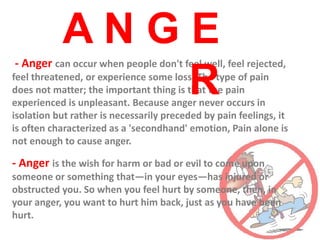
- Anger can occur when people don't feel well, feel rejected,
feel threatened, or experience some loss. The type of pain
does not matter; the important thing is that the pain
experienced is unpleasant. Because anger never occurs in
isolation but rather is necessarily preceded by pain feelings, it
is often characterized as a 'secondhand' emotion, Pain alone is
not enough to cause anger.
- Anger is the wish for harm or bad or evil to come upon
someone or something that—in your eyes—has injured or
obstructed you. So when you feel hurt by someone, then, in
your anger, you want to hurt him back, just as you have been
hurt.
A N G E
R
We need to make a clear distinction between anger and
feeling hurt or irritated. We all feel hurt or irritated when
someone or something obstructs our needs or desires.
Anger, though, is not truly an emotion. In its technical
sense, anger refers to the desire to “get even with”—that
is, to take revenge on—the cause of the hurt.
What are the Effects of
Anger on Your Body?
1-Emotional stress and anger trigger the release of stress
hormone cortisol in the body. Small releases of cortisol can give
the body a quick burst of energy.
2-It can create a blood sugar imbalance; it can decrease bone
density.
3-suppress the body's immune response and make it
susceptible to chronic inflammation; it can suppress thyroid
function.
4-slowing down the body's metabolism; it can impair the
brain's thinking ability and increase blood pressure.
5-Anger can raise your heart rate to 180 beats a minute. It
can raise your blood pressure from 120 over 80 to 220 over
130, perhaps even higher.
6-Your breathing becomes rapid as you try to get more oxygen into
your body .
7-Anger also impedes circulation. Lack of oxygen can cause severe
chest pains. Uncontrollable anger can trigger the bursting of a brain
artery resulting in a stroke.
8-Tight neck and head muscles can cause tension headaches,
migraines or lead to insomnia.
9-Anger stimulates the release of acids in the stomach causing acid
reflux and gastric ulcers.
10-Anger can also compromise lung function.
What are the Effects of
Anger and Stress on the
Brain?
1-Anger comes from the amygdale , the reptilian part of our brain .Resilient
people are able to make rapid recoveries from stress, with their prefrontal
cortex working to calm the amygdale .
2-The brain that cannot negotiate itself out of an emotional rut; instead
it floods the body with a cascade of cortisol or stress hormones.
There is evidence that chronic stress can alter brain function at the cellular
level.
3- Normally these neurons receive different chemical signals that prompt
them to switch on or off . Stress and anger compromise these functions and
jeopardize the brain's ability to slow down.
4- Other studies also show that stress blocks the growth of new neurons
in the brain resulting in neuronal death or depression .Increased stress
hormones can also lead to memory impairment and learning difficulties .
5- University College London Scientist discovered that the normal
coordinates of signals for the brain to the heart can be disrupted by
anger and emotional distress. This disruption triggers abnormal
heart rhythms which account for well over 400,000 sudden deaths a
year.
6-New studies also suggest that stress can cause neurons to
shrink and disconnect. In short, stress promotes the death of
neurons, which can explain why stress is the leading cause of
depression.
Your Anger Affects Those Around You
Getting angry can help negotiations
in some cultures, hurt it in others
- Getting angry might help you get your way if you're negotiating
with European Americans, but watch out – in negotiations with
East Asians, getting angry may actually hurt your cause. That's the
conclusion of a new study on how people from different cultures
react to anger in negotiations.
Anger in Relationships
Anger is one of the most common negative patterns in relationships.
Couples sometimes report that it is their anger that makes the
relationship feel alive. Anger takes root in insecure relationships where
open communication is absent and the emotion of love is buried beneath
years of resentment. There is typically hopelessness in the present and
doubt about the future in these relationships.
Here are some tips on how to limit
anger producing interactions in your
relationships:1- When you have anger toward another person, start with an internal
check
of your own emotional state. Ask yourself why you feel the way you do.
2- Before feeling attacked or hurt, make an attempt to give
others the benefit of the doubt, especially if you have nothing to lose by
doing so.
3- Ask yourself if you have legitimate assumptions about the
intentions of others.
4- Keep the lines of communication open. When you feel
resentment building, see if you can journal your feelings and then share
your thoughts with
a loved one.
5- Explore your participation in relationships that repeatedly
bring out the worst in you.
6- Always consider individual or family therapy in instances where
Anger and Its Effect on Children
- Children of angry parents are more aggressive and
noncompliant
- Children of angry parents are less empathetic
- Children of angry parents have poor overall adjustment
- There is a strong relationship between parental anger and
delinquency
- The effects of parental anger can continue to impact the
adult child, including increasing degrees of depression, social
alienation, spouse abuse and career and economic
achievement.
Dealing with anger is so important to ensuring a healthy family.
Besides less stress, children will feel more safe and have higher self-
Psychological States Hidden Behind Anger
- Anger occurs when pain is combined with some anger-triggering
thought. Thoughts that can trigger anger include personal
assessments, assumptions, evaluations, or interpretations of
situations that makes people think that someone else is
attempting (consciously or not) to hurt them.
-Anger may be a “natural”—that is, a commonly occurring—
social reaction to hurt and insult, yet being natural doesn't make it
good for us. Sure, “natural” foods are commonly advertised as
being healthy and good for us. Poisons, for example, are also
natural, and poisons, by definition, are deadly.
-And so there are far better ways to cope with hurt and insult
than with anger, because anger itself acts like a poison in your
own heart that ultimately degrades the quality of your own life as
much as it hurts the life of another person.
How To Manage Anger
Keeping your temper in check can be challenging.
Use simple anger management tips to stay in
control.
10 Anger Management Tips
1. Think before you speak: Take a few moments to
collect your thoughts before saying anything — and
allow others involved in the situation to do the
same.
2. Once you're calm, express your anger: As soon as
you're thinking clearly. State your concerns and
needs clearly and directly, without hurting others or
trying to control them.
10 Anger Management Tips
3. Get some exercise: Physical activity can help reduce
stress that can cause you to become angry.
4. Take a timeout : Give yourself short breaks during
times of the day that tend to be stressful.
5. Identify possible solutions: Instead of focusing on
what made you mad, work on resolving the issue at
hand.
10 Anger Management Tips
6. Stick with 'I' statements : use "I" statements to
describe the problem. Be respectful and specific. For
example, say, "I'm upset that you left the table
without offering to help with the dishes," instead of,
"You never do any housework.“
7. Don't hold a grudge : if you can forgive someone
who angered you, you might both learn from the
situation.
10 Anger Management Tips
8. Use humour to release tension : Lightening up
can help diffuse tension. Use humour to help you
face what's making you angry.
9. Practice relaxation skills : Practice deep-breathing
exercises, imagine a relaxing scene, or repeat a
calming word or phrase.
10. Know when to seek help : Consider seeking help
for anger issues if your anger seems out of control.

Anger

  • 1.
  • 2.
    Anger is naturalautomatic response to pain of one form or another
  • 3.
    ANGER is asocial emotion; You always have a target that your ANGER is directed against (even if that target is yourself).
  • 4.
    - Anger canoccur when people don't feel well, feel rejected, feel threatened, or experience some loss. The type of pain does not matter; the important thing is that the pain experienced is unpleasant. Because anger never occurs in isolation but rather is necessarily preceded by pain feelings, it is often characterized as a 'secondhand' emotion, Pain alone is not enough to cause anger. - Anger is the wish for harm or bad or evil to come upon someone or something that—in your eyes—has injured or obstructed you. So when you feel hurt by someone, then, in your anger, you want to hurt him back, just as you have been hurt. A N G E R
  • 5.
    We need tomake a clear distinction between anger and feeling hurt or irritated. We all feel hurt or irritated when someone or something obstructs our needs or desires. Anger, though, is not truly an emotion. In its technical sense, anger refers to the desire to “get even with”—that is, to take revenge on—the cause of the hurt.
  • 6.
    What are theEffects of Anger on Your Body?
  • 7.
    1-Emotional stress andanger trigger the release of stress hormone cortisol in the body. Small releases of cortisol can give the body a quick burst of energy. 2-It can create a blood sugar imbalance; it can decrease bone density. 3-suppress the body's immune response and make it susceptible to chronic inflammation; it can suppress thyroid function. 4-slowing down the body's metabolism; it can impair the brain's thinking ability and increase blood pressure. 5-Anger can raise your heart rate to 180 beats a minute. It can raise your blood pressure from 120 over 80 to 220 over 130, perhaps even higher.
  • 8.
    6-Your breathing becomesrapid as you try to get more oxygen into your body . 7-Anger also impedes circulation. Lack of oxygen can cause severe chest pains. Uncontrollable anger can trigger the bursting of a brain artery resulting in a stroke. 8-Tight neck and head muscles can cause tension headaches, migraines or lead to insomnia. 9-Anger stimulates the release of acids in the stomach causing acid reflux and gastric ulcers. 10-Anger can also compromise lung function.
  • 9.
    What are theEffects of Anger and Stress on the Brain?
  • 10.
    1-Anger comes fromthe amygdale , the reptilian part of our brain .Resilient people are able to make rapid recoveries from stress, with their prefrontal cortex working to calm the amygdale . 2-The brain that cannot negotiate itself out of an emotional rut; instead it floods the body with a cascade of cortisol or stress hormones. There is evidence that chronic stress can alter brain function at the cellular level. 3- Normally these neurons receive different chemical signals that prompt them to switch on or off . Stress and anger compromise these functions and jeopardize the brain's ability to slow down. 4- Other studies also show that stress blocks the growth of new neurons in the brain resulting in neuronal death or depression .Increased stress hormones can also lead to memory impairment and learning difficulties .
  • 11.
    5- University CollegeLondon Scientist discovered that the normal coordinates of signals for the brain to the heart can be disrupted by anger and emotional distress. This disruption triggers abnormal heart rhythms which account for well over 400,000 sudden deaths a year. 6-New studies also suggest that stress can cause neurons to shrink and disconnect. In short, stress promotes the death of neurons, which can explain why stress is the leading cause of depression.
  • 12.
    Your Anger AffectsThose Around You
  • 14.
    Getting angry canhelp negotiations in some cultures, hurt it in others - Getting angry might help you get your way if you're negotiating with European Americans, but watch out – in negotiations with East Asians, getting angry may actually hurt your cause. That's the conclusion of a new study on how people from different cultures react to anger in negotiations.
  • 15.
    Anger in Relationships Angeris one of the most common negative patterns in relationships. Couples sometimes report that it is their anger that makes the relationship feel alive. Anger takes root in insecure relationships where open communication is absent and the emotion of love is buried beneath years of resentment. There is typically hopelessness in the present and doubt about the future in these relationships.
  • 16.
    Here are sometips on how to limit anger producing interactions in your relationships:1- When you have anger toward another person, start with an internal check of your own emotional state. Ask yourself why you feel the way you do. 2- Before feeling attacked or hurt, make an attempt to give others the benefit of the doubt, especially if you have nothing to lose by doing so. 3- Ask yourself if you have legitimate assumptions about the intentions of others. 4- Keep the lines of communication open. When you feel resentment building, see if you can journal your feelings and then share your thoughts with a loved one. 5- Explore your participation in relationships that repeatedly bring out the worst in you. 6- Always consider individual or family therapy in instances where
  • 18.
    Anger and ItsEffect on Children - Children of angry parents are more aggressive and noncompliant - Children of angry parents are less empathetic - Children of angry parents have poor overall adjustment - There is a strong relationship between parental anger and delinquency - The effects of parental anger can continue to impact the adult child, including increasing degrees of depression, social alienation, spouse abuse and career and economic achievement. Dealing with anger is so important to ensuring a healthy family. Besides less stress, children will feel more safe and have higher self-
  • 19.
  • 20.
    - Anger occurswhen pain is combined with some anger-triggering thought. Thoughts that can trigger anger include personal assessments, assumptions, evaluations, or interpretations of situations that makes people think that someone else is attempting (consciously or not) to hurt them. -Anger may be a “natural”—that is, a commonly occurring— social reaction to hurt and insult, yet being natural doesn't make it good for us. Sure, “natural” foods are commonly advertised as being healthy and good for us. Poisons, for example, are also natural, and poisons, by definition, are deadly. -And so there are far better ways to cope with hurt and insult than with anger, because anger itself acts like a poison in your own heart that ultimately degrades the quality of your own life as much as it hurts the life of another person.
  • 21.
    How To ManageAnger Keeping your temper in check can be challenging. Use simple anger management tips to stay in control.
  • 22.
    10 Anger ManagementTips 1. Think before you speak: Take a few moments to collect your thoughts before saying anything — and allow others involved in the situation to do the same. 2. Once you're calm, express your anger: As soon as you're thinking clearly. State your concerns and needs clearly and directly, without hurting others or trying to control them.
  • 23.
    10 Anger ManagementTips 3. Get some exercise: Physical activity can help reduce stress that can cause you to become angry. 4. Take a timeout : Give yourself short breaks during times of the day that tend to be stressful. 5. Identify possible solutions: Instead of focusing on what made you mad, work on resolving the issue at hand.
  • 24.
    10 Anger ManagementTips 6. Stick with 'I' statements : use "I" statements to describe the problem. Be respectful and specific. For example, say, "I'm upset that you left the table without offering to help with the dishes," instead of, "You never do any housework.“ 7. Don't hold a grudge : if you can forgive someone who angered you, you might both learn from the situation.
  • 25.
    10 Anger ManagementTips 8. Use humour to release tension : Lightening up can help diffuse tension. Use humour to help you face what's making you angry. 9. Practice relaxation skills : Practice deep-breathing exercises, imagine a relaxing scene, or repeat a calming word or phrase. 10. Know when to seek help : Consider seeking help for anger issues if your anger seems out of control.