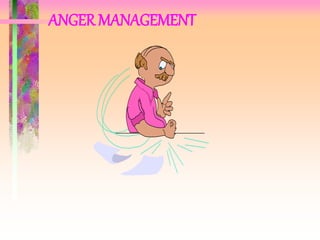
ANGER MANAGEMENT
WHAT IS ANGER?
• An emotional state.
• Varies in intensity
• A coping mechanism.
• How you deal with events that
threaten the body, self-esteem
or values.
• Related to fear.
• Can be destructive and lead
to problems - at work, in
relationships, quality of life.
• Feeling mad in response to
frustration or injury.
• Distorted thinking.
Ancient & Medieval Definitions
-Madness
-Insanity
-Those lacking ethics &morals
CURRENT VIEWS
• Angry people are hostile. (Hostility is a chronic state of
anger.
• Hostility is a permanent personality characteristic.
• Hostile people are unhappy.
• Angry people are emotionally insecure.
• Angry people have a low sense of self.
EFFECTS OF ANGER
• Anger---> Rage ---> Violence
• Does great harm - more than any other emotion.
• Associated with crime, abuse, poor working conditions,
poor health.
• Reports from Statistics and Surveys:
– Road rage -> 8,000 deaths, 1 million injuries
EFFECTS OF ANGER
• Polls reveal that people indicate that they feel like killing
others.
• Crime rate soars: rapes, murders, battering, child abuse,
domestic abuse.
• 1 in 5 women are raped - 683,000 in 1990 - 30% were less
than 11 years of age.
• Children between 3-17 years are the most violent.
CHARACTERISTICS OF ANGRY PEOPLE
• Hostility - silently or overtly
• Marital problems
• Greater stress in
interpersonal aspects of work.
• Uses threat of anger to
manipulate others.
• Negative view of work.
• Less open-minded.
• Hostile people are unhappy.
• Report more difficulties at
work.
• Less job satisfaction.
CHARACTERISTICS OF ANGRY PEOPLE
• Are cynical.
• Have antagonistic
interactions.
• Less tolerant.
• Less understanding.
• Less socially responsible.
• Distrustful, resentful.
• Competitive.
• Blame others, put down
others and demean others as
a way of seeking revenge.
• Influence other people to
share their cynicism &
pessimism.
BEHAVIORAL SIGNS
BEHAVIORAL SIGNS
• Chronically angry people frequently create unfriendly
social environments for themselves by the way they deal
with anger.
• Verbal antagonism and condescending remarks --> fuels
antagonism from others.
• Assaults: physical, rage, slapping, shoving, using a
weapon.
BEHAVIORAL SIGNS
• Aggressive: overly critical, fault finding, name-calling,
sarcasm, prejudice, cynical humor and teasing, flashes of
temper.
• Hurtful: malicious gossip, stealing, trouble-making,
revengeful, passively resistant, interferes with progress.
• Rebellious: open defiance, indirectly challenging.
BEHAVIORAL SIGNS
• Health: smokers, drink more alcohol and coffee, consume
more calories. Poor health overall.
• Others: resentful, jealous, envious, argumentative,
unforgiving, tired and anxious.
ANGER KILLS
ANGER KILLS
• Thought -> Brain -> “Let’s Get Mad” -> autonomic
nervous system -> release of hormones & chemicals in
blood -> increases heart -> increases blood sugar and
pressure -> increases breathing -> impairs senses ->
releases deadly cortisol for “fight or flight” -> drains
adrenal glands -> stimulates fat cells ->converts to
cholesterol.
ANGER KILLS
• To get angry is to slowly commit suicide.
• Anger releases a slow-acting poison. Is toxic. Damages
immune cells.
• Cumulative effect: cholesterol buildup which blocks blood
flow to arteries starving heart.
• Causes release of chemicals and killer venom.
ANGER KILLS
• Decreases production of serotonin which activates the
sympathetic nervous system which speeds up release of
cortisol - killer venom. Decreases action of
parasympathetic nervous system.
• Cortisol is potently dangerous - it lasts for 13 hours at the
cellular level when released.
• Linked to cancer. Causes slow burn.
ANGER KILLS
• Suppressedangeris equallyas bad-->bitterness,
depression,highbloodpressure,heartdisease,colitisand
otherillnesses.
WAYS TO MANAGE AND EXPRESS ANGER
• Two Rules to Live By:
– “Don’t Sweat the Small Stuff.”
– “Most Matters are Small Stuff.”
Learning to Manage Anger Can Be A Life
Saver!
• If you are an angry person, an abuser, an oppressor --
work on changing your habits!
• If you are a person impacted by an angry person, you
must alleviate the assaults the angry person makes to
your person and body or eliminate the angry person from
your life! [Angeris like second-hand smoke. It can kill a non-hostile person too! ]
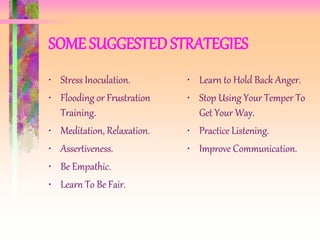
SOME SUGGESTED STRATEGIES
• Stress Inoculation.
• Flooding or Frustration
Training.
• Meditation, Relaxation.
• Assertiveness.
• Be Empathic.
• Learn To Be Fair.
• Learn to Hold Back Anger.
• Stop Using Your Temper To
Get Your Way.
• Practice Listening.
• Improve Communication.
SUGGESTED STRATEGIES
• Cognitive Restructuring.
• Stop Hostile Fantasies.
• Respect Others.
• Practice Forgiveness.
• Have a Sense of Humor.
SOME SPECIAL STRATEGIES
• A TEN-STEP PROGRAM
• RULES FOR EXPRESSING ANGER
• TIME OUT
• COPING WITH YOUR CO-WORKERS OR BOSS
• RETHINK -(RECOGNIZE, EMPATHIZE, THINK, HEAR,
INTEGRATE, NOTICE ANDKEEP)
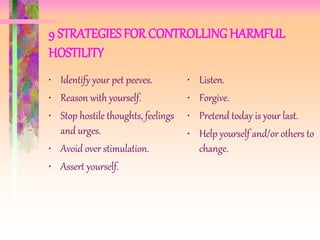
9 STRATEGIES FOR CONTROLLING HARMFUL
HOSTILITY
• Identify your pet peeves.
• Reason with yourself.
• Stop hostile thoughts, feelings
and urges.
• Avoid over stimulation.
• Assert yourself.
• Listen.
• Forgive.
• Pretend today is your last.
• Help yourself and/or others to
change.
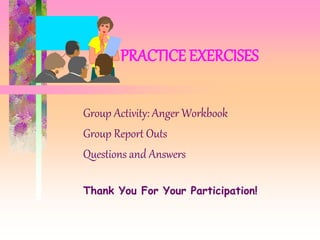
PRACTICE EXERCISES
Group Activity: Anger Workbook
Group Report Outs
Questions and Answers
Thank You For Your Participation!

Dealing with Anger.ppt

  • 1.
  • 2.
    WHAT IS ANGER? •An emotional state. • Varies in intensity • A coping mechanism. • How you deal with events that threaten the body, self-esteem or values. • Related to fear. • Can be destructive and lead to problems - at work, in relationships, quality of life. • Feeling mad in response to frustration or injury. • Distorted thinking.
  • 3.
    Ancient & MedievalDefinitions -Madness -Insanity -Those lacking ethics &morals
  • 4.
    CURRENT VIEWS • Angrypeople are hostile. (Hostility is a chronic state of anger. • Hostility is a permanent personality characteristic. • Hostile people are unhappy. • Angry people are emotionally insecure. • Angry people have a low sense of self.
  • 5.
    EFFECTS OF ANGER •Anger---> Rage ---> Violence • Does great harm - more than any other emotion. • Associated with crime, abuse, poor working conditions, poor health. • Reports from Statistics and Surveys: – Road rage -> 8,000 deaths, 1 million injuries
  • 6.
    EFFECTS OF ANGER •Polls reveal that people indicate that they feel like killing others. • Crime rate soars: rapes, murders, battering, child abuse, domestic abuse. • 1 in 5 women are raped - 683,000 in 1990 - 30% were less than 11 years of age. • Children between 3-17 years are the most violent.
  • 7.
    CHARACTERISTICS OF ANGRYPEOPLE • Hostility - silently or overtly • Marital problems • Greater stress in interpersonal aspects of work. • Uses threat of anger to manipulate others. • Negative view of work. • Less open-minded. • Hostile people are unhappy. • Report more difficulties at work. • Less job satisfaction.
  • 8.
    CHARACTERISTICS OF ANGRYPEOPLE • Are cynical. • Have antagonistic interactions. • Less tolerant. • Less understanding. • Less socially responsible. • Distrustful, resentful. • Competitive. • Blame others, put down others and demean others as a way of seeking revenge. • Influence other people to share their cynicism & pessimism.
  • 9.
  • 10.
    BEHAVIORAL SIGNS • Chronicallyangry people frequently create unfriendly social environments for themselves by the way they deal with anger. • Verbal antagonism and condescending remarks --> fuels antagonism from others. • Assaults: physical, rage, slapping, shoving, using a weapon.
  • 11.
    BEHAVIORAL SIGNS • Aggressive:overly critical, fault finding, name-calling, sarcasm, prejudice, cynical humor and teasing, flashes of temper. • Hurtful: malicious gossip, stealing, trouble-making, revengeful, passively resistant, interferes with progress. • Rebellious: open defiance, indirectly challenging.
  • 12.
    BEHAVIORAL SIGNS • Health:smokers, drink more alcohol and coffee, consume more calories. Poor health overall. • Others: resentful, jealous, envious, argumentative, unforgiving, tired and anxious.
  • 13.
  • 14.
    ANGER KILLS • Thought-> Brain -> “Let’s Get Mad” -> autonomic nervous system -> release of hormones & chemicals in blood -> increases heart -> increases blood sugar and pressure -> increases breathing -> impairs senses -> releases deadly cortisol for “fight or flight” -> drains adrenal glands -> stimulates fat cells ->converts to cholesterol.
  • 15.
    ANGER KILLS • Toget angry is to slowly commit suicide. • Anger releases a slow-acting poison. Is toxic. Damages immune cells. • Cumulative effect: cholesterol buildup which blocks blood flow to arteries starving heart. • Causes release of chemicals and killer venom.
  • 16.
    ANGER KILLS • Decreasesproduction of serotonin which activates the sympathetic nervous system which speeds up release of cortisol - killer venom. Decreases action of parasympathetic nervous system. • Cortisol is potently dangerous - it lasts for 13 hours at the cellular level when released. • Linked to cancer. Causes slow burn.
  • 17.
    ANGER KILLS • Suppressedangerisequallyas bad-->bitterness, depression,highbloodpressure,heartdisease,colitisand otherillnesses.
  • 18.
    WAYS TO MANAGEAND EXPRESS ANGER • Two Rules to Live By: – “Don’t Sweat the Small Stuff.” – “Most Matters are Small Stuff.”
  • 19.
    Learning to ManageAnger Can Be A Life Saver! • If you are an angry person, an abuser, an oppressor -- work on changing your habits! • If you are a person impacted by an angry person, you must alleviate the assaults the angry person makes to your person and body or eliminate the angry person from your life! [Angeris like second-hand smoke. It can kill a non-hostile person too! ]
  • 20.
    SOME SUGGESTED STRATEGIES •Stress Inoculation. • Flooding or Frustration Training. • Meditation, Relaxation. • Assertiveness. • Be Empathic. • Learn To Be Fair. • Learn to Hold Back Anger. • Stop Using Your Temper To Get Your Way. • Practice Listening. • Improve Communication.
  • 21.
    SUGGESTED STRATEGIES • CognitiveRestructuring. • Stop Hostile Fantasies. • Respect Others. • Practice Forgiveness. • Have a Sense of Humor.
  • 22.
    SOME SPECIAL STRATEGIES •A TEN-STEP PROGRAM • RULES FOR EXPRESSING ANGER • TIME OUT • COPING WITH YOUR CO-WORKERS OR BOSS • RETHINK -(RECOGNIZE, EMPATHIZE, THINK, HEAR, INTEGRATE, NOTICE ANDKEEP)
  • 23.
    9 STRATEGIES FORCONTROLLING HARMFUL HOSTILITY • Identify your pet peeves. • Reason with yourself. • Stop hostile thoughts, feelings and urges. • Avoid over stimulation. • Assert yourself. • Listen. • Forgive. • Pretend today is your last. • Help yourself and/or others to change.
  • 24.
    PRACTICE EXERCISES Group Activity:Anger Workbook Group Report Outs Questions and Answers Thank You For Your Participation!