“The Lord our God made a covenant, not only with our 
fathers, but with all of us living today…. The Lord said, ‘I 
am the Lord your God… Worship no God but me.” 
- The Bible
 The Near East between the Nile valley and the Sumerians soon 
became a region of cultural overlap and interchange. 
 One people and then another would take command of a portion 
of the region for a century or more, only to fall under the sway 
of the next onslaught of newcomers. 
 Kingdoms arose whose very names are sometimes forgotten but 
whose contributions to the ascent of civilization in this region 
were impressive.
 The Assyrians were a Semitic tribal group who emerged from 
nomadism in what is now northern Iraq in the twelfth century 
B.C. 
 They entered history about 900 B.C. as challengers to other 
Semites in the Tigris valley. 
 Their chief town, Nineveh, lay in the upper valley of the Tigris and their 
chief god was the very fierce Assur, from whom the people derived their 
name. 
 By 800 B.C., through their own ferocity and cunning in war, the 
Assyrian kings had conquered much of the Tigris-Euphrates 
region and were fighting the Babylonians for the southern 
portion.
 The Assyrians displayed great talent in military affairs. 
 Their army was large and seemingly irresistible, using new tactics 
to negate the traditional advantage of charioteers over foot 
soldiers. 
 By this epoch, the horse and the chariot were widely used in 
warfare. 
 It is believed that the chariot was introduced to Near Eastern warfare by 
the Hyksos invaders of Egypt in the 1500s. 
 For centuries, leather-clad warriors armed with short swords had 
fought from chariots drawn by two or three horses.
The 
Chariot 
This bas-relief 
shows King 
Assurbanipal 
charging the 
enemy in his war 
chariot, 
accompanied by 
picked spearmen 
who thrust away 
the hostile 
infantry as the 
monarch loads his 
bow.
 The chariots would split the loose ranks of the enemy foot 
soldiers and the momentum of the horses combined with the 
raised platform gave the swordsmen an almost irresistible 
advantage over opposing infantry. 
 The early Assyrian kings took away this advantage: 
 The tight-knit infantry formations were fielded with long spears and 
swords. 
 The flanks were protected by bands of horsemen who engaged the enemy 
charioteers while they were still far off. 
 The infantry were so heavily armored and so disciplined that they would 
stand up to a chariot charge without breaking. 
 The Assyrians were also experts in siege warfare and no enemy 
fort could withstand their artillery of stone-throwing catapults 
and rams.
 Anyone who resisted the Assyrians and lost suffered a terrible 
fate: 
 wholesale slavery, execution, pillage, and rape. 
 Once conquered, the enemy was closely supervised and any 
effort to spring free the Assyrian yoke was immediately 
suppressed. 
 The chronicles left by the Assyrians delight in telling of the huge 
piles of dead left by the triumphant armies of kings such as 
Tiglath-Pileser III who reigned in the seventh century B.C.
Tiglath- 
Pileser III 
Under the reign of 
Tiglath-Pileser III, 
Assyria experienced 
its last and greatest 
phase of expansion. 
He subjected Syria 
and Palestine to his 
rule and later 
merged the 
kingdoms of Assyria 
and Babylonia.
 “Like the Thunder, I crushed corpses of their warriors in the 
battle. I made their blood flow over into all the ravines and over 
the high places. I cut off their heads and piled them at the walls 
of their cities like heaps of grain. I carried off their booty, their 
goods, and their property beyond all reckoning. Six thousand, the 
remainder of their troops who had fled before my weapons and 
thrown themselves at my feet, I took away as prisoners and added 
to the peoples of my country [that is, slaves].
 The Assyrians were perhaps the most hated conquerors in 
ancient history. 
 Only their expertly calculated plans for “divide and conquer” and 
mass deportations of subject peoples enabled them to remain in 
power as long as they did. 
 At one point their empire reached from the upper Tigris to 
central Egypt. 
 It was governed from Nineveh by a network of military commanders who had no 
mercy for rebels and held large numbers of hostages for the good behavior of he 
rest of their people. 
 But less than a century later, Nineveh was in total ruins and the 
Assyrians were swept from the pages of history as though they 
had never existed.
 Their many enemies and rebellious subjects, led by the Chaldees 
of New Babylon, finally united against their oppressor and took 
full revenge for Assyrian atrocities. 
 When they captured Nineveh in 612 B.C., the victors even salted 
the fertile irrigated lands that ringed the city to prevent the site 
from ever being inhabited again. 
 It was indeed forgotten until the middle of the nineteenth century when 
Nineveh’s ruins were unearthed by some of the earliest archaeological 
expeditions to the Middle East.
 Another small but significant Semitic people were the unwarlike 
Phoenicians, who originally inhabited a strip along the coast of 
what is now Lebanon. 
 They became the greatest maritime traders and colonizers of the 
ancient Near East. 
 Their trade in luxury wares such as copper and dyes took them through the 
Mediterranean and into the Atlantic as far as the coast of Britain. 
 The Phoenicians also apparently spread the art of iron making to 
the Greeks and westward into Africa. 
 They established a whole series of colonies in the western portion of the 
Mediterranean Sea.
 The rich city-state of Carthage became the great rival to Rome 
until its final defeat around 200 B.C. 
 The Phoenicians themselves were absorbed into the Assyrian and 
succeeding empires but remained the paramount Mediterranean traders 
and seafarers until the rise of Greece in the 600s B.C. 
 The Phoenicians’ most notable contribution came in the linguistic 
field. 
 They were the first to use a phonetic alphabet , a system of twenty-two 
written marks (letters), each of which corresponded to a 
specific consonantal sound of the oral language. 
 The alphabet, which emerged about 1000 B.C., was a definite advance in 
written communications over the Sumerian’s cuneiform and the Egyptian’s 
hieroglyphs.
Lion 
Attacking 
a Youth 
This marvelous 
carved ivory 
plaque dates 
from the eighth 
or ninth century 
B.C. Phoenicia.
 Until the twentieth century, present-day Iraq was called Persia, 
which was ruled by the most powerful peoples in western Asia 
from 500 B.C. to 500 A.D. 
 The Persians were an Indo-European speaking people who had 
migrated slowly south from the central Asian steppes into Iran. 
 As of 1000 B.C., they were still nomadic and knew nothing of agricultural 
or civilized crafts and techniques. 
 They did, however, possess large numbers of horses and their 
skill of cavalry tactics enabled them to gradually overcome their 
rivals and begin a sedentary life. 
 Through war and trading contacts with their Mesopotamia neighbors to the 
west, they learned the basics of agriculture and civilized life.
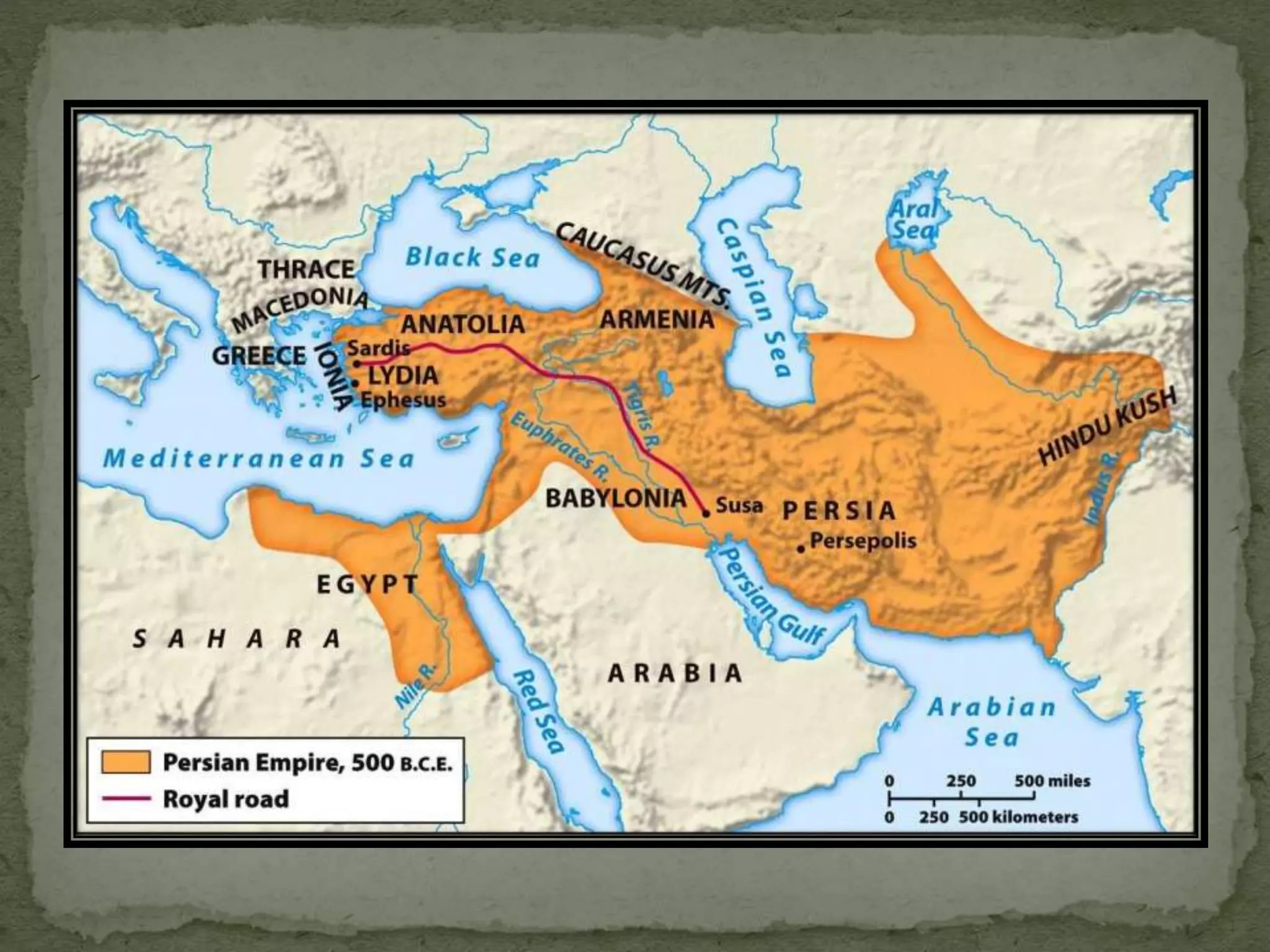
 In the mid-sixth century B.C., the Persians united under a brilliant 
warrior king, Cyrus the Great, and quickly overcame their 
Iranian cousins and neighbors, the Medes. 
 In a remarkable series of campaigns between 559 and 530 B.C., Cyrus 
extended his domains from the borders of India to the Mediterranean 
coast. 
 By 525, his son and immediate successor, Cambyses, had 
broadened the empire to include part of Arabia and the Nile 
valley. 
 The main Persian cities were at Susa, Persepolis, and Ecbatana in 
Iran, not in Mesopotamia. 
 The gradual decline of Mesopotamia’s importance can be dated to this 
time.
Cyrus 
the Great 
Cyrus II of Persia 
created the 
largest empire 
the world had 
yet seen. The 
Bible cites him 
as a tolerant and 
ideal monarch 
who liberated 
the Jewish 
captives of 
Babylonia.
Hall of a 
Hundred 
Columns 
This is the great 
assembly and 
banquet hall 
erected by Darius 
I in Persepolis 
and burned to the 
ground by the 
triumphant 
conqueror, 
Alexander the 
Great.
 Cyrus had a concept of imperial rule that was quite different 
from that of the Assyrians. 
 He realized many of his new subjects were more advanced in many ways 
than his own Persians and that he could learn from them. 
 Accordingly, his government was sort of an umbrella, sheltering 
many different peoples and beliefs under the supervision of the 
“King of Kings” at Persepolis. 
 The Persian subjects were generally allowed to retain their own 
customs, laws, and religious beliefs. 
 Their appointed Persian supervisors (satraps) only interfered when the 
central government’s policies were threatened or disobeyed.
 In the provinces, satrapies were kept in power after conquest so 
long as they swore obedience to the monarch, paid their 
(relatively light) taxes, provided soldiers, and gave aid and 
comfort to the Persians when called upon. 
 Religion was totally free and all sorts of beliefs flourished from the 
Hebrews to the fire worshippers of the Indian borderlands. 
 Most remarkably, the initial move toward an ethical religion seems to have 
come with the teaching of Zarathustra. 
 Darius I (522-486) was the third great Persian ruler, following 
Cyrus and Cambyses. 
 During his reign, the empire reached its maximal extent.
Darius 
the Great 
Darius I is noted for 
his administrative 
genius and for his 
great building 
projects. He 
attempted several 
times to conquer 
Greece: his fleet was 
destroyed by a storm 
in 492 and the 
Athenians defeated 
his army at Marathon 
in 490.
 Darius introduced a law code that was a more advanced and 
refined distillation of earlier codes from Mesopotamia and 
Egypt. 
 Additionally, a stable coinage in gold and silver and a calendar 
that was commonly used throughout the Near East was 
introduced. 
 For the next century, the peoples of the empire flourished under 
enlightened Persian leadership. 
 The Persian kings eventually made the mistake of biting off more 
than they could chew. 
 Darius and his successor, Xerxes, invaded the European mainland in an 
attempt to extend their power and it would cost them dearly.
Xerxes 
the Great 
In 465, Xerxes and 
his eldest son fell 
under the blows of 
the murderous 
court led by 
Artabanus, the 
commander of the 
royal bodyguard 
and the most 
powerful official in 
the Persian court.
 What we know of the ancient Twelve Tribes of the Hebrews is 
derived in large part from the poetic history of he Old 
Testament. 
 The Hebraic tradition of Abraham leading his people out of the 
wilderness and into the land of Canaan refers to what is accepted 
as historical fact: 
 Nomadic, primitive Semitic tribes departed from someplace in northern 
Mesopotamia in the twelfth century B.C. and wandered for a lengthy time 
through what is now Saudi Arabia. 
 By the 1500s B.C., they were established in Canaan, the southern 
part of Palestine. 
 Here they came under Egyptian rule and a good portion of the Twelve 
Tribes became coerced slaves in the Nile delta.
 The Hebrew’s Exodus from Egypt under the legendary leader 
Moses occurred during the thirteenth century B.C. 
 The exact reasons for the Exodus are not clear but it is entirely possible 
that the Old Testament story of brutal treatment by the pharaoh is true. 
 In any case, under Moses, the Hebrews resolved to return to the 
“land of milk and honey,” the Promised Land of Canaan, 
whose memory had been kept alive by their leaders in Egypt. 
 Escaping pharaoh's wrathful pursuit, the Hebrews wandered 
across the Sinai peninsula until they encountered the Canaanites 
and the Philistines, who were already settled in coastal Palestine. 
 By about 1000 B.C., the Hebrews overcame the Canaanites and established 
their own small kingdom with Saul as the first king.
Moses 
Moses our Teacher is 
revered as the most 
important prophet in 
Judaism, Christianity, 
Islam, and numerous 
other faiths. Upon his 
120th birthday, Moses 
pronounced a blessing 
over his people and 
died: God Himself 
buried him 
somewhere in a valley 
in the land of Moab 
(Deuteronomy 34:6).
 Saul carried the war to the Philistines, and his work was carried 
on by his lieutenant and successor, David. 
 David was a great warrior hero and he was successful in conquering 
Jerusalem, which then became the Hebrew’s capital. 
 David’s son, Solomon, was the most renowned king of the 
Hebrews. 
 During his reign, the Hebrews briefly became a factor in Near 
Eastern affairs, serving as trading intermediaries between Egypt 
and the Mesopotamians. 
 The famous Temple of Jerusalem, constructed of stone and cedarwood 
and decorated inside and out with gold, became a wonder of the ancient 
world.
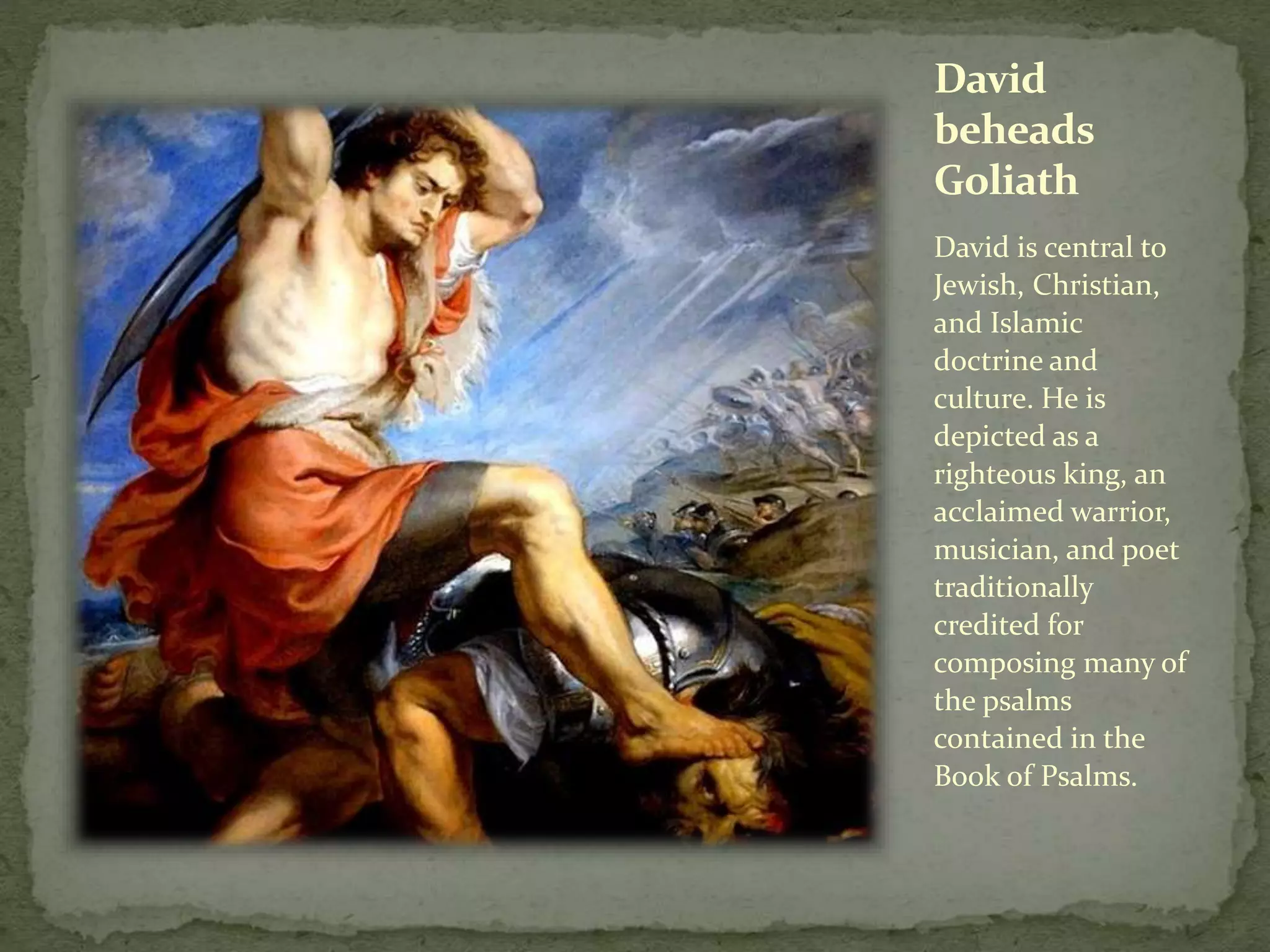
David 
beheads 
Goliath 
David is central to 
Jewish, Christian, 
and Islamic 
doctrine and 
culture. He is 
depicted as a 
righteous king, an 
acclaimed warrior, 
musician, and poet 
traditionally 
credited for 
composing many of 
the psalms 
contained in the 
Book of Psalms.
 When King Solomon died, a revolt against his successor split the 
Hebrew kingdom in two: 
 Judea and Samaria or as they are sometimes called, Judah and Israel. 
 Although ethnically very close, the two kingdoms were quite 
hostile to one another. 
 As time passed, Samaritans and Judeans came to look on one 
another as different peoples. 
 Their differences arose as the Judeans (Jews) came under the influence of 
the Egyptian empire while the Samaritans came under the influence of 
Mesopotamia. 
 The kingdom of Samaria/Israel was ended by a rebellion against 
the Assyrian overlords.
 This defeat resulted in the scattering of the populace far and 
wide, the first Diaspora or scattering . 
 Judea, however, survived under the Assyrians until their defeat in 
612 B.C., when it fell under Babylonian over-lordship. 
 The ill-fated attempt to throw off this yoke led to the crushing 
defeat by King Nebuchadnezzar in 586 and the ensuing 
Babylonian Captivity (586-539 B.C.), when thousands of Jews 
were taken off to Babylon as hostages for the good behavior of 
the rest. 
 The great temple of Solomon was demolished.
 The Judeans continued under Persian rule from 539 B.C. until 
Alexander the Great toppled the King of Kings in the 330s. 
 They lived under the Hellenistic successors of Alexander until 
the gradual extension of Roman power reached Palestine.
 From the time of the kingdom of Saul, a great god known as 
Yahweh (Jehovah) was established as the Hebrew’s chief deity but 
was by no means the only one. 
 In Samaria, Yahweh was regulated to an inferior position. 
 In Judea, Yahweh’s cult gradually triumphed over all rivals and 
this god became the only deity of the Jews of Jerusalem. 
 Monotheism was so rare that we only know of one pre-Jewish experiment 
with it – Akhanton of Egypt. 
 The Judeans Jews, under the influence of a whole series of great 
prophets including Amos, Hosea, Ezekiel, and Isaiah, came by 
the 600s B.C. to believe themselves bound to Yahweh by a sacred 
contract, the Covenant, given to Moses during the Exodus.
 From the time of the kingdom of Saul, a great god known as 
Yahweh (Jehovah) was established as the Hebrew’s chief deity but 
was by no means the only one. 
 In Samaria, Yahweh was regulated to an inferior position. 
 In Judea, Yahweh’s cult gradually triumphed over all rivals and 
this god became the only deity of the Jews of Jerusalem. 
 Monotheism was so rare that we only know of one pre-Jewish experiment 
with it – Akhanton of Egypt. 
 The Judeans Jews, under the influence of a whole series of great 
prophets including Amos, Hosea, Ezekiel, and Isaiah, came by 
the 600s B.C. to believe themselves bound to Yahweh by a sacred 
contract, the Covenant, given to Moses during the Exodus.
 The contract was understood to mean that if the Jews remained 
constant in their worship of Yahweh and kept the faith he 
instilled in them, they would eventually triumph over all their 
enemies and be a respected and lordly people on Earth. 
 The faith that Yahweh desired was supported by a set of rigid 
rules given to Moses by Yahweh on Mount Sinai, from which 
evolved a whole law code that governed every aspect of Hebrew 
daily life. 
 Coming to be known to later Jews and Christians as the Ten 
Commandments, these moral regulations have been adapted to much 
different social circumstances.
 The Ten Commandments were the property of the Jews, given to 
them as a mark of favor by their lord and protector Yahweh. 
 The Jewish faith was one of the earliest attempts to formalize an 
ethical system and to link it with the worship of supernatural 
deities. 
 Ethics is the study of good and evil and determining what is right and 
wrong in human life and conduct. 
 To Yahweh’s followers, those who did evil on Earth would be 
made to suffer, if not in this world, then in the one to come. 
 Additionally, the laws of Yahweh assured that the good would be rewarded 
– again, if not in this life, then in the eternal one to come.
Mount 
Sinai 
Some modern 
biblical scholars 
believe that the 
Israelites would have 
crossed the Sinai 
Peninsula in a direct 
route, rather than 
detouring to the 
southern tip. With 
this belief, scholars 
look for the biblical 
Mount Sinai 
elsewhere.
 When the kingdom was founded under Saul, most Hebrews were 
still rural herders and peasants, living as Abraham had lived. 
 Over the next half millennium, however, many Hebrews made 
the transition from rural to town life. 
 As many people shifted from subsistence farming to wage earning, social 
tensions dividing rich and poor began to appear. 
 Most than most, the Jews divided all humanity into “we” and 
“they.” 
 They recognized themselves as the Chosen and all non-Jews as Gentiles. 
 Jews looked upon non-Jews as distinctly lesser breeds and 
intermarriage with nonbelievers was considered treasonous. 
 Ancient Judaism was almost never open to converts.
Saul 
Saul was the first 
king of the united 
Kingdom of Israel. 
Appointed by the 
prophet Samuel, Saul 
fell on his sword to 
avoid capture in the 
battle against the 
Philistines at Mount 
Gilboa. There three 
of his sons would 
suffer death and 
David would prepare 
for his succession.
 The nuclear family was the basic unit of Hebrew society, with the 
father enjoying very extensive rights. 
 The married state was strongly preferred while bachelors were 
looked upon as failures. 
 Young men were to marry no later than the age of twenty-four while girls 
were thought to be ready at thirteen. 
 As in every ancient society, marriage was arranged by the parents, usually 
after the negotiation of a dowry (bride-price). 
 Children were the whole point of marriage – the continuation of 
the family was the primary duty of both husband and wife.
 In the centuries after the fall of the monarchies of Samaria and 
Judea, the Jew’s concept of Yahweh changed in several significant 
ways. 
 The Babylonian Captivity was a particular low-point and many Jews 
never returned to the faith after having been seduced into the 
worship of false gods. 
 Those who returned were “tried and true” believers who rebuilt 
the Temple and restructured their theology based on the new 
interpretations of the Covenant, the Talmud.
 Not only was Yahweh the only god, he was the universal god of 
all. 
 Yahweh was a just god, who would reward or punish according to 
his ethical principles, but he was also a merciful god who would 
not turn a deaf ear to the earnest penitent. 
 Yahweh was an omnipotent (all-powerful) and omniscient (all-knowing) 
master, who could do whatever he desired, always and 
everywhere. 
 There were no other opposing forces that could frustrate his will or 
wisdom. 
 Yahweh granted Man free will, who allowed the principle of evil 
to arise in the form of the fallen angel Lucifer.
 Man could ignore conscience and the Law and choose evil, but if 
he did, he would face a Last Judgment that would condemn him 
to eternal punishment and deprive him of the fate that Yahweh 
desired and offered: salvation in blessed. 
 Finally, Yahweh gradually came to be a personal deity, in a way in 
which no other ancient god had been. 
 He could be prayed to directly; he was observant of all that affected a 
man’s or a woman’s life. 
 His actions were not impulsive or unpredictable. 
 Yahweh wanted Man not as a slave but a friend. 
 The relationship between God and Man is meant to be one of 
mutual love.
 This was a vision of the relationship between the deity and his 
creature man that no other people had: 
 A mutually dependent, ethical, just but also merciful on the Lord’s side. 
 A submissive but not slavish on man’s side. 
 It was a relationship between a stern but loving father and an independent, 
sinful, but dutiful child. 
 The mold for the evolution of Christianity had been formed. 
 All that was needed was the appearance of the long-rumored 
messiah who would fulfill the promise that the Chosen would 
enter glory, some day.

Empires and Theology in the Near East

  • 1.
    “The Lord ourGod made a covenant, not only with our fathers, but with all of us living today…. The Lord said, ‘I am the Lord your God… Worship no God but me.” - The Bible
  • 2.
     The NearEast between the Nile valley and the Sumerians soon became a region of cultural overlap and interchange.  One people and then another would take command of a portion of the region for a century or more, only to fall under the sway of the next onslaught of newcomers.  Kingdoms arose whose very names are sometimes forgotten but whose contributions to the ascent of civilization in this region were impressive.
  • 3.
     The Assyrianswere a Semitic tribal group who emerged from nomadism in what is now northern Iraq in the twelfth century B.C.  They entered history about 900 B.C. as challengers to other Semites in the Tigris valley.  Their chief town, Nineveh, lay in the upper valley of the Tigris and their chief god was the very fierce Assur, from whom the people derived their name.  By 800 B.C., through their own ferocity and cunning in war, the Assyrian kings had conquered much of the Tigris-Euphrates region and were fighting the Babylonians for the southern portion.
  • 5.
     The Assyriansdisplayed great talent in military affairs.  Their army was large and seemingly irresistible, using new tactics to negate the traditional advantage of charioteers over foot soldiers.  By this epoch, the horse and the chariot were widely used in warfare.  It is believed that the chariot was introduced to Near Eastern warfare by the Hyksos invaders of Egypt in the 1500s.  For centuries, leather-clad warriors armed with short swords had fought from chariots drawn by two or three horses.
  • 6.
    The Chariot Thisbas-relief shows King Assurbanipal charging the enemy in his war chariot, accompanied by picked spearmen who thrust away the hostile infantry as the monarch loads his bow.
  • 7.
     The chariotswould split the loose ranks of the enemy foot soldiers and the momentum of the horses combined with the raised platform gave the swordsmen an almost irresistible advantage over opposing infantry.  The early Assyrian kings took away this advantage:  The tight-knit infantry formations were fielded with long spears and swords.  The flanks were protected by bands of horsemen who engaged the enemy charioteers while they were still far off.  The infantry were so heavily armored and so disciplined that they would stand up to a chariot charge without breaking.  The Assyrians were also experts in siege warfare and no enemy fort could withstand their artillery of stone-throwing catapults and rams.
  • 8.
     Anyone whoresisted the Assyrians and lost suffered a terrible fate:  wholesale slavery, execution, pillage, and rape.  Once conquered, the enemy was closely supervised and any effort to spring free the Assyrian yoke was immediately suppressed.  The chronicles left by the Assyrians delight in telling of the huge piles of dead left by the triumphant armies of kings such as Tiglath-Pileser III who reigned in the seventh century B.C.
  • 9.
    Tiglath- Pileser III Under the reign of Tiglath-Pileser III, Assyria experienced its last and greatest phase of expansion. He subjected Syria and Palestine to his rule and later merged the kingdoms of Assyria and Babylonia.
  • 10.
     “Like theThunder, I crushed corpses of their warriors in the battle. I made their blood flow over into all the ravines and over the high places. I cut off their heads and piled them at the walls of their cities like heaps of grain. I carried off their booty, their goods, and their property beyond all reckoning. Six thousand, the remainder of their troops who had fled before my weapons and thrown themselves at my feet, I took away as prisoners and added to the peoples of my country [that is, slaves].
  • 11.
     The Assyrianswere perhaps the most hated conquerors in ancient history.  Only their expertly calculated plans for “divide and conquer” and mass deportations of subject peoples enabled them to remain in power as long as they did.  At one point their empire reached from the upper Tigris to central Egypt.  It was governed from Nineveh by a network of military commanders who had no mercy for rebels and held large numbers of hostages for the good behavior of he rest of their people.  But less than a century later, Nineveh was in total ruins and the Assyrians were swept from the pages of history as though they had never existed.
  • 12.
     Their manyenemies and rebellious subjects, led by the Chaldees of New Babylon, finally united against their oppressor and took full revenge for Assyrian atrocities.  When they captured Nineveh in 612 B.C., the victors even salted the fertile irrigated lands that ringed the city to prevent the site from ever being inhabited again.  It was indeed forgotten until the middle of the nineteenth century when Nineveh’s ruins were unearthed by some of the earliest archaeological expeditions to the Middle East.
  • 13.
     Another smallbut significant Semitic people were the unwarlike Phoenicians, who originally inhabited a strip along the coast of what is now Lebanon.  They became the greatest maritime traders and colonizers of the ancient Near East.  Their trade in luxury wares such as copper and dyes took them through the Mediterranean and into the Atlantic as far as the coast of Britain.  The Phoenicians also apparently spread the art of iron making to the Greeks and westward into Africa.  They established a whole series of colonies in the western portion of the Mediterranean Sea.
  • 16.
     The richcity-state of Carthage became the great rival to Rome until its final defeat around 200 B.C.  The Phoenicians themselves were absorbed into the Assyrian and succeeding empires but remained the paramount Mediterranean traders and seafarers until the rise of Greece in the 600s B.C.  The Phoenicians’ most notable contribution came in the linguistic field.  They were the first to use a phonetic alphabet , a system of twenty-two written marks (letters), each of which corresponded to a specific consonantal sound of the oral language.  The alphabet, which emerged about 1000 B.C., was a definite advance in written communications over the Sumerian’s cuneiform and the Egyptian’s hieroglyphs.
  • 17.
    Lion Attacking aYouth This marvelous carved ivory plaque dates from the eighth or ninth century B.C. Phoenicia.
  • 18.
     Until thetwentieth century, present-day Iraq was called Persia, which was ruled by the most powerful peoples in western Asia from 500 B.C. to 500 A.D.  The Persians were an Indo-European speaking people who had migrated slowly south from the central Asian steppes into Iran.  As of 1000 B.C., they were still nomadic and knew nothing of agricultural or civilized crafts and techniques.  They did, however, possess large numbers of horses and their skill of cavalry tactics enabled them to gradually overcome their rivals and begin a sedentary life.  Through war and trading contacts with their Mesopotamia neighbors to the west, they learned the basics of agriculture and civilized life.
  • 19.
     In themid-sixth century B.C., the Persians united under a brilliant warrior king, Cyrus the Great, and quickly overcame their Iranian cousins and neighbors, the Medes.  In a remarkable series of campaigns between 559 and 530 B.C., Cyrus extended his domains from the borders of India to the Mediterranean coast.  By 525, his son and immediate successor, Cambyses, had broadened the empire to include part of Arabia and the Nile valley.  The main Persian cities were at Susa, Persepolis, and Ecbatana in Iran, not in Mesopotamia.  The gradual decline of Mesopotamia’s importance can be dated to this time.
  • 20.
    Cyrus the Great Cyrus II of Persia created the largest empire the world had yet seen. The Bible cites him as a tolerant and ideal monarch who liberated the Jewish captives of Babylonia.
  • 22.
    Hall of a Hundred Columns This is the great assembly and banquet hall erected by Darius I in Persepolis and burned to the ground by the triumphant conqueror, Alexander the Great.
  • 23.
     Cyrus hada concept of imperial rule that was quite different from that of the Assyrians.  He realized many of his new subjects were more advanced in many ways than his own Persians and that he could learn from them.  Accordingly, his government was sort of an umbrella, sheltering many different peoples and beliefs under the supervision of the “King of Kings” at Persepolis.  The Persian subjects were generally allowed to retain their own customs, laws, and religious beliefs.  Their appointed Persian supervisors (satraps) only interfered when the central government’s policies were threatened or disobeyed.
  • 24.
     In theprovinces, satrapies were kept in power after conquest so long as they swore obedience to the monarch, paid their (relatively light) taxes, provided soldiers, and gave aid and comfort to the Persians when called upon.  Religion was totally free and all sorts of beliefs flourished from the Hebrews to the fire worshippers of the Indian borderlands.  Most remarkably, the initial move toward an ethical religion seems to have come with the teaching of Zarathustra.  Darius I (522-486) was the third great Persian ruler, following Cyrus and Cambyses.  During his reign, the empire reached its maximal extent.
  • 25.
    Darius the Great Darius I is noted for his administrative genius and for his great building projects. He attempted several times to conquer Greece: his fleet was destroyed by a storm in 492 and the Athenians defeated his army at Marathon in 490.
  • 26.
     Darius introduceda law code that was a more advanced and refined distillation of earlier codes from Mesopotamia and Egypt.  Additionally, a stable coinage in gold and silver and a calendar that was commonly used throughout the Near East was introduced.  For the next century, the peoples of the empire flourished under enlightened Persian leadership.  The Persian kings eventually made the mistake of biting off more than they could chew.  Darius and his successor, Xerxes, invaded the European mainland in an attempt to extend their power and it would cost them dearly.
  • 27.
    Xerxes the Great In 465, Xerxes and his eldest son fell under the blows of the murderous court led by Artabanus, the commander of the royal bodyguard and the most powerful official in the Persian court.
  • 29.
     What weknow of the ancient Twelve Tribes of the Hebrews is derived in large part from the poetic history of he Old Testament.  The Hebraic tradition of Abraham leading his people out of the wilderness and into the land of Canaan refers to what is accepted as historical fact:  Nomadic, primitive Semitic tribes departed from someplace in northern Mesopotamia in the twelfth century B.C. and wandered for a lengthy time through what is now Saudi Arabia.  By the 1500s B.C., they were established in Canaan, the southern part of Palestine.  Here they came under Egyptian rule and a good portion of the Twelve Tribes became coerced slaves in the Nile delta.
  • 30.
     The Hebrew’sExodus from Egypt under the legendary leader Moses occurred during the thirteenth century B.C.  The exact reasons for the Exodus are not clear but it is entirely possible that the Old Testament story of brutal treatment by the pharaoh is true.  In any case, under Moses, the Hebrews resolved to return to the “land of milk and honey,” the Promised Land of Canaan, whose memory had been kept alive by their leaders in Egypt.  Escaping pharaoh's wrathful pursuit, the Hebrews wandered across the Sinai peninsula until they encountered the Canaanites and the Philistines, who were already settled in coastal Palestine.  By about 1000 B.C., the Hebrews overcame the Canaanites and established their own small kingdom with Saul as the first king.
  • 31.
    Moses Moses ourTeacher is revered as the most important prophet in Judaism, Christianity, Islam, and numerous other faiths. Upon his 120th birthday, Moses pronounced a blessing over his people and died: God Himself buried him somewhere in a valley in the land of Moab (Deuteronomy 34:6).
  • 32.
     Saul carriedthe war to the Philistines, and his work was carried on by his lieutenant and successor, David.  David was a great warrior hero and he was successful in conquering Jerusalem, which then became the Hebrew’s capital.  David’s son, Solomon, was the most renowned king of the Hebrews.  During his reign, the Hebrews briefly became a factor in Near Eastern affairs, serving as trading intermediaries between Egypt and the Mesopotamians.  The famous Temple of Jerusalem, constructed of stone and cedarwood and decorated inside and out with gold, became a wonder of the ancient world.
  • 33.
    David beheads Goliath David is central to Jewish, Christian, and Islamic doctrine and culture. He is depicted as a righteous king, an acclaimed warrior, musician, and poet traditionally credited for composing many of the psalms contained in the Book of Psalms.
  • 34.
     When KingSolomon died, a revolt against his successor split the Hebrew kingdom in two:  Judea and Samaria or as they are sometimes called, Judah and Israel.  Although ethnically very close, the two kingdoms were quite hostile to one another.  As time passed, Samaritans and Judeans came to look on one another as different peoples.  Their differences arose as the Judeans (Jews) came under the influence of the Egyptian empire while the Samaritans came under the influence of Mesopotamia.  The kingdom of Samaria/Israel was ended by a rebellion against the Assyrian overlords.
  • 35.
     This defeatresulted in the scattering of the populace far and wide, the first Diaspora or scattering .  Judea, however, survived under the Assyrians until their defeat in 612 B.C., when it fell under Babylonian over-lordship.  The ill-fated attempt to throw off this yoke led to the crushing defeat by King Nebuchadnezzar in 586 and the ensuing Babylonian Captivity (586-539 B.C.), when thousands of Jews were taken off to Babylon as hostages for the good behavior of the rest.  The great temple of Solomon was demolished.
  • 36.
     The Judeanscontinued under Persian rule from 539 B.C. until Alexander the Great toppled the King of Kings in the 330s.  They lived under the Hellenistic successors of Alexander until the gradual extension of Roman power reached Palestine.
  • 37.
     From thetime of the kingdom of Saul, a great god known as Yahweh (Jehovah) was established as the Hebrew’s chief deity but was by no means the only one.  In Samaria, Yahweh was regulated to an inferior position.  In Judea, Yahweh’s cult gradually triumphed over all rivals and this god became the only deity of the Jews of Jerusalem.  Monotheism was so rare that we only know of one pre-Jewish experiment with it – Akhanton of Egypt.  The Judeans Jews, under the influence of a whole series of great prophets including Amos, Hosea, Ezekiel, and Isaiah, came by the 600s B.C. to believe themselves bound to Yahweh by a sacred contract, the Covenant, given to Moses during the Exodus.
  • 38.
     From thetime of the kingdom of Saul, a great god known as Yahweh (Jehovah) was established as the Hebrew’s chief deity but was by no means the only one.  In Samaria, Yahweh was regulated to an inferior position.  In Judea, Yahweh’s cult gradually triumphed over all rivals and this god became the only deity of the Jews of Jerusalem.  Monotheism was so rare that we only know of one pre-Jewish experiment with it – Akhanton of Egypt.  The Judeans Jews, under the influence of a whole series of great prophets including Amos, Hosea, Ezekiel, and Isaiah, came by the 600s B.C. to believe themselves bound to Yahweh by a sacred contract, the Covenant, given to Moses during the Exodus.
  • 39.
     The contractwas understood to mean that if the Jews remained constant in their worship of Yahweh and kept the faith he instilled in them, they would eventually triumph over all their enemies and be a respected and lordly people on Earth.  The faith that Yahweh desired was supported by a set of rigid rules given to Moses by Yahweh on Mount Sinai, from which evolved a whole law code that governed every aspect of Hebrew daily life.  Coming to be known to later Jews and Christians as the Ten Commandments, these moral regulations have been adapted to much different social circumstances.
  • 40.
     The TenCommandments were the property of the Jews, given to them as a mark of favor by their lord and protector Yahweh.  The Jewish faith was one of the earliest attempts to formalize an ethical system and to link it with the worship of supernatural deities.  Ethics is the study of good and evil and determining what is right and wrong in human life and conduct.  To Yahweh’s followers, those who did evil on Earth would be made to suffer, if not in this world, then in the one to come.  Additionally, the laws of Yahweh assured that the good would be rewarded – again, if not in this life, then in the eternal one to come.
  • 41.
    Mount Sinai Somemodern biblical scholars believe that the Israelites would have crossed the Sinai Peninsula in a direct route, rather than detouring to the southern tip. With this belief, scholars look for the biblical Mount Sinai elsewhere.
  • 42.
     When thekingdom was founded under Saul, most Hebrews were still rural herders and peasants, living as Abraham had lived.  Over the next half millennium, however, many Hebrews made the transition from rural to town life.  As many people shifted from subsistence farming to wage earning, social tensions dividing rich and poor began to appear.  Most than most, the Jews divided all humanity into “we” and “they.”  They recognized themselves as the Chosen and all non-Jews as Gentiles.  Jews looked upon non-Jews as distinctly lesser breeds and intermarriage with nonbelievers was considered treasonous.  Ancient Judaism was almost never open to converts.
  • 43.
    Saul Saul wasthe first king of the united Kingdom of Israel. Appointed by the prophet Samuel, Saul fell on his sword to avoid capture in the battle against the Philistines at Mount Gilboa. There three of his sons would suffer death and David would prepare for his succession.
  • 44.
     The nuclearfamily was the basic unit of Hebrew society, with the father enjoying very extensive rights.  The married state was strongly preferred while bachelors were looked upon as failures.  Young men were to marry no later than the age of twenty-four while girls were thought to be ready at thirteen.  As in every ancient society, marriage was arranged by the parents, usually after the negotiation of a dowry (bride-price).  Children were the whole point of marriage – the continuation of the family was the primary duty of both husband and wife.
  • 45.
     In thecenturies after the fall of the monarchies of Samaria and Judea, the Jew’s concept of Yahweh changed in several significant ways.  The Babylonian Captivity was a particular low-point and many Jews never returned to the faith after having been seduced into the worship of false gods.  Those who returned were “tried and true” believers who rebuilt the Temple and restructured their theology based on the new interpretations of the Covenant, the Talmud.
  • 46.
     Not onlywas Yahweh the only god, he was the universal god of all.  Yahweh was a just god, who would reward or punish according to his ethical principles, but he was also a merciful god who would not turn a deaf ear to the earnest penitent.  Yahweh was an omnipotent (all-powerful) and omniscient (all-knowing) master, who could do whatever he desired, always and everywhere.  There were no other opposing forces that could frustrate his will or wisdom.  Yahweh granted Man free will, who allowed the principle of evil to arise in the form of the fallen angel Lucifer.
  • 47.
     Man couldignore conscience and the Law and choose evil, but if he did, he would face a Last Judgment that would condemn him to eternal punishment and deprive him of the fate that Yahweh desired and offered: salvation in blessed.  Finally, Yahweh gradually came to be a personal deity, in a way in which no other ancient god had been.  He could be prayed to directly; he was observant of all that affected a man’s or a woman’s life.  His actions were not impulsive or unpredictable.  Yahweh wanted Man not as a slave but a friend.  The relationship between God and Man is meant to be one of mutual love.
  • 48.
     This wasa vision of the relationship between the deity and his creature man that no other people had:  A mutually dependent, ethical, just but also merciful on the Lord’s side.  A submissive but not slavish on man’s side.  It was a relationship between a stern but loving father and an independent, sinful, but dutiful child.  The mold for the evolution of Christianity had been formed.  All that was needed was the appearance of the long-rumored messiah who would fulfill the promise that the Chosen would enter glory, some day.