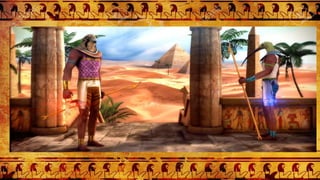
Ancient Egypt was a civilization in the NE Africa, concentrated along
the Nile River in what is now Egypt. Egyptian civilization started around
3150 BC with the political unification of Upper and Lower Egypt under
the first pharaoh MENES.
The history of ancient Egypt is separated in few different periods:
• Old Kingdom (Early Bronze Age)
• Middle Kingdom (Middle Bronze Age)
• New Kingdom (Late Bronze Age)
The success of ancient Egyptian civilization came from:
• Agriculture
• Controlled irrigation
• Surplus crops
• Dense population
• Social development and culture
Other successes:
• Mineral exploitation
• The writing system
• Collective construction
• Agricultural projects
• Trade with regions
• Strong army
Motivating and organizing these activities was a bureaucracy of people
under the control of the pharaoh:
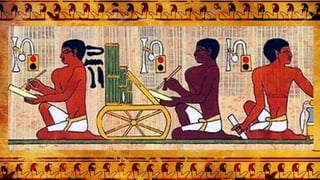
• elite scribes
• religious leaders
• administrators
Achievements of the ancient Egyptians:
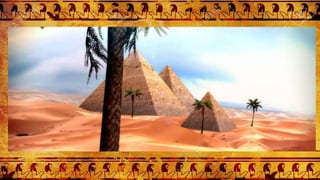
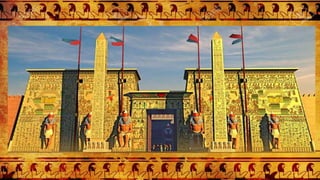
• construction techniques - building of pyramids and temples
• a system of mathematics
• a system of medicine
• the first known ships
• faience and glass technology
• new forms of literature
• the earliest known peace treaty (Hittites)
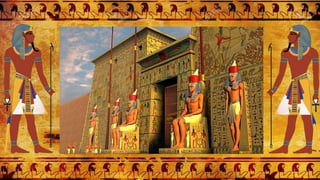
The pharaoh was the absolute monarch of the country and he was the
supreme military commander and head of the government
He relied on a bureaucracy of officials to manage his affairs.
In charge of the administration was his second in command, the vizier.
He who acted as the king's representative and coordinated land surveys, the
treasury, building projects, the legal system, and the archives.
The country was divided into 42 administrative regions called nomes
each governed by a nomarch, who was accountable to the vizier for
his jurisdiction.
The temples formed the backbone of the economy. Not only were they
houses of worship, but were also responsible for collecting and storing the
nation's wealth in a system of granaries and treasuries administered by
overseers, who redistributed grain and goods.
The economy was centrally organized and strictly controlled.
The ancient Egyptians did not use coinage until the Late period, they
did use a type of money-barter system, with standard sacks of grain
and the deben, a weight of roughly 91 grams of copper or silver.
Workers were paid in grain; a simple labourer might earn 5½ sacks (200 kg) of
grain per month, while a foreman might earn 7½ sacks (250 kg).
Prices were fixed across the country and recorded in lists to facilitate
trading; for example a shirt cost five copper deben, while a cow cost
140 deben.
Grain could be traded for other goods, according to the fixed price list. During
the fifth century BC coined money was introduced into Egypt from abroad. At
first the coins were used as standardized pieces of precious metal rather than
true money, but in the following centuries international traders came to rely
on coinage.
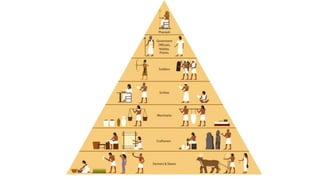
Farmers made up the bulk of the population, but agricultural produce
was owned directly by the state, temple, or noble family that owned
the land.
Farmers were also subject to a labour tax and were required to work on
irrigation or construction projects in a corvĂŠe system.
Artists and craftsmen were of higher status than farmers, but they
were also under state control, working in the shops attached to the
temples and paid directly from the state treasury.
Scribes and officials formed the upper class in ancient Egypt, known
as the "white kilt class" in reference to the bleached linen garments
that served as a mark of their rank.
The upper class displayed their social status in art and literature.
Below the nobility were the priests, physicians, and engineers with
specialized training in their field.
The ancient Egyptians viewed men and women, including people from
all social classes except slaves, as essentially equal under the law, and
even the lowliest peasant was entitled to petition the vizier and his
court for redress.
Although, slaves were mostly used as indentured servants. They were able to
buy and sell, or work their way to freedom or nobility, and usually were
treated by doctors in the workplace.
Both men and women had the right to own and sell property, make
contracts, marry and divorce, receive inheritance, and pursue legal
disputes in court.
Married couples could own property jointly and protect themselves from
divorce by agreeing to marriage contracts, which stipulated the financial
obligations of the husband to his wife and children should the marriage end.
Hieroglyphic writing dates from c. 3000 BC, and is composed of
hundreds of symbols. A hieroglyph can represent a word, a sound, or
a silent; and the same symbol can serve different purposes in
different contexts.
Hieroglyphs were a formal script, used on stone monuments and in tombs,
that could be as detailed as individual works of art. In day-to-day writing,
scribes used a cursive form of writing, called hieratic, which was quicker and
easier.
Writing first appeared in association with kingship on labels and tags
for items found in royal tombs. It was primarily an occupation of the
scribes.
The latter comprised offices, libraries (House of Books), laboratories and
observatories. Some of the best-known pieces of ancient Egyptian literature,
such as the Pyramid and Coffin Texts, were written in Classical Egyptian,
which continued to be the language of writing until about 1300 BC.
Most ancient Egyptians were farmers tied to the land. Their
dwellings were restricted to immediate family members, and were
constructed of mud-brick designed to remain cool in the heat of the
day. Each home had a kitchen with an open roof, which contained a
grindstone for milling grain and a small oven for baking the bread.
Walls were painted white and could be covered with dyed linen wall
hangings. Floors were covered with reed mats, while wooden stools, beds
raised from the floor and individual tables comprised the furniture.
The ancient Egyptians placed a great value on hygiene and
appearance. Most bathed in the Nile and used a pasty soap made
from animal fat and chalk.
Men shaved their entire bodies for cleanliness; perfumes and aromatic
ointments covered bad odours and soothed skin.
Clothing was made from simple linen sheets that were bleached
white, and both men and women of the upper classes wore wigs,
jewellery, and cosmetics. Children went without clothing until
maturity, at about age 12, and at this age males were circumcised
and had their heads shaved.
Mothers were responsible for taking care of the children, while the father
provided the family's income.
Music and dance were popular entertainments for those who could
afford them. Early instruments included flutes and harps, while
instruments similar to trumpets, oboes, and pipes developed later
and became popular.
In the New Kingdom, the Egyptians played on bells, cymbals, tambourines,
drums, and imported lutes and lyres from Asia. The sistrum was a rattle-like
musical instrument that was especially important in religious ceremonies.
The staple diet consisted of bread and beer, supplemented with
vegetables such as onions and garlic, and fruit such as dates and figs.
Wine and meat were enjoyed by all on feast days while the upper
classes indulged on a more regular basis. Fish, meat, and fowl could
be salted or dried, and could be cooked in stews or roasted on a grill.
Egyptian cuisine remained remarkably stable over time; indeed, the cuisine
of modern Egypt retains some striking similarities to the cuisine of the
ancients.
Beliefs in the divine and in the afterlife were in the ancient Egyptian
civilization from its inception; pharaonic rule was based on the
divine right of kings.
The Egyptian pantheon was populated by gods who had supernatural
powers and were called on for help or protection. However, the gods were
not always viewed as benevolent, and Egyptians believed they had to be
appeased with offerings and prayers.
The ancient Egyptians maintained a set of burial customs that they
believed were necessary to ensure immortality after death. These
customs involved preserving the body by mummification,
performing burial ceremonies, and interring with the body goods the
deceased would use in the afterlife.
Before the Old Kingdom, bodies buried in desert pits were naturally
preserved by desiccation. Wealthier Egyptians began to bury their dead in
stone tombs and use artificial mummification, which involved removing the
internal organs, wrapping the body in linen, and burying it in a rectangular
stone sarcophagus or wooden coffin.
Typical military equipment included bows and arrows, spears, and
round-topped shields made by stretching animal skin over a wooden
frame. In the New Kingdom, the military began using chariots that
had earlier been introduced by the Hyksos invaders.
Weapons and armour continued to improve after the adoption of bronze:
shields were now made from solid wood with a bronze buckle, spears were
tipped with a bronze point, and the Khopesh was adopted from Asiatic
soldiers.
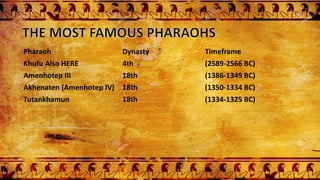
Pharaoh Dynasty Timeframe
Khufu Also HERE 4th (2589-2566 BC)
Amenhotep III 18th (1386-1349 BC)
Akhenaten (Amenhotep IV) 18th (1350-1334 BC)
Tutankhamun 18th (1334-1325 BC)

ANCIENT EGYPTIAN CIVILIZATION

  • 2.
    Ancient Egypt wasa civilization in the NE Africa, concentrated along the Nile River in what is now Egypt. Egyptian civilization started around 3150 BC with the political unification of Upper and Lower Egypt under the first pharaoh MENES.
  • 4.
    The history ofancient Egypt is separated in few different periods: • Old Kingdom (Early Bronze Age) • Middle Kingdom (Middle Bronze Age) • New Kingdom (Late Bronze Age)
  • 6.
    The success ofancient Egyptian civilization came from: • Agriculture • Controlled irrigation • Surplus crops • Dense population • Social development and culture
  • 8.
    Other successes: • Mineralexploitation • The writing system • Collective construction • Agricultural projects • Trade with regions • Strong army
  • 10.
    Motivating and organizingthese activities was a bureaucracy of people under the control of the pharaoh: • elite scribes • religious leaders • administrators
  • 12.
    Achievements of theancient Egyptians: • construction techniques - building of pyramids and temples • a system of mathematics • a system of medicine • the first known ships • faience and glass technology • new forms of literature • the earliest known peace treaty (Hittites)
  • 14.
    The pharaoh wasthe absolute monarch of the country and he was the supreme military commander and head of the government He relied on a bureaucracy of officials to manage his affairs. In charge of the administration was his second in command, the vizier. He who acted as the king's representative and coordinated land surveys, the treasury, building projects, the legal system, and the archives.
  • 16.
    The country wasdivided into 42 administrative regions called nomes each governed by a nomarch, who was accountable to the vizier for his jurisdiction. The temples formed the backbone of the economy. Not only were they houses of worship, but were also responsible for collecting and storing the nation's wealth in a system of granaries and treasuries administered by overseers, who redistributed grain and goods.
  • 18.
    The economy wascentrally organized and strictly controlled. The ancient Egyptians did not use coinage until the Late period, they did use a type of money-barter system, with standard sacks of grain and the deben, a weight of roughly 91 grams of copper or silver. Workers were paid in grain; a simple labourer might earn 5½ sacks (200 kg) of grain per month, while a foreman might earn 7½ sacks (250 kg).
  • 19.
    Prices were fixedacross the country and recorded in lists to facilitate trading; for example a shirt cost five copper deben, while a cow cost 140 deben. Grain could be traded for other goods, according to the fixed price list. During the fifth century BC coined money was introduced into Egypt from abroad. At first the coins were used as standardized pieces of precious metal rather than true money, but in the following centuries international traders came to rely on coinage.
  • 20.
    Farmers made upthe bulk of the population, but agricultural produce was owned directly by the state, temple, or noble family that owned the land. Farmers were also subject to a labour tax and were required to work on irrigation or construction projects in a corvĂŠe system.
  • 21.
    Artists and craftsmenwere of higher status than farmers, but they were also under state control, working in the shops attached to the temples and paid directly from the state treasury. Scribes and officials formed the upper class in ancient Egypt, known as the "white kilt class" in reference to the bleached linen garments that served as a mark of their rank.
  • 22.
    The upper classdisplayed their social status in art and literature. Below the nobility were the priests, physicians, and engineers with specialized training in their field.
  • 23.
    The ancient Egyptiansviewed men and women, including people from all social classes except slaves, as essentially equal under the law, and even the lowliest peasant was entitled to petition the vizier and his court for redress. Although, slaves were mostly used as indentured servants. They were able to buy and sell, or work their way to freedom or nobility, and usually were treated by doctors in the workplace.
  • 24.
    Both men andwomen had the right to own and sell property, make contracts, marry and divorce, receive inheritance, and pursue legal disputes in court. Married couples could own property jointly and protect themselves from divorce by agreeing to marriage contracts, which stipulated the financial obligations of the husband to his wife and children should the marriage end.
  • 25.
    Hieroglyphic writing datesfrom c. 3000 BC, and is composed of hundreds of symbols. A hieroglyph can represent a word, a sound, or a silent; and the same symbol can serve different purposes in different contexts. Hieroglyphs were a formal script, used on stone monuments and in tombs, that could be as detailed as individual works of art. In day-to-day writing, scribes used a cursive form of writing, called hieratic, which was quicker and easier.
  • 26.
    Writing first appearedin association with kingship on labels and tags for items found in royal tombs. It was primarily an occupation of the scribes. The latter comprised offices, libraries (House of Books), laboratories and observatories. Some of the best-known pieces of ancient Egyptian literature, such as the Pyramid and Coffin Texts, were written in Classical Egyptian, which continued to be the language of writing until about 1300 BC.
  • 27.
    Most ancient Egyptianswere farmers tied to the land. Their dwellings were restricted to immediate family members, and were constructed of mud-brick designed to remain cool in the heat of the day. Each home had a kitchen with an open roof, which contained a grindstone for milling grain and a small oven for baking the bread. Walls were painted white and could be covered with dyed linen wall hangings. Floors were covered with reed mats, while wooden stools, beds raised from the floor and individual tables comprised the furniture.
  • 28.
    The ancient Egyptiansplaced a great value on hygiene and appearance. Most bathed in the Nile and used a pasty soap made from animal fat and chalk. Men shaved their entire bodies for cleanliness; perfumes and aromatic ointments covered bad odours and soothed skin.
  • 29.
    Clothing was madefrom simple linen sheets that were bleached white, and both men and women of the upper classes wore wigs, jewellery, and cosmetics. Children went without clothing until maturity, at about age 12, and at this age males were circumcised and had their heads shaved. Mothers were responsible for taking care of the children, while the father provided the family's income.
  • 30.
    Music and dancewere popular entertainments for those who could afford them. Early instruments included flutes and harps, while instruments similar to trumpets, oboes, and pipes developed later and became popular. In the New Kingdom, the Egyptians played on bells, cymbals, tambourines, drums, and imported lutes and lyres from Asia. The sistrum was a rattle-like musical instrument that was especially important in religious ceremonies.
  • 31.
    The staple dietconsisted of bread and beer, supplemented with vegetables such as onions and garlic, and fruit such as dates and figs. Wine and meat were enjoyed by all on feast days while the upper classes indulged on a more regular basis. Fish, meat, and fowl could be salted or dried, and could be cooked in stews or roasted on a grill. Egyptian cuisine remained remarkably stable over time; indeed, the cuisine of modern Egypt retains some striking similarities to the cuisine of the ancients.
  • 32.
    Beliefs in thedivine and in the afterlife were in the ancient Egyptian civilization from its inception; pharaonic rule was based on the divine right of kings. The Egyptian pantheon was populated by gods who had supernatural powers and were called on for help or protection. However, the gods were not always viewed as benevolent, and Egyptians believed they had to be appeased with offerings and prayers.
  • 33.
    The ancient Egyptiansmaintained a set of burial customs that they believed were necessary to ensure immortality after death. These customs involved preserving the body by mummification, performing burial ceremonies, and interring with the body goods the deceased would use in the afterlife. Before the Old Kingdom, bodies buried in desert pits were naturally preserved by desiccation. Wealthier Egyptians began to bury their dead in stone tombs and use artificial mummification, which involved removing the internal organs, wrapping the body in linen, and burying it in a rectangular stone sarcophagus or wooden coffin.
  • 34.
    Typical military equipmentincluded bows and arrows, spears, and round-topped shields made by stretching animal skin over a wooden frame. In the New Kingdom, the military began using chariots that had earlier been introduced by the Hyksos invaders. Weapons and armour continued to improve after the adoption of bronze: shields were now made from solid wood with a bronze buckle, spears were tipped with a bronze point, and the Khopesh was adopted from Asiatic soldiers.
  • 35.
    Pharaoh Dynasty Timeframe KhufuAlso HERE 4th (2589-2566 BC) Amenhotep III 18th (1386-1349 BC) Akhenaten (Amenhotep IV) 18th (1350-1334 BC) Tutankhamun 18th (1334-1325 BC)