AGE RELATED CHANGES IN EYE
PRESENTED BY MIFTAHUL ISLAM
OPTOMETRIST
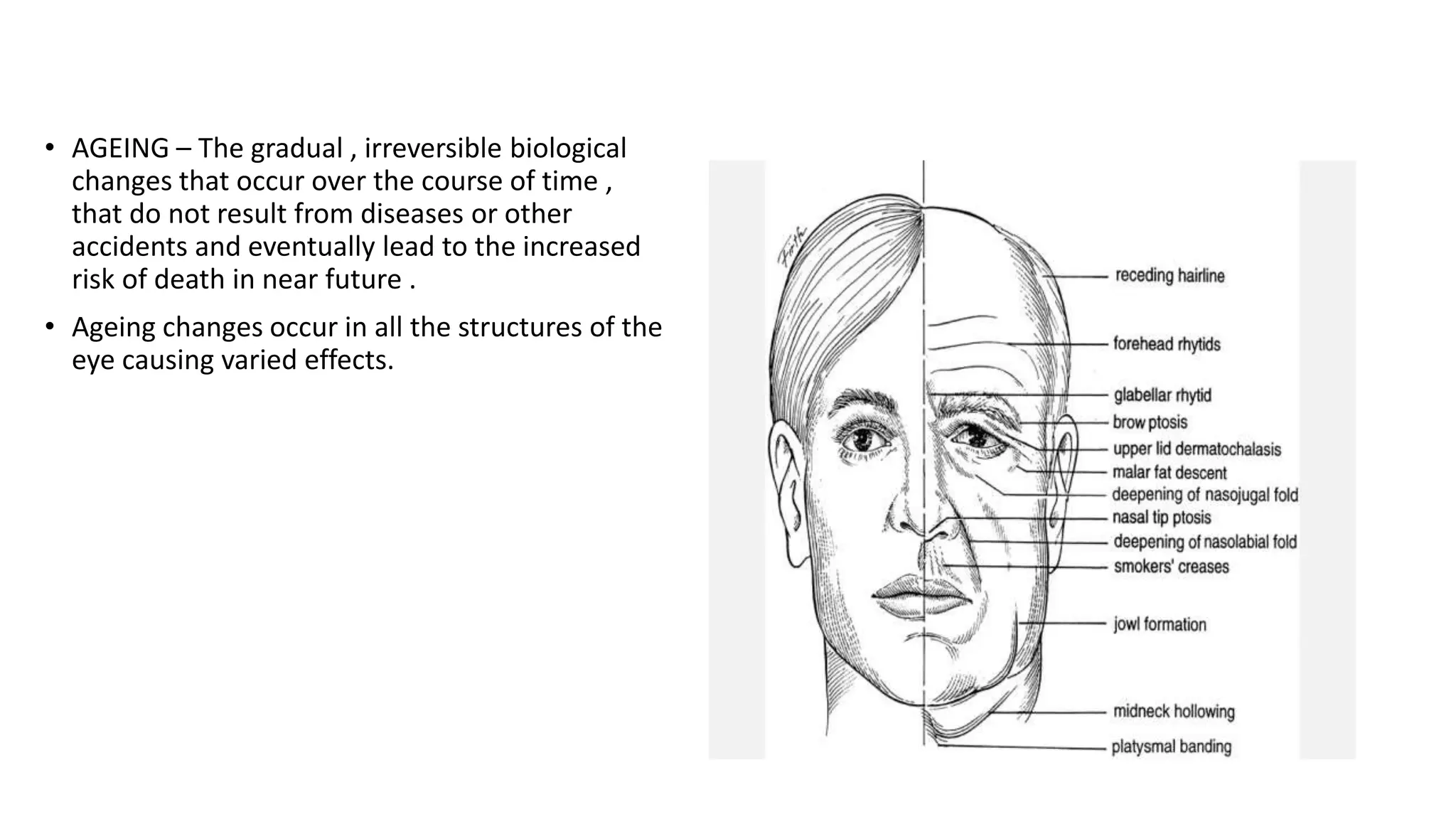
• AGEING – The gradual , irreversible biological
changes that occur over the course of time ,
that do not result from diseases or other
accidents and eventually lead to the increased
risk of death in near future .
• Ageing changes occur in all the structures of the
eye causing varied effects.
EYE LIDS -
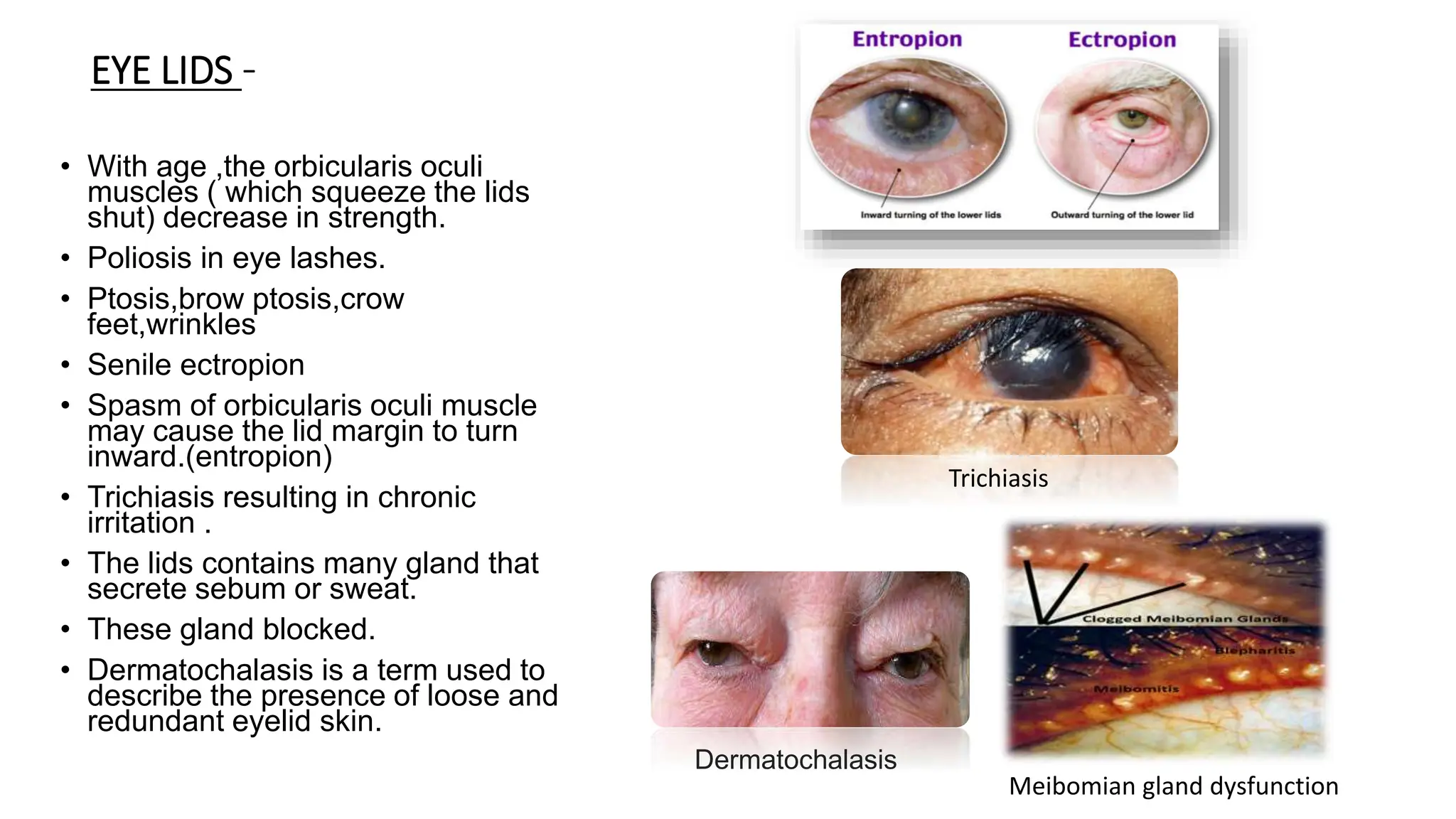
• With age ,the orbicularis oculi
muscles ( which squeeze the lids
shut) decrease in strength.
• Poliosis in eye lashes.
• Ptosis,brow ptosis,crow
feet,wrinkles
• Senile ectropion
• Spasm of orbicularis oculi muscle
may cause the lid margin to turn
inward.(entropion)
• Trichiasis resulting in chronic
irritation .
• The lids contains many gland that
secrete sebum or sweat.
• These gland blocked.
• Dermatochalasis is a term used to
describe the presence of loose and
redundant eyelid skin.
Trichiasis
Meibomian gland dysfunction
Dermatochalasis
LACRIMAL GLAND AND TEAR DRAINAGE -
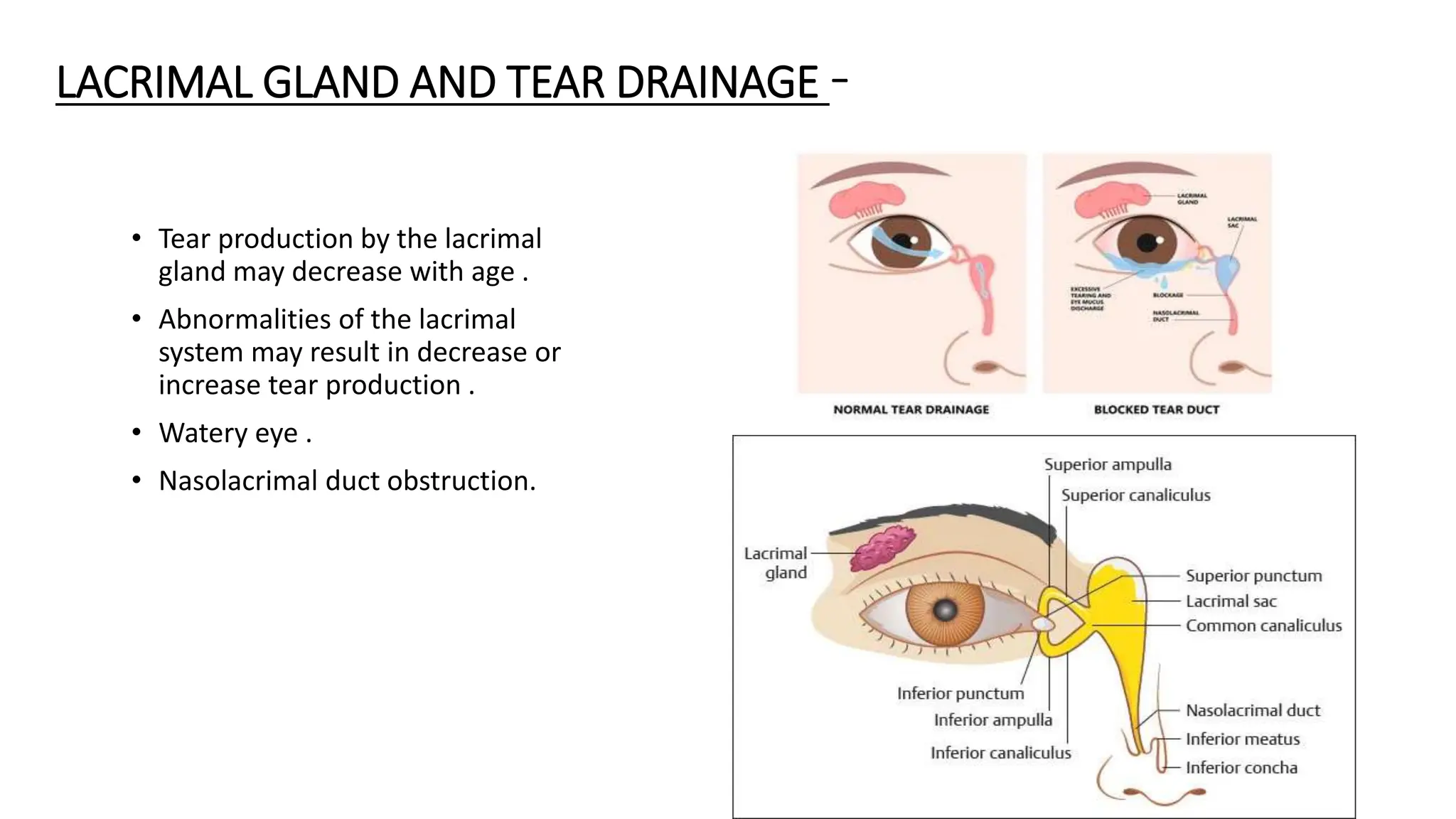
• Tear production by the lacrimal
gland may decrease with age .
• Abnormalities of the lacrimal
system may result in decrease or
increase tear production .
• Watery eye .
• Nasolacrimal duct obstruction.
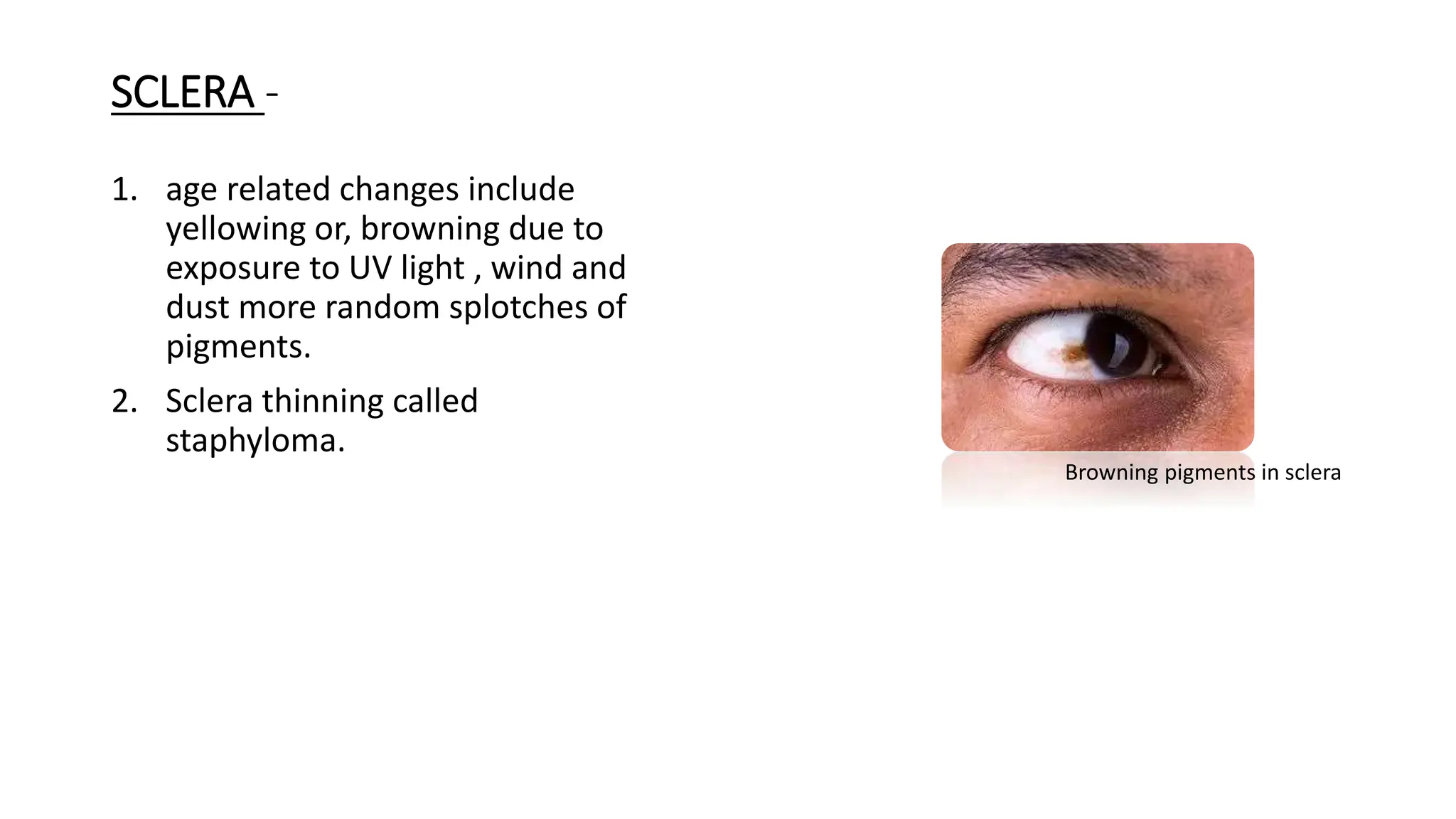
SCLERA -
1. age related changes include
yellowing or, browning due to
exposure to UV light , wind and
dust more random splotches of
pigments.
2. Sclera thinning called
staphyloma.
Browning pigments in sclera
CONJUNCTIVA -
• Pinguecula.
• Pterygium.
• Muddy conjunctiva.
• Decrease in mucus cells.
AQUEOUS HUMOR-
• Reduction in the production of
aqueous humor
• Increase in accumulation of
extracellular material in both the
trabecular meshwork and ciliary
muscles and a loss of trabecular
meshwork cells ,which contribute to
reduction in outflow and result in an
increase in intraocular pressure.
CORNEA-
• There is against rule astigmatism.
• Arcus senilis,crocodile shagreen .
• Corneal luster,corneal fragility.
• Corneal sensitivity decreases with age .
• Corneal guttate,pleomorphism, corneal
xerosis
• Age related changes like corneal
degeneration, corneal dystrophies .
Arcus senilis Corneal sensitivity decrease
Corneal degeneration( crocodile
shagreen )
Corneal degeneration( corneal guttata)
Map dot fingerprint dystrophy Epithelial basement membrane dystrophy
IRIS -
• The iris contains two set of
muscle that work together to
regulate pupillary size and
reaction to light .
• with age, these muscle
weaken, and the pupil
becomes smaller , reacts more
sluggishly to light , and dilate
more slowly in dark.
• They also experience difficulty
when going from a brightly
light environment to a darker
one (delay dark adaptation).
• Iris atrophy
• Hyper pigmentation also seen
in older age .
Iris atrophy
Hyperpigmented iris
CRYSTALLINE LENS -
• Lens thickness and surface curvature
are changed by the action of the ciliary
muscle and suspensory ligaments
(zonules).
• The lens continuously grows during life
and increase in density and weight .
• These changes decrease the elasticity
of the lens .
• Between the age of 40 and 50, the lens
usually becomes so in elastic that close
object can no longer be brought into
focus (presbyopia)without the
assistance of corrective lenses.
• Opacification of lens .i.e CATARACT.
• Cataract is an opacity(cloud formation )
of the eye lens , develop due to ageing.
• Subluxation of lens.
Cataract is an opacity(cloud formation ) of the eye lens ,
develop due to ageing.
Vision of normal eye vs cataract eye
VITREOUS HUMOR-
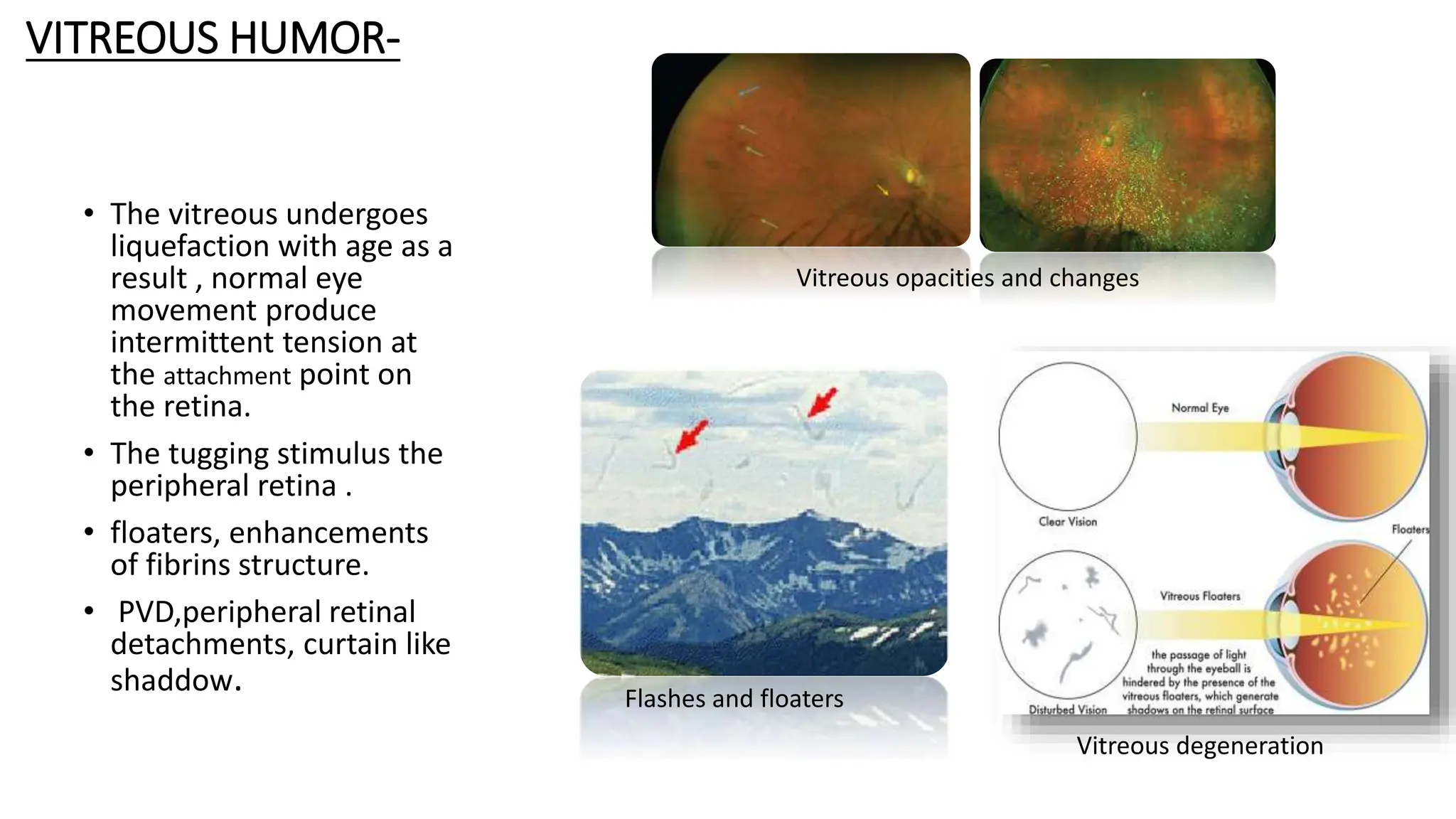
• The vitreous undergoes
liquefaction with age as a
result , normal eye
movement produce
intermittent tension at
the attachment point on
the retina.
• The tugging stimulus the
peripheral retina .
• floaters, enhancements
of fibrins structure.
• PVD,peripheral retinal
detachments, curtain like
shaddow.
Vitreous opacities and changes
Flashes and floaters
Vitreous degeneration
RETINA-
• The retina is difficult to examine in
elderly patients because of their small
pupils, increased random eye movement
and lens opacities .
• The retina ,which glistens in younger
persons ,becomes duller with age .
• The macula, which in younger persons
usually has a bright central foveal light
reflex . may show no foveal reflex in
elderly persons.
• Yellowish white spots (drusen) often
appear in the macular area .
• The retina layer may become disrupted
resulting in pigmentation and obscuring
the view of underlying blood vessels.
• Age Related Macular degeneration
Retinal pigment epitheliopathy
Normal retina
Drusen
AGE RELATED CHANGES IN OCULAR FUNCTION-
May be divided into two group
• Related to vision – like refractive changes , visual acuity, contrast sensitivity , glare, haziness, flashing light,
moving spot,colour vision and visual field .
• Related to eye comfort- foreign body sensation , headache ,dryness,watering and irritation.
AGE RELATED CHANGES IN EYE(Eyelids, Conjunctiva, cornea, iris, pupil, lens, retina).pptx

AGE RELATED CHANGES IN EYE(Eyelids, Conjunctiva, cornea, iris, pupil, lens, retina).pptx

  • 1.
    AGE RELATED CHANGESIN EYE PRESENTED BY MIFTAHUL ISLAM OPTOMETRIST
  • 2.
    • AGEING –The gradual , irreversible biological changes that occur over the course of time , that do not result from diseases or other accidents and eventually lead to the increased risk of death in near future . • Ageing changes occur in all the structures of the eye causing varied effects.
  • 3.
    EYE LIDS - •With age ,the orbicularis oculi muscles ( which squeeze the lids shut) decrease in strength. • Poliosis in eye lashes. • Ptosis,brow ptosis,crow feet,wrinkles • Senile ectropion • Spasm of orbicularis oculi muscle may cause the lid margin to turn inward.(entropion) • Trichiasis resulting in chronic irritation . • The lids contains many gland that secrete sebum or sweat. • These gland blocked. • Dermatochalasis is a term used to describe the presence of loose and redundant eyelid skin. Trichiasis Meibomian gland dysfunction Dermatochalasis
  • 4.
    LACRIMAL GLAND ANDTEAR DRAINAGE - • Tear production by the lacrimal gland may decrease with age . • Abnormalities of the lacrimal system may result in decrease or increase tear production . • Watery eye . • Nasolacrimal duct obstruction.
  • 5.
    SCLERA - 1. agerelated changes include yellowing or, browning due to exposure to UV light , wind and dust more random splotches of pigments. 2. Sclera thinning called staphyloma. Browning pigments in sclera
  • 6.
    CONJUNCTIVA - • Pinguecula. •Pterygium. • Muddy conjunctiva. • Decrease in mucus cells.
  • 7.
    AQUEOUS HUMOR- • Reductionin the production of aqueous humor • Increase in accumulation of extracellular material in both the trabecular meshwork and ciliary muscles and a loss of trabecular meshwork cells ,which contribute to reduction in outflow and result in an increase in intraocular pressure.
  • 8.
    CORNEA- • There isagainst rule astigmatism. • Arcus senilis,crocodile shagreen . • Corneal luster,corneal fragility. • Corneal sensitivity decreases with age . • Corneal guttate,pleomorphism, corneal xerosis • Age related changes like corneal degeneration, corneal dystrophies . Arcus senilis Corneal sensitivity decrease Corneal degeneration( crocodile shagreen ) Corneal degeneration( corneal guttata) Map dot fingerprint dystrophy Epithelial basement membrane dystrophy
  • 9.
    IRIS - • Theiris contains two set of muscle that work together to regulate pupillary size and reaction to light . • with age, these muscle weaken, and the pupil becomes smaller , reacts more sluggishly to light , and dilate more slowly in dark. • They also experience difficulty when going from a brightly light environment to a darker one (delay dark adaptation). • Iris atrophy • Hyper pigmentation also seen in older age . Iris atrophy Hyperpigmented iris
  • 10.
    CRYSTALLINE LENS - •Lens thickness and surface curvature are changed by the action of the ciliary muscle and suspensory ligaments (zonules). • The lens continuously grows during life and increase in density and weight . • These changes decrease the elasticity of the lens . • Between the age of 40 and 50, the lens usually becomes so in elastic that close object can no longer be brought into focus (presbyopia)without the assistance of corrective lenses. • Opacification of lens .i.e CATARACT. • Cataract is an opacity(cloud formation ) of the eye lens , develop due to ageing. • Subluxation of lens. Cataract is an opacity(cloud formation ) of the eye lens , develop due to ageing. Vision of normal eye vs cataract eye
  • 11.
    VITREOUS HUMOR- • Thevitreous undergoes liquefaction with age as a result , normal eye movement produce intermittent tension at the attachment point on the retina. • The tugging stimulus the peripheral retina . • floaters, enhancements of fibrins structure. • PVD,peripheral retinal detachments, curtain like shaddow. Vitreous opacities and changes Flashes and floaters Vitreous degeneration
  • 12.
    RETINA- • The retinais difficult to examine in elderly patients because of their small pupils, increased random eye movement and lens opacities . • The retina ,which glistens in younger persons ,becomes duller with age . • The macula, which in younger persons usually has a bright central foveal light reflex . may show no foveal reflex in elderly persons. • Yellowish white spots (drusen) often appear in the macular area . • The retina layer may become disrupted resulting in pigmentation and obscuring the view of underlying blood vessels. • Age Related Macular degeneration Retinal pigment epitheliopathy Normal retina Drusen
  • 13.
    AGE RELATED CHANGESIN OCULAR FUNCTION- May be divided into two group • Related to vision – like refractive changes , visual acuity, contrast sensitivity , glare, haziness, flashing light, moving spot,colour vision and visual field . • Related to eye comfort- foreign body sensation , headache ,dryness,watering and irritation.