Analyzing the Meaning
of the Qualitative Data
Data analysis will involve a process called
labeling and coding. The different types of
data analysis are: systematic analysis,
content analysis, narrative analysis, discourse
analysis, grounded theory and conversational
analysis. The process of coding and
categorizing is an essential part after doing
an interview, observation and others.
Codes serve as a direction to label, compile
and organize a researcher‘s data. It can also
allow a researcher to summarize and
synthesize what is happening in his/her data
The researchers need to analyze the data to
review the purpose of the study. This gives
the direction of finding a solution to a
problem which could be done in two ways.
These ways are
(1) describing a situation, incident or
occurrence; and
(2) recognizing the main themes that come
out from the field notes of your interviews,
citing in a word for word format.
The following steps to consider in analyzing
the themes are:
1. The following steps to consider in
analyzing the themes are:
2. Assign codes to the main themes.
3. Classify responses under the main themes.
4. Integrate themes and responses into the
text of your report.
Thematic analysis is a method of analyzing
qualitative data. It is usually applied to a set
of texts, such as an interview or transcripts.
The researcher closely examines the data to
identify common themes – topics, ideas and
patterns of meaning that come up
repeatedly.
When to use thematic analysis?
Thematic analysis is a good approach to
research where you’re trying to find out
something about people’s views, opinions,
knowledge, experiences or values from a set
of qualitative data – for example, interview
transcripts, social media profiles, or survey
responses.
Different approaches to thematic analysis
• An inductive approach involves allowing
the data to determine your themes.
• A deductive approach involves coming to
the data with some preconceived themes
you expect to find reflected there, based
on theory or existing knowledge.
Different approaches to thematic analysis
• A semantic approach involves analyzing
the explicit content of the data.
• A latent approach involves reading into the
subtext and assumptions underlying the
data.
There are various approaches to
conducting thematic analysis, but
the most common form follows a six-
step process:
Step 1: Familiarization
The first step is to get to know our data. It’s
important to get a thorough overview of all
the data we collected before we start
analyzing individual items. This might involve
transcribing audio, reading through the text
and taking initial notes, and generally looking
through the data to get familiar with it.
Step 2: Coding
Next up, we need to code the data. Coding
means highlighting sections of our text –
usually phrases or sentences – and coming
up with shorthand labels or “codes” to
describe their content.
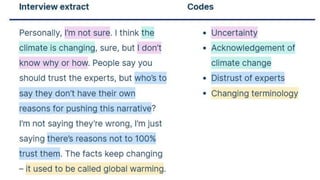
Let’s take a short example text. Say we’re
researching perceptions of climate change
among conservative voters aged 50 and up,
and we have collected data through a series
of interviews. An extract from one interview
looks like this:
`
At this stage, we want to be thorough: we go
through the transcript of every interview and
highlight everything that jumps out as
relevant or potentially interesting. As well as
highlighting all the phrases and sentences
that match these codes, we can keep adding
new codes as we go through the text.
Step 3: Generating themes
Next, we look over the codes we’ve created,
identify patterns among them, and start
coming up with themes. Themes are
generally broader than codes. Most of the
time, you’ll combine several codes into a
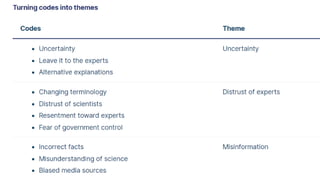
single theme. In our example, we might start
combining codes into themes like this:
At this stage, we might decide that some of
our codes are too vague or not relevant
enough (for example, because they don’t
appear very often in the data), so they can be
discarded.
Step 4: Reviewing themes
Now we have to make sure that our themes
are useful and accurate representations of
the data. Here, we return to the data set and
compare our themes against it.
If we encounter problems with our themes,
Step 4: Reviewing themes
If we encounter problems with our themes,
we might split them up, combine them,
discard them or create new ones: whatever
makes them more useful and accurate.
If we encounter problems with our themes,
we might split them up, combine them,
discard them or create new ones: whatever
makes them more useful and accurate.
Step 5: Defining and naming themes
Now that you have a final list of themes, it’s
time to name and define each of them.b
Defining themes involves formulating exactly
what we mean by each theme and figuring
out how it helps us understand the data.
Step 5: Defining and naming themes
Now that you have a final list of themes, it’s
time to name and define each of them.b
Defining themes involves formulating exactly
what we mean by each theme and figuring
out how it helps us understand the data.
Step 6: Writing up
Finally, we’ll write up our analysis of the data.
Like all academic texts, writing up a thematic
analysis requires an introduction to establish
our research question, aims and approach.
We should also include a methodology
section, describing how we collected the
data (e.g. through semi-structured interviews
or open-ended survey questions) and
explaining how we conducted the thematic
analysis itself.
The results or findings section usually
addresses each theme in turn. We describe
how often the themes come up and what
they mean, including examples from the data
as evidence. Finally, our conclusion explains
the main takeaways and shows how the
analysis has answered our research question.
Analyzing Qualitative Data PR1

Analyzing Qualitative Data PR1

  • 1.
    Analyzing the Meaning ofthe Qualitative Data
  • 2.
    Data analysis willinvolve a process called labeling and coding. The different types of data analysis are: systematic analysis, content analysis, narrative analysis, discourse analysis, grounded theory and conversational analysis. The process of coding and categorizing is an essential part after doing an interview, observation and others.
  • 3.
    Codes serve asa direction to label, compile and organize a researcher‘s data. It can also allow a researcher to summarize and synthesize what is happening in his/her data
  • 4.
    The researchers needto analyze the data to review the purpose of the study. This gives the direction of finding a solution to a problem which could be done in two ways. These ways are (1) describing a situation, incident or occurrence; and
  • 5.
    (2) recognizing themain themes that come out from the field notes of your interviews, citing in a word for word format.
  • 6.
    The following stepsto consider in analyzing the themes are: 1. The following steps to consider in analyzing the themes are: 2. Assign codes to the main themes. 3. Classify responses under the main themes. 4. Integrate themes and responses into the text of your report.
  • 7.
    Thematic analysis isa method of analyzing qualitative data. It is usually applied to a set of texts, such as an interview or transcripts. The researcher closely examines the data to identify common themes – topics, ideas and patterns of meaning that come up repeatedly.
  • 8.
    When to usethematic analysis? Thematic analysis is a good approach to research where you’re trying to find out something about people’s views, opinions, knowledge, experiences or values from a set of qualitative data – for example, interview transcripts, social media profiles, or survey responses.
  • 9.
    Different approaches tothematic analysis • An inductive approach involves allowing the data to determine your themes. • A deductive approach involves coming to the data with some preconceived themes you expect to find reflected there, based on theory or existing knowledge.
  • 10.
    Different approaches tothematic analysis • A semantic approach involves analyzing the explicit content of the data. • A latent approach involves reading into the subtext and assumptions underlying the data.
  • 11.
    There are variousapproaches to conducting thematic analysis, but the most common form follows a six- step process:
  • 12.
    Step 1: Familiarization Thefirst step is to get to know our data. It’s important to get a thorough overview of all the data we collected before we start analyzing individual items. This might involve transcribing audio, reading through the text and taking initial notes, and generally looking through the data to get familiar with it.
  • 13.
    Step 2: Coding Nextup, we need to code the data. Coding means highlighting sections of our text – usually phrases or sentences – and coming up with shorthand labels or “codes” to describe their content.
  • 14.
    Let’s take ashort example text. Say we’re researching perceptions of climate change among conservative voters aged 50 and up, and we have collected data through a series of interviews. An extract from one interview looks like this:
  • 15.
  • 16.
    At this stage,we want to be thorough: we go through the transcript of every interview and highlight everything that jumps out as relevant or potentially interesting. As well as highlighting all the phrases and sentences that match these codes, we can keep adding new codes as we go through the text.
  • 17.
    Step 3: Generatingthemes Next, we look over the codes we’ve created, identify patterns among them, and start coming up with themes. Themes are generally broader than codes. Most of the time, you’ll combine several codes into a single theme. In our example, we might start combining codes into themes like this:
  • 19.
    At this stage,we might decide that some of our codes are too vague or not relevant enough (for example, because they don’t appear very often in the data), so they can be discarded.
  • 20.
    Step 4: Reviewingthemes Now we have to make sure that our themes are useful and accurate representations of the data. Here, we return to the data set and compare our themes against it. If we encounter problems with our themes,
  • 21.
    Step 4: Reviewingthemes If we encounter problems with our themes, we might split them up, combine them, discard them or create new ones: whatever makes them more useful and accurate.
  • 22.
    If we encounterproblems with our themes, we might split them up, combine them, discard them or create new ones: whatever makes them more useful and accurate.
  • 23.
    Step 5: Definingand naming themes Now that you have a final list of themes, it’s time to name and define each of them.b Defining themes involves formulating exactly what we mean by each theme and figuring out how it helps us understand the data.
  • 24.
    Step 5: Definingand naming themes Now that you have a final list of themes, it’s time to name and define each of them.b Defining themes involves formulating exactly what we mean by each theme and figuring out how it helps us understand the data.
  • 25.
    Step 6: Writingup Finally, we’ll write up our analysis of the data. Like all academic texts, writing up a thematic analysis requires an introduction to establish our research question, aims and approach.
  • 26.
    We should alsoinclude a methodology section, describing how we collected the data (e.g. through semi-structured interviews or open-ended survey questions) and explaining how we conducted the thematic analysis itself.
  • 27.
    The results orfindings section usually addresses each theme in turn. We describe how often the themes come up and what they mean, including examples from the data as evidence. Finally, our conclusion explains the main takeaways and shows how the analysis has answered our research question.

Editor's Notes

  • #2 https://www.scribbr.com/methodology/thematic-analysis/#:~:text=Thematic%20analysis%20is%20a%20method,meaning%20that%20come%20up%20repeatedly.
  • #3 https://www.scribbr.com/methodology/thematic-analysis/#:~:text=Thematic%20analysis%20is%20a%20method,meaning%20that%20come%20up%20repeatedly.
  • #7 1. Identify the main themes. In each question, carefully study the descriptive responses of your respondents to understand the meaning they convey. Since the participants express themselves in various words and languages, choose the wording of the themes in such a way that the implication of the responses classified under a theme is precisely signified. The basis for assessing the wording of unstructured interviews therefore tends to be these themes. 2. Assign codes to the main themes. The researcher should assign codes (numbers or keywords) to the main themes obtained from the frequency of occurrence through a random selection of few responses to an open-ended question or from your observational or discussion notes. 3. Classify responses under the main themes. The identified themes classify the responses found in your transcripts of all your interviews or your notes. 4. Integrate themes and responses into the text of your report. Put together the identified different themes into the text of your report. Your choice depends on the way you want to communicate the findings to your readers. Although some people have done it either by using verbatim or word-for-word responses or by getting the frequency of the theme and a present sample of the responses.
  • #13 Berlin Sans FB
  • #14 Berlin Sans FB
  • #15 Berlin Sans FB
  • #16 Berlin Sans FB
  • #17 Berlin Sans FB
  • #18 Berlin Sans FB
  • #19 Berlin Sans FB
  • #20 Other codes might become themes in their own right. In our example, we decided that the code “uncertainty” made sense as a theme, with some other codes incorporated into it.
  • #21  Are we missing anything? Are these themes really present in the data? What can we change to make our themes work better?
  • #22  Are we missing anything? Are these themes really present in the data? What can we change to make our themes work better?
  • #23  Are we missing anything? Are these themes really present in the data? What can we change to make our themes work better?
  • #24  Naming themes involves coming up with a succinct and easily understandable name for each theme. For example, we might look at “distrust of experts” and determine exactly who we mean by “experts” in this theme. We might decide that a better name for the theme is “distrust of authority” or “conspiracy thinking”.
  • #25  Naming themes involves coming up with a succinct and easily understandable name for each theme. For example, we might look at “distrust of experts” and determine exactly who we mean by “experts” in this theme. We might decide that a better name for the theme is “distrust of authority” or “conspiracy thinking”.
  • #26 We should also include a methodology section, describing how we collected the data (e.g. through semi-structured interviews or open-ended survey questions) and explaining how we conducted the thematic analysis itself.
  • #27 We should also include a methodology section, describing how we collected the data (e.g. through semi-structured interviews or open-ended survey questions) and explaining how we conducted the thematic analysis itself.
  • #28 We should also include a methodology section, describing how we collected the data (e.g. through semi-structured interviews or open-ended survey questions) and explaining how we conducted the thematic analysis itself.
  • #29 We should also include a methodology section, describing how we collected the data (e.g. through semi-structured interviews or open-ended survey questions) and explaining how we conducted the thematic analysis itself.