6.53
INQUIRY VS.
RESEARCH
MODULE 1
LESSON 1
COMPETENCY
1.Explain the meaning
of research in relation
to inquiry; and
2.Point out the
similarities and
differences of
research and inquiry.
10
VOCABULARY
IMPROVEMENT
7/1/20XX 11
12
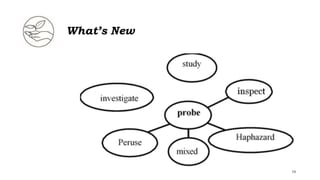
PROBE
G
I
V
E
T
H
E
S
Y
N
O
N
Y
M
S
13
NATURE OF INQUIRY AND RESEARCH
7/1/20XX 14
Inquiry is a term
that is synonymous
with the word
investigation.
NATURE OF INQUIRY AND RESEARCH
15
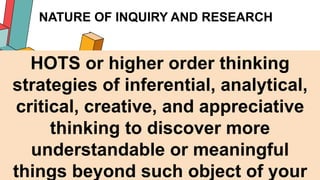
HOTS or higher order thinking
strategies of inferential, analytical,
critical, creative, and appreciative
thinking to discover more
understandable or meaningful
things beyond such object of your
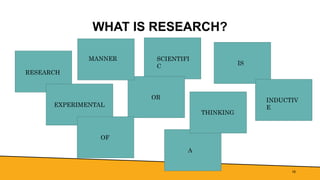
WHAT IS RESEARCH?
16
RESEARCH
IS
A
SCIENTIFI
C
EXPERIMENTAL
OR INDUCTIV
E
MANNER
OF
THINKING
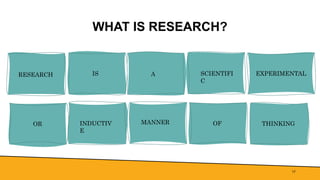
WHAT IS RESEARCH?
17
RESEARCH IS A SCIENTIFI
C
EXPERIMENTAL
OR INDUCTIV
E
MANNER OF THINKING
18
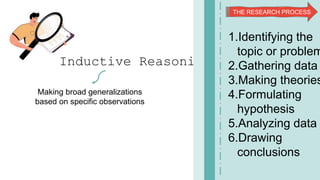
Inductive Reasoning
Making broad generalizations
based on specific observations
1.Identifying the
topic or problem
2.Gathering data
3.Making theories
4.Formulating
hypothesis
5.Analyzing data
6.Drawing
conclusions
THE RESEARCH PROCESS
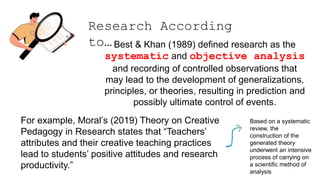
Research According
to…Best & Khan (1989) defined research as the
systematic and objective analysis
and recording of controlled observations that
may lead to the development of generalizations,
principles, or theories, resulting in prediction and
possibly ultimate control of events.
For example, Moral’s (2019) Theory on Creative
Pedagogy in Research states that “Teachers’
attributes and their creative teaching practices
lead to students’ positive attitudes and research
productivity.”
Based on a systematic
review, the
construction of the
generated theory
underwent an intensive
process of carrying on
a scientific method of
analysis
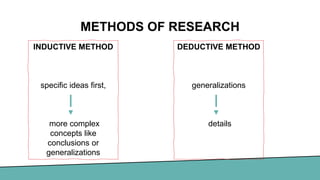
METHODS OF RESEARCH
INDUCTIVE METHOD
specific ideas first,
more complex
concepts like
conclusions or
generalizations
DEDUCTIVE METHOD
generalizations
details
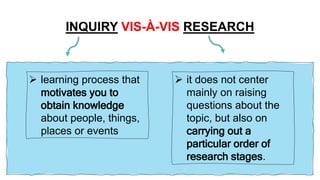
INQUIRY VIS-À-VIS RESEARCH
 learning process that
motivates you to
obtain knowledge
about people, things,
places or events
 it does not center
mainly on raising
questions about the
topic, but also on
carrying out a
particular order of
research stages.
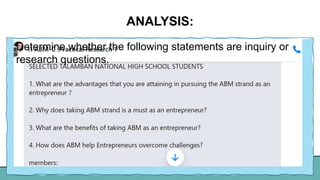
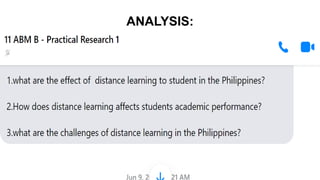
ANALYSIS:
Determine whether the following statements are inquiry or
research questions.
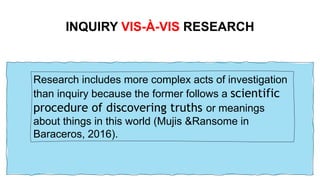
INQUIRY VIS-À-VIS RESEARCH
Research includes more complex acts of investigation
than inquiry because the former follows a scientific
procedure of discovering truths or meanings
about things in this world (Mujis &Ransome in
Baraceros, 2016).
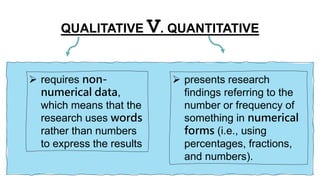
QUALITATIVE V. QUANTITATIVE
 requires non-
numerical data,
which means that the
research uses words
rather than numbers
to express the results
 presents research
findings referring to the
number or frequency of
something in numerical
forms (i.e., using
percentages, fractions,
and numbers).
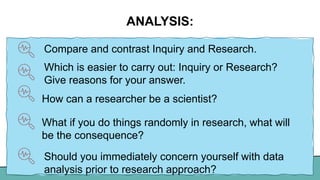
ANALYSIS:
Compare and contrast Inquiry and Research.
Which is easier to carry out: Inquiry or Research?
Give reasons for your answer.
How can a researcher be a scientist?
What if you do things randomly in research, what will
be the consequence?
Should you immediately concern yourself with data
analysis prior to research approach?
ANALYSIS:
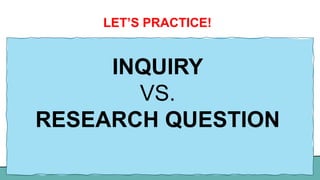
INQUIRY
VS.
RESEARCH QUESTION
LET’S PRACTICE!
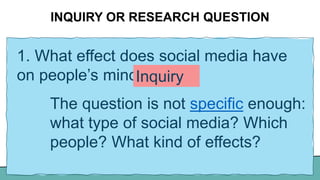
INQUIRY OR RESEARCH QUESTION
1. What effect does social media have
on people’s minds?
The question is not specific enough:
what type of social media? Which
people? What kind of effects?
Inquiry
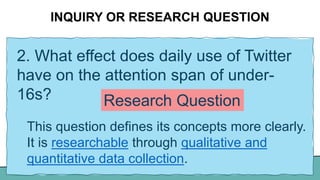
INQUIRY OR RESEARCH QUESTION
2. What effect does daily use of Twitter
have on the attention span of under-
16s?
This question defines its concepts more clearly.
It is researchable through qualitative and
quantitative data collection.
Research Question
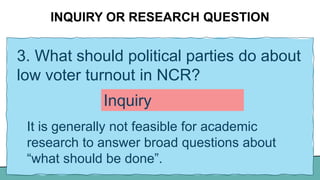
INQUIRY OR RESEARCH QUESTION
3. What should political parties do about
low voter turnout in NCR?
It is generally not feasible for academic
research to answer broad questions about
“what should be done”.
Inquiry
INQUIRY OR RESEARCH QUESTION
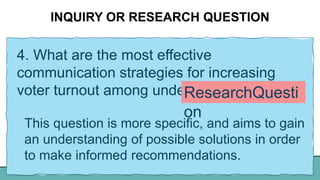
4. What are the most effective
communication strategies for increasing
voter turnout among under-30s in region X?
This question is more specific, and aims to gain
an understanding of possible solutions in order
to make informed recommendations.
ResearchQuesti
on
HOMEWORK
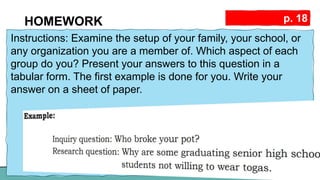
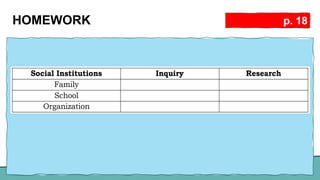
Instructions: Examine the setup of your family, your school, or
any organization you are a member of. Which aspect of each
group do you? Present your answers to this question in a
tabular form. The first example is done for you. Write your
answer on a sheet of paper.
p. 18
HOMEWORK p. 18
THANK YOU
Jessa Jean F. Velmonte
jessajean.velmonte@deped.gov.ph

Inquiry Vs. Research

  • 1.
  • 2.
    COMPETENCY 1.Explain the meaning ofresearch in relation to inquiry; and 2.Point out the similarities and differences of research and inquiry. 10
  • 3.
  • 4.
  • 5.
  • 6.
    NATURE OF INQUIRYAND RESEARCH 7/1/20XX 14 Inquiry is a term that is synonymous with the word investigation.
  • 7.
    NATURE OF INQUIRYAND RESEARCH 15 HOTS or higher order thinking strategies of inferential, analytical, critical, creative, and appreciative thinking to discover more understandable or meaningful things beyond such object of your
  • 8.
  • 9.
    WHAT IS RESEARCH? 17 RESEARCHIS A SCIENTIFI C EXPERIMENTAL OR INDUCTIV E MANNER OF THINKING
  • 10.
    18 Inductive Reasoning Making broadgeneralizations based on specific observations 1.Identifying the topic or problem 2.Gathering data 3.Making theories 4.Formulating hypothesis 5.Analyzing data 6.Drawing conclusions THE RESEARCH PROCESS
  • 11.
    Research According to…Best &Khan (1989) defined research as the systematic and objective analysis and recording of controlled observations that may lead to the development of generalizations, principles, or theories, resulting in prediction and possibly ultimate control of events. For example, Moral’s (2019) Theory on Creative Pedagogy in Research states that “Teachers’ attributes and their creative teaching practices lead to students’ positive attitudes and research productivity.” Based on a systematic review, the construction of the generated theory underwent an intensive process of carrying on a scientific method of analysis
  • 12.
    METHODS OF RESEARCH INDUCTIVEMETHOD specific ideas first, more complex concepts like conclusions or generalizations DEDUCTIVE METHOD generalizations details
  • 13.
    INQUIRY VIS-À-VIS RESEARCH learning process that motivates you to obtain knowledge about people, things, places or events  it does not center mainly on raising questions about the topic, but also on carrying out a particular order of research stages.
  • 14.
    ANALYSIS: Determine whether thefollowing statements are inquiry or research questions.
  • 15.
    INQUIRY VIS-À-VIS RESEARCH Researchincludes more complex acts of investigation than inquiry because the former follows a scientific procedure of discovering truths or meanings about things in this world (Mujis &Ransome in Baraceros, 2016).
  • 16.
    QUALITATIVE V. QUANTITATIVE requires non- numerical data, which means that the research uses words rather than numbers to express the results  presents research findings referring to the number or frequency of something in numerical forms (i.e., using percentages, fractions, and numbers).
  • 17.
    ANALYSIS: Compare and contrastInquiry and Research. Which is easier to carry out: Inquiry or Research? Give reasons for your answer. How can a researcher be a scientist? What if you do things randomly in research, what will be the consequence? Should you immediately concern yourself with data analysis prior to research approach?
  • 18.
  • 19.
  • 20.
    INQUIRY OR RESEARCHQUESTION 1. What effect does social media have on people’s minds? The question is not specific enough: what type of social media? Which people? What kind of effects? Inquiry
  • 21.
    INQUIRY OR RESEARCHQUESTION 2. What effect does daily use of Twitter have on the attention span of under- 16s? This question defines its concepts more clearly. It is researchable through qualitative and quantitative data collection. Research Question
  • 22.
    INQUIRY OR RESEARCHQUESTION 3. What should political parties do about low voter turnout in NCR? It is generally not feasible for academic research to answer broad questions about “what should be done”. Inquiry
  • 23.
    INQUIRY OR RESEARCHQUESTION 4. What are the most effective communication strategies for increasing voter turnout among under-30s in region X? This question is more specific, and aims to gain an understanding of possible solutions in order to make informed recommendations. ResearchQuesti on
  • 24.
    HOMEWORK Instructions: Examine thesetup of your family, your school, or any organization you are a member of. Which aspect of each group do you? Present your answers to this question in a tabular form. The first example is done for you. Write your answer on a sheet of paper. p. 18
  • 25.
  • 26.
    THANK YOU Jessa JeanF. Velmonte jessajean.velmonte@deped.gov.ph

Editor's Notes

  • #26 Inquiry and Research both require to answer questions or problems. However, research is more complicated than research because research follows a systematic procedure/process. In contrast, inquire does not require rigorous steps to arrive a conclusion of a problem. Inquiry is easier to carry out because it does not require a process in contrast to research. A researcher is also a scientist because research is experimental. Appropriate way of gathering the data, and analyzing the data is needed in research. The qualities of being a scientist are possessed by the researcher as well such as intellectual curiosity, intellectual honesty, prudence or creativity. If we do things randomly in research , the result cannot be trusted. (answer vary)