ANAESTHESIA…
INTRO..
• Anaesthesia enables the painless performance
of medical procedures that would not cause
severe or intolerable pain to an anaesthetized
patient.
• Three broad categories of anaesthesia exist:
1.General anesthesia
2.Sedation
3.Conduction anesthesia
CONTD.,
• General anaesthesia suppresses central nervous
system activity
• Sedation (or dissociative anaesthesia) a state of
calm or sleep produced by a sedative drug.
• Conduction anaesthesia, commonly known as
regional or local anaesthesia, blocks
transmission of nerve impulses to a targeted
organ
CONSIDERATIONS…
• Anesthetic Concentration Control
• Build Up Of Carbon Dioxide
• Consumption Of Oxygen
• Atmospheric Pollution
• Airway Control
InhaledAnestheticDeliverySystems
• Anesthesia Machine
• Vaporizers
• Anesthetic Breathing Circuit
• Ventilator
• Scavenging System
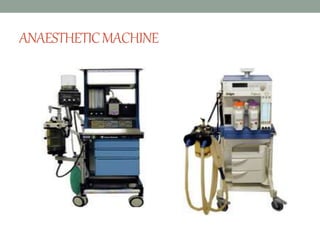
ANAESTHETICMACHINE
ANAESTHETICMACHINE
The anaesthetic machine is not a machine that
makes anaesthetics, but a complex collection of
equipment.
Continuous-flow Machine
Anaesthetic Vaporizers
Oxygen Mask
Suction Catheter
Syringe
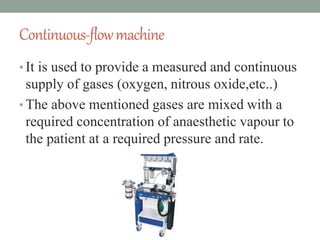
Continuous-flowmachine
• It is used to provide a measured and continuous
supply of gases (oxygen, nitrous oxide,etc..)
• The above mentioned gases are mixed with a
required concentration of anaesthetic vapour to
the patient at a required pressure and rate.
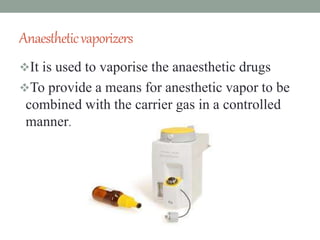
Anaestheticvaporizers
It is used to vaporise the anaesthetic drugs
To provide a means for anesthetic vapor to be
combined with the carrier gas in a controlled
manner.
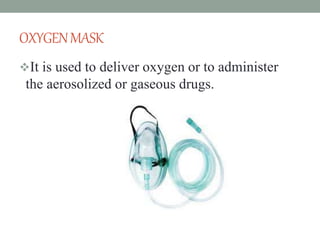
OXYGENMASK
It is used to deliver oxygen or to administer
the aerosolized or gaseous drugs.
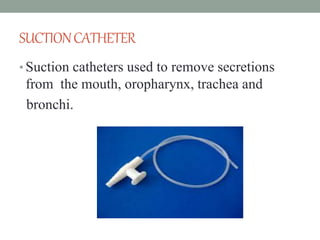
SUCTIONCATHETER
• Suction catheters used to remove secretions
from the mouth, oropharynx, trachea and
bronchi.
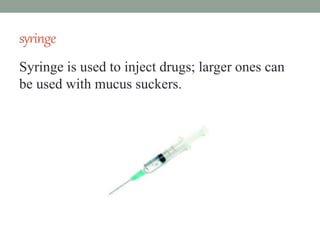
syringe
Syringe is used to inject drugs; larger ones can
be used with mucus suckers.
ANAESTHESIAMACHINE
• It has three major components:
1.A gas mixing and delivery system.
2. An anaesthetic breathing system ( circuit) and
a ventilator.
3.An array of monitors.
CONTD.,
The gas mixing and delivery system:
• The anaesthetic machine is connected to a
supply of purified gases.
• These gases usually include oxygen and nitrous
oxide, and many machines also have a supply
of compressed air.
• To this gas mixture, the anaesthetist can add
one of a range of additional, more powerful
anaesthetic agents, known as inhalational
agents.
CONTD.,
The anaesthetic breathing system (circuit) and
ventilator
• The anaesthetist determines the flow rate of the
final mixture of gases supplied to the breathing
system.
• The ventilator is an automatic breathing device,
which takes over the rhythmic inflating and
deflating of the patient’s lungs in a programmed
manner.
MONITORS
• Capnometer
• Oxygen Analyzer
• Pressure Monitor With Alarms For High And
Low Airway Pressure
• Pulse Oximeter
• Respiratory Volume Monitor (i.e., Spirometer)
BREATHINGSYSTEM
Calibrate the O2 Monitor
• Ensure the monitor reads 21% in room air.
• Verify that the low O2 alarm is enabled and
functioning.
SCAVENGINGSYSTEMS
• The collection and the subsequent removal of
vented gases from the operating room
• Components
(1) the gas-collecting assembly
(2) the transfer means
(3) the scavenging interface
(4) the gas-disposal assembly tubing
(5) an active or passive gas-disposal assembly
CONCLUSION
 They should also be checked in between cases,
ensuring that the breathing apparatus and
breathing circuit are fully patent, for the safe
anesthesia of patients.
Major manufacturers of anesthetic machines
are General Electric (GE), Larsen & Toubro
Limited, Draeger and MAQUET.
Anaesthesia suba

Anaesthesia suba

  • 1.
  • 2.
    INTRO.. • Anaesthesia enablesthe painless performance of medical procedures that would not cause severe or intolerable pain to an anaesthetized patient. • Three broad categories of anaesthesia exist: 1.General anesthesia 2.Sedation 3.Conduction anesthesia
  • 3.
    CONTD., • General anaesthesiasuppresses central nervous system activity • Sedation (or dissociative anaesthesia) a state of calm or sleep produced by a sedative drug. • Conduction anaesthesia, commonly known as regional or local anaesthesia, blocks transmission of nerve impulses to a targeted organ
  • 4.
    CONSIDERATIONS… • Anesthetic ConcentrationControl • Build Up Of Carbon Dioxide • Consumption Of Oxygen • Atmospheric Pollution • Airway Control
  • 5.
    InhaledAnestheticDeliverySystems • Anesthesia Machine •Vaporizers • Anesthetic Breathing Circuit • Ventilator • Scavenging System
  • 6.
  • 7.
    ANAESTHETICMACHINE The anaesthetic machineis not a machine that makes anaesthetics, but a complex collection of equipment. Continuous-flow Machine Anaesthetic Vaporizers Oxygen Mask Suction Catheter Syringe
  • 8.
    Continuous-flowmachine • It isused to provide a measured and continuous supply of gases (oxygen, nitrous oxide,etc..) • The above mentioned gases are mixed with a required concentration of anaesthetic vapour to the patient at a required pressure and rate.
  • 9.
    Anaestheticvaporizers It is usedto vaporise the anaesthetic drugs To provide a means for anesthetic vapor to be combined with the carrier gas in a controlled manner.
  • 10.
    OXYGENMASK It is usedto deliver oxygen or to administer the aerosolized or gaseous drugs.
  • 11.
    SUCTIONCATHETER • Suction cathetersused to remove secretions from the mouth, oropharynx, trachea and bronchi.
  • 12.
    syringe Syringe is usedto inject drugs; larger ones can be used with mucus suckers.
  • 13.
    ANAESTHESIAMACHINE • It hasthree major components: 1.A gas mixing and delivery system. 2. An anaesthetic breathing system ( circuit) and a ventilator. 3.An array of monitors.
  • 14.
    CONTD., The gas mixingand delivery system: • The anaesthetic machine is connected to a supply of purified gases. • These gases usually include oxygen and nitrous oxide, and many machines also have a supply of compressed air. • To this gas mixture, the anaesthetist can add one of a range of additional, more powerful anaesthetic agents, known as inhalational agents.
  • 15.
    CONTD., The anaesthetic breathingsystem (circuit) and ventilator • The anaesthetist determines the flow rate of the final mixture of gases supplied to the breathing system. • The ventilator is an automatic breathing device, which takes over the rhythmic inflating and deflating of the patient’s lungs in a programmed manner.
  • 16.
    MONITORS • Capnometer • OxygenAnalyzer • Pressure Monitor With Alarms For High And Low Airway Pressure • Pulse Oximeter • Respiratory Volume Monitor (i.e., Spirometer)
  • 17.
    BREATHINGSYSTEM Calibrate the O2Monitor • Ensure the monitor reads 21% in room air. • Verify that the low O2 alarm is enabled and functioning.
  • 18.
    SCAVENGINGSYSTEMS • The collectionand the subsequent removal of vented gases from the operating room • Components (1) the gas-collecting assembly (2) the transfer means (3) the scavenging interface (4) the gas-disposal assembly tubing (5) an active or passive gas-disposal assembly
  • 19.
    CONCLUSION  They shouldalso be checked in between cases, ensuring that the breathing apparatus and breathing circuit are fully patent, for the safe anesthesia of patients. Major manufacturers of anesthetic machines are General Electric (GE), Larsen & Toubro Limited, Draeger and MAQUET.