Oxygen Therapy and NIV
1
Oxygen is a drug and it doesn’t have
any substitute.
When appropriately used, it is
extremely
beneficial When misused or abused,
it is potentially harmful
2
O2 Therapy :CLINICALOBJECTIVES
Correct hypoxemia
Minimise symptoms of hypoxemia
Minimise cardiovascular effects of
hypoxemia
3
Hypoxemia
SPO2 < 90% or
PaO2 < 60 mm Hg on room air
4
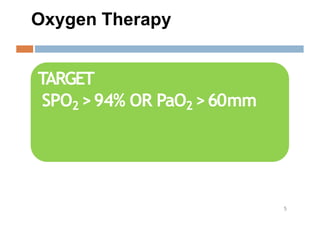
Oxygen Therapy
TARGET
SPO2 >94% OR PaO2 >60mm
5
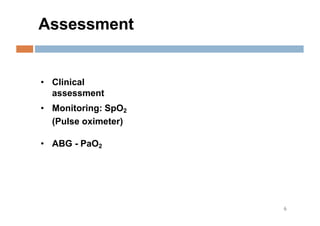
Assessment
• Clinical
assessment
• Monitoring: SpO2
(Pulse oximeter)
• ABG - PaO2
6
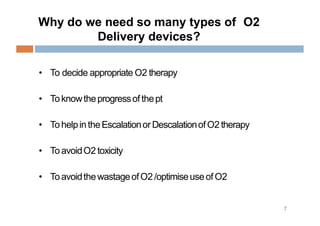
Why do we need so many types of O2
Delivery devices?
7
• To decide appropriate O2 therapy
• Toknowtheprogressofthept
• TohelpintheEscalationorDescalationofO2 therapy
• ToavoidO2 toxicity
• ToavoidthewastageofO2/optimiseuseofO2
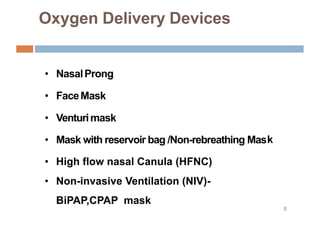
Oxygen Delivery Devices
• NasalProng
• FaceMask
k
• High flow nasal Canula (HFNC)
• Non-invasive Ventilation (NIV)-
BiPAP,CPAP mask
8
• Venturimask
• Mask with reservoir bag /Non-rebreathing Mas
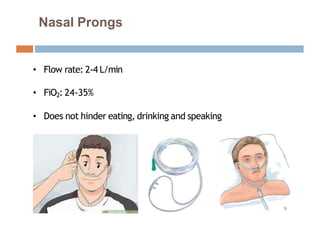
Nasal Prongs
• Flow rate: 2-4 L/min
• FiO2: 24-35%
• Does not hinder eating, drinking and speaking
9
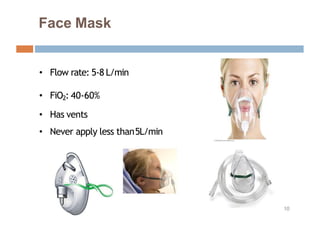
Face Mask
• Flow rate: 5-8 L/min
• FiO2: 40-60%
• Has vents
• Never apply less than5L/min
10
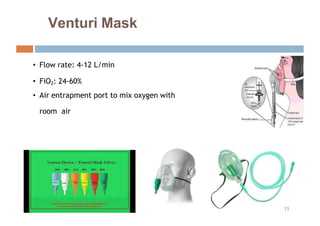
• Flow rate: 4-12 L/min
• FiO2: 24-60%
• Air entrapment port to mix oxygen with
room air
Venturi Mask
11
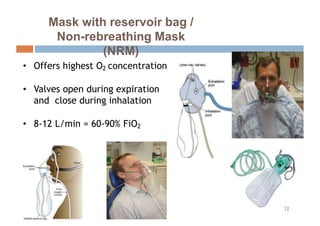
• Offers highest O2 concentration
• Valves open during expiration
and close during inhalation
• 8-12 L/min = 60-90% FiO2
Mask with reservoir bag /
Non-rebreathing Mask
(NRM)
12
Non Invasive Ventilation in Children
HighFlowNasal Cannula(HFNC)
Outline
• Introduction
• Indication
• Setting (starting, monitoring andweaning)
• Troubleshooting
• Device Operation Steps
Introductio
n
• High flow:
⎯10-60 L/min
⎯Heated (34-370 C)
⎯ Humidified gas (Air+O2)
• Nasal cannula:
⎯ Nasal prongs (postero-superior
direction)
Indication
• Hypoxemic respiratory failure (Type IRF)
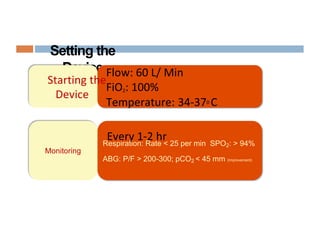
Setting the
Device
Monitoring
Flow: 60 L/ Min
Starting the
FiO2: 100%
Device
Temperature: 34-370 C
Every 1-2 hr
Respiration: Rate < 25 per min SPO2: > 94%
ABG: P/F > 200-300; pCO2 < 45 mm (Improvement)
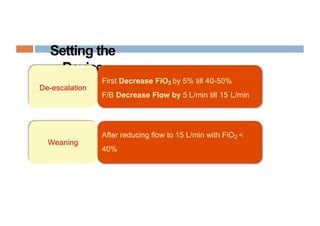
Setting the
Device
De-escalation
First Decrease FiO2 by 5% till 40-50%
F/B Decrease Flow by 5 L/min till 15 L/min
Weaning
After reducing flow to 15 L/min with FiO2 <
40%
Common
Troubleshoots
• Wrong insertion of nasalcannula
• Patient Discomfort:
• Counsel thepatient
• Apply only few minutes afterstarting
• Check flow, temperature,FiO2
• Low oxygenalarm:
• Check connection; flowmeter
• Circuit block/kink
• Condensate incircuit
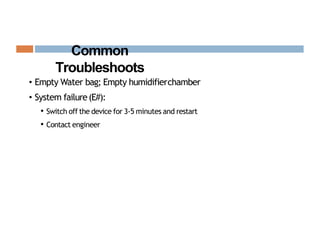
Common
Troubleshoots
• Empty Water bag; Empty humidifierchamber
• System failure(E#):
• Switch off the device for 3-5 minutes and restart
• Contact engineer
DeviceSetup
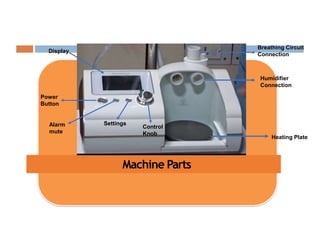
Machine Parts
Heating Plate
Humidifier
Connection
Breathing Circuit
Connection
Display
Power
Button
Alarm
mute
Settings
Control
Knob
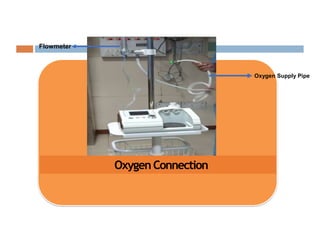
Oxygen Connection
Oxygen Supply Pipe
Flowmeter
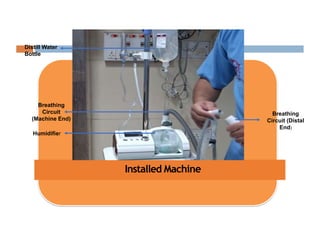
Installed Machine
Humidifier
Breathing
Circuit
(Machine End)
Distill Water
Bottle
Breathing
Circuit (Distal
End)
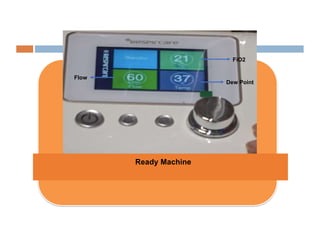
Ready Machine
Dew Point
FiO2
Flow
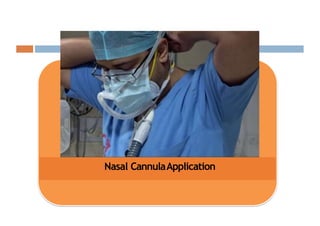
Nasal CannulaApplication
Delivery of BiPAP
• Non Invasive Ventilation delivering
machines
• Use of Ventilators
Terminology : What they Mean ?
iPAP/ PSV; Pressure Support Ventilation; Range
10-30.
PS
V
Tidal
Volume
Terminology : What they Mean?
EPAP/PEEP ; Range 5-
12
PEE
P
Alveolar
Diameter
on
Expiration
Alveoli after
Oxygenati
on
SPO2/PaO
2
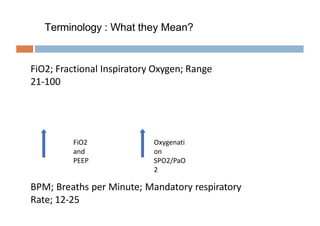
Terminology : What they Mean?
FiO2; Fractional Inspiratory Oxygen; Range
21-100
BPM; Breaths per Minute; Mandatory respiratory
Rate; 12-25
FiO2
and
PEEP
Oxygenati
on
SPO2/PaO
2
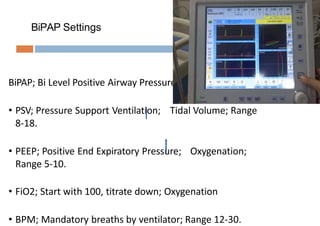
BiPAP Settings
BiPAP; Bi Level Positive Airway Pressures
• PSV; Pressure Support Ventilation; Tidal Volume; Range
8-18.
• PEEP; Positive End Expiratory Pressure; Oxygenation;
Range 5-10.
• FiO2; Start with 100, titrate down; Oxygenation
• BPM; Mandatory breaths by ventilator; Range 12-30.
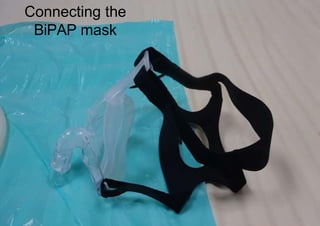
Connecting the BiPAP mask
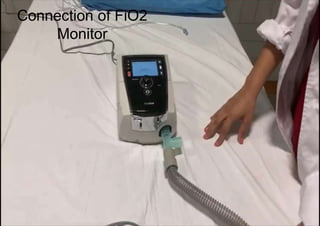
Connection of FiO2
Monitor
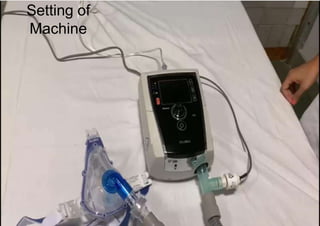
Setting of
Machine
Connecting the
BiPAP mask
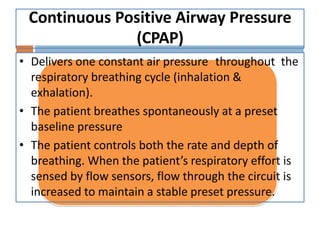
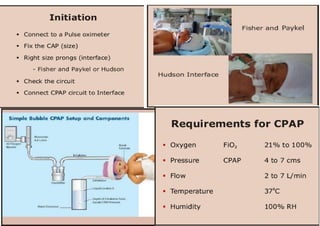
Continuous Positive Airway Pressure
(CPAP)
• Delivers one constant air pressure throughout the
respiratory breathing cycle (inhalation &
exhalation).
• The patient breathes spontaneously at a preset
baseline pressure
• The patient controls both the rate and depth of
breathing. When the patient’s respiratory effort is
sensed by flow sensors, flow through the circuit is
increased to maintain a stable preset pressure.
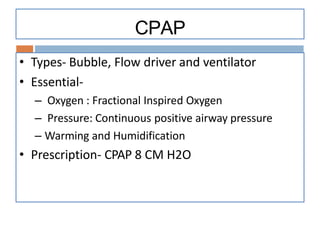
CPAP
• Types- Bubble, Flow driver and ventilator
• Essential-
– Oxygen : Fractional Inspired Oxygen
– Pressure: Continuous positive airway pressure
– Warming and Humidification
• Prescription- CPAP 8 CM H2O
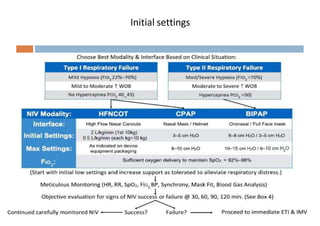
Initial settings
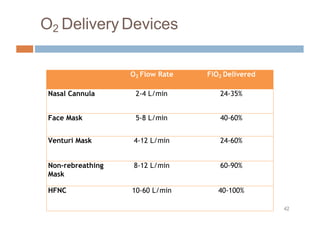
O2 Flow Rate FiO2 Delivered
Nasal Cannula 2-4 L/min 24-35%
Face Mask 5-8 L/min 40-60%
Venturi Mask 4-12 L/min 24-60%
Non-rebreathing
Mask
8-12 L/min 60-90%
HFNC 10-60 L/min 40-100%
42
O2 Delivery Devices
THANKYOU
18

Oxygen therapy and non invasive ventilation