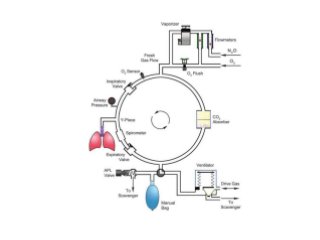
Anaesthesia Machine,
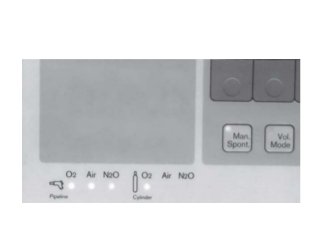
Types and Components
Presenter: Dr. Suresh Pradhan
Moderator: Dr. Yogesh Dhakal
Outline
• Introduction
• Historical Perspective
• Functions of an Anaesthesia Workstation
• Types of anaesthesia Machine
• Standards for Anaesthesia Machines & Workstations
• Essential Safety Features On A Modern Anesthesia
Workstation
• Guidelines For Determining Anesthesia Machine
Obsolescence
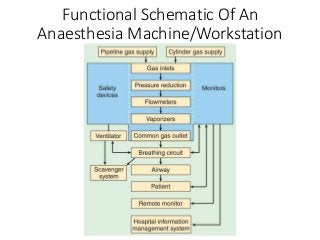
• Functional Schematic Of An Anaesthesia Machine
• Components of Anaesthesia Machine
• a device which delivers a precisely known but
variable gas mixture, including anesthetizing and
life-sustaining gases
• function of the anaesthesia machine is to:
−receive gases from the central supply & cylinders
−meter them and add anesthetic vapors, and
−deliver them to the patient breathing circuit
• conceptually, a pump for delivering medical gases
and inhalation agents to the patient’s lungs
• the “pump” in the modern anaesthesia machine is
either:
−a mechanical ventilator, or
−lungs of the spontaneously breathing patient, or
−perhaps, a combination of the two
• no piece of equipment is more intimately
associated with the practice of anesthesiology
than the anaesthesia machine
• on the most basic level, the anesthesiologist uses
the anaesthesia machine to control the patient’s
ventilation and oxygen delivery and to administer
inhalation anesthetics
• proper functioning of the machine is crucial for
patient safety
• has evolved over the past 160 years from a rather
simple ether inhaler to a complex device of valves,
pistons, vaporizers, monitors, and electronic
circuitry
• modern anaesthesia machines have become very
sophisticated, incorporating
−many built-in safety features and devices
−monitors
−multiple microprocessors that can integrate and
monitor all components
• additional monitors can be added externally and
often still be fully integrated
• moreover, modular machine designs allow a wide
variety of configurations and features within the
same product line
• the term anaesthesia workstation is therefore
often used for modern anaesthesia machines
• consists of:
−the anaesthesia machine
−ventilator
−breathing system
−scavenging system
−monitors
−added to this may be:
− drug delivery systems,
− suction equipment, and
− a data management system
• there are two major manufacturers of anaesthesia
machines in the United States:
1)Datex-Ohmeda (GE Healthcare)
2)Dräger Medical
Historical Perspective
• Early anaesthesia: no definitive airway control
∙ mask anaesthesia, inhalers, drop mask techniques
were all equally capable of producing an unconscious
patient
∙ but offered no airway protection or control against
apnea or emesis
• WTG Morton, in 1846, first publicly demonstrated
‘general anaesthesia’, at Massachusetts General
Hospital, preserved for posterity as the ‘ether
dome’
• several improvements in drugs, apparatus and
techniques have made anaesthesia safe over the
years
• 1877: Joseph Clover describes jaw-thrust technique
for opening airway
• performed surgical airway with metal canula (first
cricothyrotomy by anaesthesia provider)
• Frederick Hewitt developed a device for preventing
the tongue from obstructing the airway in the
unconscious patient
• he called this device the “air-way restorer”
• device was a direct precursor to modern oral
airways.
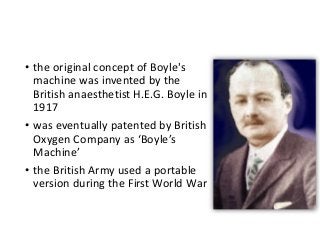
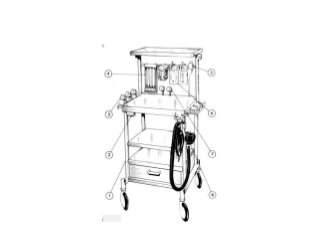
• the original concept of Boyle's
machine was invented by the
British anaesthetist H.E.G. Boyle in
1917
• was eventually patented by British
Oxygen Company as ‘Boyle’s
Machine’
• the British Army used a portable
version during the First World War
• it was a modification of the American Gwathmey
apparatus of 1912 and became the best-known
early continuous flow anaesthetic machine
• there were several features in the simple machine,
which made anaesthesia easier to administer and
safer, compared to earlier methods
• several advances were incorporated in Boyle’s
machines also over the years from the earlier Boyle
Basic to
∙Boyle E
∙Boyle F
∙Boyle G
∙Boyle H
∙Boyle M
∙Boyle major and
∙Boyle International models
• 1920 – a vaporizing (Ether) bottle was incorporated
to the machine
• 1926 – a second vaporizing bottle (Chloroform) and
by-pass controls were incorporated
• 1930 – a Plunger device was added to the
vaporizing bottles
• 1933 – a dry-bobbin type of flowmeter was
introduced and replaced the water sight feed
bottles
• 1937 – rotameters displaced dry-bobbin type of
flowmeters
• 1952 – pin-index system
• 1979 – Standards for anaesthesia machines
• the early Boyle’s machine had five elements which
are still present in all modern machines:
• a high-pressure supply of gases: It housed two
oxygen and two nitrous oxide cylinders in a
wooden box
• pressure gauges on oxygen cylinders and fine-
adjustment reducing valves
• these produced a manageable breathing system
pressure
• it had a spirit flame to warm these and prevent
obstruction of gas flow from ice
• flowmeters to control gas flow rate and adjust
proportions of gas delivered
• a metal and glass vaporizer bottle for ether
• a breathing system comprising a Cattlin bag,
three-way stopcock and facemask
• safety features were incorporated sequentially
over a huge time span of nearly 100 years of
evolution of the anaesthesia machine (since 1917),
with more and more safety systems being added as
realization of the problems and mishaps surfaced
• the traditional pneumatic anaesthesia machine has
evolved into a complex electrical, mechanical and
pneumatic multi component workstation
Functions of a WORKSTATION
• Safe provision, selection and delivery of anesthetics
• Provision of back up supplies of gases
• Respiratory support
• Monitoring of machine function
• Monitoring of patient
• Record Keeping
• Anesthetic Gas Scavenging System (AGSS)
• Suction regulator
• Supplemental oxygen
• Work surface and storage facility for “everyday
items”
• Electricity sockets
Types of anaesthesia Machine
• can be divided into two classes based on the flow
of gas through the machine
Intermittent gas flow type
Continuous gas flow type
Intermittent Gas Flow Type
• gas flows only during inspiration
• they operate on demand
• gas flow is drawn by inspiration/inhalation
• are useful for short surgical procedures
• Examples:
i. Mackessons apparatus
ii. Walton V Machine
iii.Modified Walton V Machine (Lucy Baldwin’s
apparatus)
iv.Entonox apparatus
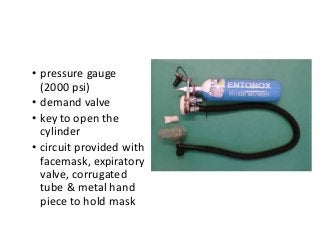
• Entonox apparatus:
• intermittent gas flow machine by Rovenstein
• it has premixed cylinder of oxygen (50%) with
nitrous oxide (50%)
• cylinder has body of French blue with top white
with pin index of 7
• pressure regulator
• pressure gauge
(2000 psi)
• demand valve
• key to open the
cylinder
• circuit provided with
facemask, expiratory
valve, corrugated
tube & metal hand
piece to hold mask
• oxygen & nitrous oxide mixture available in gas
form due to Poynting effect (at 2000 psi pressure &
at room temperature, oxygen has solvent action,
keeps nitrous oxide in gaseous form)
• the mixture separates into component parts, at -7
degree celsius known as pseudocritical
temperature, carries risk of hypoxia due to nitrous
oxide
• this is prevented by:
 proper storing
 avoiding excessive cooling
 rewarming of cylinder, shaking , inverting several
times before use
• Used very effectively as analgesic for :
⌐ Dressing of surgical wounds
⌐ Dressing of burns
⌐ Labour analgesia
⌐ Dentistry
⌐ Pain relief for trauma patients
⌐ Post-operative pain relief
⌐ In ophthalmological examination
⌐ During cardiac catheterization
• Other intermittent gas flow machines :
1. EMOTRIL
• E.M.O. apparatus with trilene
• grey in colour
• draw-over giving air + trilene (0.3 to 0.5 %)
2. TECOTA
• temperature compensated trilene apparatus giving air +
trilene
3. CYPRANE INHALER
• Giving air+ methoxyflurane (0.35 %) for labour analgesia
4. CARDIFF INHALER
• giving air+ methoxyflurane (0.35 %) for labour analgesia
• inhaled during painful uterine contractions in first stage
of labour
Continuous Gas Flow Type
• gas flows both during inspiration and expiration
• Examples:
⌐Boyle Machine
⌐Forregar
⌐Dragger
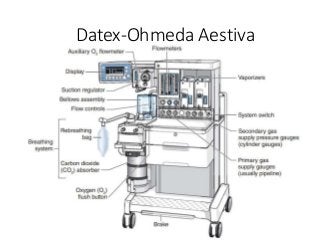
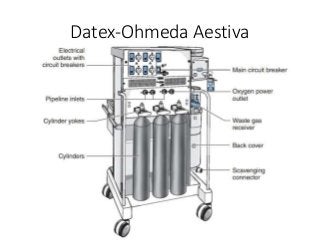
Datex-Ohmeda Aestiva
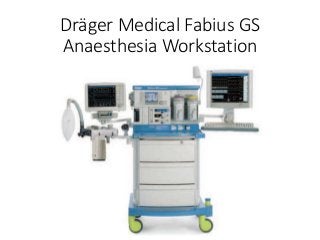
Dräger Medical Fabius GS
Anaesthesia Workstation
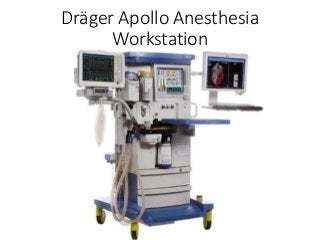
Dräger Apollo Anesthesia
Workstation
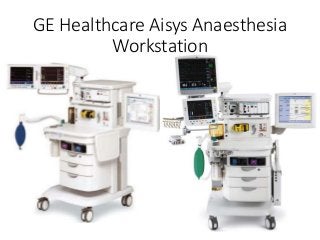
GE Healthcare Aisys Anaesthesia
Workstation
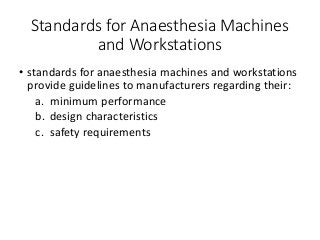
Standards for Anaesthesia Machines
and Workstations
• standards for anaesthesia machines and workstations
provide guidelines to manufacturers regarding their:
a. minimum performance
b. design characteristics
c. safety requirements
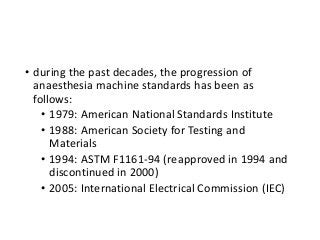
• during the past decades, the progression of
anaesthesia machine standards has been as
follows:
• 1979: American National Standards Institute
• 1988: American Society for Testing and
Materials
• 1994: ASTM F1161-94 (reapproved in 1994 and
discontinued in 2000)
• 2005: International Electrical Commission (IEC)
• 2005: ASTM (reapproved) F1850
• current standards: Standard Specification for
Particular Requirements for Anesthesia
Workstations and Their Components F1850-00,
found within ASTM volume 13.02, September
2012, Medical and Surgical Materials and
Devices
• European standard is EN740
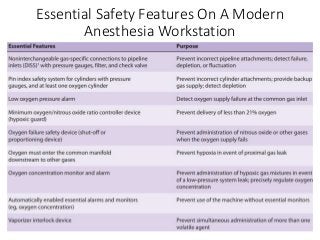
Essential Safety Features On A Modern
Anesthesia Workstation
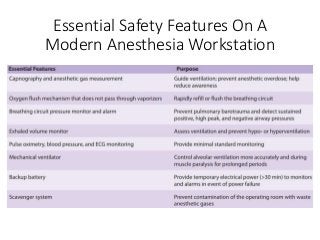
Essential Safety Features On A
Modern Anesthesia Workstation
• changes in equipment design have been directed at
minimizing the probability of breathing circuit
misconnects and disconnects and automating
machine checks
• because of the durability and functional longevity
of anesthesia machines, the ASA has developed
guidelines for determining anesthesia machine
obsolescence
Guidelines For Determining
Anesthesia Machine Obsolescence
Criterias:
• Absolute Criteria
• Relative Criteria
Absolute Criteria
• an anaesthesia machine shall be considered to be
obsolete if any of the following criteria apply
I. Lack of Essential Safety Features
i. minimum oxygen ratio device (O2 and N2O
proportionating system) on a machine that can
deliver N2O
ii. Oxygen failure safety/fail safe device
iii. Oxygen supply pressure failure alarm
iv. Vaporizer interlock device
v. Pin index safety system
vi. Non-interchangeable, gas-specific (DISS) connectors
on the gas pipeline inlets
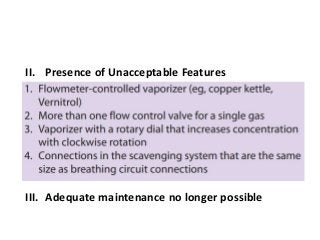
II. Presence of Unacceptable Features
III. Adequate maintenance no longer possible
Relative Criteria
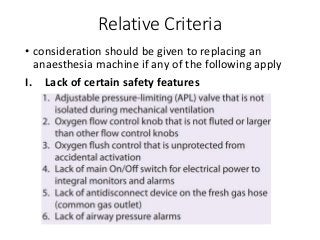
• consideration should be given to replacing an
anaesthesia machine if any of the following apply
I. Lack of certain safety features
II. Problems with maintenance
III. Potential for human error
IV. Inability to meet practice needs
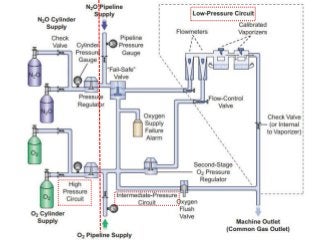
Functional Schematic Of An
Anaesthesia Machine/Workstation
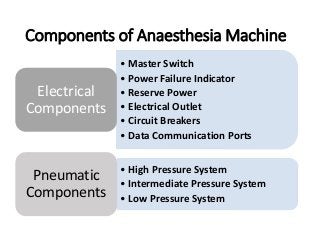
Components of Anaesthesia Machine
• Master Switch
• Power Failure Indicator
• Reserve Power
• Electrical Outlet
• Circuit Breakers
• Data Communication Ports
Electrical
Components
• High Pressure System
• Intermediate Pressure System
• Low Pressure System
Pneumatic
Components
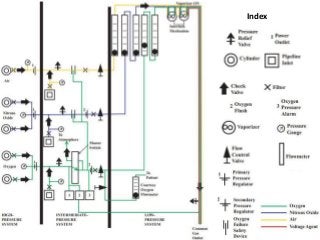
Index
Electrical Components
Master Switch
• activates both the pneumatic and electrical
functions
• on most machines, when the master switch is in
the OFF position, the only electrical components
that are active are the backup battery charger and
the electrical outlets
• on some machines, electrical components can be
activated without pneumatic power
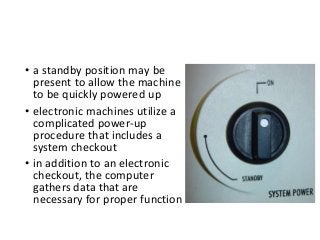
• a standby position may be
present to allow the machine
to be quickly powered up
• electronic machines utilize a
complicated power-up
procedure that includes a
system checkout
• in addition to an electronic
checkout, the computer
gathers data that are
necessary for proper function
Power Failure Indicator
• most machines are equipped with a visual and/or
audible indicator to alert the anesthesia provider to
the loss of mains electrical power
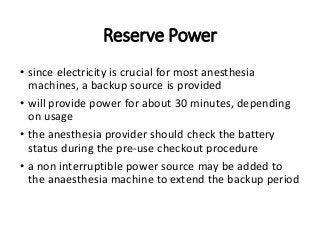
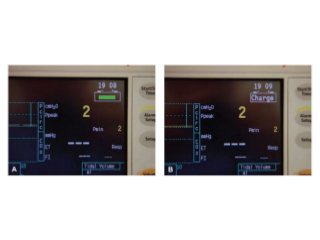
Reserve Power
• since electricity is crucial for most anesthesia
machines, a backup source is provided
• will provide power for about 30 minutes, depending
on usage
• the anesthesia provider should check the battery
status during the pre-use checkout procedure
• a non interruptible power source may be added to
the anaesthesia machine to extend the backup period
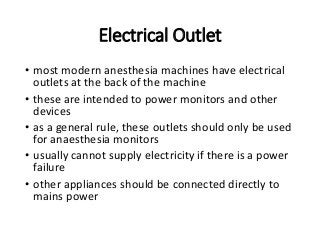
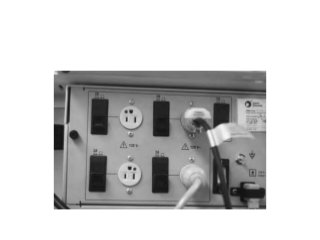
Electrical Outlet
• most modern anesthesia machines have electrical
outlets at the back of the machine
• these are intended to power monitors and other
devices
• as a general rule, these outlets should only be used
for anaesthesia monitors
• usually cannot supply electricity if there is a power
failure
• other appliances should be connected directly to
mains power
Circuit Breakers
• there are circuit breakers for both the anesthesia
machine and the outlets
• when a circuit breaker is activated, the electrical
load should be reduced and the circuit breaker
reset
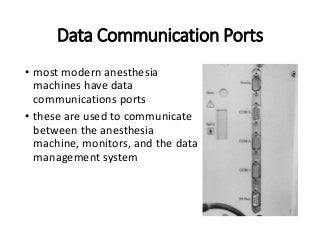
Data Communication Ports
• most modern anesthesia
machines have data
communications ports
• these are used to communicate
between the anesthesia
machine, monitors, and the data
management system
Pneumatic Components
• gases are supplied under tremendous pressure for
the convenience of storage and transport
• the anaesthesia machine receives medical gases
from a gas supply; controls the flow of desired
gases reducing their pressure to a safe level
• so, the pressure inside a source (cylinder or
pipeline) must be brought to a certain level before
it can be used for the purpose of ventilation
• also, it needs to be supplied in a constant pressure,
otherwise the flow meter would need continuous
adjustment
• this is achieved by bringing down the pressure of a
gas supply in a graded manner with the help of
three pressure reducing zones
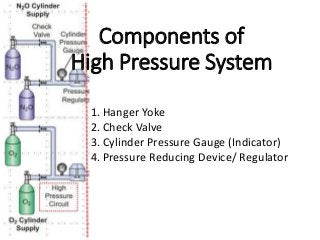
• thus, the pneumatic part of the machine can be
conveniently divided into three parts-
1. High Pressure System: from cylinder to pressure
reducing valves
2. Intermediate Pressure System: from pressure
reducing valves to the flowmeters
3. Low Pressure System: from the flowmeters to
the common gas outlet
Components of
High Pressure System
1. Hanger Yoke
2. Check Valve
3. Cylinder Pressure Gauge (Indicator)
4. Pressure Reducing Device/ Regulator
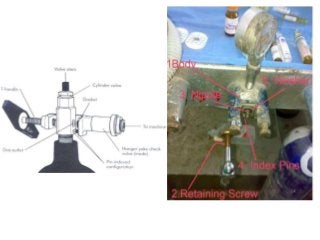
1. Hanger Yoke
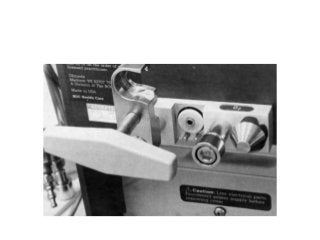
the hanger yoke assembly-
 orients and supports the cylinder
 provides a gastight seal
 ensures a unidirectional gas flow
• it is composed of several parts:
a) the body, which is the principal framework and
supporting structure
b) the retaining screw, which tightens the cylinder
in the yoke
c) the nipple, through which gas enters the
machine
d) the Pin Index Safety System pins, which prevent
an incorrect cylinder from being attached
e) the washer (bodock seal), which helps to form a
seal between the cylinder and the yoke
f) a filter to remove particulate matter that could
come from the cylinder
g) a check valve assembly, prevent retrograde flow
of gases
• the workstation standard recommends that there
be at least one yoke each for oxygen and nitrous
oxide
• if the machine is likely to be used in locations that
do not have piped gases, it is advisable to have a
double yoke, especially for oxygen
Body
• is threaded into the frame of the machine
• provides support for the cylinder
• commonly the swinging gate type is used
• When a cylinder is mounted onto or removed from
a yoke, the hinged part can be swung to side
Retaining Screw
• it is threaded into the distal end of the yoke
• tightening the screw presses the outlet of the
cylinder valve against the washer and the nipple so
that a gas tight seal is obtained
• the cylinder is then supported by the retaining
screw, the nipple, and the index pins
• the conical point of the retaining screw is shaped to
fit the conical depression on the cylinder valve
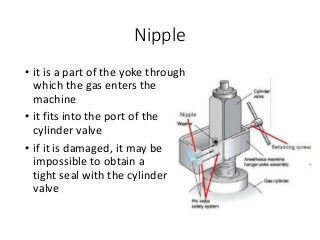
Nipple
• it is a part of the yoke through
which the gas enters the
machine
• it fits into the port of the
cylinder valve
• if it is damaged, it may be
impossible to obtain a
tight seal with the cylinder
valve
Index Pins
• are situated below the nipple
• these help to prevent mounting of incorrect
cylinder to yoke
• the holes into which the pins are fitted must be of a
specific depth
• if they extend too far into the body of the yoke, it
may be possible to mount a incorrect cylinder
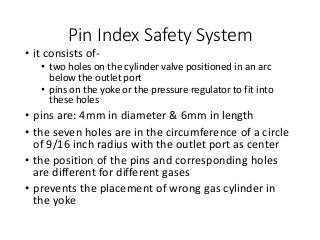
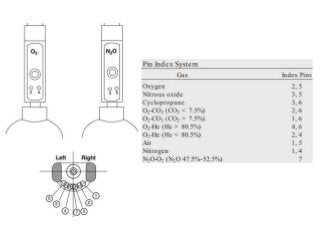
Pin Index Safety System
• it consists of-
• two holes on the cylinder valve positioned in an arc
below the outlet port
• pins on the yoke or the pressure regulator to fit into
these holes
• pins are: 4mm in diameter & 6mm in length
• the seven holes are in the circumference of a circle
of 9/16 inch radius with the outlet port as center
• the position of the pins and corresponding holes
are different for different gases
• prevents the placement of wrong gas cylinder in
the yoke
Washer (Bodock Seal)
• cylinders are fitted with yoke with a sealing
washer called Bodock Seal
• it is made up of non combustible material
• has a metal periphery which make it long lasting
• it should be less than 2.4mm thick prior to
compression
• only one seal should be use between the valve &
yoke
Filter
• is used to prevent particulate matter from entering
the machine
• is placed between the cylinder and the pressure
reducing device
Placing a Cylinder in a Yoke
• cylinder valves and yokes should not be
contaminated with oil or grease
• persons placing a cylinder in a yoke should always
wash their hands first
• Pin Index Safety System pins should be present
• the retaining screw should be retracted
• the washer is placed over the nipple
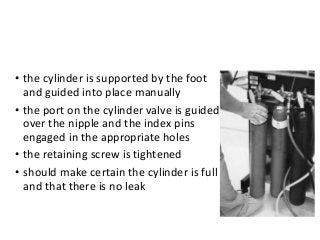
• the cylinder is supported by the foot
and guided into place manually
• the port on the cylinder valve is guided
over the nipple and the index pins
engaged in the appropriate holes
• the retaining screw is tightened
• should make certain the cylinder is full
and that there is no leak
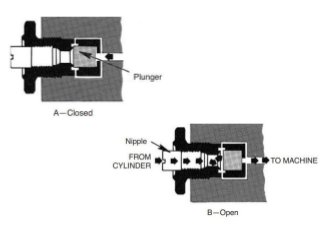
2. Check Valve
• it allows gas from a cylinder to enter the machine
but prevents gas from exiting the machine when
there is no cylinder in the yoke
• it allows an empty cylinder to be replaced with a
full one without having to turn off the cylinder in
use
• prevents transfer of gas from one cylinder to the
other with a lower pressure in a double yoke
• it consists of a plunger that slides away from the
side of the greater pressure
• it is not designed to act as a permanent seal for
empty yoke and may allow small amount of gas to
escape
• as soon as a cylinder is exhausted it should be
replaced by a full one or a dummy plug
• in order to minimize losses:
• yokes should not be left vacant for extended
periods
• an empty cylinder should be replaced as soon as
possible
• an yoke plug can be used to prevent gas leak
• an empty cylinder can be left behind after
closing the valve
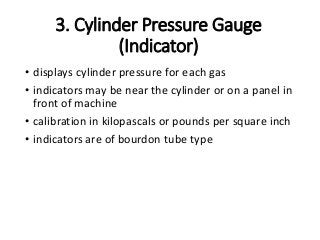
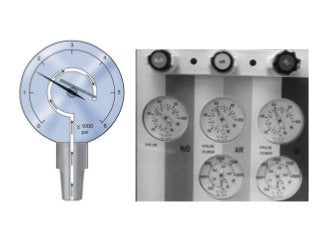
3. Cylinder Pressure Gauge
(Indicator)
• displays cylinder pressure for each gas
• indicators may be near the cylinder or on a panel in
front of machine
• calibration in kilopascals or pounds per square inch
• indicators are of bourdon tube type
• most new anaesthesia machines indicate cylinder
pressure digitally
• light-emitting diodes may also be used to indicate
adequate pressure in the cylinder
4. Pressure Reducing
Device/Regulator
• reduces the high and variable pressure delivered
from a cylinder to a lower, more constant pressure
suitable for use in an anesthesia machine
• without a regulator, it would be necessary for the
anesthesia provider to constantly alter the flow
control valve to maintain a constant flow through
the flowmeter as the pressure in the cylinder
decreases
• the machine standard requires reducing devices for
each gas supplied to the machine from cylinders
• pressure regulators used in anesthesia machines
are preset at the factory
• the pressure at the regulator outlet is set lower
than the pipeline pressure
• this ensures that pipeline gas is used preferentially
to the cylinder supply if the cylinder valve is open
while oxygen from the piping system is being used
• this differential pressure may not always prevent the
cylinder from becoming exhausted since pressure
fluctuations in the pipeline may cause the pressure
in the machine to drop below the pressure from the
pressure regulator
• physical principle- a large pressure acting over a
small area is balanced by a small pressure over a
large area
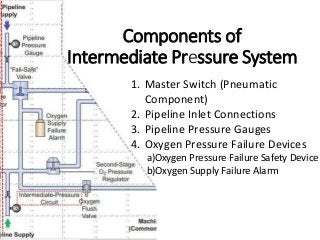
Components of
Intermediate Pressure System
1. Master Switch (Pneumatic
Component)
2. Pipeline Inlet Connections
3. Pipeline Pressure Gauges
4. Oxygen Pressure Failure Devices
a)Oxygen Pressure Failure Safety Device
b)Oxygen Supply Failure Alarm
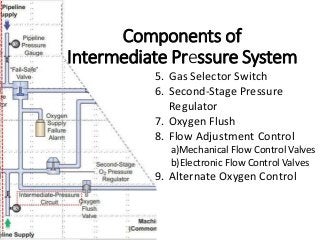
Components of
Intermediate Pressure System
5. Gas Selector Switch
6. Second-Stage Pressure
Regulator
7. Oxygen Flush
8. Flow Adjustment Control
a)Mechanical Flow Control Valves
b)Electronic Flow Control Valves
9. Alternate Oxygen Control
1. Master Switch (Pneumatic
Component)
• the pneumatic portion of the master switch is
located in the intermediate-pressure system
downstream of the inlets for the cylinder and
pipeline supplies
• the oxygen flush is usually independent of this
switch
• the master switch may be a totally electronic switch
that when activated controls the various pneumatic
components in the anesthesia machine
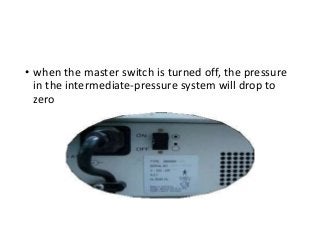
• when the master switch is turned off, the pressure
in the intermediate-pressure system will drop to
zero
2. Pipeline Inlet Connections
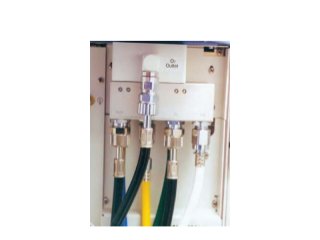
• pipeline inlet connections are the entry points for
gases from the pipelines
• the anesthesia workstation standard requires
pipeline inlet connections for oxygen and nitrous
oxide
there is usually connection for air in most machines
• the pipeline inlets are fitted with threaded non
interchangeable Diameter Index Safety System
(DISS) connectors
• each inlet contains
• a unidirectional/check valve to prevent reverse
gas flow from the machine into the piping
system (or to atmosphere if no hose is
connected)
• a filter to prevent debris from the pipeline
entering the anesthesia machine
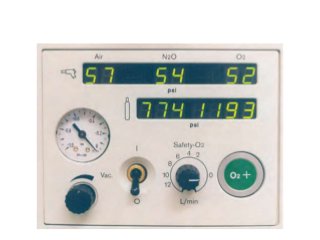
3. Pipeline Pressure Gauges
• gauges are present to monitor the pipeline pressure
of each gas
• they are usually on a panel on the front of the
machine (or the information screen, if present) and
color coded for the gases they monitor
• the workstation standard requires that the indicator
be on the pipeline side of the check valve in the
pipeline inlet
• some machines have digital pressure gauges that
display pressure either continuously or on demand
• some use light-emitting diodes (LEDs) to indicate
adequate pipeline pressure
• the sensing point for the pipeline pressure gauge is
located on the pipeline side of the check valve
• if the hose is disconnected or improperly
connected, it will read “0” even if a cylinder valve is
open
• pipeline pressure indicators should always be
checked before the machine is used
• the pressure should be between 50 and 55 psig
(345 and 380 kPa)
• indicators should be scanned repeatedly during use
4. Oxygen Pressure Failure
Devices (OPFD)
• one of the most serious mishaps that occurred with
earlier anaesthesia machines was depletion of the
oxygen supply (usually from a cylinder) without the
user’s awareness
• the result was delivery of gas containing no oxygen
to the patient
• to remedy this problem, a device that turns off the
supply of gases other than oxygen (oxygen failure
safety device) is used
• in addition, an alarm to warn when oxygen
pressure has fallen to a dangerous level is used
• can be described as
• Oxygen Pressure Failure Safety Device
• Oxygen Supply Failure Alarm
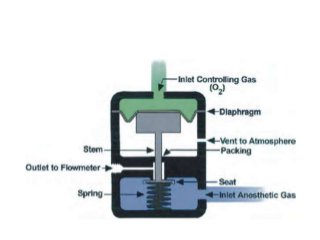
Oxygen Pressure Failure Safety Device:
• ASTM standard requires that whenever the oxygen
supply pressure fails, the delivered oxygen
concentration shall not decrease below 19% at the
common gas outlet
• the oxygen failure safety valve (fail safe) placed in
the piping system for nitrous oxide (and on some
machines air) shuts off or proportionally decreases
and ultimately interrupts the supply of the other
gas if the oxygen supply pressure decreases
• when the pneumatic system is activated, oxygen
pressure opens the oxygen pressure failure safety
device, allowing other gases to flow
• a decrease in oxygen pressure causes it to interrupt
the flow of other gases to their flow control valves
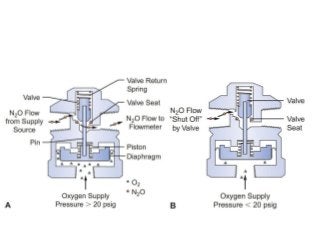
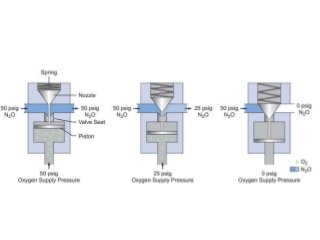
Pressure Sensor Shut-off Valve: Datex Ohmeda
• operates in a threshold manner: either open or
shut
• oxygen pressure moves the piston and pin upward
and the valve opens for N2O
• when pressure of oxygen falls below preset value,
force of the valve return spring completely closes
the valve
Oxygen Failure Protection Device: Drager
• based on a proportioning principle rather than a
threshold principle
• pressure of N2O falls in proportion of decrease of
Oxygen
• total cutoff seen at <12psig
• seat nozzle assembly connected to a spring loaded
conical tapered piston
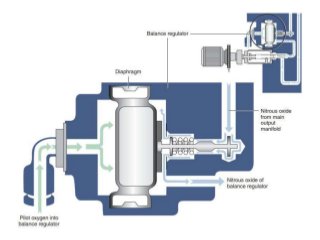
• an important concept to be understood with these
particular fail-safe devices is that
• the older Datex- Ohmeda Pressure Sensor Shut off
Valve is threshold in nature (all-or-nothing),
whereas
• the GE balance regulator and Dräger Oxygen Failure
Protection Device are variable, flow type
proportioning systems
Oxygen Supply Failure Alarm
• ASTM standard specifies that whenever the oxygen
supply pressure falls below a certain threshold
(usually 30 psig), alarm must get activated within 5
seconds
• it should not be possible to disable this alarm
• aid in preventing hypoxia caused by problems
occurring upstream in the machine circuitry
• disconnected oxygen hose
• low oxygen pressure in the pipeline
• depletion of oxygen cylinders
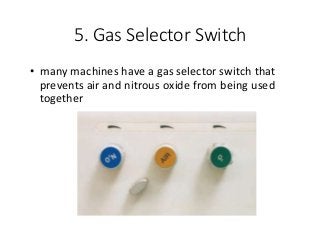
5. Gas Selector Switch
• many machines have a gas selector switch that
prevents air and nitrous oxide from being used
together
6. Second-Stage Pressure
Regulator
• some machines have additional pressure regulators
in the intermediate pressure system just upstream
of the flow adjustment controls
• the second-stage regulator receives gas from either
the pipeline or the cylinder pressure regulator
• reduces it further to around 26 psi (177 kPa) for
nitrous oxide and 14 psi (95 kPa) for oxygen
• purpose of this pressure regulator is to eliminate
fluctuations in pressure supplied to the flow
indicators
• reducing the pressures below the normal
fluctuation range causes the flow from the
flowmeters to remain more constant
• not all anesthesia machines incorporate this device
7. Oxygen Flush
• also known as oxygen bypass, emergency oxygen
bypass
• receives oxygen from the pipeline inlet or cylinder
pressure regulator and directs a high (35 to 75 L/
minute) unmetered flow directly to the common
gas outlet
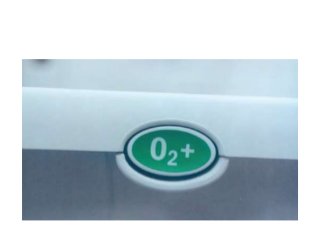
• is commonly labeled “O2+”
• the button is commonly recessed or placed in a
collar to prevent accidental activation
• on most anesthesia machines, the oxygen flush can
be activated regardless of whether the master
switch is turned ON or OFF
• the anesthesia workstation standard requires that
the connection of the flush valve delivery line to
the common gas outlet be designed so that
activation does not increase or decrease the
pressure at the vaporizer outlet by more than 10
kPa or increase the vapor output by more than 20%
Reported hazards associated with the oxygen flush
• accidental activation and internal leakage, which
result in an oxygen-enriched mixture being
delivered with anaesthetic dilution
• flush valve may get stuck in the ON position and
obstruct flow from the flowmeters
• barotrauma and awareness during anesthesia
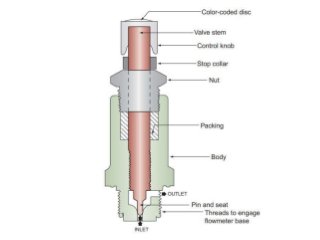
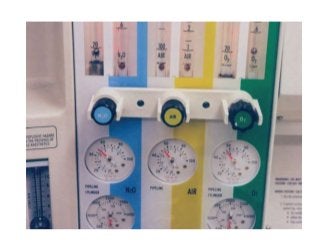
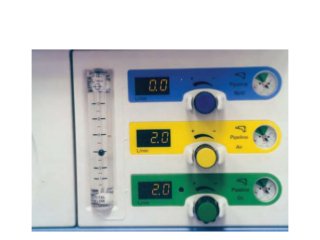
8. Flow Adjustment Control
• controls flow of gas through it’s associated
indicator by manual adjustment of a variable orifice
• current standard requires that:
 there must be only one flow control for each gas
 must be adjacent to or identifiable with its
associated flowmeter
•there are two types of flow adjustment controls:
mechanical and electronic
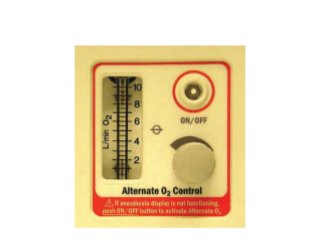
9. Alternate Oxygen Control
• when using a computer-controlled anesthesia
machine, there is always the possibility that the
electronics will fail
• different machines deal with this problem in
different ways
• usually accomplished by a means to administer
oxygen
• is separate from the auxiliary (courtesy) flowmeter
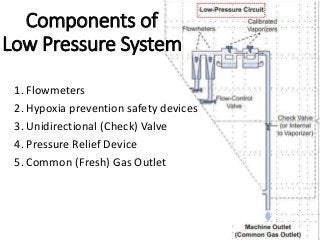
Components of
Low Pressure System
1. Flowmeters
2. Hypoxia prevention safety devices
3. Unidirectional (Check) Valve
4. Pressure Relief Device
5. Common (Fresh) Gas Outlet
1. Flowmeters
• also known as flow indicators, flow tubes, rotameters
• indicate the rate of flow of a gas passing through
them
• they may be mechanical or electronic
• electronic flowmeters usually have a representation
of a mechanical flowmeter on a screen or a number
representing the flow
Physical Principles
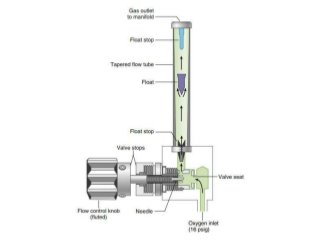
• traditional mechanical flow indicators used in
anaesthesia machines are the variable orifice
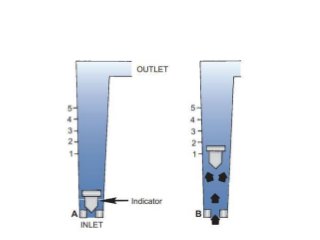
(variable area, Thorpe tube) type
• a vertical glass tube has an internal taper with its
smallest diameter at the bottom
• it contains an indicator that is free to move up and
down inside the tube
• when the flow control valve is opened, gas enters
at the bottom and flows up the tube, elevating
the indicator
• the gas passes through the annular opening
between the indicator and the tube wall and on to
the outlet at the top of the tube
• the indicator floats freely in the tube at a position
where the downward force caused by gravity
equals the upward force caused by the gas pressure
on the bottom of the indicator
• as gas flow increases, the number of gas molecules
hitting the indicator bottom increases, and it rises
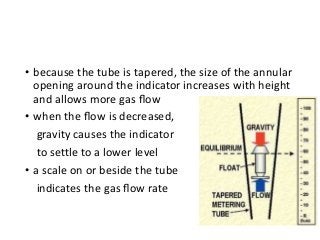
• because the tube is tapered, the size of the annular
opening around the indicator increases with height
and allows more gas flow
• when the flow is decreased,
gravity causes the indicator
to settle to a lower level
• a scale on or beside the tube
indicates the gas flow rate
• the flow rate through the tube will depend on three
factors:
• the pressure drop across the constriction
• the size of the annular opening, and
• the physical properties of the gas
• as gas flows around the indicator, it encounters
frictional resistance between the indicator and the
tube wall
• there is a resultant loss of energy, so the pressure
drops
• this pressure drop is constant for all positions in the
tube and is equal to the weight of the float divided
by its cross-sectional area
• for this reason, these flowmeters are often called
constant-pressure flowmeters
• increasing the flow does not increase the pressure
drop but causes the indicator to rise to a higher
position in the tube, thereby providing greater flow
area for the gas
• the physical characteristics of the gas affect the gas
flow through the flowmeter tube
• when a low gas flow passes through the tube, the
annular opening between the float and the tube
wall will be narrow
• as flow increases, the annular opening becomes
larger
• the physical property that relates gas flow to the
pressure difference across the constriction varies
with the form of the constriction
• with a longer and narrower constriction (low
flows), flow is laminar and is mainly a function of
the viscosity of the gas (Hagen–Poiseuille equation)
• when the constriction is shorter and wider (high
flows), flow is more turbulent and depends more
on the gas density (Graham’s law)
• flowmeters are calibrated at atmospheric pressure
(760 mm Hg) and room temperature (20°C)
• temperature and pressure changes will affect the
gas viscosity and density and so influence the
indicated flow rate accuracy
• variations in temperature as a rule are slight and do
not produce significant changes
Flowmeter Assembly
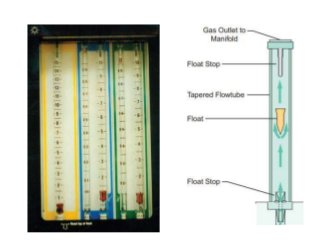
• consists of:
⌐a tube through which the gas flows
⌐an indicator inside the tube
⌐a stop at the top of the tube, and
⌐a scale that indicates the flow
• lights are available on most anesthesia machines to
allow the flowmeters to be observed in a dark room
• each assembly is marked with the appropriate color
and name or chemical symbol of the gas measured
• flowmeters are usually protected by a plastic shield
• flowmeter assembly empties into a common
manifold that delivers the measured amount of
gases into the low-pressure system
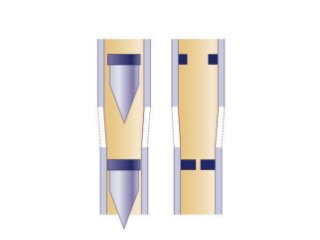
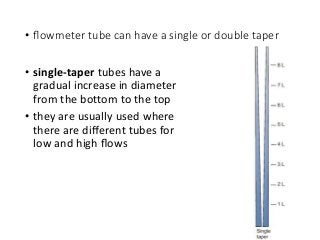
• flowmeter tube can have a single or double taper
• single-taper tubes have a
gradual increase in diameter
from the bottom to the top
• they are usually used where
there are different tubes for
low and high flows
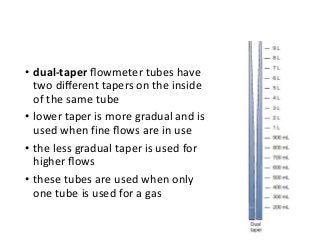
• dual-taper flowmeter tubes have
two different tapers on the inside
of the same tube
• lower taper is more gradual and is
used when fine flows are in use
• the less gradual taper is used for
higher flows
• these tubes are used when only
one tube is used for a gas
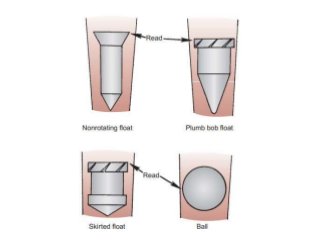
• the indicator (float, ball, rotameter or bobbin) is a
free-moving device within the tube
• it is important to observe the indicator frequently
and especially when the flow is altered
• if the indicator moves erratically, the readings may
be inaccurate
• the widest diameter of the indicator is the point
where the flow should be read
Flowmeter Tube Arrangement
• flowmeter tubes for different gases are side by side
• the various gas flows meet at the common
manifold (mixing chamber) at the top
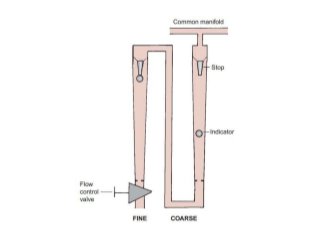
• sometimes, there are two flowmeters for the same
gas: one for low and one for high flows
• the tubes are arranged in series (tandem) with one
flow control valve for both the flowmeter tubes
• gas from the flow control valve first passes through
a tube calibrated up to 1 L/minute and then passes
through a second tube that is calibrated for higher
flows
• the total flow through two-series flowmeters is not
the sum of the two tubes but that shown on the
higher flow tube
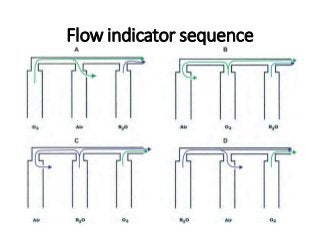
Flow indicator sequence
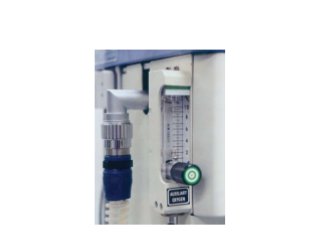
Auxiliary Oxygen Flowmeter
• an auxiliary (courtesy) oxygen flowmeter is a self-
contained flowmeter with its own flow control
valve, flow indicator, and outlet
• it is not affected by computer control
• it usually has a short tube with a maximum flow of
10 L/minute and a barbed fitting on the outlet for
connection to a face mask or nasal cannula
• it is used to supply oxygen to the patient without
turning ON the anesthesia machine
Flowmeter Problems
• the flowmeter scale, tube, and indicator must be
regarded as an inseparable unit
• the tube assembly calibrated for one gas cannot be
used for a different gas
• if a tube, indicator, and scale calibrated for one gas
are used for another gas, they will deliver an
incorrect gas flow
• if any part of the flowmeter is damaged, the
flowmeter, scale, and indicator all need to be
replaced with a new set
• flowmeter components are calibrated as a set and
if only one component is changed there will be
inaccuracy
• damage to the flow indicator can result if it is
suddenly propelled to the top of the tube when a
cylinder is opened or a pipeline hose is connected
while the flow control valve is open
Electronic Flowmeters
• most of the electronic anesthesia machines
available at this time use a conventional flow
control valve and an electronic flow sensor
• different technologies are used to measure gas flow
• the flow measured by the sensor is then
represented digitally and/or by a simulated
flowmeter on the anesthesia machine screen
• an advantage of electronic flow measurement is
that this information is available in a form that can
be sent to a data management system
2. Hypoxia Prevention Safety
Devices
• one of the hazards associated with flowmeters is
the possibility that the operator will set the flows
that could deliver a hypoxic mixture
• various devices have been developed to prevent
this problem
1. mandatory minimum oxygen flow
2. minimum oxygen ratio
a) Datex-Ohmeda Link 25 proportioning system
b) Drager- Oxygen Ratio Monitor Controller/
Sensitive Oxygen Ratio Controller
3. unidirectional check valves
4. alarms
3. Unidirectional (Check) Valve
• when ventilation is controlled or assisted, positive
pressure from the breathing system can be
transmitted back into the machine
• using the oxygen flush valve may also create a
positive back pressure
• this pressure can affect flowmeter readings and the
concentration of volatile anesthetic agents
delivered from the vaporizers on the machine
• some machines have a unidirectional (check) valve
to minimize these effects
• this valve is located between the vaporizers and the
common gas outlet, upstream of where the oxygen
flush flow joins the fresh gas flow
• this valve will lessen the pressure increase but not
prevent it, because gas will be continually flowing
from the flowmeters toward a blocked valve
• these valves are not present on all machines
• if present, they will interfere with checking for leaks
upstream of the machine outlet
4. Pressure Relief Device
• some machines have a pressure relief device near
the common gas outlet to protect the machine
from high pressures
• this valve opens to atmosphere and vents gas if a
preset pressure is exceeded
• a pressure relief device may limit the ability of an
anesthesia machine to provide adequate pressure
for jet ventilation through a catheter inserted
through the cricothyroid membrane
5. Common (Fresh) Gas Outlet
• the common (fresh) gas outlet receives all of the
gases and vapors from the machine and delivers
the mixture to the breathing system at the pressure
of 5-8 psig
• some outlets have a 15-mm female slip-joint fitting
(that will accept a tracheal tube connector)
• they may also have a manufacturer-specific fitting
• there is a mechanism to prevent a disconnection
between the machine and the hose to the
breathing system
• machine standard mandates that it be difficult to
accidently disengage the delivery hose from the
outlet
• many new anesthesia machines have internal
connections to the breathing system
• these machines may not have the conventional
common gas outlet described
• the common gas outlet should not be used to
administer supplemental oxygen to a patient
• this is will delay conversion to the breathing system
if an emergency arises
• another potential problem is that a vaporizer on
the back bar may be accidentally left ON, leading to
undesired administration of the inhalation agent
• the auxiliary oxygen flowmeter or a separate
flowmeter should be used for this purpose
THE END!!!
Anaesthesia machine, types and components

Anaesthesia machine, types and components

  • 1.
    Anaesthesia Machine, Types andComponents Presenter: Dr. Suresh Pradhan Moderator: Dr. Yogesh Dhakal
  • 2.
    Outline • Introduction • HistoricalPerspective • Functions of an Anaesthesia Workstation • Types of anaesthesia Machine • Standards for Anaesthesia Machines & Workstations • Essential Safety Features On A Modern Anesthesia Workstation
  • 3.
    • Guidelines ForDetermining Anesthesia Machine Obsolescence • Functional Schematic Of An Anaesthesia Machine • Components of Anaesthesia Machine
  • 4.
    • a devicewhich delivers a precisely known but variable gas mixture, including anesthetizing and life-sustaining gases
  • 5.
    • function ofthe anaesthesia machine is to: −receive gases from the central supply & cylinders −meter them and add anesthetic vapors, and −deliver them to the patient breathing circuit
  • 6.
    • conceptually, apump for delivering medical gases and inhalation agents to the patient’s lungs • the “pump” in the modern anaesthesia machine is either: −a mechanical ventilator, or −lungs of the spontaneously breathing patient, or −perhaps, a combination of the two
  • 7.
    • no pieceof equipment is more intimately associated with the practice of anesthesiology than the anaesthesia machine
  • 8.
    • on themost basic level, the anesthesiologist uses the anaesthesia machine to control the patient’s ventilation and oxygen delivery and to administer inhalation anesthetics • proper functioning of the machine is crucial for patient safety
  • 9.
    • has evolvedover the past 160 years from a rather simple ether inhaler to a complex device of valves, pistons, vaporizers, monitors, and electronic circuitry
  • 10.
    • modern anaesthesiamachines have become very sophisticated, incorporating −many built-in safety features and devices −monitors −multiple microprocessors that can integrate and monitor all components
  • 11.
    • additional monitorscan be added externally and often still be fully integrated • moreover, modular machine designs allow a wide variety of configurations and features within the same product line
  • 12.
    • the termanaesthesia workstation is therefore often used for modern anaesthesia machines • consists of: −the anaesthesia machine −ventilator −breathing system −scavenging system −monitors
  • 13.
    −added to thismay be: − drug delivery systems, − suction equipment, and − a data management system
  • 14.
    • there aretwo major manufacturers of anaesthesia machines in the United States: 1)Datex-Ohmeda (GE Healthcare) 2)Dräger Medical
  • 15.
    Historical Perspective • Earlyanaesthesia: no definitive airway control ∙ mask anaesthesia, inhalers, drop mask techniques were all equally capable of producing an unconscious patient ∙ but offered no airway protection or control against apnea or emesis • WTG Morton, in 1846, first publicly demonstrated ‘general anaesthesia’, at Massachusetts General Hospital, preserved for posterity as the ‘ether dome’
  • 16.
    • several improvementsin drugs, apparatus and techniques have made anaesthesia safe over the years • 1877: Joseph Clover describes jaw-thrust technique for opening airway • performed surgical airway with metal canula (first cricothyrotomy by anaesthesia provider)
  • 17.
    • Frederick Hewittdeveloped a device for preventing the tongue from obstructing the airway in the unconscious patient • he called this device the “air-way restorer” • device was a direct precursor to modern oral airways.
  • 18.
    • the originalconcept of Boyle's machine was invented by the British anaesthetist H.E.G. Boyle in 1917 • was eventually patented by British Oxygen Company as ‘Boyle’s Machine’ • the British Army used a portable version during the First World War
  • 19.
    • it wasa modification of the American Gwathmey apparatus of 1912 and became the best-known early continuous flow anaesthetic machine • there were several features in the simple machine, which made anaesthesia easier to administer and safer, compared to earlier methods
  • 20.
    • several advanceswere incorporated in Boyle’s machines also over the years from the earlier Boyle Basic to ∙Boyle E ∙Boyle F ∙Boyle G ∙Boyle H ∙Boyle M ∙Boyle major and ∙Boyle International models
  • 22.
    • 1920 –a vaporizing (Ether) bottle was incorporated to the machine • 1926 – a second vaporizing bottle (Chloroform) and by-pass controls were incorporated • 1930 – a Plunger device was added to the vaporizing bottles • 1933 – a dry-bobbin type of flowmeter was introduced and replaced the water sight feed bottles
  • 23.
    • 1937 –rotameters displaced dry-bobbin type of flowmeters • 1952 – pin-index system • 1979 – Standards for anaesthesia machines
  • 24.
    • the earlyBoyle’s machine had five elements which are still present in all modern machines: • a high-pressure supply of gases: It housed two oxygen and two nitrous oxide cylinders in a wooden box • pressure gauges on oxygen cylinders and fine- adjustment reducing valves • these produced a manageable breathing system pressure • it had a spirit flame to warm these and prevent obstruction of gas flow from ice
  • 25.
    • flowmeters tocontrol gas flow rate and adjust proportions of gas delivered • a metal and glass vaporizer bottle for ether • a breathing system comprising a Cattlin bag, three-way stopcock and facemask
  • 26.
    • safety featureswere incorporated sequentially over a huge time span of nearly 100 years of evolution of the anaesthesia machine (since 1917), with more and more safety systems being added as realization of the problems and mishaps surfaced • the traditional pneumatic anaesthesia machine has evolved into a complex electrical, mechanical and pneumatic multi component workstation
  • 27.
    Functions of aWORKSTATION • Safe provision, selection and delivery of anesthetics • Provision of back up supplies of gases • Respiratory support • Monitoring of machine function • Monitoring of patient • Record Keeping
  • 28.
    • Anesthetic GasScavenging System (AGSS) • Suction regulator • Supplemental oxygen • Work surface and storage facility for “everyday items” • Electricity sockets
  • 29.
    Types of anaesthesiaMachine • can be divided into two classes based on the flow of gas through the machine Intermittent gas flow type Continuous gas flow type
  • 30.
    Intermittent Gas FlowType • gas flows only during inspiration • they operate on demand • gas flow is drawn by inspiration/inhalation • are useful for short surgical procedures
  • 31.
    • Examples: i. Mackessonsapparatus ii. Walton V Machine iii.Modified Walton V Machine (Lucy Baldwin’s apparatus) iv.Entonox apparatus
  • 32.
    • Entonox apparatus: •intermittent gas flow machine by Rovenstein • it has premixed cylinder of oxygen (50%) with nitrous oxide (50%) • cylinder has body of French blue with top white with pin index of 7 • pressure regulator
  • 33.
    • pressure gauge (2000psi) • demand valve • key to open the cylinder • circuit provided with facemask, expiratory valve, corrugated tube & metal hand piece to hold mask
  • 34.
    • oxygen &nitrous oxide mixture available in gas form due to Poynting effect (at 2000 psi pressure & at room temperature, oxygen has solvent action, keeps nitrous oxide in gaseous form) • the mixture separates into component parts, at -7 degree celsius known as pseudocritical temperature, carries risk of hypoxia due to nitrous oxide
  • 35.
    • this isprevented by:  proper storing  avoiding excessive cooling  rewarming of cylinder, shaking , inverting several times before use
  • 36.
    • Used veryeffectively as analgesic for : ⌐ Dressing of surgical wounds ⌐ Dressing of burns ⌐ Labour analgesia ⌐ Dentistry ⌐ Pain relief for trauma patients ⌐ Post-operative pain relief ⌐ In ophthalmological examination ⌐ During cardiac catheterization
  • 37.
    • Other intermittentgas flow machines : 1. EMOTRIL • E.M.O. apparatus with trilene • grey in colour • draw-over giving air + trilene (0.3 to 0.5 %) 2. TECOTA • temperature compensated trilene apparatus giving air + trilene
  • 38.
    3. CYPRANE INHALER •Giving air+ methoxyflurane (0.35 %) for labour analgesia 4. CARDIFF INHALER • giving air+ methoxyflurane (0.35 %) for labour analgesia • inhaled during painful uterine contractions in first stage of labour
  • 39.
    Continuous Gas FlowType • gas flows both during inspiration and expiration • Examples: ⌐Boyle Machine ⌐Forregar ⌐Dragger
  • 40.
  • 41.
  • 42.
    Dräger Medical FabiusGS Anaesthesia Workstation
  • 43.
  • 44.
    GE Healthcare AisysAnaesthesia Workstation
  • 45.
    Standards for AnaesthesiaMachines and Workstations • standards for anaesthesia machines and workstations provide guidelines to manufacturers regarding their: a. minimum performance b. design characteristics c. safety requirements
  • 46.
    • during thepast decades, the progression of anaesthesia machine standards has been as follows: • 1979: American National Standards Institute • 1988: American Society for Testing and Materials • 1994: ASTM F1161-94 (reapproved in 1994 and discontinued in 2000) • 2005: International Electrical Commission (IEC)
  • 47.
    • 2005: ASTM(reapproved) F1850 • current standards: Standard Specification for Particular Requirements for Anesthesia Workstations and Their Components F1850-00, found within ASTM volume 13.02, September 2012, Medical and Surgical Materials and Devices • European standard is EN740
  • 48.
    Essential Safety FeaturesOn A Modern Anesthesia Workstation
  • 49.
    Essential Safety FeaturesOn A Modern Anesthesia Workstation
  • 50.
    • changes inequipment design have been directed at minimizing the probability of breathing circuit misconnects and disconnects and automating machine checks • because of the durability and functional longevity of anesthesia machines, the ASA has developed guidelines for determining anesthesia machine obsolescence
  • 51.
    Guidelines For Determining AnesthesiaMachine Obsolescence Criterias: • Absolute Criteria • Relative Criteria
  • 52.
    Absolute Criteria • ananaesthesia machine shall be considered to be obsolete if any of the following criteria apply I. Lack of Essential Safety Features i. minimum oxygen ratio device (O2 and N2O proportionating system) on a machine that can deliver N2O ii. Oxygen failure safety/fail safe device iii. Oxygen supply pressure failure alarm iv. Vaporizer interlock device v. Pin index safety system vi. Non-interchangeable, gas-specific (DISS) connectors on the gas pipeline inlets
  • 53.
    II. Presence ofUnacceptable Features III. Adequate maintenance no longer possible
  • 54.
    Relative Criteria • considerationshould be given to replacing an anaesthesia machine if any of the following apply I. Lack of certain safety features
  • 55.
    II. Problems withmaintenance III. Potential for human error IV. Inability to meet practice needs
  • 56.
    Functional Schematic OfAn Anaesthesia Machine/Workstation
  • 57.
    Components of AnaesthesiaMachine • Master Switch • Power Failure Indicator • Reserve Power • Electrical Outlet • Circuit Breakers • Data Communication Ports Electrical Components • High Pressure System • Intermediate Pressure System • Low Pressure System Pneumatic Components
  • 58.
  • 60.
  • 61.
    Master Switch • activatesboth the pneumatic and electrical functions • on most machines, when the master switch is in the OFF position, the only electrical components that are active are the backup battery charger and the electrical outlets • on some machines, electrical components can be activated without pneumatic power
  • 62.
    • a standbyposition may be present to allow the machine to be quickly powered up • electronic machines utilize a complicated power-up procedure that includes a system checkout • in addition to an electronic checkout, the computer gathers data that are necessary for proper function
  • 63.
    Power Failure Indicator •most machines are equipped with a visual and/or audible indicator to alert the anesthesia provider to the loss of mains electrical power
  • 64.
    Reserve Power • sinceelectricity is crucial for most anesthesia machines, a backup source is provided • will provide power for about 30 minutes, depending on usage • the anesthesia provider should check the battery status during the pre-use checkout procedure • a non interruptible power source may be added to the anaesthesia machine to extend the backup period
  • 66.
    Electrical Outlet • mostmodern anesthesia machines have electrical outlets at the back of the machine • these are intended to power monitors and other devices • as a general rule, these outlets should only be used for anaesthesia monitors • usually cannot supply electricity if there is a power failure • other appliances should be connected directly to mains power
  • 68.
    Circuit Breakers • thereare circuit breakers for both the anesthesia machine and the outlets • when a circuit breaker is activated, the electrical load should be reduced and the circuit breaker reset
  • 69.
    Data Communication Ports •most modern anesthesia machines have data communications ports • these are used to communicate between the anesthesia machine, monitors, and the data management system
  • 70.
  • 71.
    • gases aresupplied under tremendous pressure for the convenience of storage and transport • the anaesthesia machine receives medical gases from a gas supply; controls the flow of desired gases reducing their pressure to a safe level • so, the pressure inside a source (cylinder or pipeline) must be brought to a certain level before it can be used for the purpose of ventilation
  • 72.
    • also, itneeds to be supplied in a constant pressure, otherwise the flow meter would need continuous adjustment • this is achieved by bringing down the pressure of a gas supply in a graded manner with the help of three pressure reducing zones
  • 73.
    • thus, thepneumatic part of the machine can be conveniently divided into three parts- 1. High Pressure System: from cylinder to pressure reducing valves 2. Intermediate Pressure System: from pressure reducing valves to the flowmeters 3. Low Pressure System: from the flowmeters to the common gas outlet
  • 74.
    Components of High PressureSystem 1. Hanger Yoke 2. Check Valve 3. Cylinder Pressure Gauge (Indicator) 4. Pressure Reducing Device/ Regulator
  • 75.
    1. Hanger Yoke thehanger yoke assembly-  orients and supports the cylinder  provides a gastight seal  ensures a unidirectional gas flow
  • 76.
    • it iscomposed of several parts: a) the body, which is the principal framework and supporting structure b) the retaining screw, which tightens the cylinder in the yoke c) the nipple, through which gas enters the machine
  • 77.
    d) the PinIndex Safety System pins, which prevent an incorrect cylinder from being attached e) the washer (bodock seal), which helps to form a seal between the cylinder and the yoke f) a filter to remove particulate matter that could come from the cylinder g) a check valve assembly, prevent retrograde flow of gases
  • 78.
    • the workstationstandard recommends that there be at least one yoke each for oxygen and nitrous oxide • if the machine is likely to be used in locations that do not have piped gases, it is advisable to have a double yoke, especially for oxygen
  • 79.
    Body • is threadedinto the frame of the machine • provides support for the cylinder • commonly the swinging gate type is used • When a cylinder is mounted onto or removed from a yoke, the hinged part can be swung to side
  • 80.
    Retaining Screw • itis threaded into the distal end of the yoke • tightening the screw presses the outlet of the cylinder valve against the washer and the nipple so that a gas tight seal is obtained • the cylinder is then supported by the retaining screw, the nipple, and the index pins • the conical point of the retaining screw is shaped to fit the conical depression on the cylinder valve
  • 82.
    Nipple • it isa part of the yoke through which the gas enters the machine • it fits into the port of the cylinder valve • if it is damaged, it may be impossible to obtain a tight seal with the cylinder valve
  • 83.
    Index Pins • aresituated below the nipple • these help to prevent mounting of incorrect cylinder to yoke • the holes into which the pins are fitted must be of a specific depth • if they extend too far into the body of the yoke, it may be possible to mount a incorrect cylinder
  • 84.
    Pin Index SafetySystem • it consists of- • two holes on the cylinder valve positioned in an arc below the outlet port • pins on the yoke or the pressure regulator to fit into these holes • pins are: 4mm in diameter & 6mm in length • the seven holes are in the circumference of a circle of 9/16 inch radius with the outlet port as center • the position of the pins and corresponding holes are different for different gases • prevents the placement of wrong gas cylinder in the yoke
  • 87.
    Washer (Bodock Seal) •cylinders are fitted with yoke with a sealing washer called Bodock Seal • it is made up of non combustible material • has a metal periphery which make it long lasting • it should be less than 2.4mm thick prior to compression • only one seal should be use between the valve & yoke
  • 88.
    Filter • is usedto prevent particulate matter from entering the machine • is placed between the cylinder and the pressure reducing device
  • 89.
    Placing a Cylinderin a Yoke • cylinder valves and yokes should not be contaminated with oil or grease • persons placing a cylinder in a yoke should always wash their hands first • Pin Index Safety System pins should be present • the retaining screw should be retracted • the washer is placed over the nipple
  • 90.
    • the cylinderis supported by the foot and guided into place manually • the port on the cylinder valve is guided over the nipple and the index pins engaged in the appropriate holes • the retaining screw is tightened • should make certain the cylinder is full and that there is no leak
  • 91.
    2. Check Valve •it allows gas from a cylinder to enter the machine but prevents gas from exiting the machine when there is no cylinder in the yoke • it allows an empty cylinder to be replaced with a full one without having to turn off the cylinder in use • prevents transfer of gas from one cylinder to the other with a lower pressure in a double yoke • it consists of a plunger that slides away from the side of the greater pressure
  • 92.
    • it isnot designed to act as a permanent seal for empty yoke and may allow small amount of gas to escape • as soon as a cylinder is exhausted it should be replaced by a full one or a dummy plug
  • 94.
    • in orderto minimize losses: • yokes should not be left vacant for extended periods • an empty cylinder should be replaced as soon as possible • an yoke plug can be used to prevent gas leak • an empty cylinder can be left behind after closing the valve
  • 96.
    3. Cylinder PressureGauge (Indicator) • displays cylinder pressure for each gas • indicators may be near the cylinder or on a panel in front of machine • calibration in kilopascals or pounds per square inch • indicators are of bourdon tube type
  • 98.
    • most newanaesthesia machines indicate cylinder pressure digitally • light-emitting diodes may also be used to indicate adequate pressure in the cylinder
  • 101.
    4. Pressure Reducing Device/Regulator •reduces the high and variable pressure delivered from a cylinder to a lower, more constant pressure suitable for use in an anesthesia machine • without a regulator, it would be necessary for the anesthesia provider to constantly alter the flow control valve to maintain a constant flow through the flowmeter as the pressure in the cylinder decreases • the machine standard requires reducing devices for each gas supplied to the machine from cylinders
  • 102.
    • pressure regulatorsused in anesthesia machines are preset at the factory • the pressure at the regulator outlet is set lower than the pipeline pressure • this ensures that pipeline gas is used preferentially to the cylinder supply if the cylinder valve is open while oxygen from the piping system is being used
  • 103.
    • this differentialpressure may not always prevent the cylinder from becoming exhausted since pressure fluctuations in the pipeline may cause the pressure in the machine to drop below the pressure from the pressure regulator • physical principle- a large pressure acting over a small area is balanced by a small pressure over a large area
  • 104.
    Components of Intermediate PressureSystem 1. Master Switch (Pneumatic Component) 2. Pipeline Inlet Connections 3. Pipeline Pressure Gauges 4. Oxygen Pressure Failure Devices a)Oxygen Pressure Failure Safety Device b)Oxygen Supply Failure Alarm
  • 105.
    Components of Intermediate PressureSystem 5. Gas Selector Switch 6. Second-Stage Pressure Regulator 7. Oxygen Flush 8. Flow Adjustment Control a)Mechanical Flow Control Valves b)Electronic Flow Control Valves 9. Alternate Oxygen Control
  • 106.
    1. Master Switch(Pneumatic Component) • the pneumatic portion of the master switch is located in the intermediate-pressure system downstream of the inlets for the cylinder and pipeline supplies • the oxygen flush is usually independent of this switch • the master switch may be a totally electronic switch that when activated controls the various pneumatic components in the anesthesia machine
  • 107.
    • when themaster switch is turned off, the pressure in the intermediate-pressure system will drop to zero
  • 108.
    2. Pipeline InletConnections • pipeline inlet connections are the entry points for gases from the pipelines • the anesthesia workstation standard requires pipeline inlet connections for oxygen and nitrous oxide there is usually connection for air in most machines • the pipeline inlets are fitted with threaded non interchangeable Diameter Index Safety System (DISS) connectors
  • 109.
    • each inletcontains • a unidirectional/check valve to prevent reverse gas flow from the machine into the piping system (or to atmosphere if no hose is connected) • a filter to prevent debris from the pipeline entering the anesthesia machine
  • 111.
    3. Pipeline PressureGauges • gauges are present to monitor the pipeline pressure of each gas • they are usually on a panel on the front of the machine (or the information screen, if present) and color coded for the gases they monitor • the workstation standard requires that the indicator be on the pipeline side of the check valve in the pipeline inlet • some machines have digital pressure gauges that display pressure either continuously or on demand
  • 112.
    • some uselight-emitting diodes (LEDs) to indicate adequate pipeline pressure • the sensing point for the pipeline pressure gauge is located on the pipeline side of the check valve • if the hose is disconnected or improperly connected, it will read “0” even if a cylinder valve is open
  • 113.
    • pipeline pressureindicators should always be checked before the machine is used • the pressure should be between 50 and 55 psig (345 and 380 kPa) • indicators should be scanned repeatedly during use
  • 116.
    4. Oxygen PressureFailure Devices (OPFD) • one of the most serious mishaps that occurred with earlier anaesthesia machines was depletion of the oxygen supply (usually from a cylinder) without the user’s awareness • the result was delivery of gas containing no oxygen to the patient • to remedy this problem, a device that turns off the supply of gases other than oxygen (oxygen failure safety device) is used
  • 117.
    • in addition,an alarm to warn when oxygen pressure has fallen to a dangerous level is used • can be described as • Oxygen Pressure Failure Safety Device • Oxygen Supply Failure Alarm
  • 118.
    Oxygen Pressure FailureSafety Device: • ASTM standard requires that whenever the oxygen supply pressure fails, the delivered oxygen concentration shall not decrease below 19% at the common gas outlet • the oxygen failure safety valve (fail safe) placed in the piping system for nitrous oxide (and on some machines air) shuts off or proportionally decreases and ultimately interrupts the supply of the other gas if the oxygen supply pressure decreases
  • 119.
    • when thepneumatic system is activated, oxygen pressure opens the oxygen pressure failure safety device, allowing other gases to flow • a decrease in oxygen pressure causes it to interrupt the flow of other gases to their flow control valves
  • 121.
    Pressure Sensor Shut-offValve: Datex Ohmeda • operates in a threshold manner: either open or shut • oxygen pressure moves the piston and pin upward and the valve opens for N2O • when pressure of oxygen falls below preset value, force of the valve return spring completely closes the valve
  • 123.
    Oxygen Failure ProtectionDevice: Drager • based on a proportioning principle rather than a threshold principle • pressure of N2O falls in proportion of decrease of Oxygen • total cutoff seen at <12psig • seat nozzle assembly connected to a spring loaded conical tapered piston
  • 126.
    • an importantconcept to be understood with these particular fail-safe devices is that • the older Datex- Ohmeda Pressure Sensor Shut off Valve is threshold in nature (all-or-nothing), whereas • the GE balance regulator and Dräger Oxygen Failure Protection Device are variable, flow type proportioning systems
  • 127.
    Oxygen Supply FailureAlarm • ASTM standard specifies that whenever the oxygen supply pressure falls below a certain threshold (usually 30 psig), alarm must get activated within 5 seconds • it should not be possible to disable this alarm • aid in preventing hypoxia caused by problems occurring upstream in the machine circuitry • disconnected oxygen hose • low oxygen pressure in the pipeline • depletion of oxygen cylinders
  • 128.
    5. Gas SelectorSwitch • many machines have a gas selector switch that prevents air and nitrous oxide from being used together
  • 130.
    6. Second-Stage Pressure Regulator •some machines have additional pressure regulators in the intermediate pressure system just upstream of the flow adjustment controls • the second-stage regulator receives gas from either the pipeline or the cylinder pressure regulator • reduces it further to around 26 psi (177 kPa) for nitrous oxide and 14 psi (95 kPa) for oxygen
  • 131.
    • purpose ofthis pressure regulator is to eliminate fluctuations in pressure supplied to the flow indicators • reducing the pressures below the normal fluctuation range causes the flow from the flowmeters to remain more constant • not all anesthesia machines incorporate this device
  • 132.
    7. Oxygen Flush •also known as oxygen bypass, emergency oxygen bypass • receives oxygen from the pipeline inlet or cylinder pressure regulator and directs a high (35 to 75 L/ minute) unmetered flow directly to the common gas outlet • is commonly labeled “O2+”
  • 134.
    • the buttonis commonly recessed or placed in a collar to prevent accidental activation • on most anesthesia machines, the oxygen flush can be activated regardless of whether the master switch is turned ON or OFF
  • 135.
    • the anesthesiaworkstation standard requires that the connection of the flush valve delivery line to the common gas outlet be designed so that activation does not increase or decrease the pressure at the vaporizer outlet by more than 10 kPa or increase the vapor output by more than 20%
  • 136.
    Reported hazards associatedwith the oxygen flush • accidental activation and internal leakage, which result in an oxygen-enriched mixture being delivered with anaesthetic dilution • flush valve may get stuck in the ON position and obstruct flow from the flowmeters • barotrauma and awareness during anesthesia
  • 137.
    8. Flow AdjustmentControl • controls flow of gas through it’s associated indicator by manual adjustment of a variable orifice • current standard requires that:  there must be only one flow control for each gas  must be adjacent to or identifiable with its associated flowmeter •there are two types of flow adjustment controls: mechanical and electronic
  • 142.
    9. Alternate OxygenControl • when using a computer-controlled anesthesia machine, there is always the possibility that the electronics will fail • different machines deal with this problem in different ways • usually accomplished by a means to administer oxygen • is separate from the auxiliary (courtesy) flowmeter
  • 144.
    Components of Low PressureSystem 1. Flowmeters 2. Hypoxia prevention safety devices 3. Unidirectional (Check) Valve 4. Pressure Relief Device 5. Common (Fresh) Gas Outlet
  • 145.
    1. Flowmeters • alsoknown as flow indicators, flow tubes, rotameters • indicate the rate of flow of a gas passing through them • they may be mechanical or electronic • electronic flowmeters usually have a representation of a mechanical flowmeter on a screen or a number representing the flow
  • 146.
    Physical Principles • traditionalmechanical flow indicators used in anaesthesia machines are the variable orifice (variable area, Thorpe tube) type • a vertical glass tube has an internal taper with its smallest diameter at the bottom • it contains an indicator that is free to move up and down inside the tube • when the flow control valve is opened, gas enters at the bottom and flows up the tube, elevating the indicator
  • 148.
    • the gaspasses through the annular opening between the indicator and the tube wall and on to the outlet at the top of the tube • the indicator floats freely in the tube at a position where the downward force caused by gravity equals the upward force caused by the gas pressure on the bottom of the indicator • as gas flow increases, the number of gas molecules hitting the indicator bottom increases, and it rises
  • 149.
    • because thetube is tapered, the size of the annular opening around the indicator increases with height and allows more gas flow • when the flow is decreased, gravity causes the indicator to settle to a lower level • a scale on or beside the tube indicates the gas flow rate
  • 150.
    • the flowrate through the tube will depend on three factors: • the pressure drop across the constriction • the size of the annular opening, and • the physical properties of the gas
  • 151.
    • as gasflows around the indicator, it encounters frictional resistance between the indicator and the tube wall • there is a resultant loss of energy, so the pressure drops • this pressure drop is constant for all positions in the tube and is equal to the weight of the float divided by its cross-sectional area
  • 152.
    • for thisreason, these flowmeters are often called constant-pressure flowmeters • increasing the flow does not increase the pressure drop but causes the indicator to rise to a higher position in the tube, thereby providing greater flow area for the gas • the physical characteristics of the gas affect the gas flow through the flowmeter tube
  • 153.
    • when alow gas flow passes through the tube, the annular opening between the float and the tube wall will be narrow • as flow increases, the annular opening becomes larger • the physical property that relates gas flow to the pressure difference across the constriction varies with the form of the constriction
  • 154.
    • with alonger and narrower constriction (low flows), flow is laminar and is mainly a function of the viscosity of the gas (Hagen–Poiseuille equation) • when the constriction is shorter and wider (high flows), flow is more turbulent and depends more on the gas density (Graham’s law)
  • 156.
    • flowmeters arecalibrated at atmospheric pressure (760 mm Hg) and room temperature (20°C) • temperature and pressure changes will affect the gas viscosity and density and so influence the indicated flow rate accuracy • variations in temperature as a rule are slight and do not produce significant changes
  • 157.
    Flowmeter Assembly • consistsof: ⌐a tube through which the gas flows ⌐an indicator inside the tube ⌐a stop at the top of the tube, and ⌐a scale that indicates the flow
  • 158.
    • lights areavailable on most anesthesia machines to allow the flowmeters to be observed in a dark room • each assembly is marked with the appropriate color and name or chemical symbol of the gas measured • flowmeters are usually protected by a plastic shield • flowmeter assembly empties into a common manifold that delivers the measured amount of gases into the low-pressure system
  • 159.
    • flowmeter tubecan have a single or double taper • single-taper tubes have a gradual increase in diameter from the bottom to the top • they are usually used where there are different tubes for low and high flows
  • 160.
    • dual-taper flowmetertubes have two different tapers on the inside of the same tube • lower taper is more gradual and is used when fine flows are in use • the less gradual taper is used for higher flows • these tubes are used when only one tube is used for a gas
  • 161.
    • the indicator(float, ball, rotameter or bobbin) is a free-moving device within the tube • it is important to observe the indicator frequently and especially when the flow is altered • if the indicator moves erratically, the readings may be inaccurate • the widest diameter of the indicator is the point where the flow should be read
  • 164.
    Flowmeter Tube Arrangement •flowmeter tubes for different gases are side by side • the various gas flows meet at the common manifold (mixing chamber) at the top • sometimes, there are two flowmeters for the same gas: one for low and one for high flows
  • 165.
    • the tubesare arranged in series (tandem) with one flow control valve for both the flowmeter tubes • gas from the flow control valve first passes through a tube calibrated up to 1 L/minute and then passes through a second tube that is calibrated for higher flows • the total flow through two-series flowmeters is not the sum of the two tubes but that shown on the higher flow tube
  • 167.
  • 168.
    Auxiliary Oxygen Flowmeter •an auxiliary (courtesy) oxygen flowmeter is a self- contained flowmeter with its own flow control valve, flow indicator, and outlet • it is not affected by computer control • it usually has a short tube with a maximum flow of 10 L/minute and a barbed fitting on the outlet for connection to a face mask or nasal cannula • it is used to supply oxygen to the patient without turning ON the anesthesia machine
  • 170.
    Flowmeter Problems • theflowmeter scale, tube, and indicator must be regarded as an inseparable unit • the tube assembly calibrated for one gas cannot be used for a different gas • if a tube, indicator, and scale calibrated for one gas are used for another gas, they will deliver an incorrect gas flow
  • 171.
    • if anypart of the flowmeter is damaged, the flowmeter, scale, and indicator all need to be replaced with a new set • flowmeter components are calibrated as a set and if only one component is changed there will be inaccuracy • damage to the flow indicator can result if it is suddenly propelled to the top of the tube when a cylinder is opened or a pipeline hose is connected while the flow control valve is open
  • 172.
    Electronic Flowmeters • mostof the electronic anesthesia machines available at this time use a conventional flow control valve and an electronic flow sensor • different technologies are used to measure gas flow • the flow measured by the sensor is then represented digitally and/or by a simulated flowmeter on the anesthesia machine screen • an advantage of electronic flow measurement is that this information is available in a form that can be sent to a data management system
  • 173.
    2. Hypoxia PreventionSafety Devices • one of the hazards associated with flowmeters is the possibility that the operator will set the flows that could deliver a hypoxic mixture • various devices have been developed to prevent this problem
  • 174.
    1. mandatory minimumoxygen flow 2. minimum oxygen ratio a) Datex-Ohmeda Link 25 proportioning system b) Drager- Oxygen Ratio Monitor Controller/ Sensitive Oxygen Ratio Controller 3. unidirectional check valves 4. alarms
  • 175.
    3. Unidirectional (Check)Valve • when ventilation is controlled or assisted, positive pressure from the breathing system can be transmitted back into the machine • using the oxygen flush valve may also create a positive back pressure • this pressure can affect flowmeter readings and the concentration of volatile anesthetic agents delivered from the vaporizers on the machine • some machines have a unidirectional (check) valve to minimize these effects
  • 176.
    • this valveis located between the vaporizers and the common gas outlet, upstream of where the oxygen flush flow joins the fresh gas flow • this valve will lessen the pressure increase but not prevent it, because gas will be continually flowing from the flowmeters toward a blocked valve • these valves are not present on all machines • if present, they will interfere with checking for leaks upstream of the machine outlet
  • 177.
    4. Pressure ReliefDevice • some machines have a pressure relief device near the common gas outlet to protect the machine from high pressures • this valve opens to atmosphere and vents gas if a preset pressure is exceeded • a pressure relief device may limit the ability of an anesthesia machine to provide adequate pressure for jet ventilation through a catheter inserted through the cricothyroid membrane
  • 178.
    5. Common (Fresh)Gas Outlet • the common (fresh) gas outlet receives all of the gases and vapors from the machine and delivers the mixture to the breathing system at the pressure of 5-8 psig • some outlets have a 15-mm female slip-joint fitting (that will accept a tracheal tube connector) • they may also have a manufacturer-specific fitting
  • 179.
    • there isa mechanism to prevent a disconnection between the machine and the hose to the breathing system • machine standard mandates that it be difficult to accidently disengage the delivery hose from the outlet • many new anesthesia machines have internal connections to the breathing system • these machines may not have the conventional common gas outlet described
  • 180.
    • the commongas outlet should not be used to administer supplemental oxygen to a patient • this is will delay conversion to the breathing system if an emergency arises • another potential problem is that a vaporizer on the back bar may be accidentally left ON, leading to undesired administration of the inhalation agent • the auxiliary oxygen flowmeter or a separate flowmeter should be used for this purpose
  • 181.

Editor's Notes

  • #19 Coxeters built HEG (Henry Edmund Gaskin) Boyle’s original machine in 1917 under the direction of Lord George Wellesley (great-grandson of the first Duke of Wellington).
  • #20 James Tayloe Gwathmy
  • #22 boyle’s apparatus model
  • #38 EMO- Epstein-Macintosh-Oxford
  • #46 This workstation has electronic control of gas flows using a gas mixer and an electronically controlled Aladin vaporizing system for potent inhaled volatile anesthetics
  • #50 The American National Standards Institute and subsequently the ASTM International published standard specifications for anesthesia machines and their components. Table lists essential features of a modern anesthesia workstation To comply with the 2005 ASTM F1850-00 standard, newly manufactured workstations must have monitors that measure the following parameters
  • #65 In the newer machines in most cases, a machine must be turned OFF and the computer rebooted at least every 24 hours to clear previously stored start-up data. Failure to do this could cause the computer to malfunction. Check the user manual for the recommendations for your particular machine
  • #66 If the power indicator shows loss of mains electrical power or that the battery is in use, first check that the power line has not become loose or disconnected. Do what you can to conserve electrical energy until the problem is fixed.
  • #68 In the right corner of the screen, the amount of energy in the battery is displayed. B: If the battery does not carry a full charge, it can be charged by using mains power
  • #70 These outlets should not be used to power anything other than anesthesia devices and must not be used to power other devices such as operating room tables, floor vacuums, or electrosurgical units
  • #81 Usually not used, unless pipeline gas supply is off receives gases from cylinders at high variable pressures and reduce those pressures to lower and more constant pressure suitable for use in the machine
  • #88 Swinging gate-type yoke. Note the washer around the nipple and the index pins below
  • #94 The wrong Cylinder may be fitted by: 1. Using extra sealing washers 2. Removing of/ Wearing of the Index Pins 3. Placing an inverted gas cylinder
  • #96 Placing cylinder in yoke. The cylinder is supported by the foot and guided into place manually
  • #100 Yoke check valve assembly. This assembly allows gas to enter the machine but does not allow gas to exit the yoke. When the pressure in the machine exceeds that in the cylinder, the plunger moves to the left, preventing escape of gas from the machine. When cylinder pressure exceeds machine pressure, the plunger moves to the right, and gas flows into the machine.
  • #102 Yoke plug in place. Note the chain to the machine
  • #104 Bourdon pressure gauge: A Bourdon tube is a hollow metal tube(copper alloy) bent into a curve, then sealed on one side and linked to a clock like mechanism; as gas pressure within the flexible tube increases, the tube tends to straighten: this motion is translated through the gearing mechanism so that the indicator shows a higher pressure panel in front of machine
  • #106 Light-emitting diodes (LEDs) indicate cylinder pressure If the cylinder valve is open and the pressure is adequate, the LED will be green If the valve is open but the pressure is inadequate, the LED will flash red. It will be dark if the cylinder valve is not open.
  • #107 Cylinder pressure can shown digitally on the checkout screen during the checkout phase or on the main screen during the case.
  • #120 Gas pipeline connections for oxygen, air, nitrous oxide and vacuum
  • #124 Digital pressure indicators. Pipeline pressures are at the top. Cylinder pressures are below. At the left below is the vacuum regulator and gauge and ON– OFF control for suction. To the right of this is the alternative oxygen source, which can be used if there is total loss of electrical power. To the right is the recessed oxygen flush control
  • #130 Oxygen failure safety valve. When oxygen pressure in the machine is normal, it will push the diaphragm and stem downward, opening the valve. The anesthetic gas flows in at the inlet around the stem and through the outlet to the flowmeter. When the oxygen pressure falls, the stem moves upward, closing the valve. The middle chamber is vented to atmosphere to prevent mixing of anesthetic gas and oxygen in the event that the diaphragm ruptures or the packing leaks.
  • #133 Pressure-sensor shutoff valve. The valve is open in a because the oxygen supply pressure is greater than the threshold value of 20 psig. The valve is closed in B because of inadequate oxygen pressure
  • #135 Oxygen Failure Protection Device/Sensitive Oxygen Ratio Controller (OFPD/S-ORC), which responds proportionally to changes in oxygen supply pressure
  • #136 Datex-Ohmeda balance regulator.
  • #140 Electronic gas selector switch. Either nitrous oxide or air can be selected by pushing the appropriate button (lower left). Total gas flow and oxygen percentage are set by pushing the hard keys and rotating the wheel at the lower right. The balance of the fresh gas flow will be the other gas chosen (nitrous oxide or air)
  • #144 Oxygen flush valve. Note the protective ring to prevent accidental activation. O2+ is a symbol for the oxygen flush valve
  • #149 Flow adjustment control is shown in the closed position. Turning the stem creates a leak between the pin and the seat so that gas flows to the outlet. The stop collar prevents overtightening of the pin in the seat
  • #151 Flow control valves below conventional flowmeters
  • #152 Flow control valves. Note that the oxygen flow control valve is fluted and larger than the other flow control valve. Also note the guard around each flow control valve. To the left of each valve is the flow. At the left is a flowmeter for total flow
  • #158 Alternative oxygen source. This can be used to supply oxygen in case of total loss of electrical power.
  • #170 Flow tube constriction. The lower pair of illustrations represents the lower portion of a flow tube. The clearance between the head of the float and the flow tube is narrow. The equivalent channel is tubular because its diameter is less than its length. Viscosity is dominant in determining the gas flow rate through this tubular constriction. The upper pair of illustrations represents the upper portion of a flow tube. The equivalent channel is orifcial because its length is less than its width. Density is dominant in determining the gas flow rate through this orifcial constriction.
  • #178 the stops at the top of the flow indicator tubes. The flow indicator tubes are in series
  • #182 A,B: Potentially dangerous arrangements, with the oxygen flow indicator upstream. If a leak occurs, oxygen will be selectively lost C,D: Oxygen is downstream from other gases, which is a safer situation because anesthetic gas rather than oxygen will be lost arrows represent flows of gases C- Datex sequence D- Drager sequence By placing the oxygen flowmeter nearest the manifold outlet, a leak upstream from the oxygen results in loss of nitrous oxide rather than oxygen
  • #184 Courtesy (auxiliary) oxygen flowmeter