Institute of Technology
Department of Biomedical Engineering
BIOMEDICAL INSTRUMENTATION LAB-II
BMEG 3154
LECTURE ON – ANESTHESIA MACHINE
21/03/2023 1
Content
Introduction
Basic components
Anesthesia Machine Standards
21/03/2023 2
Objective
After the end of this lecture the student will able to:-
Know the definition of an Anesthesia Machine
Know the different parts of an Anesthesia Machine and their use.
Set up and use of anesthetic machine
Demonstrate anesthesia machine at lab
21/03/2023 3
Introduction
Anesthesia Machine is a device used to
provide an accurate and continuous supply
of medical gases (such as medical air,
Oxygen and nitrous oxide), mixed with an
accurate concentration of anesthetic
vapor (such as isoflurane), and deliver this
to the patient at a safe pressure and flow.
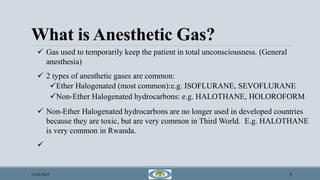
What is Anesthetic Gas?
 Gas used to temporarily keep the patient in total unconsciousness. (General
anesthesia)
 2 types of anesthetic gases are common:
Ether Halogenated (most common):e.g. ISOFLURANE, SEVOFLURANE
Non-Ether Halogenated hydrocarbons: e.g. HALOTHANE, HOLOROFORM
 Non-Ether Halogenated hydrocarbons are no longer used in developed countries
because they are toxic, but are very common in Third World. E.g. HALOTHANE
is very common in Rwanda.

21/03/2023 5
Cont.…
 Other types of anesthetic gases: XENON (costly)
 The Anesthetic gases are stored in liquid state at room
temperature but are very volatile.
 A vaporizer is used to administer the anesthetic gases to patients
21/03/2023 6
7
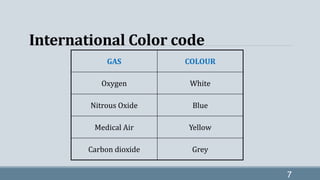
International Color code
GAS COLOUR
Oxygen White
Nitrous Oxide Blue
Medical Air Yellow
Carbon dioxide Grey
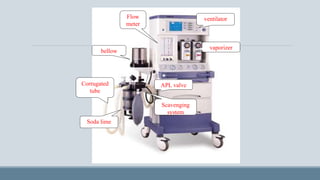
vaporizer
bellow
Corrugated
tube
Soda lime
Flow
meter
ventilator
APL valve
Scavenging
system
Basic Components
Pressure Reducing Valve
Regulates the pressure of the gas leaving the tank and going into
the anesthesia machine.
Reduces the pressure of oxygen that leaves the tank at 2200 psi to
a safer 50 psi.
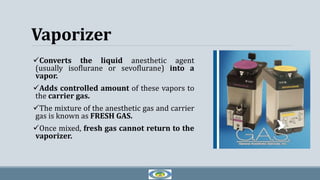
Vaporizer
Converts the liquid anesthetic agent
(usually isoflurane or sevoflurane) into a
vapor.
Adds controlled amount of these vapors to
the carrier gas.
The mixture of the anesthetic gas and carrier
gas is known as FRESH GAS.
Once mixed, fresh gas cannot return to the
vaporizer.
Safety Features of Vaporizers
• Pin safety system to prevent filling up
with wrong agent.
• Interlock mechanism to prevent using
two agents simultaneously.
Reservoir Bag
 Fills as gases enter the circuit or patient exhales, deflates as
patient inhales for manual ventilation
FUNCTIONS
1) Stores gas
2) Allows assessment of respiratory
rate and depth
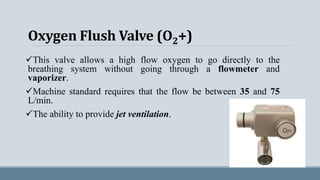
Oxygen Flush Valve (O2+)
This valve allows a high flow oxygen to go directly to the
breathing system without going through a flowmeter and
vaporizer.
Machine standard requires that the flow be between 35 and 75
L/min.
The ability to provide jet ventilation.
Carbon dioxide Absorber
 Sodalime (CaOH2 + NaOH + KOH + silica) or Baralyme
(Ba[OH] 2 + Ca[OH]2) contained in the absorber combines
with carbon dioxide, forming CaCO2 and liberating heat and
moisture (H2O).
 The canister should be changed when 25% to 50% of the
contents has changed color.
 Soda lime is the most common absorbent and is capable of
absorbing up to 23L of CO2 per 100g of absorbent. It´s
main component is calcium hydroxide (80%).
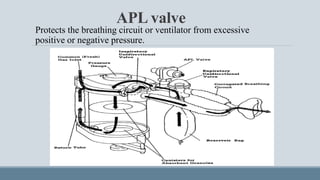
Adjustable Pressure Limiting (APL) Valve
The APL valve is used to control the pressure in the breathing
system and allows excess gas to escape.
APL Valve limits the amount of pressure buildup that can occur
only during manual ventilation.
Manual Ventilation: Valve is usually left partially open. During
inspiration the bag is squeezed pushing gas into the inspiratory
limb until the pressure relief is reached.
Cont.…
APL Valve is also called pop-off valve.
When the user adjusts the APL valve to trap more gas inside the
breathing circuit, a spring inside the APL valve is compressed
according to how much the user turns the APL valve.
The degree of spring compression exerts a proportional force on
a sealing diaphragm in the APL valve.
The pressure inside the breathing circuit must generate a force
that exceeds the spring compression force for the APL valve to
open.
APL valve
Protects the breathing circuit or ventilator from excessive
positive or negative pressure.
Anesthesia Ventilators
The bellows is compressed
intermittently when oxygen or air
is directed into the chamber,
thereby pressurizing it.
Most ventilators allow direct
adjustment of tidal volume,
with I : E ratio.
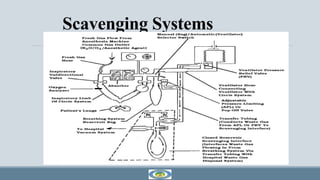
Scavenging Systems
 A scavenging system channels waste gases away from the
operating room to a location outside the hospital building.
Specific anesthetic gas-scavenging systems should be used
routinely. These systems consist of a collecting system, a
transfer system, a receiving system, and a disposal system.
Scavenging Systems
Common Gas Outlet
 The common gas outlet is the port where gases exit the
machine and is connected to the breathing system via the
fresh gas hose.
Breathing System
23
1 Absorber
canister
2 Inspiratory
port
3 Inspiratory
valve
4 Expiratory
port
5 Expiratory
valve
6 Bellows
7 Airway
pressure
gauge
8 Handle
9 Bag Arm 10 APL valve
Anesthesia Machine Standards
Compromise of 3 different pressure system.
High Pressure System: From Cylinder to pressure reducing
valves
Intermediate Pressure System: From Pressure reducing valve
to flowmeter.
Low Pressure System: From flowmeter to common gas outlet.
The Anesthesia Machine
High Intermediate Low Pressure Circuit
High Pressure System
Gas from the high pressure cylinders or from a compressor and an
O2 plant is supply via the back of the anesthesia machine (2200 psig
for O2)
The high pressure side consists of:
Hanger Yolk (reserve gas cylinder holder)
Check valve (prevent reverse flow of gas)
Cylinder Pressure Indicator (Gauge)
Pressure Reducing Device (Regulator)
Cylinders are not used if there is wall-mounted gas supply.
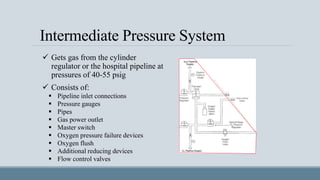
Intermediate Pressure System
 Gets gas from the cylinder
regulator or the hospital pipeline at
pressures of 40-55 psig
 Consists of:
 Pipeline inlet connections
 Pressure gauges
 Pipes
 Gas power outlet
 Master switch
 Oxygen pressure failure devices
 Oxygen flush
 Additional reducing devices
 Flow control valves
3.The low-pressure circuit: includes components distal to the flowmeter needle:
Valves
Flowmeter tubes
Vaporizers
Common gas outlet.
21/03/2023 31

anesthesia machine.pptx

  • 1.
    Institute of Technology Departmentof Biomedical Engineering BIOMEDICAL INSTRUMENTATION LAB-II BMEG 3154 LECTURE ON – ANESTHESIA MACHINE 21/03/2023 1
  • 2.
  • 3.
    Objective After the endof this lecture the student will able to:- Know the definition of an Anesthesia Machine Know the different parts of an Anesthesia Machine and their use. Set up and use of anesthetic machine Demonstrate anesthesia machine at lab 21/03/2023 3
  • 4.
    Introduction Anesthesia Machine isa device used to provide an accurate and continuous supply of medical gases (such as medical air, Oxygen and nitrous oxide), mixed with an accurate concentration of anesthetic vapor (such as isoflurane), and deliver this to the patient at a safe pressure and flow.
  • 5.
    What is AnestheticGas?  Gas used to temporarily keep the patient in total unconsciousness. (General anesthesia)  2 types of anesthetic gases are common: Ether Halogenated (most common):e.g. ISOFLURANE, SEVOFLURANE Non-Ether Halogenated hydrocarbons: e.g. HALOTHANE, HOLOROFORM  Non-Ether Halogenated hydrocarbons are no longer used in developed countries because they are toxic, but are very common in Third World. E.g. HALOTHANE is very common in Rwanda.  21/03/2023 5
  • 6.
    Cont.…  Other typesof anesthetic gases: XENON (costly)  The Anesthetic gases are stored in liquid state at room temperature but are very volatile.  A vaporizer is used to administer the anesthetic gases to patients 21/03/2023 6
  • 7.
    7 International Color code GASCOLOUR Oxygen White Nitrous Oxide Blue Medical Air Yellow Carbon dioxide Grey
  • 8.
  • 9.
    Basic Components Pressure ReducingValve Regulates the pressure of the gas leaving the tank and going into the anesthesia machine. Reduces the pressure of oxygen that leaves the tank at 2200 psi to a safer 50 psi.
  • 10.
    Vaporizer Converts the liquidanesthetic agent (usually isoflurane or sevoflurane) into a vapor. Adds controlled amount of these vapors to the carrier gas. The mixture of the anesthetic gas and carrier gas is known as FRESH GAS. Once mixed, fresh gas cannot return to the vaporizer.
  • 11.
    Safety Features ofVaporizers • Pin safety system to prevent filling up with wrong agent. • Interlock mechanism to prevent using two agents simultaneously.
  • 12.
    Reservoir Bag  Fillsas gases enter the circuit or patient exhales, deflates as patient inhales for manual ventilation FUNCTIONS 1) Stores gas 2) Allows assessment of respiratory rate and depth
  • 13.
    Oxygen Flush Valve(O2+) This valve allows a high flow oxygen to go directly to the breathing system without going through a flowmeter and vaporizer. Machine standard requires that the flow be between 35 and 75 L/min. The ability to provide jet ventilation.
  • 14.
    Carbon dioxide Absorber Sodalime (CaOH2 + NaOH + KOH + silica) or Baralyme (Ba[OH] 2 + Ca[OH]2) contained in the absorber combines with carbon dioxide, forming CaCO2 and liberating heat and moisture (H2O).  The canister should be changed when 25% to 50% of the contents has changed color.  Soda lime is the most common absorbent and is capable of absorbing up to 23L of CO2 per 100g of absorbent. It´s main component is calcium hydroxide (80%).
  • 15.
    Adjustable Pressure Limiting(APL) Valve The APL valve is used to control the pressure in the breathing system and allows excess gas to escape. APL Valve limits the amount of pressure buildup that can occur only during manual ventilation. Manual Ventilation: Valve is usually left partially open. During inspiration the bag is squeezed pushing gas into the inspiratory limb until the pressure relief is reached.
  • 16.
    Cont.… APL Valve isalso called pop-off valve. When the user adjusts the APL valve to trap more gas inside the breathing circuit, a spring inside the APL valve is compressed according to how much the user turns the APL valve. The degree of spring compression exerts a proportional force on a sealing diaphragm in the APL valve. The pressure inside the breathing circuit must generate a force that exceeds the spring compression force for the APL valve to open.
  • 17.
    APL valve Protects thebreathing circuit or ventilator from excessive positive or negative pressure.
  • 18.
    Anesthesia Ventilators The bellowsis compressed intermittently when oxygen or air is directed into the chamber, thereby pressurizing it. Most ventilators allow direct adjustment of tidal volume, with I : E ratio.
  • 19.
    Scavenging Systems  Ascavenging system channels waste gases away from the operating room to a location outside the hospital building. Specific anesthetic gas-scavenging systems should be used routinely. These systems consist of a collecting system, a transfer system, a receiving system, and a disposal system.
  • 20.
  • 22.
    Common Gas Outlet The common gas outlet is the port where gases exit the machine and is connected to the breathing system via the fresh gas hose.
  • 23.
    Breathing System 23 1 Absorber canister 2Inspiratory port 3 Inspiratory valve 4 Expiratory port 5 Expiratory valve 6 Bellows 7 Airway pressure gauge 8 Handle 9 Bag Arm 10 APL valve
  • 24.
    Anesthesia Machine Standards Compromiseof 3 different pressure system. High Pressure System: From Cylinder to pressure reducing valves Intermediate Pressure System: From Pressure reducing valve to flowmeter. Low Pressure System: From flowmeter to common gas outlet.
  • 25.
    The Anesthesia Machine HighIntermediate Low Pressure Circuit
  • 26.
    High Pressure System Gasfrom the high pressure cylinders or from a compressor and an O2 plant is supply via the back of the anesthesia machine (2200 psig for O2) The high pressure side consists of: Hanger Yolk (reserve gas cylinder holder) Check valve (prevent reverse flow of gas) Cylinder Pressure Indicator (Gauge) Pressure Reducing Device (Regulator) Cylinders are not used if there is wall-mounted gas supply.
  • 27.
    Intermediate Pressure System Gets gas from the cylinder regulator or the hospital pipeline at pressures of 40-55 psig  Consists of:  Pipeline inlet connections  Pressure gauges  Pipes  Gas power outlet  Master switch  Oxygen pressure failure devices  Oxygen flush  Additional reducing devices  Flow control valves
  • 28.
    3.The low-pressure circuit:includes components distal to the flowmeter needle: Valves Flowmeter tubes Vaporizers Common gas outlet.
  • 31.