08/27/2025 1
ANAESTHESIA MACHINE,
BREATHING SYSTEMS AND
EQUIPMENTS
By Nawezo;
Anaesthesiologist
08/27/2025 2
OUTLINE
• Anesthesia machine components
• Gas supply
• Safety measures and alarms
• Vaporizers
• Breathing systems
• Carbon dioxide absorbent
• Ventilator
• Scavenging system
08/27/2025 3
Machine check
• Before using the anesthesia machine;
1) Anesthesia machine check
2) Work station preparation
Machine
Oxygen supply
Machine (suction) and tubings
Airway equipment (ETTs, Laryngoscopes, facemasks)
Drugs (Induction agents, NMBs, vasopressors, antibiotics)
08/27/2025 4
08/27/2025 5
Schematic representation
08/27/2025 6
Gas supply: Oxygen production
• Liquid oxygen is produced by
fractional distillation of air, off-
site. It is delivered to the hospital.
• Stored in the VIE.
• Oxygen has a critical temperature
of −119°C, meaning that above
this temperature it must exist as a
gas; the VIE is therefore kept
between −160°C and −180°C.
08/27/2025 7
Gas supply (Piped or cylinder)
• Anesthetic machines are
supplied with oxygen, air and
often nitrous oxide.
• There are many design features
to prevent cross-connection of
these gases because
administration of 100% nitrous
oxide leads rapidly to profound
hypoxia.
08/27/2025 8
Cylinders
08/27/2025 9
A cylinder manifold
• A pipe with several openings, in
this case connected to cylinders
supplying pipeline oxygen,
nitrous oxide or Entonox.
• Used to supply piped nitrous
oxide and Entonox.
• May also be used as a primary
oxygen supply in small hospitals,
or as a backup supply for larger
hospitals.
08/27/2025 10
Vaporizers
• They are plenum vaporizers with a
high resistance to gas flow. E.g.
Sevoflurane, Isoflurane, Enflurane
and halothane.
Each vaporizer is calibrated for a
specific agent and cannot be
interchanged because of the differing
physical properties of the volatile
agents.
08/27/2025 11
Breathing systems
• A breathing system is a device that conducts gases such as oxygen and
anesthetic agents to the patient and conducts waste gases such as CO2
away.
• Generally, classified as open, semi-open, semi-closed and closed.
• More simply, systems can be classified in two groups:
Systems with CO2 washout (includes open and semi-open systems)
Systems with CO2 absorption (includes closed and semi-closed
systems).
08/27/2025 12
Open vs. semi-open system
08/27/2025 13
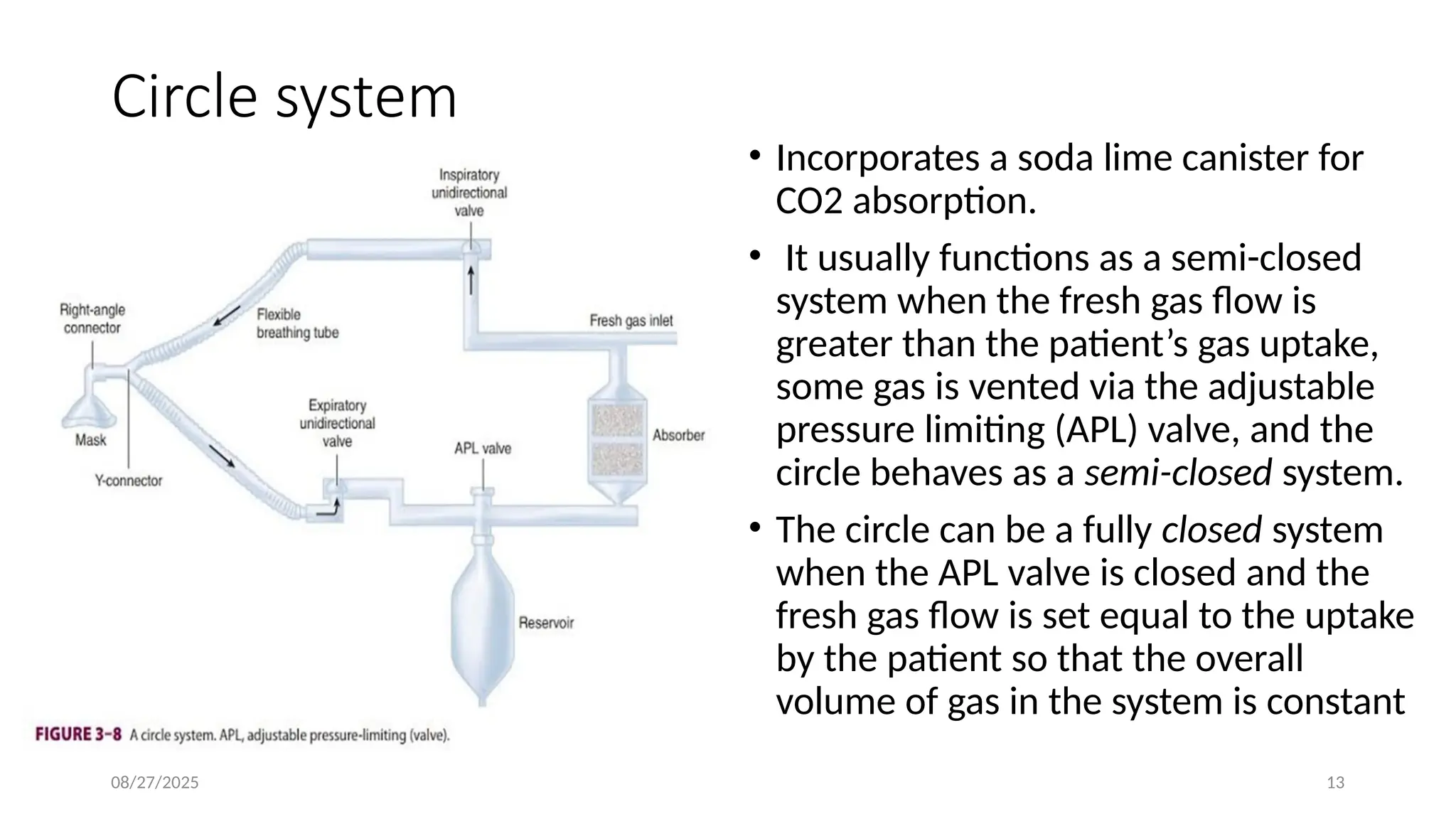
Circle system
• Incorporates a soda lime canister for
CO2 absorption.
• It usually functions as a semi-closed
system when the fresh gas flow is
greater than the patient’s gas uptake,
some gas is vented via the adjustable
pressure limiting (APL) valve, and the
circle behaves as a semi-closed system.
• The circle can be a fully closed system
when the APL valve is closed and the
fresh gas flow is set equal to the uptake
by the patient so that the overall
volume of gas in the system is constant
08/27/2025 14
Efficiency of a breathing system
• The efficiency of a breathing system is defined by the lowest fresh gas
flow that prevents the patient rebreathing CO2.
• Low fresh gas flows are desirable to reduce the amount of expensive
volatile anesthetic that is used and pollution.
• In an inefficient open system, most anesthetic will be vented into the
atmosphere, whereas in a closed system, only the amount taken up
by the patient is required.
08/27/2025 15
An ideal breathing system
• Be simple and portable
• Be safe to use in all age groups
• Reliably deliver the intended gas mixture
• Be efficient in both spontaneous and controlled ventilation
• Protect patients from barotrauma
• Permit scavenging of waste gases
• Offer low resistance to gas flow
• Conserve heat and moisture.
Unfortunately, no system fits all criteria and a compromise is
therefore made depending on the situation.
08/27/2025 16
The Mapleson classification
• Five breathing systems
(A–E) and a sixth (F) was added later.
• Systems are classified according to the relative
positions of three components:
The fresh gas flow (FGF)
The APL valve
 The gas reservoir.
• Variable lengths of corrugated tubing connect
the components.
• Mapleson systems are semi-open and rely on
sufficient fresh gas flow to wash out exhaled
gas and prevent rebreathing.
08/27/2025 17
Mapleson system
• Compared to the circle system,
Mapleson breathing systems are
inefficient.
Meaning that higher FGFs are
required to prevent rebreathing.
Expensive to use with volatile
anesthetics.
They are not used for anesthetic
delivery to adult patients in theatre –
circle systems are used instead.
Uses.
• Mapleson systems continue to be used
in the anesthetic room (D and,
occasionally, A) for;
Transfers or management of critically
ill patients outside of theatre (C).
For pediatric patients (F and,
occasionally, E).
08/27/2025 18
How the Mapleson system works
• The gases maintain their identity as fresh gas flow, dead space gas, alveolar gas, etc.,
and do not mix.
• The reservoir bag continues to fill up, without offering any resistance until it is full.
• The expiratory (APL) valve opens as soon as the reservoir bag is full and the pressure
inside the breathing system is greater than atmospheric pressure.
08/27/2025 19
How the Mapleson system works
• The valve remains open throughout the expiratory phase, without offering any
resistance to gas flow, and closes at the start of the next inspiration.
• Efficiency of a breathing system; is defined by the lowest FGF required to prevent
rebreathing of CO2.
• Afferent Vs. Efferent limbs of the breathing system; named relative to the patient.
• The afferent limb carries gas towards the patient, whereas the efferent limb
carries gas away. The reservoir may be on the afferent or efferent limb of the
system, and may consist of a reservoir bag, reservoir tubing, or both.
08/27/2025 20
Different Mapleson systems
08/27/2025 21
Carbon dioxide absorbent (soda lime)
08/27/2025 22
Soda lime
• Soda lime is used to absorb CO2. CO2
is absorbed by strong alkali (‘caustic
soda’).
• Its main use is to allow the
rebreathing of exhaled gases within
breathing systems. This is most
commonly the circle system.
• Its chemical constituents are:
Calcium hydroxide (CaOH) 80%;
Sodium hydroxide (NaOH) 4%;
 Potassium hydroxide (KOH) 1% (this
accelerates the reaction);
 Water (H2O) 15%.
08/27/2025 23
Equation
• Under ideal conditions 1 kg can absorb 250 l of CO2.
• In the presence of water and with NaOH and KOH as activators:
• The chemical reaction can be summarized as follows:
CO2 + Ca(OH2) → CaCO3 +H2O
08/27/2025 24
Ventilator
08/27/2025 25
Scavenging system
• Purpose of scavenging: The safe
removal of waste theatre gases.
• Minimizing pollution within the
theatre environment.
• Prevents the system from being
over-pressurized or applying
excessive vacuum.
08/27/2025 26
Safety and alarms
• One of the few sub specialties of
‑
medicine, which has quickly
adapted technology to improve
patient safety
• Safety features can be further
sub divided into;
‑
Gas supplies: From the central
pipeline to the machine as well
as cylinders.
Flow meters.
Vaporizers.
Fresh gas delivery: Breathing
systems and ventilators.
08/27/2025 27
08/27/2025 28
END!
• Thank you!

ANAESTHESIA MACHINE, BREATHING SYSTEMS AND EQUIPMENTS.pptx

  • 1.
    08/27/2025 1 ANAESTHESIA MACHINE, BREATHINGSYSTEMS AND EQUIPMENTS By Nawezo; Anaesthesiologist
  • 2.
    08/27/2025 2 OUTLINE • Anesthesiamachine components • Gas supply • Safety measures and alarms • Vaporizers • Breathing systems • Carbon dioxide absorbent • Ventilator • Scavenging system
  • 3.
    08/27/2025 3 Machine check •Before using the anesthesia machine; 1) Anesthesia machine check 2) Work station preparation Machine Oxygen supply Machine (suction) and tubings Airway equipment (ETTs, Laryngoscopes, facemasks) Drugs (Induction agents, NMBs, vasopressors, antibiotics)
  • 4.
  • 5.
  • 6.
    08/27/2025 6 Gas supply:Oxygen production • Liquid oxygen is produced by fractional distillation of air, off- site. It is delivered to the hospital. • Stored in the VIE. • Oxygen has a critical temperature of −119°C, meaning that above this temperature it must exist as a gas; the VIE is therefore kept between −160°C and −180°C.
  • 7.
    08/27/2025 7 Gas supply(Piped or cylinder) • Anesthetic machines are supplied with oxygen, air and often nitrous oxide. • There are many design features to prevent cross-connection of these gases because administration of 100% nitrous oxide leads rapidly to profound hypoxia.
  • 8.
  • 9.
    08/27/2025 9 A cylindermanifold • A pipe with several openings, in this case connected to cylinders supplying pipeline oxygen, nitrous oxide or Entonox. • Used to supply piped nitrous oxide and Entonox. • May also be used as a primary oxygen supply in small hospitals, or as a backup supply for larger hospitals.
  • 10.
    08/27/2025 10 Vaporizers • Theyare plenum vaporizers with a high resistance to gas flow. E.g. Sevoflurane, Isoflurane, Enflurane and halothane. Each vaporizer is calibrated for a specific agent and cannot be interchanged because of the differing physical properties of the volatile agents.
  • 11.
    08/27/2025 11 Breathing systems •A breathing system is a device that conducts gases such as oxygen and anesthetic agents to the patient and conducts waste gases such as CO2 away. • Generally, classified as open, semi-open, semi-closed and closed. • More simply, systems can be classified in two groups: Systems with CO2 washout (includes open and semi-open systems) Systems with CO2 absorption (includes closed and semi-closed systems).
  • 12.
    08/27/2025 12 Open vs.semi-open system
  • 13.
    08/27/2025 13 Circle system •Incorporates a soda lime canister for CO2 absorption. • It usually functions as a semi-closed system when the fresh gas flow is greater than the patient’s gas uptake, some gas is vented via the adjustable pressure limiting (APL) valve, and the circle behaves as a semi-closed system. • The circle can be a fully closed system when the APL valve is closed and the fresh gas flow is set equal to the uptake by the patient so that the overall volume of gas in the system is constant
  • 14.
    08/27/2025 14 Efficiency ofa breathing system • The efficiency of a breathing system is defined by the lowest fresh gas flow that prevents the patient rebreathing CO2. • Low fresh gas flows are desirable to reduce the amount of expensive volatile anesthetic that is used and pollution. • In an inefficient open system, most anesthetic will be vented into the atmosphere, whereas in a closed system, only the amount taken up by the patient is required.
  • 15.
    08/27/2025 15 An idealbreathing system • Be simple and portable • Be safe to use in all age groups • Reliably deliver the intended gas mixture • Be efficient in both spontaneous and controlled ventilation • Protect patients from barotrauma • Permit scavenging of waste gases • Offer low resistance to gas flow • Conserve heat and moisture. Unfortunately, no system fits all criteria and a compromise is therefore made depending on the situation.
  • 16.
    08/27/2025 16 The Maplesonclassification • Five breathing systems (A–E) and a sixth (F) was added later. • Systems are classified according to the relative positions of three components: The fresh gas flow (FGF) The APL valve  The gas reservoir. • Variable lengths of corrugated tubing connect the components. • Mapleson systems are semi-open and rely on sufficient fresh gas flow to wash out exhaled gas and prevent rebreathing.
  • 17.
    08/27/2025 17 Mapleson system •Compared to the circle system, Mapleson breathing systems are inefficient. Meaning that higher FGFs are required to prevent rebreathing. Expensive to use with volatile anesthetics. They are not used for anesthetic delivery to adult patients in theatre – circle systems are used instead. Uses. • Mapleson systems continue to be used in the anesthetic room (D and, occasionally, A) for; Transfers or management of critically ill patients outside of theatre (C). For pediatric patients (F and, occasionally, E).
  • 18.
    08/27/2025 18 How theMapleson system works • The gases maintain their identity as fresh gas flow, dead space gas, alveolar gas, etc., and do not mix. • The reservoir bag continues to fill up, without offering any resistance until it is full. • The expiratory (APL) valve opens as soon as the reservoir bag is full and the pressure inside the breathing system is greater than atmospheric pressure.
  • 19.
    08/27/2025 19 How theMapleson system works • The valve remains open throughout the expiratory phase, without offering any resistance to gas flow, and closes at the start of the next inspiration. • Efficiency of a breathing system; is defined by the lowest FGF required to prevent rebreathing of CO2. • Afferent Vs. Efferent limbs of the breathing system; named relative to the patient. • The afferent limb carries gas towards the patient, whereas the efferent limb carries gas away. The reservoir may be on the afferent or efferent limb of the system, and may consist of a reservoir bag, reservoir tubing, or both.
  • 20.
  • 21.
    08/27/2025 21 Carbon dioxideabsorbent (soda lime)
  • 22.
    08/27/2025 22 Soda lime •Soda lime is used to absorb CO2. CO2 is absorbed by strong alkali (‘caustic soda’). • Its main use is to allow the rebreathing of exhaled gases within breathing systems. This is most commonly the circle system. • Its chemical constituents are: Calcium hydroxide (CaOH) 80%; Sodium hydroxide (NaOH) 4%;  Potassium hydroxide (KOH) 1% (this accelerates the reaction);  Water (H2O) 15%.
  • 23.
    08/27/2025 23 Equation • Underideal conditions 1 kg can absorb 250 l of CO2. • In the presence of water and with NaOH and KOH as activators: • The chemical reaction can be summarized as follows: CO2 + Ca(OH2) → CaCO3 +H2O
  • 24.
  • 25.
    08/27/2025 25 Scavenging system •Purpose of scavenging: The safe removal of waste theatre gases. • Minimizing pollution within the theatre environment. • Prevents the system from being over-pressurized or applying excessive vacuum.
  • 26.
    08/27/2025 26 Safety andalarms • One of the few sub specialties of ‑ medicine, which has quickly adapted technology to improve patient safety • Safety features can be further sub divided into; ‑ Gas supplies: From the central pipeline to the machine as well as cylinders. Flow meters. Vaporizers. Fresh gas delivery: Breathing systems and ventilators.
  • 27.
  • 28.