Unlocking Peer Learning Building Collaborative Classroom Communities.pdf
Promoting student collaboration and deeper learning by fostering supportive, peer-driven classroom communities.
For more information:
https://www.ecoleglobale.com/blog/best-boarding-schools-in-dehradun/
Peer learning transformsthe classroom into a collaborative
space where students actively engage, support one another,
and take responsibility for their learning.
Peer learning involves students learning from and with
each other through discussion, collaboration, and
feedback.
Moves beyond traditional teacher-led instruction to
promote active participation and student ownership.
Builds a community of learners where every student
contributes to and benefits from shared knowledge.
What is Peer Learning and Why It
Matters
3.
To make peerlearning effective, structure is key. Clear goals,
respectful communication, and purposeful groupings help
students learn collaboratively and meaningfully.
Structured Group Work: Use roles (leader, recorder,
presenter) to ensure participation and accountability.
Think-Pair-Share: Encourage students to reflect, discuss
with a partner, then share with the class.
Peer Tutoring: Pair stronger and struggling students for
reciprocal support.
Collaborative Projects: Assign group tasks that require
shared input and creativity.
Strategies to Foster Peer Learning
and Collaboration
4.
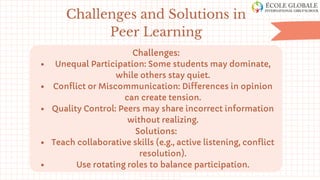
Challenges:
Unequal Participation: Somestudents may dominate,
while others stay quiet.
Conflict or Miscommunication: Differences in opinion
can create tension.
Quality Control: Peers may share incorrect information
without realizing.
Solutions:
Teach collaborative skills (e.g., active listening, conflict
resolution).
Use rotating roles to balance participation.
Challenges and Solutions in
Peer Learning
5.
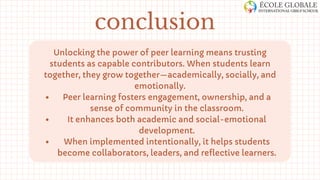
Unlocking the powerof peer learning means trusting
students as capable contributors. When students learn
together, they grow together—academically, socially, and
emotionally.
Peer learning fosters engagement, ownership, and a
sense of community in the classroom.
It enhances both academic and social-emotional
development.
When implemented intentionally, it helps students
become collaborators, leaders, and reflective learners.
conclusion