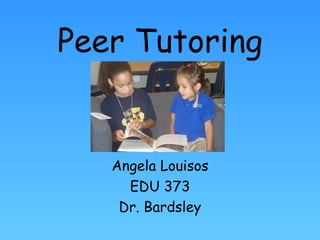
Peer Tutoring Angela Louisos EDU 373 Dr. Bardsley
Defining Peer Tutoring Peer tutoring is when students work with each other to learn and progress. Students are usually paired up or in small groups: High level students mixed with lower level students  Helps deepen understanding through conversing with peers/scaffolding “ Engages students in their “Zones of Proximal Development” (LaGue & Wilson, p. 183)
Defining Peer Tutoring  Continued “ Peer tutoring is an evidence-based, cooperative learning strategy that increases students’ engagement in functional, academic content” (Van Norman 2007, 89) “… the practice of students teaching other students in a setting directed and planned by teachers” (Peralta 2007, 13)
Scenarios and Examples Enhancing literacy skills, phonics, and reading comprehension Pairing older students working with younger students (ex. Sixth graders peer tutoring with fifth graders) Practice comprehension strategies QUICK strategy (Questioning, Understanding new words, Imaging, Connecting, Keeping it all together) Peer tutoring supports sight word identification, problem solving, and algebra Peer to peer modeling: Students model the skill/strategy for the other student during tutoring
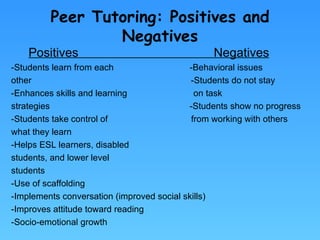
Peer Tutoring: Positives and Negatives Positives  Negatives -Students learn from each  -Behavioral issues other  -Students do not stay -Enhances skills and learning  on task strategies  -Students show no progress -Students take control of  from working with others what they learn -Helps ESL learners, disabled  students, and lower level  students -Use of scaffolding -Implements conversation (improved social skills) -Improves attitude toward reading -Socio-emotional growth
Connections to the Readings “ Demands of Today’s Classroom” by Larrivee (2009) Peer tutoring brings about a switch in roles between the teacher and students. Larrivee discusses this switch in the article “ The teacher role is changing from controlling learning to deliberately facilitating learning. The student role is changing from passive recipient to teacher-directed instruction to interactive participant…” (p.6)
Connections to Readings Continued “ Enhancing Students’ Motivation” by Weinstein and Mignano (2007) Brophy would agree with the use of peer tutoring Brophy suggests that students work and interact with peers to enhance students’ motivation (p. 205)
Online Resource Video Link: http://www.youtube.com/watch?v=XYGLdtOK5Fk This is a video that goes over how teachers can use peer tutoring during writing or a writer’s workshop. Provides examples/strategies of how to structure peer tutoring during writing instruction
Works Cited LaGue, K., & Wilson, K.. (2010). Using peer tutors to improve reading comprehension.  Kappa Delta Pi Record , 46(4), 182-186.  Retrieved October 2, 2010, from ProQuest Education Journals. (Document ID: 2054949141). Larrivee (2009) Demands of today’s classroom. 1-8. Norman, R.. (2007). "Who's on first?": Using sports trivia peer tutoring to increase conversational language.  Intervention in School and Clinic , 43(2), 88-100.  Retrieved October 3, 2010, from Research Library. (Document ID: 1378729301). Peralta, A.. (2007). Cross-age tutoring: When fifth graders become teachers of writing.  Thinking Classroom , 8(1), 13-18.  Retrieved October 3, 2010, from Research Library. (Document ID: 1387415481). Weinstein, C. S. & Mignano, A. J. (2007). Elements classroom management: Lessons from research and practice. New York: McGraw Hill, 32-58 & 202-227. 2009).  Writing Tips :Teaching peer tutoring in written language  [Online video]. Retrieved October 3, 2010, from http://www.youtube.com/watch?v=XYGLdtOK5Fk

Edu 373 peer tutoring

  • 1.
    Peer Tutoring AngelaLouisos EDU 373 Dr. Bardsley
  • 2.
    Defining Peer TutoringPeer tutoring is when students work with each other to learn and progress. Students are usually paired up or in small groups: High level students mixed with lower level students Helps deepen understanding through conversing with peers/scaffolding “ Engages students in their “Zones of Proximal Development” (LaGue & Wilson, p. 183)
  • 3.
    Defining Peer Tutoring Continued “ Peer tutoring is an evidence-based, cooperative learning strategy that increases students’ engagement in functional, academic content” (Van Norman 2007, 89) “… the practice of students teaching other students in a setting directed and planned by teachers” (Peralta 2007, 13)
  • 4.
    Scenarios and ExamplesEnhancing literacy skills, phonics, and reading comprehension Pairing older students working with younger students (ex. Sixth graders peer tutoring with fifth graders) Practice comprehension strategies QUICK strategy (Questioning, Understanding new words, Imaging, Connecting, Keeping it all together) Peer tutoring supports sight word identification, problem solving, and algebra Peer to peer modeling: Students model the skill/strategy for the other student during tutoring
  • 5.
    Peer Tutoring: Positivesand Negatives Positives Negatives -Students learn from each -Behavioral issues other -Students do not stay -Enhances skills and learning on task strategies -Students show no progress -Students take control of from working with others what they learn -Helps ESL learners, disabled students, and lower level students -Use of scaffolding -Implements conversation (improved social skills) -Improves attitude toward reading -Socio-emotional growth
  • 6.
    Connections to theReadings “ Demands of Today’s Classroom” by Larrivee (2009) Peer tutoring brings about a switch in roles between the teacher and students. Larrivee discusses this switch in the article “ The teacher role is changing from controlling learning to deliberately facilitating learning. The student role is changing from passive recipient to teacher-directed instruction to interactive participant…” (p.6)
  • 7.
    Connections to ReadingsContinued “ Enhancing Students’ Motivation” by Weinstein and Mignano (2007) Brophy would agree with the use of peer tutoring Brophy suggests that students work and interact with peers to enhance students’ motivation (p. 205)
  • 8.
    Online Resource VideoLink: http://www.youtube.com/watch?v=XYGLdtOK5Fk This is a video that goes over how teachers can use peer tutoring during writing or a writer’s workshop. Provides examples/strategies of how to structure peer tutoring during writing instruction
  • 9.
    Works Cited LaGue, K., & Wilson, K.. (2010).Using peer tutors to improve reading comprehension.  Kappa Delta Pi Record , 46(4), 182-186.  Retrieved October 2, 2010, from ProQuest Education Journals. (Document ID: 2054949141). Larrivee (2009) Demands of today’s classroom. 1-8. Norman, R.. (2007). "Who's on first?": Using sports trivia peer tutoring to increase conversational language.  Intervention in School and Clinic , 43(2), 88-100.  Retrieved October 3, 2010, from Research Library. (Document ID: 1378729301). Peralta, A.. (2007). Cross-age tutoring: When fifth graders become teachers of writing.  Thinking Classroom , 8(1), 13-18.  Retrieved October 3, 2010, from Research Library. (Document ID: 1387415481). Weinstein, C. S. & Mignano, A. J. (2007). Elements classroom management: Lessons from research and practice. New York: McGraw Hill, 32-58 & 202-227. 2009). Writing Tips :Teaching peer tutoring in written language [Online video]. Retrieved October 3, 2010, from http://www.youtube.com/watch?v=XYGLdtOK5Fk