SXSW EDU Proposal
2019
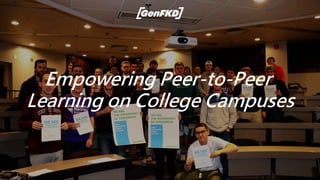
Empowering Peer-to-Peer
Learning on College Campuses
The main benefits of peer teaching include, but are not limited to, the
following:
Students receive more time for individualized learning.
Direct interaction between students promotes active learning.
Peer teachers reinforce their own learning by instructing others.
Students feel more comfortable and open when interacting with a
peer.
Peers and students share a similar discourse, allowing for greater
understanding.
Peer teaching is a financially efficient alternative to hiring more staff
members.
Teachers receive more time to focus on the next lesson.
‘Teaching peers is one of the best
ways to develop mastery”
Jeff Attwood, Stack Overflow
Peer learning is receiving an increasingly
important role in a changing workforce.
It may be time to formalize peer learning within
higher education’s required curriculum.
1. What types of concrete options do
students have for peer learning and peer
teaching?
2. How can peer-to-peer empowerment help
bridge the gap from higher education into
the workforce?
3. What steps can universities take to provide
better policy to promote peer-to-peer
learning?
Join our panel!

Sxsw edu proposal graham

  • 1.
  • 2.
  • 3.
    The main benefitsof peer teaching include, but are not limited to, the following: Students receive more time for individualized learning. Direct interaction between students promotes active learning. Peer teachers reinforce their own learning by instructing others. Students feel more comfortable and open when interacting with a peer. Peers and students share a similar discourse, allowing for greater understanding. Peer teaching is a financially efficient alternative to hiring more staff members. Teachers receive more time to focus on the next lesson.
  • 4.
    ‘Teaching peers isone of the best ways to develop mastery” Jeff Attwood, Stack Overflow
  • 5.
    Peer learning isreceiving an increasingly important role in a changing workforce. It may be time to formalize peer learning within higher education’s required curriculum.
  • 6.
    1. What typesof concrete options do students have for peer learning and peer teaching?
  • 7.
    2. How canpeer-to-peer empowerment help bridge the gap from higher education into the workforce?
  • 8.
    3. What stepscan universities take to provide better policy to promote peer-to-peer learning?
  • 9.