J. Terry Gates, Mary E. Bickel
Building Bridges, Jefferson City, Missouri Nov. 6-8, 2011
Deepen achievement now.
Create better futures for kids.
What can kids do with their
knowledge and skills?
 1: Knowledge-keepers.
 2: Knowledge-tellers.
 3: Knowledge-builders.
Knowledge-builders make magic!!
They can choose to be…
Building frameworks today…
 1: Frame and share ways to
strengthen kids’ tutoring skills.
 2: Frame a group instruction
process for peer teachers.
Kids who teach learn more deeply.
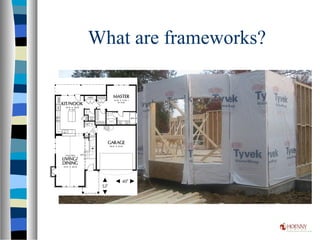
What are frameworks?
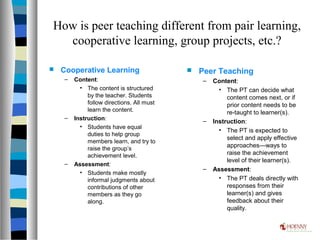
How is peer teaching different from pair learning,
cooperative learning, group projects, etc.?
 Peer Teaching
– Content:
• The PT can decide what
content comes next, or if
prior content needs to be
re-taught to learner(s).
– Instruction:
• The PT is expected to
select and apply effective
approaches—ways to
raise the achievement
level of their learner(s).
– Assessment:
• The PT deals directly with
responses from their
learner(s) and gives
feedback about their
quality.
 Cooperative Learning
– Content:
• The content is structured
by the teacher. Students
follow directions. All must
learn the content.
– Instruction:
• Students have equal
duties to help group
members learn, and try to
raise the group’s
achievement level.
– Assessment:
• Students make mostly
informal judgments about
contributions of other
members as they go
along.
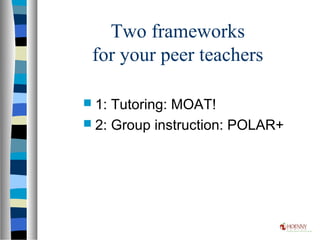
Two frameworks
for your peer teachers
 1: Tutoring: MOAT!
 2: Group instruction: POLAR+
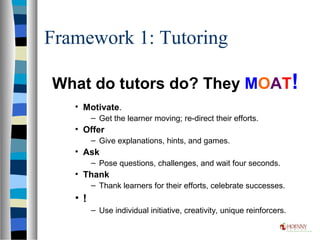
Framework 1: Tutoring
What do tutors do? They MOAT!
• Motivate.
– Get the learner moving; re-direct their efforts.
• Offer
– Give explanations, hints, and games.
• Ask
– Pose questions, challenges, and wait four seconds.
• Thank
– Thank learners for their efforts, celebrate successes.
• !
– Use individual initiative, creativity, unique reinforcers.
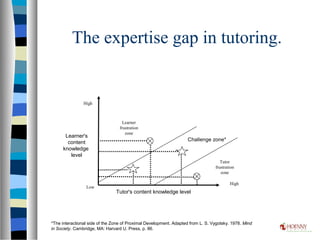
The expertise gap in tutoring.
Challenge zone*
Tutor's content knowledge level
Learner's
content
knowledge
level
Tutor
frustration
zone
Learner
frustration
zone
High
High
Low
*The interactional side of the Zone of Proximal Development. Adapted from L. S. Vygotsky. 1978. Mind
in Society. Cambridge, MA: Harvard U. Press, p. 86.
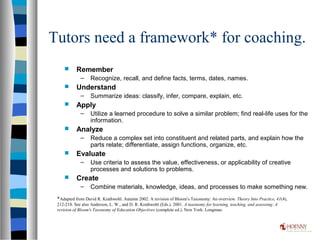
Tutors need a framework* for coaching.
 Remember
– Recognize, recall, and define facts, terms, dates, names.
 Understand
– Summarize ideas: classify, infer, compare, explain, etc.
 Apply
– Utilize a learned procedure to solve a similar problem; find real-life uses for the
information.
 Analyze
– Reduce a complex set into constituent and related parts, and explain how the
parts relate; differentiate, assign functions, organize, etc.
 Evaluate
– Use criteria to assess the value, effectiveness, or applicability of creative
processes and solutions to problems.
 Create
– Combine materials, knowledge, ideas, and processes to make something new.
*Adapted from David R. Krathwohl. Autumn 2002. A revision of Bloom’s Taxonomy: An overview. Theory Into Practice, 41(4),
212-218. See also Anderson, L. W., and D. R. Krathwohl (Eds.). 2001. A taxonomy for learning, teaching, and assessing: A
revision of Bloom's Taxonomy of Education Objectives (complete ed.). New York: Longman.
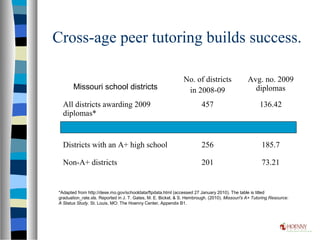
Cross-age peer tutoring builds success.
Missouri school districts
No. of districts
in 2008-09
Avg. no. 2009
diplomas
All districts awarding 2009
diplomas*
457 136.42
Districts with an A+ high school 256 185.7
Non-A+ districts 201 73.21
*Adapted from http://dese.mo.gov/schooldata/ftpdata.html (accessed 27 January 2010). The table is titled
graduation_rate.xls. Reported in J. T. Gates, M. E. Bickel, & S. Hembrough. (2010). Missouri's A+ Tutoring Resource:
A Status Study. St. Louis, MO: The Hoenny Center, Appendix B1.
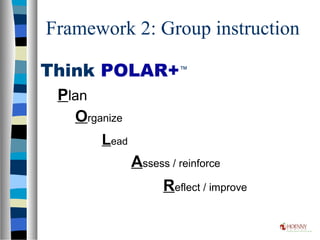
Think POLAR+™
Plan
Organize
Lead
Assess / reinforce
Reflect / improve
Framework 2: Group instruction
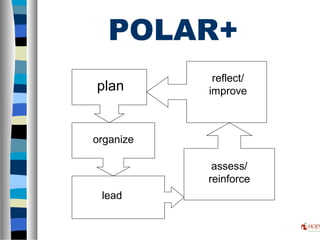
POLAR+
plan
organize
lead
assess/
reinforce
reflect/
improve
What’s the + in POLAR+?
 Real-life teaching situations require a lot.
– Intuition, creativity, individuality, perseverance, several kinds of
knowledge, much more…
 Teacher-to-teacher talk, even with kids.
 Teaching grows with people who do it.
 A Pathway in Teaching from early grades.
Adapt these ideas!
Do them YOUR way!
PPeerrssoonnaalliittyy
Safe, structured opportunities…
End-of-the-day wrap-up
 Second grade - The College School, Webster Groves, Missouri - Colleen
Corbett and Cristina Rapp
Student has each job for 2 weeks per year, in final 15 minutes each day; jobs
rotate each Monday
– Stack chairs, straighten library, etc.
– Journal entry
– Scrapbook page
– Joke of the day
– Juicy word
– Calendar work (color day block, ask questions)
– Science Fridays, featuring the scientist of the week
POLAR+ opportunity
Note: In the presentation, we showed a video of four second-graders
quizzing their peers on a) a riddle (“Joke of the Day”), b) a vocabulary
word (“Juicy Word”), and c) two questions about February. They illustrated
four different teaching personalities (philosopher, drill sergeant, nurturer,
and game show host) and many good teaching skills.
The discussion centered around several observations:
1.Their personalities came through clearly. The mentor’s job is to reveal to
them the personality traits that are effective in teaching and to help them
find alternative behaviors for traits that impede learning.
2.There were some brilliant teaching skills displayed by these children as
well as some habits that should be changed.
3.These kids responded to answers their peers gave to their questions in
various ways, consistent with their individual differences (above). The
impulse to respond is going to be there in every similar situation, but how
the child behaves on that impulse can be coached for effectiveness.
So, what do my kids need from
me in peer teaching?
 1: Safe, structured opportunities.
 2: Professional tips.
 3: Some minimal supervision:
– Coaching.
– Feedback.
– Debriefing.
– Prompts for reflecting.
Why debrief kids?
Reveal teaching strengths to themselves.
Let you know what they’re thinking.
Get kids planning for improvements.
Hear some great insights about teaching.
A third grader reflects on teaching natural science topics
to 2nd graders in the park:
“It was hard. I didn’t get a break until
lunch and I had to stand up all the time.”
Our invitation…
 Join our Professional Partners National Network.
 Add more peer teaching strategies to your classroom planning.
 Apply for a Hoenny Center Grant for an action research report.
(See “Resources” at www.hoennycenter.org.)
 Share your peer teaching successes, tips, and classroom
research through our web site.
 Invite colleagues to help you build a K-12 vertical system in your
district.
 Start a Pathway in Teaching program.
 Keep us posted at teachers@hoennycenter.org.
www.hoennycenter.org
teachers@hoennycenter.org
On the next frontier of teacher development.

Peer tutoring power point

  • 1.
    J. Terry Gates,Mary E. Bickel Building Bridges, Jefferson City, Missouri Nov. 6-8, 2011
  • 2.
    Deepen achievement now. Createbetter futures for kids.
  • 3.
    What can kidsdo with their knowledge and skills?  1: Knowledge-keepers.  2: Knowledge-tellers.  3: Knowledge-builders. Knowledge-builders make magic!! They can choose to be…
  • 4.
    Building frameworks today… 1: Frame and share ways to strengthen kids’ tutoring skills.  2: Frame a group instruction process for peer teachers. Kids who teach learn more deeply.
  • 5.
  • 6.
    How is peerteaching different from pair learning, cooperative learning, group projects, etc.?  Peer Teaching – Content: • The PT can decide what content comes next, or if prior content needs to be re-taught to learner(s). – Instruction: • The PT is expected to select and apply effective approaches—ways to raise the achievement level of their learner(s). – Assessment: • The PT deals directly with responses from their learner(s) and gives feedback about their quality.  Cooperative Learning – Content: • The content is structured by the teacher. Students follow directions. All must learn the content. – Instruction: • Students have equal duties to help group members learn, and try to raise the group’s achievement level. – Assessment: • Students make mostly informal judgments about contributions of other members as they go along.
  • 7.
    Two frameworks for yourpeer teachers  1: Tutoring: MOAT!  2: Group instruction: POLAR+
  • 8.
    Framework 1: Tutoring Whatdo tutors do? They MOAT! • Motivate. – Get the learner moving; re-direct their efforts. • Offer – Give explanations, hints, and games. • Ask – Pose questions, challenges, and wait four seconds. • Thank – Thank learners for their efforts, celebrate successes. • ! – Use individual initiative, creativity, unique reinforcers.
  • 9.
    The expertise gapin tutoring. Challenge zone* Tutor's content knowledge level Learner's content knowledge level Tutor frustration zone Learner frustration zone High High Low *The interactional side of the Zone of Proximal Development. Adapted from L. S. Vygotsky. 1978. Mind in Society. Cambridge, MA: Harvard U. Press, p. 86.
  • 10.
    Tutors need aframework* for coaching.  Remember – Recognize, recall, and define facts, terms, dates, names.  Understand – Summarize ideas: classify, infer, compare, explain, etc.  Apply – Utilize a learned procedure to solve a similar problem; find real-life uses for the information.  Analyze – Reduce a complex set into constituent and related parts, and explain how the parts relate; differentiate, assign functions, organize, etc.  Evaluate – Use criteria to assess the value, effectiveness, or applicability of creative processes and solutions to problems.  Create – Combine materials, knowledge, ideas, and processes to make something new. *Adapted from David R. Krathwohl. Autumn 2002. A revision of Bloom’s Taxonomy: An overview. Theory Into Practice, 41(4), 212-218. See also Anderson, L. W., and D. R. Krathwohl (Eds.). 2001. A taxonomy for learning, teaching, and assessing: A revision of Bloom's Taxonomy of Education Objectives (complete ed.). New York: Longman.
  • 11.
    Cross-age peer tutoringbuilds success. Missouri school districts No. of districts in 2008-09 Avg. no. 2009 diplomas All districts awarding 2009 diplomas* 457 136.42 Districts with an A+ high school 256 185.7 Non-A+ districts 201 73.21 *Adapted from http://dese.mo.gov/schooldata/ftpdata.html (accessed 27 January 2010). The table is titled graduation_rate.xls. Reported in J. T. Gates, M. E. Bickel, & S. Hembrough. (2010). Missouri's A+ Tutoring Resource: A Status Study. St. Louis, MO: The Hoenny Center, Appendix B1.
  • 12.
    Think POLAR+™ Plan Organize Lead Assess /reinforce Reflect / improve Framework 2: Group instruction
  • 13.
  • 14.
    What’s the +in POLAR+?  Real-life teaching situations require a lot. – Intuition, creativity, individuality, perseverance, several kinds of knowledge, much more…  Teacher-to-teacher talk, even with kids.  Teaching grows with people who do it.  A Pathway in Teaching from early grades. Adapt these ideas! Do them YOUR way! PPeerrssoonnaalliittyy
  • 15.
    Safe, structured opportunities… End-of-the-daywrap-up  Second grade - The College School, Webster Groves, Missouri - Colleen Corbett and Cristina Rapp Student has each job for 2 weeks per year, in final 15 minutes each day; jobs rotate each Monday – Stack chairs, straighten library, etc. – Journal entry – Scrapbook page – Joke of the day – Juicy word – Calendar work (color day block, ask questions) – Science Fridays, featuring the scientist of the week
  • 16.
    POLAR+ opportunity Note: Inthe presentation, we showed a video of four second-graders quizzing their peers on a) a riddle (“Joke of the Day”), b) a vocabulary word (“Juicy Word”), and c) two questions about February. They illustrated four different teaching personalities (philosopher, drill sergeant, nurturer, and game show host) and many good teaching skills. The discussion centered around several observations: 1.Their personalities came through clearly. The mentor’s job is to reveal to them the personality traits that are effective in teaching and to help them find alternative behaviors for traits that impede learning. 2.There were some brilliant teaching skills displayed by these children as well as some habits that should be changed. 3.These kids responded to answers their peers gave to their questions in various ways, consistent with their individual differences (above). The impulse to respond is going to be there in every similar situation, but how the child behaves on that impulse can be coached for effectiveness.
  • 17.
    So, what domy kids need from me in peer teaching?  1: Safe, structured opportunities.  2: Professional tips.  3: Some minimal supervision: – Coaching. – Feedback. – Debriefing. – Prompts for reflecting.
  • 18.
    Why debrief kids? Revealteaching strengths to themselves. Let you know what they’re thinking. Get kids planning for improvements. Hear some great insights about teaching. A third grader reflects on teaching natural science topics to 2nd graders in the park: “It was hard. I didn’t get a break until lunch and I had to stand up all the time.”
  • 19.
    Our invitation…  Joinour Professional Partners National Network.  Add more peer teaching strategies to your classroom planning.  Apply for a Hoenny Center Grant for an action research report. (See “Resources” at www.hoennycenter.org.)  Share your peer teaching successes, tips, and classroom research through our web site.  Invite colleagues to help you build a K-12 vertical system in your district.  Start a Pathway in Teaching program.  Keep us posted at teachers@hoennycenter.org.
  • 20.

Editor's Notes

  • #2 Handouts/activities Matching game Teaching autobiography
  • #9 Handouts/activities 1. Go for more than answers
  • #10 Handouts/activities Homeless kids/band Level 1-5 expectations for tutors
  • #11 Handouts/activities Krathwohl article Questioning Teaching ideas-Level 1 Tutoring advice from Lindbergh Specialty groups - share peer teaching plans
  • #20 Handouts/activities: Invitation form