An 8-Bit Multiplier 
1 
PROJECT TITLE: An8-bit Multiplier Circuit. 
COURSE NUMBER & NAME: EE- 211 Digital Logic Design. 
GROUP MEMBERS: 
Muhammad Asad Nawaz. 
Syed Mobeen Riaz. 
Muhammad Sharjeel Hashmi. 
GROUP REGISTRATION# 
11-EE-57 
11-EE-153 
11-EE-159 
DUE DATE: 3rd January 2013 
DATE HANDED IN: 13th December 2012 
ABSTRACT 
We will see how to apply the principles and components of arithmetic circuits 
to implement a subsystem of moderate complexity. Our objective is to design a fast 8- 
by-8 bit multiplier using 4-by-4 bit multipliers as building blocks, along with adders, 
arithmetic logic, and carry look-ahead units.
An 8-Bit Multiplier 
2 
INTRODUCTION 
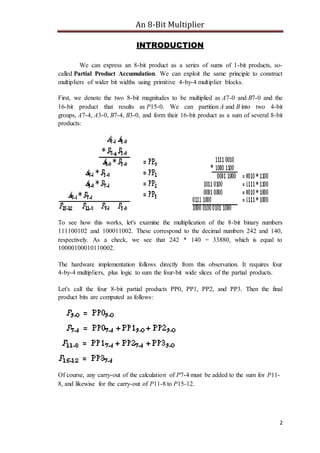
We can express an 8-bit product as a series of sums of 1-bit products, so-called 
Partial Product Accumulation. We can exploit the same principle to construct 
multipliers of wider bit widths using primitive 4-by-4 multiplier blocks. 
First, we denote the two 8-bit magnitudes to be multiplied as A7-0 and B7-0 and the 
16-bit product that results as P15-0. We can partition A and B into two 4-bit 
groups, A7-4, A3-0, B7-4, B3-0, and form their 16-bit product as a sum of several 8-bit 
products: 
To see how this works, let's examine the multiplication of the 8-bit binary numbers 
111100102 and 100011002. These correspond to the decimal numbers 242 and 140, 
respectively. As a check, we see that 242 * 140 = 33880, which is equal to 
10000100010110002. 
The hardware implementation follows directly from this observation. It requires four 
4-by-4 multipliers, plus logic to sum the four-bit wide slices of the partial products. 
Let's call the four 8-bit partial products PP0, PP1, PP2, and PP3. Then the final 
product bits are computed as follows: 
Of course, any carry-out of the calculation of P7-4 must be added to the sum for P11- 
8, and likewise for the carry-out of P11-8 to P15-12.
An 8-Bit Multiplier 
3 
IMPLEMENTATION 
The basic blocks of the implementation are (1) the calculation of partial 
products, (2) the summing of the 4-bit product slices, and (3) the carry look-ahead 
unit. We examine each of these in turn. 
Calculation of Partial Products: 
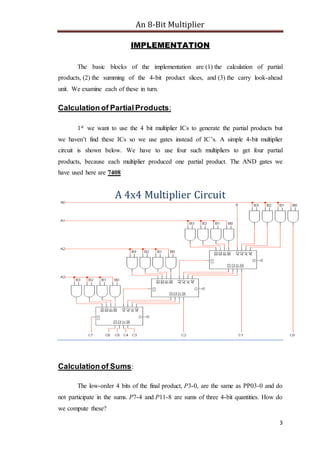
1st we want to use the 4 bit multiplier ICs to generate the partial products but 
we haven’t find these ICs so we use gates instead of IC’s. A simple 4-bit multiplier 
circuit is shown below. We have to use four such multipliers to get four partial 
products, because each multiplier produced one partial product. The AND gates we 
have used here are 7408 
A 4x4 Multiplier Circuit 
Calculation of Sums: 
The low-order 4 bits of the final product, P3-0, are the same as PP03-0 and do 
not participate in the sums. P7-4 and P11-8 are sums of three 4-bit quantities. How do 
we compute these?
An 8-Bit Multiplier 
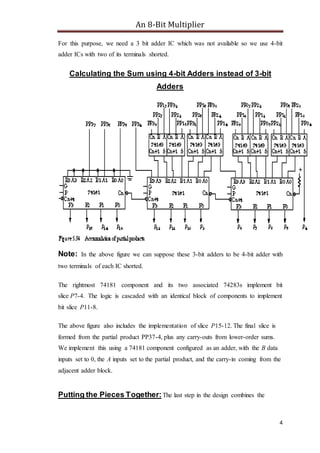
For this purpose, we need a 3 bit adder IC which was not available so we use 4-bit 
adder ICs with two of its terminals shorted. 
4 
Calculating the Sum using 4-bit Adders instead of 3-bit 
Adders 
Note: In the above figure we can suppose these 3-bit adders to be 4-bit adder with 
two terminals of each IC shorted. 
The rightmost 74181 component and its two associated 74283s implement bit 
slice P7-4. The logic is cascaded with an identical block of components to implement 
bit slice P11-8. 
The above figure also includes the implementation of slice P15-12. The final slice is 
formed from the partial product PP37-4, plus any carry-outs from lower-order sums. 
We implement this using a 74181 component configured as an adder, with the B data 
inputs set to 0, the A inputs set to the partial product, and the carry-in coming from the 
adjacent adder block. 
Putting the Pieces Together: The last step in the design combines the
An 8-Bit Multiplier 
multiplier block with the accumulation block. To further improve the performance, the 
carries between the 74181s can be replaced with a 74182 carry look-ahead unit. 
5 
Complete circuit diagram of an 8-bit Multiplier 
Package Count and Performance: 
In terms of package count, the complete implementation uses four 4-bit 
multipliers,(every multiplier requires 16 AND gates and three 4-bit adders) ,four 4-bit 
adder IC’s 74283 packages, three 74181 arithmetic logic units, and one 74182 carry 
look-ahead unit(optional). This is a total of 12 packages.
An 8-Bit Multiplier 
6 
CONCLUSIONS 
About The Current Circuit: 
Here we looked at ways to use the 4-by-4 multiplier as a fundamental building 
block to make 8 bit multiplier. The 8-by-8 multiplier we designed used a considerable 
large amount of logic, much greater than if we had built the multiplier directly using 
4-bit multiplier IC’s rather than using gates to build 4-bit multipliers building blocks. 
Here we see that 4 bit multiplier, in conjunction with even more adders, can be used to 
build multipliers of larger bit widths. 
A much Easier Approach: 
We could have done it quite easily if we just implement the 4-bit multiplier 
circuit shown above to 8-bit multiplier. But in that case we would need 8-bit adders 
IC’s which might be a problem so we have avoided that.
An 8-Bit Multiplier 
7 
References 
[1]http://www2.elo.utfsm.cl/~lsb/elo211/aplicaciones/katz/chapter5/chapter05.doc6.ht 
ml. 
[2]http://www.datasheetarchive.com/5%20bit%20binary%20multiplier%20using%20a 
dders-datasheet.html. 
[3] http://lap2.epfl.ch/courses/archord1/labs/A_8bit_Sequential_Multiplier.pdf. 
[4] https://wiki.engr.illinois.edu/download/attachments/84770821/09- 
AdditionMultiplication.pdf?version=1&modificationDate=1254112213000.
An 8-Bit Multiplier 
8 
Undertaking 
We certify that project work titled “An 8-bit Multiplier” is our own work. Where 
material has been used from other sources it has been properly acknowledged/referred. 
Names Reg# Signatures 
Muhammad Asad Nawaz 11-EE-57 
Syed Mubeen Riaz 11-EE-153 
Muhammad Sharjeel Hashmi 11-EE-159 
_____________________________________________________________________

An 8 bit_multiplier

  • 1.
    An 8-Bit Multiplier 1 PROJECT TITLE: An8-bit Multiplier Circuit. COURSE NUMBER & NAME: EE- 211 Digital Logic Design. GROUP MEMBERS: Muhammad Asad Nawaz. Syed Mobeen Riaz. Muhammad Sharjeel Hashmi. GROUP REGISTRATION# 11-EE-57 11-EE-153 11-EE-159 DUE DATE: 3rd January 2013 DATE HANDED IN: 13th December 2012 ABSTRACT We will see how to apply the principles and components of arithmetic circuits to implement a subsystem of moderate complexity. Our objective is to design a fast 8- by-8 bit multiplier using 4-by-4 bit multipliers as building blocks, along with adders, arithmetic logic, and carry look-ahead units.
  • 2.
    An 8-Bit Multiplier 2 INTRODUCTION We can express an 8-bit product as a series of sums of 1-bit products, so-called Partial Product Accumulation. We can exploit the same principle to construct multipliers of wider bit widths using primitive 4-by-4 multiplier blocks. First, we denote the two 8-bit magnitudes to be multiplied as A7-0 and B7-0 and the 16-bit product that results as P15-0. We can partition A and B into two 4-bit groups, A7-4, A3-0, B7-4, B3-0, and form their 16-bit product as a sum of several 8-bit products: To see how this works, let's examine the multiplication of the 8-bit binary numbers 111100102 and 100011002. These correspond to the decimal numbers 242 and 140, respectively. As a check, we see that 242 * 140 = 33880, which is equal to 10000100010110002. The hardware implementation follows directly from this observation. It requires four 4-by-4 multipliers, plus logic to sum the four-bit wide slices of the partial products. Let's call the four 8-bit partial products PP0, PP1, PP2, and PP3. Then the final product bits are computed as follows: Of course, any carry-out of the calculation of P7-4 must be added to the sum for P11- 8, and likewise for the carry-out of P11-8 to P15-12.
  • 3.
    An 8-Bit Multiplier 3 IMPLEMENTATION The basic blocks of the implementation are (1) the calculation of partial products, (2) the summing of the 4-bit product slices, and (3) the carry look-ahead unit. We examine each of these in turn. Calculation of Partial Products: 1st we want to use the 4 bit multiplier ICs to generate the partial products but we haven’t find these ICs so we use gates instead of IC’s. A simple 4-bit multiplier circuit is shown below. We have to use four such multipliers to get four partial products, because each multiplier produced one partial product. The AND gates we have used here are 7408 A 4x4 Multiplier Circuit Calculation of Sums: The low-order 4 bits of the final product, P3-0, are the same as PP03-0 and do not participate in the sums. P7-4 and P11-8 are sums of three 4-bit quantities. How do we compute these?
  • 4.
    An 8-Bit Multiplier For this purpose, we need a 3 bit adder IC which was not available so we use 4-bit adder ICs with two of its terminals shorted. 4 Calculating the Sum using 4-bit Adders instead of 3-bit Adders Note: In the above figure we can suppose these 3-bit adders to be 4-bit adder with two terminals of each IC shorted. The rightmost 74181 component and its two associated 74283s implement bit slice P7-4. The logic is cascaded with an identical block of components to implement bit slice P11-8. The above figure also includes the implementation of slice P15-12. The final slice is formed from the partial product PP37-4, plus any carry-outs from lower-order sums. We implement this using a 74181 component configured as an adder, with the B data inputs set to 0, the A inputs set to the partial product, and the carry-in coming from the adjacent adder block. Putting the Pieces Together: The last step in the design combines the
  • 5.
    An 8-Bit Multiplier multiplier block with the accumulation block. To further improve the performance, the carries between the 74181s can be replaced with a 74182 carry look-ahead unit. 5 Complete circuit diagram of an 8-bit Multiplier Package Count and Performance: In terms of package count, the complete implementation uses four 4-bit multipliers,(every multiplier requires 16 AND gates and three 4-bit adders) ,four 4-bit adder IC’s 74283 packages, three 74181 arithmetic logic units, and one 74182 carry look-ahead unit(optional). This is a total of 12 packages.
  • 6.
    An 8-Bit Multiplier 6 CONCLUSIONS About The Current Circuit: Here we looked at ways to use the 4-by-4 multiplier as a fundamental building block to make 8 bit multiplier. The 8-by-8 multiplier we designed used a considerable large amount of logic, much greater than if we had built the multiplier directly using 4-bit multiplier IC’s rather than using gates to build 4-bit multipliers building blocks. Here we see that 4 bit multiplier, in conjunction with even more adders, can be used to build multipliers of larger bit widths. A much Easier Approach: We could have done it quite easily if we just implement the 4-bit multiplier circuit shown above to 8-bit multiplier. But in that case we would need 8-bit adders IC’s which might be a problem so we have avoided that.
  • 7.
    An 8-Bit Multiplier 7 References [1]http://www2.elo.utfsm.cl/~lsb/elo211/aplicaciones/katz/chapter5/chapter05.doc6.ht ml. [2]http://www.datasheetarchive.com/5%20bit%20binary%20multiplier%20using%20a dders-datasheet.html. [3] http://lap2.epfl.ch/courses/archord1/labs/A_8bit_Sequential_Multiplier.pdf. [4] https://wiki.engr.illinois.edu/download/attachments/84770821/09- AdditionMultiplication.pdf?version=1&modificationDate=1254112213000.
  • 8.
    An 8-Bit Multiplier 8 Undertaking We certify that project work titled “An 8-bit Multiplier” is our own work. Where material has been used from other sources it has been properly acknowledged/referred. Names Reg# Signatures Muhammad Asad Nawaz 11-EE-57 Syed Mubeen Riaz 11-EE-153 Muhammad Sharjeel Hashmi 11-EE-159 _____________________________________________________________________