Download to read offline
![International Research Journal of Engineering and Technology (IRJET) e-ISSN: 2395-0056
Volume: 07 Issue: 01 | Jan 2020 www.irjet.net p-ISSN: 2395-0072
© 2020, IRJET | Impact Factor value: 7.34 | ISO 9001:2008 Certified Journal | Page 1031
An Efficient Multiply Accumulate Unit Design using Vedic Mathematics
Algorithm
Amandeep Kaur1, Balpreet Kaur2, Rupinder Kaur3
1,2,3Assistant Professor, Dept. of CSE, BBSBEC, Fatehgarh Sahib
--------------------------------------------------------------------------***---------------------------------------------------------------------
Abstract - A novel technique for digital multiplication is
explained and used that is differs from conventional
multiplication method using add and shift [4]. This is an
implementation of modular design style where smaller
blocks are used to design bigger blocks of NxN multiplier.
Using this multiplier, a Multiply Accumulate Unit has been
designed which shows less computation time for performing
MAC operation.
Key Words: Verilog, Digital Multiplier, Multiply
Accumulate Unit
1. INTRODUCTION
Multiply-accumulate operation is one of the basic
arithmetic operations extensively used in modern digital
signal processing (DSP). Operations such as digital
filtering, convolution and fast Fourier transform (FFT),
requires high-performance multiply accumulate
operations. A Digital Multiplier is the heart of the MAC
unit. The performance of MAC unit greatly depends on the
multiplier [2]. This paper presents a systematic design for
fast and efficient MAC unit using Vedic Mathematics [1].
This paper is organized into two sections. Section 1
presents the design methodology for NxN bit Vedic
Multiplier and in Section 2, the design of Multiply
Accumulate Unit, using Vedic Multiplier is explained.
2. Vedic Multiplier
To design a NxN multiplier, we need a 2X2 multiplier as a
building block.[3] Talking about 2X2 multiplier, lets take
two inputs say A (a1,a0) &B(b1,b0) , each two bits wide
and the result be S (s3,s2,s1,s0) which is 4 bits wide.
During this multiplication, 4 partial products are
generated due to vertical and crosswise multiplication
which are a0b0, a0b1,a1b0 and a1b1. The partial product
a0b0 directly passes on to the product S as s0, where as
the LSB of sum of a0b1 and a1b0 forms s1. The carry bit is
added to partial product a1b1 to determine s3 and s2 as
MSB and LSB after addition respectively. 2 bit
Multiplication by this method is shown in figure 1.
Fig- 1: Block Diagram of 2 bit Multiplier
Using the same technique as 2x2 bit vedic multiplier,
4,8,16 and 32 bit multipliers can be designed with slight
modification. That is, the input bits need to be grouped
into two halves of the input bit stream. Input bit steams (
of say N bits) can be divided into (N/2 = n) bit length,
which can be further divided into n/2 bit streams and this
can be continued till we reach bit streams of width 2,
which can be multiplied in parallel, using 2x2 multiplier
blocks[1]. Let us demonstrate this using a 4x4 multiplier
which uses 4, 2x2 multipliers as its building blocks. Inputs
A and B are assumed as 1101 and 1010 respectively which
are grouped in chunks of 2 bits each and multiplied using
2x2 multipliers in parallel, as shown in figure.](https://image.slidesharecdn.com/irjet-v7i1171-200220111526/85/IRJET-An-Efficient-Multiply-Accumulate-Unit-Design-using-Vedic-Mathematics-Algorithm-1-320.jpg)
![International Research Journal of Engineering and Technology (IRJET) e-ISSN: 2395-0056
Volume: 07 Issue: 01 | Jan 2020 www.irjet.net p-ISSN: 2395-0072
© 2020, IRJET | Impact Factor value: 7.34 | ISO 9001:2008 Certified Journal | Page 1031
An Efficient Multiply Accumulate Unit Design using Vedic Mathematics
Algorithm
Amandeep Kaur1, Balpreet Kaur2, Rupinder Kaur3
1,2,3Assistant Professor, Dept. of CSE, BBSBEC, Fatehgarh Sahib
--------------------------------------------------------------------------***---------------------------------------------------------------------
Abstract - A novel technique for digital multiplication is
explained and used that is differs from conventional
multiplication method using add and shift [4]. This is an
implementation of modular design style where smaller
blocks are used to design bigger blocks of NxN multiplier.
Using this multiplier, a Multiply Accumulate Unit has been
designed which shows less computation time for performing
MAC operation.
Key Words: Verilog, Digital Multiplier, Multiply
Accumulate Unit
1. INTRODUCTION
Multiply-accumulate operation is one of the basic
arithmetic operations extensively used in modern digital
signal processing (DSP). Operations such as digital
filtering, convolution and fast Fourier transform (FFT),
requires high-performance multiply accumulate
operations. A Digital Multiplier is the heart of the MAC
unit. The performance of MAC unit greatly depends on the
multiplier [2]. This paper presents a systematic design for
fast and efficient MAC unit using Vedic Mathematics [1].
This paper is organized into two sections. Section 1
presents the design methodology for NxN bit Vedic
Multiplier and in Section 2, the design of Multiply
Accumulate Unit, using Vedic Multiplier is explained.
2. Vedic Multiplier
To design a NxN multiplier, we need a 2X2 multiplier as a
building block.[3] Talking about 2X2 multiplier, lets take
two inputs say A (a1,a0) &B(b1,b0) , each two bits wide
and the result be S (s3,s2,s1,s0) which is 4 bits wide.
During this multiplication, 4 partial products are
generated due to vertical and crosswise multiplication
which are a0b0, a0b1,a1b0 and a1b1. The partial product
a0b0 directly passes on to the product S as s0, where as
the LSB of sum of a0b1 and a1b0 forms s1. The carry bit is
added to partial product a1b1 to determine s3 and s2 as
MSB and LSB after addition respectively. 2 bit
Multiplication by this method is shown in figure 1.
Fig- 1: Block Diagram of 2 bit Multiplier
Using the same technique as 2x2 bit vedic multiplier,
4,8,16 and 32 bit multipliers can be designed with slight
modification. That is, the input bits need to be grouped
into two halves of the input bit stream. Input bit steams (
of say N bits) can be divided into (N/2 = n) bit length,
which can be further divided into n/2 bit streams and this
can be continued till we reach bit streams of width 2,
which can be multiplied in parallel, using 2x2 multiplier
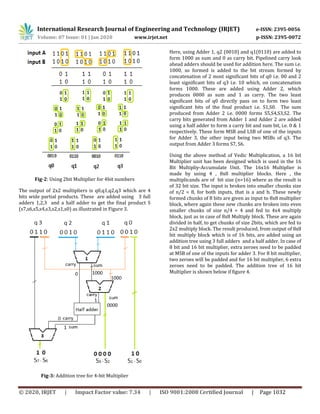
blocks[1]. Let us demonstrate this using a 4x4 multiplier
which uses 4, 2x2 multipliers as its building blocks. Inputs
A and B are assumed as 1101 and 1010 respectively which
are grouped in chunks of 2 bits each and multiplied using
2x2 multipliers in parallel, as shown in figure.](https://image.slidesharecdn.com/irjet-v7i1171-200220111526/75/IRJET-An-Efficient-Multiply-Accumulate-Unit-Design-using-Vedic-Mathematics-Algorithm-1-2048.jpg)
![International Research Journal of Engineering and Technology (IRJET) e-ISSN: 2395-0056
Volume: 07 Issue: 01 | Jan 2020 www.irjet.net p-ISSN: 2395-0072
© 2020, IRJET | Impact Factor value: 7.34 | ISO 9001:2008 Certified Journal | Page 1033
Fig-4: Addition tree for 16 bit Multiplier
3. MULTIPLY ACCUMULATE UNIT
The MAC unit employs a fast multiplier fitted in the data
path and the multiplied output of multiplier is fed into a
fast adder which is set to zero initially. The result of
addition is stored in an accumulator register. The MAC
unit produces output in one clock cycle and the new result
of addition is added to the previous one and stored in the
accumulator register. MAC architecture. Here the
multiplier that has been used is a Vedic Multiplier built
using Urdhva Tiryakbhyam Sutra. As, 16bit vedic
multiplier is faster than other multipliers for example
booth multiplier, even the MAC unit made using vedic
multiplier is faster than the conventional one as well.
In the MAC unit, the data inputs, A and B are 16 bits wide
and they are stored in two data registers, that is Data A
and Data B, both being 16 bits wide, Then the inputs are
fed into a Vedic multiplier, which stores the multiplied
output in a 32 bit wide register named, Multiply out
register. The contents of this register are continuously fed
in to an adder and the result is stored in a 64 bit wide
register “Data out register”. For fast operation, adder
should be fast and especially we have to use pipelined
carry look-ahead adder [4].
Fig-5: Block Diagram of 16 bit MAC unit
3.1. Simulation result
The 16 bit multiplier and 16 bit MAC unit have been
designed in Verilog HDL and their working has been
verified for all the possible input combinations by writing a
test bench. Here the inputs are taken to be
1111111111111111 for both inputs.
The result obtained is as given below:
Fig -6: Simulation result of 16 bit multiplier
Fig- 7: Simulation result of 16 bit MAC unit](https://image.slidesharecdn.com/irjet-v7i1171-200220111526/85/IRJET-An-Efficient-Multiply-Accumulate-Unit-Design-using-Vedic-Mathematics-Algorithm-3-320.jpg)
![International Research Journal of Engineering and Technology (IRJET) e-ISSN: 2395-0056
Volume: 07 Issue: 01 | Jan 2020 www.irjet.net p-ISSN: 2395-0072
© 2020, IRJET | Impact Factor value: 7.34 | ISO 9001:2008 Certified Journal | Page 1034
3.2 Synthesis Result
Synthesis was done using ISE 7.1. The device chosen for
synthesis is XC3S500e-4fg320 with speed grade -4. Delay
was measured after back annotation using Simprim library.
The table given below gives circuit delay for the worst case
input for the corresponding no. of bits in the input i.e. for
N=16, worst case inputs were taken as
1111111111111111 at both A and B. The synthesis was
done using Xilinx ISE software.
Table -1: Combinational Delay
Component Delay
16 bit Multiplier 9.334 ns
16 bit MAC unit 11.151 ns
Table -2: Device Utilization for 16bit MAC Unit
Device Utilization Summary
Number of Slices 384
Number of LUTs 712
Table -3: Power Dissipation for 16 bit MAC Unit
Power Dissipation
Frequency ( MHz) Power (mW)
20 90
50 188
4. CONCLUSION
In this paper, a Vedic method of multiplication is presented
and used for MAC operation of 16 bit numbers. This gives
us method for hierarchical multiplier design which has
been used in MAC operation. So the design complexity
reduces for large inputs and modularity increases which
can be effectively used in various Digital Signal Processing
applications.
REFERENCES
1. Shamim Akhter, “VHDL Implementation of Fast NXN
Multiplier Based on Vedic Mathematics”, Jaypee
Institute of Information Technology University, Noida,
201307 UP, INDIA, 2007 IEEE
2. Neil H.E Weste, David Harris, Ayan Banerjee,”CMOS
VLSI Design, A Circuits and Systems Perspective”,
Third Edition, published by Person Education, PP-327-
328]
3. Himanshu Thapliyal and Hamid R. Arabnia, “A Time
Area Power Efficient Multiplier and Square
Architecture Based On Ancient Indian Vedic
Mathematics”, Department of Computer Science, The
University of Georgia, 415 Graduate Studies Research
Center Athens, Georgia 30602-7404, U.S.A.
4. CRAWLEY, D., and AMARATUNGA, G:’pipelined carry
look-ahead adder design’, Electron. Lett., 1996,22,
(12),pp. 661-662.](https://image.slidesharecdn.com/irjet-v7i1171-200220111526/85/IRJET-An-Efficient-Multiply-Accumulate-Unit-Design-using-Vedic-Mathematics-Algorithm-4-320.jpg)

The document proposes a design for an efficient multiply accumulate (MAC) unit using an algorithm based on Vedic mathematics. It describes the design of a 16-bit multiplier based on a novel 2x2 multiplier building block. Simulation and synthesis results show that the proposed 16-bit MAC unit designed using the Vedic multiplier has lower computation time and resource utilization compared to conventional MAC units.


