University of Chakwal, Pakistan
Topic: Importance of Amylin, Cytotoxicity and
Abnormalities
Department of Zoology
Presented by: Um-e-Farwa
Roll no# UOC-BSZOL-F2020/014
BS Zoology
Session: 2020-2024
Subject: Endocrinology
Instructor Name: Dr. Syeda Nadia Ahmed
Introduction
Synthesis
Functions
Cytotoxicity
Pharmacology
Side Effects
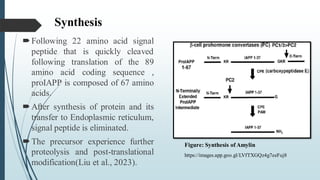
Introduction
Amylin is a 37-amino acid peptide hormone that is also
referred to as islet amyloid polypeptide (IAPP).
Amylin is a poorly understood glucoregulatory hormone that
has considerable potential to target metabolic illnesses.
It is released by the beta cells of the pancreas.
Because of the undesirable aggregative and solubility qualities,
which are further exacerbated by Amylin receptors, little is
known about the structure-function relationship of
amylin(Yoshimitsu Kiriyama and Hiromi Nochi, 2018).
Synthesis
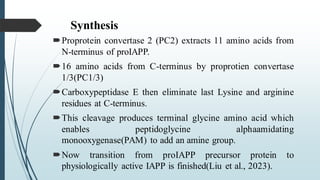
Following 22 amino acid signal
peptide that is quickly cleaved
following translation of the 89
amino acid coding sequence ,
proIAPP is composed of 67 amino
acids.
After synthesis of protein and its
transfer to Endoplasmic reticulum,
signal peptide is eliminated.
The precursor experience further
proteolysis and post-translational
modification(Liu et al., 2023).
Figure: Synthesis of Amylin
https://images.app.goo.gl/LVfTXGQz4g7eeFuj8
Synthesis
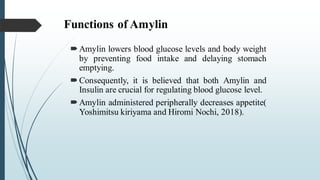
Proprotein convertase 2 (PC2) extracts 11 amino acids from
N-terminus of proIAPP.
16 amino acids from C-terminus by proprotien convertase
1/3(PC1/3)
Carboxypeptidase E then eliminate last Lysine and arginine
residues at C-terminus.
This cleavage produces terminal glycine amino acid which
enables peptidoglycine alphaamidating
monooxygenase(PAM) to add an amine group.
Now transition from proIAPP precursor protein to
physiologically active IAPP is finished(Liu et al., 2023).
Functions of Amylin
Amylin lowers blood glucose levels and body weight
by preventing food intake and delaying stomach
emptying.
Consequently, it is believed that both Amylin and
Insulin are crucial for regulating blood glucose level.
Amylin administered peripherally decreases appetite(
Yoshimitsu kiriyama and Hiromi Nochi, 2018).
Role of Amylin in central nervous system
The blood brain barrier (BBB) is crossed by Amylin in order to
get its binding sites dispersed throughout CNS.
Influence the central nervous system to govern food
consumption.
Decelerate stomach emptying resulting in decrease in body
weight.
Area postrema (hindbrain) is regarded as primary site for Amylin
action.
The inhibition of amylin on food intake is lessened when AP is
abated( Yoshimitsu kiriyama and Hiromi Nochi, 2018).
Role of amylin in Pancreatic Islet β-cells
 Amylin knock out causes β-cells to secrete more insulin in
response to glucose.
Physiological Amylin concentration upto 100pM limit this
secretion.
Amylin regulates β-cells proliferation at low glucose
concentration
Suppress proliferation at high glucose
concentration(Yoshimitsu kiriyama and Hiromi Nochi, 2018).
Role of amylin in increasing sensitivity to Leptin
The hormone leptin, which is generated by fat cells, promotes fat
burning and suppresses appetite.
Despite having higher leptin levels due to their increased fat cell
count, many obese individuals lack leptin-responsiveness.
An analog of amylin (metreleptin) by itself did not cause weight
loss
clinical experiment with 177 obese/overweight people; however,
when it was combined with an amylin medication (pramlintide),
considerable weight loss was observed(Yoshimitsu kiriyama and
Hiromi Nochi, 2018).
Cytotoxicity Of Amylin
Amyloid aggregates cause harm to pancreatic islet β-cells
and are accountable for the emergence of type 2 diabetes.
It is residues 20–29 of human amylin that cause amyloid
fibrils to develop.
In human amylin, proline substitution at positions 25
(Ala), 28 (Ser), and 29 (Ser) reduces the stability of the β-
sheet structure and pramlintide, which is used to treat
patients with type 1 and type II diabetes in clinical
settings( Yoshimitsu kiriyama and Hiromi Nochi, 2018).
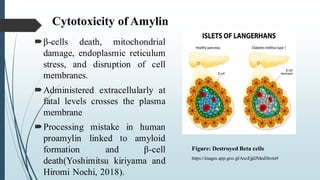
Cytotoxicity of Amylin
β-cells death, mitochondrial
damage, endoplasmic reticulum
stress, and disruption of cell
membranes.
Administered extracellularly at
fatal levels crosses the plasma
membrane
Processing mistake in human
proamylin linked to amyloid
formation and β-cell
death(Yoshimitsu kiriyama and
Hiromi Nochi, 2018).
Figure: Destroyed Beta cells
https://images.app.goo.gl/AxoEjjdJMedHrotu9
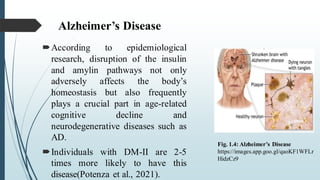
Alzheimer’s Disease
According to epidemiological
research, disruption of the insulin
and amylin pathways not only
adversely affects the body’s
homeostasis but also frequently
plays a crucial part in age-related
cognitive decline and
neurodegenerative diseases such as
AD.
Individuals with DM-II are 2-5
times more likely to have this
disease(Potenza et al., 2021).
Fig. 1.4: Alzheimer’s Disease
https://images.app.goo.gl/qaoKF1WFLr
HidzCz9
Figure: Symptoms ofAlzheimer’s Disease
https://images.app.goo.gl/n6mRoRfBd2XuNgQ17
Causes
According to several researchers, hyperamylasemia—often
observed in people with obesity or pre-diabetic insulin
resistance—may be the mechanism underlying amylin
deposition in the brains of patients with T2DM and AD.
Cure:
There's currently no cure for Alzheimer's disease. But there is
medicine available that can temporarily reduce the symptoms.
1. Acetylcholinesterase (AChE) inhibitors
2. Memantine (Potenza et al., 2021).
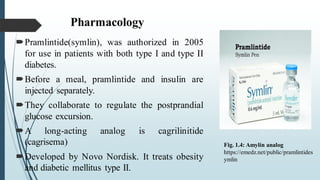
Pharmacology
Pramlintide(symlin), was authorized in 2005
for use in patients with both type I and type II
diabetes.
Before a meal, pramlintide and insulin are
injected separately.
They collaborate to regulate the postprandial
glucose excursion.
A long-acting analog is cagrilinitide
(cagrisema)
Developed by Novo Nordisk. It treats obesity
and diabetic mellitus type II.
Fig. 1.4: Amylin analog
https://emedz.net/public/pramlintides
ymlin
Side Effects
Case 1: Using semaglutide and pramlintide for ten months, a 32-
year-old male patient with obstructive sleep apnea (OSA)
dropped −20.9 kg, or 16.1% of his total body weight.
Case 2: Initially treated with topiramate, 68-year-old female
patient with coronary artery disease, hypertension,
hypothyroidism, and depression lost around 8.4 kg but then
experienced a weight plateau.
She lost an additional 12.8% of her body weight after taking
dulaglutide and pramlintide, for a total weight reduction of
−21.2 kg in seven months(Wong et al., 2023).
Side Effects
Case 3: A 49-year-old woman on semaglutide and pramlintide
lost −14.6 kg over the course of six months. She also had
depression and hypothyroidism.
Significant adverse effects weren’t detected.
Hemoglobin A1c levels either reduced or stayed constant over
the course of treatment, and all patients reported having less
insulin requirements when using pramlintide.
In patients with obesity and type 1 diabetes, pramlintide plus
GLP1RA produced excellent weight loss(Wong et al., 2023).
References
Wong, G., Garner, E. M., & Srivastava, G. (2023). Combined GLP-1 Receptor
Agonist and Amylin Analogue Pharmacotherapy to Treat Obesity Comorbid With
Type 1 Diabetes. JCEM Case Reports, 1(2),luad040.
Kiriyama, Y., & Nochi, H. (2018). Role and cytotoxicity of amylin and protection of
pancreatic islet β- cells from amylin cytotoxicity. Cells, 7(8),95.
Potenza, M. A., Sgarra, L., Desantis, V., Nacci, C., & Montagnani, M. (2021).
Diabetes and Alzheimer’s disease: might mitochondrial dysfunction help deciphering
the common path?. Antioxidants, 10(8), 1257.
https://www.ncbi.nlm.nih.gov/pmc/articles/PMC2496974/
Liu, Q. R., Zhu, M., Chen, Q., Mustapic, M., Kapogiannis, D., & Egan, J. M. (2023).
Novel Hominid-Specific IAPP Isoforms: Potential Biomarkers of Early Alzheimer’s
Disease and Inhibitors ofAmyloid Formation. Biomolecules, 13(1), 167.
Amylin Hormone.pdf

Amylin Hormone.pdf

  • 1.
  • 2.
    Topic: Importance ofAmylin, Cytotoxicity and Abnormalities Department of Zoology Presented by: Um-e-Farwa Roll no# UOC-BSZOL-F2020/014 BS Zoology Session: 2020-2024 Subject: Endocrinology Instructor Name: Dr. Syeda Nadia Ahmed
  • 3.
  • 4.
    Introduction Amylin is a37-amino acid peptide hormone that is also referred to as islet amyloid polypeptide (IAPP). Amylin is a poorly understood glucoregulatory hormone that has considerable potential to target metabolic illnesses. It is released by the beta cells of the pancreas. Because of the undesirable aggregative and solubility qualities, which are further exacerbated by Amylin receptors, little is known about the structure-function relationship of amylin(Yoshimitsu Kiriyama and Hiromi Nochi, 2018).
  • 5.
    Synthesis Following 22 aminoacid signal peptide that is quickly cleaved following translation of the 89 amino acid coding sequence , proIAPP is composed of 67 amino acids. After synthesis of protein and its transfer to Endoplasmic reticulum, signal peptide is eliminated. The precursor experience further proteolysis and post-translational modification(Liu et al., 2023). Figure: Synthesis of Amylin https://images.app.goo.gl/LVfTXGQz4g7eeFuj8
  • 6.
    Synthesis Proprotein convertase 2(PC2) extracts 11 amino acids from N-terminus of proIAPP. 16 amino acids from C-terminus by proprotien convertase 1/3(PC1/3) Carboxypeptidase E then eliminate last Lysine and arginine residues at C-terminus. This cleavage produces terminal glycine amino acid which enables peptidoglycine alphaamidating monooxygenase(PAM) to add an amine group. Now transition from proIAPP precursor protein to physiologically active IAPP is finished(Liu et al., 2023).
  • 7.
    Functions of Amylin Amylinlowers blood glucose levels and body weight by preventing food intake and delaying stomach emptying. Consequently, it is believed that both Amylin and Insulin are crucial for regulating blood glucose level. Amylin administered peripherally decreases appetite( Yoshimitsu kiriyama and Hiromi Nochi, 2018).
  • 8.
    Role of Amylinin central nervous system The blood brain barrier (BBB) is crossed by Amylin in order to get its binding sites dispersed throughout CNS. Influence the central nervous system to govern food consumption. Decelerate stomach emptying resulting in decrease in body weight. Area postrema (hindbrain) is regarded as primary site for Amylin action. The inhibition of amylin on food intake is lessened when AP is abated( Yoshimitsu kiriyama and Hiromi Nochi, 2018).
  • 9.
    Role of amylinin Pancreatic Islet β-cells  Amylin knock out causes β-cells to secrete more insulin in response to glucose. Physiological Amylin concentration upto 100pM limit this secretion. Amylin regulates β-cells proliferation at low glucose concentration Suppress proliferation at high glucose concentration(Yoshimitsu kiriyama and Hiromi Nochi, 2018).
  • 10.
    Role of amylinin increasing sensitivity to Leptin The hormone leptin, which is generated by fat cells, promotes fat burning and suppresses appetite. Despite having higher leptin levels due to their increased fat cell count, many obese individuals lack leptin-responsiveness. An analog of amylin (metreleptin) by itself did not cause weight loss clinical experiment with 177 obese/overweight people; however, when it was combined with an amylin medication (pramlintide), considerable weight loss was observed(Yoshimitsu kiriyama and Hiromi Nochi, 2018).
  • 11.
    Cytotoxicity Of Amylin Amyloidaggregates cause harm to pancreatic islet β-cells and are accountable for the emergence of type 2 diabetes. It is residues 20–29 of human amylin that cause amyloid fibrils to develop. In human amylin, proline substitution at positions 25 (Ala), 28 (Ser), and 29 (Ser) reduces the stability of the β- sheet structure and pramlintide, which is used to treat patients with type 1 and type II diabetes in clinical settings( Yoshimitsu kiriyama and Hiromi Nochi, 2018).
  • 12.
    Cytotoxicity of Amylin β-cellsdeath, mitochondrial damage, endoplasmic reticulum stress, and disruption of cell membranes. Administered extracellularly at fatal levels crosses the plasma membrane Processing mistake in human proamylin linked to amyloid formation and β-cell death(Yoshimitsu kiriyama and Hiromi Nochi, 2018). Figure: Destroyed Beta cells https://images.app.goo.gl/AxoEjjdJMedHrotu9
  • 13.
    Alzheimer’s Disease According toepidemiological research, disruption of the insulin and amylin pathways not only adversely affects the body’s homeostasis but also frequently plays a crucial part in age-related cognitive decline and neurodegenerative diseases such as AD. Individuals with DM-II are 2-5 times more likely to have this disease(Potenza et al., 2021). Fig. 1.4: Alzheimer’s Disease https://images.app.goo.gl/qaoKF1WFLr HidzCz9
  • 14.
    Figure: Symptoms ofAlzheimer’sDisease https://images.app.goo.gl/n6mRoRfBd2XuNgQ17
  • 15.
    Causes According to severalresearchers, hyperamylasemia—often observed in people with obesity or pre-diabetic insulin resistance—may be the mechanism underlying amylin deposition in the brains of patients with T2DM and AD. Cure: There's currently no cure for Alzheimer's disease. But there is medicine available that can temporarily reduce the symptoms. 1. Acetylcholinesterase (AChE) inhibitors 2. Memantine (Potenza et al., 2021).
  • 16.
    Pharmacology Pramlintide(symlin), was authorizedin 2005 for use in patients with both type I and type II diabetes. Before a meal, pramlintide and insulin are injected separately. They collaborate to regulate the postprandial glucose excursion. A long-acting analog is cagrilinitide (cagrisema) Developed by Novo Nordisk. It treats obesity and diabetic mellitus type II. Fig. 1.4: Amylin analog https://emedz.net/public/pramlintides ymlin
  • 17.
    Side Effects Case 1:Using semaglutide and pramlintide for ten months, a 32- year-old male patient with obstructive sleep apnea (OSA) dropped −20.9 kg, or 16.1% of his total body weight. Case 2: Initially treated with topiramate, 68-year-old female patient with coronary artery disease, hypertension, hypothyroidism, and depression lost around 8.4 kg but then experienced a weight plateau. She lost an additional 12.8% of her body weight after taking dulaglutide and pramlintide, for a total weight reduction of −21.2 kg in seven months(Wong et al., 2023).
  • 18.
    Side Effects Case 3:A 49-year-old woman on semaglutide and pramlintide lost −14.6 kg over the course of six months. She also had depression and hypothyroidism. Significant adverse effects weren’t detected. Hemoglobin A1c levels either reduced or stayed constant over the course of treatment, and all patients reported having less insulin requirements when using pramlintide. In patients with obesity and type 1 diabetes, pramlintide plus GLP1RA produced excellent weight loss(Wong et al., 2023).
  • 19.
    References Wong, G., Garner,E. M., & Srivastava, G. (2023). Combined GLP-1 Receptor Agonist and Amylin Analogue Pharmacotherapy to Treat Obesity Comorbid With Type 1 Diabetes. JCEM Case Reports, 1(2),luad040. Kiriyama, Y., & Nochi, H. (2018). Role and cytotoxicity of amylin and protection of pancreatic islet β- cells from amylin cytotoxicity. Cells, 7(8),95. Potenza, M. A., Sgarra, L., Desantis, V., Nacci, C., & Montagnani, M. (2021). Diabetes and Alzheimer’s disease: might mitochondrial dysfunction help deciphering the common path?. Antioxidants, 10(8), 1257. https://www.ncbi.nlm.nih.gov/pmc/articles/PMC2496974/ Liu, Q. R., Zhu, M., Chen, Q., Mustapic, M., Kapogiannis, D., & Egan, J. M. (2023). Novel Hominid-Specific IAPP Isoforms: Potential Biomarkers of Early Alzheimer’s Disease and Inhibitors ofAmyloid Formation. Biomolecules, 13(1), 167.