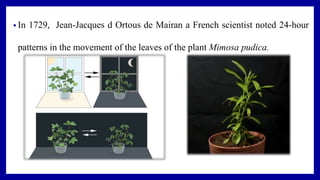
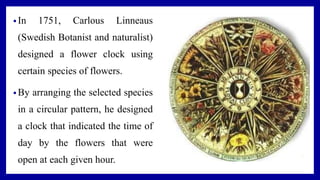
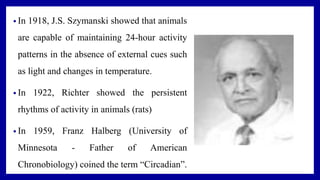
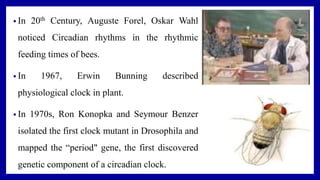
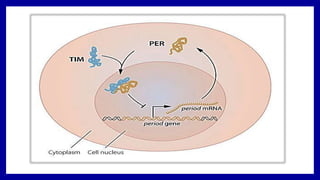
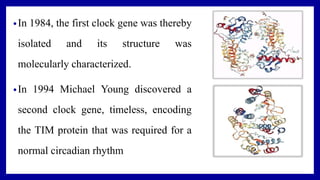
Chronobiology examines periodic phenomena in living organisms and their adaptation to solar and lunar rhythms. Biological rhythms vary from milliseconds to years and regulate essential processes like eating, sleeping, and cell regeneration in animals, and leaf movement and photosynthesis in plants. The most important rhythm is the circadian rhythm, which has been observed in plants, animals, and microbes. The history of chronobiology includes early observations of daily leaf movements and flower opening patterns. In the 20th century, scientists isolated clock genes in fruit flies and discovered their role in circadian rhythms.




![Neural_control_of_animal_behaviour[1]789.pptx](https://cdn.slidesharecdn.com/ss_thumbnails/neuralcontrolofanimalbehaviour1789-230207172442-5de82c6f-thumbnail.jpg?width=640&height=640&fit=bounds)


