University of Chakwal, Pakistan
Topic: Abnormalities of ACTH
Department of Zoology
Presented by: Komal Zahra
Roll no# UOC-BSZOL-F2020/035
BS Zoology
Session: 2020-2024
Subject: Endocrinology
Instructor Name: Dr. Syeda Nadia Ahmad
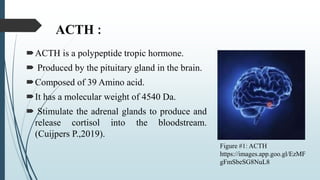
ACTH :
ACTH is a polypeptide tropic hormone.
 Produced by the pituitary gland in the brain.
Composed of 39 Amino acid.
It has a molecular weight of 4540 Da.
 Stimulate the adrenal glands to produce and
release cortisol into the bloodstream.
(Cuijpers P.,2019).
Figure #1: ACTH
https://images.app.goo.gl/EzMF
gFmSbeSG8NuL8
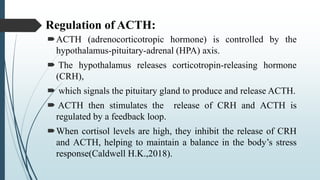
Regulation of ACTH:
ACTH (adrenocorticotropic hormone) is controlled by the
hypothalamus-pituitary-adrenal (HPA) axis.
 The hypothalamus releases corticotropin-releasing hormone
(CRH),
 which signals the pituitary gland to produce and release ACTH.
 ACTH then stimulates the release of CRH and ACTH is
regulated by a feedback loop.
When cortisol levels are high, they inhibit the release of CRH
and ACTH, helping to maintain a balance in the body’s stress
response(Caldwell H.K.,2018).
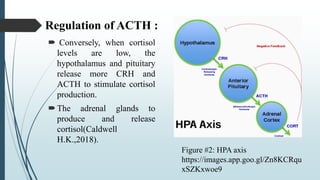
Regulation of ACTH :
 Conversely, when cortisol
levels are low, the
hypothalamus and pituitary
release more CRH and
ACTH to stimulate cortisol
production.
The adrenal glands to
produce and release
cortisol(Caldwell
H.K.,2018).
Figure #2: HPA axis
https://images.app.goo.gl/Zn8KCRqu
xSZKxwoe9
Normal Range:
Like cortisol, the level of ACTH in your blood normally peaks
in the early morning and declines throughout the day, reaching
its lowest level around midnight.
Normal ACTH levels in the blood are generally between 9 and
52 picograms per milliliter (pg/mL)(Kirsch P.,2017).
Hyper-secretions of ACTH:
High ACTH levels are often associated with increased
cortisol productions.
Hyper-secretions of ACTH results:
Cushing’s Disease/syndrome
Nelson Syndrome
Ectopic ACTH tumor Production(Hiroi, N.,etal.2020)
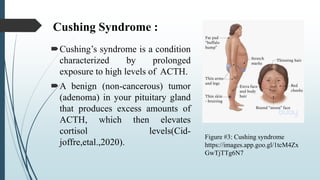
Cushing Syndrome :
Cushing’s syndrome is a condition
characterized by prolonged
exposure to high levels of ACTH.
A benign (non-cancerous) tumor
(adenoma) in your pituitary gland
that produces excess amounts of
ACTH, which then elevates
cortisol levels(Cid-
joffre,etal.,2020).
Figure #3: Cushing syndrome
https://images.app.goo.gl/1tcM4Zx
GwTjTTg6N7
Cushing Syndrome:
Symptoms of Cushing’s Syndrome:
Weight Gain
 Skin Changes
Muscle Weakness
High Blood Pressure
Glucose Intolerance
Irregular Menstrual Periods
Emotional Changes
Increased thirst and urination.
Treatment :
Treatment involves surgery to remove the pituitary tumor, if
possible.
 After surgery, the pituitary gland may slowly start to work
again and return to normal.
Radiation treatment of the pituitary gland may also be used if
the tumor is not completely removed.
Medication (Carter,etal.2019).
Ectopic ACTH Tumor:
An ectopic ACTH tumor refers to a tumor outside the pituitary
gland
 That produces high level of adrenocorticotropic hormone
(ACTH).
This can lead to increased cortisol production.
It is rare, and between 10% and 20% of Cushing’s syndrome (CS)
could be found associated with an ectopic tumor.
Symptoms same like Cushing’s syndrome
Tumors that can produce ACTH include:
Ectopic ACTH tumor:
Benign carcinoid tumors of the lung,
Islet cell tumors of the pancreas,
Medullary carcinoma of the thyroid,
 Small cell tumors of the lungs
 And tumors of the thymus gland
Treatment include:
Surgery, Chemotherapy, Radiation Therapy, Medications
and supportive care(Liddle, G. W.etal,2017).
Nelson syndrome:
Enlarging tumor in the pituitary gland,
 named after the endocrinologist Don Nelson who described
the condition in 1958.
The tumor produces an excess of a hormone called ACTH
hormone, which is involved in the production of other steroid
hormones (such as cortisol).
Large tumors invade areas around the pituitary gland, which
may cause a reduction in levels of other hormones.
The enlarged tumor compresses the rest of the pituitary
gland(Cable & Grider,.2020).
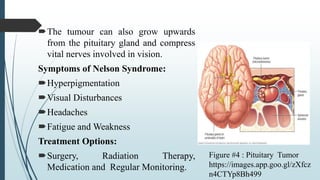
The tumour can also grow upwards
from the pituitary gland and compress
vital nerves involved in vision.
Symptoms of Nelson Syndrome:
Hyperpigmentation
Visual Disturbances
Headaches
Fatigue and Weakness
Treatment Options:
Surgery, Radiation Therapy,
Medication and Regular Monitoring.
Figure #4 : Pituitary Tumor
https://images.app.goo.gl/zXfcz
n4CTYp8Bh499
High level of ACTH in pregnancy:
The high secretion of ACTH at the beginning of the last
trimester of pregnancy may stimulate the development of the
adrenal cortex
 And result in the increased cortisol secretion necessary for
fetal lung maturation.
Placental CRH stimulates the production of maternal
adrenocorticotropin hormone (ACTH) and cortisol,
leading to substantial increases in maternal serum cortisol
levels during the third trimester.
Hypo-secretion of ACTH:
Hyposecretion in which low level of ACTH production.
The diseases include:
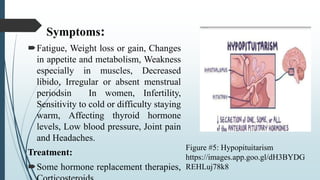
Hypopituitarism
Addison Disease
Hypopituitarism:
This is a rare condition in which there’s a lack (deficiency) of one,
multiple or all of the hormones made by your pituitary gland.
 ACTH can be one of the affected hormones.
Any type of damage to your pituitary gland, such as pressure on the
gland, surgical damage or radiation therapy, can cause
hypopituitarism.
Hypopituitarism can affect anyone at any age.
There are approximately 10 to 40 new cases per one million people
a year(Cassata,.2021).
Symptoms:
Fatigue, Weight loss or gain, Changes
in appetite and metabolism, Weakness
especially in muscles, Decreased
libido, Irregular or absent menstrual
periodsin In women, Infertility,
Sensitivity to cold or difficulty staying
warm, Affecting thyroid hormone
levels, Low blood pressure, Joint pain
and Headaches.
Treatment:
Some hormone replacement therapies,
Figure #5: Hypopituitarism
https://images.app.goo.gl/dH3BYDG
REHLuj78k8
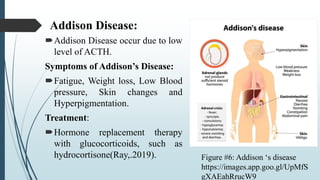
Addison Disease:
Addison Disease occur due to low
level of ACTH.
Symptoms of Addison’s Disease:
Fatigue, Weight loss, Low Blood
pressure, Skin changes and
Hyperpigmentation.
Treatment:
Hormone replacement therapy
with glucocorticoids, such as
hydrocortisone(Ray,.2019). Figure #6: Addison ‘s disease
https://images.app.goo.gl/UpMfS
gXAEahRrucW9
ACTH Test:
The ACTH test measures
adrenocorticotropic hormone
levels in the blood.
ACTH Test Procedure:
 The ACTH test typically involves
drawing blood, usually in the
morning when cortisol levels peak
and then blood samples are taken
to observe the adrenal gland’s
response.
Figure #7: ACTH test
https://images.app.goo.gl/vkRKqM
tk9e34Edq67
Results Interpretation:
Normal Results:
 Adequate cortisol production after ACTH stimulation
Low ACTH Levels:
Possible adrenal insufficiency or Addison’s disease.
High ACTH Levels:
Suggestive of conditions like Cushing’s syndrome,or a
pituitary gland issue(May, M. E.,etal.2019).
References:
Hiroi, N., Yakushiji, F., Shimojo, M., Watanabe, S., Sugano, S.,
Yamaguchi, N., & Miyachi, Y. (2020). Human ACTH
hypersensitivity syndrome associated with abnormalities of the
ACTH receptor gene. Clinical Endocrinology, 48(2), 129-134.
May, M. E., & Carey, R. M. (2019). Rapid adrenocorticotropic
hormone test in practice. Retrospective review. The American
journal of medicine, 79(6), 679-684.
Liddle, G. W., Givens, J. R., Nicholson, W. E., & Island, D. P.
(2017). The ectopic ACTH syndrome. Cancer Research,
25(7_Part_1), 1057-1061.
abnormalities of ACTH.pptx

abnormalities of ACTH.pptx

  • 1.
  • 2.
    Topic: Abnormalities ofACTH Department of Zoology Presented by: Komal Zahra Roll no# UOC-BSZOL-F2020/035 BS Zoology Session: 2020-2024 Subject: Endocrinology Instructor Name: Dr. Syeda Nadia Ahmad
  • 3.
    ACTH : ACTH isa polypeptide tropic hormone.  Produced by the pituitary gland in the brain. Composed of 39 Amino acid. It has a molecular weight of 4540 Da.  Stimulate the adrenal glands to produce and release cortisol into the bloodstream. (Cuijpers P.,2019). Figure #1: ACTH https://images.app.goo.gl/EzMF gFmSbeSG8NuL8
  • 4.
    Regulation of ACTH: ACTH(adrenocorticotropic hormone) is controlled by the hypothalamus-pituitary-adrenal (HPA) axis.  The hypothalamus releases corticotropin-releasing hormone (CRH),  which signals the pituitary gland to produce and release ACTH.  ACTH then stimulates the release of CRH and ACTH is regulated by a feedback loop. When cortisol levels are high, they inhibit the release of CRH and ACTH, helping to maintain a balance in the body’s stress response(Caldwell H.K.,2018).
  • 5.
    Regulation of ACTH:  Conversely, when cortisol levels are low, the hypothalamus and pituitary release more CRH and ACTH to stimulate cortisol production. The adrenal glands to produce and release cortisol(Caldwell H.K.,2018). Figure #2: HPA axis https://images.app.goo.gl/Zn8KCRqu xSZKxwoe9
  • 6.
    Normal Range: Like cortisol,the level of ACTH in your blood normally peaks in the early morning and declines throughout the day, reaching its lowest level around midnight. Normal ACTH levels in the blood are generally between 9 and 52 picograms per milliliter (pg/mL)(Kirsch P.,2017).
  • 7.
    Hyper-secretions of ACTH: HighACTH levels are often associated with increased cortisol productions. Hyper-secretions of ACTH results: Cushing’s Disease/syndrome Nelson Syndrome Ectopic ACTH tumor Production(Hiroi, N.,etal.2020)
  • 8.
    Cushing Syndrome : Cushing’ssyndrome is a condition characterized by prolonged exposure to high levels of ACTH. A benign (non-cancerous) tumor (adenoma) in your pituitary gland that produces excess amounts of ACTH, which then elevates cortisol levels(Cid- joffre,etal.,2020). Figure #3: Cushing syndrome https://images.app.goo.gl/1tcM4Zx GwTjTTg6N7
  • 9.
    Cushing Syndrome: Symptoms ofCushing’s Syndrome: Weight Gain  Skin Changes Muscle Weakness High Blood Pressure Glucose Intolerance Irregular Menstrual Periods Emotional Changes Increased thirst and urination.
  • 10.
    Treatment : Treatment involvessurgery to remove the pituitary tumor, if possible.  After surgery, the pituitary gland may slowly start to work again and return to normal. Radiation treatment of the pituitary gland may also be used if the tumor is not completely removed. Medication (Carter,etal.2019).
  • 11.
    Ectopic ACTH Tumor: Anectopic ACTH tumor refers to a tumor outside the pituitary gland  That produces high level of adrenocorticotropic hormone (ACTH). This can lead to increased cortisol production. It is rare, and between 10% and 20% of Cushing’s syndrome (CS) could be found associated with an ectopic tumor. Symptoms same like Cushing’s syndrome Tumors that can produce ACTH include:
  • 12.
    Ectopic ACTH tumor: Benigncarcinoid tumors of the lung, Islet cell tumors of the pancreas, Medullary carcinoma of the thyroid,  Small cell tumors of the lungs  And tumors of the thymus gland Treatment include: Surgery, Chemotherapy, Radiation Therapy, Medications and supportive care(Liddle, G. W.etal,2017).
  • 13.
    Nelson syndrome: Enlarging tumorin the pituitary gland,  named after the endocrinologist Don Nelson who described the condition in 1958. The tumor produces an excess of a hormone called ACTH hormone, which is involved in the production of other steroid hormones (such as cortisol). Large tumors invade areas around the pituitary gland, which may cause a reduction in levels of other hormones. The enlarged tumor compresses the rest of the pituitary gland(Cable & Grider,.2020).
  • 14.
    The tumour canalso grow upwards from the pituitary gland and compress vital nerves involved in vision. Symptoms of Nelson Syndrome: Hyperpigmentation Visual Disturbances Headaches Fatigue and Weakness Treatment Options: Surgery, Radiation Therapy, Medication and Regular Monitoring. Figure #4 : Pituitary Tumor https://images.app.goo.gl/zXfcz n4CTYp8Bh499
  • 15.
    High level ofACTH in pregnancy: The high secretion of ACTH at the beginning of the last trimester of pregnancy may stimulate the development of the adrenal cortex  And result in the increased cortisol secretion necessary for fetal lung maturation. Placental CRH stimulates the production of maternal adrenocorticotropin hormone (ACTH) and cortisol, leading to substantial increases in maternal serum cortisol levels during the third trimester.
  • 16.
    Hypo-secretion of ACTH: Hyposecretionin which low level of ACTH production. The diseases include: Hypopituitarism Addison Disease
  • 17.
    Hypopituitarism: This is arare condition in which there’s a lack (deficiency) of one, multiple or all of the hormones made by your pituitary gland.  ACTH can be one of the affected hormones. Any type of damage to your pituitary gland, such as pressure on the gland, surgical damage or radiation therapy, can cause hypopituitarism. Hypopituitarism can affect anyone at any age. There are approximately 10 to 40 new cases per one million people a year(Cassata,.2021).
  • 18.
    Symptoms: Fatigue, Weight lossor gain, Changes in appetite and metabolism, Weakness especially in muscles, Decreased libido, Irregular or absent menstrual periodsin In women, Infertility, Sensitivity to cold or difficulty staying warm, Affecting thyroid hormone levels, Low blood pressure, Joint pain and Headaches. Treatment: Some hormone replacement therapies, Figure #5: Hypopituitarism https://images.app.goo.gl/dH3BYDG REHLuj78k8
  • 19.
    Addison Disease: Addison Diseaseoccur due to low level of ACTH. Symptoms of Addison’s Disease: Fatigue, Weight loss, Low Blood pressure, Skin changes and Hyperpigmentation. Treatment: Hormone replacement therapy with glucocorticoids, such as hydrocortisone(Ray,.2019). Figure #6: Addison ‘s disease https://images.app.goo.gl/UpMfS gXAEahRrucW9
  • 20.
    ACTH Test: The ACTHtest measures adrenocorticotropic hormone levels in the blood. ACTH Test Procedure:  The ACTH test typically involves drawing blood, usually in the morning when cortisol levels peak and then blood samples are taken to observe the adrenal gland’s response. Figure #7: ACTH test https://images.app.goo.gl/vkRKqM tk9e34Edq67
  • 21.
    Results Interpretation: Normal Results: Adequate cortisol production after ACTH stimulation Low ACTH Levels: Possible adrenal insufficiency or Addison’s disease. High ACTH Levels: Suggestive of conditions like Cushing’s syndrome,or a pituitary gland issue(May, M. E.,etal.2019).
  • 22.
    References: Hiroi, N., Yakushiji,F., Shimojo, M., Watanabe, S., Sugano, S., Yamaguchi, N., & Miyachi, Y. (2020). Human ACTH hypersensitivity syndrome associated with abnormalities of the ACTH receptor gene. Clinical Endocrinology, 48(2), 129-134. May, M. E., & Carey, R. M. (2019). Rapid adrenocorticotropic hormone test in practice. Retrospective review. The American journal of medicine, 79(6), 679-684. Liddle, G. W., Givens, J. R., Nicholson, W. E., & Island, D. P. (2017). The ectopic ACTH syndrome. Cancer Research, 25(7_Part_1), 1057-1061.