University of Chakwal, Pakistan
Topic: Brain Natriuretic Peptide (BNP)
Department of Zoology
Presented by: Mehreen Afzal
Roll no# UOC-BSZOL-F2020/031
BS Zoology
Session: 2020-2024
Subject: Endocrinology
Instructor Name: Dr. Syeda Nadia Ahmad
Brain Natriuretic
Peptide
Introduction
The cardiac hormone known as brain natriuretic peptide (BNP),
which is generated by ventricular myocytes, is crucial for
controlling blood pressure and fluid volume.
While serum BNP levels rise with age in healthy individuals, more
research is necessary to fully understand this response and
potential sex differences in the setting of drug-induced cardiac
damage(Waziri et al., 2023).
Discovery and structure of BNP
In 1988, extracted brain natriuretic peptide (BNP) from pig brain
natriuretic peptide (pBNP), which were initially termed after the
porcine brain from which the protein was produced.
It consists of 26 amino acid chains.
Pig brain and heart have been shown to contain a bigger precursor form,
12 kDa, and another form, BNP1-32, which has six extra residues at the
N-terminus.
It quickly became evident that the heart, not the brain, was the primary
source of this natriuretic peptide(Maalouf & Bailey, 2016).
BNP vs proBNP
 By attaching to the natriuretic peptide receptor type C (NPR-C) and
being proteolyzed by neutral endopeptidases, BNP is removed from
plasma.
 Conversely, NT-proBNP is primarily eliminated through renal
excretion. Recent research indicates that there may be additional
significant NT-proBNP clearance processes, nevertheless.
 Although both molecules are produced in equimolar amounts, NT-
proBNP has a half-life of 120 minutes compared to 20 minutes for
BNP.
 This difference in half-lives accounts for the roughly six-fold
increase in NT-proBNP serum concentrations above BNP
readings(Weber, 2005).
Functions
BNP has main functions:
Cardiac function
Vasodilation
Fluid balance
Diagnostic and monitoring
Regulate blood pressure
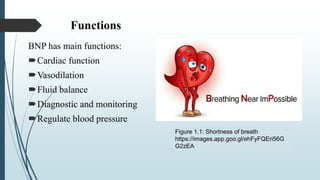
Figure 1.1: Shortness of breath
https://images.app.goo.gl/ehFyFQEri56G
G2zEA
Causes of high BNP levels:
Cardiac causes
Pulmonary embolism
Heart failure
Acute coronary syndrome
Myocarditis
Hypertrophic or restrictive
cardiomyopathy
Valvular heart disease
Congenital heart disease
Atrial and ventricular tachyarrhythmia
Cardioversion, ICD shock
Pulmonary hypertension
Non cardiac causes
Advance age
Ischaemic stroke
Renal dysfunction
Liver dysfunction
Paraneoplastic syndrome
Chronic pulmonary obstructive disease
Anaemia
Severe burns
Up regulation of BNP
 The abnormal range of BNP when over from
100pg/ml in adults.
 Kidney failure
 Pulmonary embolism
 Pulmonary hypertension
 Sever infection (sepsis)
Figure 1.2:Pulmonary embolism
https://images.app.goo.gl/qoHWETm
rvRGXMQVF8
Down regulation of BNP
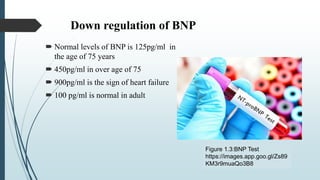
 Normal levels of BNP is 125pg/ml in
the age of 75 years
 450pg/ml in over age of 75
 900pg/ml is the sign of heart failure
 100 pg/ml is normal in adult
Figure 1.3:BNP Test
https://images.app.goo.gl/Zs89
KM3r9muaQo3B8
Symptoms of high BNP level
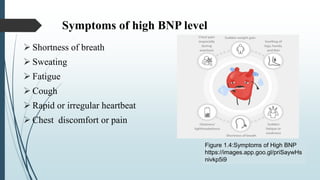
 Shortness of breath
 Sweating
 Fatigue
 Cough
 Rapid or irregular heartbeat
 Chest discomfort or pain
Figure 1.4:Symptoms of High BNP
https://images.app.goo.gl/priSaywHs
nivkp5i9
Treatment
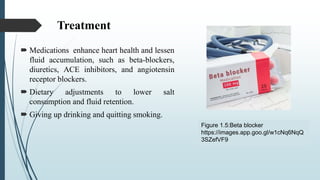
 Medications enhance heart health and lessen
fluid accumulation, such as beta-blockers,
diuretics, ACE inhibitors, and angiotensin
receptor blockers.
 Dietary adjustments to lower salt
consumption and fluid retention.
 Giving up drinking and quitting smoking.
Figure 1.5:Beta blocker
https://images.app.goo.gl/w1cNq6NqQ
3SZefVF9
BNP receptor agonists and potential applications
Nesiritide: A recombinant version of human
BNP is called nesiritide. It is used to treat
acute decompensated heart failure by
predominantly activating NPA-B receptors.
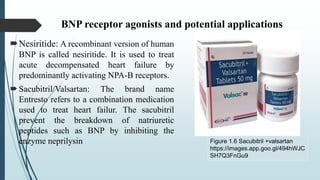
Sacubitril/Valsartan: The brand name
Entresto refers to a combination medication
used to treat heart failur. The sacubitril
prevent the breakdown of natriuretic
peptides such as BNP by inhibiting the
enzyme neprilysin Figure 1.6 Sacubitril +valsartan
https://images.app.goo.gl/494hWJC
SH7Q3FnGu9
The impact of covid 19 on BNP in heart
patients:
The relationship between cardiac biomarker known as brain
natriuretic peptide (BNP) and covid 19 can be seen specifically
in patients with heart failure.
The BNP assess the hemodynamic stress on the heart wall and
have the potential to seras biomarker for evaluating the severity
of covid 19 infection in heart failure patients(Rawaz
D. Tawfeeq et al., 2023).
BNP and perpartum cardiomyopathy:
Peripartum cardiomyopathy (PPCM) is an
uncommon form of heart failure that can
arise during pregnancy or in the
postpartum period. It is associated with the
higher levels of BNP.
Increases BNP levels can be used to
diagnose and gauge the severity of heart
failure in patients with PAD by indicating
myocardial stress(American Heart
Association).
Figure 1.7:Peripartum Cardiomyopathy
https://images.app.goo.gl/nS9G5Y224x93u
W5YA
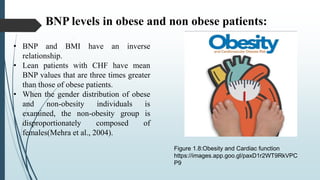
BNP levels in obese and non obese patients:
• BNP and BMI have an inverse
relationship.
• Lean patients with CHF have mean
BNP values that are three times greater
than those of obese patients.
• When the gender distribution of obese
and non-obesity individuals is
examined, the non-obesity group is
disproportionately composed of
females(Mehra et al., 2004).
Figure 1.8:Obesity and Cardiac function
https://images.app.goo.gl/paxD1r2WT9RkVPC
P9
BNP and proBNP monitoring:
Assays:
1. Radio-labeled tracers were used in competitive immunoassay
techniques to provide the first BNP assays.
2. Multiple cardiac biomarkers can be simultaneously screened for
with micromosaic immunoassays (μMIAs).
3. Pro-BNP and BNP breakdown products are measured by various
commercially available BNP assays(Maalouf & Bailey, 2016).
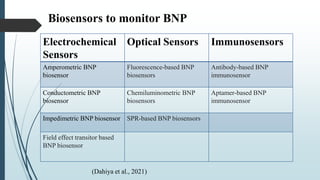
Biosensors to monitor BNP
Electrochemical
Sensors
Optical Sensors Immunosensors
Amperometric BNP
biosensor
Fluorescence-based BNP
biosensors
Antibody-based BNP
immunosensor
Conductometric BNP
biosensor
Chemiluminometric BNP
biosensors
Aptamer-based BNP
immunosensor
Impedimetric BNP biosensor SPR-based BNP biosensors
Field effect transitor based
BNP biosensor
(Dahiya et al., 2021)
References
Waziri, B. I., Wali, N. Y., & Salisu, A. I. (2023). Age and sex variations in serum brain natriuretic
peptide level following doxorubicin-induced myocardial injury in Wistar rats. circulation, 3, 4.
Tawfeeq, R. D., Alwan, M. H., Ismael, A. T., & Hamad, B. K. (2023). The impact of COVID-19 on BNP,
NT-proBNP and ANP in heart failure. Cellular and Molecular Biology, 69(9), 143-148.
Mehra, M. R., Uber, P. A., Park, M. H., Scott, R. L., Ventura, H. O., Harris, B. C., & Frohlich, E. D.
(2004). Obesity and suppressed B-type natriuretic peptide levels in heart failure. Journal of the
American College of Cardiology, 43(9), 1590-1595.
Weber, M., & Hamm, C. (2006). Role of B-type natriuretic peptide (BNP) and NT-proBNP in clinical
routine. Heart, 92(6), 843-849.
Maalouf, R., & Bailey, S. (2016). A review on B-type natriuretic peptide monitoring: assays and
biosensors. Heart failure reviews, 21, 567-578.
Dahiya, T., Yadav, S., Yadav, N., Mann, A., Sharma, M., & Rana, J. S. (2021). Monitoring of BNP
cardiac biomarker with major emphasis on biosensing methods: a review. Sensors International, 2,
100103.
BNP.pptx

BNP.pptx

  • 1.
  • 2.
    Topic: Brain NatriureticPeptide (BNP) Department of Zoology Presented by: Mehreen Afzal Roll no# UOC-BSZOL-F2020/031 BS Zoology Session: 2020-2024 Subject: Endocrinology Instructor Name: Dr. Syeda Nadia Ahmad
  • 3.
  • 4.
    Introduction The cardiac hormoneknown as brain natriuretic peptide (BNP), which is generated by ventricular myocytes, is crucial for controlling blood pressure and fluid volume. While serum BNP levels rise with age in healthy individuals, more research is necessary to fully understand this response and potential sex differences in the setting of drug-induced cardiac damage(Waziri et al., 2023).
  • 5.
    Discovery and structureof BNP In 1988, extracted brain natriuretic peptide (BNP) from pig brain natriuretic peptide (pBNP), which were initially termed after the porcine brain from which the protein was produced. It consists of 26 amino acid chains. Pig brain and heart have been shown to contain a bigger precursor form, 12 kDa, and another form, BNP1-32, which has six extra residues at the N-terminus. It quickly became evident that the heart, not the brain, was the primary source of this natriuretic peptide(Maalouf & Bailey, 2016).
  • 6.
    BNP vs proBNP By attaching to the natriuretic peptide receptor type C (NPR-C) and being proteolyzed by neutral endopeptidases, BNP is removed from plasma.  Conversely, NT-proBNP is primarily eliminated through renal excretion. Recent research indicates that there may be additional significant NT-proBNP clearance processes, nevertheless.  Although both molecules are produced in equimolar amounts, NT- proBNP has a half-life of 120 minutes compared to 20 minutes for BNP.  This difference in half-lives accounts for the roughly six-fold increase in NT-proBNP serum concentrations above BNP readings(Weber, 2005).
  • 7.
    Functions BNP has mainfunctions: Cardiac function Vasodilation Fluid balance Diagnostic and monitoring Regulate blood pressure Figure 1.1: Shortness of breath https://images.app.goo.gl/ehFyFQEri56G G2zEA
  • 8.
    Causes of highBNP levels: Cardiac causes Pulmonary embolism Heart failure Acute coronary syndrome Myocarditis Hypertrophic or restrictive cardiomyopathy Valvular heart disease Congenital heart disease Atrial and ventricular tachyarrhythmia Cardioversion, ICD shock Pulmonary hypertension Non cardiac causes Advance age Ischaemic stroke Renal dysfunction Liver dysfunction Paraneoplastic syndrome Chronic pulmonary obstructive disease Anaemia Severe burns
  • 9.
    Up regulation ofBNP  The abnormal range of BNP when over from 100pg/ml in adults.  Kidney failure  Pulmonary embolism  Pulmonary hypertension  Sever infection (sepsis) Figure 1.2:Pulmonary embolism https://images.app.goo.gl/qoHWETm rvRGXMQVF8
  • 10.
    Down regulation ofBNP  Normal levels of BNP is 125pg/ml in the age of 75 years  450pg/ml in over age of 75  900pg/ml is the sign of heart failure  100 pg/ml is normal in adult Figure 1.3:BNP Test https://images.app.goo.gl/Zs89 KM3r9muaQo3B8
  • 11.
    Symptoms of highBNP level  Shortness of breath  Sweating  Fatigue  Cough  Rapid or irregular heartbeat  Chest discomfort or pain Figure 1.4:Symptoms of High BNP https://images.app.goo.gl/priSaywHs nivkp5i9
  • 12.
    Treatment  Medications enhanceheart health and lessen fluid accumulation, such as beta-blockers, diuretics, ACE inhibitors, and angiotensin receptor blockers.  Dietary adjustments to lower salt consumption and fluid retention.  Giving up drinking and quitting smoking. Figure 1.5:Beta blocker https://images.app.goo.gl/w1cNq6NqQ 3SZefVF9
  • 13.
    BNP receptor agonistsand potential applications Nesiritide: A recombinant version of human BNP is called nesiritide. It is used to treat acute decompensated heart failure by predominantly activating NPA-B receptors. Sacubitril/Valsartan: The brand name Entresto refers to a combination medication used to treat heart failur. The sacubitril prevent the breakdown of natriuretic peptides such as BNP by inhibiting the enzyme neprilysin Figure 1.6 Sacubitril +valsartan https://images.app.goo.gl/494hWJC SH7Q3FnGu9
  • 14.
    The impact ofcovid 19 on BNP in heart patients: The relationship between cardiac biomarker known as brain natriuretic peptide (BNP) and covid 19 can be seen specifically in patients with heart failure. The BNP assess the hemodynamic stress on the heart wall and have the potential to seras biomarker for evaluating the severity of covid 19 infection in heart failure patients(Rawaz D. Tawfeeq et al., 2023).
  • 15.
    BNP and perpartumcardiomyopathy: Peripartum cardiomyopathy (PPCM) is an uncommon form of heart failure that can arise during pregnancy or in the postpartum period. It is associated with the higher levels of BNP. Increases BNP levels can be used to diagnose and gauge the severity of heart failure in patients with PAD by indicating myocardial stress(American Heart Association). Figure 1.7:Peripartum Cardiomyopathy https://images.app.goo.gl/nS9G5Y224x93u W5YA
  • 16.
    BNP levels inobese and non obese patients: • BNP and BMI have an inverse relationship. • Lean patients with CHF have mean BNP values that are three times greater than those of obese patients. • When the gender distribution of obese and non-obesity individuals is examined, the non-obesity group is disproportionately composed of females(Mehra et al., 2004). Figure 1.8:Obesity and Cardiac function https://images.app.goo.gl/paxD1r2WT9RkVPC P9
  • 17.
    BNP and proBNPmonitoring: Assays: 1. Radio-labeled tracers were used in competitive immunoassay techniques to provide the first BNP assays. 2. Multiple cardiac biomarkers can be simultaneously screened for with micromosaic immunoassays (μMIAs). 3. Pro-BNP and BNP breakdown products are measured by various commercially available BNP assays(Maalouf & Bailey, 2016).
  • 18.
    Biosensors to monitorBNP Electrochemical Sensors Optical Sensors Immunosensors Amperometric BNP biosensor Fluorescence-based BNP biosensors Antibody-based BNP immunosensor Conductometric BNP biosensor Chemiluminometric BNP biosensors Aptamer-based BNP immunosensor Impedimetric BNP biosensor SPR-based BNP biosensors Field effect transitor based BNP biosensor (Dahiya et al., 2021)
  • 19.
    References Waziri, B. I.,Wali, N. Y., & Salisu, A. I. (2023). Age and sex variations in serum brain natriuretic peptide level following doxorubicin-induced myocardial injury in Wistar rats. circulation, 3, 4. Tawfeeq, R. D., Alwan, M. H., Ismael, A. T., & Hamad, B. K. (2023). The impact of COVID-19 on BNP, NT-proBNP and ANP in heart failure. Cellular and Molecular Biology, 69(9), 143-148. Mehra, M. R., Uber, P. A., Park, M. H., Scott, R. L., Ventura, H. O., Harris, B. C., & Frohlich, E. D. (2004). Obesity and suppressed B-type natriuretic peptide levels in heart failure. Journal of the American College of Cardiology, 43(9), 1590-1595. Weber, M., & Hamm, C. (2006). Role of B-type natriuretic peptide (BNP) and NT-proBNP in clinical routine. Heart, 92(6), 843-849. Maalouf, R., & Bailey, S. (2016). A review on B-type natriuretic peptide monitoring: assays and biosensors. Heart failure reviews, 21, 567-578. Dahiya, T., Yadav, S., Yadav, N., Mann, A., Sharma, M., & Rana, J. S. (2021). Monitoring of BNP cardiac biomarker with major emphasis on biosensing methods: a review. Sensors International, 2, 100103.