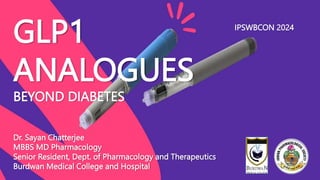
GLP1
ANALOGUES
BEYOND DIABETES
Dr. Sayan Chatterjee
MBBS MD Pharmacology
Senior Resident, Dept. of Pharmacology and Therapeutics
Burdwan Medical College and Hospital
IPSWBCON 2024
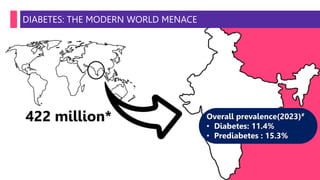
DIABETES: THE MODERN WORLD MENACE
Overall prevalence(2023)#
• Diabetes: 11.4%
• Prediabetes : 15.3%
422 million*
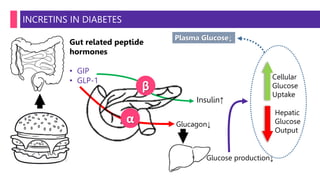
INCRETINS IN DIABETES
Insulin↑
Gut related peptide
hormones
• GIP
• GLP-1
β
α Glucagon↓
Glucose production↓
Cellular
Glucose
Uptake
Hepatic
Glucose
Output
Plasma Glucose↓
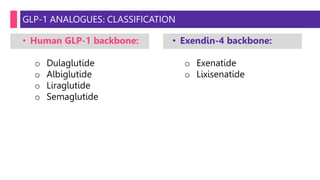
GLP-1 ANALOGUES: CLASSIFICATION
• Human GLP-1 backbone:
o Dulaglutide
o Albiglutide
o Liraglutide
o Semaglutide
• Exendin-4 backbone:
o Exenatide
o Lixisenatide
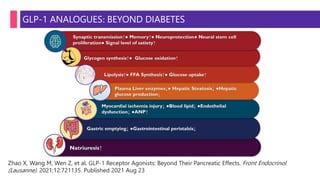
GLP-1 ANALOGUES: BEYOND DIABETES
Zhao X, Wang M, Wen Z, et al. GLP-1 Receptor Agonists: Beyond Their Pancreatic Effects. Front Endocrinol
(Lausanne). 2021;12:721135. Published 2021 Aug 23
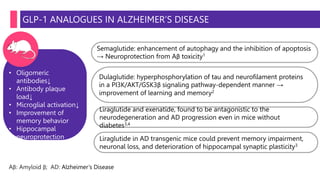
GLP-1 ANALOGUES IN ALZHEIMER’S DISEASE
• Oligomeric
antibodies↓
• Antibody plaque
load↓
• Microglial activation↓
• Improvement of
memory behavior
• Hippocampal
neuroprotection
Semaglutide: enhancement of autophagy and the inhibition of apoptosis
→ Neuroprotection from Aβ toxicity1
Dulaglutide: hyperphosphorylation of tau and neurofilament proteins
in a PI3K/AKT/GSK3β signaling pathway-dependent manner →
improvement of learning and memory2
Liraglutide and exenatide, found to be antagonistic to the
neurodegeneration and AD progression even in mice without
diabetes3,4
Liraglutide in AD transgenic mice could prevent memory impairment,
neuronal loss, and deterioration of hippocampal synaptic plasticity3
Aβ: Amyloid β; AD: Alzheimer’s Disease
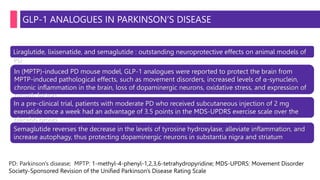
GLP-1 ANALOGUES IN PARKINSON’S DISEASE
Liraglutide, lixisenatide, and semaglutide : outstanding neuroprotective effects on animal models of
PD
In (MPTP)-induced PD mouse model, GLP-1 analogues were reported to protect the brain from
MPTP-induced pathological effects, such as movement disorders, increased levels of α-synuclein,
chronic inflammation in the brain, loss of dopaminergic neurons, oxidative stress, and expression of
growth factors
In a pre-clinical trial, patients with moderate PD who received subcutaneous injection of 2 mg
exenatide once a week had an advantage of 3.5 points in the MDS-UPDRS exercise scale over the
placebo group
Semaglutide reverses the decrease in the levels of tyrosine hydroxylase, alleviate inflammation, and
increase autophagy, thus protecting dopaminergic neurons in substantia nigra and striatum
PD: Parkinson's disease; MPTP: 1-methyl-4-phenyl-1,2,3,6-tetrahydropyridine; MDS-UPDRS: Movement Disorder
Society-Sponsored Revision of the Unified Parkinson's Disease Rating Scale
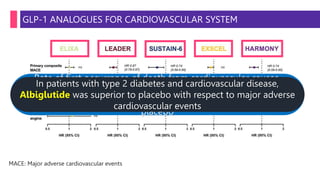
GLP-1 ANALOGUES FOR CARDIOVASCULAR SYSTEM
No significant difference in the reduction of MACE for Lixenatide
Patients with Type 2 diabetes with high ASCVD had lower rates of
cardiovascular events and death from any cause in the Liraglutide
group
Rate of first occurrence of death from cardiovascular causes,
nonfatal myocardial infarction, or nonfatal stroke was significantly
lower in those receiving Semaglutide than in those receiving
placebo
Once-weekly administration of extended-release Exenatide in
patients with type 2 diabetes patients with high ASCVD appeared
not to cause an increase in their overall cardiovascular risk
In patients with type 2 diabetes and cardiovascular disease,
Albiglutide was superior to placebo with respect to major adverse
cardiovascular events
MACE: Major adverse cardiovascular events
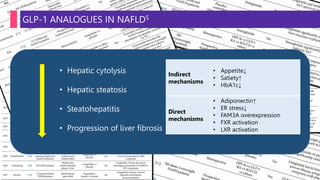
GLP-1 ANALOGUES IN NAFLD5
• Hepatic cytolysis
• Hepatic steatosis
• Steatohepatitis
• Progression of liver fibrosis
Indirect
mechanisms
• Appetite↓
• Satiety↑
• HbA1c↓
Direct
mechanisms
• Adiponectin↑
• ER stress↓
• FAM3A overexpression
• FXR activation
• LXR activation
GLP-1 ANALOGUES IN CANCER
Occurrence of endometrial cancer, hepatobiliary cancer, pancreatic cancer, breast cancer,
prostate cancer, and colorectal cancer is positively correlated with T2DM6,7
Meta-analysis of clinical studies indicated that treatment with GLP-1RAs of obese T2DM patients did
not increase the risk of breast tumors, acute pancreatitis, pancreatic cancer, and overall tumor
neoplasia8-10
Gier et. al. GLP-1RAs might not increase the risk of new thyroid tumors in T2DM patients9
Inhibits PI3K/AKT/mTOR , NF-Kb and ERK/MAPK pathways→ ↓ prostate and pancreatic cancers11-13
Liraglutide and exenatide reported to induce apoptosis and autophagy through the AMPK signaling
pathway, inhibiting the progression of endometrial cancer14,15
GLP-1 ANALOGUES IN OBESITY
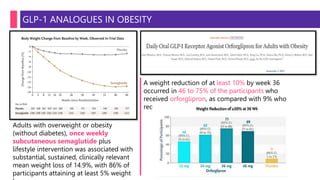
Adults with overweight or obesity
(without diabetes), once weekly
subcutaneous semaglutide plus
lifestyle intervention was associated with
substantial, sustained, clinically relevant
mean weight loss of 14.9%, with 86% of
participants attaining at least 5% weight
A weight reduction of at least 10% by week 36
occurred in 46 to 75% of the participants who
received orforglipron, as compared with 9% who
received placebo.
GLP-1 ANALOGUES IN PCOS
Causal relationship between Insulin Resistance (IR), Obesity and PCOS16,17
Weight loss being shown to improve the reproductive function, hyperandrogenism and
metabolism of women with PCOS16,17
GLP-1RAs have been increasingly used in the treatment of PCOS because of their ability to
reduce weight and improve IR16-20
GLP-1/GLP-1R axis was demonstrated to enhance the activity of PCOS ovarian granulosa cells by
partially modifying the FoxO1 phosphorylation sites, thereby promoting oocyte maturation21
Liraglutide was found to repair the cognitive impairment in a rat model of PCOS by inhibiting the
overexpression of the Notch signaling pathway22
CONCLUSION
Overall, GLP-1RAs are considered novel blood glucose lowering drugs used in the treatment of
T2DM
In addition, GLP-1RAs are valuable in the treatment and prevention of diseases of the nervous
and cardiovascular system, endocrine disorders, or metabolic diseases due to their
neuroprotective, cardiovascular protective, and metabolic regulatory effects
However, there are still many controversies regarding the tolerability and adverse reactions of
GLP-1RAs in the treatment of diabetes
Being macromolecular peptide preparations, these drugs are highly costly making them less
patient compliant
1. Chang YF, Zhang D, Hu WM, Liu DX, Li L. Semaglutide-Mediated Protection Against Aβ Correlated With
Enhancement of Autophagy and Inhibition of Apotosis. J Clin Neurosci (2020) 81:234–9
2. Zhou M, Chen S, Peng P, Gu Z, Yu J, Zhao G, et al.. Dulaglutide Ameliorates STZ Induced AD-Like Impairment of
Learning and Memory Ability by Modulating Hyperphosphorylation of Tau and NFs Through GSK3β. Biochem
Biophys Res Commun (2019) 511(1):154–60
3. McClean PL, Parthsarathy V, Faivre E, Hölscher C. The Diabetes Drug Liraglutide Prevents Degenerative
Processes in a Mouse Model of Alzheimer’s Disease. J Neurosci (2011) 31(17):6587–94
4. Bomfim TR, Forny-Germano L, Sathler LB, Brito-Moreira J, Houzel JC, Decker H, et al.. An Anti-Diabetes Agent
Protects the Mouse Brain From Defective Insulin Signaling Caused by Alzheimer’s Disease- Associated Aβ
Oligomers. J Clin Invest (2012) 122(4):1339–53
5. Nevola R, Epifani R, Imbriani S, Tortorella G, Aprea C, Galiero R, Rinaldi L, Marfella R, Sasso FC. GLP-1 Receptor
Agonists in Non-Alcoholic Fatty Liver Disease: Current Evidence and Future Perspectives. International Journal of
Molecular Sciences. 2023; 24(2):1703
6. Tsilidis KK, Kasimis JC, Lopez DS, Ntzani EE, Ioannidis JP. Type 2 Diabetes and Cancer: Umbrella Review of Meta-
Analyses of Observational Studies. BMJ (2015) 350:g7607
7. Harding JL, Shaw JE, Peeters A, Cartensen B, Magliano DJ. Cancer risk among people with type 1 and type 2
diabetes: disentangling true associations, detection bias, and reverse causation [published correction appears in
Diabetes Care. 2015 Apr;38(4):734-5]. Diabetes Care. 2015;38(2):264-270
REFERENCES
8. Piccoli GF, Mesquita LA, Stein C, Aziz M, Zoldan M, Degobi NAH, et al.. Do GLP-1 Receptor Agonists Increase the
Risk of Breast Cancer? A Systematic Review and Meta-Analysis. J Clin Endocrinol Metab (2021) 106(3):912–21.
9. Gier B, Butler PC, Lai CK, Kirakossian D, DeNicola MM, Yeh MW. Glucagon Like Peptide-1 Receptor Expression in
the Human Thyroid Gland. J Clin Endocrinol Metab (2012) 97(1):121–31.
10. Alves C, Batel-Marques F, Macedo AF. A Meta-Analysis of Serious Adverse Events Reported With Exenatide and
Liraglutide: Acute Pancreatitis and Cancer. Diabetes Res Clin Pract (2012) 98(2):271–84
11. Wenjing H, Shao Y, Yu Y, Huang W, Feng G, Li J. Exendin-4 Enhances the Sensitivity of Prostate Cancer to
Enzalutamide by Targeting Akt Activation. Prostate (2020) 80(5):367–75.
12. Iwaya C, Nomiyama T, Komatsu S, Kawanami T, Tsutsumi Y, Hamaguchi Y, et al.. Exendin-4, a Glucagonlike
Peptide-1 Receptor Agonist, Attenuates Breast Cancer Growth by Inhibiting NF-κb
Activation. Endocrinology (2017) 158(12):4218–32.
13. Nomiyama T, Kawanami T, Irie S, Hamaguchi Y, Terawaki Y, Murase K, et al.. Exendin-4, a GLP-1 Receptor Agonist,
Attenuates Prostate Cancer Growth. Diabetes (2014) 63(11):3891–905
14. Kanda R, Hiraike H, Wada-Hiraike O, Ichinose T, Nagasaka K, Sasajima Y, et al.. Expression of the Glucagon-Like
Peptide-1 Receptor and Its Role in Regulating Autophagy in Endometrial Cancer. BMC Cancer (2018) 18(1):657
15. Zhang Y, Xu F, Liang H, Cai M, Wen X, Li X, et al.. Exenatide Inhibits the Growth of Endometrial Cancer Ishikawa
Xenografts in Nude Mice. Oncol Rep (2016) 35(3):1340–8
16. De Leo V, la Marca A, Petraglia F. Insulin-Lowering Agents in the Management of Polycystic Ovary Syndrome.
Endocr Rev (2003) 24(5):633–67
17. Lamos EM, Malek R, Davis SN. GLP-1 Receptor Agonists in the Treatment of Polycystic Ovary Syndrome. Expert
Rev Clin Pharmacol (2017) 10(4):401–8
18. Frøssing S, Nylander M, Chabanova E, Frystyk J, Holst JJ, Kistorp C, et al.. Effect of Liraglutide on Ectopic Fat in
Polycystic Ovary Syndrome: A Randomized Clinical Trial. Diabetes Obes Metab (2018) 20(1):215–8
19. Jensterle M, Kravos NA, Goričar K, Janez A. Short-Term Effectiveness of Low Dose Liraglutide in Combination
With Metformin Versus High Dose Liraglutide Alone in Treatment of Obese PCOS: Randomized Trial. BMC Endocr
Disord (2017) 17(1):5
20. Papaetis GS, Filippou PK, Constantinidou KG, Stylianou CS. Liraglutide: New Perspectives for the Treatment of
Polycystic Ovary Syndrome. Clin Drug Investig (2020) 40(8):695–713
21. Sun Z, Li P, Wang X, Lai S, Qiu H, Chen Z, et al.. GLP-1/GLP-1r Signaling Regulates Ovarian PCOS-Associated
Granulosa Cells Proliferation and Antiapoptosis by Modification of Forkhead Box Protein O1 Phosphorylation Sites.
Int J Endocrinol (2020) 2020:1484321
22. Saad MA, Eltarzy MA, Abdel Salam RM, Ahmed MAE. Liraglutide Mends Cognitive Impairment by Averting Notch
Signaling Pathway Overexpression in a Rat Model of Polycystic Ovary Syndrome. Life Sci (2021) 265:118731
THANK
YOU

GLP1 ANALOGUES- BEYOND DIABETES.pptx

  • 1.
    GLP1 ANALOGUES BEYOND DIABETES Dr. SayanChatterjee MBBS MD Pharmacology Senior Resident, Dept. of Pharmacology and Therapeutics Burdwan Medical College and Hospital IPSWBCON 2024
  • 2.
    DIABETES: THE MODERNWORLD MENACE Overall prevalence(2023)# • Diabetes: 11.4% • Prediabetes : 15.3% 422 million*
  • 3.
    INCRETINS IN DIABETES Insulin↑ Gutrelated peptide hormones • GIP • GLP-1 β α Glucagon↓ Glucose production↓ Cellular Glucose Uptake Hepatic Glucose Output Plasma Glucose↓
  • 4.
    GLP-1 ANALOGUES: CLASSIFICATION •Human GLP-1 backbone: o Dulaglutide o Albiglutide o Liraglutide o Semaglutide • Exendin-4 backbone: o Exenatide o Lixisenatide
  • 5.
    GLP-1 ANALOGUES: BEYONDDIABETES Zhao X, Wang M, Wen Z, et al. GLP-1 Receptor Agonists: Beyond Their Pancreatic Effects. Front Endocrinol (Lausanne). 2021;12:721135. Published 2021 Aug 23
  • 6.
    GLP-1 ANALOGUES INALZHEIMER’S DISEASE • Oligomeric antibodies↓ • Antibody plaque load↓ • Microglial activation↓ • Improvement of memory behavior • Hippocampal neuroprotection Semaglutide: enhancement of autophagy and the inhibition of apoptosis → Neuroprotection from Aβ toxicity1 Dulaglutide: hyperphosphorylation of tau and neurofilament proteins in a PI3K/AKT/GSK3β signaling pathway-dependent manner → improvement of learning and memory2 Liraglutide and exenatide, found to be antagonistic to the neurodegeneration and AD progression even in mice without diabetes3,4 Liraglutide in AD transgenic mice could prevent memory impairment, neuronal loss, and deterioration of hippocampal synaptic plasticity3 Aβ: Amyloid β; AD: Alzheimer’s Disease
  • 7.
    GLP-1 ANALOGUES INPARKINSON’S DISEASE Liraglutide, lixisenatide, and semaglutide : outstanding neuroprotective effects on animal models of PD In (MPTP)-induced PD mouse model, GLP-1 analogues were reported to protect the brain from MPTP-induced pathological effects, such as movement disorders, increased levels of α-synuclein, chronic inflammation in the brain, loss of dopaminergic neurons, oxidative stress, and expression of growth factors In a pre-clinical trial, patients with moderate PD who received subcutaneous injection of 2 mg exenatide once a week had an advantage of 3.5 points in the MDS-UPDRS exercise scale over the placebo group Semaglutide reverses the decrease in the levels of tyrosine hydroxylase, alleviate inflammation, and increase autophagy, thus protecting dopaminergic neurons in substantia nigra and striatum PD: Parkinson's disease; MPTP: 1-methyl-4-phenyl-1,2,3,6-tetrahydropyridine; MDS-UPDRS: Movement Disorder Society-Sponsored Revision of the Unified Parkinson's Disease Rating Scale
  • 8.
    GLP-1 ANALOGUES FORCARDIOVASCULAR SYSTEM No significant difference in the reduction of MACE for Lixenatide Patients with Type 2 diabetes with high ASCVD had lower rates of cardiovascular events and death from any cause in the Liraglutide group Rate of first occurrence of death from cardiovascular causes, nonfatal myocardial infarction, or nonfatal stroke was significantly lower in those receiving Semaglutide than in those receiving placebo Once-weekly administration of extended-release Exenatide in patients with type 2 diabetes patients with high ASCVD appeared not to cause an increase in their overall cardiovascular risk In patients with type 2 diabetes and cardiovascular disease, Albiglutide was superior to placebo with respect to major adverse cardiovascular events MACE: Major adverse cardiovascular events
  • 9.
    GLP-1 ANALOGUES INNAFLD5 • Hepatic cytolysis • Hepatic steatosis • Steatohepatitis • Progression of liver fibrosis Indirect mechanisms • Appetite↓ • Satiety↑ • HbA1c↓ Direct mechanisms • Adiponectin↑ • ER stress↓ • FAM3A overexpression • FXR activation • LXR activation
  • 10.
    GLP-1 ANALOGUES INCANCER Occurrence of endometrial cancer, hepatobiliary cancer, pancreatic cancer, breast cancer, prostate cancer, and colorectal cancer is positively correlated with T2DM6,7 Meta-analysis of clinical studies indicated that treatment with GLP-1RAs of obese T2DM patients did not increase the risk of breast tumors, acute pancreatitis, pancreatic cancer, and overall tumor neoplasia8-10 Gier et. al. GLP-1RAs might not increase the risk of new thyroid tumors in T2DM patients9 Inhibits PI3K/AKT/mTOR , NF-Kb and ERK/MAPK pathways→ ↓ prostate and pancreatic cancers11-13 Liraglutide and exenatide reported to induce apoptosis and autophagy through the AMPK signaling pathway, inhibiting the progression of endometrial cancer14,15
  • 11.
    GLP-1 ANALOGUES INOBESITY Adults with overweight or obesity (without diabetes), once weekly subcutaneous semaglutide plus lifestyle intervention was associated with substantial, sustained, clinically relevant mean weight loss of 14.9%, with 86% of participants attaining at least 5% weight A weight reduction of at least 10% by week 36 occurred in 46 to 75% of the participants who received orforglipron, as compared with 9% who received placebo.
  • 12.
    GLP-1 ANALOGUES INPCOS Causal relationship between Insulin Resistance (IR), Obesity and PCOS16,17 Weight loss being shown to improve the reproductive function, hyperandrogenism and metabolism of women with PCOS16,17 GLP-1RAs have been increasingly used in the treatment of PCOS because of their ability to reduce weight and improve IR16-20 GLP-1/GLP-1R axis was demonstrated to enhance the activity of PCOS ovarian granulosa cells by partially modifying the FoxO1 phosphorylation sites, thereby promoting oocyte maturation21 Liraglutide was found to repair the cognitive impairment in a rat model of PCOS by inhibiting the overexpression of the Notch signaling pathway22
  • 13.
    CONCLUSION Overall, GLP-1RAs areconsidered novel blood glucose lowering drugs used in the treatment of T2DM In addition, GLP-1RAs are valuable in the treatment and prevention of diseases of the nervous and cardiovascular system, endocrine disorders, or metabolic diseases due to their neuroprotective, cardiovascular protective, and metabolic regulatory effects However, there are still many controversies regarding the tolerability and adverse reactions of GLP-1RAs in the treatment of diabetes Being macromolecular peptide preparations, these drugs are highly costly making them less patient compliant
  • 14.
    1. Chang YF,Zhang D, Hu WM, Liu DX, Li L. Semaglutide-Mediated Protection Against Aβ Correlated With Enhancement of Autophagy and Inhibition of Apotosis. J Clin Neurosci (2020) 81:234–9 2. Zhou M, Chen S, Peng P, Gu Z, Yu J, Zhao G, et al.. Dulaglutide Ameliorates STZ Induced AD-Like Impairment of Learning and Memory Ability by Modulating Hyperphosphorylation of Tau and NFs Through GSK3β. Biochem Biophys Res Commun (2019) 511(1):154–60 3. McClean PL, Parthsarathy V, Faivre E, Hölscher C. The Diabetes Drug Liraglutide Prevents Degenerative Processes in a Mouse Model of Alzheimer’s Disease. J Neurosci (2011) 31(17):6587–94 4. Bomfim TR, Forny-Germano L, Sathler LB, Brito-Moreira J, Houzel JC, Decker H, et al.. An Anti-Diabetes Agent Protects the Mouse Brain From Defective Insulin Signaling Caused by Alzheimer’s Disease- Associated Aβ Oligomers. J Clin Invest (2012) 122(4):1339–53 5. Nevola R, Epifani R, Imbriani S, Tortorella G, Aprea C, Galiero R, Rinaldi L, Marfella R, Sasso FC. GLP-1 Receptor Agonists in Non-Alcoholic Fatty Liver Disease: Current Evidence and Future Perspectives. International Journal of Molecular Sciences. 2023; 24(2):1703 6. Tsilidis KK, Kasimis JC, Lopez DS, Ntzani EE, Ioannidis JP. Type 2 Diabetes and Cancer: Umbrella Review of Meta- Analyses of Observational Studies. BMJ (2015) 350:g7607 7. Harding JL, Shaw JE, Peeters A, Cartensen B, Magliano DJ. Cancer risk among people with type 1 and type 2 diabetes: disentangling true associations, detection bias, and reverse causation [published correction appears in Diabetes Care. 2015 Apr;38(4):734-5]. Diabetes Care. 2015;38(2):264-270 REFERENCES
  • 15.
    8. Piccoli GF,Mesquita LA, Stein C, Aziz M, Zoldan M, Degobi NAH, et al.. Do GLP-1 Receptor Agonists Increase the Risk of Breast Cancer? A Systematic Review and Meta-Analysis. J Clin Endocrinol Metab (2021) 106(3):912–21. 9. Gier B, Butler PC, Lai CK, Kirakossian D, DeNicola MM, Yeh MW. Glucagon Like Peptide-1 Receptor Expression in the Human Thyroid Gland. J Clin Endocrinol Metab (2012) 97(1):121–31. 10. Alves C, Batel-Marques F, Macedo AF. A Meta-Analysis of Serious Adverse Events Reported With Exenatide and Liraglutide: Acute Pancreatitis and Cancer. Diabetes Res Clin Pract (2012) 98(2):271–84 11. Wenjing H, Shao Y, Yu Y, Huang W, Feng G, Li J. Exendin-4 Enhances the Sensitivity of Prostate Cancer to Enzalutamide by Targeting Akt Activation. Prostate (2020) 80(5):367–75. 12. Iwaya C, Nomiyama T, Komatsu S, Kawanami T, Tsutsumi Y, Hamaguchi Y, et al.. Exendin-4, a Glucagonlike Peptide-1 Receptor Agonist, Attenuates Breast Cancer Growth by Inhibiting NF-κb Activation. Endocrinology (2017) 158(12):4218–32. 13. Nomiyama T, Kawanami T, Irie S, Hamaguchi Y, Terawaki Y, Murase K, et al.. Exendin-4, a GLP-1 Receptor Agonist, Attenuates Prostate Cancer Growth. Diabetes (2014) 63(11):3891–905 14. Kanda R, Hiraike H, Wada-Hiraike O, Ichinose T, Nagasaka K, Sasajima Y, et al.. Expression of the Glucagon-Like Peptide-1 Receptor and Its Role in Regulating Autophagy in Endometrial Cancer. BMC Cancer (2018) 18(1):657 15. Zhang Y, Xu F, Liang H, Cai M, Wen X, Li X, et al.. Exenatide Inhibits the Growth of Endometrial Cancer Ishikawa Xenografts in Nude Mice. Oncol Rep (2016) 35(3):1340–8
  • 16.
    16. De LeoV, la Marca A, Petraglia F. Insulin-Lowering Agents in the Management of Polycystic Ovary Syndrome. Endocr Rev (2003) 24(5):633–67 17. Lamos EM, Malek R, Davis SN. GLP-1 Receptor Agonists in the Treatment of Polycystic Ovary Syndrome. Expert Rev Clin Pharmacol (2017) 10(4):401–8 18. Frøssing S, Nylander M, Chabanova E, Frystyk J, Holst JJ, Kistorp C, et al.. Effect of Liraglutide on Ectopic Fat in Polycystic Ovary Syndrome: A Randomized Clinical Trial. Diabetes Obes Metab (2018) 20(1):215–8 19. Jensterle M, Kravos NA, Goričar K, Janez A. Short-Term Effectiveness of Low Dose Liraglutide in Combination With Metformin Versus High Dose Liraglutide Alone in Treatment of Obese PCOS: Randomized Trial. BMC Endocr Disord (2017) 17(1):5 20. Papaetis GS, Filippou PK, Constantinidou KG, Stylianou CS. Liraglutide: New Perspectives for the Treatment of Polycystic Ovary Syndrome. Clin Drug Investig (2020) 40(8):695–713 21. Sun Z, Li P, Wang X, Lai S, Qiu H, Chen Z, et al.. GLP-1/GLP-1r Signaling Regulates Ovarian PCOS-Associated Granulosa Cells Proliferation and Antiapoptosis by Modification of Forkhead Box Protein O1 Phosphorylation Sites. Int J Endocrinol (2020) 2020:1484321 22. Saad MA, Eltarzy MA, Abdel Salam RM, Ahmed MAE. Liraglutide Mends Cognitive Impairment by Averting Notch Signaling Pathway Overexpression in a Rat Model of Polycystic Ovary Syndrome. Life Sci (2021) 265:118731
  • 17.