1
Amplitude Modulation
2
Content
• What is Modulation
• Amplitude Modulation (AM)
• Demodulation of AM signals
• Calculation and Examples
• Summary
3
What is Modulation
• Modulation
– In the modulation process, some characteristic
of a high-frequency carrier signal (bandpass), is
changed according to the instantaneous
amplitude of the information (baseband) signal.
• Why Modulation
– Suitable for signal transmission (distance…etc)
– Multiple signals transmitted on the same channel
– Capacitive or inductive devices require high
frequency AC input (carrier) to operate.
– Stability and noise rejection
4
About Modulation
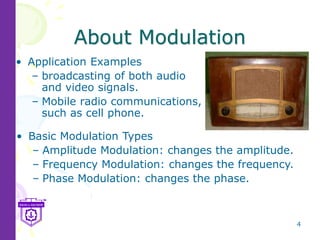
• Application Examples
– broadcasting of both audio
and video signals.
– Mobile radio communications,
such as cell phone.
• Basic Modulation Types
– Amplitude Modulation: changes the amplitude.
– Frequency Modulation: changes the frequency.
– Phase Modulation: changes the phase.
5
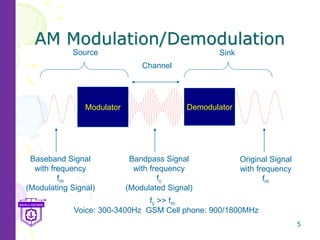
AM Modulation/Demodulation
Modulator Demodulator
Baseband Signal
with frequency
fm
(Modulating Signal)
Bandpass Signal
with frequency
fc
(Modulated Signal)
Channel
Original Signal
with frequency
fm
Source Sink
fc >> fm
Voice: 300-3400Hz GSM Cell phone: 900/1800MHz
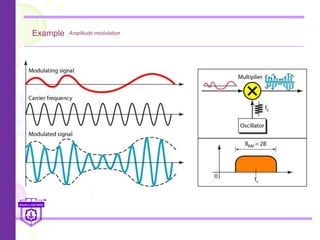
Example Amplitude modulation
7
Amplitude Modulation
• The amplitude of high-carrier signal is
varied according to the instantaneous
amplitude of the modulating message
signal m(t).
Carrier Signal: or
Modulating Message Signal: or
The AM Signal:
cos(2 ) cos( )
( ): cos(2 ) cos( )
( ) [ ( )]cos(2 )
c c
m m
AM c c
f t t
m t f t t
s t A m t f t
 
 

 
8
Amplitude Modulation
• The AM signal is generated using a
multiplier.
• All info is carried in the amplitude of
the carrier, AM carrier signal has
time-varying envelope.
• In frequency domain the AM
waveform are the lower-side
frequency/band (fc - fm), the carrier
frequency fc, the upper-side
frequency/band (fc + fm).
9
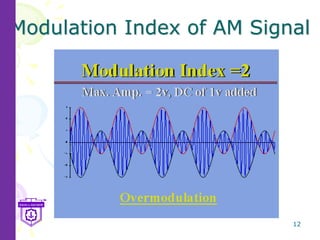
Modulation Index of AM Signal
m
c
A
k
A

)
2
cos(
)
( t
f
A
t
m m
m 

Carrier Signal: cos(2 ) DC:
c C
f t A

For a sinusoidal message signal
Modulation Index is defined as:
Modulated Signal: ( ) [ cos(2 )]cos(2 )
[1 cos(2 )]cos(2 )
AM c m m c
c m c
S t A A f t f t
A k f t f t
 
 
 
 
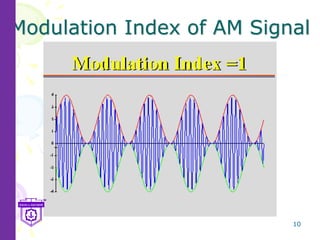
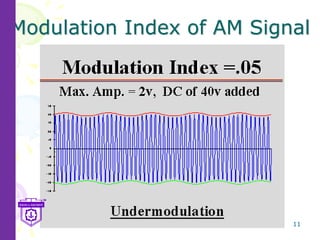
Modulation index k is a measure of the extent to
which a carrier voltage is varied by the modulating
signal. When k=0 no modulation, when k=1 100%
modulation, when k>1 over modulation.
10
Modulation Index of AM Signal
CSULB May 22, 2006 11
Modulation Index of AM Signal
12
Modulation Index of AM Signal
13
High Percentage Modulation
• It is important to use as high percentage of
modulation as possible (k=1) while ensuring
that over modulation (k>1) does not occur.
• The sidebands contain the information and
have maximum power at 100% modulation.
• Useful equation
Pt = Pc(1 + k2/2)
Pt =Total transmitted power (sidebands and
carrier)
Pc = Carrier power

Ampitude Modulation...........................

  • 1.
  • 2.
    2 Content • What isModulation • Amplitude Modulation (AM) • Demodulation of AM signals • Calculation and Examples • Summary
  • 3.
    3 What is Modulation •Modulation – In the modulation process, some characteristic of a high-frequency carrier signal (bandpass), is changed according to the instantaneous amplitude of the information (baseband) signal. • Why Modulation – Suitable for signal transmission (distance…etc) – Multiple signals transmitted on the same channel – Capacitive or inductive devices require high frequency AC input (carrier) to operate. – Stability and noise rejection
  • 4.
    4 About Modulation • ApplicationExamples – broadcasting of both audio and video signals. – Mobile radio communications, such as cell phone. • Basic Modulation Types – Amplitude Modulation: changes the amplitude. – Frequency Modulation: changes the frequency. – Phase Modulation: changes the phase.
  • 5.
    5 AM Modulation/Demodulation Modulator Demodulator BasebandSignal with frequency fm (Modulating Signal) Bandpass Signal with frequency fc (Modulated Signal) Channel Original Signal with frequency fm Source Sink fc >> fm Voice: 300-3400Hz GSM Cell phone: 900/1800MHz
  • 6.
  • 7.
    7 Amplitude Modulation • Theamplitude of high-carrier signal is varied according to the instantaneous amplitude of the modulating message signal m(t). Carrier Signal: or Modulating Message Signal: or The AM Signal: cos(2 ) cos( ) ( ): cos(2 ) cos( ) ( ) [ ( )]cos(2 ) c c m m AM c c f t t m t f t t s t A m t f t       
  • 8.
    8 Amplitude Modulation • TheAM signal is generated using a multiplier. • All info is carried in the amplitude of the carrier, AM carrier signal has time-varying envelope. • In frequency domain the AM waveform are the lower-side frequency/band (fc - fm), the carrier frequency fc, the upper-side frequency/band (fc + fm).
  • 9.
    9 Modulation Index ofAM Signal m c A k A  ) 2 cos( ) ( t f A t m m m   Carrier Signal: cos(2 ) DC: c C f t A  For a sinusoidal message signal Modulation Index is defined as: Modulated Signal: ( ) [ cos(2 )]cos(2 ) [1 cos(2 )]cos(2 ) AM c m m c c m c S t A A f t f t A k f t f t         Modulation index k is a measure of the extent to which a carrier voltage is varied by the modulating signal. When k=0 no modulation, when k=1 100% modulation, when k>1 over modulation.
  • 10.
  • 11.
    CSULB May 22,2006 11 Modulation Index of AM Signal
  • 12.
  • 13.
    13 High Percentage Modulation •It is important to use as high percentage of modulation as possible (k=1) while ensuring that over modulation (k>1) does not occur. • The sidebands contain the information and have maximum power at 100% modulation. • Useful equation Pt = Pc(1 + k2/2) Pt =Total transmitted power (sidebands and carrier) Pc = Carrier power