Topic: To design a
Notch filter having
 central frequency
     3.1206 KHz


            Submitted by:-
            Sushil Kumar Mishra
            ECE-I
            05311502809

                                  1
Introduction:
In signal processing, a band-stop filter or band-rejection filter is
a filter that passes most frequencies unaltered, but attenuates those in
a specific range to very low levels. It is the opposite of a band-pass fil-
ter. A notch filter is a band-stop filter with a narrow stopband (high Q
factor).
Narrow notch filters (optical) are used in Raman spectroscopy, live
sound reproduction (public address systems, or PA systems) and
in instrument amplifiers (especially amplifiers or preamplifiers for acous-
tic instruments such as acoustic guitar, mandolin, bass instrument am-
plifier, etc.) to reduce or prevent audio feedback, while having little no-
ticeable effect on the rest of the frequency spectrum
(electronic or software filters). Other names include 'band limit filter', 'T-
notch filter', 'band-elimination filter', and 'band-reject filter'.
Typically, the width of the stopband is 1 to 2 decades (that is, the high-
est frequency attenuated is 10 to 100 times the lowest frequency atten-
uated). However, in the audioband, a notch filter has high and low fre-
quencies that may be only semitones apart.


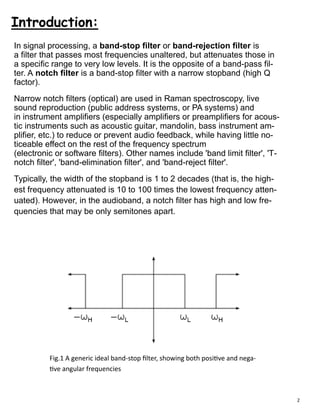
          Fig.1 A generic ideal band-stop filter, showing both positive and nega-
          tive angular frequencies


                                                                                    2
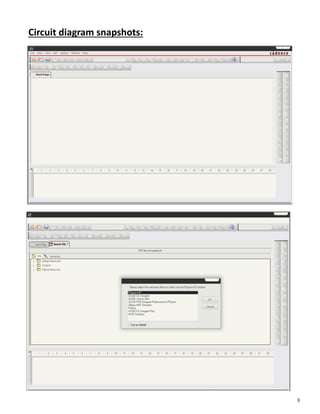
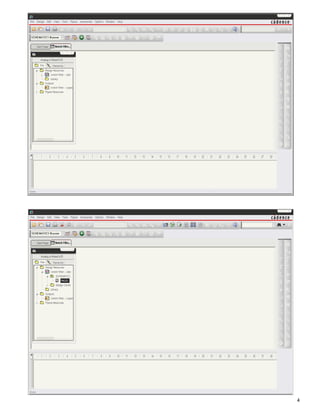
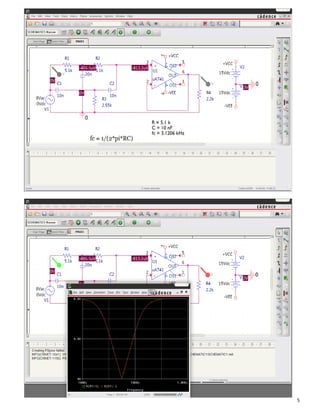
Circuit diagram snapshots:


                             3
4
5
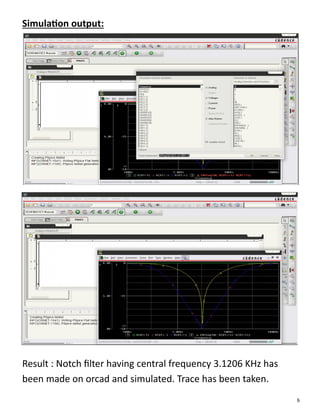
Simulation output:


Result : Notch filter having central frequency 3.1206 KHz has
been made on orcad and simulated. Trace has been taken.
                                                                6

Designing a notch filter using orcad 15.3

  • 1.
    Topic: To designa Notch filter having central frequency 3.1206 KHz Submitted by:- Sushil Kumar Mishra ECE-I 05311502809 1
  • 2.
    Introduction: In signal processing,a band-stop filter or band-rejection filter is a filter that passes most frequencies unaltered, but attenuates those in a specific range to very low levels. It is the opposite of a band-pass fil- ter. A notch filter is a band-stop filter with a narrow stopband (high Q factor). Narrow notch filters (optical) are used in Raman spectroscopy, live sound reproduction (public address systems, or PA systems) and in instrument amplifiers (especially amplifiers or preamplifiers for acous- tic instruments such as acoustic guitar, mandolin, bass instrument am- plifier, etc.) to reduce or prevent audio feedback, while having little no- ticeable effect on the rest of the frequency spectrum (electronic or software filters). Other names include 'band limit filter', 'T- notch filter', 'band-elimination filter', and 'band-reject filter'. Typically, the width of the stopband is 1 to 2 decades (that is, the high- est frequency attenuated is 10 to 100 times the lowest frequency atten- uated). However, in the audioband, a notch filter has high and low fre- quencies that may be only semitones apart. Fig.1 A generic ideal band-stop filter, showing both positive and nega- tive angular frequencies 2
  • 3.
  • 4.
  • 5.
  • 6.
    Simulation output: Result :Notch filter having central frequency 3.1206 KHz has been made on orcad and simulated. Trace has been taken. 6