
By : 
Dr .Safia A. Alrezami
What mean thyroid ? 
Is one of the largest endocrine glands ,located in the 
lower part of the neck, below the Adam's apple. 
Types of hormone secreted : 
The most important thyroid hormones are 
1.Thyroxine (T4) . 
2. Triiodothyronine (T3). 
3. calcitonin . 
Thyroid stimulating hormone (TSH), which is 
produced by the pituitary gland, acts to stimulate 
hormone production by the thyroid gland ( uses 
iodine form food in production process).
Function of gland : 
Essential for the function of every cell in the body. 
 They help regulate growth and the rate of chemical 
reactions (metabolism) in the body(the rate at which 
food is converted into energy). 
 help children grow and develop . 
 help regulate the heart rate, blood pressure, body 
temperature. 
 calcitonin, is involved in calcium metabolism and 
stimulating bone cells to add calcium to bone.
Disease of gland : 
1.Hyperthyroidism (over - 
activity) 
2.Hypothyroidism (low-activity) 
.
Hyperthyroidism 
Increase produce Of T3T4 above 
normal.
Cause 
. 1.Graves' disease (an autoimmune 
disorder) is the most common. occurs 
more often in women and tends to run 
in families. In Graves' disease, 
antibodies stimulate the thyroid to 
secrete too much hormone.
Cause 
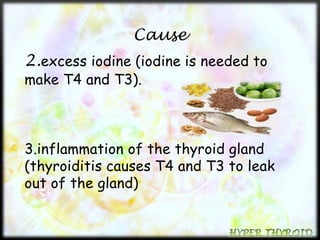
2.excess iodine (iodine is needed to 
make T4 and T3). 
3.inflammation of the thyroid gland 
(thyroiditis causes T4 and T3 to leak 
out of the gland)
Cause 
4.Tumors of the ovaries or testes. 
5.Taking large amounts of T3 (through 
dietary supplements or medication). 
6.Benign tumors of the thyroid or 
pituitary gland
Symptom 
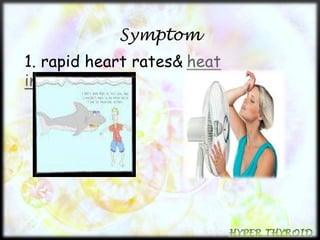
1. rapid heart rates& heat 
intolerance.
Symptom 
2.Weight loss &Tremor 
3.Nervousness, anxiety and 
irritability
Symptom 
4. An enlarged thyroid gland (goiter), 
which may appear as a swelling at the 
base of your neck. 
5. Fatigue, muscle weakness &Difficulty 
sleeping
Diagnosis 
1. Medical history and physical exam. During the 
exam your doctor may try to detect a slight tremor 
in your fingers when they're extended and other 
symptom.
Diagnosis 
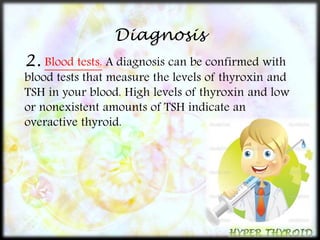
2. Blood tests. A diagnosis can be confirmed with 
blood tests that measure the levels of thyroxin and 
TSH in your blood. High levels of thyroxin and low 
or nonexistent amounts of TSH indicate an 
overactive thyroid.
Diagnosis 
3. Radioactive iodine uptake test. 
For this test, you take a small, oral dose of 
radioactive iodine (radioiodine). Over time, the 
iodine collects in your thyroid gland because your 
thyroid uses iodine to manufacture hormones. 
You'll be checked after two, six or 24 hours — and 
sometimes after all three time periods — to 
determine how much iodine your thyroid gland has 
absorbed.
Diagnosis 
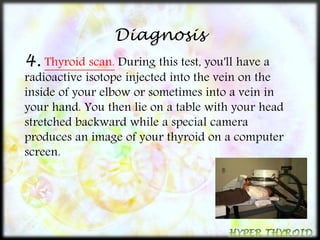
4. Thyroid scan. During this test, you'll have a 
radioactive isotope injected into the vein on the 
inside of your elbow or sometimes into a vein in 
your hand. You then lie on a table with your head 
stretched backward while a special camera 
produces an image of your thyroid on a computer 
screen.
Treatment 
1. Anti-thyroid Drugs 
The goal with this form of drug therapy is to 
prevent the thyroid from producing hormones.
Treatment 
1. Anti-thyroid Drugs 
a. methimazole and propylthiouracil (PTU). 
M.O.A 
interfere with the thyroid gland's ability to make its 
hormones.
Treatment 
1. Anti-thyroid Drugs 
patients treated with these medications 
can develop liver inflammation or a 
deficiency of white blood cells therefore, 
patients taking anti thyroid drugs should be 
aware that they must stop their medication 
and call their doctor promptly if they 
develop yellowing of the skin, a high fever, 
or severe sore throat.
Treatment 
2. Radioactive Iodine Treatment 
By giving a radioactive form of iodine, the 
thyroid cells which absorb it will be damaged 
or killed. Because iodine is not absorbed by 
any other cells in the body, there is very little 
radiation exposure (or side effects) for the rest 
of the body. Radioiodine can be taken by 
mouth without the need to be hospitalized. 
This form of therapy often takes one to two 
months before the thyroid has been killed, but 
the radioactivity medicine is completely gone 
from the body within a few days.
Treatment 
2. Radioactive Iodine Treatment 
By giving a radioactive form of iodine, the 
thyroid cells which absorb it will be damaged 
or killed. Because iodine is not absorbed by 
any other cells in the body, there is very little 
radiation exposure (or side effects) for the rest 
of the body. Radioiodine can be taken by 
mouth without the need to be hospitalized. 
This form of therapy often takes one to two 
months before the thyroid has been killed, but 
the radioactivity medicine is completely gone 
from the body within a few days.
Treatment 
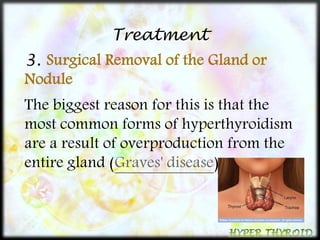
3. Surgical Removal of the Gland or 
Nodule 
The biggest reason for this is that the 
most common forms of hyperthyroidism 
are a result of overproduction from the 
entire gland (Graves' disease)
THANK YOU ,,,,

HyperthyrOid.pptx

  • 1.
    By : Dr.Safia A. Alrezami
  • 2.
    What mean thyroid? Is one of the largest endocrine glands ,located in the lower part of the neck, below the Adam's apple. Types of hormone secreted : The most important thyroid hormones are 1.Thyroxine (T4) . 2. Triiodothyronine (T3). 3. calcitonin . Thyroid stimulating hormone (TSH), which is produced by the pituitary gland, acts to stimulate hormone production by the thyroid gland ( uses iodine form food in production process).
  • 3.
    Function of gland: Essential for the function of every cell in the body.  They help regulate growth and the rate of chemical reactions (metabolism) in the body(the rate at which food is converted into energy).  help children grow and develop .  help regulate the heart rate, blood pressure, body temperature.  calcitonin, is involved in calcium metabolism and stimulating bone cells to add calcium to bone.
  • 4.
    Disease of gland: 1.Hyperthyroidism (over - activity) 2.Hypothyroidism (low-activity) .
  • 5.
    Hyperthyroidism Increase produceOf T3T4 above normal.
  • 6.
    Cause . 1.Graves'disease (an autoimmune disorder) is the most common. occurs more often in women and tends to run in families. In Graves' disease, antibodies stimulate the thyroid to secrete too much hormone.
  • 7.
    Cause 2.excess iodine(iodine is needed to make T4 and T3). 3.inflammation of the thyroid gland (thyroiditis causes T4 and T3 to leak out of the gland)
  • 8.
    Cause 4.Tumors ofthe ovaries or testes. 5.Taking large amounts of T3 (through dietary supplements or medication). 6.Benign tumors of the thyroid or pituitary gland
  • 9.
    Symptom 1. rapidheart rates& heat intolerance.
  • 10.
    Symptom 2.Weight loss&Tremor 3.Nervousness, anxiety and irritability
  • 11.
    Symptom 4. Anenlarged thyroid gland (goiter), which may appear as a swelling at the base of your neck. 5. Fatigue, muscle weakness &Difficulty sleeping
  • 12.
    Diagnosis 1. Medicalhistory and physical exam. During the exam your doctor may try to detect a slight tremor in your fingers when they're extended and other symptom.
  • 13.
    Diagnosis 2. Bloodtests. A diagnosis can be confirmed with blood tests that measure the levels of thyroxin and TSH in your blood. High levels of thyroxin and low or nonexistent amounts of TSH indicate an overactive thyroid.
  • 14.
    Diagnosis 3. Radioactiveiodine uptake test. For this test, you take a small, oral dose of radioactive iodine (radioiodine). Over time, the iodine collects in your thyroid gland because your thyroid uses iodine to manufacture hormones. You'll be checked after two, six or 24 hours — and sometimes after all three time periods — to determine how much iodine your thyroid gland has absorbed.
  • 15.
    Diagnosis 4. Thyroidscan. During this test, you'll have a radioactive isotope injected into the vein on the inside of your elbow or sometimes into a vein in your hand. You then lie on a table with your head stretched backward while a special camera produces an image of your thyroid on a computer screen.
  • 16.
    Treatment 1. Anti-thyroidDrugs The goal with this form of drug therapy is to prevent the thyroid from producing hormones.
  • 17.
    Treatment 1. Anti-thyroidDrugs a. methimazole and propylthiouracil (PTU). M.O.A interfere with the thyroid gland's ability to make its hormones.
  • 18.
    Treatment 1. Anti-thyroidDrugs patients treated with these medications can develop liver inflammation or a deficiency of white blood cells therefore, patients taking anti thyroid drugs should be aware that they must stop their medication and call their doctor promptly if they develop yellowing of the skin, a high fever, or severe sore throat.
  • 19.
    Treatment 2. RadioactiveIodine Treatment By giving a radioactive form of iodine, the thyroid cells which absorb it will be damaged or killed. Because iodine is not absorbed by any other cells in the body, there is very little radiation exposure (or side effects) for the rest of the body. Radioiodine can be taken by mouth without the need to be hospitalized. This form of therapy often takes one to two months before the thyroid has been killed, but the radioactivity medicine is completely gone from the body within a few days.
  • 20.
    Treatment 2. RadioactiveIodine Treatment By giving a radioactive form of iodine, the thyroid cells which absorb it will be damaged or killed. Because iodine is not absorbed by any other cells in the body, there is very little radiation exposure (or side effects) for the rest of the body. Radioiodine can be taken by mouth without the need to be hospitalized. This form of therapy often takes one to two months before the thyroid has been killed, but the radioactivity medicine is completely gone from the body within a few days.
  • 21.
    Treatment 3. SurgicalRemoval of the Gland or Nodule The biggest reason for this is that the most common forms of hyperthyroidism are a result of overproduction from the entire gland (Graves' disease)
  • 22.