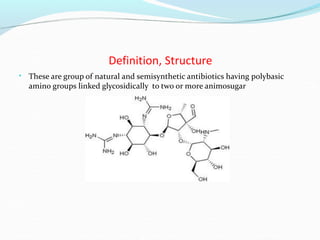
Definition, Structure
• These are group of natural and semisynthetic antibiotics having polybasic
amino groups linked glycosidically to two or more animosugar
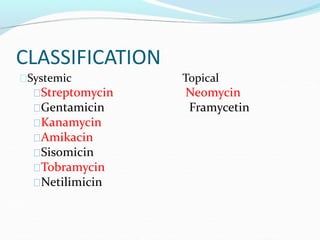
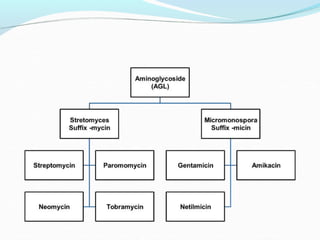
CLASSIFICATION
Systemic Topical
Streptomycin Neomycin
Gentamicin Framycetin
Kanamycin
Amikacin
Sisomicin
Tobramycin
Netilimicin
INTRODUCTION
These are a group of natural and semisynthetic
antibiotics.
Having polybasic amino groups linked glycosidically to
two or more amino sugar residue.
Streptomycin was the first member discovered in 1994
by Waksmann and its colleagues.
All aminoglycosides are produced by soil actinomycetes
.
Properties:
All are used as sulfate salts, which are highly water
soluble .
They ionize in solution, and are not absorbed orally do
not cross BBB.
All are bactericidal and more active at alkaline pH.
All are active primarily active against aerobic gram-
negative bacteria.
All exhibit ototoxicity and nephrotoxicity.
Properties
All are sulfate salts which are highly soluble in water
are stable for months
and solutions
2.
They ionize in solution, not absorbed orally, distribute only
extracellularly and do not penetrate in brain and CSF
All are excreted unchanged in urine
All are bactericidal and more active at
3.
4. alkaline pH
Act by interfering bacterial protein synthesis
Active against aerobic gm –ve bacteria, but spectrum differs
5.
6.
7. Partial cross resistance, organisms
may still respond to another
Narrow margin of safety
resistant to one amino glycoside
8.
9. All exhibit ototoxity and nephrotoxicity.
Post antibiotic effect
Aminoglycosides exhibit concentration dependent
Killing increased conc. Can kill more bacteria at rapid
rate
They also possess significant Post-antibiotic effect.
continue to suppress bacterial growth several hours
after fall in MIC(Minimum Inhibitary Concentration)
Single daily dosing at least as effective as and no more
toxic than multiple dosing renal cortical uptake is a
capacity dependent saturable process enhanced
bactericidal activity
Antibacterial spectrum
• Aerobic G-ve bacteria ( Citrobacter, Enterobacter, E. coli, proteus, shigella,
proteus, Pseudomonas, Enterococci and Staph aureus )
• Streptomycin and kanamicin are active against mycobacterium
tuberculosis while amikacin, gentamicin and tobramycin are active against
S. faecalis and P. aeruginosa.
• They are not effective against G+ve bacilli, G-ve cocci and anaerobes
• Aminoglycosides are not effective against anaerobes because the
penetration of aminoglycoside across porin channel depend upon
polarized membrane and oxygen dependent active process, since lack
of oxygen make them ineffective against anaerobes
• Sometimes even facultative anaerobes are resistant in oxygen supply
deficient
Mechanism of Action
•
The aminoglycosides are bactericidal antibiotics and all having
same general pattern of action. It is described in two ways
1. Transport of amino glycoside through the bacterial cell wall and
cytoplasmic membrane depending upon polarity and oxygen
dependent active process
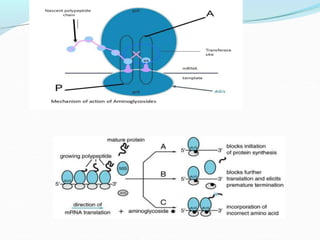
Binding to ribosome resulting in inhibition of protein synthesis
The aminoglycosides act on bacterial 30Sribosomes and distort
2.
• the
messenger ribonucleic acid translation of genetic code, so prevent
the formation of normal complex required to initiate protein
synthesis.
Different aminoglycosides cause misreading at different levels
•
depending on their selective affinity for specific ribosomal
proteins.
They also combines anionic
• membrane groups and damage the
bacterial cell membranes (proteins, aminoacids leak out) and also
block energy production of Kreb’s cycle.
RESISTANCE
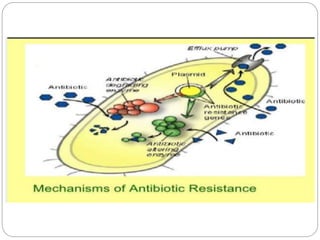
May be plasmid mediated inactivation by microbial enzymes or
Failure of drug penetration mutation of porin channel , so
decrease in aminoglycoside transport mechanism (decrease in
premeability of pores in outer coat if bacteria)
Synthesis of metabolizing enzymes
Acetyl transferase acetylation
Phosphotransferase phosphorylation
Adenyltransferase adenylation
Mutation may alter ribosomal binding site for the
aminoglycosides prevent binding to 30S
• Cross resistance is observed.
Resistance of aminogylcosides is acquired by one of the following
mechanism:
A. Acquisition of cell membrane bound inactivating enzymes
which phosphorylate / adenylate or acetylate the antibiotic.
The conjugated aminoglycosides do not bind to the target
ribosome's and are incapable of enhancing active transport.
These enzymes are acquired mainly by conjugation and transfer of
plasmids.
B. Mutation decreasing the affinity of ribosomal proteins that
normally bind the aminoglycosides this mechanism can confer
high degree resistance e.g. E.coli develop resistance to
streptomycin.
C. Decreased efficiency of the aminoglycosides transporting
mechanism either the pores in the outer coat become less
permeable or the active transport is interfered.
Pharmacokinetics
ABSORPTION: highly ionised, not absorbed or destroyed by G.I.T , I.M- rapid,
plasma peak concentration-30-60 mins.
DISTRIBUTION: Extracellularly -20-30%, High concentration in endolymph
and renal cortex , do not cross b.b.b. , may cross placenta , they get
distributed in serous fluids like synovial, pleural , peritoneal etc
EXCRETION: Excreted unchanged in urine . Main channel of excretion is
glomerular filtration , plasma T half : 2-4 hrs
After chronic dosing : 2-3 weeks drug persists in urine
In elderly people and neonates , the drug dosing should be low as they low
glomerular filtration rate
Renal clearance of aminoglycosides parallels creatinine . So an creatinine
clearance of 70ml/ min indicates no reduction of daily dose of
aminoglycosides.
Shared toxicities
1. Ototoxicity:
Vestibular and cochlear part affected with aminoglycosides. These drugs
get concentrated in labyrinthine fluid. Ototoxicity is greater when plasma
concentration of drug is high.
Vestibular/cochlear sensory cells get
ear drops are contraindicated .
Cochlear damage:
destructive changes, aminoglycoside
Hearing defect, deafness, tinnitus appears, on stopping drug tinnitus
disappers.
Vestibular damage:
2.
Headache, nausea, vomiting, dizziness, nystagmus, ataxia, vertigo.
Nephrotoxicity:
Tubular damage resulting in loss of urinary concentrating power, low GFR,
nitrogen retention, albuminuria and casts.
Continued…
•
Aminoglycosides attain high concentration in renal cortex and toxicity is
related to total amount of drug receiving drug by patient.
•
It is more in elderly and in those with preexisting kidney disease. Howeve
the kidney damage is reversible if drug is discontinued.
• It has been suggested that aminoglycosides interfere with production of
prostaglandins in kidney and so there is reduced GFR.
Neuromuscular blockade:
3.
• All aminoglycosides reduce Ach release from motor nerve ending, they
have curare like action and cause neuromuscular blockade that can caus
paralysis and fatal respiratory arrest.
•
They may cause apnea on iv injection,the blockade if severe can be
effectively treated by neostigmine.
Precautions and interactions
• Avoid during pregnancy, risk of foetal ototoxicity.
• Avoid concurent use of other ototoxic drugs e.g. high ceiling diuretics,
minocycline
• Avoid concurrent use of other nephrotoxic drugs. E.g. amphotericine B,
vancomycin, cephalothin, cyclosporin etc
• Cautious use in patients past middle age and in those with kidney damage
• Cautious use in muscle relaxants.
• Do not mix aminoglycosides with any drug in same syringe or infusion bottle.
STREPTOMYCIN
• It is older antibiotics and obtained by Streptomyces griseus, used in past but now
used for treatment of TB.
The antibacterium spectrum is relatively
•
•
narrow.
Sensitive to H.ducrey, Brucella, Yersinia pestis, F.tularensis, Nocardia, M.
tuberculosis, E. coli, Klebsiella, enterococci, Shigella
Resistance
•
• Many organisms develop rapid resistance. E. coli, S.aureus. S.pneumoniae are
resistant
Resistance occurs by:
•
•
1. 1 step mutation
2. Acquisition of plasmid which codes for inactivation of
st
enzymes
Streptomycin dependence
•
• Certain mutants become dependent on streptomycin as they promote mutant
growth bi induced misreading of genetic code which becomes normal feature for
organisms . Occurs mainly in Tb
Cross resistance:
•
• Partial or unidirectional cross resistance occur.
Pharmacokinetics
Neither absorbed nor destroyed
in git.
Absorption from injection site
in muscle is rapid.
Distributed extracellularly,
volume of distribution 0.3 L/kg
Attains low concentration
synovial, pleural fluid.
in
It is not metabolized. Excreted
unchanged in urine
Plasma half life is 2-4 hrs
Adverse effects
Vestibular disturbances,
auditory disturbances
Nephrotoxicity
Hypersensitivity are rare-rashes,
eosinophilia, dermatitis
Pain at injection site
Paresthesias and scotoma are
occasional
Preparation:
Ambistryn 0.75, 1 g dry powder
per vial.
CONTRAINDICATION: pregnancy causes foetal ototoxicity
DOSE: Tb – 1g or 0.75 g i.m OD or thrice weekly for 30-60
days
Acute infection: 1g i.m OD or BD for 7-10 days
USES:
1.TB
2. SABE(Subacute bacterial endocardiatis):
given with pencillin/ampicillin/vancomycin for 4-6
weeks
3. Plague: rapid cure within 7-12 days
4. Tularemia: Streptomycin cures it in 7-10 days
GENTAMICIN
• It was obtained from Micromonospora purpurea in1964 and has become most
common antibiotic in acute infections
The properties include
Plasma half life 2-4 hours after i.m. injections same as streptomycin
•
•
• But it has following differences from streptomycin
It is more potent
•
• It has boarder spectrum of action and effective against P. aeruginosa and most
strains of Proteus, E.coli, Klebsiella, enterobactor, Serratia
• It is not effective against M.tuberculosis, Str.pyogenes, stre. Pneumoniae, and
some Stre. Aureus
It is more nephrotoxic.
•
uses
Use restricted to serious Gm-ve bacillary infections
Septicaemia, sepsis, fever in immunocompromised patients
used with penicillins /cephalosporins
Pelvic infections : with metronidazole
SABE: with Penicillin G or ampicillin or vancomycin, where
gentamicin dose is 1mg/kg for 8 hrs i.m
Coliform infection: with ampicillin or ceftriaxone
Pseudomonal infections: with ticarcillin
Meningitis by Gm-ve bacilli : III generation cephalosporin alone
or with gentamicin
Topical-infected burns, wounds, skin lessions (with purulent
exudates
KANAMYCIN
Obtained from S.Kanamycetius , similar to streptomycin
and even against M.tuberculosis but lack activity on
pseudomonas
More toxic to cochlea and kidney , hearing loss id
irreversible . Because of toxicity and narrow spectrum it is
replaced by other drugs.
DOSE : 0.5 g i.m BD
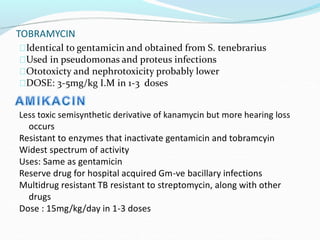
TOBRAMYCIN
Identical to gentamicin and obtained from S. tenebrarius
Used in pseudomonas and proteus infections
Ototoxicty and nephrotoxicity probably lower
DOSE: 3-5mg/kg I.M in 1-3 doses
Less toxic semisynthetic derivative of kanamycin but more hearing loss
occurs
Resistant to enzymes that inactivate gentamicin and tobramcyin
Widest spectrum of activity
Uses: Same as gentamicin
Reserve drug for hospital acquired Gm-ve bacillary infections
Multidrug resistant TB resistant to streptomycin, along with other
drugs
Dose : 15mg/kg/day in 1-3 doses
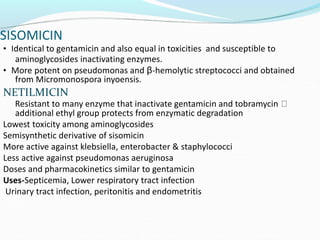
SISOMICIN
• Identical to gentamicin and also equal in toxicities and susceptible to
aminoglycosides inactivating enzymes.
• More potent on pseudomonas and β-hemolytic streptococci and obtained
from Micromonospora inyoensis.
NETILMICIN
Resistant to many enzyme that inactivate gentamicin and tobramycin
additional ethyl group protects from enzymatic degradation
Lowest toxicity among aminoglycosides
Semisynthetic derivative of sisomicin
More active against klebsiella, enterobacter & staphylococci
Less active against pseudomonas aeruginosa
Doses and pharmacokinetics similar to gentamicin
Uses-Septicemia, Lower respiratory tract infection
Urinary tract infection, peritonitis and endometritis
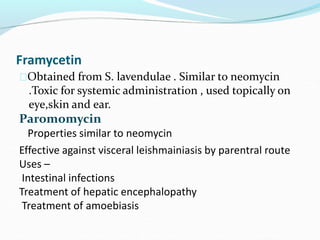
Framycetin
Obtained from S. lavendulae . Similar to neomycin
.Toxic for systemic administration , used topically on
eye,skin and ear.
Paromomycin
Properties similar to neomycin
Effective against visceral leishmainiasis by parentral route
Uses –
Intestinal infections
Treatment of hepatic encephalopathy
Treatment of amoebiasis
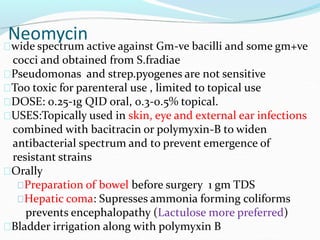
Neomycin
wide spectrum active against Gm-ve bacilli and some gm+ve
cocci and obtained from S.fradiae
Pseudomonas and strep.pyogenes are not sensitive
Too toxic for parenteral use , limited to topical use
DOSE: 0.25-1g QID oral, 0.3-0.5% topical.
USES:Topically used in skin, eye and external ear infections
combined with bacitracin or polymyxin-B to widen
antibacterial spectrum and to prevent emergence of
resistant strains
Orally
Preparation of bowel before surgery 1 gm TDS
Hepatic coma: Supresses ammonia forming coliforms
prevents encephalopathy (Lactulose more preferred)
Bladder irrigation along with polymyxin B
ADR: Low sensitizing potential, rashes , oral
neomycin damage intestinal villi. Prolonged
treatment causes malabsorption syndrome , diarrhoea
Decreasing the absorption of digoxin , bile acids ,
suppresses gut flora causing superinfection by
candida
It is excreted unchanged in kidney causing kidney
damage and ototoxicity
In serous cavity it causes apnoea due to muscle
paralysing action .

aminoglycosideppt-160110093602.pptx

  • 2.
    Definition, Structure • Theseare group of natural and semisynthetic antibiotics having polybasic amino groups linked glycosidically to two or more animosugar
  • 3.
    CLASSIFICATION Systemic Topical Streptomycin Neomycin GentamicinFramycetin Kanamycin Amikacin Sisomicin Tobramycin Netilimicin
  • 4.
    INTRODUCTION These are agroup of natural and semisynthetic antibiotics. Having polybasic amino groups linked glycosidically to two or more amino sugar residue. Streptomycin was the first member discovered in 1994 by Waksmann and its colleagues. All aminoglycosides are produced by soil actinomycetes . Properties: All are used as sulfate salts, which are highly water soluble . They ionize in solution, and are not absorbed orally do not cross BBB. All are bactericidal and more active at alkaline pH. All are active primarily active against aerobic gram- negative bacteria. All exhibit ototoxicity and nephrotoxicity.
  • 6.
    Properties All are sulfatesalts which are highly soluble in water are stable for months and solutions 2. They ionize in solution, not absorbed orally, distribute only extracellularly and do not penetrate in brain and CSF All are excreted unchanged in urine All are bactericidal and more active at 3. 4. alkaline pH Act by interfering bacterial protein synthesis Active against aerobic gm –ve bacteria, but spectrum differs 5. 6. 7. Partial cross resistance, organisms may still respond to another Narrow margin of safety resistant to one amino glycoside 8. 9. All exhibit ototoxity and nephrotoxicity.
  • 7.
    Post antibiotic effect Aminoglycosidesexhibit concentration dependent Killing increased conc. Can kill more bacteria at rapid rate They also possess significant Post-antibiotic effect. continue to suppress bacterial growth several hours after fall in MIC(Minimum Inhibitary Concentration) Single daily dosing at least as effective as and no more toxic than multiple dosing renal cortical uptake is a capacity dependent saturable process enhanced bactericidal activity
  • 8.
    Antibacterial spectrum • AerobicG-ve bacteria ( Citrobacter, Enterobacter, E. coli, proteus, shigella, proteus, Pseudomonas, Enterococci and Staph aureus ) • Streptomycin and kanamicin are active against mycobacterium tuberculosis while amikacin, gentamicin and tobramycin are active against S. faecalis and P. aeruginosa. • They are not effective against G+ve bacilli, G-ve cocci and anaerobes • Aminoglycosides are not effective against anaerobes because the penetration of aminoglycoside across porin channel depend upon polarized membrane and oxygen dependent active process, since lack of oxygen make them ineffective against anaerobes • Sometimes even facultative anaerobes are resistant in oxygen supply deficient
  • 9.
    Mechanism of Action • Theaminoglycosides are bactericidal antibiotics and all having same general pattern of action. It is described in two ways 1. Transport of amino glycoside through the bacterial cell wall and cytoplasmic membrane depending upon polarity and oxygen dependent active process Binding to ribosome resulting in inhibition of protein synthesis The aminoglycosides act on bacterial 30Sribosomes and distort 2. • the messenger ribonucleic acid translation of genetic code, so prevent the formation of normal complex required to initiate protein synthesis. Different aminoglycosides cause misreading at different levels • depending on their selective affinity for specific ribosomal proteins. They also combines anionic • membrane groups and damage the bacterial cell membranes (proteins, aminoacids leak out) and also block energy production of Kreb’s cycle.
  • 11.
    RESISTANCE May be plasmidmediated inactivation by microbial enzymes or Failure of drug penetration mutation of porin channel , so decrease in aminoglycoside transport mechanism (decrease in premeability of pores in outer coat if bacteria) Synthesis of metabolizing enzymes Acetyl transferase acetylation Phosphotransferase phosphorylation Adenyltransferase adenylation Mutation may alter ribosomal binding site for the aminoglycosides prevent binding to 30S • Cross resistance is observed.
  • 12.
    Resistance of aminogylcosidesis acquired by one of the following mechanism: A. Acquisition of cell membrane bound inactivating enzymes which phosphorylate / adenylate or acetylate the antibiotic. The conjugated aminoglycosides do not bind to the target ribosome's and are incapable of enhancing active transport. These enzymes are acquired mainly by conjugation and transfer of plasmids. B. Mutation decreasing the affinity of ribosomal proteins that normally bind the aminoglycosides this mechanism can confer high degree resistance e.g. E.coli develop resistance to streptomycin. C. Decreased efficiency of the aminoglycosides transporting mechanism either the pores in the outer coat become less permeable or the active transport is interfered.
  • 14.
    Pharmacokinetics ABSORPTION: highly ionised,not absorbed or destroyed by G.I.T , I.M- rapid, plasma peak concentration-30-60 mins. DISTRIBUTION: Extracellularly -20-30%, High concentration in endolymph and renal cortex , do not cross b.b.b. , may cross placenta , they get distributed in serous fluids like synovial, pleural , peritoneal etc EXCRETION: Excreted unchanged in urine . Main channel of excretion is glomerular filtration , plasma T half : 2-4 hrs After chronic dosing : 2-3 weeks drug persists in urine In elderly people and neonates , the drug dosing should be low as they low glomerular filtration rate Renal clearance of aminoglycosides parallels creatinine . So an creatinine clearance of 70ml/ min indicates no reduction of daily dose of aminoglycosides.
  • 15.
    Shared toxicities 1. Ototoxicity: Vestibularand cochlear part affected with aminoglycosides. These drugs get concentrated in labyrinthine fluid. Ototoxicity is greater when plasma concentration of drug is high. Vestibular/cochlear sensory cells get ear drops are contraindicated . Cochlear damage: destructive changes, aminoglycoside Hearing defect, deafness, tinnitus appears, on stopping drug tinnitus disappers. Vestibular damage: 2. Headache, nausea, vomiting, dizziness, nystagmus, ataxia, vertigo. Nephrotoxicity: Tubular damage resulting in loss of urinary concentrating power, low GFR, nitrogen retention, albuminuria and casts.
  • 16.
    Continued… • Aminoglycosides attain highconcentration in renal cortex and toxicity is related to total amount of drug receiving drug by patient. • It is more in elderly and in those with preexisting kidney disease. Howeve the kidney damage is reversible if drug is discontinued. • It has been suggested that aminoglycosides interfere with production of prostaglandins in kidney and so there is reduced GFR. Neuromuscular blockade: 3. • All aminoglycosides reduce Ach release from motor nerve ending, they have curare like action and cause neuromuscular blockade that can caus paralysis and fatal respiratory arrest. • They may cause apnea on iv injection,the blockade if severe can be effectively treated by neostigmine.
  • 17.
    Precautions and interactions •Avoid during pregnancy, risk of foetal ototoxicity. • Avoid concurent use of other ototoxic drugs e.g. high ceiling diuretics, minocycline • Avoid concurrent use of other nephrotoxic drugs. E.g. amphotericine B, vancomycin, cephalothin, cyclosporin etc • Cautious use in patients past middle age and in those with kidney damage • Cautious use in muscle relaxants. • Do not mix aminoglycosides with any drug in same syringe or infusion bottle.
  • 18.
    STREPTOMYCIN • It isolder antibiotics and obtained by Streptomyces griseus, used in past but now used for treatment of TB. The antibacterium spectrum is relatively • • narrow. Sensitive to H.ducrey, Brucella, Yersinia pestis, F.tularensis, Nocardia, M. tuberculosis, E. coli, Klebsiella, enterococci, Shigella Resistance • • Many organisms develop rapid resistance. E. coli, S.aureus. S.pneumoniae are resistant Resistance occurs by: • • 1. 1 step mutation 2. Acquisition of plasmid which codes for inactivation of st enzymes Streptomycin dependence • • Certain mutants become dependent on streptomycin as they promote mutant growth bi induced misreading of genetic code which becomes normal feature for organisms . Occurs mainly in Tb Cross resistance: • • Partial or unidirectional cross resistance occur.
  • 19.
    Pharmacokinetics Neither absorbed nordestroyed in git. Absorption from injection site in muscle is rapid. Distributed extracellularly, volume of distribution 0.3 L/kg Attains low concentration synovial, pleural fluid. in It is not metabolized. Excreted unchanged in urine Plasma half life is 2-4 hrs Adverse effects Vestibular disturbances, auditory disturbances Nephrotoxicity Hypersensitivity are rare-rashes, eosinophilia, dermatitis Pain at injection site Paresthesias and scotoma are occasional Preparation: Ambistryn 0.75, 1 g dry powder per vial.
  • 20.
    CONTRAINDICATION: pregnancy causesfoetal ototoxicity DOSE: Tb – 1g or 0.75 g i.m OD or thrice weekly for 30-60 days Acute infection: 1g i.m OD or BD for 7-10 days USES: 1.TB 2. SABE(Subacute bacterial endocardiatis): given with pencillin/ampicillin/vancomycin for 4-6 weeks 3. Plague: rapid cure within 7-12 days 4. Tularemia: Streptomycin cures it in 7-10 days
  • 21.
    GENTAMICIN • It wasobtained from Micromonospora purpurea in1964 and has become most common antibiotic in acute infections The properties include Plasma half life 2-4 hours after i.m. injections same as streptomycin • • • But it has following differences from streptomycin It is more potent • • It has boarder spectrum of action and effective against P. aeruginosa and most strains of Proteus, E.coli, Klebsiella, enterobactor, Serratia • It is not effective against M.tuberculosis, Str.pyogenes, stre. Pneumoniae, and some Stre. Aureus It is more nephrotoxic. •
  • 22.
    uses Use restricted toserious Gm-ve bacillary infections Septicaemia, sepsis, fever in immunocompromised patients used with penicillins /cephalosporins Pelvic infections : with metronidazole SABE: with Penicillin G or ampicillin or vancomycin, where gentamicin dose is 1mg/kg for 8 hrs i.m Coliform infection: with ampicillin or ceftriaxone Pseudomonal infections: with ticarcillin Meningitis by Gm-ve bacilli : III generation cephalosporin alone or with gentamicin Topical-infected burns, wounds, skin lessions (with purulent exudates
  • 23.
    KANAMYCIN Obtained from S.Kanamycetius, similar to streptomycin and even against M.tuberculosis but lack activity on pseudomonas More toxic to cochlea and kidney , hearing loss id irreversible . Because of toxicity and narrow spectrum it is replaced by other drugs. DOSE : 0.5 g i.m BD
  • 24.
    TOBRAMYCIN Identical to gentamicinand obtained from S. tenebrarius Used in pseudomonas and proteus infections Ototoxicty and nephrotoxicity probably lower DOSE: 3-5mg/kg I.M in 1-3 doses Less toxic semisynthetic derivative of kanamycin but more hearing loss occurs Resistant to enzymes that inactivate gentamicin and tobramcyin Widest spectrum of activity Uses: Same as gentamicin Reserve drug for hospital acquired Gm-ve bacillary infections Multidrug resistant TB resistant to streptomycin, along with other drugs Dose : 15mg/kg/day in 1-3 doses
  • 25.
    SISOMICIN • Identical togentamicin and also equal in toxicities and susceptible to aminoglycosides inactivating enzymes. • More potent on pseudomonas and β-hemolytic streptococci and obtained from Micromonospora inyoensis. NETILMICIN Resistant to many enzyme that inactivate gentamicin and tobramycin additional ethyl group protects from enzymatic degradation Lowest toxicity among aminoglycosides Semisynthetic derivative of sisomicin More active against klebsiella, enterobacter & staphylococci Less active against pseudomonas aeruginosa Doses and pharmacokinetics similar to gentamicin Uses-Septicemia, Lower respiratory tract infection Urinary tract infection, peritonitis and endometritis
  • 26.
    Framycetin Obtained from S.lavendulae . Similar to neomycin .Toxic for systemic administration , used topically on eye,skin and ear. Paromomycin Properties similar to neomycin Effective against visceral leishmainiasis by parentral route Uses – Intestinal infections Treatment of hepatic encephalopathy Treatment of amoebiasis
  • 27.
    Neomycin wide spectrum activeagainst Gm-ve bacilli and some gm+ve cocci and obtained from S.fradiae Pseudomonas and strep.pyogenes are not sensitive Too toxic for parenteral use , limited to topical use DOSE: 0.25-1g QID oral, 0.3-0.5% topical. USES:Topically used in skin, eye and external ear infections combined with bacitracin or polymyxin-B to widen antibacterial spectrum and to prevent emergence of resistant strains Orally Preparation of bowel before surgery 1 gm TDS Hepatic coma: Supresses ammonia forming coliforms prevents encephalopathy (Lactulose more preferred) Bladder irrigation along with polymyxin B
  • 28.
    ADR: Low sensitizingpotential, rashes , oral neomycin damage intestinal villi. Prolonged treatment causes malabsorption syndrome , diarrhoea Decreasing the absorption of digoxin , bile acids , suppresses gut flora causing superinfection by candida It is excreted unchanged in kidney causing kidney damage and ototoxicity In serous cavity it causes apnoea due to muscle paralysing action .