AMINO ACIDS
20 amino acids that are commonly found in proteins
These amino acids are referred to as standard
amino acids
19 of the standard amino acids have the same
general structure
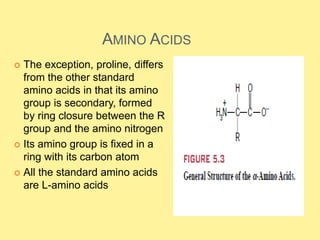
These molecules contain a central carbon atom (the
a-carbon) to which an amino group, a carboxylate
group, a hydrogen atom, and an R (side chain)
group are attached
AMINO ACIDS
 The exception, proline, differs
from the other standard
amino acids in that its amino
group is secondary, formed
by ring closure between the R
group and the amino nitrogen
 Its amino group is fixed in a
ring with its carbon atom
 All the standard amino acids
are L-amino acids
AMINO ACID
Nonstandard amino acids consist of amino acid
residues that have been chemically modified after
they have been incorporated into a polypeptide or
amino acids that occur in living organisms but are
not found in proteins
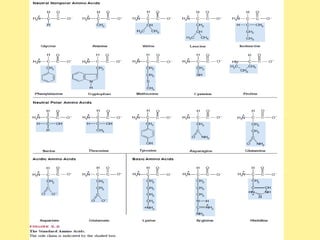
Amino acids are classified according to their
capacity to interact with water. By using this
criterion, four classes may be distinguished: (1)
nonpolar and neutral, (2) polar and neutral, (3)
acidic, and (4) basic.
NEUTRAL NONPOLAR AMINO ACIDS
 neutral nonpolar amino acids contain mostly
hydrocarbon R groups
 term neutral is used because these R groups do not
bear positive or negative charges
 They do not react with water or very poorly react
 Two types of hydrocarbon side chains are found in
this group: aromatic and aliphatic
 Phenylalanine and tryptophan contain aromatic ring
structures
 Glycine, alanine, valine, leucine, isoleucine, and
proline have aliphatic R groups
NEUTRAL POLAR AMINO ACIDS
 polar amino acids have functional groups capable of
hydrogen bonding, they easily interact with water
 Polar amino acids are described as “hydrophilic” or
“water-loving”
 Serine, threonine, tyrosine, asparagine, cysteine and
glutamine belong to this category
 Serine, threonine, and tyrosine contain a polar hydroxyl
group, which enables them to participate in hydrogen
bonding, an important factor in protein structure
 Asparagine and glutamine are amide derivatives of the
acidic amino acids aspartic acid and glutamic acid,
respectively. Because the amide functional group is highly
polar, the hydrogen-bonding capability of asparagine and
glutamine has a significant effect on protein stability
ACIDIC AMINO ACIDS
 Two standard amino acids have side chains
with carboxylate groups. Because the side
chains of aspartic acid and glutamic acid
are negatively charged at physiological pH,
they are often referred to as aspartate and
glutamate
 They are proton donor
BASIC AMINO ACIDS
 Basic amino acids bear a positive charge at
physiological pH. They can therefore form ionic
bonds with acidic amino acids
 Lysine, which has a side chain amino group, accepts
a proton from water to form the conjugate acid
 The guanidino group of arginine is permanently
protonated at physiological pH and, therefore, does
not function in acid-base reactions
 Histidine, on the other hand, is a weak base,
because it is only partially ionized at pH 7.
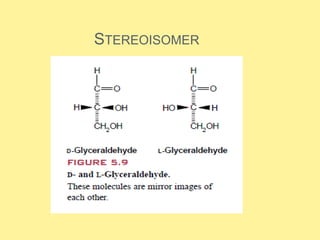
AMINO ACID STEREOISOMER
 the a-carbons of 19 of the 20 standard
amino acids are attached to four different
groups (i.e., a hydrogen, a carboxyl group,
an amino group, and an R group), they are
referred to as asymmetric or chiral carbons
 Glycine is a symmetrical molecule because
its a-carbon is attached to two hydrogens
 Molecules with chiral carbons can exist as
stereoisomers, molecules that differ only in
the spatial arrangement of their atoms
STEREOISOMER
AMINO ACID REACTIONS
 The functional groups of organic molecules
determine which reactions they may undergo.
Amino acids with their carboxyl groups, amino
groups, and various R groups can undergo
numerous chemical reactions. However, two
reactions (i.e, peptide bond and disulfide bridge
formation) are of special interest because of their
effect on protein structure
PEPTIDE BOND
 Peptide bonds are amide linkages formed when
the unshared electron pair of the a-amino nitrogen
atom of one amino acid attacks the a-carboxyl
carbon of another
 Polypeptides are linear polymers composed of
amino acids linked together by peptide bonds
• This reaction is a dehydration (i.e., a water
molecule is removed) reaction
 The linked amino acids are referred to as amino
acid residues
PEPTIDE BOND
 When two amino acid molecules are linked, the product is called a
dipeptide
 As amino acids are added and the chain lengthens, the prefix
reflects the number of residues. For example, a tripeptide contains
three amino acid residues, a tetrapeptide four, and so on
 By convention the amino acid residue with the free amino group is
called the N-terminal residue and is written to the left. The free
carboxyl group on the C-terminal residue appears on the right.
Peptides are named by using their
amino acid sequences, beginning from their N-terminal residue. For
example, H2N-Tyr-Ala-Cys-Gly-COOH
DISULFIDE BOND
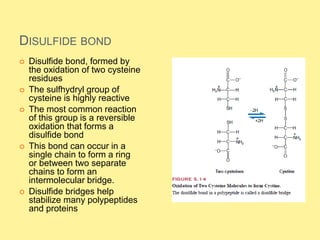
 Disulfide bond, formed by
the oxidation of two cysteine
residues
 The sulfhydryl group of
cysteine is highly reactive
 The most common reaction
of this group is a reversible
oxidation that forms a
disulfide bond
 This bond can occur in a
single chain to form a ring
or between two separate
chains to form an
intermolecular bridge.
 Disulfide bridges help
stabilize many polypeptides
and proteins
AMINO ACID POLYMERS
 Amino acid polymers are often differentiated
according to their molecular weights or the number
of amino acid residues they contain
 Some biochemists define oligopeptides as
polymers consisting of two to ten amino acids
 Polypeptides as having more than ten residues
 Proteins, in this view, have molecular weights
greater than 10,000 D. In addition, the terms protein
and polypeptide are often used interchangeably.
BIOLOGICALLY ACTIVE AMINO ACIDS
In addition to their primary function as components of protein,
amino acids have several other biological roles
 Several a-amino acids or their derivatives act as chemical
messengers For example, glycine, g-amino butyric acid
(GABA, a derivative of glutamate), and serotonin and
melatonin (derivatives of tryptophan) are neurotransmitters,
substances released from one nerve cell that influence the
function of a second nerve cell or a muscle cell
 Thyroxine (a tyrosine derivative produced in the thyroid gland
of animals) and indole acetic acid (a tryptophan derivative
found in plants) are two examples of hormones. Hormones
are chemical signal molecules produced in one cell that
regulate the function of other cells.
BIOLOGICALLY ACTIVE AMINO ACIDS
 Amino acids are precursors of a variety of complex
nitrogen-containing molecules Examples include the
nitrogenous base components of nucleotides and the
nucleic acids, heme (the iron-containing organic group
required for the biological activity of several important
proteins), and chlorophyll (a pigment of critical
importance in photosynthesis).
 Several standard and nonstandard amino acids act as
metabolic intermediates. For example, arginine,
citrulline, and ornithine are components of the urea
cycle The synthesis of urea, a molecule formed in
vertebrate livers, is the principal mechanism for the
disposal of nitrogenous waste.

Amino acids

  • 1.
    AMINO ACIDS 20 aminoacids that are commonly found in proteins These amino acids are referred to as standard amino acids 19 of the standard amino acids have the same general structure These molecules contain a central carbon atom (the a-carbon) to which an amino group, a carboxylate group, a hydrogen atom, and an R (side chain) group are attached
  • 2.
    AMINO ACIDS  Theexception, proline, differs from the other standard amino acids in that its amino group is secondary, formed by ring closure between the R group and the amino nitrogen  Its amino group is fixed in a ring with its carbon atom  All the standard amino acids are L-amino acids
  • 3.
    AMINO ACID Nonstandard aminoacids consist of amino acid residues that have been chemically modified after they have been incorporated into a polypeptide or amino acids that occur in living organisms but are not found in proteins Amino acids are classified according to their capacity to interact with water. By using this criterion, four classes may be distinguished: (1) nonpolar and neutral, (2) polar and neutral, (3) acidic, and (4) basic.
  • 4.
    NEUTRAL NONPOLAR AMINOACIDS  neutral nonpolar amino acids contain mostly hydrocarbon R groups  term neutral is used because these R groups do not bear positive or negative charges  They do not react with water or very poorly react  Two types of hydrocarbon side chains are found in this group: aromatic and aliphatic  Phenylalanine and tryptophan contain aromatic ring structures  Glycine, alanine, valine, leucine, isoleucine, and proline have aliphatic R groups
  • 5.
    NEUTRAL POLAR AMINOACIDS  polar amino acids have functional groups capable of hydrogen bonding, they easily interact with water  Polar amino acids are described as “hydrophilic” or “water-loving”  Serine, threonine, tyrosine, asparagine, cysteine and glutamine belong to this category  Serine, threonine, and tyrosine contain a polar hydroxyl group, which enables them to participate in hydrogen bonding, an important factor in protein structure  Asparagine and glutamine are amide derivatives of the acidic amino acids aspartic acid and glutamic acid, respectively. Because the amide functional group is highly polar, the hydrogen-bonding capability of asparagine and glutamine has a significant effect on protein stability
  • 6.
    ACIDIC AMINO ACIDS Two standard amino acids have side chains with carboxylate groups. Because the side chains of aspartic acid and glutamic acid are negatively charged at physiological pH, they are often referred to as aspartate and glutamate  They are proton donor
  • 7.
    BASIC AMINO ACIDS Basic amino acids bear a positive charge at physiological pH. They can therefore form ionic bonds with acidic amino acids  Lysine, which has a side chain amino group, accepts a proton from water to form the conjugate acid  The guanidino group of arginine is permanently protonated at physiological pH and, therefore, does not function in acid-base reactions  Histidine, on the other hand, is a weak base, because it is only partially ionized at pH 7.
  • 8.
    AMINO ACID STEREOISOMER the a-carbons of 19 of the 20 standard amino acids are attached to four different groups (i.e., a hydrogen, a carboxyl group, an amino group, and an R group), they are referred to as asymmetric or chiral carbons  Glycine is a symmetrical molecule because its a-carbon is attached to two hydrogens  Molecules with chiral carbons can exist as stereoisomers, molecules that differ only in the spatial arrangement of their atoms
  • 9.
  • 11.
    AMINO ACID REACTIONS The functional groups of organic molecules determine which reactions they may undergo. Amino acids with their carboxyl groups, amino groups, and various R groups can undergo numerous chemical reactions. However, two reactions (i.e, peptide bond and disulfide bridge formation) are of special interest because of their effect on protein structure
  • 12.
    PEPTIDE BOND  Peptidebonds are amide linkages formed when the unshared electron pair of the a-amino nitrogen atom of one amino acid attacks the a-carboxyl carbon of another  Polypeptides are linear polymers composed of amino acids linked together by peptide bonds • This reaction is a dehydration (i.e., a water molecule is removed) reaction  The linked amino acids are referred to as amino acid residues
  • 13.
    PEPTIDE BOND  Whentwo amino acid molecules are linked, the product is called a dipeptide  As amino acids are added and the chain lengthens, the prefix reflects the number of residues. For example, a tripeptide contains three amino acid residues, a tetrapeptide four, and so on  By convention the amino acid residue with the free amino group is called the N-terminal residue and is written to the left. The free carboxyl group on the C-terminal residue appears on the right. Peptides are named by using their amino acid sequences, beginning from their N-terminal residue. For example, H2N-Tyr-Ala-Cys-Gly-COOH
  • 14.
    DISULFIDE BOND  Disulfidebond, formed by the oxidation of two cysteine residues  The sulfhydryl group of cysteine is highly reactive  The most common reaction of this group is a reversible oxidation that forms a disulfide bond  This bond can occur in a single chain to form a ring or between two separate chains to form an intermolecular bridge.  Disulfide bridges help stabilize many polypeptides and proteins
  • 15.
    AMINO ACID POLYMERS Amino acid polymers are often differentiated according to their molecular weights or the number of amino acid residues they contain  Some biochemists define oligopeptides as polymers consisting of two to ten amino acids  Polypeptides as having more than ten residues  Proteins, in this view, have molecular weights greater than 10,000 D. In addition, the terms protein and polypeptide are often used interchangeably.
  • 17.
    BIOLOGICALLY ACTIVE AMINOACIDS In addition to their primary function as components of protein, amino acids have several other biological roles  Several a-amino acids or their derivatives act as chemical messengers For example, glycine, g-amino butyric acid (GABA, a derivative of glutamate), and serotonin and melatonin (derivatives of tryptophan) are neurotransmitters, substances released from one nerve cell that influence the function of a second nerve cell or a muscle cell  Thyroxine (a tyrosine derivative produced in the thyroid gland of animals) and indole acetic acid (a tryptophan derivative found in plants) are two examples of hormones. Hormones are chemical signal molecules produced in one cell that regulate the function of other cells.
  • 18.
    BIOLOGICALLY ACTIVE AMINOACIDS  Amino acids are precursors of a variety of complex nitrogen-containing molecules Examples include the nitrogenous base components of nucleotides and the nucleic acids, heme (the iron-containing organic group required for the biological activity of several important proteins), and chlorophyll (a pigment of critical importance in photosynthesis).  Several standard and nonstandard amino acids act as metabolic intermediates. For example, arginine, citrulline, and ornithine are components of the urea cycle The synthesis of urea, a molecule formed in vertebrate livers, is the principal mechanism for the disposal of nitrogenous waste.