BIOCHEMISTRY
AMINOACIDS
PEPTIDS and PROTEINS
AGENDA:
AMINO ACIDS – essencial, non essencial
PROTEINS – structure: primary,
secondary, tertiary and quaternary
physical and chemical properties;
simple proteins;
proteinogramm
compaund proteins
chromoproteins, citochroms,
lipoproteins α- β- preβ- khilomicrons
metaloproteins
All proteins, which may find in living bodies, are
consists of amino acids
Degradation of proteins into smaller fragments –
polypeptide chains may be broken by proteolytic
enzymes such as trypsin, chymopripsin, pepsin,
elastase – the final point of protein degradation is
amino acid.
All amino acids occur in proteins are
L-, and α- (alpha)- amino acids
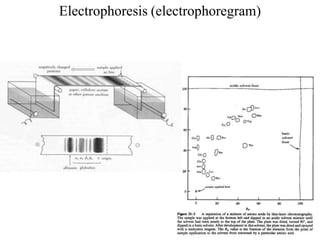
Electrophoresis (electrophoregram)
Sponsored
Medical Lecture Notes – All Subjects
USMLE Exam (America) – Practice
Classification of Amino Acids
A.Classification based on structure:
Each amino acid is assigned a 3 letter or 1 letter
symbol
These symbols are commonly used to represent the
amino acids in protein structure
e.g.:
ANGIOTENSIN II (octapeptide)
[Asp-Arg-Val-Tyr-Ile-His-Pro-Phe]
or simply
[D-R-V-Y-I-H-P-F]
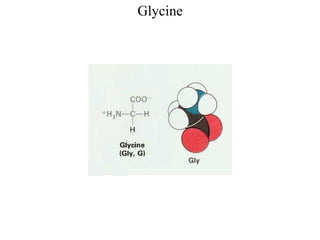
Glycine
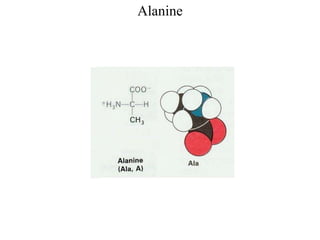
Alanine
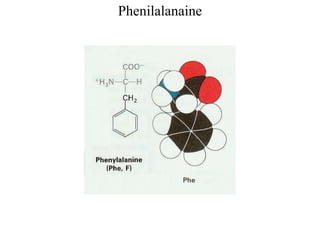
Phenilalanaine
Cystein
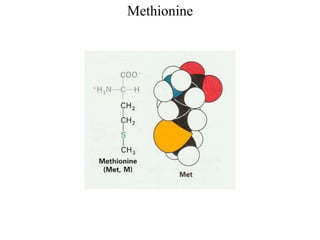
Methionine
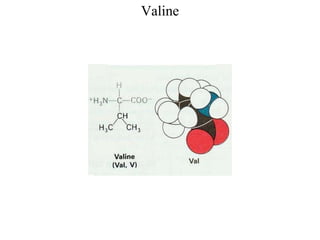
Valine
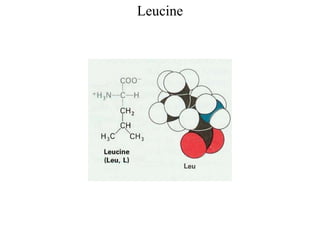
Leucine
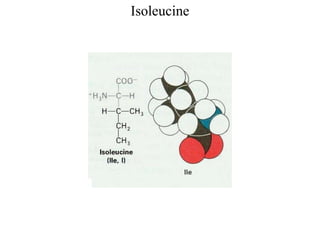
Isoleucine
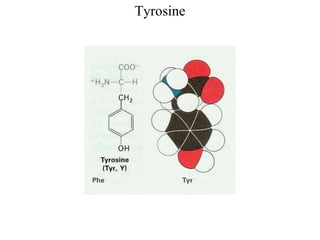
Tyrosine
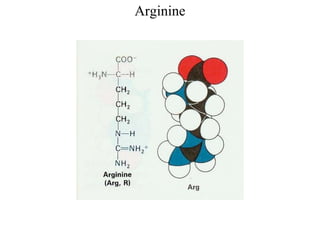
Arginine
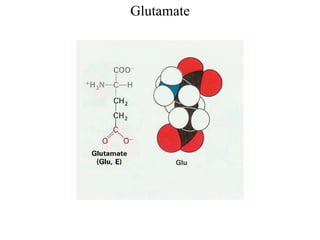
Glutamate
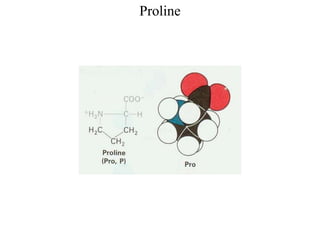
Proline
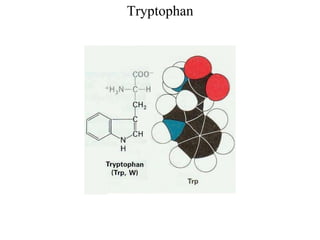
Tryptophan
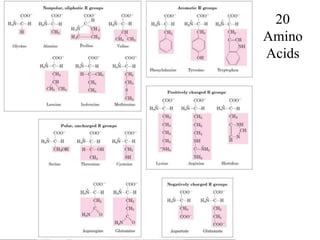
Classification of amino acids based on polarity
There are four groups of AA depending topolarity
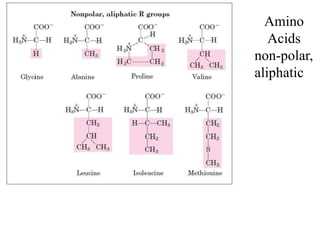
1.Non-polar AA (also referred as hydrophobic [water hating]) nocharge
on ‘R’group
[Alanine, Leucine, Isoleucine, Valine, Methionine, Phenylalanine,
Tryptophan, Proline]
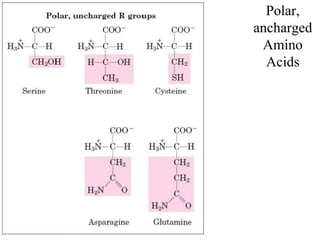
2.PolarAAwith no charge on ‘R’group
[Glycine, Serine, Threonine, Cysteine, Glutamine, Asparagine.Tyrosine]
– they however possess groups such as hydroxyl, sulfhydryl, amide –
and participate in hydrogen bonding of protein structure.
3.PolarAAwith positive ‘R’group
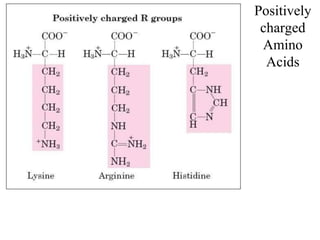
[Lysine, Arginine, Histidine]
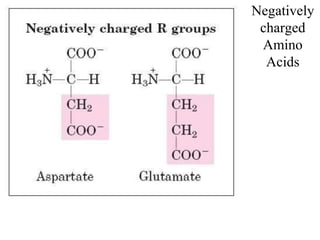
4.PolarAAwith negative ‘R’group
[Aspartic acid, GlutamicAcid]
20
Amino
Acids
Amino
Acids
non-polar,
aliphatic
Aromatic
Amino
Acids
Positively
charged
Amino
Acids
Negatively
charged
Amino
Acids
Polar,
ancharged
Amino
Acids
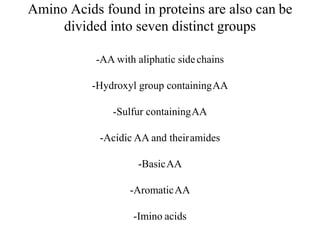
Amino Acids found in proteins are also can be
divided into seven distinct groups
-AA with aliphatic sidechains
-Hydroxyl group containingAA
-Sulfur containingAA
-Acidic AA and theiramides
-BasicAA
-AromaticAA
-Imino acids
Aliphatic amino acids
[Glycin, Alanin, Valin, Leucin, Isoleucin]
Hydroxyl group containing AA
[Serine, Threonine, Tyrosine]
Sulfur containing AA
[Cystein (with sulfhydryl group), Methionine (with thioether group)]
Acidic Amino acids and their amides
[Aspertic acid (Aspartate), Glutamic acid (Glutamate)] – dicarboxylic
monoamino acids
[Aspargine, Glutamine] – their respective amide derivatives
all these fourAApossess distinct codons for their incorporation into
proteins
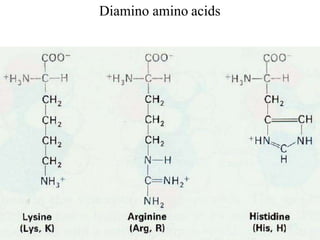
Basic AA
[Lysine, Arginine (with gunidino
group), histidine (imidazole ring)]
dibasic monocarboxylic acids (they
are highly basic in character)
Aromatic AA
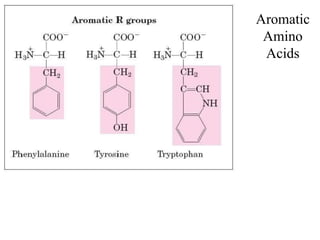
[Phenilalanine, Tyrosine, Tryptophan (with indolering)]
Imino acids
[Proline (containing pyrrolidine ring)] – it has an imino group (=NH)
instead of amino group (–NH2). Therefore Proline is α-imino acid
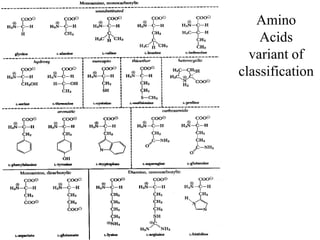
Diamino amino acids
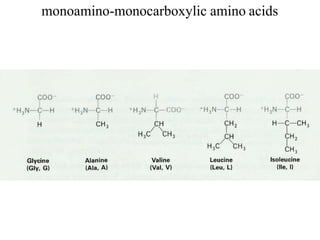
monoamino-monocarboxylic amino acids
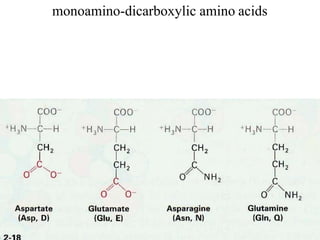
monoamino-dicarboxylic amino acids
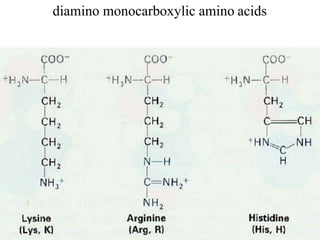
diamino monocarboxylic amino acids
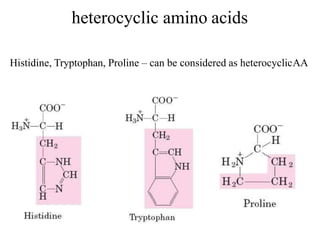
heterocyclic amino acids
Histidine, Tryptophan, Proline – can be considered as heterocyclicAA
Amino
Acids
variant of
classification
Nutrificational classification of amino acids
The 20AA are required for the synthesis of variety proteins, besides
other biologicalfunctions.
However, all these 20 AA need not be taken in thediet.
Based on the nutritional requirements, amino acids are grouped into two
classes:
Essential and Non-essential.
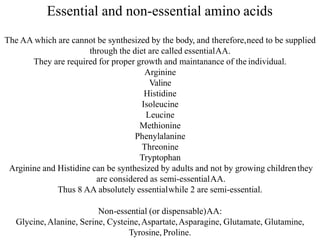
Essential and non-essential amino acids
The AA which are cannot be synthesized by the body, and therefore,need to be supplied
through the diet are called essentialAA.
They are required for proper growth and maintanance of the individual.
Arginine
Valine
Histidine
Isoleucine
Leucine
Methionine
Phenylalanine
Threonine
Tryptophan
Arginine and Histidine can be synthesized by adults and not by growing childrenthey
are considered as semi-essentialAA.
Thus 8 AA absolutely essentialwhile 2 are semi-essential.
Non-essential (or dispensable)AA:
Glycine,Alanine, Serine, Cysteine,Aspartate,Asparagine, Glutamate, Glutamine,
Tyrosine, Proline.
AA classification based on their metabolic fate
Carbone skeleton of AA can serve as a precursor for the synthesisof
glucose (glycogenic) or fat (ketogenic) or both.
1.Glycogenic AA (can serve as precursors for the formation of glucoseor
glycogen)
[Alanine, Aspartate, Glycin, Methionineetc]
2.Ketonic AA (fat can besynthesized)
[Leucine, Lysine]
3.Glycogenic and kethogenicAA
[Isoleucine, Phenylalanine, Tryptophan, Tyrosine] – precursors for
synthesis of glucose as well as fat.
I.Physical propertie of amino acids1-solubility
1.Solubility
– most of amino acids are usually soluble in water and insoluble in
organic solvents
I.Physical properties of amino acids2-melting
2.Melting point
– amibno acids generally melt at higher temperature, often above 200ºC
I.Physical properties of amino acids3-taste
3.Taste
– amino acids may be
-sweet (Gly, Ala,Val),
-tasteless (Leu),
-bitter (Arg, Ile)
Monosodium glutamate (MSG, ajinomoto) is used as a flavoring agent in
food industry, and Chinese food to increase taste and flavor.
In some individuals intolerant to Monosodium glutamate (MSG),
Chinese syndrome (brief and reversible flulike symptoms) is observed.
I.Physical properties of amino acids4-optical
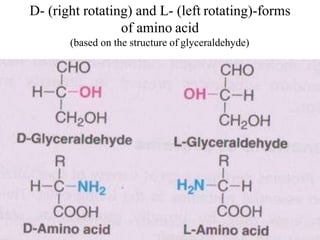
4.Optical properties – all amino acids (except Glycine)
possess optical isomers
due to the presence of asymmetric carbon atom
D- (right rotating) and L- (left rotating)-forms
of amino acid
(based on the structure of glyceraldehyde)
I.Physical properties of amino acids5-ampholytes
Amiono acids as ampholytes
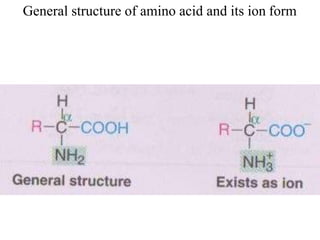
AA contain both acidic (–COOH) and basic (–NH2) groups.
They can donate a proton or accept a proton – hence AAare regarded as
ampholytes.
Zwitter ion (or dipolar ion) – [name zwitter is from German – means
hybrid].
Is a hybrid molecule containing positive and negative ionic groups.
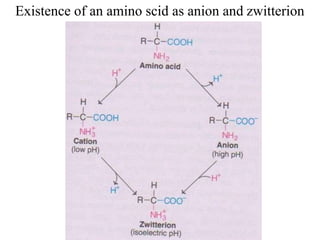
The AA rarely exist in a neutral form with free carboxylic(–COOH) and
free amino [basic] (–NH2) groups. In strongly acidic pH (low pH), the
amino acid is positively charged (cation), while in strongly alkaline pH
(high pH), it is negatively charged (anion). Each AA has acharacteristic
pH at which it carries positive and negative charges and exists as
zwitterions.
General structure of amino acid and its ion form
Existence of an amino scid as anion and zwitterion
I.Physical properties of amino acids5-isoelectricity
Isoelectric pH (sympol pI) is difined as the pH at which a
molecule exists as a zwitterions or dopolar ion and carries no
net charge. Thus, the molecule is electrically neutral.
The pI value can be calculated by taking the average pKa
values corresponding to the ionizable groups.
Titration curve of amino acid [Leucine]
II1.Chemical properties of amino acids
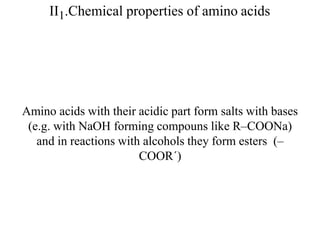
Amino acids with their acidic part form salts with bases
(e.g. with NaOH forming compouns like R–COONa)
and in reactions with alcohols they form esters (–
COOR´)
II2. Chemical properties of amino acids
Amino acids undergo decarboxylation – to produce
corresponding amines
Reactions due to –COOH group
this reaction assumes significance in the living cells due to the
formation of many biologically important amines [histamine
(from histidine), tyramine (from tyrosine), γ-amino buteric
acid (GABA) – from grutamate]
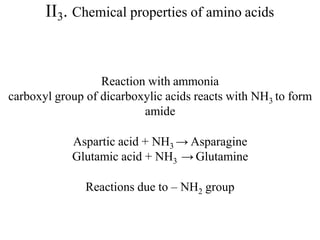
II3. Chemical properties of amino acids
Reaction with ammonia
carboxyl group of dicarboxylic acids reacts with NH3 to form
amide
Aspartic acid + NH3 → Asparagine
Glutamic acid + NH3 → Glutamine
Reactions due to – NH2 group
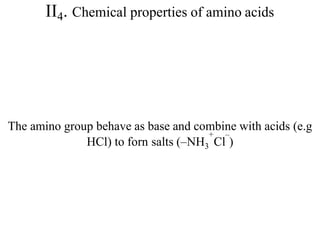
II4. Chemical properties of amino acids
The amino group behave as base and combine with acids (e.g
+ –
HCl) to forn salts (–NH3 Cl )
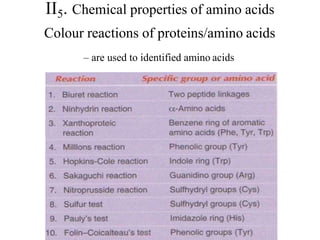
II5. Chemical properties of amino acids
Colour reactions of proteins/amino acids
– are used to identified amino acids
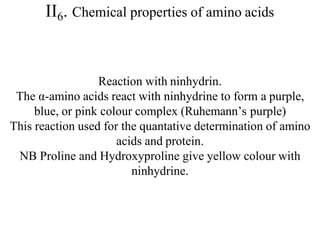
II6. Chemical properties of amino acids
Reaction with ninhydrin.
The α-amino acids react with ninhydrine to form a purple,
blue, or pink colour complex (Ruhemann’s purple)
This reaction used for the quantative determination of amino
acids and protein.
NB Proline and Hydroxyproline give yellow colour with
ninhydrine.
II7. Chemical properties of amino acids
Transamination – very important reaction in amino acid
metabolism – based on transfer of an amino group from an
amino acid to keto acid to form a new amino acid
II8. Chemical properties of amino acids
Amino acid in reaction of oxidative deamination – liberate
free ammonia
Amino acids used in Drugs
D-Penicillamine (D-dimethylglycine)
N-Acetylcysteine
Gabapentine (γ-amonobutyrate linked to cyclohexane)
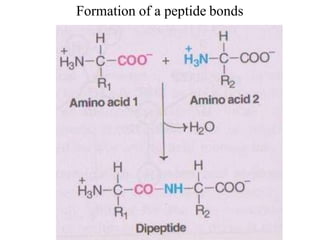
Formation of a peptide bonds
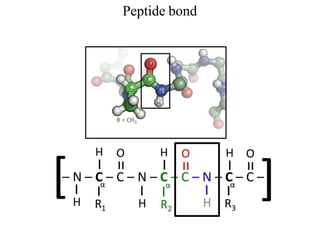
Peptide bond
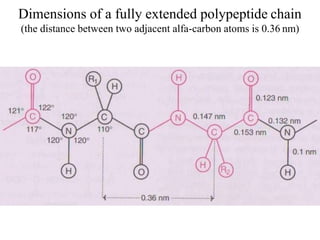
Dimensions of a fully extended polypeptide chain
(the distance between two adjacent alfa-carbon atoms is 0.36 nm)
Classification of peptides and proteins
Peptides names consist af amino acids and always start
with amino ending amino acid listing the sequence of
all next
Peptides are divided into oligopeptide (40 and less
amino acind)
and polypeptides – more than 40 amino acids
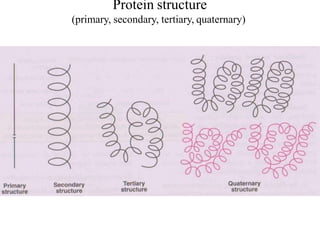
Structure of proteins
Primary structure of protein
Secondary structure of protein
Tertiary structure of proteins
Quaternary structure of proteins
Protein structure
(primary, secondary, tertiary, quaternary)
Secondary structure of protein
A right handed alfa-helix
–CH–R groups of amino acids;
Dotted blue lines are hydrogen
bonds.
[here only a few hydrogen bonds shown
for clarity]
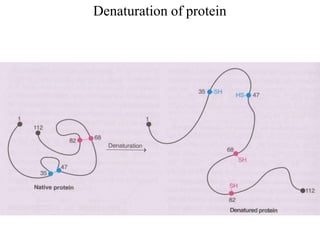
Denaturation of protein
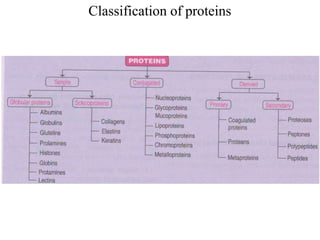
Classification of proteins
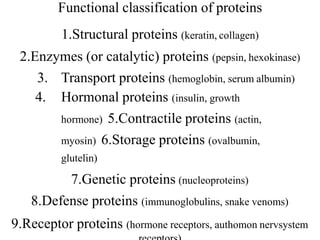
Functional classification of proteins
1.Structural proteins (keratin, collagen)
2.Enzymes (or catalytic) proteins (pepsin, hexokinase)
3. Transport proteins (hemoglobin, serum albumin)
4. Hormonal proteins (insulin, growth
hormone) 5.Contractile proteins (actin,
myosin) 6.Storage proteins (ovalbumin,
glutelin)
7.Genetic proteins (nucleoproteins)
8.Defense proteins (immunoglobulins, snake venoms)
9.Receptor proteins (hormone receptors, authomon nervsystem
Protein classification based on chemical nature and
solubility
1. Simple proteins (only AAresidues)
2.Conjugated proteins(plus non protein moiety –
prosthetic group)
3.Derived proteins – degraded ordenaturated products
of simple and conjugated proteins
Thank YOU for ATTENTION

Amino Acids Peptides & Proteins

  • 1.
  • 2.
    AGENDA: AMINO ACIDS –essencial, non essencial PROTEINS – structure: primary, secondary, tertiary and quaternary physical and chemical properties; simple proteins; proteinogramm compaund proteins chromoproteins, citochroms, lipoproteins α- β- preβ- khilomicrons metaloproteins
  • 3.
    All proteins, whichmay find in living bodies, are consists of amino acids Degradation of proteins into smaller fragments – polypeptide chains may be broken by proteolytic enzymes such as trypsin, chymopripsin, pepsin, elastase – the final point of protein degradation is amino acid. All amino acids occur in proteins are L-, and α- (alpha)- amino acids
  • 4.
  • 5.
    Sponsored Medical Lecture Notes– All Subjects USMLE Exam (America) – Practice
  • 6.
    Classification of AminoAcids A.Classification based on structure: Each amino acid is assigned a 3 letter or 1 letter symbol These symbols are commonly used to represent the amino acids in protein structure e.g.: ANGIOTENSIN II (octapeptide) [Asp-Arg-Val-Tyr-Ile-His-Pro-Phe] or simply [D-R-V-Y-I-H-P-F]
  • 7.
  • 8.
  • 9.
  • 10.
  • 11.
  • 12.
  • 13.
  • 14.
  • 15.
  • 16.
  • 17.
  • 18.
  • 19.
  • 20.
    Classification of aminoacids based on polarity There are four groups of AA depending topolarity 1.Non-polar AA (also referred as hydrophobic [water hating]) nocharge on ‘R’group [Alanine, Leucine, Isoleucine, Valine, Methionine, Phenylalanine, Tryptophan, Proline] 2.PolarAAwith no charge on ‘R’group [Glycine, Serine, Threonine, Cysteine, Glutamine, Asparagine.Tyrosine] – they however possess groups such as hydroxyl, sulfhydryl, amide – and participate in hydrogen bonding of protein structure. 3.PolarAAwith positive ‘R’group [Lysine, Arginine, Histidine] 4.PolarAAwith negative ‘R’group [Aspartic acid, GlutamicAcid]
  • 21.
  • 22.
  • 23.
  • 24.
  • 25.
  • 26.
  • 27.
    Amino Acids foundin proteins are also can be divided into seven distinct groups -AA with aliphatic sidechains -Hydroxyl group containingAA -Sulfur containingAA -Acidic AA and theiramides -BasicAA -AromaticAA -Imino acids
  • 28.
    Aliphatic amino acids [Glycin,Alanin, Valin, Leucin, Isoleucin]
  • 29.
    Hydroxyl group containingAA [Serine, Threonine, Tyrosine]
  • 30.
    Sulfur containing AA [Cystein(with sulfhydryl group), Methionine (with thioether group)]
  • 31.
    Acidic Amino acidsand their amides [Aspertic acid (Aspartate), Glutamic acid (Glutamate)] – dicarboxylic monoamino acids [Aspargine, Glutamine] – their respective amide derivatives all these fourAApossess distinct codons for their incorporation into proteins
  • 32.
    Basic AA [Lysine, Arginine(with gunidino group), histidine (imidazole ring)] dibasic monocarboxylic acids (they are highly basic in character)
  • 33.
    Aromatic AA [Phenilalanine, Tyrosine,Tryptophan (with indolering)]
  • 34.
    Imino acids [Proline (containingpyrrolidine ring)] – it has an imino group (=NH) instead of amino group (–NH2). Therefore Proline is α-imino acid
  • 35.
  • 36.
  • 37.
  • 38.
  • 39.
  • 40.
    heterocyclic amino acids Histidine,Tryptophan, Proline – can be considered as heterocyclicAA
  • 41.
  • 42.
    Nutrificational classification ofamino acids The 20AA are required for the synthesis of variety proteins, besides other biologicalfunctions. However, all these 20 AA need not be taken in thediet. Based on the nutritional requirements, amino acids are grouped into two classes: Essential and Non-essential.
  • 43.
    Essential and non-essentialamino acids The AA which are cannot be synthesized by the body, and therefore,need to be supplied through the diet are called essentialAA. They are required for proper growth and maintanance of the individual. Arginine Valine Histidine Isoleucine Leucine Methionine Phenylalanine Threonine Tryptophan Arginine and Histidine can be synthesized by adults and not by growing childrenthey are considered as semi-essentialAA. Thus 8 AA absolutely essentialwhile 2 are semi-essential. Non-essential (or dispensable)AA: Glycine,Alanine, Serine, Cysteine,Aspartate,Asparagine, Glutamate, Glutamine, Tyrosine, Proline.
  • 44.
    AA classification basedon their metabolic fate Carbone skeleton of AA can serve as a precursor for the synthesisof glucose (glycogenic) or fat (ketogenic) or both. 1.Glycogenic AA (can serve as precursors for the formation of glucoseor glycogen) [Alanine, Aspartate, Glycin, Methionineetc] 2.Ketonic AA (fat can besynthesized) [Leucine, Lysine] 3.Glycogenic and kethogenicAA [Isoleucine, Phenylalanine, Tryptophan, Tyrosine] – precursors for synthesis of glucose as well as fat.
  • 45.
    I.Physical propertie ofamino acids1-solubility 1.Solubility – most of amino acids are usually soluble in water and insoluble in organic solvents
  • 46.
    I.Physical properties ofamino acids2-melting 2.Melting point – amibno acids generally melt at higher temperature, often above 200ºC
  • 47.
    I.Physical properties ofamino acids3-taste 3.Taste – amino acids may be -sweet (Gly, Ala,Val), -tasteless (Leu), -bitter (Arg, Ile) Monosodium glutamate (MSG, ajinomoto) is used as a flavoring agent in food industry, and Chinese food to increase taste and flavor. In some individuals intolerant to Monosodium glutamate (MSG), Chinese syndrome (brief and reversible flulike symptoms) is observed.
  • 48.
    I.Physical properties ofamino acids4-optical 4.Optical properties – all amino acids (except Glycine) possess optical isomers due to the presence of asymmetric carbon atom
  • 49.
    D- (right rotating)and L- (left rotating)-forms of amino acid (based on the structure of glyceraldehyde)
  • 50.
    I.Physical properties ofamino acids5-ampholytes Amiono acids as ampholytes AA contain both acidic (–COOH) and basic (–NH2) groups. They can donate a proton or accept a proton – hence AAare regarded as ampholytes. Zwitter ion (or dipolar ion) – [name zwitter is from German – means hybrid]. Is a hybrid molecule containing positive and negative ionic groups. The AA rarely exist in a neutral form with free carboxylic(–COOH) and free amino [basic] (–NH2) groups. In strongly acidic pH (low pH), the amino acid is positively charged (cation), while in strongly alkaline pH (high pH), it is negatively charged (anion). Each AA has acharacteristic pH at which it carries positive and negative charges and exists as zwitterions.
  • 51.
    General structure ofamino acid and its ion form
  • 52.
    Existence of anamino scid as anion and zwitterion
  • 53.
    I.Physical properties ofamino acids5-isoelectricity Isoelectric pH (sympol pI) is difined as the pH at which a molecule exists as a zwitterions or dopolar ion and carries no net charge. Thus, the molecule is electrically neutral. The pI value can be calculated by taking the average pKa values corresponding to the ionizable groups.
  • 54.
    Titration curve ofamino acid [Leucine]
  • 55.
    II1.Chemical properties ofamino acids Amino acids with their acidic part form salts with bases (e.g. with NaOH forming compouns like R–COONa) and in reactions with alcohols they form esters (– COOR´)
  • 56.
    II2. Chemical propertiesof amino acids Amino acids undergo decarboxylation – to produce corresponding amines Reactions due to –COOH group this reaction assumes significance in the living cells due to the formation of many biologically important amines [histamine (from histidine), tyramine (from tyrosine), γ-amino buteric acid (GABA) – from grutamate]
  • 57.
    II3. Chemical propertiesof amino acids Reaction with ammonia carboxyl group of dicarboxylic acids reacts with NH3 to form amide Aspartic acid + NH3 → Asparagine Glutamic acid + NH3 → Glutamine Reactions due to – NH2 group
  • 58.
    II4. Chemical propertiesof amino acids The amino group behave as base and combine with acids (e.g + – HCl) to forn salts (–NH3 Cl )
  • 59.
    II5. Chemical propertiesof amino acids Colour reactions of proteins/amino acids – are used to identified amino acids
  • 60.
    II6. Chemical propertiesof amino acids Reaction with ninhydrin. The α-amino acids react with ninhydrine to form a purple, blue, or pink colour complex (Ruhemann’s purple) This reaction used for the quantative determination of amino acids and protein. NB Proline and Hydroxyproline give yellow colour with ninhydrine.
  • 61.
    II7. Chemical propertiesof amino acids Transamination – very important reaction in amino acid metabolism – based on transfer of an amino group from an amino acid to keto acid to form a new amino acid
  • 62.
    II8. Chemical propertiesof amino acids Amino acid in reaction of oxidative deamination – liberate free ammonia
  • 63.
    Amino acids usedin Drugs D-Penicillamine (D-dimethylglycine) N-Acetylcysteine Gabapentine (γ-amonobutyrate linked to cyclohexane)
  • 64.
    Formation of apeptide bonds
  • 65.
  • 66.
    Dimensions of afully extended polypeptide chain (the distance between two adjacent alfa-carbon atoms is 0.36 nm)
  • 67.
    Classification of peptidesand proteins Peptides names consist af amino acids and always start with amino ending amino acid listing the sequence of all next Peptides are divided into oligopeptide (40 and less amino acind) and polypeptides – more than 40 amino acids
  • 68.
    Structure of proteins Primarystructure of protein Secondary structure of protein Tertiary structure of proteins Quaternary structure of proteins
  • 69.
  • 70.
    Secondary structure ofprotein A right handed alfa-helix –CH–R groups of amino acids; Dotted blue lines are hydrogen bonds. [here only a few hydrogen bonds shown for clarity]
  • 71.
  • 72.
  • 73.
    Functional classification ofproteins 1.Structural proteins (keratin, collagen) 2.Enzymes (or catalytic) proteins (pepsin, hexokinase) 3. Transport proteins (hemoglobin, serum albumin) 4. Hormonal proteins (insulin, growth hormone) 5.Contractile proteins (actin, myosin) 6.Storage proteins (ovalbumin, glutelin) 7.Genetic proteins (nucleoproteins) 8.Defense proteins (immunoglobulins, snake venoms) 9.Receptor proteins (hormone receptors, authomon nervsystem
  • 74.
    Protein classification basedon chemical nature and solubility 1. Simple proteins (only AAresidues) 2.Conjugated proteins(plus non protein moiety – prosthetic group) 3.Derived proteins – degraded ordenaturated products of simple and conjugated proteins
  • 75.
    Thank YOU forATTENTION