PROTEINS: STRUCTURE, TYPES &
FUNCTIONS
BY
SYEDA SADAF WAJAHAT
Proteins
 Proteins are large, complex molecules that play many critical roles in the body.
 They do most of the work in cells and are required for the structure, function, and
regulation of the body’s tissues and organs.
 Proteins are made up of hundreds or thousands of smaller units called amino acids,
which are attached to one another in long chains.
 There are 20 different types of amino acids that can be combined to make a protein.
 The sequence of amino acids determines each protein’s unique 3-dimensional structure
and its specific function.
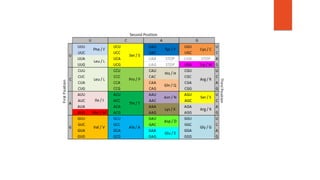
 Amino acids are coded by combinations of three DNA building blocks (nucleotides),
determined by the sequence of genes.
Amino acids
 Amino acids are the monomers that make up proteins.
 Protein is made up of one or more linear chains of amino acids, each of which is called
a polypeptide.
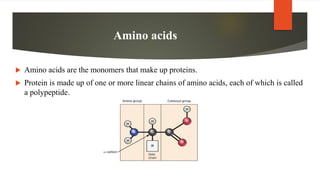
 Amino acids share a basic structure, which consists of a central carbon atom, also
known as the alpha (α) carbon, bonded to an amino group (NH2), a carboxyl group
(COOH), and a hydrogen atom.
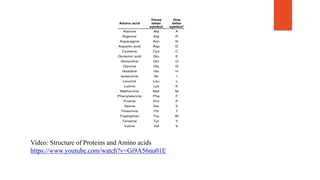
 There are 20 amino acids commonly found in proteins.
 The amino acids three letter and one letter codes are given in the following table.
Video: Structure of Proteins and Amino acids
https://www.youtube.com/watch?v=Gi9A56nu01E
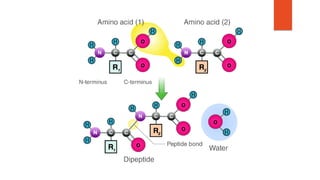
 Multiple amino acids are linked together by peptide bonds, thereby forming a long
chain.
 Peptide bonds are formed by a biochemical reaction that extracts a water molecule as it
joins the amino group of one amino acid to the carboxyl group of a neighboring amino
acid.
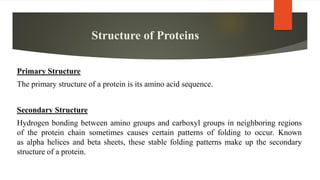
Structure of Proteins
Primary Structure
The primary structure of a protein is its amino acid sequence.
Secondary Structure
Hydrogen bonding between amino groups and carboxyl groups in neighboring regions
of the protein chain sometimes causes certain patterns of folding to occur. Known
as alpha helices and beta sheets, these stable folding patterns make up the secondary
structure of a protein.
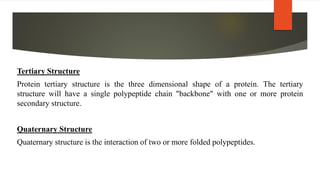
Tertiary Structure
Protein tertiary structure is the three dimensional shape of a protein. The tertiary
structure will have a single polypeptide chain "backbone" with one or more protein
secondary structure.
Quaternary Structure
Quaternary structure is the interaction of two or more folded polypeptides.
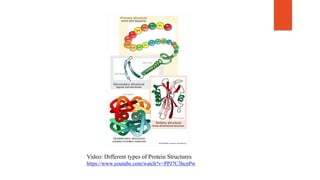
Video: Different types of Protein Structures
https://www.youtube.com/watch?v=PPJ7C3hcnPw
Types & Functions of Proteins
 There is a total of seven different protein types under which all proteins fall. These
include antibodies, contractile proteins, enzymes, hormonal proteins, structural
proteins, storage proteins, and transport proteins.
 Antibodies are specialized proteins that defend the body against antigens or foreign
invaders.
 Contractile proteins are responsible for muscle contraction and movement. Examples
of these proteins include actin and myosin.
 Enzymes are proteins that facilitate and speed up biochemical reactions. Examples
include lactase and pepsin, proteins that are familiar for their roles in digestive
medical conditions and specialty diets.
 Hormonal proteins are messenger proteins that help coordinate certain bodily
functions. Examples include insulin, oxytocin, and somatotropin.
 Structural proteins are fibrous and stringy, this formation making them ideal for
supporting various other proteins such as keratin, collagen, and elastin.
 Storage proteins reserve amino acids for the body until ready for use. Examples of
storage proteins include ferritin that stores iron in the transport protein, hemoglobin.
 Transport proteins are carrier proteins that move molecules from one place to
another in the body. Hemoglobin is one of these and is responsible for transporting
oxygen through the blood via red blood cells.
 Video: Functions of Proteins
https://www.youtube.com/watch?v=Ok2k4Oc9jXs
Proteins

Proteins

  • 1.
    PROTEINS: STRUCTURE, TYPES& FUNCTIONS BY SYEDA SADAF WAJAHAT
  • 2.
    Proteins  Proteins arelarge, complex molecules that play many critical roles in the body.  They do most of the work in cells and are required for the structure, function, and regulation of the body’s tissues and organs.  Proteins are made up of hundreds or thousands of smaller units called amino acids, which are attached to one another in long chains.  There are 20 different types of amino acids that can be combined to make a protein.
  • 3.
     The sequenceof amino acids determines each protein’s unique 3-dimensional structure and its specific function.  Amino acids are coded by combinations of three DNA building blocks (nucleotides), determined by the sequence of genes.
  • 5.
    Amino acids  Aminoacids are the monomers that make up proteins.  Protein is made up of one or more linear chains of amino acids, each of which is called a polypeptide.
  • 6.
     Amino acidsshare a basic structure, which consists of a central carbon atom, also known as the alpha (α) carbon, bonded to an amino group (NH2), a carboxyl group (COOH), and a hydrogen atom.  There are 20 amino acids commonly found in proteins.  The amino acids three letter and one letter codes are given in the following table.
  • 7.
    Video: Structure ofProteins and Amino acids https://www.youtube.com/watch?v=Gi9A56nu01E
  • 8.
     Multiple aminoacids are linked together by peptide bonds, thereby forming a long chain.  Peptide bonds are formed by a biochemical reaction that extracts a water molecule as it joins the amino group of one amino acid to the carboxyl group of a neighboring amino acid.
  • 10.
    Structure of Proteins PrimaryStructure The primary structure of a protein is its amino acid sequence. Secondary Structure Hydrogen bonding between amino groups and carboxyl groups in neighboring regions of the protein chain sometimes causes certain patterns of folding to occur. Known as alpha helices and beta sheets, these stable folding patterns make up the secondary structure of a protein.
  • 11.
    Tertiary Structure Protein tertiarystructure is the three dimensional shape of a protein. The tertiary structure will have a single polypeptide chain "backbone" with one or more protein secondary structure. Quaternary Structure Quaternary structure is the interaction of two or more folded polypeptides.
  • 12.
    Video: Different typesof Protein Structures https://www.youtube.com/watch?v=PPJ7C3hcnPw
  • 13.
    Types & Functionsof Proteins  There is a total of seven different protein types under which all proteins fall. These include antibodies, contractile proteins, enzymes, hormonal proteins, structural proteins, storage proteins, and transport proteins.  Antibodies are specialized proteins that defend the body against antigens or foreign invaders.  Contractile proteins are responsible for muscle contraction and movement. Examples of these proteins include actin and myosin.
  • 14.
     Enzymes areproteins that facilitate and speed up biochemical reactions. Examples include lactase and pepsin, proteins that are familiar for their roles in digestive medical conditions and specialty diets.  Hormonal proteins are messenger proteins that help coordinate certain bodily functions. Examples include insulin, oxytocin, and somatotropin.  Structural proteins are fibrous and stringy, this formation making them ideal for supporting various other proteins such as keratin, collagen, and elastin.
  • 15.
     Storage proteinsreserve amino acids for the body until ready for use. Examples of storage proteins include ferritin that stores iron in the transport protein, hemoglobin.  Transport proteins are carrier proteins that move molecules from one place to another in the body. Hemoglobin is one of these and is responsible for transporting oxygen through the blood via red blood cells.  Video: Functions of Proteins https://www.youtube.com/watch?v=Ok2k4Oc9jXs