Phenylketonuria
Iram Asim Tanveer
Department-MMG
Chromosomal Abnormalities and Genetic Counselling
Points to be Discusses
• Introduction
• Symptoms
• Causes
• How the disorder is inherited
• Diagnosis
• Treatment
• How many and what type of people are likely to have the disorder
Introduction
• Is a rare genetic condition that causes an amino acid called phenylalanine to
build up in the body
• Phenylalanine is found in all proteins and some artificial sweeteners.
• our body uses an enzyme called phenylalanine hydroxylase to convert
phenylalanine into tyrosine, a nonessential amino acid
• While tyrosine helps to create neurotransmitters, such as epinephrine,
norepinephrine, and dopamine.
• It generally effect the brain and if left untreated, the disorder will result in
permanent brain damage and other significant health problems.
Symptoms
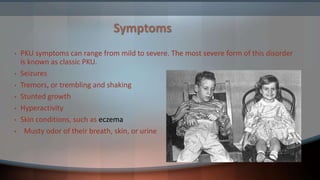
• PKU symptoms can range from mild to severe. The most severe form of this disorder
is known as classic PKU.
• Seizures
• Tremors, or trembling and shaking
• Stunted growth
• Hyperactivity
• Skin conditions, such as eczema
• Musty odor of their breath, skin, or urine
Cause
• Caused by a defect in the PAH gene. The PAH gene helps create phenylalanine
hydroxylase, the enzyme responsible for breaking down phenylalanine. A
dangerous buildup of phenylalanine can occur when someone eats high-protein
foods, such as eggs and meat
• PKU is a mutation by the gene for the hepatic enzyme. Phenylketonuria (PKU)
is inherited, which means it is passed down through families.
How the disorder is inherited
• Both parents must pass on a defective version of the PAH gene for their child
to inherit the disorder. If just one parent passes on an altered gene, the child
won’t have any symptoms, but they’ll be a carrier of the gene.
• It's autosomal, which means not sex-linked
• Classical PKU is , caused by mutations in both alleles of the gene
for phenylalanine hydroxylase (PAH), found on chromosome 12 in the bands
12q22-q24.1
• The disease PKU is clearly inherited as a recessive trait. Only if one inherits a
mutant allele from each parent will one develop the disease.
• However, heterozygous people are easily distinguished from homozygotes by
the phenylalanine tolerance test.
Treatment
• The main way to treat PKU is to eat a special diet that limits foods containing
phenylalanine. Infants with PKU may be fed breast milk.
• They usually also consume a special formula that’s often known as Lofenalac
• eggs
• cheese
• nuts
• milk
• beans
• chicken
• beef
• pork
• fish
• FDA recently approved sapropterin Kuvan for the treatment of PKU.
Sapropterin helps lower phenylalanine levels. This medication must be used in
combination with a special PKU meal plan.
• However, it doesn’t work for everyone with PKU. It’s most effective in children
with mild cases of PKU.
Pregnancy and PKU
• Woman with PKU may be at risk for complications if they don’t follow a PKU
meal plan during their childbearing years. This includes possible miscarriage.
There’s also a chance that the unborn baby will be exposed to high levels of
phenylalanine
Gene Therapy and PKU
• Gene therapy is an experimental, yet very promising approach for PKU
treatment. By delivering a functional PAH gene to the liver in vivo, its activity
should be reconstituted leading to normal clearance of Phe in the blood
therefore eliminating the need for dietary restrictions or frequent enzyme
replacement therapies.
• Significantly, it has been reported that reconstitution of 10-20% of normal
PAH enzymatic activity is sufficient to restore normal serum Phe levels
• Advances in PKU treatment by gene therapy has been accelerated by the
availability of pre-clinical models of disease.
Diagnosis
• Bacterial inhibition assay (Guthrie test)
• Immunoassays using fluorometric or photometric detection
• Amino acid measurement using tandem mass spectrometry (MS/MS)
• Genetic testing is also done
People affected by PKU
• PKU, develop more often among people whose ancestors come from a
particular region.
• People originally from the same region frequently share versions of their
genes that have been passed down from common ancestors. These can
include genes with mutations or changes that can cause PKU
• In the United States, PKU is most common in people of European or Native
American ancestry. It is much less common among people of African,
Hispanic, or Asian ancestry
How common it is??
• Experts estimate that PKU occurs in 1 of 10,000 to 15,000 newborns
• Most cases of PKU are detected shortly after birth by newborn screening, and
treatment is started promptly
• There has been great progress in our understanding of the genetics and
treatment of phenylketonuria over the last few years.
• Early neonatal diagnosis of PKU allowed for the introduction of a low-Phe diet
which drastically prevented neurological damages associated with high blood
Phe.
• In addition, several disease modifying agents are either commercially
available or in late clinical trial stages. Finally, gene therapy approaches are in
the pre-clinical stage and hold a great promise in the efficient PKU treatment.
Phenylketonuria

Phenylketonuria

  • 1.
  • 2.
    Points to beDiscusses • Introduction • Symptoms • Causes • How the disorder is inherited • Diagnosis • Treatment • How many and what type of people are likely to have the disorder
  • 3.
    Introduction • Is arare genetic condition that causes an amino acid called phenylalanine to build up in the body • Phenylalanine is found in all proteins and some artificial sweeteners. • our body uses an enzyme called phenylalanine hydroxylase to convert phenylalanine into tyrosine, a nonessential amino acid • While tyrosine helps to create neurotransmitters, such as epinephrine, norepinephrine, and dopamine. • It generally effect the brain and if left untreated, the disorder will result in permanent brain damage and other significant health problems.
  • 5.
    Symptoms • PKU symptomscan range from mild to severe. The most severe form of this disorder is known as classic PKU. • Seizures • Tremors, or trembling and shaking • Stunted growth • Hyperactivity • Skin conditions, such as eczema • Musty odor of their breath, skin, or urine
  • 6.
    Cause • Caused bya defect in the PAH gene. The PAH gene helps create phenylalanine hydroxylase, the enzyme responsible for breaking down phenylalanine. A dangerous buildup of phenylalanine can occur when someone eats high-protein foods, such as eggs and meat • PKU is a mutation by the gene for the hepatic enzyme. Phenylketonuria (PKU) is inherited, which means it is passed down through families.
  • 8.
    How the disorderis inherited • Both parents must pass on a defective version of the PAH gene for their child to inherit the disorder. If just one parent passes on an altered gene, the child won’t have any symptoms, but they’ll be a carrier of the gene. • It's autosomal, which means not sex-linked • Classical PKU is , caused by mutations in both alleles of the gene for phenylalanine hydroxylase (PAH), found on chromosome 12 in the bands 12q22-q24.1
  • 10.
    • The diseasePKU is clearly inherited as a recessive trait. Only if one inherits a mutant allele from each parent will one develop the disease. • However, heterozygous people are easily distinguished from homozygotes by the phenylalanine tolerance test.
  • 11.
    Treatment • The mainway to treat PKU is to eat a special diet that limits foods containing phenylalanine. Infants with PKU may be fed breast milk. • They usually also consume a special formula that’s often known as Lofenalac • eggs • cheese • nuts • milk • beans • chicken • beef • pork • fish
  • 13.
    • FDA recentlyapproved sapropterin Kuvan for the treatment of PKU. Sapropterin helps lower phenylalanine levels. This medication must be used in combination with a special PKU meal plan. • However, it doesn’t work for everyone with PKU. It’s most effective in children with mild cases of PKU.
  • 14.
    Pregnancy and PKU •Woman with PKU may be at risk for complications if they don’t follow a PKU meal plan during their childbearing years. This includes possible miscarriage. There’s also a chance that the unborn baby will be exposed to high levels of phenylalanine
  • 15.
    Gene Therapy andPKU • Gene therapy is an experimental, yet very promising approach for PKU treatment. By delivering a functional PAH gene to the liver in vivo, its activity should be reconstituted leading to normal clearance of Phe in the blood therefore eliminating the need for dietary restrictions or frequent enzyme replacement therapies. • Significantly, it has been reported that reconstitution of 10-20% of normal PAH enzymatic activity is sufficient to restore normal serum Phe levels • Advances in PKU treatment by gene therapy has been accelerated by the availability of pre-clinical models of disease.
  • 17.
    Diagnosis • Bacterial inhibitionassay (Guthrie test) • Immunoassays using fluorometric or photometric detection • Amino acid measurement using tandem mass spectrometry (MS/MS) • Genetic testing is also done
  • 18.
    People affected byPKU • PKU, develop more often among people whose ancestors come from a particular region. • People originally from the same region frequently share versions of their genes that have been passed down from common ancestors. These can include genes with mutations or changes that can cause PKU • In the United States, PKU is most common in people of European or Native American ancestry. It is much less common among people of African, Hispanic, or Asian ancestry
  • 19.
    How common itis?? • Experts estimate that PKU occurs in 1 of 10,000 to 15,000 newborns • Most cases of PKU are detected shortly after birth by newborn screening, and treatment is started promptly
  • 21.
    • There hasbeen great progress in our understanding of the genetics and treatment of phenylketonuria over the last few years. • Early neonatal diagnosis of PKU allowed for the introduction of a low-Phe diet which drastically prevented neurological damages associated with high blood Phe. • In addition, several disease modifying agents are either commercially available or in late clinical trial stages. Finally, gene therapy approaches are in the pre-clinical stage and hold a great promise in the efficient PKU treatment.