Amblyopia & Eccentric
fixation
Linda Osman(MSc. Optom.)
Dept. of Binocular Vision
Ibn Sina University
Adaptation to strabismus
1. Sensory adaptation
• Amblyopia
• Eccentric fixation
• Suppression
• Abnormal retinal correspondence
2. Motor adaptation
• Abnormal head posture
• Increase angle of deviation
3. Psychological adaptation
• Ignoring
Amblyopia
• Is a partial loss of sight in one or both eyes, caused by
abnormal visual development secondary to abnormal visual
stimulation in the absence of ophthalmoscopic signs.
• Is a spectrum of visual loss ranging from missing a few
letters on 6/6 line to hand motion vision.
• Present when there is at least two Snellen's lines difference
in the visual acuity between the eyes.
• Is a condition of diminished visual form sense which is not
associated with any structural abnormality or disease of the
media, fundi or visual pathways and which is not overcome
by correction of the refractive error.
New definition of amblyopia
• Amblyopia can be defined as unilateral (or bilateral) condition in
which the best corrected visual acuity is poorer than 6/6 in the
absence of any obvious structural or pathologic anomalies but with
one or more of the following conditions occurring before the age of
6 years:
- Anisometropia.
- Constant unilateral esotropia or exotropia.
- Bilateral isometropia.
- Unilateral or bilateral astigmatism.
- Image degradation.
Prevalence of amblyopia
• Amblyopia occurs in 2.5 to 3.2 % of population.
• In monocular visual loss 66% of cases are due to amblyopia.
• Prevalence of different types of amblyopia:
1. Anisometropic 50%
2. Strabismic 19%
3. Mixed strabismic and anisometropic 27%
4. Visual deprivation 4%
Global prevalence of amblyopia
Country Prevalence of amblyopia
Denmark 1.5% and 2.7%.
Romania 2.8%,
Bulgaria 2.5%,
India 1.75% and 17.2%.
China 1.47%,
Malaysia 7.53%,
United States 1% to 4 %
Regional prevalence of amblyopia
Country Prevalence of amblyopia
Yemen 6.7%.
Saudi Arabia 2.5% and 3.9%
Iraq 2.2%
Egypt 1.98%
Classification of amblyopia
• Organic amblyopia:
• Retinal eye diseases.
• Optic nerve diseases.
• Nystagmus.
• Keratoconus.
• Nutritional amblyopia.
• Toxic amblyopia.
• Idiopathic or congenital amblyopia.
• Functional amblyopia:
1. Stimulus or visual deprivation amblyopia. Amblyopia exanopsia
2. Strabismic amblyopia.
3. Refractive amblyopia:
• Anisometropic amblyopia
• Isoametropic amblyopia .
• Meridional amblyopia.
4. Psychogenic amblyopia(hysterical amblyopia).
Strabismic amblyopia
• Seen in patients with unilateral constant strabismus.
• Is a common form of amblyopia
• Typical feature:
1. Grating acuity is less reduced than the Snellen’s acuity.
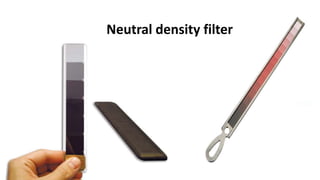
2. Neutral density filter effect.
3. Is always unilateral.
4. Seen more often in esotropes than exotropes.
5. Occur very rarely in patients with hypertropia.
6. Don’t occur in patients with alternate strabismus.
Neutral density filter
Stimulus deprivation amblyopia
• Amblyopia exanopsia = amblyopia of disuse
• Occur when one eye or both eyes are totally prevented from seeing
early in life due to :
1. Monocular or binocular congenital or traumatic cataract.
2. Complete ptosis.
3. Corneal opacity.
4. Prolonged patching of the normal eye.
• Characteristic feature:
1. It is the least common but most damaging.
2. Difficult to treat form of amblyopia.
3. Visual loss resulting from unilateral deprivation is worse
than that produced by bilateral deprivation of similar
degree.
Anisometropic amblyopia
• Occurring in an eye having higher degree of refractive error than the
fellow eye.
• More common in patients with anisohypermetropia than in those
with anisomyopia.
• However unilateral high myopia (-6.0D or more) result in sever
amblyopia.
• Strabismus is frequently associated with Anisometropia.
Isoametropic amblyopia
• Is bilateral amblyopia occurring in children with bilateral
uncorrected high refractive error.
• Hyperopia of more than +5.0D and myopia more than -
10.0D and astigmatism more than 2.5D have a risk of
inducing bilateral amblyopia.
Meridional amblyopia
• Occurring in patient with uncorrected astigmatic refractive error.
• Selective amblyopia.
• Even small amount of unilateral astigmatism may cause
amblyopia.
Clinical characteristic of amblyopia
• Recognition acuity
• Snellen’s acuity and grating acuity
• Effect of neutral density filter
• Crowding phenomenon
• Absolute central scotoma
• Localization of an object of regard
• Colour vision
• Light perception
• Pupillary light reflexes
• Light and dark adaptation
• Amblyopia with eccentric fixation
Amblyopia with eccentric fixation
• Eccentric fixation is a monocular condition in which a point
on the retina other than the fovea is used for fixation.
• Present in purely strabismic amblyopia.
• Investigated by:
1. Vesoscope
2. Ophthalmoscope
3. After image transfer method
4. Past pointing test
Investigation of amblyopia
1. Evaluation of visual acuity.
2. Neutral density filter test.
3. Test for crowding phenomenon.
4. Fundus examination.
5. Evaluation of central fixation.
Prognosis of amblyopia
• Depends upon the age of patient, type of amblyopia and
type of treatment:
1. Younger the child better the prognosis
2. Amblyopia due to deprivation has the poorest prognosis
3. Strabismic amblyopia has the best prognosis
4. Anisometropic amblyopia has intermediate prognosis
5. Presence of eccentric fixation worsen the prognosis
6. Amblyopia with unilateral high hypermetropia has poorer prognosis
7. Prognosis is better when treated with total full – time occlusion
than other methods.
Any question?
Thank you

2.Amblyopia and Eccentric fixation.pptx

  • 1.
    Amblyopia & Eccentric fixation LindaOsman(MSc. Optom.) Dept. of Binocular Vision Ibn Sina University
  • 2.
    Adaptation to strabismus 1.Sensory adaptation • Amblyopia • Eccentric fixation • Suppression • Abnormal retinal correspondence 2. Motor adaptation • Abnormal head posture • Increase angle of deviation 3. Psychological adaptation • Ignoring
  • 3.
    Amblyopia • Is apartial loss of sight in one or both eyes, caused by abnormal visual development secondary to abnormal visual stimulation in the absence of ophthalmoscopic signs. • Is a spectrum of visual loss ranging from missing a few letters on 6/6 line to hand motion vision. • Present when there is at least two Snellen's lines difference in the visual acuity between the eyes.
  • 4.
    • Is acondition of diminished visual form sense which is not associated with any structural abnormality or disease of the media, fundi or visual pathways and which is not overcome by correction of the refractive error.
  • 5.
    New definition ofamblyopia • Amblyopia can be defined as unilateral (or bilateral) condition in which the best corrected visual acuity is poorer than 6/6 in the absence of any obvious structural or pathologic anomalies but with one or more of the following conditions occurring before the age of 6 years: - Anisometropia. - Constant unilateral esotropia or exotropia. - Bilateral isometropia. - Unilateral or bilateral astigmatism. - Image degradation.
  • 6.
    Prevalence of amblyopia •Amblyopia occurs in 2.5 to 3.2 % of population. • In monocular visual loss 66% of cases are due to amblyopia. • Prevalence of different types of amblyopia: 1. Anisometropic 50% 2. Strabismic 19% 3. Mixed strabismic and anisometropic 27% 4. Visual deprivation 4%
  • 7.
    Global prevalence ofamblyopia Country Prevalence of amblyopia Denmark 1.5% and 2.7%. Romania 2.8%, Bulgaria 2.5%, India 1.75% and 17.2%. China 1.47%, Malaysia 7.53%, United States 1% to 4 %
  • 8.
    Regional prevalence ofamblyopia Country Prevalence of amblyopia Yemen 6.7%. Saudi Arabia 2.5% and 3.9% Iraq 2.2% Egypt 1.98%
  • 9.
    Classification of amblyopia •Organic amblyopia: • Retinal eye diseases. • Optic nerve diseases. • Nystagmus. • Keratoconus. • Nutritional amblyopia. • Toxic amblyopia. • Idiopathic or congenital amblyopia.
  • 10.
    • Functional amblyopia: 1.Stimulus or visual deprivation amblyopia. Amblyopia exanopsia 2. Strabismic amblyopia. 3. Refractive amblyopia: • Anisometropic amblyopia • Isoametropic amblyopia . • Meridional amblyopia. 4. Psychogenic amblyopia(hysterical amblyopia).
  • 11.
    Strabismic amblyopia • Seenin patients with unilateral constant strabismus. • Is a common form of amblyopia • Typical feature: 1. Grating acuity is less reduced than the Snellen’s acuity. 2. Neutral density filter effect. 3. Is always unilateral. 4. Seen more often in esotropes than exotropes. 5. Occur very rarely in patients with hypertropia. 6. Don’t occur in patients with alternate strabismus.
  • 12.
  • 13.
    Stimulus deprivation amblyopia •Amblyopia exanopsia = amblyopia of disuse • Occur when one eye or both eyes are totally prevented from seeing early in life due to : 1. Monocular or binocular congenital or traumatic cataract. 2. Complete ptosis. 3. Corneal opacity. 4. Prolonged patching of the normal eye.
  • 14.
    • Characteristic feature: 1.It is the least common but most damaging. 2. Difficult to treat form of amblyopia. 3. Visual loss resulting from unilateral deprivation is worse than that produced by bilateral deprivation of similar degree.
  • 15.
    Anisometropic amblyopia • Occurringin an eye having higher degree of refractive error than the fellow eye. • More common in patients with anisohypermetropia than in those with anisomyopia. • However unilateral high myopia (-6.0D or more) result in sever amblyopia. • Strabismus is frequently associated with Anisometropia.
  • 16.
    Isoametropic amblyopia • Isbilateral amblyopia occurring in children with bilateral uncorrected high refractive error. • Hyperopia of more than +5.0D and myopia more than - 10.0D and astigmatism more than 2.5D have a risk of inducing bilateral amblyopia.
  • 17.
    Meridional amblyopia • Occurringin patient with uncorrected astigmatic refractive error. • Selective amblyopia. • Even small amount of unilateral astigmatism may cause amblyopia.
  • 18.
    Clinical characteristic ofamblyopia • Recognition acuity • Snellen’s acuity and grating acuity • Effect of neutral density filter • Crowding phenomenon • Absolute central scotoma
  • 19.
    • Localization ofan object of regard • Colour vision • Light perception • Pupillary light reflexes • Light and dark adaptation • Amblyopia with eccentric fixation
  • 20.
    Amblyopia with eccentricfixation • Eccentric fixation is a monocular condition in which a point on the retina other than the fovea is used for fixation. • Present in purely strabismic amblyopia. • Investigated by: 1. Vesoscope 2. Ophthalmoscope 3. After image transfer method 4. Past pointing test
  • 21.
    Investigation of amblyopia 1.Evaluation of visual acuity. 2. Neutral density filter test. 3. Test for crowding phenomenon. 4. Fundus examination. 5. Evaluation of central fixation.
  • 22.
    Prognosis of amblyopia •Depends upon the age of patient, type of amblyopia and type of treatment: 1. Younger the child better the prognosis 2. Amblyopia due to deprivation has the poorest prognosis 3. Strabismic amblyopia has the best prognosis 4. Anisometropic amblyopia has intermediate prognosis 5. Presence of eccentric fixation worsen the prognosis 6. Amblyopia with unilateral high hypermetropia has poorer prognosis 7. Prognosis is better when treated with total full – time occlusion than other methods.
  • 23.
  • 24.