






Chronic Obstructive Pulmonary Disease
Abdullatiff Sami Al-Rashed
Block 4.1
College of Medicine, King Faisal University
Al-Ahsa, Saudi Arabia
Outline
Case
A 66-year-old man with a smoking history of one pack per day for the past 47
years presents with progressive shortness of breath and chronic cough,
productive of yellowish sputum, for the past 2 years.
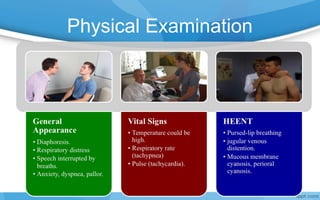
On examination he appears cachectic and in moderate respiratory distress,
especially after walking to the examination room, and has pursed-lip breathing.
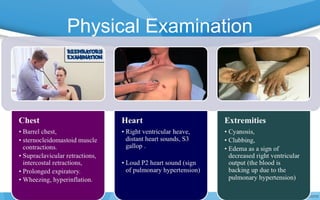
His neck veins are mildly distended. Lung examination reveals a barrel chest
and poor air entry bilaterally, with moderate inspiratory and expiratory
wheezing. Heart and abdominal examination are within normal limits. Lower
extremities exhibit scant pitting edema.
Introduction
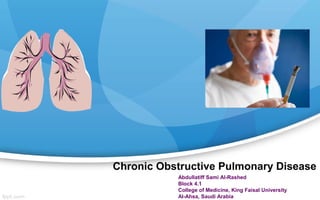
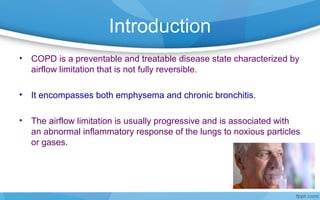
• COPD is a preventable and treatable disease state characterized by
airflow limitation that is not fully reversible.
• It encompasses both emphysema and chronic bronchitis.
• The airflow limitation is usually progressive and is associated with
an abnormal inflammatory response of the lungs to noxious particles
or gases.
Introduction
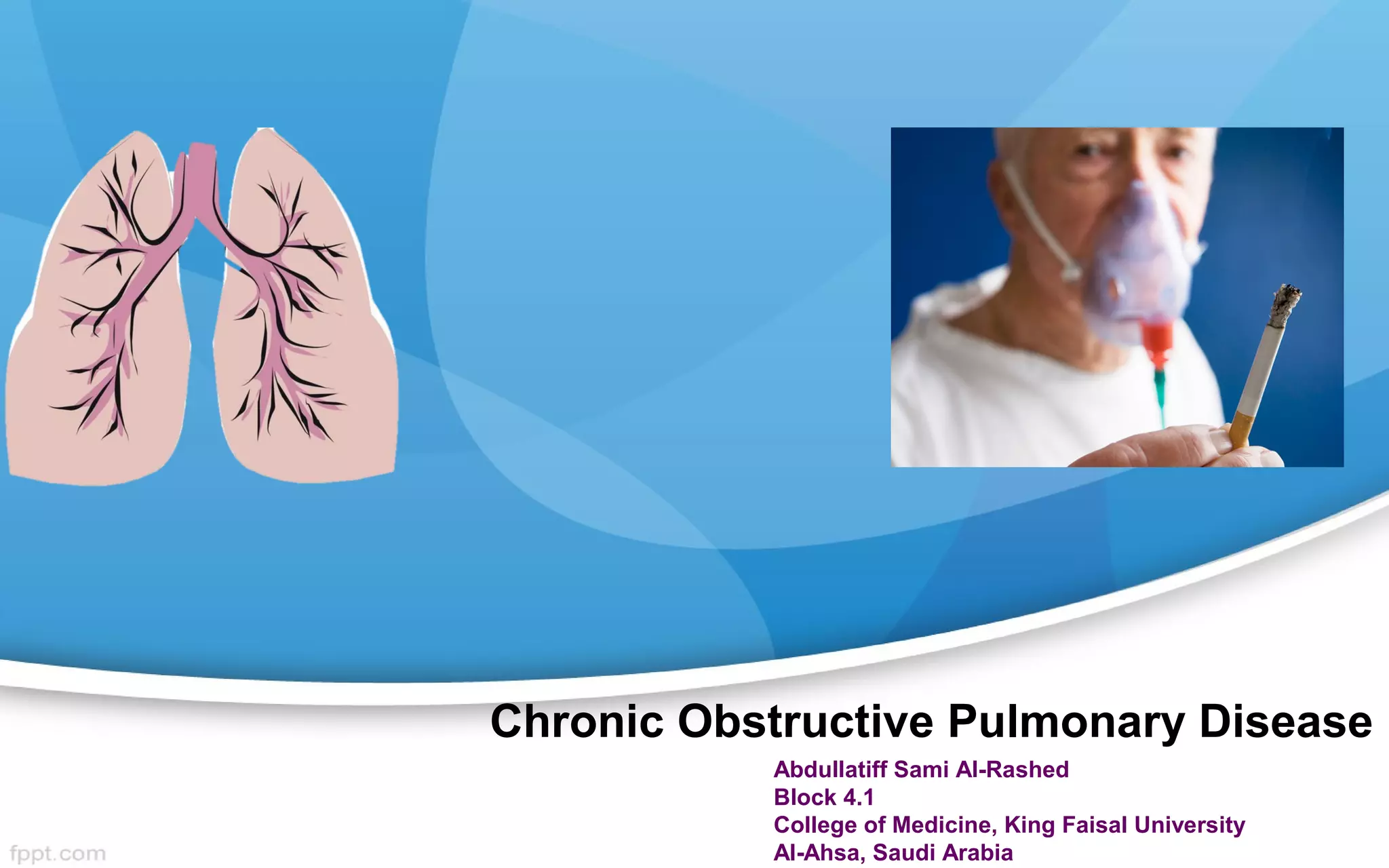
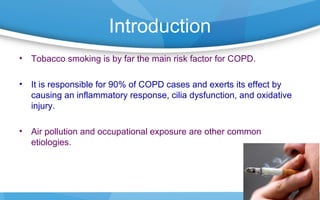
• Tobacco smoking is by far the main risk factor for COPD.
• It is responsible for 90% of COPD cases and exerts its effect by
causing an inflammatory response, cilia dysfunction, and oxidative
injury.
• Air pollution and occupational exposure are other common
etiologies.
Diagnosis of copdDiagnosis of copd
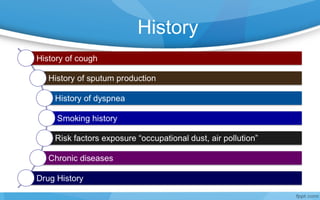
History
History
Physical Examination
Early in the disease, the physical
examination may be normal, or may show
only prolonged expiration or wheezes on
forced exhalation.
Physical Examination
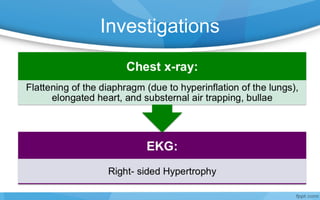
Investigations
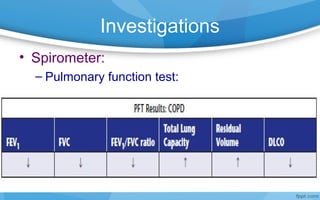
• Spirometer:
– Pulmonary function test:
Investigations
Investigations
Deferential diagnosesDeferential diagnoses
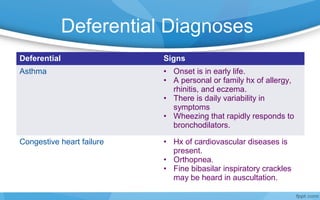
Deferential Diagnoses
Deferential Signs
Asthma • Onset is in early life.
• A personal or family hx of allergy,
rhinitis, and eczema.
• There is daily variability in
symptoms
• Wheezing that rapidly responds to
bronchodilators.
Congestive heart failure • Hx of cardiovascular diseases is
present.
• Orthopnea.
• Fine bibasilar inspiratory crackles
may be heard in auscultation.
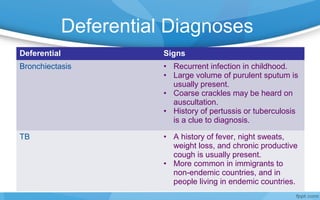
Deferential Diagnoses
Deferential Signs
Bronchiectasis • Recurrent infection in childhood.
• Large volume of purulent sputum is
usually present.
• Coarse crackles may be heard on
auscultation.
• History of pertussis or tuberculosis
is a clue to diagnosis.
TB • A history of fever, night sweats,
weight loss, and chronic productive
cough is usually present.
• More common in immigrants to
non-endemic countries, and in
people living in endemic countries.
References
Approach to Chronic Obstructive Pulmonary Disease

Approach to Chronic Obstructive Pulmonary Disease

  • 1.
    Chronic Obstructive PulmonaryDisease Abdullatiff Sami Al-Rashed Block 4.1 College of Medicine, King Faisal University Al-Ahsa, Saudi Arabia
  • 2.
  • 3.
    Case A 66-year-old manwith a smoking history of one pack per day for the past 47 years presents with progressive shortness of breath and chronic cough, productive of yellowish sputum, for the past 2 years. On examination he appears cachectic and in moderate respiratory distress, especially after walking to the examination room, and has pursed-lip breathing. His neck veins are mildly distended. Lung examination reveals a barrel chest and poor air entry bilaterally, with moderate inspiratory and expiratory wheezing. Heart and abdominal examination are within normal limits. Lower extremities exhibit scant pitting edema.
  • 6.
    Introduction • COPD isa preventable and treatable disease state characterized by airflow limitation that is not fully reversible. • It encompasses both emphysema and chronic bronchitis. • The airflow limitation is usually progressive and is associated with an abnormal inflammatory response of the lungs to noxious particles or gases.
  • 7.
    Introduction • Tobacco smokingis by far the main risk factor for COPD. • It is responsible for 90% of COPD cases and exerts its effect by causing an inflammatory response, cilia dysfunction, and oxidative injury. • Air pollution and occupational exposure are other common etiologies.
  • 8.
  • 9.
  • 10.
  • 11.
    Physical Examination Early inthe disease, the physical examination may be normal, or may show only prolonged expiration or wheezes on forced exhalation.
  • 12.
  • 13.
  • 14.
  • 15.
  • 16.
  • 17.
  • 18.
    Deferential Diagnoses Deferential Signs Asthma• Onset is in early life. • A personal or family hx of allergy, rhinitis, and eczema. • There is daily variability in symptoms • Wheezing that rapidly responds to bronchodilators. Congestive heart failure • Hx of cardiovascular diseases is present. • Orthopnea. • Fine bibasilar inspiratory crackles may be heard in auscultation.
  • 19.
    Deferential Diagnoses Deferential Signs Bronchiectasis• Recurrent infection in childhood. • Large volume of purulent sputum is usually present. • Coarse crackles may be heard on auscultation. • History of pertussis or tuberculosis is a clue to diagnosis. TB • A history of fever, night sweats, weight loss, and chronic productive cough is usually present. • More common in immigrants to non-endemic countries, and in people living in endemic countries.
  • 20.

Editor's Notes

  • #11 Heart disease Metabolic syndrome Osteoporosis Sleep apnea Depression Lung cancer Skin wrinkling
  • #15 Decrease in FEV1 Decrease in FVC from loss of elastic recoil of the lung Decrease in the FEV1/FVC ratio Increase in total lung capacity from air trapping Increase in residual volume Decrease in diffusion capacity lung carbon monoxide (DLCO) caused by destruction of lung interstitium
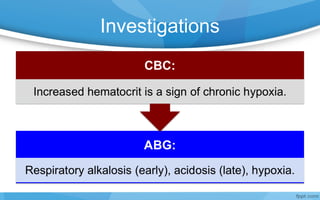
  • #16 CBC: Increased hematocrit is a sign of chronic hypoxia. ABG: Respiratory alkalosis (early), acidosis (late), hypoxia. Chest x-ray: Flattening of the diaphragm (due to hyperinflation of the lungs), elongated heart, and substernal air trapping, bullae EKG: Right- sided Hypertrophy