
Topic: all testing of textile lab
• Name ID
• Md Ruhul Amin 162-23-4718
• HM Tofayel Ahamad 162-23-4765
• Md Mohidul Hasan 162-23-4780
• Md Samiul Islam 153-23-4456
BREAKING STRENGTH
BREAKING STRENGTH
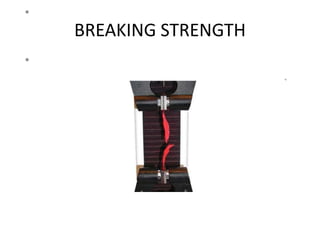
• Mainly used for woven fabric because the tests
are unidirectional and woven fabrics have
unidirectional yarns.
• Factors that produce a strong fabric include fiber
content, yarn size and type, weave, and yarns per
inch.
• Breaking strength is expressed in pounds and the
elongation is expressed as a percent and in both
cases a number of warp tests and weft test are
performed.
IMPORTANCE OF BREAKING STRENGTH
TEST
• Breaking strength is important in various end
uses such as automotive safety
belts, parachute harness and pants.
• Breaking strength can also be used to test the
effects of destructive forces upon a woven
fabric including sunlight, abrasion, laundering
etc.
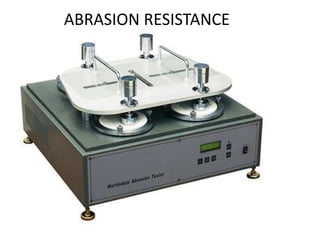
ABRASION RESISTANCE
ABRASION RESISTANCE
• Abrasion resistance is the wearing away of
any part of a material when rubbed against
any other material.
• Abrasion resistance is the wearing away of
any part of a material when rubbed against
any other material.
ABRASION RESISTANCE
• Garments that are made from fibres that
possess both high breaking strength and
abrasion resistance can be worn often and for
a long period of time before signs of physical
wear appear.. Nylon is extremely high in
abrasion resistance so it is used widely in
action outer whereas Acetate has poor
abrasion resistance so it does not last long
when used for lining in jackets and coats.
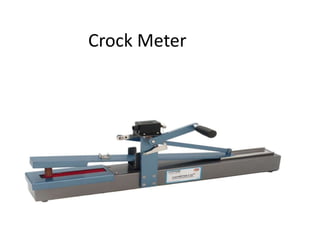
Crock Meter
Apparatus and Material Used in ISO
105/AATCC
• Crock Meter
• Cotton Rubbing Fabric
• Grey Scale
• Stop Watch
• Weight (9N)
• Color Matching Cabinet
.
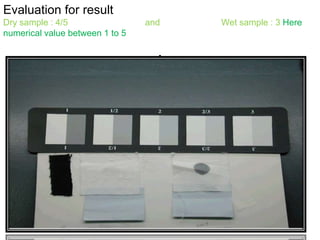
Evaluation for result
Dry sample : 4/5 and Wet sample : 3 Here
numerical value between 1 to 5
Color Fastness To Dry Cleaning
•
Color Fastness To Dry Cleaning
• Color may change due to dry cleaning too.
• This test indicates what will happen to the color
of textile materials after repeated commercial dry
cleaning.
• Perchlorethylene is used in the test:
• Commonly used dry cleaning solvents.
• It is slightly more severe in solvent action.
• A color that may get affected by perchlorethylene
will not get affected by Stoddard solvent
(petroleum base).
Color Fastness To Dry Cleaning
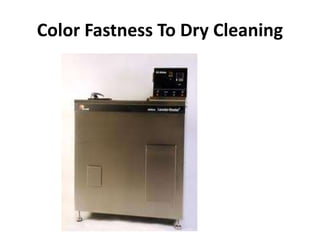
• Device used for this test is the launder-
• ometer.
• Dry cleaning solvent instead of water is used
as liquid.
All Testing Of Textile Lab

All Testing Of Textile Lab

  • 2.
    Topic: all testingof textile lab • Name ID • Md Ruhul Amin 162-23-4718 • HM Tofayel Ahamad 162-23-4765 • Md Mohidul Hasan 162-23-4780 • Md Samiul Islam 153-23-4456
  • 3.
  • 4.
    BREAKING STRENGTH • Mainlyused for woven fabric because the tests are unidirectional and woven fabrics have unidirectional yarns. • Factors that produce a strong fabric include fiber content, yarn size and type, weave, and yarns per inch. • Breaking strength is expressed in pounds and the elongation is expressed as a percent and in both cases a number of warp tests and weft test are performed.
  • 5.
    IMPORTANCE OF BREAKINGSTRENGTH TEST • Breaking strength is important in various end uses such as automotive safety belts, parachute harness and pants. • Breaking strength can also be used to test the effects of destructive forces upon a woven fabric including sunlight, abrasion, laundering etc.
  • 6.
  • 7.
    ABRASION RESISTANCE • Abrasionresistance is the wearing away of any part of a material when rubbed against any other material. • Abrasion resistance is the wearing away of any part of a material when rubbed against any other material.
  • 8.
    ABRASION RESISTANCE • Garmentsthat are made from fibres that possess both high breaking strength and abrasion resistance can be worn often and for a long period of time before signs of physical wear appear.. Nylon is extremely high in abrasion resistance so it is used widely in action outer whereas Acetate has poor abrasion resistance so it does not last long when used for lining in jackets and coats.
  • 9.
  • 10.
    Apparatus and MaterialUsed in ISO 105/AATCC • Crock Meter • Cotton Rubbing Fabric • Grey Scale • Stop Watch • Weight (9N) • Color Matching Cabinet
  • 11.
    . Evaluation for result Drysample : 4/5 and Wet sample : 3 Here numerical value between 1 to 5
  • 12.
    Color Fastness ToDry Cleaning •
  • 13.
    Color Fastness ToDry Cleaning • Color may change due to dry cleaning too. • This test indicates what will happen to the color of textile materials after repeated commercial dry cleaning. • Perchlorethylene is used in the test: • Commonly used dry cleaning solvents. • It is slightly more severe in solvent action. • A color that may get affected by perchlorethylene will not get affected by Stoddard solvent (petroleum base).
  • 14.
    Color Fastness ToDry Cleaning • Device used for this test is the launder- • ometer. • Dry cleaning solvent instead of water is used as liquid.