INTRODUCTION
Name: Ashibur Rahman
ID: 191-23-5558
Department: Textile Engeneering
Section: Eve.(A)
Subject: Textile Testing & Quality Control 2
Subject Code: TE-315
PRESENTATION
Textile Testing & Quality Control 2
Topics:Crease recovery of fabric & test method
Crease recovery of fabric & test method
▪ Crease is a fold in fabric introduced unintentionally at
some stages of processing. Crease or crushing of textile
material is a complex effect involving tensile,
compressive, flexing and torsional stresses. Crease
recovery is a fabric property which indicates the ability
of fabric to go back to its original position after
creasing.
Theory:
Crease recovery is a measure of creases resistance, specified
quantitatively in terms of crease recovery angle. To measure this,
the popular instrument is Shirley crease recovery tester. The
instrument consists of a circular dial which carries the clamp for
holding the specimen. Directly under the centre of the dial there
is a knife edge and an index line for measuring the recovery
angle. Crease recovery is determined depending upon this
recovery angle. If the angle is 0o then recovery is zero and if the
angle is 180o then recovery is full. Crease recovery depends on
the construction, twist of yarn, pressure, time etc. Usually crease
recovery is more in warp way than in weft way. This is because
warp yarns are well in quality, strength, treated with sizing , kept
in more tension during weaving etc.
Apparatus:
a) Crease recovery tester
b) Scissor
c) Glass plates
d) Steel plates
e) Weight.
Procedure:
 The specimen is cut by template and carefully creased by folding
in half.
 The crease is imparted on fabric by placing it between two glass
plates and adding to 500gm weight on it.
 After 1 min the weight is removed and the creased fabric is
clamped on the instrument.
 Then it is allowed to recover from the crease. The recovery time
may vary to suit particular creases. Usually it is 1 min.
 When crease recovers the dial of the instrument is rotated to
keep the free edge of the specimen inline with the knife edge.
 The recovery angle is read from the engraved scale.
 In this way 10 tests are done in warp way and 10 for weft way.
 The mean value of recovery angle is taken and thus crease
recovery is measured.
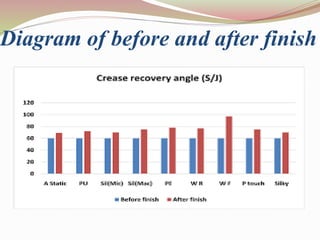
Diagram of before and after finish
crease Recovery

crease Recovery

  • 2.
    INTRODUCTION Name: Ashibur Rahman ID:191-23-5558 Department: Textile Engeneering Section: Eve.(A) Subject: Textile Testing & Quality Control 2 Subject Code: TE-315
  • 3.
    PRESENTATION Textile Testing &Quality Control 2 Topics:Crease recovery of fabric & test method
  • 4.
    Crease recovery offabric & test method ▪ Crease is a fold in fabric introduced unintentionally at some stages of processing. Crease or crushing of textile material is a complex effect involving tensile, compressive, flexing and torsional stresses. Crease recovery is a fabric property which indicates the ability of fabric to go back to its original position after creasing.
  • 5.
    Theory: Crease recovery isa measure of creases resistance, specified quantitatively in terms of crease recovery angle. To measure this, the popular instrument is Shirley crease recovery tester. The instrument consists of a circular dial which carries the clamp for holding the specimen. Directly under the centre of the dial there is a knife edge and an index line for measuring the recovery angle. Crease recovery is determined depending upon this recovery angle. If the angle is 0o then recovery is zero and if the angle is 180o then recovery is full. Crease recovery depends on the construction, twist of yarn, pressure, time etc. Usually crease recovery is more in warp way than in weft way. This is because warp yarns are well in quality, strength, treated with sizing , kept in more tension during weaving etc.
  • 6.
    Apparatus: a) Crease recoverytester b) Scissor c) Glass plates d) Steel plates e) Weight.
  • 7.
    Procedure:  The specimenis cut by template and carefully creased by folding in half.  The crease is imparted on fabric by placing it between two glass plates and adding to 500gm weight on it.  After 1 min the weight is removed and the creased fabric is clamped on the instrument.  Then it is allowed to recover from the crease. The recovery time may vary to suit particular creases. Usually it is 1 min.  When crease recovers the dial of the instrument is rotated to keep the free edge of the specimen inline with the knife edge.  The recovery angle is read from the engraved scale.  In this way 10 tests are done in warp way and 10 for weft way.  The mean value of recovery angle is taken and thus crease recovery is measured.
  • 8.
    Diagram of beforeand after finish