 Discrete version of the delta function defined by
 δ𝑖𝑗 = {1𝑓𝑜𝑟 𝑖=𝑗
0𝑓𝑜𝑟 𝑖≠𝑗
 if the coordinates 𝑥1
, 𝑥2
, 𝑥3
, … … 𝑥𝑁
are independent
then

𝜕𝑥𝑖
𝜕𝑥𝑗= {1𝑓𝑜𝑟 𝑖=𝑗
0𝑓𝑜𝑟 𝑖≠𝑗
 𝜹𝒊
𝒊
= 𝜹𝟏
𝟏
+ 𝜹𝟐
𝟐
+ ⋯ + 𝜹𝑵
𝑵
= 𝟏 + 𝟏 + ⋯ + 𝟏(𝑵 𝒕𝒊𝒎𝒆𝒔) = 𝑵
 𝜹𝒊
𝒊
=N
CONTRAVARIANT VECTORS
• Let 𝐴𝑖 𝑏𝑒 a set of N functions of N co ordinates
𝑥1, 𝑥2, 𝑥3, … … 𝑥𝑁 in a given system (𝑥𝑖).
• Then the quantities 𝐴𝑖 are said to form the
components of a contra variant vector.
• if these components transform according to the
following rule on change of co ordinates system
from 𝑥𝑖
to another system 𝑥𝑖
.
𝐴𝑖
=
𝜕 𝑥𝑖
𝜕𝑥𝑗
𝐴𝑗
CONTRAVARIANT VECTORS
• 𝐴𝑖
=
𝜕 𝑥𝑖
𝜕𝑥𝑗 𝐴𝑗
multiply by
𝜕𝑥𝑝
𝜕 𝑥𝑖
•
𝜕𝑥𝑝
𝜕 𝑥𝑖 𝐴𝑖 =
𝜕𝑥𝑝
𝜕 𝑥𝑖
𝜕 𝑥𝑖
𝜕𝑥𝑗 𝐴𝑗
•
𝜕𝑥𝑝
𝜕 𝑥𝑖 𝐴𝑖
=
𝜕𝑥𝑝
𝜕𝑥𝑗 𝐴𝑗
•
𝝏𝒙𝒑
𝝏 𝒙𝒊 𝑨𝒊
= 𝜹𝒋
𝒑
𝑨𝒋
=𝑨𝒑
CONTRAVARIANT VECTORS
• Let 𝐴𝑖𝑗 𝑏𝑒 a set of N functions of N co ordinates
𝑥1, 𝑥2, 𝑥3, … … 𝑥𝑁 in a given system (𝑥𝑖).
• Then the quantities 𝐴𝑖𝑗 are said to form the
components of a contra variant vector of order two.
• if these components transform according to the
following rule on change of co ordinates system
from 𝑥𝑖
to another system 𝑥𝑖
.
𝑨𝒊𝒋
=
𝝏 𝒙𝒊
𝝏𝒙𝒑
𝝏 𝒙𝒋
𝝏𝒙𝒒
𝑨𝒋
• 𝑨𝒊𝒋
=
𝝏 𝒙𝒊
𝝏𝒙𝒑
𝝏 𝒙𝒋
𝝏𝒙𝒒 𝑨𝒋
Multiply by
𝝏𝒙𝒓
𝝏 𝒙𝒊
𝝏𝒙𝒔
𝝏 𝒙𝒋
•
𝝏𝒙𝒓
𝝏 𝒙𝒊
𝝏𝒙𝒔
𝝏 𝒙𝒋 𝑨𝒊𝒋
=
𝝏𝒙𝒓
𝝏 𝒙𝒊
𝝏𝒙𝒔
𝝏 𝒙𝒋
𝝏 𝒙𝒊
𝝏𝒙𝒑
𝝏 𝒙𝒋
𝝏𝒙𝒒 𝑨𝒋
•
𝝏𝒙𝒓
𝝏 𝒙𝒊
𝝏𝒙𝒔
𝝏 𝒙𝒋 𝑨𝒊𝒋
=
𝝏𝒙𝒓
𝝏𝒙𝒑
𝝏𝒙𝒔
𝝏𝒙𝒒 𝑨𝒋
•
𝝏𝒙𝒓
𝝏 𝒙𝒊
𝝏𝒙𝒔
𝝏 𝒙𝒋 𝑨𝒊𝒋 = 𝜹𝒑
𝒓𝜹𝒒
𝒔 𝑨𝒑𝒒 = 𝑨𝒓𝒔
CONTRAVARIANT VECTORS
• Let 𝐴𝑖 𝑏𝑒 a set of N functions of N co ordinates
𝑥1, 𝑥2, 𝑥3, … … 𝑥𝑁 in a given system (𝑥𝑖).
• Then the quantities 𝐴𝑖
𝑝
are said to form the
components of a contra variant vector.
• if these components transform according to the
following rule on change of co ordinates system
from 𝑥𝑖 to another system 𝑥𝑖.
𝐴𝑖
=
𝜕 𝑥𝑖
𝜕𝑥𝑗
𝐴𝑗
CO VARIANT VECTORS
• Let 𝐴𝑖 𝑏𝑒 a set of N functions of N co ordinates
𝑥1, 𝑥2, 𝑥3, … … 𝑥𝑁 in a given system (𝑥𝑖).
• Then the quantities 𝐴𝑖are said to form the
components of a contra variant vector.
• if these components transform according to the
following rule on change of co ordinates system
from 𝑥𝑖 to another system 𝑥𝑖.
𝐴𝑖 =
𝜕𝑥𝑗
𝜕𝑥𝑖
𝐴𝑗
CO VARIANT VECTORS
•
𝝏 𝒙𝒊
𝝏𝒙𝒑 𝐴𝑖 =
𝝏 𝒙𝒊
𝝏𝒙𝒑
𝜕𝑥𝑗
𝜕𝑥𝑖
𝐴𝑗=𝜹𝒑
𝒋
𝐴𝑝=𝐴𝑝
•
𝝏 𝒙𝒊
𝝏𝒙𝒓
𝝏 𝒙𝒋
𝝏𝒙𝒔 𝑨𝒊𝒋 = 𝑨𝒓𝒔
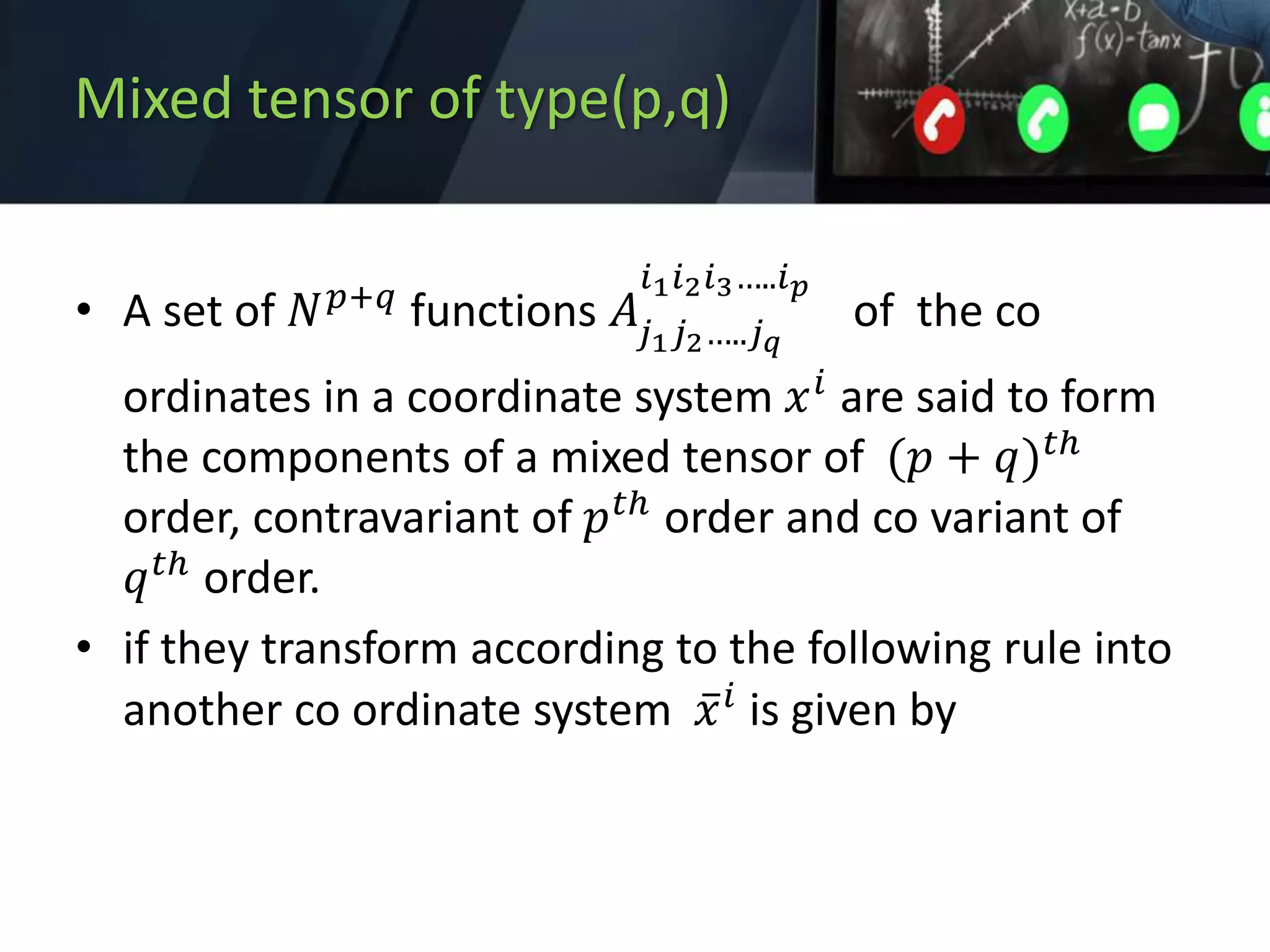
Mixed tensor of type(p,q)
• A set of 𝑁𝑝+𝑞
functions 𝐴𝑗1𝑗2…..𝑗𝑞
𝑖1𝑖2𝑖3…..𝑖𝑝
of the co
ordinates in a coordinate system 𝑥𝑖
are said to form
the components of a mixed tensor of (𝑝 + 𝑞)𝑡ℎ
order, contravariant of 𝑝𝑡ℎ order and co variant of
𝑞𝑡ℎ
order.
• if they transform according to the following rule into
another co ordinate system 𝑥𝑖
is given by
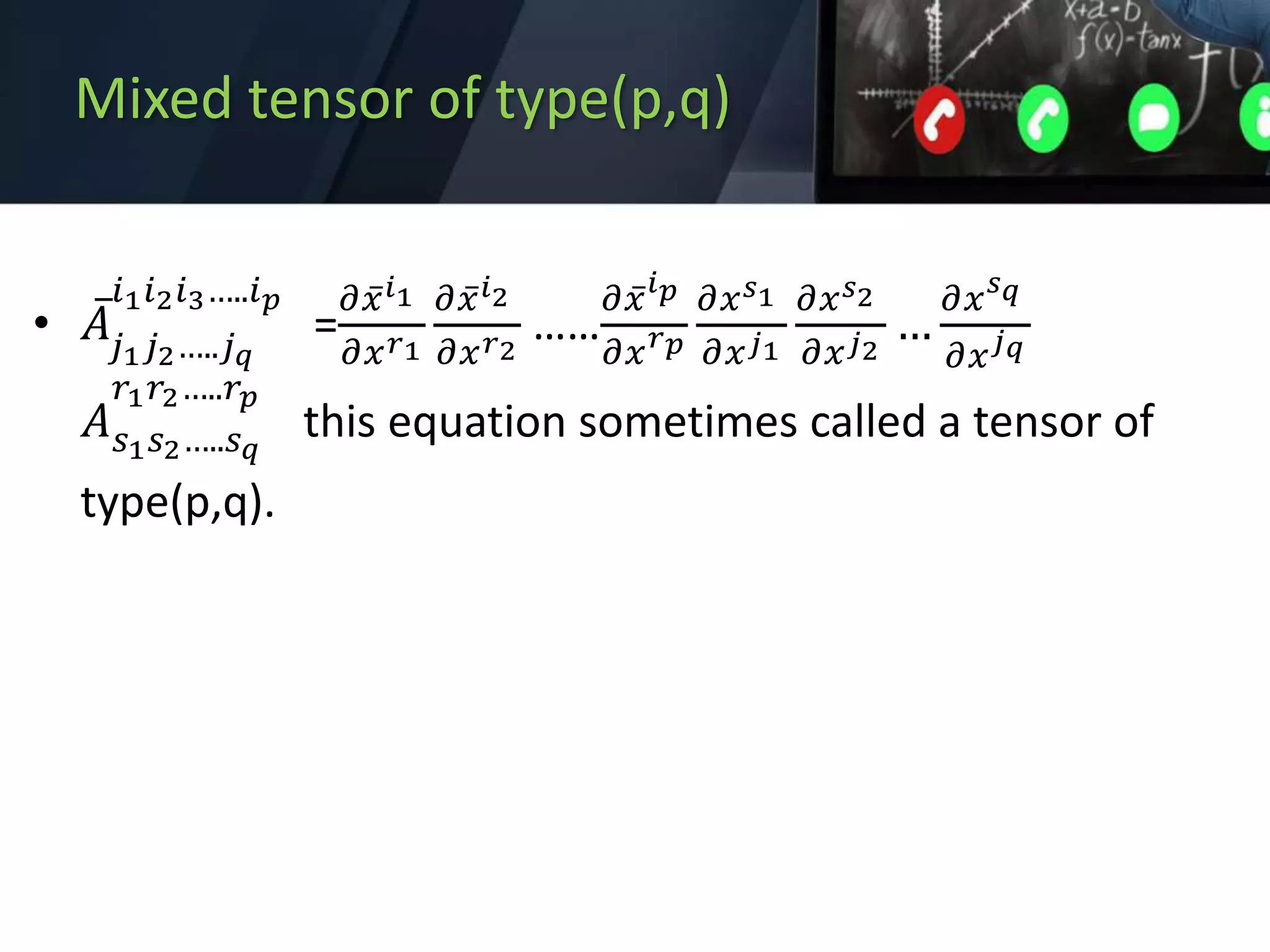
Mixed tensor of type(p,q)
• 𝐴𝑗1𝑗2…..𝑗𝑞
𝑖1𝑖2𝑖3…..𝑖𝑝
=
𝜕𝑥𝑖1
𝜕𝑥𝑟1
𝜕𝑥𝑖2
𝜕𝑥𝑟2
……
𝜕𝑥𝑖𝑝
𝜕𝑥𝑟𝑝
𝜕𝑥𝑠1
𝜕𝑥𝑗1
𝜕𝑥𝑠2
𝜕𝑥𝑗2
…
𝜕𝑥𝑠𝑞
𝜕𝑥𝑗𝑞
𝐴𝑠1𝑠2…..𝑠𝑞
𝑟1𝑟2…..𝑟𝑝
this equation sometimes called a tensor of
type(p,q).
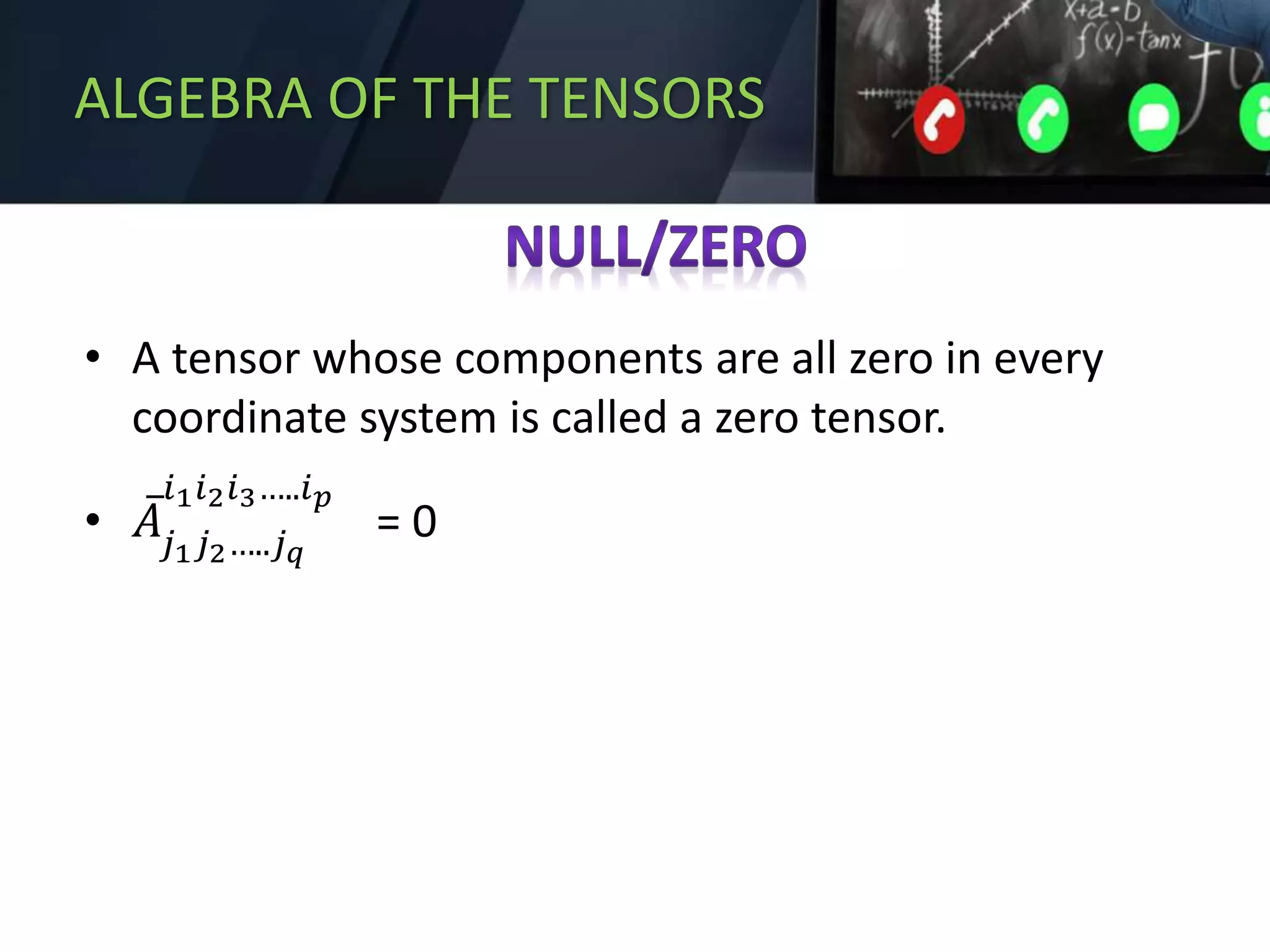
ALGEBRA OF THE TENSORS
• A tensor whose components are all zero in every
coordinate system is called a zero tensor.
• 𝐴𝑗1𝑗2…..𝑗𝑞
𝑖1𝑖2𝑖3…..𝑖𝑝
= 0
EQUALITY OF TWO TENSOR
• 𝐴𝑗1𝑗2…..𝑗𝑞
𝑖1𝑖2𝑖3…..𝑖𝑝
AND 𝐵𝑗1𝑗2…..𝑗𝑞
𝑖1𝑖2𝑖3…..𝑖𝑝
are the components of
two equal tensor of type( p+q) in the same
coordinate system, then
• 𝐴𝑗1𝑗2…..𝑗𝑞
𝑖1𝑖2𝑖3…..𝑖𝑝
= 𝐵𝑗1𝑗2…..𝑗𝑞
𝑖1𝑖2𝑖3…..𝑖𝑝
Hence the difference
𝑨𝒋𝟏𝒋𝟐…..𝒋𝒒
𝒊𝟏𝒊𝟐𝒊𝟑…..𝒊𝒑
- 𝑩𝒋𝟏𝒋𝟐…..𝒋𝒒
𝒊𝟏𝒊𝟐𝒊𝟑…..𝒊𝒑
are the components of a
zero tensor in the coordinate system 𝑥𝑖
.
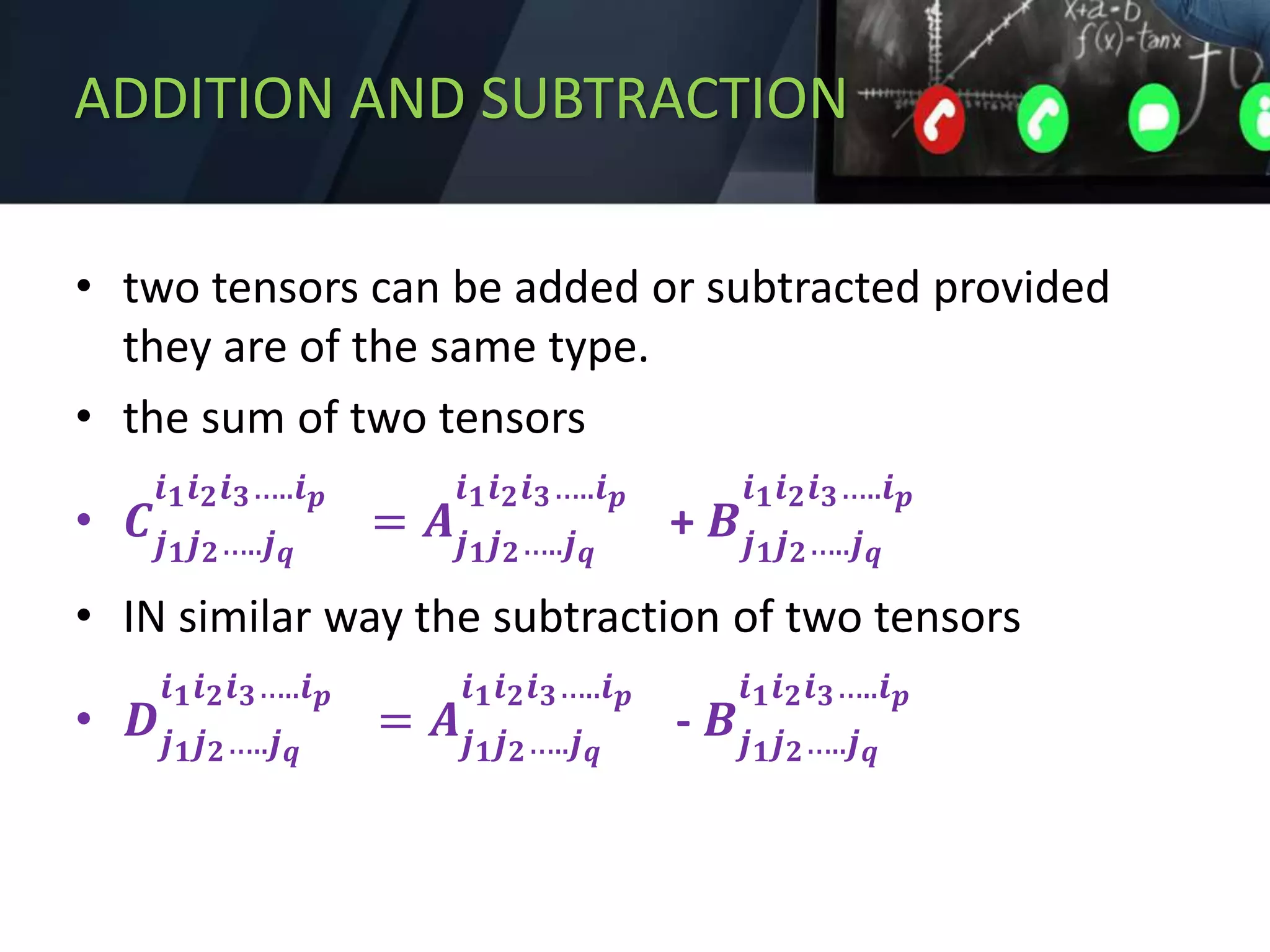
ADDITION AND SUBTRACTION
• two tensors can be added or subtracted provided
they are of the same type.
• the sum of two tensors
• 𝑪𝒋𝟏𝒋𝟐…..𝒋𝒒
𝒊𝟏𝒊𝟐𝒊𝟑…..𝒊𝒑
= 𝑨𝒋𝟏𝒋𝟐…..𝒋𝒒
𝒊𝟏𝒊𝟐𝒊𝟑…..𝒊𝒑
+ 𝑩𝒋𝟏𝒋𝟐…..𝒋𝒒
𝒊𝟏𝒊𝟐𝒊𝟑…..𝒊𝒑
• IN similar way the subtraction of two tensors
• 𝑫𝒋𝟏𝒋𝟐…..𝒋𝒒
𝒊𝟏𝒊𝟐𝒊𝟑…..𝒊𝒑
= 𝑨𝒋𝟏𝒋𝟐…..𝒋𝒒
𝒊𝟏𝒊𝟐𝒊𝟑…..𝒊𝒑
- 𝑩𝒋𝟏𝒋𝟐…..𝒋𝒒
𝒊𝟏𝒊𝟐𝒊𝟑…..𝒊𝒑
outer product of tensor
• 𝐴𝑘
𝑖𝑗
𝑎𝑛𝑑 𝐵𝑞
𝑝
• the tensors 𝐴𝑘
𝑖𝑗
𝑎𝑛𝑑 𝐵𝑞
𝑝
transform according to the
following equations
• 𝐶𝑘𝑞
𝑖𝑗𝑝
= 𝐴𝑘
𝑖𝑗
. 𝐵𝑞
𝑝
• 𝐶𝑘𝑞
𝑖𝑗𝑝
this shows is a tensor of contravariant rank 3,
co variant rank 2 and total 5.
• this is known as open or outer product or kroncker
delta product of two tensor.
CONTRACTION OF A TENSOR
• in a mixed tensor one covariant and one
contravariant suffixes are equal, the process is called
CONTRACTION.
CONTRACTION OF A TENSOR
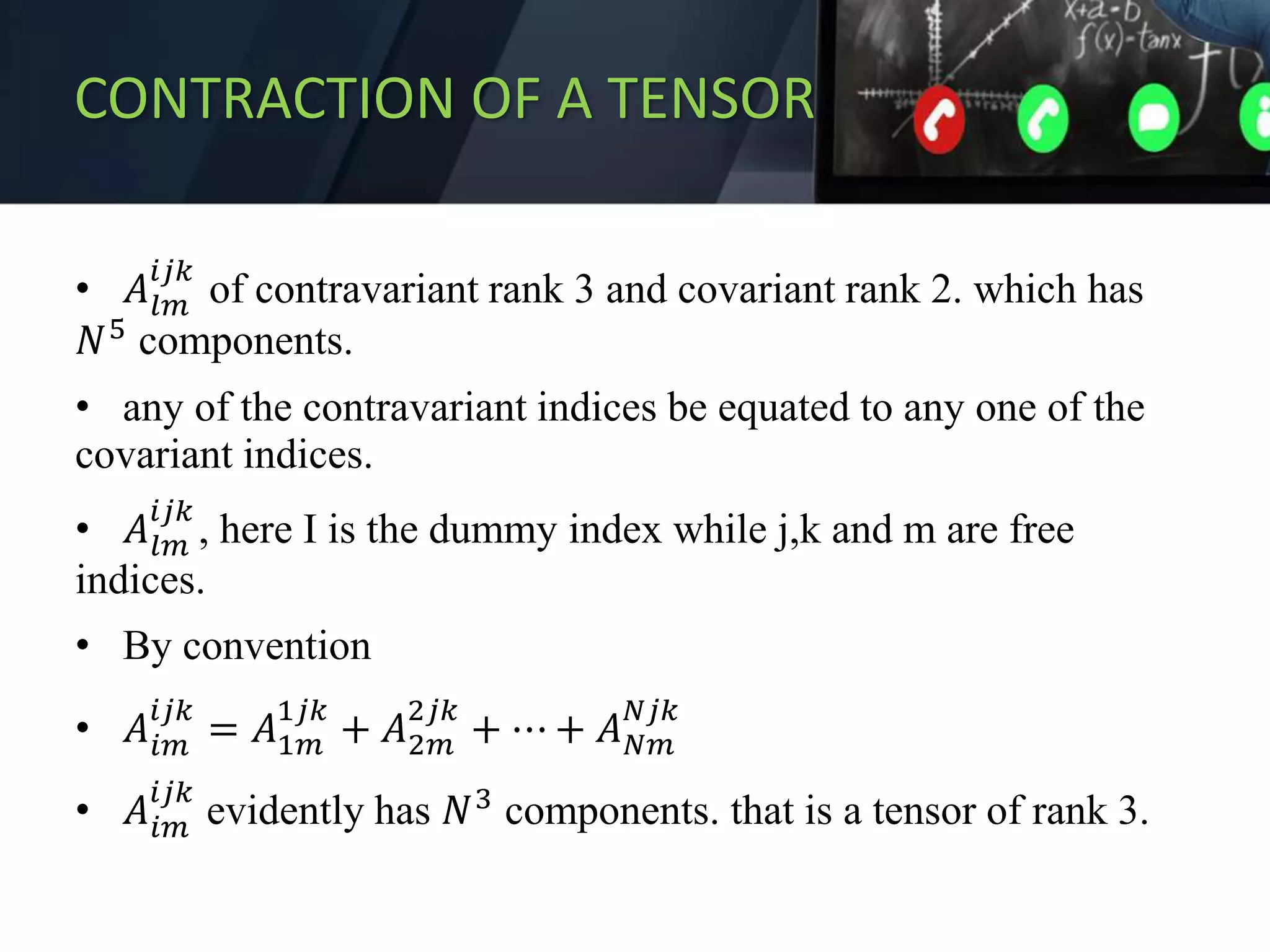
• 𝐴𝑙𝑚
𝑖𝑗𝑘
of contravariant rank 3 and covariant rank 2. which has
𝑁5
components.
• any of the contravariant indices be equated to any one of the
covariant indices.
• 𝐴𝑙𝑚
𝑖𝑗𝑘
, here I is the dummy index while j,k and m are free
indices.
• By convention
• 𝐴𝑖𝑚
𝑖𝑗𝑘
= 𝐴1𝑚
1𝑗𝑘
+ 𝐴2𝑚
2𝑗𝑘
+ ⋯ + 𝐴𝑁𝑚
𝑁𝑗𝑘
• 𝐴𝑖𝑚
𝑖𝑗𝑘
evidently has 𝑁3 components. that is a tensor of rank 3.
CONTRACTION OF A TENSOR
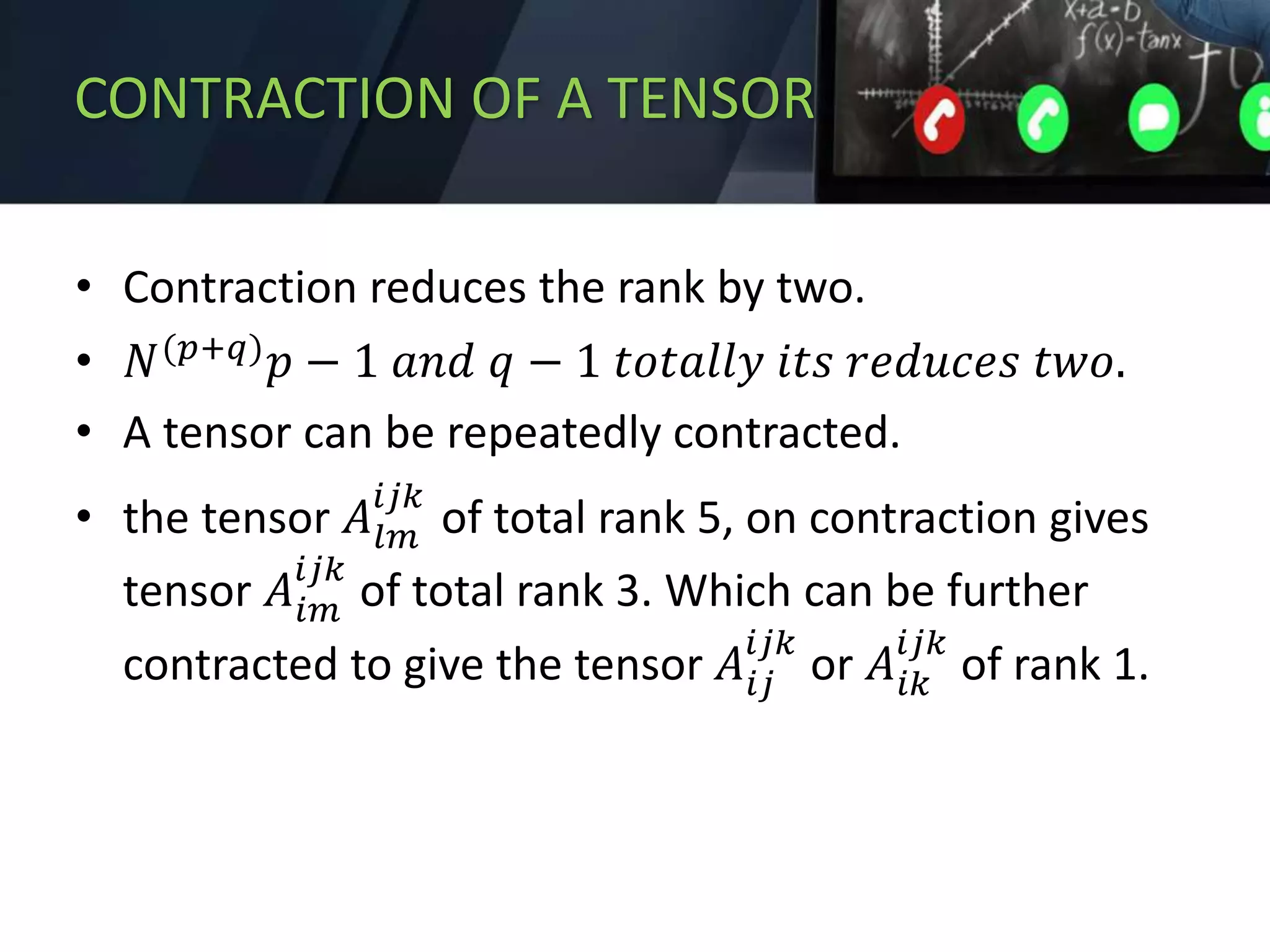
• Contraction reduces the rank by two.
• 𝑁(𝑝+𝑞)𝑝 − 1 𝑎𝑛𝑑 𝑞 − 1 𝑡𝑜𝑡𝑎𝑙𝑙𝑦 𝑖𝑡𝑠 𝑟𝑒𝑑𝑢𝑐𝑒𝑠 𝑡𝑤𝑜.
• A tensor can be repeatedly contracted.
• the tensor 𝐴𝑙𝑚
𝑖𝑗𝑘
of total rank 5, on contraction gives
tensor 𝐴𝑖𝑚
𝑖𝑗𝑘
of total rank 3. Which can be further
contracted to give the tensor 𝐴𝑖𝑗
𝑖𝑗𝑘
or 𝐴𝑖𝑘
𝑖𝑗𝑘
of rank 1.
SYMMETRIC TENSOR
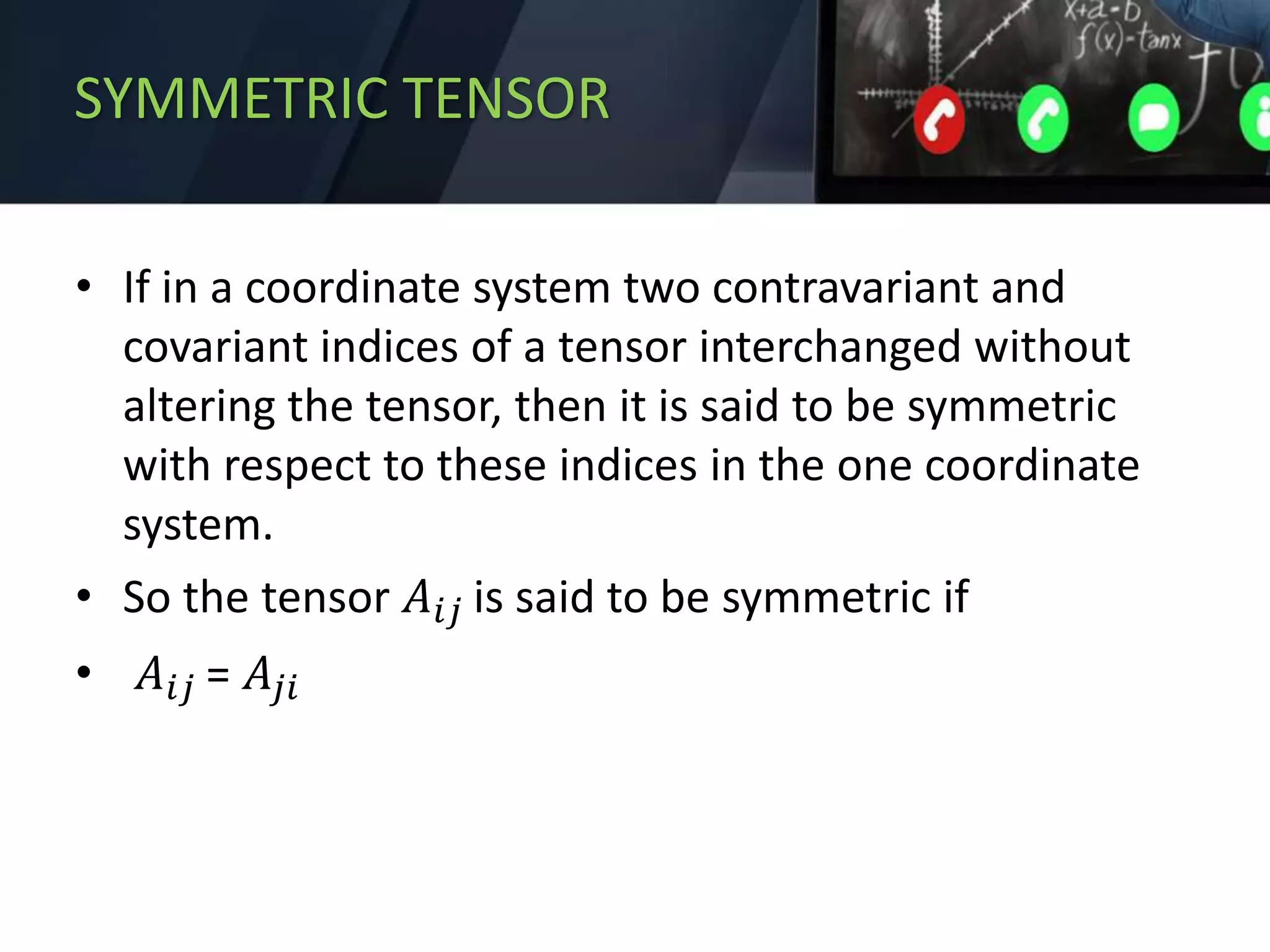
• If in a coordinate system two contravariant and
covariant indices of a tensor interchanged without
altering the tensor, then it is said to be symmetric
with respect to these indices in the one coordinate
system.
• So the tensor 𝐴𝑖𝑗 is said to be symmetric if
• 𝐴𝑖𝑗 = 𝐴𝑗𝑖
ANTI SYMMETRIC TENSOR OR
SKEW SYMMETRIC TENSOR
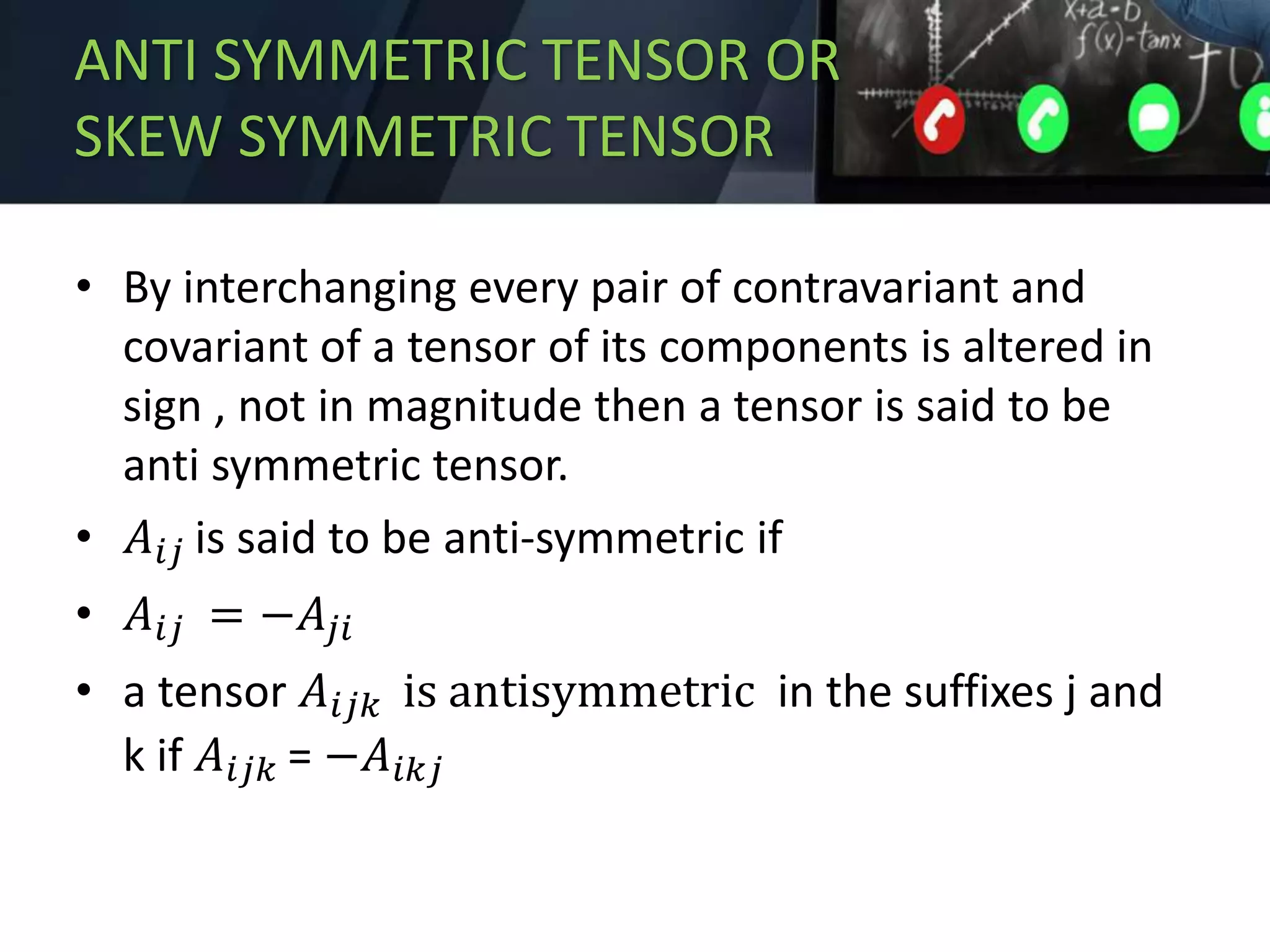
• By interchanging every pair of contravariant and
covariant of a tensor of its components is altered in
sign , not in magnitude then a tensor is said to be
anti symmetric tensor.
• 𝐴𝑖𝑗 is said to be anti-symmetric if
• 𝐴𝑖𝑗 = −𝐴𝑗𝑖
• a tensor 𝐴𝑖𝑗𝑘 is antisymmetric in the suffixes j and
k if 𝐴𝑖𝑗𝑘 = −𝐴𝑖𝑘𝑗
ALGEBRA OF TENSOR .pptx

ALGEBRA OF TENSOR .pptx

  • 2.
     Discrete versionof the delta function defined by  δ𝑖𝑗 = {1𝑓𝑜𝑟 𝑖=𝑗 0𝑓𝑜𝑟 𝑖≠𝑗  if the coordinates 𝑥1 , 𝑥2 , 𝑥3 , … … 𝑥𝑁 are independent then  𝜕𝑥𝑖 𝜕𝑥𝑗= {1𝑓𝑜𝑟 𝑖=𝑗 0𝑓𝑜𝑟 𝑖≠𝑗  𝜹𝒊 𝒊 = 𝜹𝟏 𝟏 + 𝜹𝟐 𝟐 + ⋯ + 𝜹𝑵 𝑵 = 𝟏 + 𝟏 + ⋯ + 𝟏(𝑵 𝒕𝒊𝒎𝒆𝒔) = 𝑵  𝜹𝒊 𝒊 =N
  • 3.
    CONTRAVARIANT VECTORS • Let𝐴𝑖 𝑏𝑒 a set of N functions of N co ordinates 𝑥1, 𝑥2, 𝑥3, … … 𝑥𝑁 in a given system (𝑥𝑖). • Then the quantities 𝐴𝑖 are said to form the components of a contra variant vector. • if these components transform according to the following rule on change of co ordinates system from 𝑥𝑖 to another system 𝑥𝑖 . 𝐴𝑖 = 𝜕 𝑥𝑖 𝜕𝑥𝑗 𝐴𝑗
  • 4.
    CONTRAVARIANT VECTORS • 𝐴𝑖 = 𝜕𝑥𝑖 𝜕𝑥𝑗 𝐴𝑗 multiply by 𝜕𝑥𝑝 𝜕 𝑥𝑖 • 𝜕𝑥𝑝 𝜕 𝑥𝑖 𝐴𝑖 = 𝜕𝑥𝑝 𝜕 𝑥𝑖 𝜕 𝑥𝑖 𝜕𝑥𝑗 𝐴𝑗 • 𝜕𝑥𝑝 𝜕 𝑥𝑖 𝐴𝑖 = 𝜕𝑥𝑝 𝜕𝑥𝑗 𝐴𝑗 • 𝝏𝒙𝒑 𝝏 𝒙𝒊 𝑨𝒊 = 𝜹𝒋 𝒑 𝑨𝒋 =𝑨𝒑
  • 5.
    CONTRAVARIANT VECTORS • Let𝐴𝑖𝑗 𝑏𝑒 a set of N functions of N co ordinates 𝑥1, 𝑥2, 𝑥3, … … 𝑥𝑁 in a given system (𝑥𝑖). • Then the quantities 𝐴𝑖𝑗 are said to form the components of a contra variant vector of order two. • if these components transform according to the following rule on change of co ordinates system from 𝑥𝑖 to another system 𝑥𝑖 . 𝑨𝒊𝒋 = 𝝏 𝒙𝒊 𝝏𝒙𝒑 𝝏 𝒙𝒋 𝝏𝒙𝒒 𝑨𝒋
  • 6.
    • 𝑨𝒊𝒋 = 𝝏 𝒙𝒊 𝝏𝒙𝒑 𝝏𝒙𝒋 𝝏𝒙𝒒 𝑨𝒋 Multiply by 𝝏𝒙𝒓 𝝏 𝒙𝒊 𝝏𝒙𝒔 𝝏 𝒙𝒋 • 𝝏𝒙𝒓 𝝏 𝒙𝒊 𝝏𝒙𝒔 𝝏 𝒙𝒋 𝑨𝒊𝒋 = 𝝏𝒙𝒓 𝝏 𝒙𝒊 𝝏𝒙𝒔 𝝏 𝒙𝒋 𝝏 𝒙𝒊 𝝏𝒙𝒑 𝝏 𝒙𝒋 𝝏𝒙𝒒 𝑨𝒋 • 𝝏𝒙𝒓 𝝏 𝒙𝒊 𝝏𝒙𝒔 𝝏 𝒙𝒋 𝑨𝒊𝒋 = 𝝏𝒙𝒓 𝝏𝒙𝒑 𝝏𝒙𝒔 𝝏𝒙𝒒 𝑨𝒋 • 𝝏𝒙𝒓 𝝏 𝒙𝒊 𝝏𝒙𝒔 𝝏 𝒙𝒋 𝑨𝒊𝒋 = 𝜹𝒑 𝒓𝜹𝒒 𝒔 𝑨𝒑𝒒 = 𝑨𝒓𝒔 CONTRAVARIANT VECTORS
  • 7.
    CONTRAVARIANT VECTORS • Let𝐴𝑖 𝑏𝑒 a set of N functions of N co ordinates 𝑥1, 𝑥2, 𝑥3, … … 𝑥𝑁 in a given system (𝑥𝑖). • Then the quantities 𝐴𝑖 𝑝 are said to form the components of a contra variant vector. • if these components transform according to the following rule on change of co ordinates system from 𝑥𝑖 to another system 𝑥𝑖. 𝐴𝑖 = 𝜕 𝑥𝑖 𝜕𝑥𝑗 𝐴𝑗
  • 8.
    CO VARIANT VECTORS •Let 𝐴𝑖 𝑏𝑒 a set of N functions of N co ordinates 𝑥1, 𝑥2, 𝑥3, … … 𝑥𝑁 in a given system (𝑥𝑖). • Then the quantities 𝐴𝑖are said to form the components of a contra variant vector. • if these components transform according to the following rule on change of co ordinates system from 𝑥𝑖 to another system 𝑥𝑖. 𝐴𝑖 = 𝜕𝑥𝑗 𝜕𝑥𝑖 𝐴𝑗
  • 9.
    CO VARIANT VECTORS • 𝝏𝒙𝒊 𝝏𝒙𝒑 𝐴𝑖 = 𝝏 𝒙𝒊 𝝏𝒙𝒑 𝜕𝑥𝑗 𝜕𝑥𝑖 𝐴𝑗=𝜹𝒑 𝒋 𝐴𝑝=𝐴𝑝 • 𝝏 𝒙𝒊 𝝏𝒙𝒓 𝝏 𝒙𝒋 𝝏𝒙𝒔 𝑨𝒊𝒋 = 𝑨𝒓𝒔
  • 10.
    Mixed tensor oftype(p,q) • A set of 𝑁𝑝+𝑞 functions 𝐴𝑗1𝑗2…..𝑗𝑞 𝑖1𝑖2𝑖3…..𝑖𝑝 of the co ordinates in a coordinate system 𝑥𝑖 are said to form the components of a mixed tensor of (𝑝 + 𝑞)𝑡ℎ order, contravariant of 𝑝𝑡ℎ order and co variant of 𝑞𝑡ℎ order. • if they transform according to the following rule into another co ordinate system 𝑥𝑖 is given by
  • 11.
    Mixed tensor oftype(p,q) • 𝐴𝑗1𝑗2…..𝑗𝑞 𝑖1𝑖2𝑖3…..𝑖𝑝 = 𝜕𝑥𝑖1 𝜕𝑥𝑟1 𝜕𝑥𝑖2 𝜕𝑥𝑟2 …… 𝜕𝑥𝑖𝑝 𝜕𝑥𝑟𝑝 𝜕𝑥𝑠1 𝜕𝑥𝑗1 𝜕𝑥𝑠2 𝜕𝑥𝑗2 … 𝜕𝑥𝑠𝑞 𝜕𝑥𝑗𝑞 𝐴𝑠1𝑠2…..𝑠𝑞 𝑟1𝑟2…..𝑟𝑝 this equation sometimes called a tensor of type(p,q).
  • 12.
    ALGEBRA OF THETENSORS • A tensor whose components are all zero in every coordinate system is called a zero tensor. • 𝐴𝑗1𝑗2…..𝑗𝑞 𝑖1𝑖2𝑖3…..𝑖𝑝 = 0
  • 13.
    EQUALITY OF TWOTENSOR • 𝐴𝑗1𝑗2…..𝑗𝑞 𝑖1𝑖2𝑖3…..𝑖𝑝 AND 𝐵𝑗1𝑗2…..𝑗𝑞 𝑖1𝑖2𝑖3…..𝑖𝑝 are the components of two equal tensor of type( p+q) in the same coordinate system, then • 𝐴𝑗1𝑗2…..𝑗𝑞 𝑖1𝑖2𝑖3…..𝑖𝑝 = 𝐵𝑗1𝑗2…..𝑗𝑞 𝑖1𝑖2𝑖3…..𝑖𝑝 Hence the difference 𝑨𝒋𝟏𝒋𝟐…..𝒋𝒒 𝒊𝟏𝒊𝟐𝒊𝟑…..𝒊𝒑 - 𝑩𝒋𝟏𝒋𝟐…..𝒋𝒒 𝒊𝟏𝒊𝟐𝒊𝟑…..𝒊𝒑 are the components of a zero tensor in the coordinate system 𝑥𝑖 .
  • 14.
    ADDITION AND SUBTRACTION •two tensors can be added or subtracted provided they are of the same type. • the sum of two tensors • 𝑪𝒋𝟏𝒋𝟐…..𝒋𝒒 𝒊𝟏𝒊𝟐𝒊𝟑…..𝒊𝒑 = 𝑨𝒋𝟏𝒋𝟐…..𝒋𝒒 𝒊𝟏𝒊𝟐𝒊𝟑…..𝒊𝒑 + 𝑩𝒋𝟏𝒋𝟐…..𝒋𝒒 𝒊𝟏𝒊𝟐𝒊𝟑…..𝒊𝒑 • IN similar way the subtraction of two tensors • 𝑫𝒋𝟏𝒋𝟐…..𝒋𝒒 𝒊𝟏𝒊𝟐𝒊𝟑…..𝒊𝒑 = 𝑨𝒋𝟏𝒋𝟐…..𝒋𝒒 𝒊𝟏𝒊𝟐𝒊𝟑…..𝒊𝒑 - 𝑩𝒋𝟏𝒋𝟐…..𝒋𝒒 𝒊𝟏𝒊𝟐𝒊𝟑…..𝒊𝒑
  • 15.
    outer product oftensor • 𝐴𝑘 𝑖𝑗 𝑎𝑛𝑑 𝐵𝑞 𝑝 • the tensors 𝐴𝑘 𝑖𝑗 𝑎𝑛𝑑 𝐵𝑞 𝑝 transform according to the following equations • 𝐶𝑘𝑞 𝑖𝑗𝑝 = 𝐴𝑘 𝑖𝑗 . 𝐵𝑞 𝑝 • 𝐶𝑘𝑞 𝑖𝑗𝑝 this shows is a tensor of contravariant rank 3, co variant rank 2 and total 5. • this is known as open or outer product or kroncker delta product of two tensor.
  • 16.
    CONTRACTION OF ATENSOR • in a mixed tensor one covariant and one contravariant suffixes are equal, the process is called CONTRACTION.
  • 17.
    CONTRACTION OF ATENSOR • 𝐴𝑙𝑚 𝑖𝑗𝑘 of contravariant rank 3 and covariant rank 2. which has 𝑁5 components. • any of the contravariant indices be equated to any one of the covariant indices. • 𝐴𝑙𝑚 𝑖𝑗𝑘 , here I is the dummy index while j,k and m are free indices. • By convention • 𝐴𝑖𝑚 𝑖𝑗𝑘 = 𝐴1𝑚 1𝑗𝑘 + 𝐴2𝑚 2𝑗𝑘 + ⋯ + 𝐴𝑁𝑚 𝑁𝑗𝑘 • 𝐴𝑖𝑚 𝑖𝑗𝑘 evidently has 𝑁3 components. that is a tensor of rank 3.
  • 18.
    CONTRACTION OF ATENSOR • Contraction reduces the rank by two. • 𝑁(𝑝+𝑞)𝑝 − 1 𝑎𝑛𝑑 𝑞 − 1 𝑡𝑜𝑡𝑎𝑙𝑙𝑦 𝑖𝑡𝑠 𝑟𝑒𝑑𝑢𝑐𝑒𝑠 𝑡𝑤𝑜. • A tensor can be repeatedly contracted. • the tensor 𝐴𝑙𝑚 𝑖𝑗𝑘 of total rank 5, on contraction gives tensor 𝐴𝑖𝑚 𝑖𝑗𝑘 of total rank 3. Which can be further contracted to give the tensor 𝐴𝑖𝑗 𝑖𝑗𝑘 or 𝐴𝑖𝑘 𝑖𝑗𝑘 of rank 1.
  • 19.
    SYMMETRIC TENSOR • Ifin a coordinate system two contravariant and covariant indices of a tensor interchanged without altering the tensor, then it is said to be symmetric with respect to these indices in the one coordinate system. • So the tensor 𝐴𝑖𝑗 is said to be symmetric if • 𝐴𝑖𝑗 = 𝐴𝑗𝑖
  • 20.
    ANTI SYMMETRIC TENSOROR SKEW SYMMETRIC TENSOR • By interchanging every pair of contravariant and covariant of a tensor of its components is altered in sign , not in magnitude then a tensor is said to be anti symmetric tensor. • 𝐴𝑖𝑗 is said to be anti-symmetric if • 𝐴𝑖𝑗 = −𝐴𝑗𝑖 • a tensor 𝐴𝑖𝑗𝑘 is antisymmetric in the suffixes j and k if 𝐴𝑖𝑗𝑘 = −𝐴𝑖𝑘𝑗