MAT 163


Surds, Indices, and Logarithms
Radical
Definition of the Radical

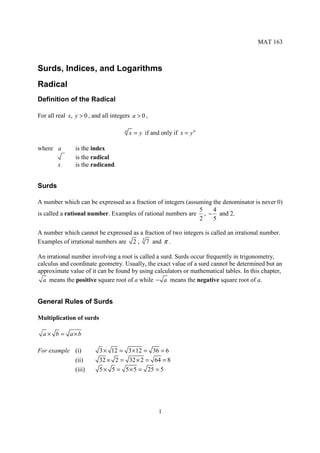
For all real x, y > 0 , and all integers a > 0 ,

                                      a
                                          x = y if and only if x = y a

where a         is the index
                is the radical
        x       is the radicand.


Surds

A number which can be expressed as a fraction of integers (assuming the denominator is never 0)
                                                               5    4
is called a rational number. Examples of rational numbers are , − and 2.
                                                               2    5

A number which cannot be expressed as a fraction of two integers is called an irrational number.
Examples of irrational numbers are 2 , 3 7 and π .

An irrational number involving a root is called a surd. Surds occur frequently in trigonometry,
calculus and coordinate geometry. Usually, the exact value of a surd cannot be determined but an
approximate value of it can be found by using calculators or mathematical tables. In this chapter,
  a means the positive square root of a while − a means the negative square root of a.


General Rules of Surds

Multiplication of surds

  a × b = a×b

For example (i)           3 × 12 = 3 ×12 = 36 = 6
                (ii)      32 × 2 = 32 × 2 = 64 = 8
                (iii)     5 × 5 = 5 × 5 = 25 = 5


                                                      1
MAT 163


Division of surds

             a   a
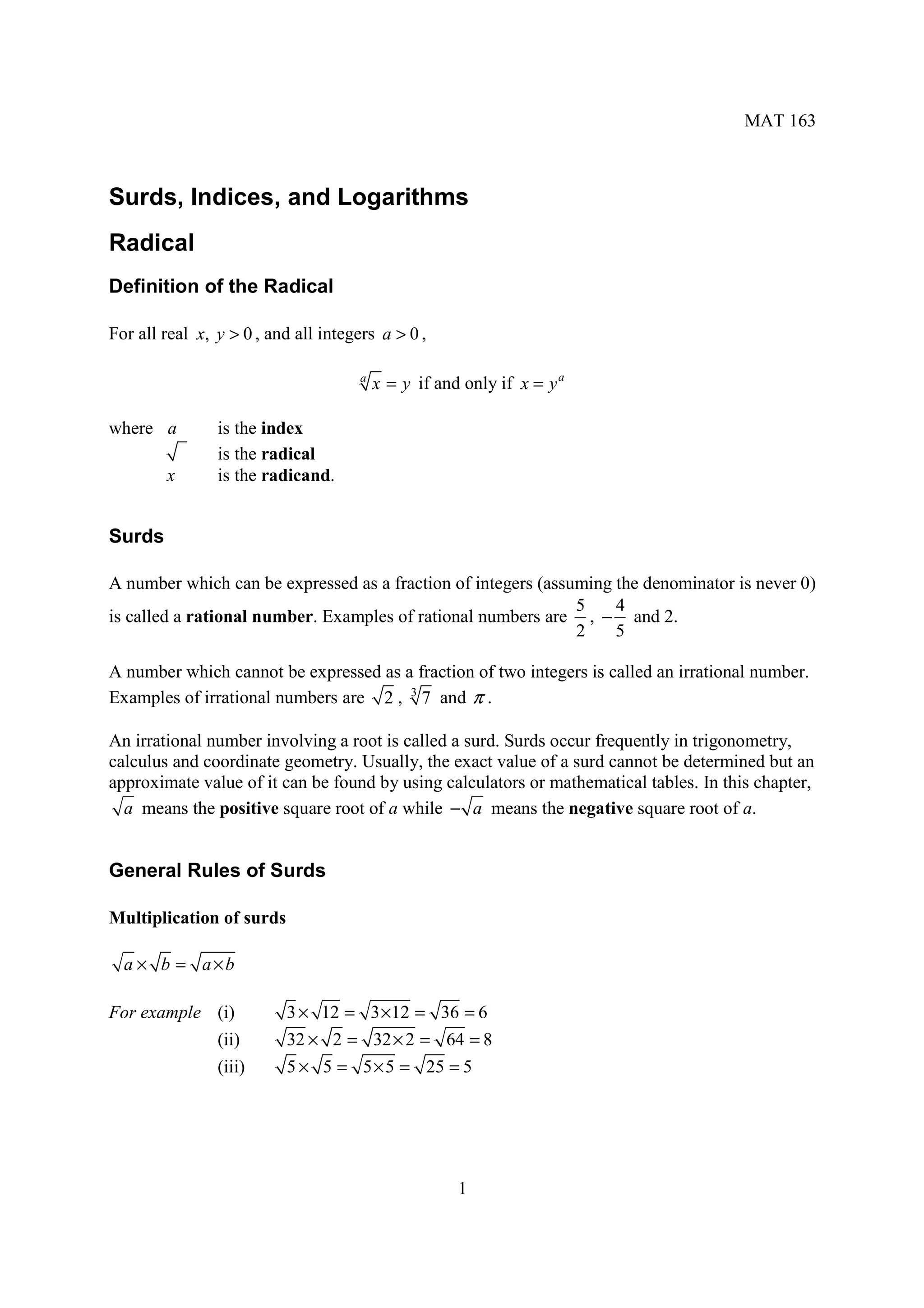
  a÷ b=        =
             b   b
                                    72
For example (i)            72 ÷ 2 =    = 36 = 6
                                     2
                                    45
              (ii)         45 ÷ 5 =    = 9 =3
                                    5

These rules are useful for simplifying two or more surds of for combining them into one single
surd.

Note, however, that 3 + 6 ≠ 3 + 6 and 6 − 2 ≠ 6 − 2 which can be easily checked by a
calculator; and, therefore, in general a + b ≠ a + b and a − b ≠ a − b .

Example 1
(i)  3 5 + 5 = (3 + 1) 5                      (ii)       40 = 4 ×10 = 4 × 10
                    =4 5                                   = 2 10

Example 2
Simplify      (i)          243 − 12 + 2 75
              (ii)         50 + 8 + 32

Solution:
(i)       243 − 12 + 2 75 = 81× 3 − 4 × 3 + 2 25 × 3
                                = 81 × 3 − 4 × 3 + 2 25 × 3
                                = 9 3 − 2 × 3 + 10 × 3
                                = (9 − 2 + 10) 3
                                = 17 3

(ii)     50 + 8 + 32 = 25 × 2 + 4 × 2 + 16 × 2
                           = 25 × 2 + 4 × 2 + 16 × 2
                           = 5× 2 + 2× 2 + 4× 2
                           = (5 + 2 + 4) 2
                           = 11 2

Try This 1
Simplify      (i)          27            (ii) 28 − 175 + 112        (iii)      5 × 125 × 8


                                                     2
MAT 163


Rationalization of the Denominator
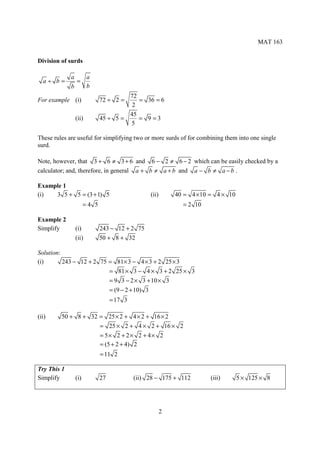
                                                      3
When a fraction has a surd in its denominator, e.g.      , it is usual to eliminate the surd in the
                                                       2
denominator. In fact, the writing of surds in the denominators of fractions should be avoided.
The process of removing this surd is called rationalizing of the denominator.

  m + n and m − n are specially related surds known as conjugate surds. The product of
conjugate surds is always a rational number.

                          ( m + n )( m − n ) = ( m )2 − ( n ) 2 = m − n

For example     ( 9 + 5)( 9 − 5) = ( 9)2 − ( 5) 2 = 9 − 5 = 4
                ( 7 + 3)( 7 − 3) = ( 7)2 − ( 3)2 = 7 − 3 = 4

Example 3                                              Example 4
         5                                                             4
Simplify    .                                          Simplify            .
          3                                                           7+ 3

Solution:                                              Solution:
 5     5    3                                              4        4     7− 3
    =     ×                                                      =      ×
  3     3   3                                            7+ 3      7+ 3   7− 3
        5 3                                                        4( 7 − 3)
    =                                                             =
         3                                                            7−3
                                                                  = 7− 3

Example 5
                                                                1    1
Simplify, without using tables or calculators, the value of       +     .
                                                              3− 2 3+ 2

Solution:
   1      1     (3 + 2)        (3 − 2)
       +    =             +
3 − 2 3 + 2 (3 − 2)(3 + 2) (3 + 2)(3 − 2)
                   (3 + 2) + (3 − 2)
                 =
                         9−2
                   6
                 =
                   7


                                                  3
MAT 163


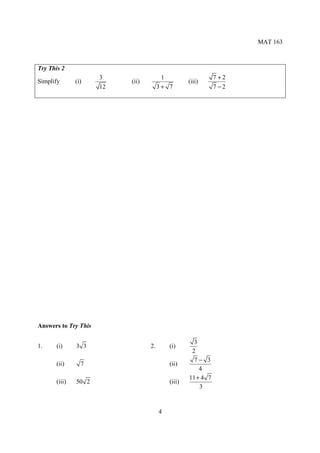
Try This 2
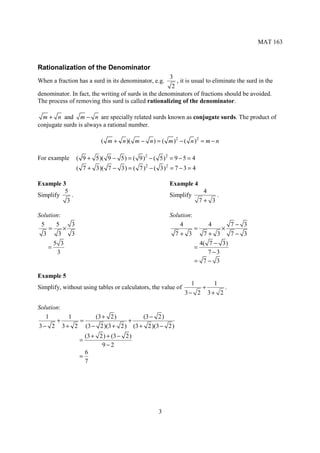
                      3                 1                     7 +2
Simplify       (i)         (ii)                    (iii)
                      12               3+ 7                   7 −2


Answers to Try This

                                                     3
1.     (i)     3 3                2.       (i)
                                                    2
                                                     7− 3
       (ii)      7                         (ii)
                                                       4
                                                   11 + 4 7
       (iii)   50 2                        (iii)
                                                       3


                                       4
MAT 163


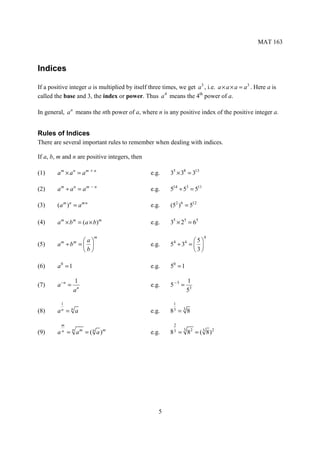
Indices

If a positive integer a is multiplied by itself three times, we get a3 , i.e. a × a × a = a 3 . Here a is
called the base and 3, the index or power. Thus a 4 means the 4th power of a.

In general, a n means the nth power of a, where n is any positive index of the positive integer a.


Rules of Indices
There are several important rules to remember when dealing with indices.

If a, b, m and n are positive integers, then

(1)     am × an = am + n                         e.g.     35 × 38 = 313

(2)     am ÷ an = am − n                         e.g.     514 ÷ 53 = 511

(3)     (a m )n = a m n                          e.g.     (52 )6 = 512

(4)     a m × b m = ( a × b) m                   e.g.     35 × 25 = 65

                           m                                               4
               a                                               5
(5)     a ÷b =  
          m        m
                                                 e.g.     5 ÷3 =  
                                                           4       4

               b                                               3

(6)     a0 = 1                                   e.g.     50 = 1

                 1                                                 1
(7)     a−n =                                    e.g.     5 −3 =
                 an                                                53

         1                                                 1
(8)     an    = a
               n
                                                 e.g.     83    =38

         m                                                  2
(9)     an    = a = ( a)
                n      m   n     m
                                                 e.g.     8 3   = 3 82 = ( 3 8)2


                                                     5
MAT 163


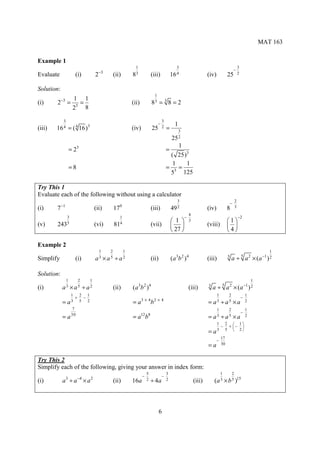
Example 1
                                                             1                                 3                                              3
                                                                                                                                          −
                                      −3
Evaluate           (i)            2            (ii)         83             (iii)            16 4                  (iv)            25          2


Solution:
                                                                            1
            −3     1 1
(i)     2        = 3=                                       (ii)           83     =38=2
                  2   8

           3                                                                        3
                                                                                −             1
(iii)   16 4     = ( 16)
                       4     3
                                                            (iv)           25       2   =      3
                                                                                            25 2
                                                                                            1
                 = 23                                                                   =
                                                                                         ( 25)3
                                                                                          1   1
                 =8                                                                     = 3=
                                                                                         5 125

Try This 1
Evaluate each of the following without using a calculator
                                                                                               3                                          2
                                                                                                                                      −
            −1                                      0                                                                                     3
(i)     7                         (ii)         17                          (iii)            49 2                  (iv)            8
                                                                                                      4
            3                                    1                                                  −                                         −2
            5                                                                                1     3                            1
(v)     243                       (vi)         814                         (vii)                                (viii)           
                                                                                             27                                 4

Example 2
                                      1    2            1                                                                                                    1
Simplify           (i)            a3 × a5 ÷ a2                             (ii)             (a 3b 2 )4            (iii)           3
                                                                                                                                      a ÷ 5 a 2 × ( a −1 ) 2

Solution:
             1      2         1                                                                                                                  1
                                                                                                                                              −1 2
(i)         a3   ×a 5      ÷ a2                (ii)              3 2 4
                                                            (a b )                                   (iii)        3
                                                                                                                      a÷ a   5    2
                                                                                                                                          × (a )
                  1 2 1                                                                                                1        2                     1
                   + −                                                                                                                            −
                                                                   3×4 2×4
            =    a3 5 2                                     =a             b                                      =   a3     ÷ a5         ×a          2
                  7                                                                                                    1        2                     1
                                                                                                                                                  −
            =a    30
                                                            =a b   12 8
                                                                                                                  =   a3     ÷ a5         ×a          2
                                                                                                                          1 2  1
                                                                                                                           − + − 
                                                                                                                  =a      3 5  2

                                                                                                                             17
                                                                                                                         −
                                                                                                                  =a         30


Try This 2
Simplify each of the following, giving your answer in index form:
                                                                       5                3                                    1        2
                                                                   −                −
(i)         a 3 ÷ a −4 × a 2                   (ii)         16a        2   ÷ 4a         2                 (iii)       (a 3 × b 5 )15


                                                                                  6
MAT 163


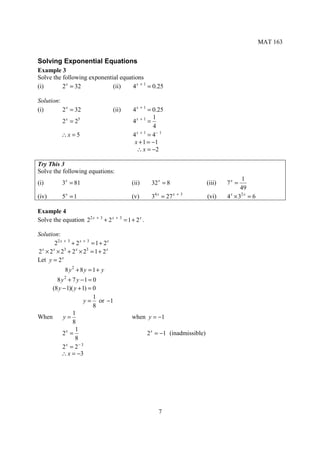
Solving Exponential Equations
Example 3
Solve the following exponential equations
(i)       2 x = 32           (ii)    4 x + 1 = 0.25

Solution:
(i)       2 x = 32                      (ii)   4 x + 1 = 0.25
                                                         1
            2 x = 25                           4x + 1 =
                                                         4
                                                 x +1
            ∴x = 5                             4       = 4− 1
                                                x + 1 = −1
                                                 ∴ x = −2

Try This 3
Solve the following equations:
                                                                                             1
(i)         3x = 81                            (ii)    32 x = 8                 (iii)   7x =
                                                                                             49
(iv)        5x = 1                             (v)     34 x = 27 x + 3          (vi)    4 × 32 x = 6
                                                                                         x


Example 4
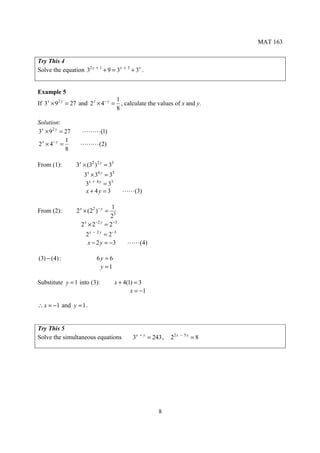
Solve the equation 22 x + 3 + 2 x + 3 = 1 + 2 x .

Solution:
         22 x + 3 + 2 x + 3 = 1 + 2 x
2 x × 2 x × 23 + 2 x × 23 = 1 + 2 x
Let y = 2 x
              8 y2 + 8 y = 1 + y
       8 y2 + 7 y −1 = 0
     (8 y − 1)( y + 1) = 0
                         1
                     y = or −1
                         8
               1
When      y=                                   when y = −1
               8
                1
          2x =                                        2 x = −1 (inadmissible)
                8
          2 = 2− 3
           x

         ∴ x = −3


                                                          7
MAT 163


Try This 4
Solve the equation 32 x + 1 + 9 = 3x + 3 + 3x .


Example 5
                                  1
If 3x × 92 y = 27 and 2 x × 4− y = , calculate the values of x and y.
                                  8

Solution:
3x × 92 y = 27     ⋯⋯⋯ (1)
             1
2 x × 4− y =       ⋯⋯⋯ (2)
             8

From (1):        3x × (32 ) 2 y = 33
                    3x × 34 y = 33
                     3x + 4 y = 33
                     x + 4y = 3           ⋯⋯ (3)

                                     1
From (2):        2 x × (22 )− y =
                                    23
                   2 x × 2 −2 y   = 2−3
                     2 x − 2 y = 2 −3
                      x − 2 y = −3          ⋯⋯ (4)

(3) − (4) :                6y = 6
                            y =1

Substitute y = 1 into (3):             x + 4(1) = 3
                                              x = −1

∴ x = −1 and y = 1 .


Try This 5
Solve the simultaneous equations              3x + y = 243 ,   22 x − 5 y = 8


                                                         8
MAT 163


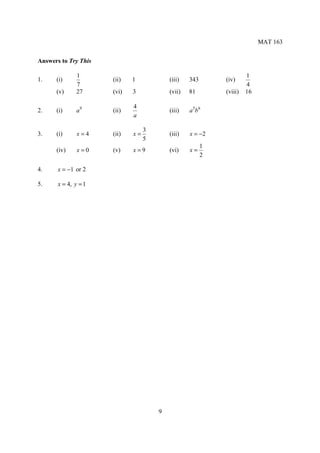
Answers to Try This

              1                                                      1
1.    (i)             (ii)   1            (iii)   343       (iv)
              7                                                      4
      (v)     27      (vi)   3            (vii)   81        (viii)   16

                             4
2.    (i)     a9      (ii)                (iii)   a 5b 6
                             a

                                  3
3.    (i)      x=4    (ii)   x=           (iii)   x = −2
                                  5
                                                        1
      (iv)     x=0    (v)    x=9          (vi)    x=
                                                        2

4.     x = −1 or 2

5.     x = 4, y = 1


                                      9
MAT 163


Logarithms
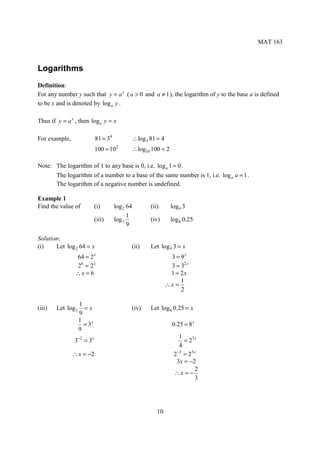
Definition:
For any number y such that y = a x ( a > 0 and a ≠ 1 ), the logarithm of y to the base a is defined
to be x and is denoted by log a y .

Thus if y = a x , then log a y = x

For example,                 81 = 34          ∴ log 3 81 = 4
                             100 = 10   2
                                              ∴ log10 100 = 2

Note: The logarithm of 1 to any base is 0, i.e. log a 1 = 0 .
      The logarithm of a number to a base of the same number is 1, i.e. log a a = 1 .
      The logarithm of a negative number is undefined.

Example 1
Find the value of            (i)       log 2 64       (ii)       log9 3
                                             1
                             (iii)     log 3          (iv)       log8 0.25
                                             9

Solution:
(i)    Let log 2 64 = x                       (ii)    Let log 9 3 = x
                64 = 2       x
                                                                3 = 9x
                26 = 2 x                                        3 = 32 x
                ∴x = 6                                          1 = 2x
                                                                    1
                                                               ∴x =
                                                                    2

                    1
(iii)   Let log 3     =x                      (iv)    Let log8 0.25 = x
                    9
                    1
                      = 3x                                       0.25 = 8 x
                    9
                                                                    1
               3−2 = 3x                                               = 23 x
                                                                    4
                                                                   −2
               ∴ x = −2                                           2 = 23 x
                                                                   3x = −2
                                                                           2
                                                                  ∴x = −
                                                                           3


                                                         10
MAT 163


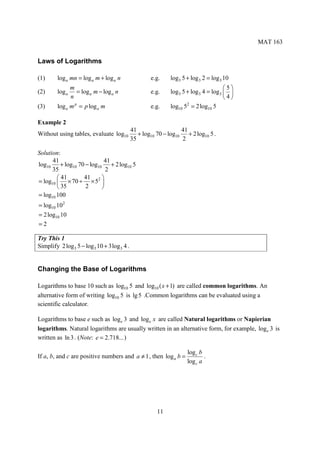
Laws of Logarithms

(1)      log a mn = log a m + log a n                e.g.    log3 5 + log 3 2 = log 3 10
                 m                                                                    5
(2)      log a     = log a m − log a n               e.g.    log3 5 + log 3 4 = log 3  
                 n                                                                    4
(3)      log a m p = p log a m                       e.g.    log10 5 = 2 log10 5
                                                                    2


Example 2
                                             41                   41
Without using tables, evaluate log10            + log10 70 − log10 + 2 log10 5 .
                                             35                   2

Solution:
      41                     41
log10     + log10 70 − log10 + 2 log10 5
      35                      2
         41        41      
= log10  × 70 ÷ × 52 
         35         2      
= log10 100
= log10 102
= 2 log10 10
=2

Try This 1
Simplify 2 log 3 5 − log 3 10 + 3log 3 4 .


Changing the Base of Logarithms

Logarithms to base 10 such as log10 5 and log10 ( x + 1) are called common logarithms. An
alternative form of writing log10 5 is lg 5 .Common logarithms can be evaluated using a
scientific calculator.

Logarithms to base e such as log e 3 and log e x are called Natural logarithms or Napierian
logarithms. Natural logarithms are usually written in an alternative form, for example, log e 3 is
written as ln 3 . (Note: e = 2.718... )

                                                                    log c b
If a, b, and c are positive numbers and a ≠ 1 , then log a b =              .
                                                                    log c a


                                                        11
MAT 163


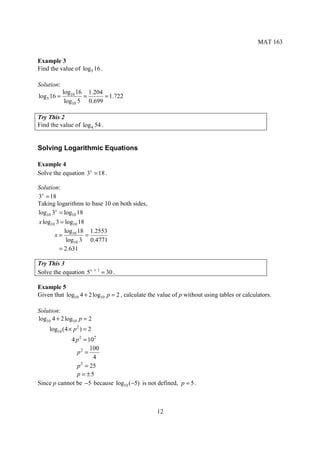
Example 3
Find the value of log5 16 .

Solution:
            log10 16 1.204
log5 16 =           =      = 1.722
             log10 5 0.699

Try This 2
Find the value of log 4 54 .


Solving Logarithmic Equations

Example 4
Solve the equation 3x = 18 .

Solution:
3x = 18
Taking logarithms to base 10 on both sides,
log10 3x = log10 18
x log10 3 = log10 18
           log10 18 1.2553
       x=            =
            log10 3 0.4771
         = 2.631

Try This 3
Solve the equation 5 x + 1 = 30 .

Example 5
Given that log10 4 + 2 log10 p = 2 , calculate the value of p without using tables or calculators.

Solution:
log10 4 + 2 log10 p = 2
     log10 (4 × p 2 ) = 2
             4 p 2 = 102
                      100
               p2 =
                       4
               p = 25
                  2

               p = ±5
Since p cannot be −5 because log10 (−5) is not defined, p = 5 .


                                                  12
MAT 163


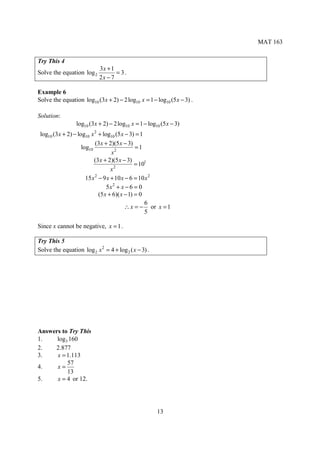
Try This 4
                            3x + 1
Solve the equation log 2           = 3.
                            2x − 7

Example 6
Solve the equation log10 (3x + 2) − 2 log10 x = 1 − log10 (5 x − 3) .

Solution:
                 log10 (3x + 2) − 2 log10 x = 1 − log10 (5 x − 3)
 log10 (3 x + 2) − log10 x 2 + log10 (5 x − 3) = 1
                           (3x + 2)(5 x − 3)
                     log10                     =1
                                   x2
                           (3 x + 2)(5 x − 3)
                                     2
                                               = 101
                                   x
                       15 x − 9 x + 10 x − 6 = 10 x 2
                           2

                                 5x2 + x − 6 = 0
                             (5 x + 6)( x − 1) = 0
                                                   6
                                          ∴ x = − or x = 1
                                                   5

Since x cannot be negative, x = 1 .

Try This 5
Solve the equation log 2 x 2 = 4 + log 2 ( x − 3) .


Answers to Try This
1.    log3 160
2.   2.877
3.    x = 1.113
          57
4.    x=
          13
5.    x = 4 or 12.


                                                      13

Surds,

  • 1.
    MAT 163 Surds, Indices,and Logarithms Radical Definition of the Radical For all real x, y > 0 , and all integers a > 0 , a x = y if and only if x = y a where a is the index is the radical x is the radicand. Surds A number which can be expressed as a fraction of integers (assuming the denominator is never 0) 5 4 is called a rational number. Examples of rational numbers are , − and 2. 2 5 A number which cannot be expressed as a fraction of two integers is called an irrational number. Examples of irrational numbers are 2 , 3 7 and π . An irrational number involving a root is called a surd. Surds occur frequently in trigonometry, calculus and coordinate geometry. Usually, the exact value of a surd cannot be determined but an approximate value of it can be found by using calculators or mathematical tables. In this chapter, a means the positive square root of a while − a means the negative square root of a. General Rules of Surds Multiplication of surds a × b = a×b For example (i) 3 × 12 = 3 ×12 = 36 = 6 (ii) 32 × 2 = 32 × 2 = 64 = 8 (iii) 5 × 5 = 5 × 5 = 25 = 5 1
  • 2.
    MAT 163 Division ofsurds a a a÷ b= = b b 72 For example (i) 72 ÷ 2 = = 36 = 6 2 45 (ii) 45 ÷ 5 = = 9 =3 5 These rules are useful for simplifying two or more surds of for combining them into one single surd. Note, however, that 3 + 6 ≠ 3 + 6 and 6 − 2 ≠ 6 − 2 which can be easily checked by a calculator; and, therefore, in general a + b ≠ a + b and a − b ≠ a − b . Example 1 (i) 3 5 + 5 = (3 + 1) 5 (ii) 40 = 4 ×10 = 4 × 10 =4 5 = 2 10 Example 2 Simplify (i) 243 − 12 + 2 75 (ii) 50 + 8 + 32 Solution: (i) 243 − 12 + 2 75 = 81× 3 − 4 × 3 + 2 25 × 3 = 81 × 3 − 4 × 3 + 2 25 × 3 = 9 3 − 2 × 3 + 10 × 3 = (9 − 2 + 10) 3 = 17 3 (ii) 50 + 8 + 32 = 25 × 2 + 4 × 2 + 16 × 2 = 25 × 2 + 4 × 2 + 16 × 2 = 5× 2 + 2× 2 + 4× 2 = (5 + 2 + 4) 2 = 11 2 Try This 1 Simplify (i) 27 (ii) 28 − 175 + 112 (iii) 5 × 125 × 8 2
  • 3.
    MAT 163 Rationalization ofthe Denominator 3 When a fraction has a surd in its denominator, e.g. , it is usual to eliminate the surd in the 2 denominator. In fact, the writing of surds in the denominators of fractions should be avoided. The process of removing this surd is called rationalizing of the denominator. m + n and m − n are specially related surds known as conjugate surds. The product of conjugate surds is always a rational number. ( m + n )( m − n ) = ( m )2 − ( n ) 2 = m − n For example ( 9 + 5)( 9 − 5) = ( 9)2 − ( 5) 2 = 9 − 5 = 4 ( 7 + 3)( 7 − 3) = ( 7)2 − ( 3)2 = 7 − 3 = 4 Example 3 Example 4 5 4 Simplify . Simplify . 3 7+ 3 Solution: Solution: 5 5 3 4 4 7− 3 = × = × 3 3 3 7+ 3 7+ 3 7− 3 5 3 4( 7 − 3) = = 3 7−3 = 7− 3 Example 5 1 1 Simplify, without using tables or calculators, the value of + . 3− 2 3+ 2 Solution: 1 1 (3 + 2) (3 − 2) + = + 3 − 2 3 + 2 (3 − 2)(3 + 2) (3 + 2)(3 − 2) (3 + 2) + (3 − 2) = 9−2 6 = 7 3
  • 4.
    MAT 163 Try This2 3 1 7 +2 Simplify (i) (ii) (iii) 12 3+ 7 7 −2 Answers to Try This 3 1. (i) 3 3 2. (i) 2 7− 3 (ii) 7 (ii) 4 11 + 4 7 (iii) 50 2 (iii) 3 4
  • 5.
    MAT 163 Indices If apositive integer a is multiplied by itself three times, we get a3 , i.e. a × a × a = a 3 . Here a is called the base and 3, the index or power. Thus a 4 means the 4th power of a. In general, a n means the nth power of a, where n is any positive index of the positive integer a. Rules of Indices There are several important rules to remember when dealing with indices. If a, b, m and n are positive integers, then (1) am × an = am + n e.g. 35 × 38 = 313 (2) am ÷ an = am − n e.g. 514 ÷ 53 = 511 (3) (a m )n = a m n e.g. (52 )6 = 512 (4) a m × b m = ( a × b) m e.g. 35 × 25 = 65 m 4 a 5 (5) a ÷b =   m m e.g. 5 ÷3 =   4 4 b 3 (6) a0 = 1 e.g. 50 = 1 1 1 (7) a−n = e.g. 5 −3 = an 53 1 1 (8) an = a n e.g. 83 =38 m 2 (9) an = a = ( a) n m n m e.g. 8 3 = 3 82 = ( 3 8)2 5
  • 6.
    MAT 163 Example 1 1 3 3 − −3 Evaluate (i) 2 (ii) 83 (iii) 16 4 (iv) 25 2 Solution: 1 −3 1 1 (i) 2 = 3= (ii) 83 =38=2 2 8 3 3 − 1 (iii) 16 4 = ( 16) 4 3 (iv) 25 2 = 3 25 2 1 = 23 = ( 25)3 1 1 =8 = 3= 5 125 Try This 1 Evaluate each of the following without using a calculator 3 2 − −1 0 3 (i) 7 (ii) 17 (iii) 49 2 (iv) 8 4 3 1 − −2 5  1  3 1 (v) 243 (vi) 814 (vii)   (viii)    27  4 Example 2 1 2 1 1 Simplify (i) a3 × a5 ÷ a2 (ii) (a 3b 2 )4 (iii) 3 a ÷ 5 a 2 × ( a −1 ) 2 Solution: 1 2 1 1 −1 2 (i) a3 ×a 5 ÷ a2 (ii) 3 2 4 (a b ) (iii) 3 a÷ a 5 2 × (a ) 1 2 1 1 2 1 + − − 3×4 2×4 = a3 5 2 =a b = a3 ÷ a5 ×a 2 7 1 2 1 − =a 30 =a b 12 8 = a3 ÷ a5 ×a 2 1 2  1 − + −  =a 3 5  2 17 − =a 30 Try This 2 Simplify each of the following, giving your answer in index form: 5 3 1 2 − − (i) a 3 ÷ a −4 × a 2 (ii) 16a 2 ÷ 4a 2 (iii) (a 3 × b 5 )15 6
  • 7.
    MAT 163 Solving ExponentialEquations Example 3 Solve the following exponential equations (i) 2 x = 32 (ii) 4 x + 1 = 0.25 Solution: (i) 2 x = 32 (ii) 4 x + 1 = 0.25 1 2 x = 25 4x + 1 = 4 x +1 ∴x = 5 4 = 4− 1 x + 1 = −1 ∴ x = −2 Try This 3 Solve the following equations: 1 (i) 3x = 81 (ii) 32 x = 8 (iii) 7x = 49 (iv) 5x = 1 (v) 34 x = 27 x + 3 (vi) 4 × 32 x = 6 x Example 4 Solve the equation 22 x + 3 + 2 x + 3 = 1 + 2 x . Solution: 22 x + 3 + 2 x + 3 = 1 + 2 x 2 x × 2 x × 23 + 2 x × 23 = 1 + 2 x Let y = 2 x 8 y2 + 8 y = 1 + y 8 y2 + 7 y −1 = 0 (8 y − 1)( y + 1) = 0 1 y = or −1 8 1 When y= when y = −1 8 1 2x = 2 x = −1 (inadmissible) 8 2 = 2− 3 x ∴ x = −3 7
  • 8.
    MAT 163 Try This4 Solve the equation 32 x + 1 + 9 = 3x + 3 + 3x . Example 5 1 If 3x × 92 y = 27 and 2 x × 4− y = , calculate the values of x and y. 8 Solution: 3x × 92 y = 27 ⋯⋯⋯ (1) 1 2 x × 4− y = ⋯⋯⋯ (2) 8 From (1): 3x × (32 ) 2 y = 33 3x × 34 y = 33 3x + 4 y = 33 x + 4y = 3 ⋯⋯ (3) 1 From (2): 2 x × (22 )− y = 23 2 x × 2 −2 y = 2−3 2 x − 2 y = 2 −3 x − 2 y = −3 ⋯⋯ (4) (3) − (4) : 6y = 6 y =1 Substitute y = 1 into (3): x + 4(1) = 3 x = −1 ∴ x = −1 and y = 1 . Try This 5 Solve the simultaneous equations 3x + y = 243 , 22 x − 5 y = 8 8
  • 9.
    MAT 163 Answers toTry This 1 1 1. (i) (ii) 1 (iii) 343 (iv) 7 4 (v) 27 (vi) 3 (vii) 81 (viii) 16 4 2. (i) a9 (ii) (iii) a 5b 6 a 3 3. (i) x=4 (ii) x= (iii) x = −2 5 1 (iv) x=0 (v) x=9 (vi) x= 2 4. x = −1 or 2 5. x = 4, y = 1 9
  • 10.
    MAT 163 Logarithms Definition: For anynumber y such that y = a x ( a > 0 and a ≠ 1 ), the logarithm of y to the base a is defined to be x and is denoted by log a y . Thus if y = a x , then log a y = x For example, 81 = 34 ∴ log 3 81 = 4 100 = 10 2 ∴ log10 100 = 2 Note: The logarithm of 1 to any base is 0, i.e. log a 1 = 0 . The logarithm of a number to a base of the same number is 1, i.e. log a a = 1 . The logarithm of a negative number is undefined. Example 1 Find the value of (i) log 2 64 (ii) log9 3 1 (iii) log 3 (iv) log8 0.25 9 Solution: (i) Let log 2 64 = x (ii) Let log 9 3 = x 64 = 2 x 3 = 9x 26 = 2 x 3 = 32 x ∴x = 6 1 = 2x 1 ∴x = 2 1 (iii) Let log 3 =x (iv) Let log8 0.25 = x 9 1 = 3x 0.25 = 8 x 9 1 3−2 = 3x = 23 x 4 −2 ∴ x = −2 2 = 23 x 3x = −2 2 ∴x = − 3 10
  • 11.
    MAT 163 Laws ofLogarithms (1) log a mn = log a m + log a n e.g. log3 5 + log 3 2 = log 3 10 m 5 (2) log a = log a m − log a n e.g. log3 5 + log 3 4 = log 3   n 4 (3) log a m p = p log a m e.g. log10 5 = 2 log10 5 2 Example 2 41 41 Without using tables, evaluate log10 + log10 70 − log10 + 2 log10 5 . 35 2 Solution: 41 41 log10 + log10 70 − log10 + 2 log10 5 35 2  41 41  = log10  × 70 ÷ × 52   35 2  = log10 100 = log10 102 = 2 log10 10 =2 Try This 1 Simplify 2 log 3 5 − log 3 10 + 3log 3 4 . Changing the Base of Logarithms Logarithms to base 10 such as log10 5 and log10 ( x + 1) are called common logarithms. An alternative form of writing log10 5 is lg 5 .Common logarithms can be evaluated using a scientific calculator. Logarithms to base e such as log e 3 and log e x are called Natural logarithms or Napierian logarithms. Natural logarithms are usually written in an alternative form, for example, log e 3 is written as ln 3 . (Note: e = 2.718... ) log c b If a, b, and c are positive numbers and a ≠ 1 , then log a b = . log c a 11
  • 12.
    MAT 163 Example 3 Findthe value of log5 16 . Solution: log10 16 1.204 log5 16 = = = 1.722 log10 5 0.699 Try This 2 Find the value of log 4 54 . Solving Logarithmic Equations Example 4 Solve the equation 3x = 18 . Solution: 3x = 18 Taking logarithms to base 10 on both sides, log10 3x = log10 18 x log10 3 = log10 18 log10 18 1.2553 x= = log10 3 0.4771 = 2.631 Try This 3 Solve the equation 5 x + 1 = 30 . Example 5 Given that log10 4 + 2 log10 p = 2 , calculate the value of p without using tables or calculators. Solution: log10 4 + 2 log10 p = 2 log10 (4 × p 2 ) = 2 4 p 2 = 102 100 p2 = 4 p = 25 2 p = ±5 Since p cannot be −5 because log10 (−5) is not defined, p = 5 . 12
  • 13.
    MAT 163 Try This4 3x + 1 Solve the equation log 2 = 3. 2x − 7 Example 6 Solve the equation log10 (3x + 2) − 2 log10 x = 1 − log10 (5 x − 3) . Solution: log10 (3x + 2) − 2 log10 x = 1 − log10 (5 x − 3) log10 (3 x + 2) − log10 x 2 + log10 (5 x − 3) = 1 (3x + 2)(5 x − 3) log10 =1 x2 (3 x + 2)(5 x − 3) 2 = 101 x 15 x − 9 x + 10 x − 6 = 10 x 2 2 5x2 + x − 6 = 0 (5 x + 6)( x − 1) = 0 6 ∴ x = − or x = 1 5 Since x cannot be negative, x = 1 . Try This 5 Solve the equation log 2 x 2 = 4 + log 2 ( x − 3) . Answers to Try This 1. log3 160 2. 2.877 3. x = 1.113 57 4. x= 13 5. x = 4 or 12. 13