Chapter 2 Notes


Lesson 2.1
                                 Lesson 2.4


Lesson 2.2
                                 Lesson 2.5


Lesson 2.3
                                  Lesson 2.6


             Lesson 2.7
2.1 Adding Rational Numbers


identity property of addition


                                    n+0=n


additive inverse


                                          a when the opposite is added to a number the sum equals zero


additive identity property


                       a number plus its opposite equals zero
                       x + (-x) = 0


adding numbers with same signs


                        add numbers together the answer will have the same sign


  adding numbers with different signs


                        subtract numbers; the answer will have the same sign as the larger number (not looking at sign)
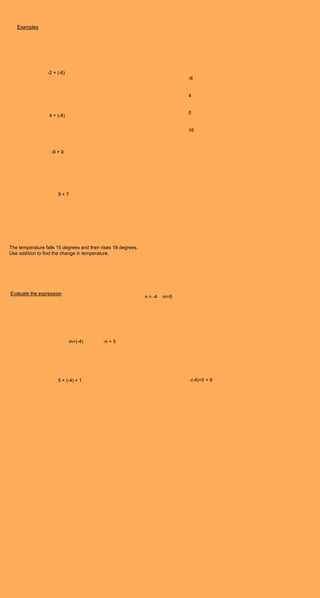
Examples


                 -2 + (-6)
                                                                             -8


                                                                             4


                                                                             0
                  4 + (-8)


                                                                             16


                   -9 + 9


                      9+7


The temperature falls 15 degrees and then rises 18 degrees.
Use addition to find the change in temperature.


Evaluate the expression
                                                              n = -4   m=5


                             m+(-4)        -n + 5


                      5 + (-4) = 1                                           -(-4)+5 = 9
Matrix


              [                                        ]


                      4            6                                   Row
                                               5


                      7            1           8


                                                                         2 rows by 3 columns


                                       Column


                               ]                           [                                ]
[
         -2       5                                                4         -1
                                           +                       3         0                      =
          7       1


[                                                  ]                              [                       ]

         -2 + 4       5+(-1)                                   =                       2        4
         7+3          1+0                                                              10       1


                                                                                                    End
2.2 Subtracting Rational numbers


Subtracting numbers


                        change the second number to its opposite and follow the addition rules


Absolute value


                      do all the operations inside the absolute value then take the positive of the answer
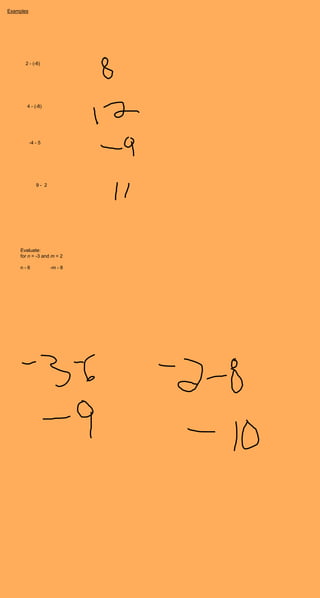
Examples


       2 - (-6)


        4 - (-8)


           -4 - 5


              9- 2


     Evaluate:
     for n = -3 and m = 2

     n-6             -m - 8
Examples


                | -8 - 6|            |6-2|


                                     ]                   [                         ]
  [
           -2         5                                          4        -1
            7         1                      -                   3        0


   [                                             ]           [                         ]

           -2 - 4           5-(-1)                                   -6        6
                                                     =
           7-3              1-0                                      4         1
2.3 Multiplying and Dividing Rational Numbers


          Identity Property of Multiplication


                                                     n*1=n


          Multiplication Property of Zero


                                                         n*0=0


            Multiplication Property of -1


                                                     n * (-1) = -n


          Multiplying or Dividing Numbers with same sign


               Multiply or Divide numbers together; answer is POSITIVE


          Multiplying or Dividing Numbers with different signs


              Multiply or Dividing numbers together; answer is NEGATIVE
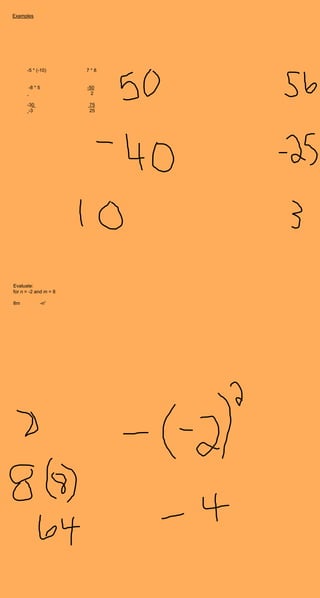
Examples


      -5 * (-10)       7*8


       -8 * 5          -50
                         2

      -30              75
       -3              25


Evaluate:
for n = -2 and m = 8

8m              -n2
Matrix scalar multiplication


                                   ]                  [                           ]
    [
                                                           5(4) 5(-5) 5(-1)
5        4   -5      -1                       =            5(3) 5(0) 5(-9)
         3    0       -9


                                                                              ]
                                                  [
                                       Pull


                                                          20 -25 -5
                                                          15 0 -45
2.4 The Distributive Property


Distributive property


                        a(b + c) = a(b) + a(c)
Example


          2(3 + 7)
          2(3) + 2(7)
          6 + 14
          20


          3(4x -9)
          3(4x) - 3(9)
          12x - 27


              -(6n + 8)
              -1(6n + 8)
              -6n - 8
Example


                        Like Terms


    5a2 - 9ab - 18


                                     Constant
          coefficient


   8x + 3(x + 4)
   8x + 3x +12
   11x + 12


                                                End
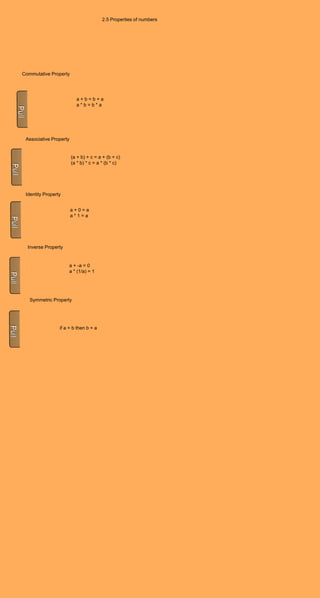
2.5 Properties of numbers


Commutative Property


                          a+b=b+a
                          a*b=b*a


 Associative Property


                        (a + b) + c = a + (b + c)
                        (a * b) * c = a * (b * c)


 Identity Property


                        a+0=a
                        a*1=a


  Inverse Property


                     a + -a = 0
                     a * (1/a) = 1


   Symmetric Property


                 if a = b then b = a
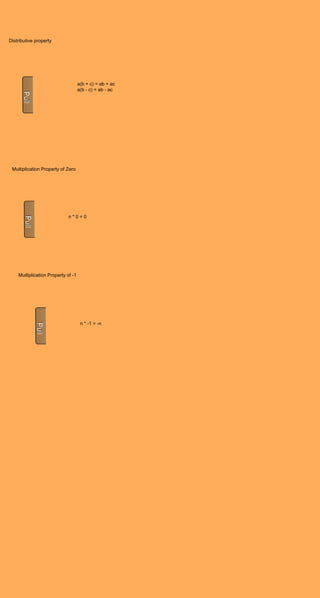
Distributive property


                                    a(b + c) = ab + ac
                                    a(b - c) = ab - ac


 Multiplication Property of Zero


                             n*0=0


    Mutliplication Property of -1


                                     n * -1 = -n
End
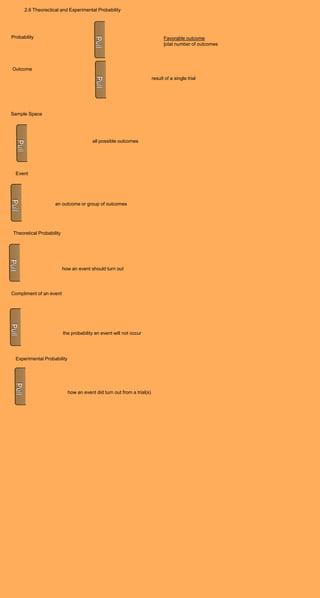
2.6 Theorectical and Experimental Probability


Probability                                                                    Favorable outcome
                                                                               total number of outcomes


Outcome
                                                                         result of a single trial


Sample Space


                                         all possible outcomes


  Event


                    an outcome or group of outcomes


Theoretical Probability


                          how an event should turn out


Compliment of an event


                          the probability an event will not occur


  Experimental Probability


                             how an event did turn out from a trial(s)
Example


                                 P (green) = 1
                                            5      = 20%


                                     P (Red) = 2   = 40%
                                               5


                                P ( not red) = 3   = 60%
                                               5


          Red   Pink   Orange            Blue
2.7 Probability of Compound events


Independant Events


events that do not effect each other


                                                                 P ( A and B) = P(A) * P(B)


Dependant Event


            events that do effect each other


                           P ( A and B) = P(A) * P(B after A)


                                                                                              End
You have a bag of marbles with 8 red marbles, 10 blue marbles,
7 yellow, and 5 black marbles.


What are the following probabilities WITHOUT replacement?
P( yellow and black)
P(2 reds)
P(purple)

What are the following probabilities with replacement?
P( yellow and black)
P(2 reds)
P(purple)
Algebra 1 chapter 2 notes

Algebra 1 chapter 2 notes

  • 1.
    Chapter 2 Notes Lesson2.1 Lesson 2.4 Lesson 2.2 Lesson 2.5 Lesson 2.3 Lesson 2.6 Lesson 2.7
  • 2.
    2.1 Adding RationalNumbers identity property of addition n+0=n additive inverse a when the opposite is added to a number the sum equals zero additive identity property a number plus its opposite equals zero x + (-x) = 0 adding numbers with same signs add numbers together the answer will have the same sign adding numbers with different signs subtract numbers; the answer will have the same sign as the larger number (not looking at sign)
  • 3.
    Examples -2 + (-6) -8 4 0 4 + (-8) 16 -9 + 9 9+7 The temperature falls 15 degrees and then rises 18 degrees. Use addition to find the change in temperature. Evaluate the expression n = -4 m=5 m+(-4) -n + 5 5 + (-4) = 1 -(-4)+5 = 9
  • 4.
    Matrix [ ] 4 6 Row 5 7 1 8 2 rows by 3 columns Column ] [ ] [ -2 5 4 -1 + 3 0 = 7 1 [ ] [ ] -2 + 4 5+(-1) = 2 4 7+3 1+0 10 1 End
  • 5.
    2.2 Subtracting Rationalnumbers Subtracting numbers change the second number to its opposite and follow the addition rules Absolute value do all the operations inside the absolute value then take the positive of the answer
  • 6.
    Examples 2 - (-6) 4 - (-8) -4 - 5 9- 2 Evaluate: for n = -3 and m = 2 n-6 -m - 8
  • 7.
    Examples | -8 - 6| |6-2| ] [ ] [ -2 5 4 -1 7 1 - 3 0 [ ] [ ] -2 - 4 5-(-1) -6 6 = 7-3 1-0 4 1
  • 8.
    2.3 Multiplying andDividing Rational Numbers Identity Property of Multiplication n*1=n Multiplication Property of Zero n*0=0 Multiplication Property of -1 n * (-1) = -n Multiplying or Dividing Numbers with same sign Multiply or Divide numbers together; answer is POSITIVE Multiplying or Dividing Numbers with different signs Multiply or Dividing numbers together; answer is NEGATIVE
  • 9.
    Examples -5 * (-10) 7*8 -8 * 5 -50 2 -30 75 -3 25 Evaluate: for n = -2 and m = 8 8m -n2
  • 10.
    Matrix scalar multiplication ] [ ] [ 5(4) 5(-5) 5(-1) 5 4 -5 -1 = 5(3) 5(0) 5(-9) 3 0 -9 ] [ Pull 20 -25 -5 15 0 -45
  • 11.
    2.4 The DistributiveProperty Distributive property a(b + c) = a(b) + a(c)
  • 12.
    Example 2(3 + 7) 2(3) + 2(7) 6 + 14 20 3(4x -9) 3(4x) - 3(9) 12x - 27 -(6n + 8) -1(6n + 8) -6n - 8
  • 13.
    Example Like Terms 5a2 - 9ab - 18 Constant coefficient 8x + 3(x + 4) 8x + 3x +12 11x + 12 End
  • 14.
    2.5 Properties ofnumbers Commutative Property a+b=b+a a*b=b*a Associative Property (a + b) + c = a + (b + c) (a * b) * c = a * (b * c) Identity Property a+0=a a*1=a Inverse Property a + -a = 0 a * (1/a) = 1 Symmetric Property if a = b then b = a
  • 15.
    Distributive property a(b + c) = ab + ac a(b - c) = ab - ac Multiplication Property of Zero n*0=0 Mutliplication Property of -1 n * -1 = -n
  • 16.
  • 17.
    2.6 Theorectical andExperimental Probability Probability Favorable outcome total number of outcomes Outcome result of a single trial Sample Space all possible outcomes Event an outcome or group of outcomes Theoretical Probability how an event should turn out Compliment of an event the probability an event will not occur Experimental Probability how an event did turn out from a trial(s)
  • 18.
    Example P (green) = 1 5 = 20% P (Red) = 2 = 40% 5 P ( not red) = 3 = 60% 5 Red Pink Orange Blue
  • 19.
    2.7 Probability ofCompound events Independant Events events that do not effect each other P ( A and B) = P(A) * P(B) Dependant Event events that do effect each other P ( A and B) = P(A) * P(B after A) End
  • 20.
    You have abag of marbles with 8 red marbles, 10 blue marbles, 7 yellow, and 5 black marbles. What are the following probabilities WITHOUT replacement? P( yellow and black) P(2 reds) P(purple) What are the following probabilities with replacement? P( yellow and black) P(2 reds) P(purple)